What Does Meta Mean in GeoGuessr?
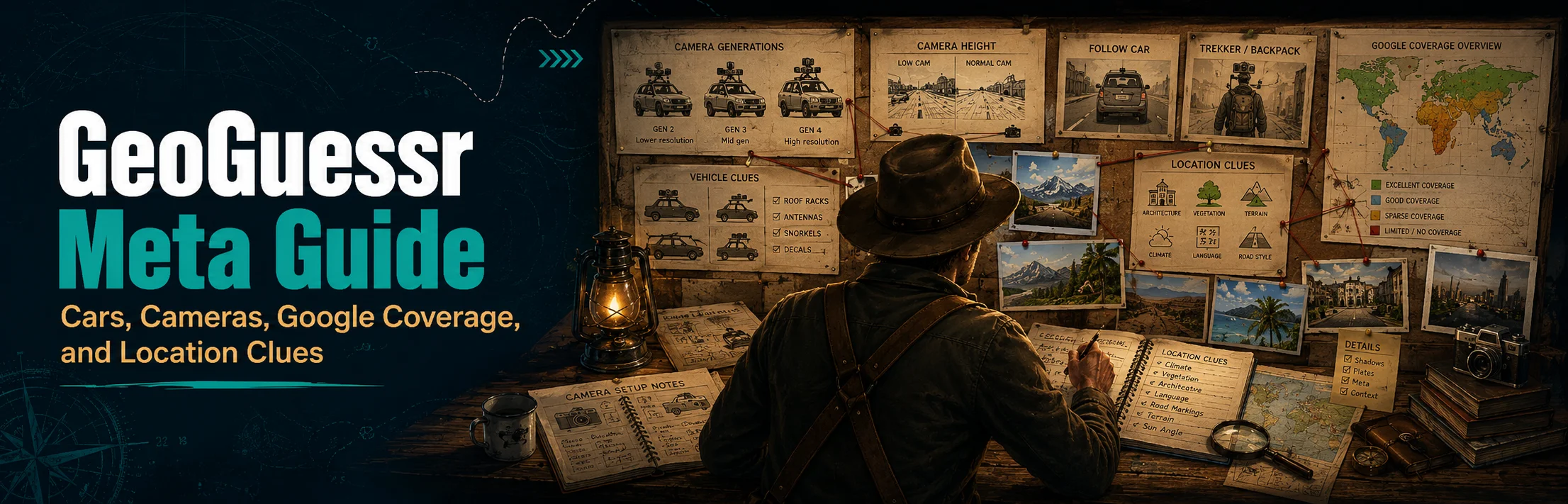
In GeoGuessr terminology, meta generally refers to clues produced by the way Street View imagery was captured rather than by the physical location itself.
For example, a road sign is a geographic or infrastructure clue.
A visible Google car antenna is meta.
A language is a geographic clue.
A distinctive circular camera blur is meta.
A mountain range is geographic.
Knowing that a particular country has only certain generations of official Street View coverage is meta.
GeoGuessr itself uses Google Maps and Google Street View to display the environments in which players guess locations.
Common GeoGuessr meta clues include
Many of these clues can be learned visually in the same way players learn bollards or utility poles.
Why GeoGuessr Meta Is So Powerful
Meta can work even when almost everything else is missing.
Imagine a round showing:
Geographically, dozens of countries could appear plausible.
But if part of the Street View vehicle reveals a roof rack configuration strongly associated with one country's coverage, the round may suddenly become much easier.
That is why advanced players pay attention not only to the world in front of the camera, but also to the camera itself.
Meta is especially valuable in restrictive modes
When movement is unavailable, you cannot search for another sign or drive toward a town.
In those situations, small imagery clues become much more important.
A visible car, blur, antenna, or camera-generation clue is available immediately and may provide more information than the entire landscape.
Meta Should Support Geography, Not Replace It
One of the biggest mistakes when learning GeoGuessr meta is treating every memorized clue as guaranteed.
Street View changes.
Google can:
replace older imagery;
add newer camera generations;
cover additional roads;
use multiple vehicles in one country;
use special equipment in parks or pedestrian areas.
Community maps may also intentionally include unusual coverage.
GeoHints distinguishes between frequently encountered official coverage, rarer trekker-style coverage, and places that normally require unofficial imagery or specialized maps.
The safest approach is:
meta clue + geographic clue = strong guess
For example, if a vehicle clue suggests Kenya and you also see left-hand traffic, Kenyan road infrastructure, and an East African environment, your confidence becomes much stronger.
Understanding Google Street View Camera Generations
The GeoGuessr community commonly divides major official Street View imagery into four broad camera generations:
Generation 1;
Generation 2;
Generation 3;
Generation 4.
These generations differ in image quality, color, stitching, blur, and other characteristics.
The names are community shorthand for successive eras of Street View camera technology rather than game modes.
Generation 1 Camera
Generation 1 is the oldest and easiest generation to recognize.
Typical characteristics include:
Current learning references describe Gen 1 as rare and associated primarily with old coverage in the United States, Australia, and New Zealand.
Why Gen 1 is useful
Because its geographic distribution is limited, simply recognizing the camera generation can eliminate most of the world.
That does not mean you should instantly guess the United States.
Instead, combine it with:
driving side;
road markings;
vegetation;
road design;
architecture.
Gen 1 is becoming increasingly uncommon
Old Street View is continuously replaced.
A camera-generation clue that was common years ago may become much rarer as newer coverage overwrites it.
This is one reason meta guides require regular updating.
Generation 2 Camera
Generation 2 is another older form of Street View imagery.
It generally has better quality than Gen 1 but remains noticeably inferior to newer imagery.
One of its most famous GeoGuessr characteristics is the halo-like discoloration or distortion in the sky.
Players may also notice:
softer image quality;
a large circular blur around the car;
less readable distant text;
visible color distortion.
GeoGuessr learning resources commonly describe the sky halo and large vehicle blur as the easiest ways to recognize Gen 2.
Gen 2 can eliminate countries
The important question is not simply:
“Is this Gen 2?”
It is:
“Which of my possible countries actually have Gen 2 coverage?”
For example, Plonk It notes that Canada still has a considerable amount of Generation 2 imagery, particularly in rural or remote areas, while comparable Gen 2 imagery is much rarer in the United States.
That can become useful when geography already suggests North America.
Generation 3 Camera
Generation 3 is significantly clearer than Gen 2.
Typical characteristics include:
Because Gen 3 is widespread, recognizing it does not usually solve a country by itself.
Its value comes from combining the generation with country-specific car meta.
A certain Gen 3 country might have:
a white car;
a red car;
an antenna;
no antenna;
a roof rack;
visible mirrors.
That combination can become much more specific.
Generation 4 Camera
Generation 4 generally offers the best image quality among the four commonly discussed generations.
Typical characteristics include:
Current camera guides describe Gen 4 as the highest-quality generation and increasingly common as old coverage is replaced.
Gen 4 vs Gen 3
This is one of the harder generation comparisons.
Do not rely entirely on saturation.
Instead, consider:
overall sharpness;
text readability;
image processing;
vehicle blur;
known country coverage.
With experience, the difference becomes easier to recognize.
Camera Generation Is an Elimination Tool
Knowing the generation is not useful because “Gen 4 means country X.”
It is useful because certain countries may:
only have Gen 3;
have Gen 3 and Gen 4;
contain substantial Gen 2;
contain only newer car coverage;
have regional generation differences.
For example, current Plonk It references describe:
Germany's normal car coverage as Generation 4;
Austria as primarily Generation 3 and Generation 4;
Switzerland's normal car coverage as low-cam imagery.
If German-language surroundings leave you choosing among those countries, camera characteristics can become an additional separator.
What Is Google Car Meta?
Google car meta refers to visible characteristics of the vehicle or equipment used to capture Street View.
Look downward and around the bottom of the panorama.
You may see:
part of the hood;
roof rack;
antenna;
side mirrors;
pickup bed;
snorkel;
colored vehicle panels;
tape;
unusual blur.
GeoHints currently catalogs Street View vehicle clues across a large number of countries, demonstrating how varied these capture setups can be.
Visible Car Color
Sometimes only a small strip of the vehicle is visible.
That can still matter.
Cars used for Street View have appeared in colors such as:
However, car color alone is rarely safe.
Many countries may have black or white cars.
Color becomes useful when combined with:
camera generation;
antenna type;
blur shape;
roof rack;
country geography.
Antenna Meta
Antennas are among the most recognizable car clues.
They may appear:
long;
short;
stubby;
coiled;
taped;
centered;
offset.
Sometimes the difference between two plausible countries comes down to whether a particular generation normally shows an antenna.
Ukraine example
Current Plonk It material describes Ukraine's normal coverage as Generation 3, with a red Street View car common across much of the country.
It also notes useful differences from Russia: Russia can contain Generation 4 and some Generation 2 coverage, while Ukraine's official car coverage remains Generation 3. Russian Gen 3 cars also use antennas, whereas Ukrainian coverage may sometimes show no antenna.
This demonstrates how generation + car color + antenna can form a much stronger clue than any one feature alone.
Roof Rack Meta
Visible roof racks are some of the most famous GeoGuessr metas.
You may see:
The exact configuration matters.
Guatemala
Guatemala's regular car coverage features a gray Street View car with visible roof rack and side mirrors.
Plonk It notes that Laos can have a similar vehicle, so surrounding geography remains important.
This is a perfect example of responsible meta use.
Do not think:
roof rack = Guatemala
Think:
this roof rack strongly supports Guatemala, but could also fit another limited set of locations.
Then check:
language;
driving side;
vegetation;
architecture;
road markings.
Ghana Car Meta
Ghana is one of the best-known countries for car meta.
Its Street View coverage can show distinctive roof-rack and tape characteristics, although special locations may use different vehicles or obscure the normal setup.
Plonk It specifically warns that some nature reserves and sanctuaries use unusual cars while still retaining parts of the familiar Ghana meta in certain coverage.
Why this matters
Learning the common Ghana clue is useful.
Learning its exceptions is even better.
Advanced meta knowledge is often about knowing when not to trust the obvious clue.
Kenya Snorkel Meta
Kenya provides another famous example.
Current coverage includes significant Generation 4 pickup-truck imagery. Depending on the panorama, parts of the vehicle may be blurred, but visible vehicle features can include a snorkel.
Generation 3 Kenya can also show roof racks and snorkels.
Plonk It currently notes that Mongolia is another country where a Generation 4 snorkel may appear, so the snorkel should still be combined with the landscape.
Kenya might show:
Mongolia will generally look completely different.
Meta gives the shortlist. Geography confirms it.
Follow Cars
Sometimes another vehicle repeatedly appears behind or near the Street View vehicle.
This is known as follow-car meta.
A follow car can exist because of:
Nigeria
Nigeria is the classic example.
Current Plonk It information describes much of Nigerian coverage as showing a visible pickup Street View vehicle along with a police car following it.
When clearly visible, this can be an extremely strong country clue.
Kenya
Some Kenyan coverage can also show a gray SUV following the Street View vehicle.
This is another reason players should learn the complete visual combination rather than simply memorizing “follow car = Nigeria.”
Sky Rifts and Image Artifacts
Not all meta comes from the vehicle.
Sometimes the sky itself reveals the capture setup.
Players use terms such as rifts for visible seams or strange lines created by panorama stitching.
These artifacts can appear as:
lines across the sky;
unusual separations;
discoloration;
camera stitching errors.
Albania
Some Albanian Generation 3 coverage combines a long antenna with visible sky rifts, while other Albanian coverage uses a shorter antenna without the same rifts.
A rift by itself is not enough.
The useful clue is the combination of:
camera generation + antenna + rift + geography
What Is Low-Cam?
Low-cam is a community term for Street View where the camera sits noticeably lower than normal.
The result changes the perspective.
You may notice:
vehicles appearing taller;
barriers blocking more of the horizon;
the camera feeling closer to road level;
a larger or unusual bottom blur.
Low-cam can become valuable because some countries or coverage sets use it more consistently than others.
Sri Lanka
Current Plonk It references state that all Generation 4 coverage in Sri Lanka uses low-cam imagery.
If other clues already suggest South Asia, recognizing low-cam can provide additional support.
What Is Smallcam?
Smallcam is another community term.
It refers to certain newer coverage captured from a lower setup than regular Gen 4.
Players often recognize it through:
Smallcam now appears in several parts of the world, so it is not a country-exclusive clue.
Plonk It currently documents smallcam coverage in places including Austria, Spain, Finland, Brazil, and parts of the United States.
Why smallcam knowledge matters
Seeing smallcam may not tell you the country.
But it may eliminate countries that do not use that type of imagery and help with regional guessing inside countries where its distribution is known.
This is advanced meta and should come after learning ordinary car clues.
What Is Trekker Coverage?
Not every Street View panorama is captured from a car.
Google and contributors have recorded locations using:
GeoHints currently maintains separate vehicle categories for many of these capture types.
Where trekkers appear
Trekker imagery is common in locations that normal vehicles cannot easily reach, such as:
historical sites;
hiking areas;
parks;
islands;
pedestrian centers;
tourist attractions.
This can sometimes make a seemingly impossible country appear in a specialized GeoGuessr map.
Official vs Unofficial Coverage
Understanding coverage type is one of the most important parts of GeoGuessr meta.
Official coverage
Official Street View is imagery collected through Google's normal Street View systems.
This is where the commonly discussed camera generations and Google cars are most useful.
Unofficial or contributed coverage
Street View can also contain contributor imagery captured through supported 360 cameras and uploaded imagery.
Some locations may contain individual photospheres rather than continuous drivable Street View.
Unofficial coverage may:
have unusual image quality;
lack normal Google-car meta;
use different camera heights;
have strange stitching;
only allow limited movement.
This is why you must understand what kind of map you are playing.
Google Coverage Can Eliminate Impossible Guesses
Coverage knowledge is one of the most powerful forms of GeoGuessr meta.
Not every country has normal official Street View.
GeoHints currently separates:
countries with common official coverage;
rare official or trekker-heavy countries;
locations mostly appearing on specialized maps;
countries without ordinary official coverage.
Imagine that a landscape could plausibly fit three neighboring countries.
If only one commonly has official Street View of that type, coverage knowledge becomes extremely valuable.
But map selection matters
A custom map can deliberately include:
unofficial imagery;
trekkers;
unusual photospheres;
rare coverage.
Never say:
“That country can never appear.”
Say:
“That country would be unusual in normal official-coverage maps unless this map intentionally includes alternative imagery.”
Sparse Coverage Can Become a Regional Clue
Coverage knowledge can go beyond country recognition.
Some countries have Street View only along:
major highways;
selected cities;
certain regions;
popular destinations.
That means once you identify the country, understanding where imagery exists can help region-guess.
Laos
Current Plonk It guidance describes Laos as having very limited normal coverage concentrated in only five cities: Vientiane, Vang Vieng, Luang Prabang, Savannakhet, and Pakse.
Recognizing Laos therefore changes the question.
Instead of:
“Where in the entire country am I?”
You can compare a much smaller set of covered areas.
Nigeria
Nigeria also has uneven coverage. Current guides note sparse coverage in parts of the northwest and east, with much imagery concentrated around larger cities and connecting highways.
Coverage maps can therefore become advanced region-guessing tools.
Camera Generation Can Also Help Region-Guess
Different parts of one country may have been captured during different Street View campaigns.
That can produce regional generation patterns.
Nigeria
Current Plonk It research notes that:
Generation 3 is not found north of Abuja;
Generation 4 has its own regional limitations;
other lower-quality official imagery occurs across additional areas.
Once the country is confirmed, the camera generation becomes a second-stage clue.
South Korea
Generation 2 imagery in South Korea is currently concentrated largely around Seoul and Busan, with only limited remaining highway coverage elsewhere.
This demonstrates an important advanced principle:
the same meta clue can identify a country at first and a region later.
Street View Date and Seasonal Meta
Imagery was captured at different times of year.
That can create consistent seasonal patterns.
Examples can include:
Finland
Plonk It notes that much Finnish Generation 3 imagery was captured in autumn, producing distinctive fall colors more often than comparable Gen 3 coverage in neighboring Nordic countries.
Croatia
A similar seasonal clue exists in Croatia, where much Generation 3 coverage was captured during autumn.
This is useful, but it is not geography.
The same location could look completely different in newer imagery.
Copyright-year meta
In some countries, the imagery copyright year can help with regional coverage identification.
Bangladesh provides an advanced example, where different Generation 4 coverage years can correlate with particular regions, although newer dates increasingly overlap multiple parts of the country.
This is highly advanced and update-sensitive meta.
Coverage Replacement Can Break Old Meta
One of the most important things to understand about GeoGuessr meta is that it ages.
Suppose an older guide says:
“Country X always has Gen 3.”
Then Google publishes Gen 4 imagery.
The clue is no longer universal.
Suppose a country used one distinctive car for years.
New coverage may introduce another vehicle.
This is why strong players periodically update their meta knowledge.
Prioritize current references
When studying meta, prefer resources that are actively maintained.
GeoHints and Plonk It both currently maintain country and imagery references that reflect ongoing Street View changes.
Old guides can still teach fundamentals, but exact coverage claims should be checked.
Do Not Confuse Meta With Real-World Clues
Players sometimes use “meta” loosely to describe almost every trick.
It is useful to distinguish between categories.
Capture meta
Produced by Street View itself:
Google car;
camera generation;
blur;
roof rack;
antenna;
image artifacts.
Coverage meta
Based on where and how Street View exists:
country coverage;
regional coverage;
generation distribution;
trekker locations.
Geographic clues
Present in the real world:
road markings;
utility poles;
languages;
bollards;
license plates;
architecture.
Both can identify countries.
But geographic clues remain useful even if Google replaces the imagery tomorrow.
Meta may not.
Build a Meta Clue Hierarchy
Some metas deserve more confidence than others.
Very strong meta
Examples may include:
highly distinctive country-specific vehicle;
unusual follow car;
unique combination of roof rack and mirror setup;
country-exclusive coverage type.
Strong meta
Examples include:
Supporting meta
Examples include:
Never let a weak meta override multiple strong geographic clues.
Use Meta as a Decision Tree
A good way to process a difficult round is:
What camera generation is this?
Then:
Can I see the vehicle?
Then:
Does it have an antenna, roof rack, snorkel, mirror, or unusual blur?
Then:
What countries can produce this combination?
Finally:
Which of those countries fits the actual geography?
This converts memorized trivia into a repeatable method.
Common GeoGuessr Meta Mistakes
Seeing a roof rack and instantly guessing Ghana
Roof racks exist in several countries.
Check the exact design and surrounding environment.
Assuming every snorkel means Kenya
Kenya has highly recognizable snorkel coverage, but it is not the only possible location.
Use landscape and infrastructure too.
Guessing from car color alone
A black, blue, or white car may exist in multiple countries.
Generation and vehicle details matter more.
Confusing Gen 2 with poor-quality unofficial imagery
Poor resolution does not automatically mean Gen 2.
Look for the characteristic sky halo and vehicle blur.
Treating low-cam as country-specific
Low-mounted cameras appear in multiple locations.
Use low-cam to narrow possibilities, not automatically finish the round.
Memorizing old metas
Street View coverage evolves.
An outdated “always” clue is dangerous.
Forgetting map context
A competitive map and a specialized community map may use very different coverage pools.
How to Learn Google Car Meta Efficiently
Do not memorize every car in GeoHints immediately.
Start with distinctive, high-value examples.
A useful initial set includes:
Ghana roof-rack/tape meta;
Guatemala roof rack;
Kenya snorkel;
Nigeria follow car;
Ukraine red car;
Sri Lanka visible Gen 3 car pattern;
obvious Gen 2 halo;
obvious Gen 1 quality;
common low-cam appearances.
Once those become automatic, add more country pairs and regional variants.
Study Similar Metas Side by Side
This is much more effective than memorizing isolated screenshots.
For example:
Guatemala vs Laos
Both can show similar roof-rack vehicles.
Separate them using:
writing system;
architecture;
driving side;
landscape;
coverage.
Ghana vs Réunion
Both can involve visible rack/tape features.
Réunion has its own rack configuration and French infrastructure, while Ghana has very different surrounding geography and roadside systems.
Kenya vs Mongolia snorkel
A Generation 4 snorkel can suggest either.
But their environments and road systems are radically different.
This type of comparison teaches you why a clue works.
Meta Is Especially Important in NMPZ
In Moving games, you can hunt for:
town signs;
domains;
highways;
businesses.
In No Move, fewer clues are available.
In NMPZ, you cannot move, pan, or zoom, so the immediate visual composition becomes everything.
That increases the value of:
Meta is therefore particularly important for high-level NMPZ recognition.
But geographic fundamentals still matter because the expected car clue may not be visible.
How to Practice Meta Without Cheating
Meta knowledge itself is part of GeoGuessr skill.
Learning a Google car beforehand is no different from learning a bollard beforehand.
The important distinction is when you consult external information.
GeoGuessr's current Community Rules prohibit using Google or other external information sources as assistance during play and also prohibit third-party software or scripts that provide an unfair competitive advantage.
Use references:
During competitive play, rely on what you have learned.
Review Meta After Every Wrong Guess
When you miss a country because of imagery, ask:
Which camera generation was it?
Was the Google car visible?
Did I miss an antenna?
Was there a roof rack?
Was the camera unusually low?
Did the sky contain an artifact?
Was coverage itself a clue?
Was my remembered meta outdated?
This turns individual mistakes into reusable knowledge.
GeoGuessr Meta FAQ
What is meta in GeoGuessr?
Meta usually refers to clues created by Street View capture rather than by the physical geography. Examples include Google cars, cameras, antennas, roof racks, blur patterns, and coverage.
What are the GeoGuessr camera generations?
Players commonly distinguish four major generations: Gen 1, Gen 2, Gen 3, and Gen 4. Gen 1 is oldest and lowest-quality, while Gen 4 generally offers the sharpest and most modern imagery.
How do I recognize Gen 2?
Generation 2 commonly has lower image quality, a large circular vehicle blur, and a recognizable halo or discoloration in the sky.
How do I tell Gen 3 from Gen 4?
Gen 4 is generally sharper and more vibrant, while Gen 3 often appears somewhat more muted. Country coverage knowledge can help when the visual difference is unclear.
What is Google car meta?
Google car meta uses visible parts of the Street View vehicle—such as its color, roof rack, mirrors, antenna, snorkel, hood, or blur—to narrow the location.
What is low-cam in GeoGuessr?
Low-cam refers to imagery where the Street View camera sits noticeably lower than normal. It changes perspective and can sometimes help identify the coverage set.
What is smallcam?
Smallcam is a community term for certain lower-mounted newer Street View coverage with a characteristic vehicle blur and camera perspective. It exists in multiple countries, so it is not a country-specific clue.
What is a follow car?
A follow car is another vehicle that repeatedly appears alongside or behind the Street View car. Nigeria is especially well known for follow-car meta.
Can Street View coverage identify a country?
Yes. Knowing which countries have ordinary official coverage can eliminate many impossible locations, although custom maps may deliberately use unofficial or rare imagery.
Are GeoGuessr metas permanent?
No. Google updates and replaces Street View imagery, so car, camera, and coverage metas can change over time.
Should beginners learn meta?
Yes, but only after learning basic geographic clues. Start with a handful of distinctive cars and camera generations rather than trying to memorize every coverage variation.
Is using meta cheating in GeoGuessr?
Recognizing learned visual clues is part of normal play. Using external sources, third-party software, or scripts to gain assistance during competitive play violates GeoGuessr's current rules.
Final Tips for Learning GeoGuessr Meta
Meta changes the way you look at a GeoGuessr panorama.
Instead of only asking:
“What does this place look like?”
You begin asking:
“How was this image captured?”
Check the camera quality. Look at the bottom of the panorama. Notice the blur. Search for an antenna, roof rack, mirror, snorkel, follow car, or strange perspective.
Then ask whether that type of coverage makes sense for the countries you are considering.
The strongest players do not choose between meta and geography.
They use both.
A Google car can give you the country shortlist. A road, language, landscape, or utility pole can confirm the answer.
Learn meta as an extra layer of evidence, keep your coverage knowledge current, and avoid relying on any one clue as an absolute guarantee.



