How Competitive GeoGuessr Ranked Play Works
GeoGuessr's current Ranked Play centers around competitive Duels.
Players compete against opponents, climb divisions, and maintain an overall rating. Rating changes depend partly on the rating of the opponent you play.
The major competitive formats are:
Players in Gold division and above can also unlock separate statistical ratings for these individual modes after playing enough games. GeoGuessr states that these mode-specific ratings are informational and do not independently determine matchmaking, promotion, or demotion.
The objective is different from Classic GeoGuessr
In a normal score-based game, your goal is usually to get as close as possible to every location.
In Duels, your immediate goal is simpler:
guess closer than your opponent.
A mediocre guess can still be a successful competitive guess if your opponent is much farther away.
That distinction is fundamental.
Competitive GeoGuessr rewards relative accuracy, not perfection on every round.
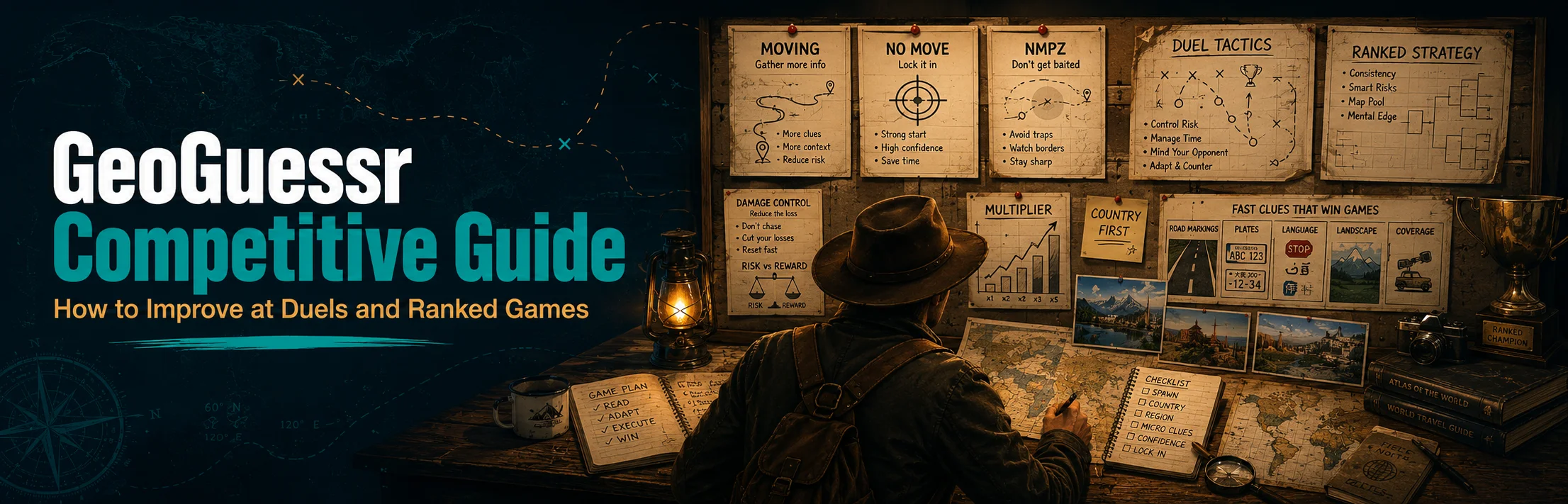
Understanding Health and Damage in GeoGuessr Duels
Duels use a health system.
Both players continue through locations while trying to deal enough damage to reduce the opponent's health.
Damage comes from the difference between the players' round performances.
This creates an important strategic distinction between:
If you are 20 km closer than your opponent, you may gain an advantage.
If you identify the correct country while your opponent guesses another continent, the health swing can be much larger.
Small mistakes and catastrophic mistakes are not equal
Competitive improvement therefore requires reducing catastrophic misses.
Being 80 km away instead of 30 km away is not ideal.
Being in Brazil when the location is Cambodia is much worse.
One of the strongest ways to climb consistently is to reduce the number of rounds where your guess is geographically disastrous.
You do not need to become a perfect region-guesser before improving your rank.
You need to stop giving away enormous damage.
Individual Damage Multipliers Changed Ranked Duels
GeoGuessr changed the Duel multiplier system in April 2026.
Individual Multipliers replaced Mutual Multipliers in Solo and Team Duels.
Under the individual system, the player or team that wins a round increases its own damage multiplier for subsequent rounds rather than automatically increasing the multiplier for both sides.
Normal Duel multiplier increases are in 0.5x increments; the separate Turbo format uses larger 1x increments.
This makes early-round performance more meaningful.
Why individual multipliers change strategy
Under the current system, winning rounds can increase the damage you are capable of dealing later.
That means a player who consistently wins small early battles may build a stronger position for later rounds.
You should therefore avoid thinking:
“Early rounds do not matter because the damage is small.”
They matter because round wins can influence the future damage environment.
Consistency has become even more valuable.
Do Not Confuse Damage Multipliers With Point Tokens
GeoGuessr also introduced Point Tokens in Bronze, Silver, and Gold competitive Solo Duels.
These are separate from Duel damage multipliers.
Point Tokens multiply the ranked points and round bonuses earned from a game. They do not mean that your geographical guess suddenly deals extra in-round damage simply because you spent tokens.
For actual gameplay improvement, focus primarily on:
The ranking-point economy should not distract you from becoming a stronger player.
The Most Important Competitive Skill: Avoid Huge Misses
Many players try to improve by learning more obscure metas.
That helps.
But competitive consistency usually improves fastest when you eliminate catastrophic guesses.
Suppose you are unsure whether a round is:
Austria or Slovenia;
Colombia or Ecuador;
Malaysia or Indonesia.
Being wrong within the correct region may hurt.
But compare that with guessing:
Europe instead of South America;
Australia instead of South Africa;
Argentina instead of Kyrgyzstan.
Those errors can destroy an otherwise strong game.
Think continent first when uncertain
When information is limited, establish the safest broad region before trying to become precise.
Ask:
Which continent?
Which hemisphere?
Left-driving or right-driving?
Tropical, temperate, arid, or alpine?
What script?
Which coverage families are plausible?
Then narrow.
A conservative correct-region guess is often competitively superior to an ambitious but poorly supported country guess.
Competitive GeoGuessr Is About Expected Value
Every guess contains risk.
Imagine you think:
60% Brazil;
25% Bolivia;
15% Peru.
You need to decide whether there is enough evidence to commit strongly to Brazil or whether a safer regional placement offers better protection.
That is competitive decision-making.
Do not chase perfect accuracy without evidence
The goal is not:
“Where would I place this if I had unlimited time?”
The better question is:
“Where can I place this pin that minimizes the damage if my leading theory is wrong?”
This concept becomes especially important in:
Russia;
Brazil;
Australia;
Argentina;
Canada;
United States;
Indonesia.
Large countries punish incorrect regional commitments heavily.
Learn When to Hedge
A hedge means positioning your guess between multiple plausible possibilities.
It can be extremely useful.
Suppose you know the location is probably Belgium but cannot decide between Brussels and the eastern part of the country.
A central placement may protect you better than aggressively committing to one edge.
Good hedges
A good hedge is based on a genuine uncertainty.
Examples:
central Netherlands when city evidence is weak;
central South Korea when regional clues are absent;
reasonable midpoint between two plausible areas;
safer central position inside a very large country.
Bad hedges
Do not hedge simply because you are afraid to choose.
If strong evidence says:
southern Chile;
northern Norway;
western Turkey;
then blindly clicking the center of the country throws away information you already possess.
Hedging should reduce uncertainty, not ignore clues.
Country Recognition Comes Before Region Guessing
A ranked Duel can be lost because you spent too much time trying to pinpoint a region while your country identification was still weak.
Separate the two decisions.
First:
What country am I in?
Then:
How confidently can I region-guess it?
Use a confidence threshold
If country confidence is high, spend your remaining thought process on region.
If country confidence is low, continue checking country-level clues.
Do not spend valuable attention deciding between northern and southern Argentina when Argentina itself is only a 40% possibility.
Learn a Competitive Clue Hierarchy
Time matters more in Duels than in relaxed single-player rounds.
You need to prioritize clues.
A useful competitive hierarchy is:
Direct location evidence
country names;
city names;
road numbers;
domains.
Strong country clues
script;
driving side;
plates;
distinctive bollards;
road markings;
strong Google-car meta.
Regional clues
road numbering;
landscape;
architecture;
utility poles;
vegetation;
terrain.
Weak impressions
lighting;
general vibe;
one generic building;
one common tree.
Do not spend ten seconds analyzing a tree while ignoring a readable highway sign.
How to Improve at Moving Duels
Moving gives you access to the most information, but it also creates a new skill:
information hunting.
The strongest Moving player is not necessarily the person who knows the most clues from the starting panorama.
It may be the person who finds useful information faster.
Move with a purpose
Do not click randomly.
Look ahead and target:
intersections;
large roads;
signs;
town entrances;
businesses;
highway junctions;
bridges;
bus stops.
If the road ahead looks empty while a settlement appears behind you, turn around.
Information density matters
A large intersection may provide:
road number;
city name;
directional arrows;
language;
route shield.
That can be worth far more than traveling several kilometers through empty countryside.
Choose movement based on expected information.
Do Not Overmove in Moving Duels
Moving creates a common trap.
Players keep searching because they believe the next sign will finally solve everything.
Meanwhile, they already had enough information to make a strong guess.
Know when you have enough
If you already have:
confirmed country;
recognizable region;
useful town or road;
reasonable pin;
additional movement may add very little.
Stopping at the right time is a competitive skill.
Information has diminishing returns.
A second clue confirming France is less valuable once France is already certain.
Use your remaining attention to improve the regional placement.
Search Direction Is a Skill
At the start of a Moving round, quickly compare both directions.
Look for:
buildings;
larger junctions;
sign silhouettes;
road widening;
traffic;
commercial areas.
Moving toward civilization generally creates more opportunities for useful text.
Avoid repeatedly reversing direction
Constantly switching directions wastes time.
Make an early decision based on visible information density and commit unless there is a clear reason to return.
How to Improve at No Move
No Move removes information hunting.
Everything you need must come from the starting panorama, but you can still inspect the scene.
This shifts the skill emphasis toward:
clue recognition;
panning efficiently;
zooming intelligently;
coverage knowledge;
road infrastructure;
environmental reading.
GeoGuessr expanded competitive No Move access to Bronze and Silver divisions in April 2026, making the format relevant across more of the ranked ladder.
Scan systematically
Do not spin around randomly.
Check:
road;
cars;
signs;
poles;
buildings;
horizon;
camera/car;
vegetation.
The goal is to extract every high-value clue from the panorama quickly.
Zoom Only When There Is Something Worth Reading
Zooming is useful in No Move, but excessive zooming wastes attention.
Good zoom targets include:
distant signs;
plates;
business names;
utility-pole details;
road shields;
writing on vehicles.
Weak zoom targets include:
Train yourself to recognize which objects have information potential.
How to Improve at NMPZ
NMPZ means:
No Moving, Panning, or Zooming.
It is the most restrictive major ranked format.
You receive one fixed view and must extract as much information as possible immediately.
That makes NMPZ especially dependent on:
Stop searching for invisible information
In NMPZ, there is no hidden sign around the corner that you can find.
Accept uncertainty faster.
Your job is to make the best possible decision from incomplete information.
This psychological adjustment is important.
Players often lose valuable thinking time wishing they could inspect something that the mode simply does not allow them to inspect.
NMPZ Rewards Broad Knowledge
Very niche knowledge helps, but broad recognition wins more games.
Prioritize learning:
continent recognition;
common countries;
major camera metas;
road-line systems;
driving-side cues;
distinctive vegetation;
major soil types;
common pole families.
Being able to distinguish 30 common countries reliably is more valuable than knowing one obscure clue in 100 countries but constantly missing continents.
Use the Entire NMPZ Frame
Because you cannot pan, every visible section matters.
Check:
Bottom
car;
road lines;
surface;
shadows.
Middle
buildings;
poles;
signs;
vegetation.
Horizon
mountains;
ocean;
settlement density;
climate.
Sky and image
camera generation;
rifts;
lighting;
imagery artifacts.
Do not fixate on the center of the screen.
Fast Guessing Can Be a Competitive Weapon
In Duels, guessing quickly can pressure your opponent.
Once one player commits, the opponent has limited time to respond according to the mode's timer.
That means speed has strategic value.
But speed is useful only when your confidence justifies it.
Good fast guesses
Fast guessing makes sense when you see something decisive:
unmistakable country domain;
highly distinctive Google car;
clear language and road system;
recognizable city;
unique coverage clue.
Bad fast guesses
Do not insta-guess because:
the landscape feels familiar;
you saw one generic bollard;
you think the opponent might panic.
A bad aggressive guess can pressure you more than your opponent.
Learn to Recognize When Your Opponent Knows
You cannot see your opponent's thought process, but their guess timing still provides information.
A very fast opponent guess may mean:
they recognized a strong meta;
they found a language clue;
the country is obvious to them;
they are deliberately applying pressure;
they guessed aggressively without certainty.
Do not automatically panic.
Opponent speed is not proof
Strong players occasionally make quick mistakes.
Your responsibility is still to solve the location.
However, if your opponent insta-guesses on a panorama containing an unfamiliar Google-car clue, that may be a signal that the round contains recognizable meta worth checking quickly.
Use opponent behavior as secondary information, not geographic evidence.
Protect Your Health When You Are Unsure
Competitive GeoGuessr is partly a survival game.
When uncertainty is high, ask:
Where can I guess that avoids maximum damage?
If you are reasonably confident that a round is Central Europe but cannot identify the country, a geographically central regional hedge may be safer than randomly choosing Portugal.
If you know it is Southeast Asia but are torn between Thailand, Cambodia, and Laos, staying within that region protects you from a disastrous cross-continent miss.
Survival creates future opportunities
You do not have to win every round.
Sometimes the best outcome is simply:
lose small.
If you survive, the next round may strongly favor your knowledge.
Round Wins Matter More Under Individual Multipliers
Because the current Duel system increases the winning player's individual damage multiplier, repeated round wins can create increasing pressure.
That changes how you should value small advantages.
A narrow round win may deal limited immediate damage but still strengthen your future multiplier.
Consistency compounds
Imagine two players:
Player A has five spectacular rounds and several major misses.
Player B is slightly better on almost every round.
Under a system rewarding round wins with individual multiplier growth, Player B's consistency becomes particularly valuable.
The competitive lesson is clear:
stop giving away winnable rounds.
Do Not Tilt After Taking Heavy Damage
One major mistake often causes a second.
You take big damage and immediately think:
“I need to win everything back.”
Then you make an unnecessarily aggressive guess.
That creates another big loss.
Reset after every location
Treat the next round as independent.
You cannot undo the previous guess.
Your only useful question is:
What is the strongest decision on this panorama?
Competitive GeoGuessr rewards emotional stability.
Playing From Behind
When your health is low, your objective changes slightly.
Check out some of our most popular GeoGuessr services:
You still need accurate guesses, but survival becomes urgent.
Prioritize country certainty
A risky region guess that gains 200 extra points is worthless if getting the country wrong eliminates you.
First survive the country.
Then improve the region if evidence allows it.
Look for comeback opportunities without forcing them
Large countries and difficult rural rounds naturally create bigger potential swings.
You do not need to manufacture one.
Continue playing correctly and wait for a round where your knowledge creates an advantage.
Playing With a Health Lead
A major lead does not mean you can relax.
Individual multipliers mean an opponent who begins winning rounds may gradually become more dangerous.
Continue solving normally.
Reduce unnecessary variance
When ahead:
avoid unsupported continent gambles;
use safe country placements;
do not overcommit regionally without evidence;
trust strong clues over instinct.
Your opponent is the one who needs something unusual to happen.
Do not create that opportunity for them.
Large Countries Decide Many Duels
Players often learn country recognition but ignore region guessing.
That becomes costly in countries such as:
Russia;
Brazil;
Australia;
United States;
Canada;
Argentina;
Indonesia.
Two players can identify the same country yet end up thousands of kilometers apart.
Start learning regional fundamentals
For large countries, study:
climate zones;
road systems;
terrain;
vegetation;
utility poles;
soil;
architecture;
coverage distribution.
You do not need perfect regional knowledge.
Even improving from “random Brazil” to “probably southern Brazil” can save enormous amounts of health.
Russia Requires Damage-Control Thinking
Russia is one of the strongest examples.
If you know the country but have almost no regional evidence, random city guessing can be dangerous because the country spans enormous distances.
Look for:
When evidence remains weak, think carefully about a placement that limits worst-case distance rather than automatically clicking Moscow.
Brazil Rewards Regional Knowledge
Brazil also produces enormous Duel swings.
Useful regional clues include:
A player who consistently identifies broad Brazilian regions has a major competitive advantage over someone who simply knows “Brazil.”
Australia Is More Diverse Than It Looks
Australia is another country where central guessing can become expensive.
Different parts of Australia vary significantly in:
climate;
vegetation;
soil;
road infrastructure;
urban design.
Coastal population patterns also matter.
Learning to separate tropical north, dry interior, temperate southeast, and other broad environments improves Duel survival substantially.
Small Countries Reward Precision Differently
In a small country, identifying the country may already produce a strong score.
That means you should not waste too much time searching for perfect city information unless it is clearly available.
Examples include small European countries or compact island nations.
Match effort to potential gain
Ask:
How much can better regional accuracy realistically improve this guess?
If the whole country is geographically compact, another five seconds of speculation may produce little competitive benefit.
Learn Common Border Confusions
Many competitive rounds are not “country vs world.”
They are close-country decisions.
Useful pairs to study include:
Spain vs Portugal;
Sweden vs Finland;
Norway vs Sweden;
Netherlands vs Belgium;
Czechia vs Slovakia;
Croatia vs Slovenia;
Serbia vs North Macedonia;
Russia vs Ukraine;
Colombia vs Ecuador;
Peru vs Bolivia;
Argentina vs Uruguay;
Malaysia vs Indonesia;
Australia vs New Zealand;
South Africa vs Botswana;
United States vs Canada.
Learn a few reliable separators for every pair you frequently miss.
That creates immediate ranked value.
Build Stronger Region-Guessing Through Terrain
Terrain is frequently underused.
Once the country is identified, ask:
These broad questions can remove large sections of a country.
You do not always need an exact city.
You need to be less wrong than your opponent.
Use Population Density Carefully
When you have no strong regional clues, population can influence a safe guess.
Most Street View locations are not uniformly distributed across every square kilometer of a country.
Road networks, settlements, and coverage matter.
However, blindly clicking the largest city is not good strategy.
Use visible settlement density.
Urban location
Consider major population centers and metropolitan regions.
Remote rural location
A capital-city pin may become less sensible if the environment is clearly hundreds of kilometers from dense development.
Use population as a supporting clue.
Learn Competitive Meta, But Do Not Become Meta-Dependent
Google-car and camera clues can produce enormous advantages in Duels.
Useful competitive meta may include:
roof racks;
antennas;
snorkels;
follow cars;
camera generations;
low-cam;
sky rifts;
coverage patterns.
However, meta changes as Street View coverage changes.
Use it to complement real-world knowledge.
Ask for confirmation
If a car clue points toward Ghana, check whether:
If everything contradicts the remembered meta, reconsider.
Review Losses by Error Type
Simply playing more Ranked Duels is not enough.
After a loss, classify the error.
Was it:
This tells you what actually needs improvement.
Country errors deserve priority
If most of your damage comes from wrong-country guesses, spending hours learning Brazilian subdivisions will not fix your main problem.
Improve country recognition first.
Region errors come next
Once country accuracy becomes strong, region guessing becomes increasingly important.
Your study priorities should follow your actual mistakes.
Study Your Opponent's Guess After the Round
The result screen provides valuable information.
If your opponent destroyed you on a difficult location, ask:
What did they probably recognize?
Look back at the panorama.
Maybe you missed:
a bollard;
utility pole;
camera car;
road marking;
mountain pattern;
language clue.
You can turn an opponent's strong round into a learning opportunity.
Practice the Mode You Actually Struggle With
Moving, No Move, and NMPZ reward overlapping but different skills.
If Moving is your weakness
Work on:
If No Move is your weakness
Work on:
panoramic scanning;
plates;
bollards;
poles;
signs;
car meta.
If NMPZ is your weakness
Work on:
Your overall ranked performance improves faster when you target the weakest format rather than only playing your favorite one.
Turbo Duels Require a Different Mental Pace
GeoGuessr introduced Turbo Mode to Solo Duels in 2026.
Turbo is always No Move, has shorter round limits, and uses faster individual multiplier growth than normal Duels. It queues separately from Moving, No Move, and NMPZ while contributing to No Move statistics.
The exact faster format means you have less time to second-guess yourself.
Turbo rewards immediate clue prioritization
Focus first on:
script;
road;
driving side;
car meta;
landscape.
Do not attempt a complete forensic analysis of every panorama.
Your first strong clue often matters more than your fifth weak clue.
Speed Comes From Recognition, Not Rushing
Players sometimes try to become faster by forcing themselves to guess sooner.
That is backwards.
Fast competitive guessing develops because recognition becomes automatic.
Instead of consciously thinking:
“That bollard has a black rectangle and white reflector…”
you eventually think:
“Country X.”
That frees mental bandwidth for regional clues.
Automate common knowledge
High-value clues worth making automatic include:
Speed naturally follows familiarity.
Accuracy and Speed Must Be Balanced
There are two bad extremes.
Too slow
You keep analyzing after reaching high confidence and risk unnecessary pressure.
Too fast
You commit before checking obvious contradictory evidence.
A strong competitive player develops a decision threshold.
When enough independent evidence points in one direction, guess.
Do not require certainty.
Competitive GeoGuessr rarely provides it.
Improve Your Map Placement Speed
Knowing the location is only half the job.
You must also put the pin in the correct area quickly.
Practice:
finding countries immediately;
recognizing country shapes;
locating major cities;
understanding neighboring borders;
zooming efficiently;
identifying major regional geography.
Avoid fighting the map
If it takes several seconds to locate Botswana after correctly recognizing Botswana, your geographic knowledge is not yet translating fully into Duel performance.
Map familiarity is a real competitive skill.
Learn Where Countries Are Relative to Each Other
This becomes critical when you are uncertain.
If you know a location is somewhere around:
Slovenia/Croatia;
Uganda/Kenya;
Peru/Bolivia;
Thailand/Cambodia;
then understanding the shared border lets you make a safer hedge.
Poor world-map knowledge turns a reasonable clue read into unnecessary damage.
Stop Chasing Every Opponent's Style
Some opponents guess instantly.
Others use nearly all available time.
Do not completely change your strategy every match.
Develop your own stable process.
A fast opponent should not make you reckless.
A slow opponent should not make you overanalyze.
Adapt only when useful
You can still respond strategically.
If an opponent repeatedly insta-guesses clear metas, expect pressure on similar rounds.
If they repeatedly struggle on large-country region guesses, precision may give you an advantage.
But geography remains more important than mind games.
Mental Consistency Matters During Ranked Play
Competitive GeoGuessr naturally produces streaks.
You may:
lose a round you were sure about;
get destroyed by an obscure meta;
miss a country you normally recognize;
lose after having a major lead.
Check out some of our most popular GeoGuessr services:
Do not let one result alter the quality of your next guess.
Separate outcome from decision quality
Sometimes you make the correct decision and still lose the round.
If your evidence supports Peru and your opponent happens to region-guess Peru perfectly, that does not automatically mean your process was poor.
Judge:
Was my decision reasonable with the information available?
Improvement comes from better decisions, not from expecting to win every round.
Do Not Use External Help During Competitive Games
Study resources are extremely useful outside matches.
You can learn from:
country guides;
road references;
coverage maps;
camera meta guides;
educational videos;
previous rounds.
But GeoGuessr's current Community Rules explicitly prohibit using Google or other external information sources as assistance during play. Third-party software or scripts that create an unfair advantage are also prohibited.
Use study materials before and after ranked matches.
During the Duel, rely on your own knowledge.
The Skills That Matter Most for Climbing Ranked
Competitive improvement becomes easier when you prioritize the right fundamentals.
The most valuable skills are:
Country consistency — eliminate catastrophic misses.
Fast clue recognition — identify high-value information quickly.
Large-country regional knowledge — reduce huge distance losses.
Damage control — know when a safe guess is better than a risky one.
Moving efficiency — find useful information rather than wandering.
No Move scanning — extract everything from one panorama.
NMPZ pattern recognition — make good decisions from limited evidence.
Meta knowledge — understand common cars, cameras, and coverage.
Map placement — convert recognition into accurate pins quickly.
Mental consistency — avoid turning one bad round into several.
You do not need to master all ten simultaneously.
But these skills produce much more competitive value than collecting random obscure facts.
Common GeoGuessr Competitive Mistakes
Trying to 5K every round
Perfect pinpointing is unnecessary if you only need to beat the opponent.
Use your time where it produces meaningful competitive advantage.
Forgetting the opponent is relative
A 4,000-point guess may look disappointing but still be excellent if your opponent scores 2,000.
Guessing the capital automatically
Capital guessing can be useful in some situations, but large countries punish it heavily when the environment points elsewhere.
Overcommitting regionally
Do not turn a correct-country round into a huge loss because you invented regional confidence you did not have.
Underusing regional clues
The opposite mistake also matters.
If clear terrain points south, do not click the center simply because it feels safer.
Panicking after an opponent insta-guesses
Their speed does not make their location correct.
Solve the panorama.
Ignoring individual multipliers
Under the current system, repeated round wins increase a player's own damage multiplier, so consistent early wins have strategic value.
Studying only meta
Meta can disappear when coverage changes.
Maintain strong geography underneath it.
Playing without reviewing mistakes
Repeated mistakes become habits if you never identify them.
GeoGuessr Competitive FAQ
How does Ranked Play work in GeoGuessr?
Ranked Play matches players competitively and uses divisions plus an overall rating. Rating gains or losses depend partly on the opponent's rating. Higher divisions can also display separate Moving, No Move, and NMPZ statistical ratings.
What modes are used in competitive GeoGuessr?
The primary ranked formats are Moving, No Move, and NMPZ. GeoGuessr also offers Turbo Solo Duels as a separate fast No Move queue.
What is NMPZ?
NMPZ means No Moving, Panning, or Zooming. You must identify the location entirely from the initial fixed view.
How do individual multipliers work in GeoGuessr Duels?
GeoGuessr replaced mutual multipliers with individual multipliers in Solo and Team Duels in April 2026. Winning a round increases the winning player's or team's own multiplier for later rounds. Normal Duel increments are 0.5x.
What is more important in Duels: country or region guessing?
Country accuracy comes first. Once you consistently identify countries, regional accuracy becomes increasingly important, particularly in large countries such as Brazil, Russia, Australia, Canada, and Argentina.
Should I guess quickly in GeoGuessr Duels?
Fast guessing is valuable when you have strong evidence because it places time pressure on your opponent. Do not rush when your country identification is still uncertain.
Should I hedge in GeoGuessr?
Yes, when your uncertainty is genuine. A well-placed hedge can reduce expected damage when several nearby locations remain plausible.
How can I improve at No Move?
Improve panoramic scanning, road infrastructure recognition, license plates, utility poles, bollards, Google-car meta, landscapes, and coverage knowledge.
How can I improve at NMPZ?
Build broad country-recognition skills and learn clues visible without interaction: landscapes, road systems, camera generation, car meta, architecture, vegetation, terrain, and coverage.
What should I practice if I keep losing ranked games?
Review your losses and identify whether the main problem is wrong continent, wrong country, poor region guesses, missed clues, rushing, weak map placement, or mode-specific mechanics. Study the largest recurring weakness first.
Is using Google during a competitive GeoGuessr game allowed?
No. GeoGuessr's current rules prohibit using Google or other external information sources as assistance during play, along with third-party software or scripts that provide an unfair competitive advantage.
Final Tips for Improving at GeoGuessr Duels
Competitive GeoGuessr is not about knowing every clue in existence.
It is about making better decisions than the opponent, repeatedly.
Recognize the country before chasing the city.
Protect yourself when information is weak.
Become aggressive when evidence is strong.
Learn large-country regions.
Move toward information rather than moving randomly.
Use meta without depending on it.
And most importantly, eliminate the catastrophic mistakes that remove thousands of health in a single round.
The strongest competitive improvement often comes from becoming harder to beat, not from trying to make every guess spectacular.
Once your country recognition, damage control, regional knowledge, and decision speed become consistent, the ranked ladder becomes much less about hoping for favorable locations and much more about reliably converting the clues you are given into round wins.



