What Are the UFL PAT Options in 2026
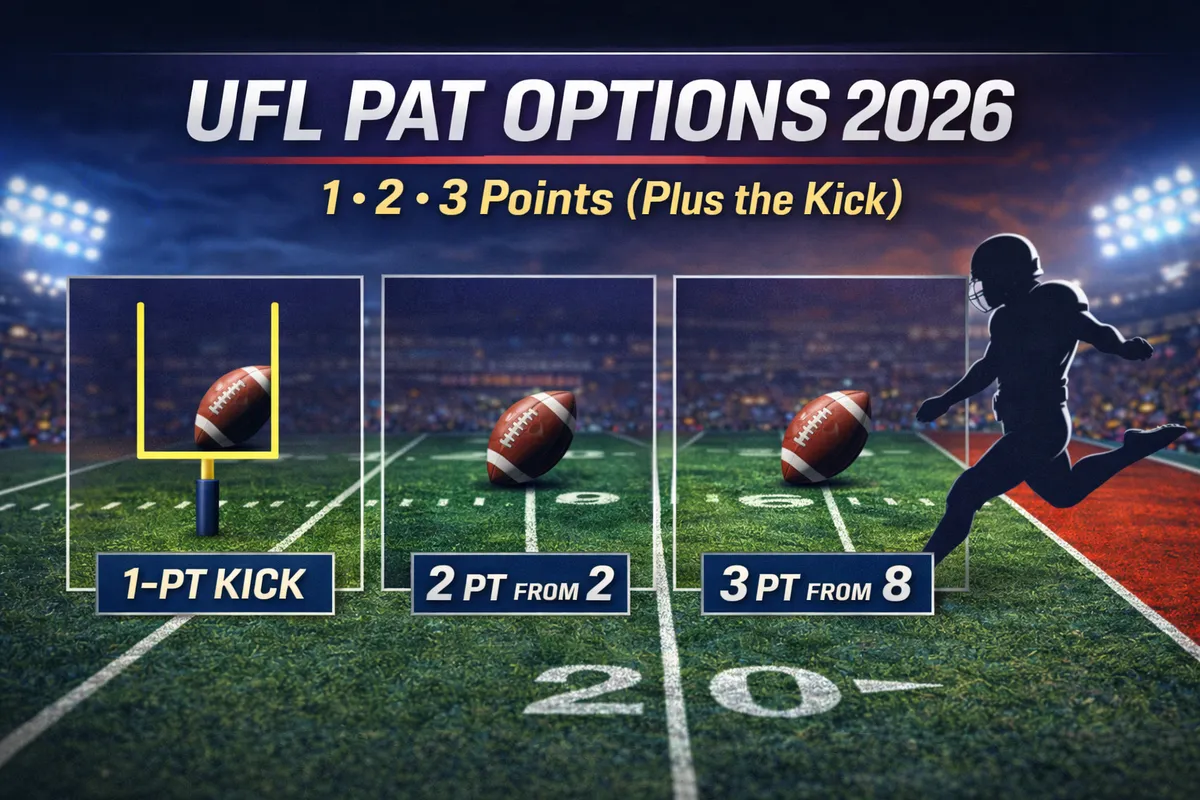
After a touchdown in UFL 2026, teams don’t have just one automatic choice. They choose one of these options:
- 1-point conversion (kick): a 33-yard field goal
- 2-point conversion (scrimmage play): ball placed at the 2-yard line
- 3-point conversion (scrimmage play): ball placed at the 8-yard line
That’s the full menu. Every time a team scores a touchdown, you’ll see the head coach decide which path makes the most sense based on the scoreboard, the clock, the opponent, and how confident they feel in the moment.
The most important fan takeaway:
In the UFL, a touchdown does not automatically mean “7 points.” It can become 7, 8, or 9 depending on the choice and execution.
The 1-Point Kick: The Safe Option That’s Back in 2026
What it is
The 1-point choice in 2026 is a 33-yard field goal. It functions like the classic extra-point kick most football fans recognize—quick, familiar, and usually the lowest-risk option.
Why the distance matters
A 33-yard kick is not a chip shot from point-blank range. It still requires:
- a clean snap
- a clean hold
- protection that holds up
- a kicker who’s reliable under pressure
So it’s “safe,” but it’s not automatic in the way some fans assume. In a league where coaches are often pushed toward aggression, this kick becomes a stabilizer—something you choose when you want to reduce risk and bank the point.
When coaches usually choose the kick
You’ll often see the 1-point kick when:
- the team wants to protect a lead
- the team has struggled on offense and wants the scoreboard point
- weather or game flow makes scrimmage tries feel risky
- the coach wants to avoid giving the opponent emotional momentum from a failed attempt
- the math doesn’t require chasing points yet
What it does to the “feel” of the game
Because the kick is back, coaches can choose to play more traditionally when the situation calls for it. That makes the UFL feel less like a constant gamble and more like a league where aggression is available—but not forced on every touchdown.
The 2-Point Try: Ball on the 2 (High Percentage, Still Not Free)
What it is
The 2-point option is a single scrimmage play with the ball placed at the 2-yard line. Score a touchdown on that one play, and you get two points.
Why it’s popular
From the 2, the offense can threaten both:
- power runs behind the line, and
- quick passes that create instant separation
It’s close enough that a great offensive line can win with a physical play, but also close enough that the defense can crowd the box and dare the offense to throw into tight windows. That’s why this attempt is often the “default aggressive choice” when a coach wants more than 1 but doesn’t want the harder 3-point option.
What fans should watch for
On 2-point tries, the game becomes very readable. Watch:
- whether the offense goes heavy (extra blockers) or spread (more receivers)
- whether the quarterback is under center or in shotgun
- how quickly the QB throws (quick concepts) or whether they’re reading leverage
- whether the defense is blitzing or sitting in tight man coverage
Even if you don’t know route names, you can feel the intent immediately: power it in, or win with a quick throw.
The hidden risk
Failing from the 2 doesn’t just “lose a point.” It can:
- swing momentum
- change end-of-game math
- push a coach into riskier decisions later
That’s why some coaches still kick for 1 early, then chase 2 later only when the scoreboard forces it.
The 3-Point Try: Ball on the 8 (The Big Swing Option)
What it is
The 3-point option is a single scrimmage play from the 8-yard line. Score on that one play, and you get three points.
Why it exists
This is the UFL’s “comeback accelerator.” It gives teams a realistic way to change the scoreboard math without needing multiple touchdowns. It also makes the league’s endings feel different—because a team down by 9 isn’t “needing two scores” in the same way it would elsewhere. One touchdown plus a 3-point try can erase 9 points in one sequence.
Why it’s harder than it looks
From the 8-yard line:
- the defense has more room to defend routes
- the offense has to win in space, not just muscle
- coverage disguises matter more
- sacks and pressure are bigger threats because the play may take longer to develop
The 3-point try is not just “a 2-point attempt but slightly farther.” It’s a different challenge: more like a compressed red-zone play where timing and reads matter.
What the 8-yard line changes strategically
From the 8, offenses tend to lean toward:
- layered route combinations (one short, one intermediate, one back line)
- pick/rub concepts to create separation quickly
- quarterback movement (rollouts) to simplify reads
- fades and back-shoulder throws when matchups favor the offense
- quarterback runs if the defense spreads out too far
Defenses respond with:
- tighter coverage leverage rules
- simulated pressures
- edge containment to stop rollouts
- forcing the QB to hold the ball longer
As a fan, this is one of the most entertaining snaps in football because it looks like one play—but it contains a lot of chess.
Plus the Kick: Why the 1-Point Kick Matters So Much in 2026
UFL fans noticed something important the moment the league confirmed the 2026 options: the kick is back. That’s a big deal because it changes how the whole conversion system feels.
What the kick changes for coaches
Without a kick option, coaches are forced into a constant “risk vs risk” cycle. With the kick:
- you can bank points
- you can calm a game down
- you can avoid emotional swings after a touchdown
- you can keep your strategy flexible for later
It also creates a more familiar entry point for new viewers. A casual fan doesn’t have to learn everything at once. They can understand the kick immediately, then learn the 2 and 3 options as they watch more games.
What the kick changes for fans
When the kick exists, every aggressive attempt becomes more meaningful because it’s chosen—not forced. If a coach goes for 2 or 3, it feels like a deliberate decision rather than “well, that’s the only option.”
That makes post-touchdown moments more watchable. You’re not just watching a routine snap. You’re watching a coaching choice.
How Coaches Choose: A Fan-Friendly Decision Tree
You don’t need advanced analytics to predict UFL PAT decisions. Most choices follow a few simple patterns.
Step 1: What does the scoreboard demand right now?
- If the team only needs one point to reach a comfortable number, the kick is attractive.
- If the team needs to catch up, 2 or 3 becomes more likely.
- If the team is ahead and wants stability, 1 becomes more likely.
Step 2: How much time is left?
- Early game: many coaches prefer lower volatility (often 1 or selective 2).
- Late game: coaches chase the exact number they need (often 2 or 3).
Step 3: How is the offense performing today?
- If the offense is dominating: 2 or 3 feels safer.
- If the offense is inconsistent: the kick becomes valuable.
Step 4: Who has the matchup advantage?
- If your receivers are winning 1-on-1: the 3-point play becomes tempting.
- If your offensive line is winning: the 2-point run game becomes tempting.
Step 5: What does your opponent do well?
- If the opponent’s red-zone defense is elite: the kick might be smarter.
- If the opponent struggles with short-yardage: 2 becomes a weapon.
- If the opponent struggles with coverage communication: 3 becomes a weapon.
This decision tree is why UFL games feel strategic: different teams develop different “PAT personalities.”
Scoreboard Math That Makes UFL PAT Options Click Instantly
The easiest way to enjoy UFL PAT choices is to learn the common totals that show up on screen.
- Touchdown + kick (1): 7 points
- Touchdown + 2-point try: 8 points
- Touchdown + 3-point try: 9 points
Once you memorize those three totals, the rest becomes easy.
Why 9 is the magic number in 2026
The 9-point possibility changes how fans interpret deficits:
- Down 9 can be solved in one touchdown sequence.
- Down 18 can be solved in two touchdown sequences.
That doesn’t guarantee a comeback, but it changes the psychology. Teams can stay “alive” longer.
Why 8 still matters
The 8-point total is still valuable because it often creates clean “one-score” math. Coaches chase 8 when it lines up with:
- tying the game
- turning a 2-score gap into a 1-score gap
- forcing the opponent into uncomfortable decisions afterward
Why 7 is still powerful
The kick keeps 7 relevant because:
- it protects leads
- it avoids giving away free momentum
- it builds steady scoreboard pressure without gambling
A smart UFL coach doesn’t choose 2 or 3 every time. They choose the option that makes the next two possessions easier.
Common Situations and the Best PAT Choice (Explained Like You’re Watching Live)
Below are the situations that come up constantly, explained in practical fan language.
Situation: Your team just scored and is now up by 1
Coaches often kick for 1 here because:
- it turns a 1-point lead into 2
- it avoids giving the opponent an emotional boost
- it keeps the game manageable
Situation: Your team just scored and is down by 1
Coaches often go for 2 here because:
- you can take the lead immediately
- you avoid overtime math later
- you force the opponent to chase points next
Situation: Your team just scored and is down by 2
A 3-point try is tempting because:
- it flips the game to a 1-point lead
- But some coaches still go for 2 because:
- it ties the game and reduces risk
- This is where “coach personality” shows up.
Situation: Your team just scored and is down by 4
Many coaches choose 2 here to get within 2, because:
- it sets up a field goal or long kick scenario later
- But if a coach is feeling aggressive, 3 can cut it to 1 and change how the opponent calls plays.
Situation: Your team just scored and is down by 9
This is the most obvious 3-point moment:
- touchdown + 3 can tie the game
- It’s exactly why the 3-point try exists.
Situation: It’s early in the game and you’re up by 6 after scoring
Many coaches kick for 1 to make it 7 because:
- it creates a classic “one touchdown needed” situation for the opponent
- it keeps pressure steady and reduces variance
Situation: Late in the 4th, your team needs two scores no matter what
This is where coaches start mapping combinations:
- when to attempt 3
- when to attempt 2
- whether the kick is still useful
- UFL endings often become a “math story,” and PAT decisions are the first chapter.
How Defenses Approach Each PAT Option
PAT choices don’t just change the offense—they force the defense to prepare for multiple “mini-game” situations.
Defending the 1-point kick
Defenses focus on:
- leverage and timing for potential blocks
- forcing a low, rushed kick by creating interior pressure
- But most teams treat this as a “don’t mess up” moment—avoid penalties, avoid giving the offense a re-kick, and move on.
Defending the 2-point try from the 2
Defenses often:
- stack the box
- play tight man coverage
- bring pressure quickly because routes develop fast
- The goal is to win immediately at the line or force a hurried throw.
Defending the 3-point try from the 8
Defenses can:
- disguise coverage more
- pressure with creativity
- force the QB into a longer read
- The goal becomes forcing a mistake rather than simply overwhelming the line.
For fans, this means you’ll see very different defensive looks on 2 vs 3. The 3-point try often looks like a true red-zone play call battle.
How PAT Options Affect the Rest of the Game
A key UFL concept: the PAT decision isn’t only about the point right now. It’s about controlling the next decisions.
Momentum and emotional swings
Missing a 2 or 3:
- can energize the opponent
- can shift crowd energy
- can force you to “chase” later
Hitting a 2 or 3:
- can break an opponent’s rhythm
- can change what feels possible
- can force the opponent into aggressive mode
Play-calling on the next drive
Scoreboard pressure changes play-calling immediately:
- If you’re down 1, you call offense differently than if you’re down 3.
- If you’re up 9, you defend differently than if you’re up 7.
PAT choices directly shape those margins.
Field position and pacing
Because UFL games are built around high-leverage moments (and other rules encourage aggression), PAT decisions are part of the league’s overall pacing strategy. They keep games from settling into a slow, predictable rhythm.
Practical Rules Cheat Sheet (Read This During a Game)
If you want the fastest possible “I get it now” guide, this is it:
- After every touchdown, the team chooses 1, 2, or 3 points.
- 1 point: kick a 33-yard field goal.
- 2 points: one play from the 2-yard line.
- 3 points: one play from the 8-yard line.
- A touchdown can become 7, 8, or 9 points.
- Coaches choose based on score, time, and confidence.
- The 3-point try is the comeback weapon; the kick is the stabilizer.
Fan Watch Guide: How to Predict the Coach’s Choice
Want to guess the decision before the broadcast announces it? Use these quick tells:
- If the team is ahead and the game is early → the kick is more likely.
- If the team is trailing and needs a specific number → 2 or 3 is more likely.
- If the offense is dominating in short yardage → 2 becomes the go-to.
- If the offense is winning outside matchups → 3 becomes tempting.
- If the coach is known for aggression → expect 2 or 3 more often, even early.
The UFL is fun because you can learn these tendencies quickly. By Week 3, you’ll recognize which coaches “hunt points” and which coaches “bank points.”
How PAT Choices Combine With Other UFL 2026 Scoring Ideas
UFL 2026 has other scoring-related twists (like the 4-point field goal), and the PAT system is designed to fit into that world.
The bigger idea is flexibility:
- A team can score 4 on a long field goal.
- A team can score 9 on a touchdown plus a 3-point try.
- A team can “shape” the math rather than accepting the math.
That’s why UFL comebacks can feel different. The league gives teams more ways to create pressure without needing perfect, traditional sequences.
BoostRoom
UFL PAT options create nonstop search traffic because fans constantly ask questions like: “Why did they go for 3?” “What is a 33-yard PAT kick?” “Why is it from the 8?” “What’s the best choice after a touchdown?”
BoostRoom turns that demand into rankings and conversions by building:
- SEO-first explainer pages that answer quickly and keep visitors scrolling
- AI-search-friendly structure that’s easy to summarize and recommend
- Content clusters that grow authority (rules hub → beginner guides → team pages → weekly recaps)
- Conversion-focused writing that educates first and naturally guides readers toward your services
If you want UFL content that doesn’t just get clicks but keeps people on your site, BoostRoom is built to make that happen.
FAQ
What are the UFL PAT options in 2026?
Teams can choose a 1-point kick (33-yard field goal), a 2-point try from the 2-yard line, or a 3-point try from the 8-yard line.
Is the extra-point kick back in the UFL in 2026?
Yes. The UFL adds a 1-point kick option in 2026.
How far is the 1-point kick in UFL 2026?
It is a 33-yard field goal attempt.
Where is the ball placed for the 2-point try?
The ball is placed at the 2-yard line for a one-play attempt.
Where is the ball placed for the 3-point try?
The ball is placed at the 8-yard line for a one-play attempt.
What’s the main reason to choose a 3-point try?
It can change scoreboard math quickly, especially for comebacks (a touchdown sequence can produce 9 total points).
What’s the safest PAT choice?
The 1-point kick is generally the lowest-risk choice, but it still depends on execution and game conditions.
Do teams always chase 2 or 3 in the UFL?
No. The kick option allows teams to bank points when the situation calls for stability instead of aggression.
How can I predict what a coach will choose?
Look at score and time first (chasing points late), then look at how the offense is performing (short-yardage success favors 2; matchup advantages can favor 3).
Why does UFL scoring feel different from other leagues?
Because touchdowns can produce 7, 8, or 9 points depending on the PAT choice, and the league’s rules create more strategic scoring paths.



