Why a Weekly Routine Makes UFL More Fun
The UFL is small enough to follow completely, but fast enough to punish “I’ll catch up later.” With only eight teams and a short regular season, standings pressure builds early, and one weekend can change the entire playoff picture.
A routine fixes the two problems most new fans run into:
- Problem 1: You watch games but don’t feel the stakes.
- Without tracking standings and storylines, every matchup can feel equal—even though it isn’t.
- Problem 2: You miss the UFL’s signature moments.
- The UFL’s rule set makes certain plays extra important (kickoffs, post-TD choices, fourth downs near midfield, late-half long kick attempts, and the “three tries” overtime). If you treat those moments like bathroom breaks, you miss what makes the league unique.
The good news: you don’t need a complicated system. You just need a repeating rhythm that takes minutes on weekdays and makes weekends feel connected.
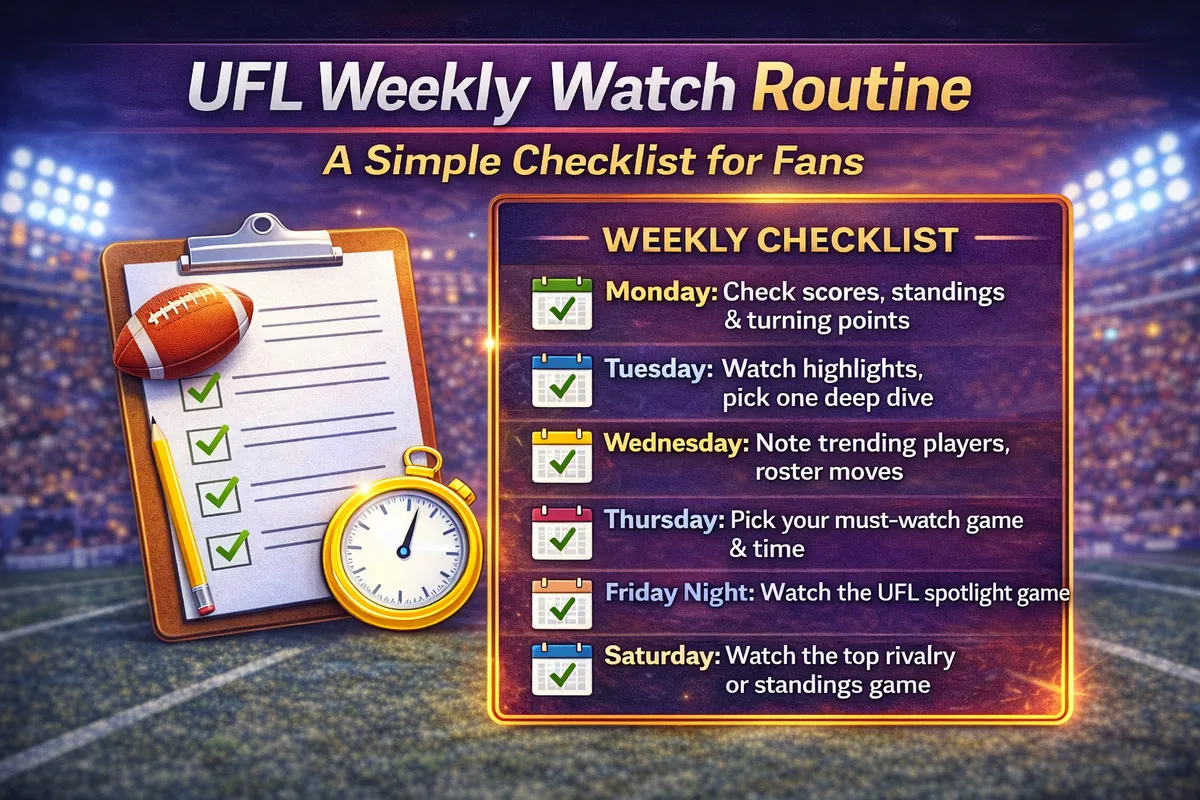
Your One-Page Weekly Checklist
Use this as your simplest possible UFL routine. If you do only these steps, you’ll stay fully “in the loop” all season.
Monday (10 minutes)
- Check scores and standings.
- Note the current top four (playoff line).
- Write down the biggest turning point from each game (one sentence each).
Tuesday (15–30 minutes)
- Watch condensed highlights for games you missed.
- Pick one “deep dive” game to watch a longer recap (10–15 minutes) or rewatch key drives.
Wednesday (10 minutes)
- Check who’s trending up/down: quarterbacks, kickers, and defenses.
- Look for any major roster/injury updates that affect next week.
Thursday (10–20 minutes)
- Pick your “must-watch” game of the weekend.
- Decide how you’ll watch: live, replay, or highlights-only.
- Set calendar reminders in your local time zone.
Friday (Game night)
- Watch the dedicated Friday window if you can—UFL 2026 is built around a weekly Friday night spotlight called FOX UFL Friday.
Saturday (Choose one)
- Watch the best matchup based on standings or rivalry energy.
- If you’re busy, watch the first quarter + last 8 minutes (you’ll catch most turning points).
Sunday (Finish strong)
- Watch the game that most affects the top four or features the hottest team.
- If you missed earlier games, watch highlights before Monday so you reset with context.
That’s the entire system. Now let’s make it easier and more fun with detailed versions.
Friday Night Routine
Friday is your habit anchor. UFL 2026 specifically brands Friday nights as a dedicated weekly window, so if you want one “automatic” weekly plan, choose Friday.
Your Friday plan (before kickoff)
- 10 minutes before: open the standings and check what a win/loss would do for each team.
- 5 minutes before: decide your “one storyline” for this game (examples below).
- Kickoff rule: promise yourself you won’t miss kickoffs and post-TD tries. In the UFL, those moments can swing field position and points faster than you expect.
Pick one storyline (easy options)
- “Which coach gets bold first?”
- “Will we see a 3-point try after a touchdown?”
- “Does the kicker have 60+ range?”
- “How many fourth downs happen once a team crosses midfield?”
- “Which defense tackles better on kickoffs and screens?”
What to do right after the game (2 minutes)
Write one sentence:
- “The game flipped when ______.”
- This tiny habit turns a weekend of games into a season you remember.
Saturday Routine
Saturday is where you decide how much of a fan you want to be.
Option A: The full-game Saturday
- Watch the matchup that feels like the best football or the biggest rivalry.
- Track two things: (1) third downs, (2) red zone execution. Those two stats usually explain the winner.
Option B: The “smart skim” Saturday (30–45 minutes total)
- Watch the first quarter to learn how teams plan to win.
- Watch the last 8 minutes to catch the real decisions: fourth downs, conversion choices, kickoff field position, and overtime pressure if it happens.
- If you have time for only one extra piece, watch the drives immediately after turnovers—UFL momentum swings can be violent.
Option C: The highlights-only Saturday (15 minutes)
If you can’t watch live, you can still keep up by doing this:
- Watch highlights.
- Then check the play-by-play summary for the final four possessions.
- That’s where UFL games often get decided.
Sunday Routine
Sunday is where you “close the loop.” It’s your chance to finish the weekend with the game that matters most for standings.
How to pick the right Sunday game
Choose the game that matches one of these:
- A top-four team is playing (playoff pressure).
- Two teams are tied or close in the standings (tiebreak vibe).
- A new franchise is hosting at home (identity-building opportunity).
- The matchup feels like a rivalry (emotion usually creates chaos).
Sunday habit that makes you feel like a real fan
At halftime, check two things:
- Time of possession is less important than you think.
- Turnovers + red zone + third down usually tells the story.
- If a team is losing but winning those categories, a comeback is more likely than it looks.
Monday Reset
Monday is where you become a “season-long” fan instead of a “weekend-only” viewer.
The 10-minute Monday reset
- Standings check: write down the top four.
- Biggest moment list: one turning point per game.
- Team identity notes: one sentence per team you care about.
Here’s a template you can reuse every week:
- Team: “We win when ______.”
- Team: “Our problem is ______.”
- Team: “Our biggest weapon is ______.”
If you do this for even two teams, your brain starts watching games differently—because you’re watching for identity, not random plays.
Tuesday Highlights and One Deep Dive
Tuesday is your “keep up without stress” day.
Step 1: Watch condensed highlights (10–15 minutes)
Pick the games you missed, and watch highlight packages. Don’t chase every clip—your goal is to understand:
- how each game flowed,
- what the big swings were,
- and whether the final score matches the feel.
Step 2: Choose one deep dive (10–20 minutes)
Pick one game to rewatch the most important drives:
- the first scoring drive (sets the plan),
- the last two drives (shows decision-making),
- and any overtime tries (shows coaching under pressure).
If you can only deep dive one thing all season, deep dive late-game sequences. The UFL’s rule set is designed to create endings worth studying.
Wednesday Midweek Check
Wednesday is where you get ahead of the weekend. Don’t overthink it—this is about noticing patterns.
What to check (10 minutes)
- Quarterback stability: who looks calm and repeatable?
- Kicking confidence: who is attempting long kicks, and who avoids them?
- Fourth-down personality: who keeps the offense on the field inside scoring territory?
- Discipline: who keeps giving away free first downs with penalties?
- Injury/roster notes: any major starter changes that would reshape next game.
This is where you start predicting outcomes without gambling or overanalyzing. It’s just pattern recognition.
Thursday Game Selection
Thursday is your planning day. It’s where you turn “I might watch” into “I will watch.”
Step 1: Pick your must-watch game
Pick based on one of these:
- Top-four clash
- Rivalry energy
- New team proving itself
- Big coaching storyline
- You simply love the matchup
Step 2: Choose your watch method
- Live: best for emotion and learning rules.
- Replay (same night): best if time zones are rough.
- Highlights-only: best if you’re busy but still want context.
Step 3: Set reminders in your time zone
Most schedules are listed in U.S. Eastern Time, so reminders prevent missed kickoffs—especially if you’re outside the U.S.
The Busy Fan Routine
If you’re busy, this routine keeps you connected without stress.
Weekday total: 25 minutes
- Monday: 10 minutes (standings + turning points)
- Tuesday: 15 minutes (highlights)
Weekend total: 60–90 minutes
- Watch Friday OR one weekend game (not both).
- Watch first quarter + last 8 minutes.
- Watch overtime if it happens (UFL overtime is fast and the most fun part to watch live).
Busy fan rule:
If you watch only one part of a UFL game, watch the final 8 minutes. UFL rules create the most “coach personality” moments late.
The Regular Fan Routine
This is the best routine for most people. It’s simple, satisfying, and keeps you up to date.
Weekday total: 45–60 minutes
- Monday: standings + storylines (10–15)
- Tuesday: highlights (15–20)
- Thursday: choose weekend must-watch (10)
- Optional Wednesday check (10)
Weekend total: 3–5 hours
- Watch Friday night game if you can (or Saturday).
- Watch one Saturday game.
- Watch one Sunday game.
Check out some of our most popular UFL services:
This routine makes you feel like you’re following the entire league without needing to sacrifice your whole weekend.
The Superfan Routine
If you love football and want to follow the whole league, this is the routine that turns you into the person everyone asks for updates.
Monday (20 minutes)
- Full standings scan
- Watch the final 5 minutes of each game (if available)
Tuesday (45–60 minutes)
- Watch condensed versions of all games
- Create a “power ranking” of how teams look, not just record
Wednesday (30 minutes)
- Focus on one matchup: watch defensive clips or key drives (third down + red zone)
Thursday (20 minutes)
- Set your viewing plan for every game
- Identify one “player to watch” per matchup (QB, edge rusher, CB, kicker)
Friday–Sunday (as much as you want)
- Watch live and keep notes
- Track decisions: 4th downs, PAT choices, long field goal attempts, kickoff outcomes, overtime calls
Superfan tip: the best way to feel smart fast is to track decision moments, not stats. That’s what makes UFL 2026 its own product.
International Fan Routine
If you’re outside the U.S. (including Africa/Cairo), your biggest issue is kickoff times. The answer isn’t “don’t watch,” it’s “watch smarter.”
International plan that works
- Watch the game that lands in your most comfortable window live (often Saturday afternoon U.S. time becomes evening in many regions).
- For late-night kickoffs, watch a replay or condensed version the next morning.
- Use Monday and Tuesday to stay caught up with highlights and standings.
Time-zone practical tip
Because U.S. daylight saving and local daylight saving can shift, don’t rely on “always +X hours.” Use calendar conversions or a single weekly time conversion on Thursday when you set your reminders.
International fan rule:
If you can’t watch live, watch within 12–18 hours. The faster you watch, the more the league feels “alive” and less like old news.
Don’t Miss These UFL-Only Moments
If you want to feel the difference between UFL 2026 and other football instantly, stop leaving your seat (or your screen) during these moments:
Kickoffs
UFL 2026 uses a landing-zone kickoff system that can create big field position swings. If you miss the kickoff, you can miss a hidden turning point.
The play after a touchdown
In 2026, teams can choose a 1-point kick or go for 2 or 3 points on a play. That means the scoreboard can swing in unusual but logical jumps, and coaches reveal personality right here.
Fourth downs once teams cross midfield
UFL 2026 restricts punting inside the opponent’s 50 in most situations, so “drive-ending punts” happen less often where fans expect them. That creates more must-have fourth downs.
Long field goal attempts
UFL 2026 introduces 4-point field goals from 60+ yards. That changes end-of-half strategy and makes midfield feel like scoring territory sometimes.
Overtime
UFL overtime uses a “three tries” format from close range. It’s quick, intense, and the easiest overtime to follow because every snap is high stakes.
If you focus your attention on these moments, your routine becomes more rewarding because you’re watching the parts that matter most.
Simple Tracking Tools That Make Your Routine Stick
You don’t need spreadsheets. You just need one small system.
Tool 1: A notes app (or one notebook page)
Create a weekly note with:
- Top four teams by record
- One sentence per game (“game flipped when…”)
- One “team identity” sentence for your favorite team
- One “coach personality” sentence (aggressive vs conservative)
Tool 2: A calendar reminder system
Set three recurring reminders:
- Thursday night: “Set UFL weekend plan”
- Friday: “UFL spotlight game” (or your must-watch game)
- Monday: “UFL standings reset”
Tool 3: A watchlist
Pick:
- 1 favorite team
- 1 rival team (fun to root against)
- 1 “floating” team (the hottest or most chaotic team each week)
This creates a narrative loop. Even if your favorite team is off, you still have a reason to watch.
How to Choose a Team and a Rivalry for Your Routine
If you don’t have a team yet, pick based on what keeps you watching.
Pick a team based on your fan personality
- Want the “standard” vibe? Pick a team that feels like a measuring stick.
- Want to build from Day 1? Pick a new franchise and grow with them.
- Want big atmosphere? Pick a team known for loud home games.
- Want coaching chess? Pick a team whose decisions are always bold.
Pick one rivalry to follow weekly
Rivalries make neutral games fun. Choose:
- a big-stage rivalry (loud fan culture + high stakes), or
- a regional pride rivalry (two nearby markets), or
- “standard vs challenger” (who can knock off the league’s benchmark team).
Once you care about one rivalry, your weekly routine feels connected even if you miss a game.
Common Problems and Quick Fixes
“I miss games because the schedule moves.”
Fix: Set your Thursday reminder, then set game-day reminders in your local time.
“I only watch highlights and I don’t feel attached.”
Fix: Watch one full game per week live (or within 12 hours). Attachment comes from time, not information.
“I get overwhelmed because there are multiple games.”
Fix: Follow your team + one rivalry + standings. You don’t need everything.
“I keep missing the most exciting plays.”
Fix: Stop leaving during kickoffs, after touchdowns, and fourth downs near midfield. Those moments are amplified by UFL 2026 rules.
“I don’t know what matters in the standings.”
Fix: Top four is the playoff line in 2026. Treat that as your weekly scoreboard.
Practical Rules
- Pick one “anchor” viewing slot per week (Friday OR one weekend day) and protect it.
- Always do a Monday reset: scores, standings, top four, and one sentence per game.
- Watch UFL turning points on purpose: kickoffs, post-TD tries, fourth downs inside scoring territory, long kick attempts, and overtime.
- Don’t chase every game. Chase the story: top four race + your team + one rivalry.
- If you can’t watch live, watch within 12–18 hours so the season still feels current.
- Use Thursday as your planning day: choose one must-watch matchup and set reminders.
- Track decisions more than stats—UFL games often swing on coaching choices that don’t show in a box score.
- Build one small habit that creates memory: “the game flipped when…” after each game.
- If you’re new, commit to a three-week routine before judging the league; by Week 3, identities and rivalries feel real.
- Keep your routine realistic. The best routine is the one you can actually repeat.
Check out some of our most popular UFL services:
BoostRoom
If you run a sports website (or you’re building one), a “Weekly Watch Routine” page is one of the highest-retention assets you can publish because it targets fans who are trying to turn curiosity into habit. These readers aren’t just looking for info—they’re looking for a system they can follow all season.
BoostRoom helps turn UFL interest into growth by building pages that:
- Rank for high-intent fan searches (how to follow, what to watch, weekly routine, schedule habit)
- Keep visitors scrolling with clean structure and fan-friendly checklists
- Perform in AI search results by using clear, summarized steps and repeatable frameworks
- Funnel readers naturally into related content (rules explainers, team guides, weekly previews, and recap hubs)
If your goal is traffic that sticks—and visitors who return every week—BoostRoom builds UFL content that behaves like a season-long product, not a one-time article.
FAQ
Do I have to watch every UFL game to follow the season?
No. Follow your team, track the top four standings, and watch one “must-watch” game each week. Highlights fill the gaps.
What’s the best day to watch UFL each week?
Friday is the league’s dedicated weekly spotlight window in 2026 (FOX UFL Friday), but Saturday or Sunday can work if that fits your schedule.
How much time do I need weekly to feel caught up?
About 60–90 minutes per week is enough: one game segment (first quarter + last 8 minutes) plus highlights and a quick standings check.
What should I check on Monday?
Scores, standings, the top four playoff line, and one turning point per game.
What moments should I never miss in a UFL game?
Kickoffs, the play after touchdowns (PAT choices), fourth downs inside scoring territory, long kick attempts, and overtime.
How do I follow the UFL if I’m outside the U.S.?
Choose one game to watch live in your best time window, then use replays/highlights within 12–18 hours. Set reminders in your local time zone.
How do I pick the “must-watch” game each weekend?
Pick the game that affects the top four standings most, or the game with the strongest rivalry energy.
I’m new to spring football. How do I get attached to a team?
Watch three straight games of one team, learn five names (QB, one WR/RB, one defender, kicker, head coach), and track one storyline per week.
Why do UFL games feel more “decision heavy”?
Because 2026 rules create more high-leverage moments (punt restrictions inside the 50, 4-point long field goals, multiple PAT choices, and the “three tries” overtime).
What’s the easiest routine that still works?
Monday standings reset + one live (or near-live) game each week + highlights for everything else.



