Why These Four Positions Matter Most in Spring Football
Spring football has a different “ecosystem” than fall football. Teams have less time together, fewer reps to build chemistry, and thinner margins for error because the season is short. That changes what’s most predictive of winning.
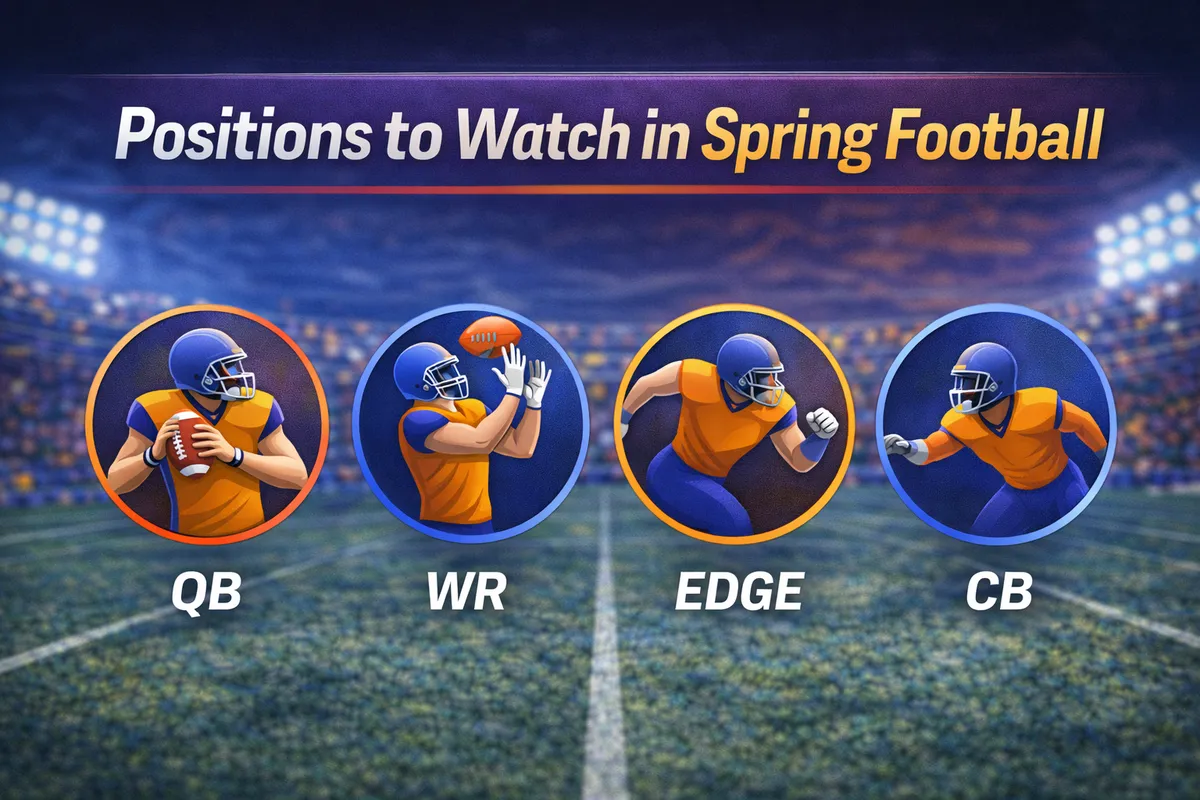
QB, WR, EDGE, and CB rise to the top because they:
- touch the ball (or the ball’s outcome) on most snaps,
- show skill differences clearly even in early-season “sloppy” games,
- decide high-leverage moments (3rd down, red zone, late drives),
- and create the plays that swing momentum (explosive passes, sacks, picks, pass breakups).
If you’re a new fan, these positions also make the game easier to follow. You don’t need to memorize every front and coverage. Just track:
- Can the QB make good decisions under pressure?
- Can WRs get open and finish catches?
- Can EDGE players disrupt the pocket consistently?
- Can CBs hold up without grabbing or busting coverage?
When you can answer those four questions, you understand the game.
The Spring Football Advantage: Why Players “Pop” Faster
In spring leagues, you often see clearer evaluation because the environment forces traits to show quickly.
Why that happens:
- Less disguise early: defenses simplify early in the season to avoid busts, which makes it easier to spot real QB processing and WR separation.
- Protection chemistry is still forming: offensive line timing and communication can lag early, which reveals which EDGE players can win without help.
- Coverage communication is stressed: new secondaries can struggle with handoffs and leverage rules, which exposes CB technique and discipline.
- More high-leverage snaps per game: many spring rules push teams into “make a play now” decisions, which magnifies QB, WR, EDGE, and CB impact.
So if you want the most fun “who’s legit?” storyline, these positions give it to you first.
A Fan-Friendly Cheat Sheet: What to Watch on Every Snap
Use this simple sequence. It works even if you don’t know play names.
Before the snap
- QB: Where are his eyes? Does he change the protection? Does he look calm?
- WR: Is the WR facing press or off coverage? Can he win the first two steps?
- EDGE: Is the EDGE wide or tight? Does he look like he’s attacking the tackle’s outside shoulder?
- CB: Is the CB inside or outside leverage? Is he looking at the QB or locked on the WR?
At the snap
- QB: Does he get the ball out on time or hesitate?
- WR: Does he create separation at the top of the route?
- EDGE: Does he win the first two steps or get stuck on the tackle?
- CB: Does he stay in phase without grabbing?
After the snap
- QB: Does he throw the ball to the right spot (not just “complete”)?
- WR: Does he catch cleanly and finish the play?
- EDGE: Did he force the QB off the spot or into an early throw?
- CB: Did he contest the catch point or force a throwaway?
If you do only this, you’ll feel the “real story” of the game faster than the box score.
Quarterback: The Position That Decides Spring Football Fast
Quarterback play swings spring football more than almost any other factor. In a short season, a team can’t “wait for the QB to develop.” The QB must stabilize the offense quickly, especially in leagues where coaching decisions are more aggressive and possessions carry more weight.
What makes spring QB evaluation different:
- The QB must learn and execute quickly, often with limited practice time.
- Timing routes and protection calls can be inconsistent early.
- Coaches may be more aggressive on fourth down and after touchdowns, which puts more pressure on QB decision-making.
So the QB isn’t just throwing. He’s managing:
- tempo,
- risk,
- situational football,
- and emotional momentum.
QB Trait 1: Processing Speed
Processing speed is the ability to:
- identify the defense pre-snap,
- confirm it post-snap,
- and make the correct decision fast.
A spring QB can look “strong-armed” and still fail if he’s late. Late throws turn into:
- interceptions,
- big hits,
- or drive-killing sacks.
How fans can spot processing fast
- If the ball comes out on rhythm and the QB’s feet match the route timing, that’s a good sign.
- If the QB stares down one option, double-clutches, and drifts into pressure, that’s a warning sign.
You don’t need to know the coverage. Just watch: does the QB look decisive?
QB Trait 2: Accuracy That Matches Route Type
Accuracy isn’t just “did it hit the WR.” Great spring QBs throw the right type of ball:
- front-shoulder on in-breaking routes,
- back-shoulder on tight boundary throws,
- lead throws that let WRs run after catch,
- low and safe throws when the defense is closing.
Fan tip: Watch the WR after the catch.
- If the WR catches and instantly turns upfield, the throw was usually placed well.
- If the WR has to stop, jump backward, or spin awkwardly, the throw might be “complete” but still low quality.
QB Trait 3: Pocket Presence
Pocket presence isn’t speed. It’s the ability to:
- feel pressure,
- slide and reset,
- and keep throwing posture without panicking.
In spring football, pocket presence matters because protection can be inconsistent early. The QBs who survive and win are the ones who:
- don’t bail too early,
- don’t drift into EDGE rushers,
- and can reset their feet after movement.
Easy tell: When the first read isn’t there, does the QB:
- step up and scan, or
- sprint sideways and shrink the field?
Stepping up usually keeps the play alive.
QB Trait 4: Situational Courage (Smart Aggression)
Spring rules often create situations where coaches push:
- fourth-down attempts,
- multi-point tries after touchdowns,
- short-field overtime pressure,
- and late-half scoring strategies.
That means QBs must play a controlled version of aggressive football:
- take the smart shots,
- protect the ball,
- and accept checkdowns when needed.
The best spring QBs don’t play scared—but they also don’t play reckless.
How Rule Innovations Put More Pressure on QBs
In modern spring leagues (including UFL-style rules), the game structure magnifies quarterback decision-making.
Examples of QB pressure situations you’ll see more often:
- Fourth down inside scoring territory: the QB must execute in one snap, not “live to punt.”
- After-touchdown decisions: the QB may be asked to convert for 2 or 3 points on a single play.
- Short-field overtime: one snap from close range can decide the game.
- Boundary passing emphasis: when catch rules favor one-foot in bounds, offenses attack the sideline more; QBs must place the ball precisely.
This is why QB is the #1 position to watch: rules create more moments where the QB must be right now, not eventually.
QB Watch Checklist: 10 Things to Track in One Game
Use this like a personal scorecard.
- Did he identify pressure and adjust protection?
- Did he throw with rhythm on early downs?
- Did he avoid negative plays (sacks, bad throws) on 2nd-and-medium?
- Did he convert at least one key third down with timing?
- Did he handle a bad snap/broken play calmly?
- Did he avoid “panic drift” toward the sideline?
- Did he throw at least one accurate boundary ball?
- Did he protect the ball in the red zone?
- Did he make one “NFL throw” (anticipation, tight window, good placement)?
- Did he finish the game stronger than he started?
If a QB checks 7+ of these, he’s usually a real winning driver in spring football.
Wide Receiver: The Fastest Way to See Skill Differences
Wide receivers are the “pop” position in spring football because separation and hands are obvious on TV. And in 2026 spring rulesets, WRs become even more important because:
- boundary catches can be easier (one-foot standards),
- conversions after touchdowns can be worth more (bigger “gotta have it” plays),
- and late-game drive efficiency matters more when scoring swings are larger.
WR Trait 1: Releases and First Two Steps
A release is how a WR beats the defender at the line of scrimmage.
What you’ll see on TV
- Against press coverage: does the WR get stuck, or does he win clean?
- Against off coverage: does the WR eat cushion quickly and force the CB to turn?
Fan tip: If a WR wins the first two steps consistently, he becomes “QB friendly.” That means:
- the QB can trust timing,
- and the offense can stay on schedule.
WR Trait 2: Separation at the Top of the Route
Separation is the real gold. In spring football, many WRs are athletic. The ones who stand out are the ones who separate with detail:
- clean stems,
- efficient footwork,
- no wasted steps,
- and sharp breaks.
Easy tell: At the break point, does the WR:
- snap his hips and create space, or
- round the route and let the CB stay attached?
Rounding routes is the fastest way to look “fast” but not effective.
WR Trait 3: Hands and Catch Finish
Spring football is full of “almost” plays. The WRs who earn attention are the ones who:
- catch cleanly through contact,
- finish plays near the boundary,
- and don’t turn routine catches into adventures.
If the ball hits a WR in the hands and drops, that’s not just a missed stat. It’s a drive lost—and spring seasons are too short for that.
WR Trait 4: Boundary Skill
One-foot catch standards (UFL-style rules) reward WRs who can:
- toe tap,
- toe drag,
- and finish while being pushed wide.
But the boundary still punishes sloppy technique. The WR must:
- secure the ball first,
- control his body,
- and avoid stepping out early.
Fan tip: Watch the WR’s eyes and hands.
- Great boundary WRs “attack” the ball with hands first.
- Inconsistent WRs let the ball travel and rely on body catches—dangerous near the sideline.
WR Trait 5: Blocking (Yes, It Matters)
In spring football, WR blocking is a roster and playing-time separator. Coaches love WRs who:
- block on screens,
- crack safely on run plays,
- and help spring explosive plays.
For fans: when you see a WR consistently on the field, one reason might be that coaches trust his blocking and assignment discipline—not just his targets.
WR Watch Checklist: 10 Things to Track
- Does he beat press without panic?
- Does he win at the top of routes (real separation)?
- Does he catch cleanly in traffic?
- Does he finish boundary catches confidently?
- Does he run after catch with vision (not just speed)?
- Does he fight back to the ball on scramble drills?
- Does he avoid drops on routine throws?
- Does he block with effort and technique?
- Does he convert on 3rd down (sticks awareness)?
- Does the QB look for him when the game tightens?
If the QB “leans on” a WR in big moments, that WR is almost always a real difference-maker.
Edge Rusher: The Position That Breaks Offenses
Edge rushers matter more than sacks. In spring football, offensive lines can be inconsistent early (communication, technique, cohesion). That environment gives EDGE defenders a chance to dominate—and forces offenses to reveal whether they can protect their QB.
EDGE is also a “translation position.” The traits that win in spring football often win everywhere:
- get-off,
- bend,
- hand usage,
- speed-to-power,
- and motor.
EDGE Trait 1: Get-Off (First Step)
Get-off is how fast the EDGE threatens the tackle. Great get-off forces:
- early sets,
- rushed footwork,
- and panic punches.
Fan tip: Watch the tackle’s first two steps.
- If the tackle immediately turns and runs to protect the corner, the EDGE is threatening him.
- If the tackle stays calm and vertical, the EDGE isn’t winning early.
EDGE Trait 2: Bend and Cornering
Bend is the ability to turn the corner without losing speed and balance. You’ll see it when the EDGE:
- dips the shoulder,
- flattens to the QB,
- and doesn’t drift too wide.
Even if the EDGE doesn’t get the sack, bend can force the QB to step up—right into interior pressure.
EDGE Trait 3: Hand Usage and Counters
A spring EDGE who only wins with speed can disappear once tackles adjust. The best ones have:
- swipes,
- rips,
- long-arm moves,
- spins,
- and counters when the tackle oversets.
Fan tip: If an EDGE wins the same way three times, the tackle will adjust. The great EDGE wins again with a different answer.
EDGE Trait 4: Speed-to-Power
Speed-to-power is when the rusher threatens speed, then converts into a bull rush. This matters because:
- it collapses the pocket,
- it forces QB discomfort,
- and it makes tackles hesitant to overset for the corner.
Even without sacks, speed-to-power creates ugly QB throws.
EDGE Trait 5: Run Contain and Discipline
Spring fans love sacks, but coaches love edges who set the edge:
- keep outside leverage,
- force runs back inside,
- and don’t get washed out.
Discipline matters even more in leagues that encourage aggression on fourth down. If a defense can’t trust its edges, offenses will attack the perimeter in short-yardage situations.
EDGE Watch Checklist: 10 Things to Track
- Does he win the first step consistently?
- Can he bend without falling?
- Does he have more than one pass rush move?
- Does he counter when the tackle oversets?
- Does he convert speed to power?
- Does he keep contain (no easy QB escapes)?
- Does he finish plays (motor)?
- Does he create pressure even when not getting sacks?
- Does the offense start sliding protection toward him?
- Does he show up on “must-have” downs (3rd down, 4th down)?
If protections start adjusting because of one EDGE, he’s controlling the game.
Cornerback: The Position That Determines Whether Offense Is Easy or Hard
Cornerback play can be invisible when it’s good—and painfully obvious when it’s bad. In spring football, CBs are under constant stress because:
- offenses often lean on timing throws and boundary routes,
- catch rules can favor receivers (one-foot),
- and teams test corners early to see who can hold up.
The best corners in spring football do three things:
- stay in phase,
- avoid penalties,
- and finish at the catch point.
CB Trait 1: Leverage and Positioning
CBs win before the ball is thrown. Leverage is how the CB positions himself relative to the WR and help defenders.
Simple leverage idea
- Inside leverage: CB protects inside routes, tries to force throws to the sideline.
- Outside leverage: CB protects boundary throws, tries to force throws inside.
In spring football with one-foot catches, boundary throws can be more viable—so CB leverage discipline matters even more. A CB who gives up easy outs and comebacks will get targeted all night.
CB Trait 2: Eyes and Processing
Great corners see the route concept developing. In zone or pattern-match systems, eyes matter:
- Are they staring at the QB and losing the WR?
- Are they too locked on the WR and missing route combinations?
- Do they pass routes off cleanly, or do they create busts?
Spring secondaries often bust coverages early in the season. The CBs who can communicate and process reduce those busts—and that’s a huge competitive advantage.
CB Trait 3: Press Technique (When Used)
Press coverage is a risk-reward choice. A press CB must:
- stay balanced,
- strike with good hands,
- and not panic when beat early.
Fan tip: Watch the feet.
- If the CB’s feet die at the snap, he’s vulnerable.
- If his feet stay alive and he stays square, he can disrupt timing.
CB Trait 4: Recovery Speed and Calmness
Even the best CBs get beat sometimes. What separates pros is recovery:
- can he regain position without grabbing?
- can he locate the ball?
- can he finish with a breakup?
In spring football, penalties can be drive killers. A CB who panics and commits pass interference can swing the game more than a missed tackle.
CB Trait 5: Tackling
Modern corners must tackle. Especially in spring rulesets where kickoffs and boundary throws can create space, CB tackling is not optional.
A CB who:
- takes the right angle,
- breaks down,
- and wraps cleanly
- creates “hidden stops” that keep drives from turning into explosives.
CB Watch Checklist: 10 Things to Track
- Does he stay in phase on slants/outs?
- Does he hold leverage properly (especially near the sticks)?
- Does he avoid grabby hands when beaten?
- Does he locate the ball and play through hands?
- Does he communicate on bunch sets and motion?
- Does he tackle in space?
- Does he contest boundary catches cleanly?
- Does he limit easy completions on 3rd down?
- Does the QB stop targeting him?
- Does he make one “drive-ending” play (PBU, pick, tackle for loss)?
A CB doesn’t need interceptions to dominate a game. He needs to make throws feel uncomfortable.
How These Positions Interact: The Matchups That Decide Games
Spring football is a chain reaction sport. These four positions are connected:
- EDGE affects QB: pressure speeds decisions and lowers accuracy.
- QB affects CB: good QBs move defenders with eyes and attack leverage.
- WR affects CB: separation and route detail force the CB to choose wrong.
- CB affects WR: tight coverage disrupts timing and forces tougher catches.
- QB + WR chemistry defeats coverage: timing throws beat even good leverage.
- EDGE + coverage creates turnovers: if CBs cover long enough, EDGE gets home.
If you want to watch “who is winning the game” beyond the scoreboard, watch these connections:
- Is the QB getting comfortable?
- Is the EDGE forcing him off the spot?
- Are WRs winning quickly or only on scramble chaos?
- Are CBs holding up without penalties?
That’s the real story.
A Simple Weekly Tracking Method
If you want to follow the league without getting overwhelmed, track one stat-like idea per position each week:
- QB: “How many bad plays?” (turnover-worthy throws, panic sacks, forced balls)
- WR: “How often did they separate on schedule?” (especially 3rd down)
- EDGE: “How often did they affect the QB?” (pressure, hits, forced movement)
- CB: “How many clean wins?” (targets forced away, PBUs, no flags)
Spring football success is often about minimizing bad plays more than maximizing highlights.
Where to Focus in High-Leverage Moments
If you only watch one part of a game closely, make it these moments:
- 3rd down: QB processing, WR separation, EDGE pressure, CB leverage.
- Red zone: condensed space exposes technique (QB placement, WR releases, EDGE discipline, CB ball skills).
- After touchdowns: conversion plays amplify QB decision-making and WR/CB execution.
- Fourth down near midfield: spring rules often force aggression; QB and EDGE become huge.
- Overtime: short-field pressure is the ultimate test of QB calm, WR quick separation, EDGE contain, CB discipline.
High leverage is where real players separate from “looks good on a highlight” players.
Practical Rules
- Watch decisions, not just results: a smart throwaway can be a winning play.
- Track pressure created, not only sacks: pressure is the QB’s enemy.
- Value separation over “contested catches”: separation is repeatable.
- Don’t punish CBs for completions that are “perfect throws” — focus on leverage and technique.
- If a WR blocks and plays special teams, he’ll stay on the field more; that matters in spring rosters.
- If an EDGE keeps contain while rushing, he’s more valuable than a reckless sack hunter.
- The best way to evaluate a QB is: “Does he make the offense feel calm?”
- If a CB avoids flags while staying aggressive, that’s elite spring football value.
- In spring football, consistency across 10–12 meaningful snaps beats one crazy highlight.
- Learn one thing per week. You’ll become “advanced” faster than you think.
BoostRoom
If you’re building a football website, these “positions to watch” pages are SEO gold because they answer what fans actually search during the season: “What should I watch for?” “Why is this player important?” “How do I understand defense?” The pages that rank and convert are the ones that keep readers engaged with simple checklists, clear explanations, and season-long relevance.
BoostRoom helps you turn spring football traffic into real growth by creating:
- SEO-first content built around what fans ask (rules, positions, strategy, watch guides)
- AI-search-friendly formatting that’s easy to summarize and recommend
- Topic clusters that keep visitors on your site (beginner guide → teams → rules → weekly watch pages)
- Conversion-focused writing that builds trust and leads readers toward your services naturally
If you want visitors who don’t bounce—and who come back every week—BoostRoom builds content that performs.
FAQ
What are the best positions to watch in spring football?
Quarterback, wide receiver, edge rusher, and cornerback are the fastest positions to reveal team quality and game momentum.
Why does QB matter more in spring football than people expect?
Because seasons are short and chemistry is limited; a QB must process quickly and avoid bad plays immediately.
What should I watch for to evaluate a QB fast?
Processing speed, pocket presence, ball placement, and situational decision-making on 3rd/4th down and in the red zone.
What makes a wide receiver stand out in spring football?
Clean releases, real separation at the top of routes, reliable hands, and ability to finish boundary catches.
Why do edge rushers dominate early in spring seasons?
Offensive lines often need time to build communication and timing, which gives skilled EDGE players more chances to win.
Is it better to track sacks or pressures for EDGE players?
Pressures tell you more. Pressure forces early throws and mistakes even when it doesn’t become a sack.
How can I tell if a cornerback is playing well if the QB doesn’t throw at him?
If the QB avoids him, if he holds leverage without grabbing, and if he communicates cleanly on motion and bunch sets, he’s likely doing his job well.
Do one-foot catch rules change what WRs and CBs need to do?
Yes. WRs can finish boundary catches more often, and CBs must rely more on leverage and catch-point technique instead of “push him out.”
What’s the most important moment to watch these positions?
Third down and red zone. Those snaps reveal separation, processing, pressure, and coverage discipline.
How can I follow these positions week to week without overthinking it?
Track “bad plays” for QBs, “separation wins” for WRs, “QB disruption” for EDGE, and “clean coverage wins/no flags” for CBs.



