Why UFL Rivalries Form Faster Than You Expect
In the NFL, rivalries are built over decades. In the UFL, rivalries form fast because the league’s structure makes games feel heavier right away:
- Only 8 teams means you recognize everyone quickly and storylines repeat in a way that feels familiar.
- Only 10 weeks means there’s no time to “figure it out later.” Every win counts immediately.
- Top four make the playoffs with no conferences in 2026, so the standings race is one shared table—every team is in everyone’s way.
- Rules force aggressive choices (fourth downs, conversions, kickoffs), creating memorable turning points that stick in your head and fuel “we remember what you did” energy.
That combination creates the perfect rivalry recipe: tight league + high leverage + repeated spotlight windows.
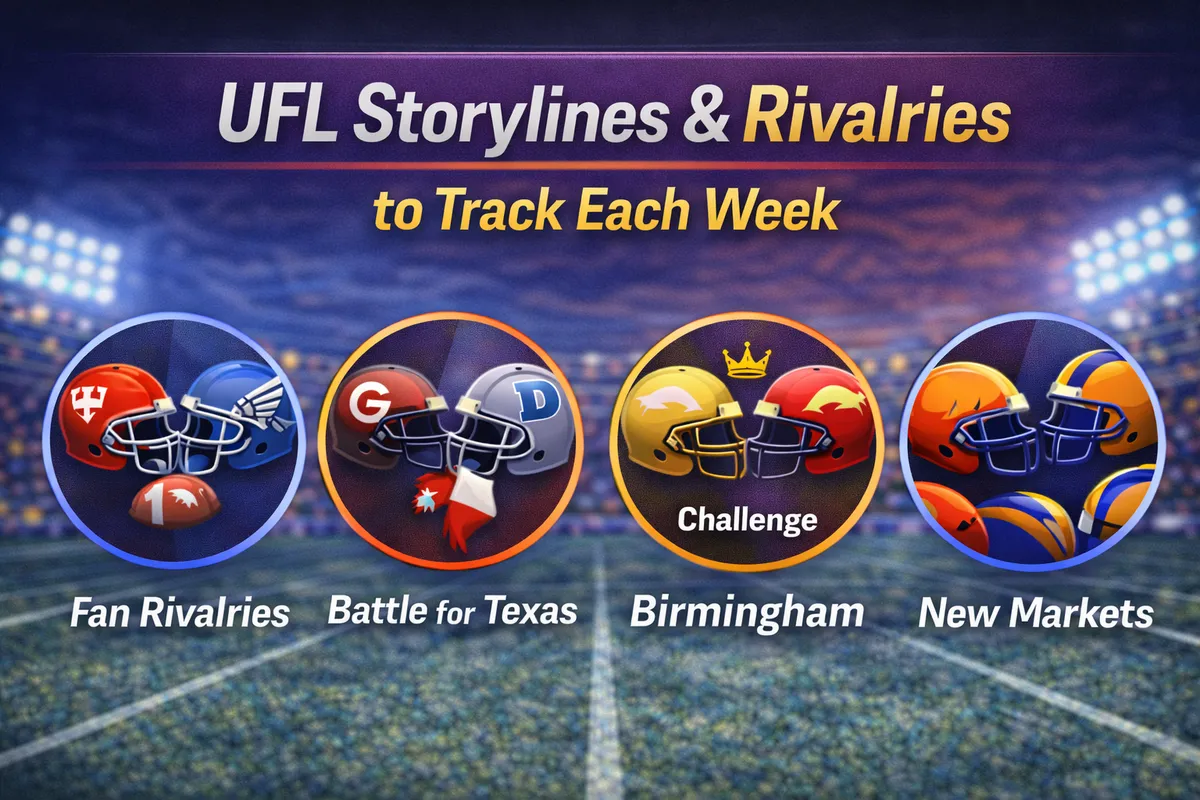
The UFL 2026 Story Engine
If you’re wondering why 2026 feels like a “fresh start” year, it’s because multiple league-wide changes hit at once:
- New markets: Columbus, Louisville, and Orlando join the league as new franchises.
- Rebrands and venue changes: Dallas and Houston enter new identity chapters (new names and/or venue shifts).
- A new league format: conferences are gone; it’s one combined table with the top four advancing.
- A schedule built for habit viewing: the season begins March 27 and features a dedicated Friday night national window (“FOX UFL Friday”).
- Rule changes that change game flow: long kicks worth more, fewer punts in scoring-adjacent territory, and a simpler overtime format.
When you combine all that, the league becomes easy to follow like a series:
New characters (teams) + new settings (stadiums) + new rules (plot twists) + short season (fast pacing).
The Rivalry Ladder
Not every rivalry is the same. In 2026, UFL rivalries fall into three tiers. Knowing the tiers helps you decide which games to prioritize each week.
Tier 1 Rivalries: Big-Stage, High-Stakes, Repeat-Conversation Games
These are the matchups that feel like events and create league-wide talk.
DC Defenders vs St. Louis Battlehawks
This is the league’s most “TV-ready” rivalry because it combines brand power, loud fan culture, and recent postseason intensity. DC enters 2026 as the most recent champion, and St. Louis has one of the biggest “big-game atmosphere” identities in the league. When they play, it rarely feels like “just another week.”
Houston Gamblers vs Dallas Renegades (Texas pride game)
Texas football culture doesn’t need help—but the UFL puts a spotlight on this matchup early and often. It’s a clean rivalry idea that new fans instantly understand: two Texas markets, two big identities, one scoreboard. Even when the rosters change, the pride angle stays.
Birmingham Stallions vs whoever looks real
Birmingham is the league’s measuring stick brand. In 2026, Birmingham games feel like a rivalry even without geography because every opponent wants to prove it can beat “the standard.” That creates a steady weekly storyline: who’s ready for Birmingham football right now?
Tier 2 Rivalries: Identity Wars and New-Market Grudges
These rivalries grow from style clashes, rebrands, and “we’re building our culture” energy.
New franchise battles (Columbus, Louisville, Orlando)
When new franchises play each other, the energy is different. It’s not just “win this game,” it’s “define who we are.” These games create early traditions, inside jokes, and first-ever highlight moments that become part of each team’s origin story.
Rebrand credibility matchups (Dallas and Houston vs established brands)
Rebrands create a natural storyline: is the new identity real, or just a new logo? The fastest way to make a rebrand feel real is to beat a respected opponent in a spotlight window.
Tier 3 Rivalries: Weekly “Heat Checks” That Become Personal
These are the matchups that become rivalries because of one moment:
- a controversial fourth-down call,
- a late conversion decision,
- a long kick that flips the game,
- a sideline catch ruling,
- or an overtime “three tries” finish.
In the UFL, Tier 3 rivalries can become Tier 1 in a single weekend because there’s less history—but also less “noise” drowning the moment.
The Schedule Windows That Supercharge Rivalries
Storylines don’t only come from matchups. They come from how the league presents those matchups.
FOX UFL Friday: The Weekly Spotlight Window
Every Friday night in the regular season is built as a habit. If you only watch one game per week, Friday is the easiest choice because:
- it’s the league’s consistent weekly anchor,
- it often features teams the league wants to highlight,
- and it turns ordinary matchups into “event games” simply by giving them a consistent national stage.
Rivalries grow faster when the audience is shared. Friday creates shared audience.
The First-Ever Tuesday Night Game
The UFL schedule includes a Tuesday night game (a rare football TV window) as part of its “make the schedule feel special” strategy. When the league does something rare, fans pay attention, and players feel it too.
Tuesday games often become storyline accelerators because:
- teams prepare on a strange rhythm,
- travel and recovery become part of the narrative,
- and coaches make more “weird week” decisions that stand out.
Event Thursdays
The UFL uses special Thursday windows as showcase nights, including a streaming-focused presentation. This matters because:
- the league is training fans to “check in” on non-traditional nights,
- and it gives certain teams a spotlight that can define their identity quickly.
For example, Louisville is featured in major event windows early, which is exactly what you want for a new franchise trying to build a fan habit fast.
Derby Week: Louisville’s “Make It Local” Rivalry Builder
Louisville’s schedule includes a special Thursday night home game tied to Kentucky Derby week energy, creating a new tradition right away. It’s not only a football storyline; it’s a culture storyline: “This team belongs to the city.”
Games like this become rivalry builders because:
- the atmosphere is different,
- the stakes feel bigger even if the standings are normal,
- and fans remember the event even if they don’t remember the box score.
The Rule Changes That Create Weekly Debate
One reason UFL storylines feel louder in 2026 is that rules create repeatable arguments—the kind fans love:
- “Why did they go for it there?”
- “Why didn’t they kick?”
- “Do you take 1, 2, or 3 after a touchdown?”
- “Is that a catch?”
- “Is that in range for four points?”
Here are the rule changes that most directly fuel weekly rivalries:
- 4-point field goal (60+ yards): turns midfield into potential scoring territory and creates dramatic late-half swings.
- No punting inside the opponent’s 50 (until late in halves): forces coaches into fourth-down decisions that become identity moments.
- One foot in bounds for catches: changes sideline offense and creates replay drama that fans talk about all week.
- PAT menu (1-point kick or 2/3-point plays): makes every touchdown a coaching decision, not a routine.
- Overtime “three tries” format: creates a clean, dramatic ending that becomes a highlight machine.
- Kickoff landing zone system: makes kickoff outcomes matter more, so field position becomes part of rivalry talk.
If you want to track UFL storylines each week, track how teams handle these rule moments.
The Two Rivalries You Should Adopt as a New Fan
If you’re new and want instant emotional investment, adopt one of these:
Adopt DC vs St. Louis if you love big energy, loud environments, and “this game matters” vibes. It’s the easiest matchup to treat like a weekly headline.
Adopt Houston vs Dallas if you love regional pride and “we’re not losing to them” energy. Texas matchups are built for drama.
Then add a “floating rivalry” each week:
Birmingham vs the hottest team—because Birmingham games are the league’s best measuring-stick episodes.
Team-by-Team Storyline Boards
This section is designed to help you follow the league like a series. Each team has:
- a 2026 identity story,
- the matchups that create rivalry energy,
- and the weekly question you should ask when you watch them.
Birmingham Stallions: The Standard That Everyone Chases
Birmingham enters 2026 as the league’s measuring stick brand. Even when the roster shifts, Birmingham carries a “this is how you win spring football” reputation. That’s why Birmingham games naturally feel like rivalries: every opponent wants to prove Birmingham is beatable right now.
What makes Birmingham a storyline team in 2026
- A new head coach storyline: A.J. McCarron steps into a role with massive expectations after Birmingham’s legendary championship-era continuity. That’s instant pressure.
- Birmingham’s identity is not just “win.” It’s “win clean”: discipline, situational football, and patience under pressure.
Rivalry energy matchups
- Birmingham vs DC: champion vs standard, leadership vs tradition.
- Birmingham vs St. Louis: big-stage feel, high attention, big crowd environments.
- Birmingham vs new franchises: “welcome to the league” tests that can become grudges if the new team steals a signature win.
Weekly question to track
Can Birmingham stay the standard under a new coaching era—especially in the new 2026 rule environment where fourth-down choices and special teams swings are louder?
DC Defenders: The Champion With a Target on Its Back
DC enters 2026 as the most recent champion, and that changes everything. Champions don’t just play games—they get everyone’s best shot.
What makes DC a storyline team in 2026
- Winning creates a target: every opponent plays DC like it’s a measuring-stick weekend.
- DC’s home identity matters: Audi Field games feel intense, and the fan culture is part of the brand now.
Rivalry energy matchups
- DC vs St. Louis: a rivalry that already has postseason tension baked into it.
- DC vs Birmingham: the “who defines the league?” storyline.
- DC vs new markets: new fan bases love making their first signature statement against the champs.
Weekly question to track
Can DC handle being the hunted while still playing the aggressive, confident style that made them champions?
St. Louis Battlehawks: Big Atmosphere, Big Stakes, Big Expectations
St. Louis has one of the league’s strongest “event game” identities. Even casual viewers feel the difference because the setting looks and sounds bigger.
What makes St. Louis a storyline team in 2026
- A new head coach era: Ricky Proehl taking over adds a fresh leadership chapter to a team that already feels like a flagship market.
- St. Louis carries a “we should be in the biggest games” identity, which means every loss creates louder conversation.
Rivalry energy matchups
- St. Louis vs DC: the headline rivalry.
- St. Louis vs Birmingham: the “prove you’re the best” test.
- St. Louis vs Louisville (Derby Week): a special-event game that can become a new tradition rivalry if it delivers.
Weekly question to track
Can St. Louis convert big atmosphere into big wins—especially in the league’s new high-leverage rules that reward clean execution?
Houston Gamblers: Rebrand Credibility and a New Home Feel
Houston’s 2026 story is not subtle: new name chapter, new venue strategy, and a coach with deep Texas football context.
What makes Houston a storyline team in 2026
- Kevin Sumlin brings a recognizable coaching storyline and an “identity reset” vibe.
- Houston’s home environment shifts to a downtown soccer stadium setting, designed to feel louder and more intimate.
Rivalry energy matchups
- Houston vs Dallas: the Texas pride game that’s easy for new fans to latch onto.
- Houston vs Birmingham: a measuring-stick clash that tests whether Houston’s rebrand is real on the field.
- Houston vs St. Louis: loud crowd vs “prove you belong” energy.
Weekly question to track
Does Houston become the league’s most emotional momentum team—one big stop or one big kick that flips a game?
Dallas Renegades: Big-Market Spotlight and “Prove It” Energy
Dallas enters 2026 with a brand identity that screams “big football market.” That alone creates storyline gravity.
What makes Dallas a storyline team in 2026
- Rick Neuheisel’s presence adds a recognizable coaching personality, and big-market teams always get extra attention.
- Dallas plays in a venue that fits the league’s new approach: smaller, louder, more TV-friendly than cavernous football stadiums.
Rivalry energy matchups
- Dallas vs Houston: the Texas rivalry.
- Dallas vs DC: coaching decision battles that often come down to fourth downs and conversions.
- Dallas vs St. Louis: spotlight windows like the Tuesday game turn this into “event” energy quickly.
Weekly question to track
Is Dallas the league’s most aggressive decision-making team—or the team that gets burned by aggression at the worst moments?
Columbus Aviators: New Franchise, New Identity, Immediate Tests
Columbus is a true “start from scratch” story in 2026. That’s exciting because every win feels like history.
What makes Columbus a storyline team in 2026
- A debut franchise is always a storyline because every tradition starts somewhere: first home win, first rivalry moment, first breakout star.
- Ted Ginn Jr. as head coach makes Columbus one of the most talked-about new teams immediately—especially for fans who love football personality stories.
Rivalry energy matchups
- Columbus vs Orlando: new franchise vs new franchise, identity clash, “who builds faster?”
- Columbus vs Louisville: two new markets competing for attention and early fan momentum.
- Columbus vs established teams (DC, Birmingham): defining tests that can create lasting grudges if Columbus steals a signature win.
Weekly question to track
Does Columbus look organized and disciplined quickly—or do they need half a season to become themselves?
Louisville Kings: New Market, Strong Culture Hook, Derby Week Moment
Louisville is built to feel like a local event franchise from the jump. The schedule and marketing lean into that.
What makes Louisville a storyline team in 2026
- Chris Redman as head coach gives Louisville a clear leadership anchor with a direct market connection.
- Louisville’s schedule includes a special Derby Week Thursday night home game designed to create a tradition instantly.
Rivalry energy matchups
- Louisville vs St. Louis (Derby Week): special-event energy that can become a real rivalry seed if it hits.
- Louisville vs Birmingham: new franchise vs standard—signature upset potential.
- Louisville vs Columbus/Orlando: the “new market triangle” that can form long-term rivalries through repeated close games.
Weekly question to track
Can Louisville become the league’s most fun home environment outside the established flagship markets?
Orlando Storm: New Franchise With Big-Event Potential
Orlando enters 2026 as a new franchise but in a market that understands entertainment. That matters in spring football.
What makes Orlando a storyline team in 2026
- Anthony Becht as head coach brings spring-football familiarity and a clear competitive edge for a new team.
- Orlando plays in a soccer stadium setting that can feel loud quickly if the fan base shows up.
Rivalry energy matchups
- Orlando vs Columbus and Louisville: new team identity battles.
- Orlando vs Birmingham: a classic “welcome to the league” test that can become a lasting grudge if Orlando plays them tight.
- Orlando vs DC: champ vs new franchise, spotlight potential.
Weekly question to track
Does Orlando become the league’s “chaos team”—the one that pulls off wild comebacks and turns games into highlights?
How to Track Storylines Each Week Without Overthinking
Here’s the simplest way to follow UFL storylines every weekend: track roles and decisions, not only stats.
Use this weekly checklist during games:
- Standings pressure: Who is currently in the top four, and who is chasing?
- Fourth-down identity: Which coaches are aggressive inside scoring territory, and which play it safe?
- Post-touchdown choices: Who consistently takes 1, and who hunts 2 or 3?
- Long-kick mindset: Who is willing to try for 4 points from 60+ when the game is tight?
- Kickoff field position: Which teams consistently start drives with good position because of kickoff outcomes?
- Late-game calm: Who looks organized in the final five minutes?
- Overtime readiness: If a game goes to “three tries,” who looks prepared and who looks like they’re improvising?
- Discipline: Which teams avoid drive-killing penalties and red-zone mistakes?
- Signature moment: What was the one snap everyone will remember on Monday?
If you can answer these nine questions weekly, you’ll understand the league story better than most viewers.
The Season Arc: How Storylines Evolve Over 10 Weeks
Instead of thinking “Week 1, Week 2, Week 3,” think in phases. This makes it easier to follow.
Phase 1: Launch and Identity (Weeks 1–2)
This is where new franchises reveal whether they’re organized or chaotic. The storylines are:
- first impressions,
- first home crowd moments,
- coaching calm under pressure,
- and how quickly teams adapt to rule changes.
What matters most in Phase 1:
- clean snaps, clean penalties, and basic situational discipline.
Phase 2: Pattern Formation (Weeks 3–6)
By mid-April into early May, teams stop being “new” and start becoming themselves. Rivalries heat up because:
- one team realizes it hates playing another team’s style,
- and because late-half decisions begin to repeat (the same coach keeps making the same kinds of calls).
This is where “Tier 3 rivalries” are born—one controversial moment becomes a weekly storyline.
Phase 3: Playoff Pressure (Weeks 7–10)
The top-four race becomes real, and your brain changes how it watches:
- a loss isn’t just a loss; it’s a playoff path problem,
- and every close finish becomes a standings swing.
In this phase, storylines are decided by:
- red-zone execution,
- special teams discipline,
- and who stays healthy enough to remain consistent.
How Rivalries Are Actually Built in the UFL
If you want to predict which matchups will become real rivalries, watch for these ingredients:
- Repeated close games (one-score finishes are rivalry fuel).
- Rule-driven turning points (a fourth-down stop, a 3-point try decision, a 4-point kick attempt).
- Public coaching debates (fans arguing “he should’ve kicked it” is how rivalries grow).
- Stadium identity (markets that feel loud on TV create bigger moments).
- A shared spotlight window (Friday night games and special weeknight games create shared conversation).
Rivalries don’t need decades. They need memories.
If You’re Neutral, Here’s How to Pick a Rivalry to Care About
You don’t need a hometown team to enjoy rivalry football. Pick a rivalry based on what you like.
- If you like big-stage games: choose DC vs St. Louis.
- If you like regional pride: choose Houston vs Dallas.
- If you like underdog identity building: choose a new franchise (Columbus/Louisville/Orlando) and treat every matchup against an established team as rivalry week.
- If you like coaching chess: follow Dallas and DC games—decision-making is always part of the story.
- If you like event nights: circle the Tuesday game and the Derby Week Thursday game; these nights are designed to feel bigger.
Once you care about one rivalry, every other game becomes easier to enjoy because you always have a comparison point.
How to Make Every Weekend Feel Connected
A league becomes addictive when you create a routine. Here’s a simple one that works even if you’re busy:
- Friday: watch the FOX UFL Friday game (or highlights first thing Saturday).
- Saturday: watch the game with the biggest rivalry energy.
- Sunday: watch the game that most affects the top-four standings.
Then do one quick habit:
Write down one sentence per game:
“What was the moment?”
That’s how you build storyline memory fast.
Practical Rules
- Treat the UFL like an 8-episode series with bonus content—not like random football.
- Track the top four every week; it makes every matchup feel bigger instantly.
- Watch the “UFL moments” on purpose: fourth downs inside the 50, PAT choices, long-kick attempts, kickoffs, and overtime.
- Don’t chase stats—chase identity (how a team wins and loses).
- If a new franchise wins a close game, treat it like a franchise milestone. Those games build rivalries.
- Build one rivalry you always watch (DC–St. Louis or Houston–Dallas) and one floating rivalry that changes weekly.
- If you want to sound like a real fan fast, talk about decisions (kick vs go, 1 vs 2 vs 3, take 4 points vs go for it).
BoostRoom
If you’re building a sports website, UFL storyline and rivalry hubs are some of the strongest “return traffic” pages you can publish—because fans don’t read them once. They come back every week to see what changed.
BoostRoom helps you turn UFL weekly curiosity into consistent growth by creating:
- SEO-first rivalry and storyline hubs that match what fans search every weekend
- AI-search-friendly structure that makes your pages easy to summarize and recommend
- Content clusters that keep visitors on your site (teams → schedule → rules → storylines → recaps)
- Conversion-focused writing that builds trust and turns attention into customers
If you want UFL traffic that doesn’t bounce and doesn’t fade after Week 2, BoostRoom builds pages designed for weekly repeat visits.
FAQ
What are the biggest UFL rivalries in 2026?
The most immediate headline rivalries are DC Defenders vs St. Louis Battlehawks and the Texas matchup Houston Gamblers vs Dallas Renegades, plus “measuring-stick” games against Birmingham that feel like rivalries because of reputation.
Why did the UFL change so much in 2026?
The league added new markets, rebranded teams, shifted to new stadium strategies, removed conferences, and introduced rule changes designed to create more high-leverage moments.
How do UFL playoffs work in 2026?
The UFL uses one combined league table (no conferences) and the top four teams advance to the playoffs.
What weekly TV window should I always watch?
The UFL runs a dedicated national Friday night window (“FOX UFL Friday”) throughout the 10-week regular season.
What rule creates the most weekly debate?
The no-punt zone inside the opponent’s 50 and the new scoring options (4-point long field goals and 1/2/3-point PAT choices) create constant weekly coaching debates.
Which teams are new in 2026?
Columbus Aviators, Louisville Kings, and Orlando Storm are new franchises.
Which teams changed identity for 2026?
Dallas and Houston enter 2026 with major identity resets (names/branding and venue strategy changes), which creates “rebrand credibility” storylines.
What is Louisville’s Derby Week game?
Louisville hosts a special Thursday night home game tied to Kentucky Derby week as the start of a new local tradition.
How can I follow UFL storylines if I can’t watch every game?
Watch Friday night, choose one Saturday game based on rivalry energy, and choose one Sunday game based on standings—then watch highlights for the rest.
What’s the simplest way to become a real UFL fan fast?
Pick one rivalry to follow weekly, track the top four standings, and pay attention to the UFL’s signature decision moments (fourth downs, PAT choices, long-kick attempts, overtime).



