UFL Kickoff Landing Zone Rules: The Big Idea
The UFL 2026 kickoff rule is built around incentives. Instead of hoping teams choose to kick returnable balls, the league rewards accurate, returnable kicks and punishes “easy” outcomes like blasting the ball straight through the end zone.
Here’s the big idea in one sentence:
The kicking team must deliver the kick into the landing zone (or risk giving the receiving team the ball near midfield).
That’s why UFL kickoffs feel more “alive” in 2026. The rules are designed so that:
- Kickers aim for a target area instead of “as deep as possible.”
- Returns happen more often.
- The receiving team’s starting field position is strongly affected by kickoff accuracy.
- The most dangerous high-speed collision runway is reduced by moving most players closer together.
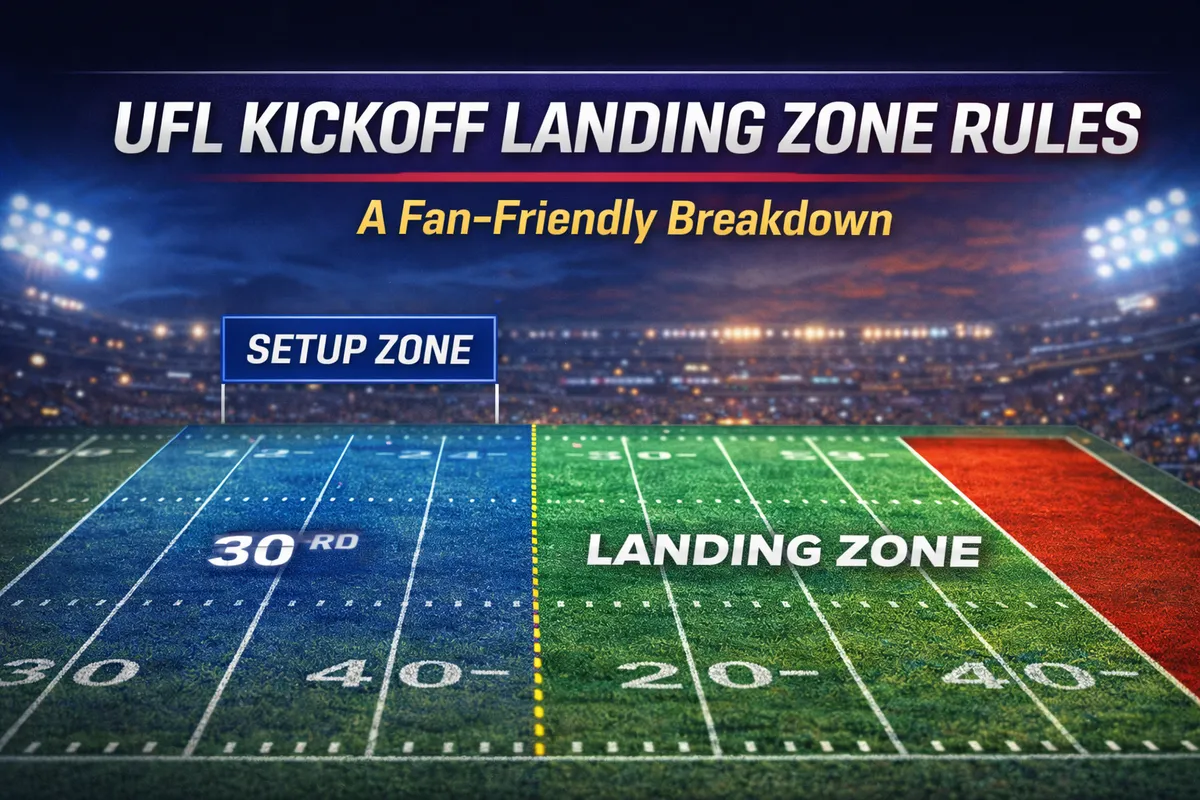
The Three Zones You Need to Know
To understand UFL kickoffs quickly, you only need to learn three field concepts:
1) The Kickoff Line (where the kick is taken from)
The ball is kicked from the kicking team’s 30-yard line.
2) The Setup Zone (where most of the receiving team lines up)
The receiving team’s setup zone is the 5-yard area from its 40-yard line to its 35-yard line, and the receiving team must place at least nine players in that zone.
3) The Landing Zone (the target area for the kick)
The landing zone is the area from the receiving team’s 20-yard line to its goal line.
If you remember nothing else, remember this:
Landing zone = 20 to goal line. Setup zone = 40 to 35. Kick from the 30.
Where Players Line Up on a UFL Kickoff
This is the part that looks different on TV.
Kicking team (coverage team) alignment
- The kicker kicks from the kicking team’s 30-yard line.
- The other 10 kicking team players line up at the receiving team’s 45-yard line.
That single detail—coverage at the receiving 45—shortens the sprint distance and reduces full-speed impacts.
Receiving team alignment
- The receiving team’s restraining line is the 40-yard line.
- The receiving team must put at least nine players between the 40 and 35 (setup zone).
- Some receiving players can line up deeper, including the returners.
This creates a “compressed” kickoff where blockers and coverage are closer from the start—but movement is restricted until the kick reaches the landing zone or end zone (more on that below).
Movement Rules: Why It’s Safer and Cleaner
UFL kickoffs in 2026 have strict “no early movement” rules to prevent the most dangerous collisions.
Here’s the fan-friendly version:
- Most players cannot start running until the ball reaches the landing zone (or end zone).
- Blocking is also restricted until the same moment.
This creates a kickoff that feels more structured—almost like a designed “return play” rather than a chaotic sprint.
Why fans should care:
It makes returns easier to watch. You can actually see lanes form and understand who won each block, because the play doesn’t explode into full-speed chaos immediately.
What the Landing Zone Actually Does
The landing zone is the target. The UFL wants kickers to put the ball there because it creates returnable kicks and meaningful decisions.
If the kick reaches the landing zone
If the ball hits the landing zone (or is touched by a player in the landing zone), the play stays “normal” in the sense that:
- The receiving team can field it and return it.
- The kicking team can also have recovery opportunities if the ball becomes loose (depending on how the kick is handled).
- If the ball ends up dead in the end zone after first reaching the landing zone, the touchback can come out to the 20 (not the 40).
If the kick does NOT reach the landing zone
If the ball lands short of the landing zone (short of the receiving team’s 20) or goes out of bounds, the kicking team is effectively punished with a big field-position loss.
In simple terms:
Miss the landing zone, and you probably just handed the opponent the ball around its 40-yard line—or better.
The Two Touchback Spots: Why It’s 20 Sometimes and 40 Other Times
This is the most important “watching on TV” detail: UFL kickoffs in 2026 have two different touchback spots.
Touchback that comes out to the 20-yard line
The ball comes out to the 20-yard line when the kick:
- Touches the ground or a player in the landing zone first, and then
- Ends up dead in the end zone (for example, it rolls in and the receiving team downs it, or it goes out behind the goal line).
Fan translation:
If the kicker “did the job” by getting the ball into the landing zone first, the touchback penalty is smaller. The receiving team gets the ball at the 20.
Touchback that comes out to the 40-yard line
The ball comes out to the 40-yard line when the kick goes into the end zone without first touching the landing zone. This includes kicks that:
- Land at or beyond the goal line in the air,
- Go out of bounds behind the goal line, or
- Strike the goalpost/uprights/crossbar.
Fan translation:
If the kicker tries to “cheat” with an automatic end-zone kick that avoids a return, the receiving team gets a massive reward: ball at the 40.
This single incentive is why you’ll see fewer “blast it deep” kickoffs in the UFL. A touchback can be a great outcome for the receiving team.
What Happens If the Kick Lands Short of the Landing Zone
This is the “missed target” scenario, and it’s one of the easiest ways to understand the entire system.
If a kickoff:
- Goes out of bounds, or
- Is last touched by the kicking team before going out of bounds between the goal lines, or
- First touches the ground or a player short of the landing zone (short of the receiving team’s 20),
…the receiving team gets very favorable ball placement options. The rule is built so the receiving team is not punished for the kicker’s inaccuracy.
Fan-friendly takeaway:
- A kick that lands short is basically treated like a kickoff mistake.
- The receiving team can typically choose a very favorable spot (often around its 40, and sometimes even better depending on where the kick went out or touched).
What Happens If the Kick Goes Out of Bounds
Out of bounds is never “fine” in the UFL 2026 kickoff system.
If the kick travels out of bounds, the receiving team gets strong options for where to take the ball. Practically, you should treat it like this:
- Out of bounds = big win for the receiving team.
- You’ll often see the receiving team start with excellent field position.
This is why UFL kickers are trained to be precise. A kickoff is no longer a casual “boot it anywhere” play—it’s a high-value field-position decision.
Can the Kicking Team Recover the Kickoff in the Landing Zone
Yes—this is part of what keeps kickoffs exciting.
If the kick lands in the landing zone (or is touched in the landing zone or end zone), the kicking team may have legal opportunities to touch, catch, or recover the ball in certain situations—especially if the ball becomes loose or is mishandled.
What this creates for fans:
- More “live-ball” kickoffs.
- More pressure on returners to secure the catch cleanly.
- More moments where a kickoff can swing momentum beyond just field position.
However, the system is still designed to avoid chaos. That’s why movement and blocking restrictions exist before the ball reaches the landing zone/end zone.
Blocking Rules: When Players Are Allowed to Engage
Kickoff blocking is restricted early in the play.
Before the ball reaches the landing zone or end zone
- Receiving team players cannot initiate blocks against the kicking team.
- The kicking team is also operating under restrictions.
After the ball hits or is touched in the landing zone or end zone
- Blocking becomes legal and the return play behaves more like a normal football runback.
This “delayed engagement” is a key safety feature. It removes the long runway and forces the kickoff to become a shorter, more controlled collision environment.
Wedge Blocks and Double Teams: What’s Allowed and What Isn’t
The UFL is strict about certain blocking tactics on kickoffs.
Wedge blocks
A wedge block (multiple players intentionally aligning shoulder-to-shoulder and moving forward together) is not permitted.
Double team blocks
Double team blocks are limited: they are allowed only by players who were initially lined up in the setup zone at the time of the kick, and other players cannot participate in a double team block during a kick or return.
Fan takeaway:
- The league wants returns, but it doesn’t want “mass-blocking formations” that create dangerous pile-ups.
- Expect kickoff returns to look more like structured lane runs instead of huge wedges.
A Fan-Friendly Kickoff Flowchart
Use this during games—this is the simplest way to read UFL kickoffs in 2026.
Step 1: Did the kick reach the landing zone (20 to goal line)?
- Yes: continue to Step 2.
- No: receiving team likely gets great field position (often around its 40).
Step 2: Did the ball go into the end zone?
- No: it’s a live return situation.
- Yes: continue to Step 3.
Step 3: Did it touch the landing zone first?
- Yes: touchback can come out to the 20 if downed.
- No: touchback comes out to the 40.
That’s it. Three steps. You now understand UFL 2026 kickoffs better than most first-time viewers.
Examples That Make the Rule Instantly Clear
Here are common kickoff outcomes, explained exactly how you’ll see them play out.
Example 1: The “perfect” kickoff
The ball lands around the receiving team’s 10-yard line (inside the landing zone), is fielded cleanly, and returned.
- Result: normal live return.
- Why it’s perfect: accurate, returnable, and doesn’t give up free field position.
Example 2: The “landing zone bounce” touchback (ball to the 20)
The ball lands at the 15, bounces forward into the end zone, and the returner downs it.
- Result: touchback to the 20.
- Why: the ball hit the landing zone first.
Example 3: The “cheap touchback” (ball to the 40)
The kicker blasts it through the end zone untouched.
- Result: touchback to the 40.
- Why: it never touched the landing zone.
Example 4: Short kick (penalized)
The kick lands at the 17 (short of the landing zone), or is touched short of the 20.
- Result: receiving team gets an advantageous spot selection (commonly around the 40, potentially better depending on where it touched or went out).
- Why: the kick did not reach the landing zone.
Example 5: Kickoff out of bounds
The ball sails out of bounds.
- Result: receiving team gets a favorable placement option.
- Why: out-of-bounds kickoffs are penalized by design.
These five examples cover almost everything you’ll see in a game.
Why the UFL’s Landing Zone Rules Feel Different From the NFL
The UFL kickoff system resembles the “dynamic kickoff” concept, but the UFL 2026 incentives are more aggressive in one major way:
- UFL makes many touchbacks extremely costly for the kicking team by placing the ball at the 40 in key touchback scenarios.
That one change creates a totally different behavior:
- Kickers aim for precision.
- Coaches treat kickoffs as strategic possessions.
- Returns happen more often because “safe touchback” is no longer the best outcome for the kicking team.
For fans, this is a win: kickoffs matter again.
How Kickoff Strategy Changes in 2026
Because field position penalties are so strong, kickoff strategy becomes its own mini-chess match.
What kickers want
- A kick that reaches the landing zone
- With hang time (so coverage can arrive together)
- And directional placement (to limit return lanes)
- While avoiding the end-zone “untouched touchback” that gifts the 40
This is why you’ll see more kicks that look “placed” rather than simply “crushed.”
What returners want
- A chance to trigger the best possible starting field position
- A clean catch (because muffing is more dangerous when the kicking team is closer)
- Smart decision-making on whether to return or down the ball
What coaches want
- Predictability and discipline
- Avoiding the worst-case outcomes:
- Ball at the opponent’s 40 on a touchback
- Ball at an even better spot on an out-of-bounds kick
- A surprise recovery by the kicking team after a mishandle
Kickoffs become a place where coaching discipline shows up immediately.
The Hidden Benefit: Better “TV Understanding” for Casual Fans
Old kickoffs had a weird problem: half the time, nothing happened. Touchback, commercial, next drive. Casual fans would check out because it felt like a ritual, not a play.
The UFL landing zone system creates obvious “meaning”:
- If a kickoff is short, the receiving team is rewarded.
- If a kickoff is blasted deep, the receiving team is rewarded.
- If the kickoff is placed correctly, the kicking team gets a fair fight and a real coverage play.
That “cause and effect” is great for new fans and great for broadcast pacing.
What Fans Should Watch for on Every Kickoff
If you want to enjoy UFL kickoffs more (and understand them instantly), watch these three things:
1) The ball’s first contact
Did it land in the landing zone (20 to goal line), land short, or fly straight into the end zone?
2) The returner’s choice
Does the returner field it and go? Or do they down it? That decision changes the spot.
3) The official’s signal and spot
Watch where the officials mark the ball:
- 20 often signals a landing-zone-first touchback.
- 40 often signals a penalty touchback or a kick that went into the end zone untouched.
Once you connect those, the kickoff becomes one of the easiest parts of the game to read.
Practical Rules: The “Don’t Get Confused” Checklist
Keep this checklist in your head and you’ll never feel lost:
- The landing zone is 20 to goal line.
- The kick must reach the landing zone or the receiving team gets a major advantage.
- Touchbacks can come out to 20 or 40 depending on whether the landing zone was touched first.
- A kick through the end zone untouched is usually ball at the 40.
- A kick that hits the landing zone and then goes into the end zone can be ball at the 20 if downed.
- Out of bounds or short of the landing zone = receiving team gets strong placement options.
- Blocking and movement are restricted early; the action “starts” when the ball reaches the landing zone/end zone.
This is the UFL kickoff system in practical terms.
Common Mistakes Teams Will Make Early in 2026
Because this kickoff system demands precision, early-season games often reveal mistakes:
- Over-kicking (automatic end-zone kicks that gift the 40)
- Under-kicking (balls that land short of the landing zone)
- Directional misses (out of bounds)
- Returner mishandles (because the coverage and recovery opportunities are closer and more dangerous)
- Coverage lane discipline errors (players are closer, so angles matter more)
Teams that fix these quickly gain a real competitive edge—because starting field position impacts everything: play-calling, fourth-down choices, and how aggressive a coach can be.
How the Landing Zone Changes Field Position and Scoring
Field position is a silent scoreboard. A team that consistently starts drives at:
- the 20,
- the 25,
- the 35,
- or the 40
…will have dramatically different scoring chances over a game.
Because the UFL kickoff rules can push the ball to the 40 in certain outcomes, kickoffs can quietly create:
- more short fields,
- more quick scores,
- more comeback opportunities,
- and more pressure on defenses.
In a league where other rules also encourage aggression, kickoff field position becomes even more important. A drive that starts at the 40 is not a “slow build” drive. It’s often a “we’re already close” drive.
What This Means for Special Teams Players
UFL 2026 kickoff rules increase the value of certain skill sets:
Kickers with placement control
Not just strong legs—precision. A kicker who can consistently land the ball in the landing zone without gifting the 40 becomes a serious advantage.
Coverage players with discipline
Because the play is more structured, bad angles and missed lanes show up immediately.
Returners with decision-making
The best returners aren’t just fast. They understand:
- when to return,
- when to down,
- and how to avoid the one mistake that swings a game (a muff).
Blocking units that understand the restrictions
Because some blocks can’t start early and wedge tactics are restricted, smarter, cleaner blocks matter more.
How to Explain UFL Kickoffs to a Friend in 10 Seconds
If you’re watching with someone new, here’s the simplest explanation:
“They kick from the 30 and aim for the ‘landing zone’ between the 20 and the goal line. If they miss it or kick it too deep, the receiving team gets the ball near the 40. So kickoffs are strategic now.”
That’s the whole concept.
BoostRoom
UFL kickoff landing zone rules create constant search demand because fans keep asking: “Why is it at the 40?” “What’s the landing zone?” “Why did that short kick get penalized?” “Why is this touchback at the 20?”
BoostRoom helps you turn those questions into traffic that sticks and converts by building:
- SEO-first explainer pages that answer fast and keep visitors scrolling
- AI-search-friendly formatting that makes your content easy to summarize and recommend
- Topic clusters that build authority (kickoff rules → full rules hub → weekly recaps → team pages)
- Conversion-focused writing that educates first and guides readers naturally toward your services
If you want UFL content that ranks during the season and keeps bringing visitors back every week, BoostRoom is the engine that makes it consistent.
FAQ
What is the UFL kickoff landing zone in 2026?
The landing zone is the area from the receiving team’s 20-yard line to its goal line.
Where do UFL kickoffs happen from in 2026?
The kicking team kicks off from its 30-yard line.
Where do the coverage and blocking teams line up?
The 10 non-kicker kicking team players line up at the receiving team’s 45-yard line. The receiving team must place at least nine players in the setup zone between its 40 and 35.
Why do some touchbacks go to the 40-yard line?
If the kick goes into/through the end zone without first touching the landing zone, the touchback brings the ball out to the receiving team’s 40-yard line.
Why do other touchbacks go to the 20-yard line?
If the ball touches the landing zone first and then ends up dead in the end zone, the touchback comes out to the 20-yard line.
What happens if a kickoff lands short of the landing zone?
If the kick first touches short of the receiving team’s 20-yard line, the receiving team is rewarded with very favorable ball placement options (commonly around its 40 or better depending on the specific outcome).
What happens if the kickoff goes out of bounds?
An out-of-bounds kickoff is penalized by giving the receiving team advantageous placement options.
Are players allowed to block immediately on UFL kickoffs?
No. Blocking and movement are restricted early. Blocking is generally allowed only after the ball hits or is touched in the landing zone or end zone.
Can the kicking team recover the ball on a kickoff?
If the kickoff reaches the landing zone or end zone and becomes loose or is mishandled, the kicking team can have legal recovery opportunities in certain situations.
Why did the UFL change kickoff rules?
To encourage returns, reduce high-speed collision runups, and make kickoff outcomes more meaningful and strategic.



