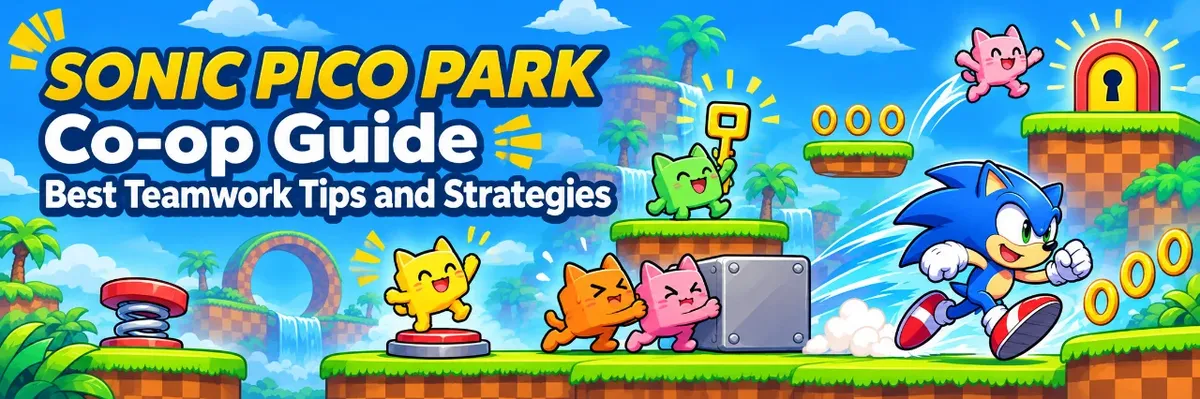
SONIC PICO PARK Gameplay Tips – How to Win with Friends
SONIC PICO PARK takes the speed and excitement of Sonic the Hedgehog and combines it with the cooperative puzzle-solving gameplay of PICO PARK. The result is a colorful multiplayer adventure where your success depends on much more than fast reflexes.
In this game, teamwork is everything.
Whether you're playing with two friends or organizing a full eight-player group, every stage requires communication, coordination, and a willingness to help teammates overcome difficult obstacles.
The rules are simple: everyone must reach the Goal Plate to complete a level. However, accomplishing this becomes increasingly challenging as the game introduces tricky platforms, dangerous obstacles, Sonic-inspired abilities, rings, switches, and puzzles that require multiple players to act together.
Unlike traditional Sonic games, rushing toward the finish line is not always the best strategy.
Sometimes you need to stop and help someone cross a gap. Other situations require players to perform the Spin Dash simultaneously, distribute rings carefully, or use a specific character ability to unlock the path forward.
The best teams understand when to move quickly, when to remain patient, and how to turn individual character abilities into useful cooperative strategies.
This guide covers the best SONIC PICO PARK gameplay tips, including beginner strategies, advanced teamwork techniques, multiplayer coordination, puzzle-solving methods, and advice for World Mode, Battle Mode, and Endless Mode.
If you're ready to stop repeating failed attempts and start winning with your friends, these tips will help your team work more effectively.

Understand the Most Important Rule in SONIC PICO PARK
Before learning complicated strategies, every player should understand the game's central objective.
SONIC PICO PARK is a cooperative action-puzzle game for 2 to 8 players, and the main World Mode challenges require everyone to reach the Goal Plate.
That means individual progress is not enough.
One player might complete a difficult platforming section perfectly, but the level will not be finished if another teammate remains behind.
This changes how you should think about winning.
Winning Is About Team Progress
In many platforming games, the best player is the one who reaches the finish first.
SONIC PICO PARK works differently.
The most valuable teammate is often the person who helps others reach the objective.
That might involve activating a switch, assisting with a difficult jump, or explaining how an unfamiliar puzzle works.
A player who moves slowly but helps everyone succeed can be more useful than someone who repeatedly rushes ahead.
Best tip: Always consider how your actions affect the entire team.
Speed Is Useful, but Coordination Is Better
The game includes familiar Sonic mechanics such as the Spin Dash, loops, springs, and rings.
These features encourage players to move quickly, but excessive speed can create problems.
Moving too early may leave a teammate stranded.
Jumping before everyone is ready might interfere with a platform mechanism.
The best players combine fast movement with careful decision-making.
Learn when the game rewards momentum and when precise positioning is more important.
Best SONIC PICO PARK Gameplay Tips for Beginners
New players can improve quickly by developing a few simple habits.
You do not need advanced platforming experience to succeed.
Understanding the game's cooperative rules and communicating effectively will make a significant difference.
1. Observe the Level Before Moving
One of the most common beginner mistakes is immediately running toward the right side of the screen.
Instead, take a moment to examine the environment.
Look for important objects such as:
Try to identify which objects are connected.
For example, a button might activate a nearby platform, while a cracked wall may require a Spin Dash.
Once you understand the obstacle, you can begin planning how to overcome it.
2. Communicate Before Important Actions
Even experienced players can struggle when everyone acts independently.
Before attempting a difficult jump or activating a mechanism, tell your teammates what you intend to do.
Simple phrases work best.
For example:
These instructions reduce confusion and help everyone coordinate their movements.
Best tip: One clear instruction is more useful than several players shouting different strategies.
3. Practice Basic Movement
The controls are relatively straightforward, but cooperative puzzles require accurate movement.
Practice walking, stopping, jumping, and using the Spin Dash.
Pay attention to how your character accelerates and lands.
Some stages require players to remain in specific positions, so learning to stop precisely can be more important than moving quickly.
If you're playing a flying character, become familiar with the additional movement controls before attempting complex puzzles.
4. Avoid Unnecessary Risks
When a stage contains dangerous obstacles, avoid experimenting recklessly while other players depend on your position.
For example, a teammate may need you to remain on a switch while they cross a gap.
Moving away just to investigate another area could disrupt the entire sequence.
Experimentation is important, but it should happen when the group understands the consequences.
5. Learn From Failed Attempts
Failure is a natural part of SONIC PICO PARK.
When a strategy fails, identify what happened.
Was someone too early?
Did a player move in the wrong direction?
Was the wrong object activated?
Understanding the cause of failure is much more useful than repeating the same attempt.
Master the Spin Dash to Win More Challenges
The Spin Dash is one of the most recognizable Sonic abilities, and it plays an important role in SONIC PICO PARK.
Every playable character can use it, making it an essential mechanic for the entire team.
However, the Spin Dash is not simply a tool for moving faster.
It can help players interact with obstacles, generate momentum, and solve particular puzzles.
Use Spin Dash to Break Obstacles
Some levels contain cracked walls that require sufficient momentum to destroy.
These barriers are an obvious opportunity to use the Spin Dash.
Move into a suitable starting position, prepare your acceleration, and release the ability toward the obstacle.
If the wall does not break, consider whether you need more momentum or assistance from another player.
Certain challenges require cooperation rather than individual movement.
Coordinate Spin Dash Timing
When several players need to accelerate together, timing becomes essential.
Start by assigning everyone a position.
Then agree on a countdown.
Have the group perform the required movement on the same signal.
If one player repeatedly reaches the obstacle too early, adjust their starting position or timing.
Small corrections can improve the team's consistency.
Do Not Use Spin Dash Everywhere
Using maximum speed is not always helpful.
Narrow platforms, fragile bridges, and dangerous obstacles frequently require more controlled movement.
A player who accelerates unnecessarily may overshoot a safe landing area.
Before using the Spin Dash, ask whether the challenge actually requires momentum.
If the objective is precise positioning, moving slowly may be the better strategy.
Best tip: Mastering the Spin Dash means knowing when to accelerate and when to stop.
Choose Characters That Help Your Team
SONIC PICO PARK features a variety of recognizable Sonic characters alongside the PICO PARK mascots.
While every playable character has access to the Spin Dash, certain characters possess additional movement abilities.
These differences can influence how your team approaches obstacles.
Tails – A Useful Choice for Team Assistance
Tails can fly and carry another player.
This gives him useful cooperative potential in stages involving gaps, vertical movement, and elevated platforms.
For example, if a teammate struggles to reach a higher position, Tails may be able to provide assistance.
However, carrying other players has limitations.
The group should still plan a safe route instead of assuming flight will solve every challenge.
Knuckles – Gliding and Moving Blocks
Knuckles can glide and interact with certain movable blocks.
His abilities can be particularly useful in environmental puzzles.
When a level requires a block to be moved, coordinate its position before pushing.
Moving a block without a plan may create an obstacle for another teammate.
Knuckles' gliding ability also offers another movement option when crossing certain gaps.
Cream, Charmy, and Rouge – Additional Flying Options
These characters can also fly, creating additional possibilities for cooperative movement.
In larger groups, multiple flying characters can be helpful when several players need assistance.
Rather than relying on one teammate for every difficult crossing, the group can divide responsibilities.
However, character selection should reflect the puzzle's actual requirements.
Sonic and Other Characters
Sonic, Shadow, and other characters can still contribute effectively even without flight.
Because everyone can use the Spin Dash, all players can participate in momentum-based puzzles.
The most important factor is understanding what the team needs.
A player with excellent timing and communication can be valuable regardless of character selection.
Can You Switch Characters When Needed?
Some stages provide a character-switching door when a specific ability is required.
This prevents teams from becoming permanently blocked simply because they selected different characters.
Best tip: Choose characters you enjoy, but remain flexible when a puzzle introduces a special requirement.
How to Solve Puzzles Faster With Friends
Puzzle-solving is the foundation of SONIC PICO PARK.
The most effective teams use a consistent process rather than experimenting randomly.
Identify the Main Problem
Before acting, determine what prevents the team from reaching the goal.
Perhaps a platform is too high.
Maybe a door remains locked.
Another stage might contain an obstacle that requires several players to interact with it.
Focus on the main problem before attempting smaller actions.
Divide the Puzzle Into Steps
Complicated stages become easier when separated into individual tasks.
For example, a puzzle involving a switch and a moving platform could be approached like this:
Identify which object the switch controls.
Assign one teammate to operate the switch.
Have the remaining players prepare to cross.
Activate the mechanism.
Move across the obstacle in the correct order.
Determine how the final teammate will follow.
This is a general strategy rather than a fixed solution for one particular level.
The exact actions will depend on the stage, but breaking the puzzle into smaller steps makes coordination easier.
Assign Responsibilities
If multiple players are needed in different positions, give everyone a clear task.
One person can operate a mechanism while another collects an important object.
A third player might need to prepare a safe route.
Assigning responsibilities prevents unnecessary crowding and conflicting movements.
Change One Thing After Failure
If your group fails, avoid changing the entire strategy immediately.
Instead, identify the specific problem.
Maybe the switch was released too early.
Perhaps the player carrying the key moved before the platform was ready.
Correcting one mistake can turn an unsuccessful attempt into a victory.
Use Rings Strategically to Protect Your Friends
Rings are one of the most recognizable mechanics from Sonic games.
In SONIC PICO PARK, they can provide protection against certain hazards and serve specific purposes in cooperative challenges.
Their usefulness extends beyond ordinary collection.
Do Not Collect Every Ring Automatically
Sometimes a puzzle requires particular players to receive protection.
If one teammate must cross a dangerous obstacle while others remain safe, it may be better to let that player collect the available ring.
A player who already has protection might not need an additional resource as urgently as someone preparing for a hazardous section.
Think about who needs the ring before collecting it.
Plan Dangerous Crossings
When a stage involves spikes or other hazards, examine the route carefully.
Determine whether rings are available and how they interact with the obstacle.
In some puzzles, players must take advantage of temporary protection after receiving damage.
This requires careful timing.
Avoid sending the entire group into danger without understanding the mechanic.
Protect Players With Important Responsibilities
Some encounters require one teammate to remain on a button or platform while the others perform another task.
If that player is exposed to danger, ring protection may be particularly valuable.
For example, during certain Dr. Eggman encounters, one player must maintain a mechanism that allows another player to attack.
Giving protection to the teammate operating the mechanism can improve the group's chances of success.
Best tip: Treat rings as shared resources whenever the stage depends on survival.
Best Strategies for Two-Player Co-op
Playing with two people can be one of the easiest ways to learn SONIC PICO PARK.
Communication is simple, and both players can quickly discuss strategies.
However, each person may need to perform several different tasks.
Divide Responsibilities Clearly
When encountering a puzzle, determine which player will perform each action.
One person might activate a button while the other moves forward.
Once the first task is complete, switch responsibilities if necessary.
This approach allows both players to contribute.
Use Complementary Abilities
A combination such as Tails and Knuckles offers several useful movement options.
Tails can provide flight assistance, while Knuckles can glide and interact with certain blocks.
However, this combination is not required.
The game supports different character choices, and some stages provide access to specific characters when their abilities are necessary.
Practice Synchronization
Even with only two players, some obstacles require simultaneous movement.
Use a countdown before jumping or activating a mechanism together.
This establishes a consistent rhythm and reduces timing errors.
Best Strategies for Four-Player Co-op
Four-player sessions provide more opportunities to divide responsibilities.
However, coordination becomes increasingly important as the number of participants grows.
Divide the Group Into Pairs
When a puzzle allows it, divide four players into two smaller groups.
One pair can operate a mechanism while the other prepares to cross an obstacle.
This reduces confusion and allows the group to complete different tasks efficiently.
Balance Movement Abilities
Consider including characters with different movement options.
For example, flying characters can provide assistance during vertical platforming challenges.
Other teammates can focus on positioning, Spin Dash timing, or operating mechanisms.
The best combination depends on the puzzle.
Choose One Player for Countdowns
If everyone gives instructions simultaneously, even a simple challenge can become chaotic.
Assign one person to provide countdowns during synchronized actions.
The other players should follow the agreed signal.
This makes coordinated movement more predictable.
How to Win With Eight Players in SONIC PICO PARK
Eight-player sessions create some of the most entertaining experiences in the game.
However, the larger group also increases the number of things that can go wrong.
A puzzle requiring two people to jump together is straightforward compared with coordinating eight different players.
Establish a Team Coordinator
For difficult puzzles, choose someone to explain the strategy.
This player can assign responsibilities, provide countdowns, and confirm that everyone is ready.
The coordinator does not need to control every decision.
Their purpose is simply to keep the group organized.
Use Clear Player Identification
With several characters moving simultaneously, it can be difficult to determine who should perform an action.
Use player names or character names when giving instructions.
For example, asking Tails to assist someone is clearer than telling an unspecified player to move.
Avoid Crowding Around Mechanisms
Not every puzzle requires the entire group to stand in the same location.
Some mechanisms respond differently depending on player positioning.
If too many players crowd around an object, the team may accidentally interfere with the intended solution.
Assign positions and move only when necessary.
Keep Communication Simple
Large groups can easily become overwhelmed by unnecessary conversation.
During difficult sequences, use short instructions.
Save longer discussions for moments when everyone is safe.
Best tip: The larger your group becomes, the more valuable clear communication is.
How to Beat Difficult Platforming Challenges
Some SONIC PICO PARK levels emphasize platforming rather than complicated logical puzzles.
These challenges may involve springs, loops, moving platforms, fragile surfaces, or dangerous gaps.
Master Spring Timing
Springs can launch characters across gaps or toward elevated platforms.
Before using one, observe the direction and likely landing area.
If teammates need to land together, coordinate the sequence.
Avoid jumping immediately after another player without knowing whether the destination is safe.
Maintain Momentum Through Loops
Loops are familiar Sonic obstacles that reward proper movement.
Some require players to build enough speed before entering.
The Spin Dash can help generate the necessary momentum.
However, make sure the exit path is clear before accelerating.
Understand Moving Platforms
Moving platforms may require players to stand together, remain separated, or activate switches.
Pay attention to how the platform reacts.
If the platform moves downward when someone jumps, the group may need to synchronize its movement.
If it becomes unstable when players stand too close together, adjust your spacing.
Be Careful on Fragile Surfaces
Some platforms do not tolerate excessive movement or repeated interactions.
Avoid using the Spin Dash without understanding how the surface behaves.
Careful walking and coordinated jumps may be safer.
How to Beat Metal Sonic Chase Challenges
SONIC PICO PARK includes sequences where players must escape from Metal Sonic.
These stages emphasize speed and synchronization.
Unlike slower puzzles, chase sections provide less time to discuss a solution during execution.
Plan Before the Chase
Before beginning a difficult sequence, identify the route ahead.
Look for important switches, obstacles, and places where players need to cooperate.
Assign responsibility for any mechanism that must be activated.
Keep Everyone Moving Together
The team should maintain a coordinated pace.
If one player falls behind or misses an important action, the group may fail.
Use short instructions rather than lengthy explanations.
Coordinate Switch Activation
Certain chase sections require one player to operate a switch while another continues forward.
Timing is essential.
Have the switch operator prepare before the other teammate begins the movement sequence.
If the attempt fails, determine whether the problem was speed, positioning, or switch timing.
Best tip: Practice the difficult section and agree on the sequence before restarting.
How to Win Boss Encounters With Friends
Boss encounters introduce additional challenges involving enemy attacks, platforming, and cooperative mechanisms.
The best strategy is to understand the boss's behavior before attempting to deal damage.
Watch Attack Patterns
Avoid rushing toward the boss immediately.
Observe how the enemy attacks and where dangerous areas appear.
Some attacks can be avoided through careful positioning.
Once the pattern becomes familiar, identify safe opportunities to advance.
Assign Offensive and Support Roles
Certain encounters require one player to activate a mechanism while another attacks.
For example, a button may activate a platform needed to reach Dr. Eggman.
The player operating the button must remain in position while the attacking player uses the platform.
This creates a situation where the team needs to coordinate offense and support.
Use Rings for Protection
If one teammate is exposed to danger while maintaining a mechanism, consider giving that player ring protection.
This may allow the group to continue the encounter without immediately failing when the operator takes damage.
Prioritize Survival
Repeated unsuccessful attacks are usually less effective than waiting for a safe opportunity.
Avoid unnecessary risks.
The group's goal is to complete the encounter together.
Best Tips for SONIC PICO PARK World Mode
World Mode is the main cooperative adventure.
It includes 15 worlds with four stages each, for a total of 60 main levels.
Each world introduces different mechanics or combinations of challenges.
Learn Each World's Main Mechanic
Some worlds emphasize speed and movement.
Others focus on linked players, character abilities, timed mechanisms, or logical puzzles.
When entering a new world, pay attention to the first stage.
It often introduces an important mechanic that becomes more challenging in later stages.
Understanding that mechanic early can make the rest of the world easier.
Do Not Skip the Learning Process
If a stage introduces an unfamiliar interaction, experiment with it carefully.
Try to understand why the mechanism works rather than completing the level through random movement.
Later stages may build on similar ideas.
Review Difficult Mechanics
If your group repeatedly struggles with a particular type of puzzle, revisit earlier examples.
Practice synchronized jumps, platform activation, or Spin Dash timing.
Improving one skill can benefit the entire team.
Adapt to New Challenges
Do not assume the same strategy will work in every world.
A speed-focused level may require fast movement, while a logical puzzle may reward patience.
The strongest teams recognize the difference and adjust their approach.
How to Win More Games in Battle Mode
Battle Mode introduces competitive multiplayer challenges.
Instead of working toward the same Goal Plate, players compete against one another.
This requires a different approach from World Mode.
Ring Battle – Collect and Protect Your Rings
Ring Battle rewards players for collecting rings while avoiding situations that cause them to lose their collection.
Positioning is important.
Instead of rushing toward every ring, consider the safest route.
Avoid unnecessary collisions with hazards and watch how opponents move.
A player who protects their collection effectively may outperform someone who takes too many risks.
Sphere Battle – Plan Your Route
Sphere Battle features mechanics inspired by classic Sonic bonus stages.
Players move through an arena containing colored spheres.
Blue spheres turn red after being crossed, and contacting a red sphere can eliminate a player.
This creates opportunities for strategic movement.
Instead of moving randomly, plan your route.
Consider how your actions change the arena and whether opponents may become trapped.
Good positioning can provide a significant advantage.
Spin Battle – Focus on Precision
Spin Battle emphasizes movement control and timing.
Rather than relying exclusively on speed, learn how to position your character accurately.
Watch the arena and adjust your movement according to the objective.
The skills developed while practicing Spin Dash control in World Mode can be useful here.
Learn Your Opponents' Habits
Battle Mode becomes more interesting when playing repeatedly with the same friends.
Pay attention to how they approach each challenge.
Some players move aggressively, while others prefer safe routes.
Understanding these habits can help you anticipate their actions.
Best Strategies for Endless Mode
Endless Mode offers another cooperative challenge.
Instead of progressing through a fixed series of puzzles, the screen advances automatically as the group attempts to survive and travel as far as possible.
Successful runs require awareness, movement control, and teamwork.
Maintain a Consistent Pace
Because the environment moves forward, players must remain aware of their position.
Falling behind can create problems.
Keep the group moving and avoid unnecessary delays.
Watch Upcoming Hazards
Do not focus exclusively on your own character.
Pay attention to obstacles approaching from the right side of the screen.
If you notice a dangerous section, warn your teammates immediately.
Short instructions are particularly valuable because the team has limited time to react.
Avoid Unnecessary Risks
Endless Mode rewards consistent survival.
A difficult shortcut is not always worth attempting if a safer route is available.
Focus on keeping everyone alive.
Practice as a Team
Repeated attempts can help the group understand how to react to common hazards.
Discuss what caused previous failures and adjust your movement.
With practice, your team can improve its coordination and reach greater distances.
Common SONIC PICO PARK Mistakes That Make You Lose
Understanding common mistakes can help players improve without needing complicated techniques.
Rushing Ahead of Teammates
Moving toward the Goal Plate without considering the rest of the group often creates problems.
Solution: Stay aware of your teammates and help them reach the objective.
Using Spin Dash at the Wrong Moment
Unnecessary acceleration can cause players to overshoot platforms or interfere with cooperative mechanisms.
Solution: Use the Spin Dash when momentum is required and controlled movement elsewhere.
Ignoring Character Abilities
Players sometimes attempt difficult jumps without considering the available movement options.
Solution: Review your team's abilities and use flight, gliding, or other relevant mechanics where appropriate.
Moving Away From Important Switches
A player may leave a button before the rest of the group has completed the required action.
Solution: Confirm that the mechanism is no longer needed before moving.
Poor Ring Distribution
A player collects protection that another teammate may need for a dangerous task.
Solution: Determine who faces the greatest risk and distribute rings accordingly.
Giving Conflicting Instructions
Several players attempt to coordinate the group simultaneously.
Solution: Choose one temporary coordinator for difficult sequences.
Repeating Failed Strategies
The group continues attempting the same unsuccessful solution.
Solution: Identify the exact problem and adjust the timing, positioning, or order of actions.
Advanced Tips to Become a Better Teammate
Once you're comfortable with the basic mechanics, focus on improving how you contribute to the group.
These habits can make difficult stages easier and multiplayer sessions more enjoyable.
Watch Other Players, Not Just Yourself
Pay attention to where your teammates are standing.
Notice when someone is preparing to jump or struggling with a particular obstacle.
If another player needs assistance, adjust your actions.
Awareness is one of the most useful cooperative skills.
Think About the Last Player
A common puzzle-solving mistake is finding a route that works for everyone except the teammate operating the mechanism.
Before starting, ask how that player will reach the goal.
Planning the final crossing prevents unnecessary restarts.
Use Safe Positions as Checkpoints for Your Strategy
When the group reaches a stable area, use that moment to discuss the next obstacle.
Avoid starting complicated movements while teammates are still recovering from the previous section.
Progress through each challenge deliberately.
Share Information Clearly
If you discover how a mechanism works, explain it.
Do not assume everyone saw the same interaction.
For example, if a platform responds to player spacing, tell the group before another attempt.
Information becomes more useful when every teammate understands it.
Stay Calm During Repeated Failures
Some puzzles require several attempts.
Becoming frustrated makes communication harder.
Instead of blaming someone, focus on the next improvement.
The most effective teams treat failure as useful information.
How to Make SONIC PICO PARK More Fun With Friends
Winning is satisfying, but SONIC PICO PARK is also designed to create entertaining multiplayer moments.
The most enjoyable sessions often involve a balance between cooperation and experimentation.
Let Everyone Participate
Avoid allowing one experienced player to make every decision.
Encourage teammates to suggest solutions.
Someone unfamiliar with platformers may notice an important environmental detail that other players overlooked.
Rotate Responsibilities
If one player always operates switches while another performs every difficult jump, the experience may become repetitive.
When possible, change responsibilities.
This gives everyone a chance to practice different mechanics.
Experiment With Different Characters
Try playing with different character combinations.
A group that previously relied on Tails might discover another interesting approach using Knuckles or a different flying character.
Character variety can make familiar stages feel different.
Explore All Three Game Modes
World Mode provides the main cooperative experience.
Battle Mode creates opportunities for friendly competition.
Endless Mode tests survival and coordination.
Switching between modes can keep the experience entertaining after completing the campaign.
Frequently Asked Questions About SONIC PICO PARK Gameplay
How Do You Win in SONIC PICO PARK?
In World Mode, every player must reach the Goal Plate after completing the stage's required challenges.
Good communication and teamwork are essential.
What Are the Best SONIC PICO PARK Gameplay Tips?
Observe the stage before moving, communicate clearly, assign responsibilities, coordinate Spin Dashes, use character abilities, and avoid rushing ahead of teammates.
How Many Players Can Play Together?
SONIC PICO PARK supports 2 to 8 players through local and online multiplayer.
Can You Play SONIC PICO PARK Alone?
No. The game is designed for cooperative multiplayer and requires at least two players.
Which Character Is Best for Winning?
Tails is a useful choice because he can fly and assist other players.
Knuckles also offers helpful abilities such as gliding and moving certain blocks.
However, no character guarantees victory.
Can Every Character Use Spin Dash?
Yes. Every playable character can use the Spin Dash.
How Do Rings Work?
Rings can provide protection against certain hazards and are used in specific puzzles.
Their distribution may be important when teammates face different risks.
How Many Levels Are in World Mode?
World Mode contains 60 stages divided across 15 worlds.
How Do You Win More Battle Mode Matches?
Learn the objective of each competitive mode, control your movement carefully, avoid unnecessary risks, and anticipate opponents' actions.
What Is the Best Strategy for Endless Mode?
Maintain a consistent pace, communicate approaching hazards, and prioritize survival over risky movement.
Does SONIC PICO PARK Support Crossplay?
Yes. The game supports cross-platform online multiplayer between compatible systems.
Is SONIC PICO PARK Difficult?
The basic controls are approachable, but certain puzzles require precise coordination.
Difficulty can increase when several players must perform actions simultaneously.
What's the Biggest Beginner Mistake?
Rushing toward the finish without considering how teammates will complete the stage.
The game rewards cooperation rather than individual speed.
Final Thoughts – How to Win More in SONIC PICO PARK
SONIC PICO PARK combines Sonic-inspired movement with the cooperative puzzle-solving that makes the PICO PARK series so entertaining.
Its gameplay may look simple, but completing difficult challenges requires much more than jumping and moving quickly.
The best players understand how to communicate, coordinate their actions, and help teammates overcome obstacles.
Mastering the Spin Dash is important, but so is knowing when to slow down.
Character abilities can provide useful advantages, but successful puzzle-solving still depends on cooperation.
Rings can protect players, while switches, platforms, and environmental mechanisms demand careful planning.
Whether you're tackling the 60 World Mode levels, competing in Battle Mode, or testing your survival skills in Endless Mode, the same principle remains valuable: understand the objective and make every action count.
For smaller groups, clear communication and complementary abilities can make difficult stages easier.
For larger groups, assigning responsibilities and using synchronized countdowns can reduce unnecessary chaos.
Most importantly, remember that winning with friends is what SONIC PICO PARK is all about.
A successful player is not necessarily the fastest person on the screen.
It's the teammate who helps everyone reach the finish line.
Gather your friends, choose your favorite Sonic characters, master the mechanics, and turn every challenging puzzle into another shared victory!