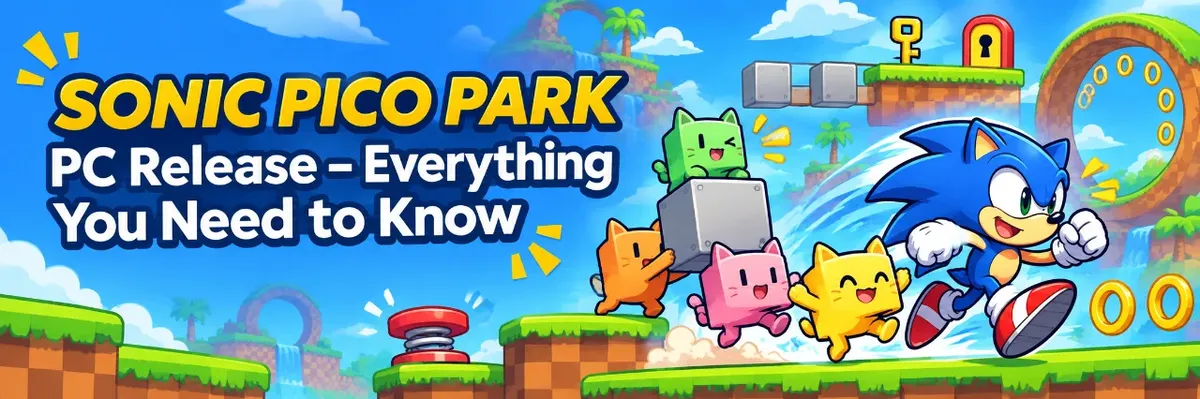
What Is SONIC PICO PARK and How Does It Work?
SONIC PICO PARK is a cooperative 2D action-puzzle game developed by TECOPARK and published by PICO PARK Inc. in collaboration with SEGA.
The game retains the central concept of PICO PARK: multiple players must work together to complete stages that cannot be solved through individual effort alone.
Instead of controlling a single character through a conventional Sonic level, players choose from a lineup featuring Sonic characters and the familiar PICO CAT mascots.
Each stage contains different obstacles, platforms, interactive objects, and cooperative challenges.
The objective is usually straightforward: get every player to the Goal Plate at the right side of the stage.
Reaching that destination is where things become interesting.
Why Teamwork Is Essential
Some levels require players to stand on switches simultaneously. Others involve coordinating jumps, sharing access to platforms, using movement abilities, or protecting teammates from hazards.
One player might need to remain in position while another crosses an obstacle.
In another situation, several players may need to perform Spin Dashes together to interact with part of the environment.
The game constantly introduces situations where individual skill is not enough.
Even if you understand a puzzle immediately, your entire team must execute the solution successfully.
This is why communication is one of the most important skills in SONIC PICO PARK.
Can You Play SONIC PICO PARK Alone?
No. SONIC PICO PARK is designed around multiplayer gameplay and requires at least two players.
Fortunately, the game supports local and online multiplayer, allowing friends to cooperate from the same room or different locations.
For beginners, playing with one or two friends can be a comfortable way to understand the mechanics before joining larger groups.

How to Start Playing SONIC PICO PARK
Getting started is relatively straightforward, but organizing your group before entering the first level can prevent unnecessary confusion.
Step 1: Install and Launch the Game
First, install SONIC PICO PARK on your preferred platform.
PC players can purchase and download the game through Steam.
After installation, launch the game and review the available multiplayer and control options.
If you're using a controller, confirm that the game recognizes your input before beginning.
For local multiplayer, make sure each participant has an appropriate input device.
Step 2: Choose Your Multiplayer Setup
SONIC PICO PARK supports several ways to play:
Local multiplayer: Play together on one system.
Online multiplayer: Connect with players remotely.
Cross-platform multiplayer: Join supported online sessions across different platforms.
Mixed local and online play: Combine participants sharing one system with remote players.
The game supports up to eight participants in a session.
On Steam, up to seven local players can join an online session from a single PC, while the total group remains limited to eight.
Choose the appropriate multiplayer option and follow the game's on-screen instructions to bring your group together.
Step 3: Select Your Character
Once your group has assembled, choose your character.
SONIC PICO PARK features recognizable Sonic characters, including Sonic, Tails, Knuckles, Amy, Shadow, and several others.
The familiar PICO CAT characters are also part of the experience.
Character choice can affect gameplay because certain characters possess additional abilities.
For your first session, choose someone whose movements feel comfortable rather than selecting purely based on appearance.
Step 4: Start With World Mode
World Mode is the best starting point for new players.
This is the main cooperative adventure, consisting of 15 worlds with four stages each, for a total of 60 main levels.
The stages introduce different puzzles, mechanics, and challenges.
Starting here allows players to develop their basic movement and teamwork skills before exploring the additional modes.
Step 5: Learn the Mechanics Together
Before rushing toward the finish, allow everyone to practice moving and jumping.
Experiment with the Spin Dash and observe how the chosen characters interact with the environment.
Once everyone understands their basic actions, begin working through the first challenges.
Remember that the objective is not to finish before your friends.
The objective is to finish together.
SONIC PICO PARK Controls Explained
The controls in SONIC PICO PARK are designed to be approachable, even for players who are unfamiliar with traditional Sonic games.
The most important actions involve movement, jumping, and using the Spin Dash.
Certain characters also have additional movement abilities.
Basic Character Movement
Moving left and right allows players to position themselves around the stage.
Positioning is particularly important because many puzzles require precise placement.
For example, standing too close to a platform edge or moving away from a switch too early can interfere with another player's progress.
Beginners should practice stopping accurately rather than constantly moving at maximum speed.
Good movement control makes nearly every cooperative challenge easier.
Jumping and Platforming
Jumping allows characters to cross gaps, reach elevated platforms, and avoid obstacles.
Although jumping is familiar to anyone who has played platformers, SONIC PICO PARK adds a cooperative twist.
Sometimes you must wait until another player reaches the correct position before attempting a jump.
In other situations, teammates may need to provide temporary support or activate a platform.
Learning to coordinate jumps is more useful than trying to complete every obstacle independently.
Using the Spin Dash
The Spin Dash is one of the most recognizable Sonic abilities.
In SONIC PICO PARK, every playable character can use it.
The move involves charging a spinning movement and releasing it to accelerate rapidly across the stage.
It can be important for building momentum, interacting with certain obstacles, and completing speed-based puzzles.
The specific button mapping depends on the platform and control configuration, so check the game's control instructions for the correct input.
Practice charging and releasing the move in a safe section before trying it near hazards.
Additional Character Actions
Some characters have special movement capabilities beyond the shared Spin Dash.
For example, Tails can fly, while Knuckles can glide.
These differences can influence how your group approaches particular obstacles.
The game also includes situations where a required character can be selected during a level, allowing teams to handle mechanics involving particular abilities.
Understanding your character's options makes it easier to contribute to the group.
How to Master the Spin Dash in SONIC PICO PARK
The Spin Dash is one of the most important mechanics that distinguishes SONIC PICO PARK from earlier PICO PARK games.
It introduces Sonic's signature speed into environments designed around teamwork.
However, speed can become a disadvantage when used without planning.
Practice Charging and Releasing
Start by learning the basic Spin Dash sequence.
Find a clear section of a level and practice charging the move before releasing it.
Observe how quickly your character accelerates and how much distance is covered.
Repeat the action until you can reliably control the timing.
The goal is not simply to move as quickly as possible.
It's to understand how momentum affects your character.
Use Spin Dash to Break Obstacles
Some stages include obstacles that can be cleared using the Spin Dash.
Certain cracked walls require players to generate enough force, and some challenges require multiple teammates to act together.
If you encounter an obstacle that does not respond to an ordinary jump or movement, look for clues that momentum may be involved.
Experiment with the Spin Dash from a suitable position.
If the obstacle appears to require several players, coordinate the attempt rather than repeatedly attacking it individually.
Coordinate Multiple Spin Dashes
In cooperative challenges, timing is essential.
Imagine that two players need to strike an obstacle at approximately the same moment.
If one player releases the Spin Dash early, the attempt may fail.
An effective strategy is to use a simple countdown.
Have everyone prepare, then agree on when to release.
This keeps your movements synchronized and reduces repeated mistakes.
Avoid Unnecessary Speed
Using the Spin Dash near teammates or narrow platforms can create problems.
A fast-moving character may overshoot a safe position or interfere with another player's movement.
Before using the ability, examine the surrounding environment.
If the challenge requires precise placement, use controlled movement instead.
The best SONIC PICO PARK players know when to move quickly and when to slow down.
SONIC PICO PARK Characters and Special Abilities
One of the most enjoyable features of the crossover is the opportunity to control recognizable Sonic characters.
Character abilities introduce additional possibilities for cooperative puzzle-solving.
Sonic the Hedgehog
Sonic represents the fast-paced identity of the franchise.
He is an approachable choice for players who want to focus on the game's core movement mechanics.
Like every playable character, Sonic can use the Spin Dash.
Players choosing Sonic should concentrate on learning acceleration, movement timing, and the relationship between speed and positioning.
Tails
Tails possesses the ability to fly.
Flight can help players reach certain positions or assist teammates in situations where vertical movement is important.
This makes Tails particularly useful in cooperative platforming challenges.
Tails can also carry another character while flying, although carrying additional teammates is more limited.
Beginners should practice controlling flight before relying on it to solve complicated puzzles.
Knuckles
Knuckles has access to gliding and can push certain blocks.
These capabilities make him useful when the team encounters obstacles involving movement or environmental objects.
Gliding can help with positioning, while his block-related interactions provide another way to contribute to puzzle solutions.
Other Flying Characters
Cream, Charmy, and Rouge also have flight capabilities.
Including a flying character in your team can provide additional flexibility when working through the adventure.
For larger groups, a mixture of flying and non-flying characters can be helpful.
However, there is no need to treat a particular team composition as mandatory for every stage.
Which Character Should Beginners Choose?
For new players, Tails is a practical choice because flight can provide additional movement options.
Sonic is suitable for learning the core Spin Dash mechanics.
Knuckles offers another useful combination of movement and environmental interaction.
Ultimately, the best character depends on the stage and the abilities your team needs.
The game allows players to experience its content with different group sizes and character combinations.
How to Solve Co-op Puzzles in SONIC PICO PARK
Puzzle-solving is the foundation of SONIC PICO PARK.
Most challenges become easier when your team approaches them systematically instead of experimenting without communicating.
Observe the Entire Level
Before moving, examine the visible environment.
Look for:
Try to identify which objects interact with each other.
A platform may respond to a switch, or a barrier may require movement from more than one player.
Understanding the environment should come before attempting the solution.
Identify the Main Objective
Every stage has a clear completion condition, but the steps required to achieve it can differ.
Ask yourself what is preventing the group from reaching the goal.
Is a platform inaccessible?
Does someone need to remain on a switch?
Is an obstacle blocking the route?
Once the team identifies the main problem, it becomes easier to divide the solution into manageable actions.
Assign Responsibilities
In levels where several things must happen simultaneously, give each player a clear role.
One person may operate a switch.
Another may prepare to jump across a gap.
A third might need to activate an object at the correct moment.
This prevents everyone from attempting the same action while ignoring another essential part of the puzzle.
For larger teams, assigning responsibilities is especially useful.
Use Simple Communication
Clear instructions are more effective than complicated explanations during active gameplay.
Use short directions such as:
These instructions are easy to understand and execute.
When timing matters, a countdown helps keep everyone synchronized.
Learn From Failed Attempts
Not every solution will work immediately.
If your group fails, identify the exact problem before restarting.
Perhaps someone jumped too early or moved away from a necessary position.
Maybe the team misunderstood how an object works.
Correcting one specific mistake is usually more productive than repeating the entire sequence unchanged.
Understanding Rings, Springs, and Loops
SONIC PICO PARK includes familiar mechanics from Sonic's classic adventures.
These elements are not simply decorations. They play meaningful roles in the cooperative puzzles.
Rings and Damage Protection
Rings can protect characters from certain hazards, similar to their traditional role in Sonic games.
In some stages, having a ring allows a character to survive an otherwise dangerous hit.
This makes ring distribution important.
If a puzzle requires several players to cross a hazardous section, the team may need to consider who should collect the available rings.
Giving every ring to one player is not necessarily the best strategy.
Different challenges can use rings in different ways, so always pay attention to the stage's mechanics.
Springs and Launch Timing
Springs launch characters through the environment.
They may help players reach elevated platforms, cross gaps, or continue through a movement-based sequence.
However, the timing of a spring interaction can matter.
If another player needs to activate something before you land, launching too early might interfere with the plan.
Watch where the spring sends your character before attempting a coordinated sequence.
Loops and Momentum
Loops are a recognizable part of the Sonic universe.
In SONIC PICO PARK, they appear in stages involving movement and speed.
Successfully navigating these sections may require enough momentum.
This is where understanding the Spin Dash becomes particularly useful.
Practice building speed before entering a loop, and avoid unnecessary interruptions that could prevent your character from completing the movement.
How to Complete Your First SONIC PICO PARK Levels
The early World Mode stages provide a useful environment for learning the core mechanics.
Rather than focusing on completing them as quickly as possible, use them to develop good cooperative habits.
First, Understand the Goal Plate
The Goal Plate is the central completion objective.
Every player must reach it to finish the stage.
If one participant reaches the goal while another remains behind, the team has not completed the challenge.
This teaches the most important lesson of SONIC PICO PARK.
Success is shared.
Make sure everyone understands this before beginning the adventure.
Next, Practice Waiting for Teammates
Many beginners naturally move forward whenever they see an open path.
In SONIC PICO PARK, this is not always helpful.
Sometimes advancing too early leaves another player without the support they need.
Practice stopping at safe positions and allowing slower teammates to catch up.
Being patient can save more time than repeated failed attempts.
Then, Experiment With Different Mechanics
When the game introduces a new mechanic, spend a moment understanding it.
Try the Spin Dash at different distances.
Observe how springs affect movement.
Test how your character interacts with environmental objects.
If a stage introduces an unusual requirement, consider what the game is trying to teach.
Most puzzles become easier once the underlying mechanic is understood.
Finally, Coordinate the Entire Team
Once everyone knows their responsibilities, agree on the sequence of actions.
For example:
One player activates the mechanism.
Another crosses the obstacle.
The first player moves after the route is safe.
Both players regroup.
Everyone reaches the Goal Plate.
This is a general problem-solving example rather than a specific stage walkthrough, but the approach works well throughout the game.
Best SONIC PICO PARK Beginner Tips and Strategies
Improving at SONIC PICO PARK is less about learning complicated techniques and more about developing consistent habits.
Start With a Small Group
Playing with two or three people makes communication easier.
Everyone can understand the puzzle and discuss the next action without multiple conversations happening simultaneously.
Once you're comfortable with the mechanics, larger groups can provide a different and more chaotic experience.
Choose a Team Coordinator
For difficult puzzles, it can help to have one person explain the strategy.
This does not mean they control every decision.
Their job is simply to coordinate the sequence and ensure everyone knows when to act.
A clear plan can prevent unnecessary confusion.
Keep Track of Important Objects
If a puzzle includes rings, switches, movable blocks, or other interactive elements, make sure your team understands their purpose.
Moving an object without discussing it can disrupt the intended solution.
Pay particular attention to objects that appear limited or essential.
Do Not Rush Past Teammates
Fast movement is exciting, especially in a Sonic crossover.
However, racing ahead provides little benefit when everyone must finish together.
If you reach a safe location before the others, stop and assess whether they need help.
The strongest players contribute to the entire team's progress.
Be Careful Around Hazards
Spikes, barriers, and other dangerous objects require attention.
Before crossing a hazardous area, consider whether the level provides rings, movement options, or another way to reduce the risk.
Observe the obstacle's behavior and coordinate your movement accordingly.
Change Your Approach When Stuck
If the same strategy fails repeatedly, reconsider the puzzle.
Ask whether a different character ability, timing adjustment, or player position might help.
Sometimes the solution requires a completely different interpretation of the environment.
Experiment deliberately rather than repeating random actions.
Make Use of Character Abilities
If a flying character can help a teammate reach a necessary position, consider using that ability.
If a block needs to be pushed, look for the appropriate interaction.
Different characters can provide useful solutions to environmental problems.
Learning these differences improves the team's flexibility.
Keep the Experience Enjoyable
SONIC PICO PARK is designed to produce entertaining cooperative moments.
Mistakes are part of the experience.
Instead of becoming frustrated when someone fails, explain the problem and try again.
Groups that communicate calmly often make progress more consistently.
SONIC PICO PARK Game Modes Explained
After learning the basic mechanics, players can explore the game's three main modes.
Each offers a different way to enjoy the multiplayer experience.
World Mode
World Mode is the primary cooperative adventure.
It features 15 worlds, each containing four stages.
The challenges introduce different mechanics involving movement, timing, puzzles, and Sonic-inspired gameplay.
Some worlds emphasize careful coordination, while others explore faster movement or distinctive environmental interactions.
This mode is the recommended starting point for beginners.
Completing its stages provides a broad understanding of the game's mechanics.
Battle Mode
Battle Mode focuses on competitive multiplayer challenges.
Players compete in activities involving rings, movement, and other mechanics.
Ring Battle challenges, for example, reward players for collecting and maintaining more rings than their opponents.
Other competitive activities provide different objectives.
Battle Mode is an entertaining alternative when your group wants a break from cooperative puzzle-solving.
However, winning against other players requires a different mindset from World Mode.
Endless Mode
Endless Mode returns to cooperative gameplay.
The environment scrolls forward automatically, requiring players to continue moving while avoiding obstacles.
The objective is to survive and progress as far as possible.
Because the group must react to changing situations, communication and awareness remain important.
This mode is particularly useful for testing how effectively your team can coordinate under pressure.
Common SONIC PICO PARK Beginner Mistakes
New players frequently encounter similar problems during their first sessions.
Understanding these mistakes can help your group progress more smoothly.
Moving Before Everyone Is Ready
A player may activate a switch or start a movement sequence before teammates have reached their positions.
This can disrupt the solution.
Before beginning a coordinated action, confirm that everyone is ready.
Overusing Spin Dash
The Spin Dash is powerful, but unnecessary acceleration can cause positioning mistakes.
Use it when speed is required, not simply because it is available.
Ignoring Ring Distribution
In stages involving damage protection, rings may be important for more than one player.
Consider who needs protection before collecting everything.
Choosing Abilities Without Considering the Puzzle
Characters with flight or other special movement abilities can provide practical advantages.
If a stage introduces a character-specific interaction, make sure your group recognizes the available options.
Trying to Solve Every Problem Individually
SONIC PICO PARK is designed around cooperation.
When a solution appears impossible for one person, consider how another teammate could help.
The level may require simultaneous actions or shared positioning.
Repeating the Same Failed Strategy
If an approach does not work, identify the cause.
Adjusting the timing, positioning, or order of actions can make a major difference.
How to Improve Your SONIC PICO PARK Teamwork
As the game becomes more challenging, cooperation becomes increasingly important.
Learning a consistent approach to puzzle-solving can reduce unnecessary mistakes.
Establish a Simple Communication System
Agree on a few basic instructions before beginning.
Words like "ready," "wait," "jump," and "go" can help coordinate movement.
For larger groups, avoid multiple players giving conflicting directions simultaneously.
Watch the Whole Screen
Do not focus exclusively on your own character.
Observe what teammates are doing and how their actions affect the environment.
A player struggling on the opposite side of the level may need your assistance.
Awareness is one of the most valuable cooperative skills.
Plan Complex Actions in Advance
When a stage requires several simultaneous movements, explain the sequence before attempting it.
Make sure everyone understands their role.
Then execute the plan using a countdown or another agreed signal.
Adapt to Your Group Size
The game supports different player counts, but larger groups introduce additional coordination challenges.
With two players, communication is usually straightforward.
With eight players, assigning responsibilities and giving clear instructions becomes more important.
Adjust your approach to the number of participants.
Focus on Shared Progress
A successful attempt is one where the entire team reaches the goal.
Helping another player understand a mechanic is often more valuable than demonstrating that you can complete a section quickly.
This attitude makes difficult stages more manageable and the overall experience more enjoyable.
Frequently Asked Questions About SONIC PICO PARK
Is SONIC PICO PARK Beginner-Friendly?
Yes. The game features approachable controls and straightforward objectives.
However, some puzzles become challenging because they require communication and coordination between several players.
How Many Players Do You Need?
SONIC PICO PARK requires at least two players and supports up to eight.
Both local and online multiplayer are available.
Can You Play SONIC PICO PARK Online?
Yes. The game supports online cooperative multiplayer, allowing friends to participate from different locations.
Does SONIC PICO PARK Support Crossplay?
Yes. Supported platforms can connect through cross-platform online multiplayer.
What Is the Main Objective?
The main objective in World Mode is to get every player to the Goal Plate.
The stage is completed only when the whole group succeeds.
Can Every Character Use Spin Dash?
Yes. Every playable character can perform the Spin Dash.
Certain characters also possess additional movement abilities.
Which Character Is Best for Beginners?
Tails is a useful beginner choice because of his flight ability.
Sonic is also a good option for learning the standard movement and Spin Dash mechanics.
How Many Levels Are in SONIC PICO PARK?
World Mode features 60 main stages distributed across 15 worlds.
Are There Different Game Modes?
Yes. The game includes World Mode, Battle Mode, and Endless Mode.
Is SONIC PICO PARK Available on Steam?
Yes. The game is available on Steam and supports local and online multiplayer.
Do You Need to Be Good at Sonic Games?
No. Although the game incorporates Sonic mechanics, it is primarily a cooperative puzzle experience.
Understanding teamwork and basic platforming is more important than mastering traditional Sonic games.
Final Thoughts – Getting Started With SONIC PICO PARK
SONIC PICO PARK offers a creative combination of classic Sonic mechanics and PICO PARK's cooperative puzzle gameplay.
Its approachable controls make it easy to begin, while the teamwork-focused challenges provide opportunities to improve communication, coordination, and problem-solving skills.
For beginners, the most important lessons are straightforward.
Learn how to move, jump, and use the Spin Dash. Understand the special abilities of different characters. Observe each puzzle before acting, and cooperate with teammates to reach the goal.
Start with World Mode, practice the mechanics together, and gradually explore the additional challenges available in Battle Mode and Endless Mode.
Most importantly, remember that SONIC PICO PARK rewards teamwork rather than individual speed.
Whether you're playing with one friend or a full group of eight, every successful stage is a shared achievement.
Choose your favorite character, gather your teammates, and prepare to solve the game's cooperative challenges together.