What “Dungeons & Raids” Really Mean in Verra 🗺️⚔️
In a lot of MMOs, dungeons are “content bubbles” — you teleport in, do your route, teleport out, and that’s it. Ashes leans more into the world itself: PvE is designed to feel like part of the map, not a separate mini-game.
So when people say “dungeon,” it can mean different vibes:
- A dangerous place you travel to, not a menu option.
- A PvE hotspot that might attract other groups.
- A place with contested moments, where timing and awareness matter (not just your DPS meter).
And raids? Raids aren’t meant to be “spam this weekly lockout and leave.” They’re designed to be big, mechanical, coordinated fights where a single mistake can cascade across the whole team.
If you want the honest truth: your best weapon in dungeon/raid content isn’t your gear… it’s the group’s ability to stay calm and execute.
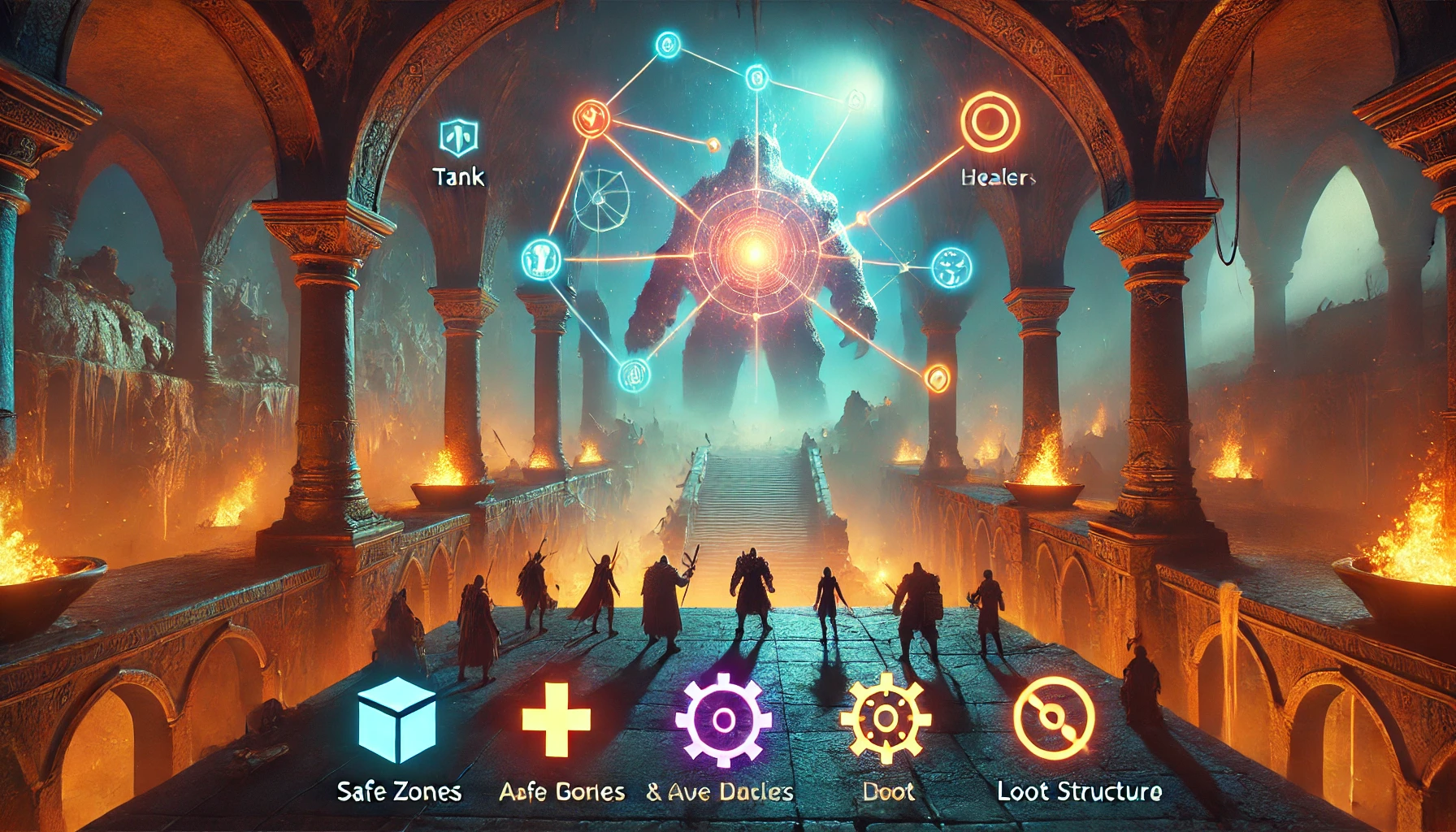
Group Sizes and Why They Change Everything 👥📏
Ashes is built around the idea that a “normal group” is bigger than the classic 5-man feeling. The design direction that’s been shared publicly is:
- Group (party) size is intended around 8 players
- Raid size is intended around ~40 players
That one detail changes everything:
- You can run more support tools without killing damage.
- You can split responsibilities (interrupt team, cleanse team, add-control team).
- Your group can survive mistakes more often… but raids punish messy play harder because chaos spreads faster.
Big tip: In an 8-player group, you don’t build “the perfect comp.” You build a stable comp. Stability beats ego every time.
Holy Trinity in Ashes (And the “Hidden Fourth Role”) 🛡️💚⚔️✨
Yes, the holy trinity still exists in practical gameplay:
- Tank: controls threat/attention, positions enemies, soaks heavy hits.
- Healer: keeps the group alive, handles recovery after mistakes.
- DPS: deletes targets, controls pacing, clears adds fast.
But Ashes-style MMO design usually adds a real fourth “job” that matters a lot:
Support / Utility (The Run-Carrier Role) 🎻🧠
Support isn’t “extra.” Support is what turns a messy group into a clean group:
- Buffs that raise group output
- Debuffs that reduce boss pressure
- Crowd control and safety tools
- Tempo control (helping the group move faster without overpulling)
Bold truth: Most wipes happen because your group can’t control chaos. Support/utility is how you control chaos.
How to Build a Beginner-Friendly 8-Person Dungeon Party ✅
If you’re aiming for comfort (not speedrunning), your ideal “safe” party usually looks like:
- 1 Tank 🛡️
- 1 Main Healer 💚
- 1 Support / Utility ✨
- 5 DPS ⚔️
Then you flex depending on the dungeon:
- If damage intake is brutal → add more sustain/utility.
- If there are constant adds → bring stronger AoE + control.
- If mechanics require frequent interrupts → make sure you have multiple interrupt-capable players.
Bold rule: If your group is wiping to “random damage,” it’s usually not random. It’s missed interrupts, bad positioning, or no defensive rotation plan.
Dungeon Types: Open-World vs Instanced PvE 🏰🌲🌀
Here’s the clean way to understand it:
Open-World Dungeons 🌍
These are part of the world. That means:
- You travel there.
- You might see other groups.
- You might compete for rooms, bosses, or events.
- The dungeon can feel “alive” because activity changes based on players around.
What this creates: pressure and opportunity.
- More people → more risk, but also more dynamic gameplay.
- Good groups can farm efficiently.
- Unprepared groups get squeezed out.
Instanced Dungeons 🌀
Instanced content gives you:
- Controlled environment
- Cleaner pacing
- Less outside interference
- More reliable learning (great for practicing mechanics)
What this creates: consistency.
- Great for progression.
- Great for learning.
- Less “world chaos,” more “pure PvE execution.”
Bold truth: Open-world dungeons test your awareness. Instanced dungeons test your execution.
How Dungeon Runs Usually Feel (The Core Loop) 🔁
Most successful dungeon runs follow the same rhythm:
- Scout & mark 👀
- You don’t need to overthink it. Just identify:
- Dangerous casters
- Healers
- Explosive adds
- Patrol timing
- Controlled pull 🎯
- Tank pulls with intent. DPS waits half a second. Healer gets positioned.
- Priority kills ☠️
- Delete the targets that cause wipes:
- “Big damage caster”
- “Summoner”
- “Heals the pack”
- “Explodes on death”
- “Chains CC”
- Reset and repeat ✅
- Loot, rebuff, re-check cooldowns, then go again.
Bold rule: Speed is earned. You go fast after you prove you can go clean.
Dungeon Mechanics You Should Expect (And How to Survive Them) 🧠🧩
Even without naming specific bosses, dungeon mechanics usually fall into familiar categories. The trick is learning how to react without panicking.
Interrupt Checks 🔇
Boss starts casting = your group needs a plan.
- Assign 2–4 interrupters in a rotation.
- Don’t overlap everything at once.
- Save emergency interrupts for “wipe casts.”
Bold line: The fastest way to wipe is everyone assuming someone else will interrupt.
Positioning Checks 🧍♂️↔️🧍
Common situations:
- Cone attacks
- Tail swipes
- Cleaves that punish stacking
- Ground zones that force movement
The fix is simple:
- Tank faces boss away from group.
- DPS plays safe angles.
- Healer stays in vision, not hugging danger.
Add Waves 🐜
Adds are usually the “real” mechanic.
- Some need to be burned instantly.
- Some need to be controlled.
- Some need to be dragged into AoE zones.
Simple callout system helps a lot:
- “Adds left!”
- “Kill small first!”
- “CC the big!”
Environmental / Puzzle Moments 🗝️
Not every mechanic is combat-only:
- Levers, triggers, objects
- “Stand on plates”
- “Carry item”
- “Split the group”
The groups that win are the groups that talk.
Raids: What Changes When You Go to 40 Players 🐉📢
A raid isn’t “a bigger dungeon.” It’s a different game.
Your raid becomes a machine ⚙️
You need structure:
- Raid leader (calls pacing + big mechanics)
- Sub-leaders (each party/side)
- Assigned roles (interrupt team, add team, tank swap plan)
Communication is the real difficulty 🎙️
In 40-player content:
- Too much talking = no one hears the important call.
- No talking = nobody reacts together.
Bold rule: Callouts should be short, repeatable, and obvious.
Examples:
- “Stack!”
- “Spread!”
- “Behind!”
- “Left group cleanse!”
- “Adds now!”
Raids reward discipline more than skill 🧠
You can have insane players and still lose because:
- half the raid panics
- cooldowns overlap randomly
- positioning collapses
The best raids look boring. Because boring = controlled.
Basic Raid Expectations (If You Don’t Want to Be “That Guy”) ✅
If you want to be welcomed back:
- Show up repaired and ready
- Bring whatever sustain tools your build offers
- Know your core rotation without staring at bars
- Ask one question early instead of ten questions mid-pull
- If you mess up, say it fast: “My bad, missed interrupt.”
Bold truth: Good raids don’t kick people for mistakes. They kick people for repeating the same mistake silently.
Loot Structure: How It Usually Works Without Drama 🎁😅
Loot is one of the biggest reasons groups fall apart. Not because people are evil — because expectations aren’t clear.
Here are the typical systems and what they mean in real life:
Finite loot (not “everyone gets their own”) 🧱
In the design direction that’s been shared publicly, loot is treated as finite for the group/raid to distribute, rather than every player getting personal loot automatically.
That means social rules matter:
- Guild rules
- Party leader rules
- Reputation rules
Common loot distribution methods 🎲
These are the classic systems many MMOs use:
- Master Looter: leader assigns loot (fast, but needs trust)
- Round Robin: rotates who receives drops (fair-ish, simple)
- Need Before Greed: people roll based on need (works best with honesty)
- Bidding / DKP-style approaches: gold/points decide loot (organized guild style)
Bold line: Pick the loot system BEFORE the first boss dies. Not after a rare item drops.
Open-world boss loot “rights” (the messy part) 🌍⚠️
When bosses exist in the open world, games often use systems like:
- tagging a target
- contribution thresholds
- damage/healing/participation rules
What that means for you: if you show up late or unorganized, you might do the work and still lose the reward to a better-prepared group.
So if you want consistent results:
- arrive early
- bring enough people
- stay coordinated
- secure the kill cleanly
Open-World PvE: The “Third Boss” Is Other Players 😈
Open-world PvE is fun because it’s unpredictable… but that unpredictability is pressure.
You can be having the cleanest dungeon run of your life, then:
- another group shows up
- someone trains mobs
- boss gets contested
- your healer is suddenly under stress
- your plan collapses
Bold truth: In open-world PvE, your “tank” is also your “traffic cop.” Good tanks don’t just hold threat — they manage space, timing, and panic.
The Smooth Run Checklist (Dungeon + Raid) ✅🧾
Before you start, check these:
- Roles are clear (who tanks, who main heals, who supports)
- Interrupt plan exists (even a simple rotation)
- Marking system is agreed (skull = kill first, etc.)
- Positioning rules (tank faces away, group avoids cleave zone)
- Loot rules stated (master loot? need/greed? bidding?)
- Wipe rule (wipe = quick reset, no blame spam)
Bold line: A 30-second plan saves a 30-minute wipe-fest.
Common Mistakes New Groups Make (And Easy Fixes) ❌➡️✅
Mistake: Overpulling to “save time”
Fix: Pull smaller until healer is comfortable.
Mistake: No priority target
Fix: Kill what causes wipes first, not what has the biggest HP bar.
Mistake: Everyone stands wherever
Fix: Create “safe zones” and “no-go zones.”
Mistake: Loot drama
Fix: Loot rules upfront. Always.
Mistake: Silent runs
Fix: You don’t need constant chatter — you need callouts.
How BoostRoom Helps Players Who Want Fast, Clean PvE Progress 🚀
Some players love learning every mechanic from scratch. Others just want to:
- get through content smoothly
- grab the rewards
- avoid wasted hours
- play on their schedule
BoostRoom is built for that second type of player too:
- Dungeon help when you want consistent clears
- Raid help when you want a structured group experience
- Coaching if you want to improve without guessing
- Farm/support services when you’d rather skip the grind and focus on fun
Bold line: Time is the real currency in MMOs. Spend it where you actually enjoy the game.
Conclusion 🎬
Dungeons and raids in Ashes of Creation are designed to feel bigger than a checklist. Group sizes encourage real teamwork, mechanics reward coordination, and loot systems push communities to build trust and rules.
If you remember only one thing, remember this:
Clean runs aren’t about perfect damage — they’re about clear roles, simple plans, and calm execution. 🛡️🐉