⚔️ What “Siege Week” Really Means in Ashes of Creation
A siege isn’t just “big PvP.” It’s structured conflict with rules, timers, objectives, and real consequences.
In normal PvP, you win fights. In sieges, you win the future.
That’s why people show up with full squads, backup plans, politics, spies, and a lot of ego.
Sieges are also where Ashes becomes a true PvX sandbox:
- Crafters matter (weapons, ammo, siege tools, consumables) 🛠️
- Gatherers matter (materials, logistics, scouting routes) ⛏️
- Traders matter (moving supplies safely before and after) 🚚
- PvPers matter (obvious… but also coordination, not just kills) ⚔️
- Social power matters (alliances, diplomacy, intimidation, betrayal) 🤝😵
If you’ve ever wanted an MMO where your server’s history feels unique, sieges are the reason.
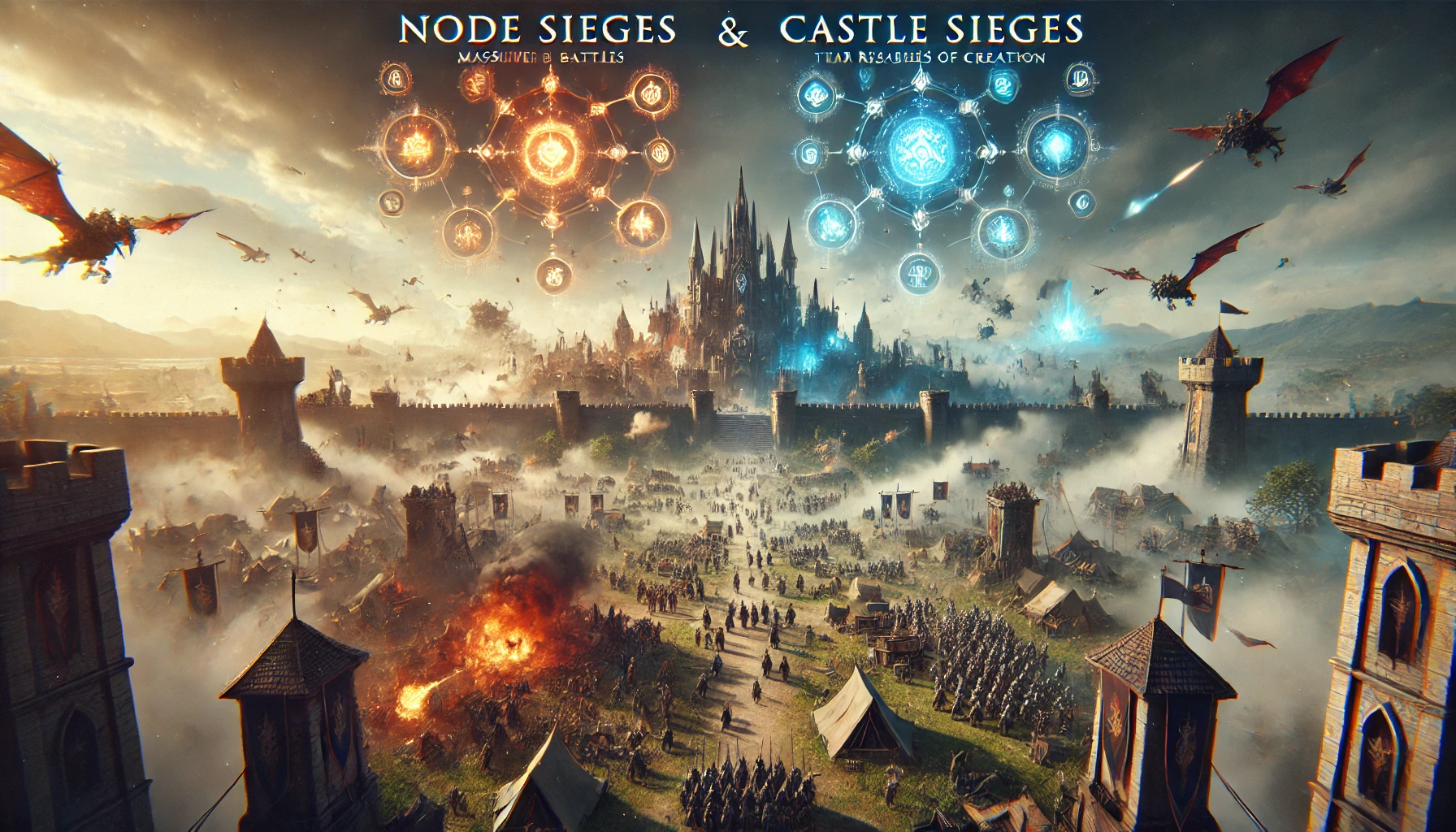
🏰 Node Siege vs Castle Siege: The Quick Difference
Let’s cleanly separate them, because people mix them up all the time:
Node Sieges (Settlements) 🏠🔥
- The target is a player-grown settlement (a Node that developed into a real town/city).
- The fight is about destroying or saving that settlement’s progress and influence.
- These are community wars: citizens, neighbors, rivals, random mercs — the whole server can get involved.
Castle Sieges 🏰👑
- The target is one of the major castles of the world (there are five castles).
- The fight is about regional control, prestige, and long-term power.
- These are heavily guild-driven, because castles are basically the “kingmaker” content.
Simple rule:
Node Sieges reshape the local map. Castle Sieges reshape the political map.
📣 How Sieges Get Declared (And Why the “Before” Matters)
Most players only think about the siege day. That’s a mistake.
The declaration period is where wars are won.
It’s when:
- alliances form,
- rivalries become public,
- supply lines get attacked,
- defense plans get built,
- and the “real” fight starts in Discord long before the first arrow flies.
Node Siege Declaration
Node Sieges are triggered through a declaration process (often described as coming from a quest/declaration item), and once it’s active, it kicks off a countdown until siege day. The higher
the settlement stage, the more notice time you get. 🧾⏳
During that window, everyone starts playing chess:
- Defenders try to stabilize and reinforce the settlement.
- Attackers try to weaken it socially and economically.
- Third parties try to profit by selling support, info, or supplies.
Castle Siege Declaration
Castle Sieges also have their own declaration process and build-up cycle. Castle ownership is meant to be a big deal, and managing a castle is described as a serious responsibility, not a trophy you AFK with. 🏰🧠
That “management” part matters because defenders aren’t just defending walls — they’re defending a whole region’s structure of power.
⏱️ Timers & Windows: When Sieges Actually Happen
Sieges aren’t designed to happen at weird hours when nobody is online.
Ashes has discussed objective-based events (including node sieges and castle sieges) happening inside a prime-time window (server-dependent). That’s important because it means you’re usually fighting when the server is awake — so politics and preparation matter more than sneaky timing. 🌙🚫
How long do sieges last?
A commonly referenced design point is that settlement sieges can last up to around two hours — meaning you don’t “win” by being slightly better for five minutes. You win by being better at pressure, resets, and objective control for a full war session. 🕑🔥
For castles, you’ll also see siege duration discussed in multi-hour terms, and big-player-count targets get mentioned alongside them — the idea is that castles are headline events, not quick battleground matches.
🧾 Registration Rules: Who Can Attack, Who Must Defend
One of the most important (and most misunderstood) siege ideas is: not everyone has the same options.
For Node Sieges, commonly described rules include:
- Citizens of the attacked node are automatically defenders.
- Vassal citizens may be restricted to defending (not attacking).
- Attackers/defenders can include many players outside the node — meaning your diplomacy matters. 🤝
Translation:
If you live there, you don’t get to “stay neutral” in the system’s eyes — even if you personally plan to hide in a cave that day. The node is your home, and the siege is about your home.
For Castle Sieges, the dynamic leans more guild-controlled, including how attackers get organized and how defenders are chosen. That’s why castles feel like “kingdom warfare.”
🛡️ Pre-Siege Prep: What Defenders Should Do Before the Horn Blows
Defending is not just “stand on the point.” The best defenders treat siege prep like a mini-season.
Here’s what actually wins defenses:
1) Lock down information 🕵️♂️
- Scout roads.
- Watch choke points.
- Track enemy rally locations.
- Identify which guilds are truly committed vs just “showing up for content.”
2) Build a real role plan (not just “stack DPS”) 🧩
A siege force needs:
- Frontline holders (soaks, peel, CC layers) 🛡️
- Backline damage (burst + sustained) 🎯
- Healers/supports (obvious, but organized) 💚
- Disrupt squads (assassins/flankers to break channels and wipe healers) 🗡️
- Utility squads (mobility, anti-siege, scouting, counter-flanks) 🌪️
3) Practice respawn discipline 🔁
Most siege losses aren’t from “lack of skill.” They’re from:
- staggered respawns,
- trickling back one-by-one,
- and losing objectives while everyone is “almost back.” 😭
4) Prepare “objective moments,” not kill moments 🎯
You need a plan for:
- the first big clash,
- the first wipe,
- the first regroup,
- and the final 10–15 minutes when everyone is out of cooldowns and out of patience.
Defenders who survive late usually win late.
Because attackers are on a clock.
🔥 Pre-Siege Prep: What Attackers Should Do (Without Feeding Kills)
Attackers have one big advantage: initiative.
Defenders have one big advantage: home field.
To win as attackers, you must play clean.
1) Choose the real win condition early 🧠
A lot of attackers lose because they treat the siege like a highlight reel.
You’re not here to “win fights.” You’re here to win objectives.
2) Build squads around tasks 🎒
You want groups that specialize:
- Breach squads (siege tools / gate pressure / anti-wall) 🧨
- Point squads (objective holding, channel protection, CC denial) 🏁
- Assassin squads (pick healers, break channels, punish rotations) 🗡️
- Intercept squads (hunt reinforcements, stop regrouping) 🐺
- Siege-hunter squads (kill enemy siege, sabotage defense tools) 🧱🔥
3) Don’t waste the early phase 💀
If you spend the first 30 minutes “testing” defenders with random fights, you’re gifting them time to stabilize and learn your pattern.
4) Learn the “wipe rhythm” 🔁
Attackers win when they can:
- force a wipe,
- immediately convert it into control points/spawn advantage,
- then repeat before defenders fully reset.
If you wipe defenders but don’t convert, it’s basically a cosmetic win.
🗺️ Node Siege Flow: Districts, Objectives, and the Big Win Condition
Node Sieges are designed to feel like an urban war, not just a field fight.
You’ll often see node siege descriptions talk about the node being divided into sections/districts, with objectives that affect:
- respawn access,
- defender pressure,
- and the attackers’ ability to push deeper.
A commonly referenced objective concept is:
- attackers contest areas to secure closer pressure/respawns,
- defenders try to hold key points or push out to break attacker staging.
The “moment” that ends a Node Siege
A key idea you’ll see tied to settlement sieges is a central objective that attackers must complete — often described in terms of reaching the core and channeling an objective (with channel time long enough that you must protect the channel, not just start it). 🏁⏳
That creates the classic siege drama:
- Attackers finally reach the center…
- Defenders throw everything into a last stand…
- And one interrupt at the right time can decide the whole war.
What happens if attackers win a Node Siege?
The big consequence commonly described is:
the settlement is destroyed/reset (meaning its stage and influence don’t just “drop a little” — they’re gone). 🔥🏚️
That’s why node sieges are feared. People don’t fight because of pride. They fight because:
- housing can be lost,
- progress can be erased,
- and the local “power structure” can be wiped off the map.
What happens if defenders win?
If defenders successfully hold, the node survives and usually gains a protection period (a window where it can’t just be instantly sieged again). 🛡️✅
Translation: a successful defense doesn’t just “save today.” It buys breathing room.
🧨 Castle Siege Flow: Gates, Control Points, Relics, and Keeping the Crown
Castle Sieges are the prestige war content. Official descriptions emphasize that they’re meant to be massive events with hundreds of players, and they’re built to reward strategy — not just zerging. 🏰⚔️
Here’s how castle siege gameplay is typically framed:
1) Control points & positioning matter 🗺️
Good sieges aren’t “everyone rush the front gate.”
They’re about:
- staging,
- controlling approach routes,
- and forcing defenders to split attention.
2) Siege tools matter 🧨
Castle siege talk often includes siege engines (trebuchets, rams, ballistas, traps). The point is to make castles feel like castles:
- walls matter,
- gates matter,
- and “bringing the right tools” matters.
3) The final objective is deep 🏁
In official siege-mode descriptions, attackers win by taking a final objective tied to the heart of the castle (often described like a relic/control point in the inner area). Defenders win by running out the clock and preventing that capture.
Even if the exact castle mechanics evolve, the spirit stays the same:
attackers must break in and finish the job; defenders must survive.
What happens if attackers win a Castle Siege?
Castle victories are described as meaningful, including titles/leadership status and major regional control themes. Owning a castle isn’t just cosmetics — it’s power and pressure.
And because castles tie into surrounding structures (tax and node relationships often get discussed), castle ownership becomes a reason the entire region cares about your guild.
What happens if defenders win?
Defenders keep power — and that usually means:
- they keep regional influence,
- they keep their political leverage,
- and they keep being the group everyone plans around (or plans against). 👑😈
💰 Rewards & Consequences: What Changes If You Win or Lose
This is the part most players feel but can’t always explain.
Node Siege Rewards (Attackers)
Winning a node siege gives attackers something stronger than loot:
- control over the future shape of the region
- removal of a rival’s safe hub
- disruption of housing and local economy
- a chance for different nodes to rise instead
It’s the ultimate “server storyline” play.
Node Siege Rewards (Defenders)
Defenders get:
- survival (the biggest reward) 🛡️
- protection time to rebuild and prepare
- stability that attracts citizens, traders, crafters
- and a reputation boost: “this node doesn’t fold.”
Castle Siege Rewards
Castle content gets described as having big rewards because of how hard it is to take and keep a castle. Castle regions are also tied to systems like taxation and ongoing events/pressure (including tax deliveries). That makes castles a long-term money-and-power loop, not a one-night victory.
In plain gamer talk:
A castle isn’t just “we won.”
A castle is “we have enemies now.” 🔥
🧠 Raid-Lead Checklist: Comms, Supplies, and Roles
If you want your siege group to feel “pro,” steal this checklist:
1) Comms structure 🎧
- One main shotcaller.
- One backup.
- Squad leads who relay short info (no essays mid-fight).
2) Objective calls only 🎯
Kills are allowed to be celebrated after.
During, calls should sound like:
- “Rotate left gate.”
- “Hold channel—peel north.”
- “Reset now, don’t trickle.”
- “Group on rally point, 10 seconds.”
3) Consumables win wars 🧪
Your best DPS is useless if they’re out of sustain or mobility.
4) Don’t improvise your roster
Sieges punish “random comps.” Build around:
- holding power,
- CC layering,
- and anti-channel tools.
🧱 Anti-Zerg Strategy: How Smaller Groups Still Matter
Even in massive fights, small squads decide outcomes because sieges are objective-based.
A disciplined 8–12 player group can:
- wipe a backline healer pocket,
- break a key channel,
- assassinate siege operators,
- or delay a rotation notice just long enough to flip an objective.
Big armies win battles. Smart squads win sieges. 😈
❌ Common Siege Mistakes That Throw Wins
Here are the classic “why did we lose?” moments:
1) Trickling back after a wipe
You die twice before you even regroup. That’s free time for the enemy.
2) Fighting in the wrong place
If the objective is inside the node/castle, and you’re brawling outside for ego… you’re losing. 😭
3) No anti-channel discipline
If victory requires a channel, then interrupting channels is literally the highest value action in the war.
4) Ignoring logistics
Running out of supplies, losing caravans, lacking siege tools… these are “silent losses” that show up 40 minutes later.
✅ Fast FAQ: Sieges in One Screen
Can anyone join a Node Siege? 🤔
Typically, yes — but citizens are usually forced into defender eligibility, and some related citizens (like vassals) may be restricted to defending.
How long are sieges? 🕑
Settlement sieges are commonly described as lasting up to around two hours.
Do sieges happen at random hours? 🌙
They’re generally intended to occur inside server prime-time windows for objective-based events.
What’s the biggest difference between node and castle sieges? 🏰🏠
Node sieges are about destroying/saving settlement progression. Castle sieges are about regional rule and long-term political power.
🎯 Why BoostRoom Players Love Siege Weeks
Siege weeks are where a lot of players suddenly realize they want:
- better coordination,
- stronger builds,
- smoother gearing,
- and more confidence in group play.
Because nothing exposes weak prep like a two-hour war. 😅
And honestly? Even if you’re not a hardcore PvPer, sieges are still content you’ll feel:
- trade routes change,
- hubs change,
- prices change,
- and the “safe” places on the map change.
That’s the magic of Verra.
🏁 Conclusion: Make the Map Remember You
Node Sieges and Castle Sieges aren’t side content. They’re the heartbeat of Ashes of Creation.
If you want to play Verra seriously, don’t ask “How do I win fights?”
Ask:
“How do I win the story?” 📖🔥
Because once sieges start firing, the server stops being a world… and becomes a history book.