🧭 The Big Idea: Timed Content Is Where Verra Feels Alive
In many MMOs, “events” are basically side quests with fireworks. In Ashes, events are built to be public, reactive, and sometimes region-changing.
That matters because:
- Events pull players together (even enemies).
- Events create temporary hotspots (XP, loot, rare materials, PvP).
- Events can change what’s safe (or what’s profitable) for a while.
- Events often reward preparation more than raw DPS.
Treat events like a weekly paycheck. The people who show up ready are the ones who walk out richer.
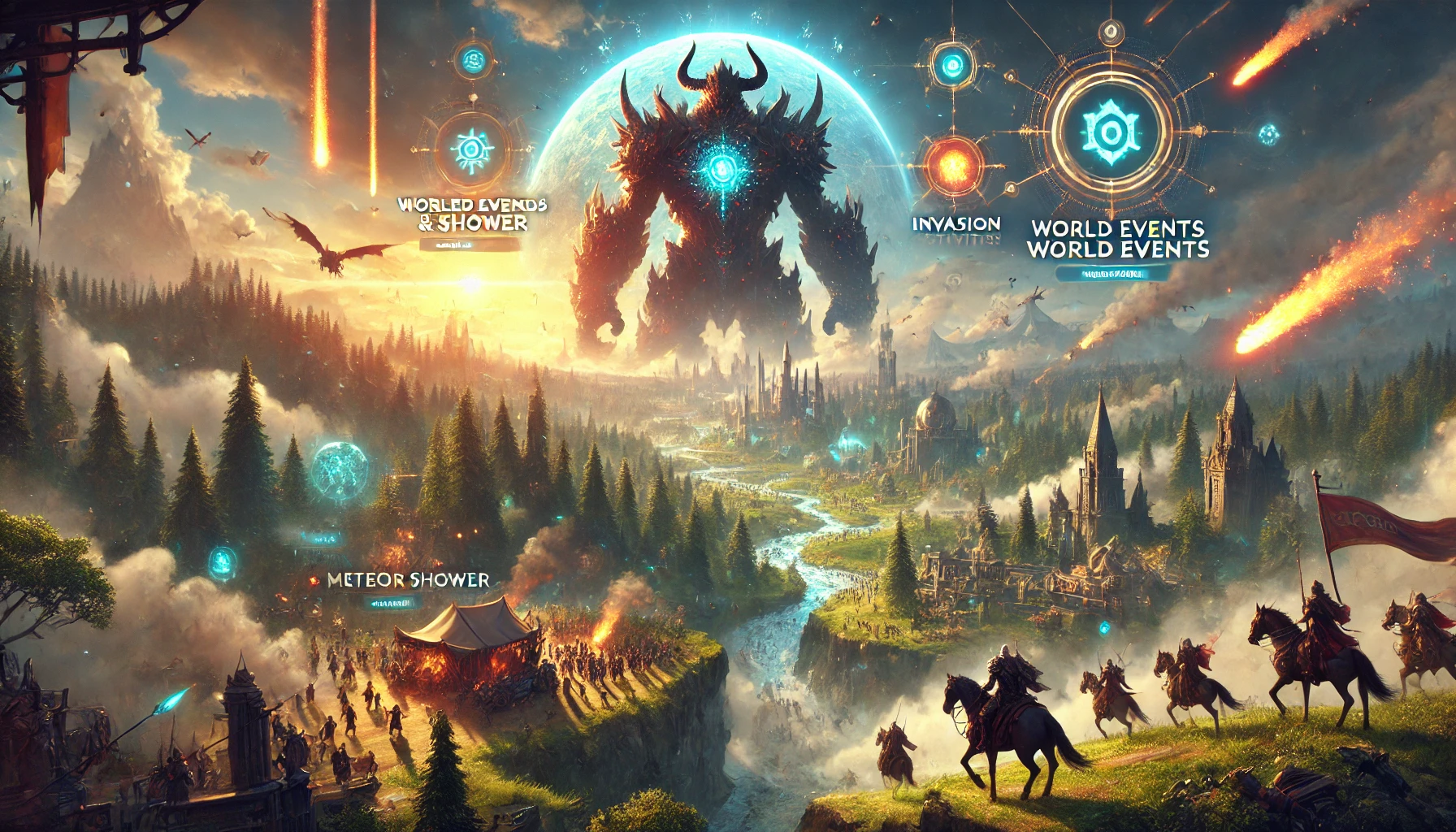
🗺️ Event Types You’ll See in Ashes
Think of Ashes events in four big buckets:
World Events (Open-World Pop-Ups) 🌲⚡
Quick-to-medium activities that appear in wilderness or points of interest. Usually easy to join, scale up with player power, and reward people who respond fast.
Node-Triggered Events (Local → Regional) 🏘️🔥
Events tied to node progression, node tasks, local threats, and sometimes “calamity” style outcomes. These are the “your town is under pressure” moments.
Invasions (Large-Scale Regional Threats) 🌀🧟
Longer, multi-phase, high-intensity events that can transform how a zone plays for a while. These are the ones that make guilds ping everyone.
World Bosses (Big Targets, Big Drama) 🐉💎
Open-world bosses or event bosses that bring large groups, contested space, and serious rewards.
If you understand those buckets, you’ll always know what you’re looking at when the map starts lighting up.
🔔 How You’ll Hear About Events (Your “Event Radar”)
You don’t need to memorize every timer. You need a system.
Your best event radar looks like this:
- Watch for region messages / announcements (the game tells you when big stuff is starting).
- Use the map often (get in the habit of checking it whenever you return to town).
- Hang around active nodes (busy nodes are magnets for content and player movement).
- Follow the noise: if you see players sprinting out of town in packs… something is up. 😅
Pro tip: Make it a rule:
Every time you finish a quest loop or dump items in storage, do a quick map scan. That one habit saves you from missing half the game.
🌲 World Events: The “Drop Everything and Go” Content
World events are the classic “pop-up challenge” style content. They’re meant to be approachable, fast to join, and not locked behind long prep.
What makes them special in Ashes is the philosophy: events scale and adapt, so you don’t need to be maxed to participate, and they can remain relevant.
What World Events Usually Feel Like
You’ll commonly see patterns like:
- Clear waves of enemies
- Defend a location or NPC
- Escort something across danger
- Kill a mini-boss that spawns at the end
- Collect objectives under pressure (while mobs keep spawning)
The secret sauce is speed.
If you’re the first group there, you get more uptime on progress and you’re less likely to get crowded out.
How to Prep for World Events (Without Overthinking It)
Keep a “world event kit” in your bags:
- Sustain (food, potions, regen tools) 🧪
- Mobility (anything that helps you rotate fast) 🏃
- AoE option (events love waves) 💥
- One panic button (a defensive cooldown, cleanse, or escape tool)
You don’t need perfect gear. You need to stay alive and keep hitting.
🏘️ Node Events: When Your Town’s Progress Gets Tested
Nodes aren’t just housing and politics. They’re living systems. And living systems get attacked.
Node-related gameplay often includes:
- Tasks that push the node forward
- Local events that test the node
- Regional pressure that grows as the node grows
Here’s the key mindset:
The bigger your node becomes, the more attention it attracts.
Sometimes that attention is players. Sometimes it’s PvE threats. Sometimes it’s both.
Why Node Events Matter More Than They Look
Node progression can be influenced by what players do in the area… but there are also forces that can set it back. That’s where PvE events and siege-like pressures become a big deal.
So if you’re a “casual” player who thinks node events don’t matter:
They matter when your favorite crafting hub starts struggling, or when travel routes shift, or when the local market dries up.
How to Play Node Events Smart
If you want consistent results:
- Do node tasks when it’s quiet (less competition, smoother progress).
- Show up for node defense events (these often become the “community moment”).
- Keep an eye on rival nodes (their growth can change your region’s future).
Node events are how the world reminds you: “this place isn’t guaranteed.” 😈
🪙 Monster Coin Events: The “Let Me Be the Monster” Chaos
This is one of the most “Ashes” ideas ever.
In a Monster Coin style event, players can activate monster coins and temporarily play as monsters to cause havoc. It’s not just a PvE event. It’s a social stress test. 😅👹
Why Monster Coin Events Are a Big Deal
- They create unpredictable fights (because players become the threat).
- They turn normal zones into temporary danger maps.
- They encourage weird teamwork:
- “Are we stopping the monsters… or becoming them?” 🤝😈
How to Profit From Monster Coin Events
Even if you don’t want to be a monster:
- Follow the event for loot, XP, and opportunity
- Sell supplies (potions, ammo, food) because people burn through them
- Watch the edges of the event for gathering windows (riskier, but often less crowded)
Rule: Don’t go in with “main character syndrome.”
Go in with “get in, get value, get out.”
🌀 Invasions: The Content That Turns Regions Into Warzones
Invasions are where Ashes stops feeling like “an MMO with events” and starts feeling like a world reacting to threats.
Some invasion-style systems are described as multi-phase encounters that escalate:
- waves,
- gates or spawning points,
- commanders,
- and deeper objectives that reward groups willing to push farther.
Example: Harbinger-Style Regional Invasion Gameplay
Ashes has described a large-scale invasion system where a zone can be transformed into a lawless, high-intensity battleground, with escalating phases that include:
- fighting waves,
- responding to a gate unleashing stronger enemies,
- defeating powerful commanders (presented as world-boss level targets),
- and then pushing into deeper “inner” areas for higher-risk objectives and rare drops.
Also—this part matters—some invasion designs include a dangerous ending where the zone becomes deadly and players inside must escape quickly once the event concludes. That’s peak Verra energy. 😅🔥
How to Approach Invasions Without Getting Farmed
Invasions are “easy to join, hard to maximize.”
If you’re solo or casual:
- Follow groups, don’t lead
- Focus on survival + consistent damage
- Loot smart, don’t tunnel vision on one target
If you’re in a guild:
- Assign squads (frontline, backline, objective runners, cleanup)
- Set a rally point and a reset rule (“if wiped, regroup here, don’t trickle”)
- Decide early if your goal is boss kill, deep objective, or farming phases
Bold truth: Invasions punish messy groups.
They reward teams that can keep moving and keep respawning together.
🐉 World Bosses: How to Win the Loot Without Losing Your Mind
World bosses are the flashy content that makes everyone show up.
But they’re also where people waste time the most:
- arriving late,
- having no sustain,
- not understanding roles,
- or fighting other players instead of the boss.
What Makes a “World Boss” Different
A true world boss usually has:
- big health / big damage
- mechanics that punish random zerg play
- add waves or environment threats
- a long enough fight that coordination matters
And the boss isn’t the only challenge. The other challenge is:
other players also want it. 😈
Your Boss-Fight Checklist
Before you even tag the boss, ask yourself:
Can I survive 60–120 seconds of pressure without a healer?
If not, bring more sustain.
Do we have enough damage and enough control?
Some fights aren’t “DPS checks.” They’re “don’t die to mechanics” checks.
Do we have someone calling mechanics?
One calm voice beats 40 panicking players.
Team Roles That Actually Matter
Even if Ashes’ final meta evolves, big bosses always value the same structure:
- Tanks / frontline: hold space, control boss facing, stop chaos 🛡️
- Healers / support: keep the line alive, cleanse pressure 💚
- DPS: burn priority targets, don’t pad meters 🎯
- Utility: interrupts, slows, stuns, anti-add tools 🌪️
Bold line: The best boss groups are boring.
They do the same clean thing every pull. That’s why they win.
🎒 “Don’t Miss It” Strategy: How to Catch Events Even With Limited Time
Not everyone can play all day. So play smart.
The 3-Block Routine (Works for Busy Players)
Block 1: Login Scan (2 minutes)
Check map, announcements, local node area.
Block 2: One Major Activity (30–90 minutes)
Pick ONE:
- invasion phase push,
- world boss hunt,
- node event chain,
- caravan support run tied to the region’s activity.
Block 3: Cash Out (10 minutes)
Sell junk, craft consumables, restock, set yourself up for next time.
If you do that, you’ll always feel progress, even on short sessions.
💰 How Players Make Gold From Events
Events aren’t just “fun.” They’re economy engines.
Here are the most consistent event money methods:
Sell the basics 🧪
Potions, food, ammo, repair materials. Events burn supplies.
Craft what events consume 🛠️
If a region is under pressure, people will buy anything that keeps them alive or speeds them up.
Farm phases, not just finales ⏳
A lot of players only show up for “boss spawn.” Smart players farm the earlier phases where:
- mobs are easier,
- loot is steady,
- and competition is lower.
Buy low during panic, sell high after stability 📈
When an invasion hits, people dump items. When it ends, demand spikes for rebuilding.
Bold line: Events create market moods. Learn the mood.
⚠️ Risk vs Reward: When Events Turn Into PvP Hotspots
Some events naturally attract PvP because:
- the loot is good,
- travel routes get crowded,
- and emotions run high.
Even if you personally don’t want PvP, you should expect:
- ambushes on roads,
- fights over boss space,
- or clashes near objectives.
Simple survival rules:
- Don’t carry your entire net worth into an event zone.
- Use safer routes when you’re transporting value.
- If you see multiple guild banners grouping, assume conflict is coming.
🧠 Common Mistakes That Make Players Miss Everything
Let’s be real—most missed content comes down to bad habits.
Mistake 1: “I’ll check after I finish this quest.”
That’s how you miss world bosses.
Mistake 2: No consumables.
You die more, you earn less, you leave early.
Mistake 3: Showing up solo to group content and expecting magic.
You don’t need a mega guild, but you do need a plan: join a group, follow a tag, be useful.
Mistake 4: Loot goblin brain.
If you stop moving to grab every drop, you miss objectives and get deleted.
Mistake 5: Not learning the event’s “end condition.”
Every event has a win condition. Figure it out fast.
✅ Mini FAQ: Quick Answers for New Players
Are world events always scheduled? ⏰
Not necessarily. Many are designed to pop up dynamically in the open world, often responding to player presence and progression.
Do node events matter if I don’t own housing? 🏠
Yes. Node stability affects travel, safety, markets, crafting hubs, and what content spawns nearby.
Are invasions worth it if I’m undergeared? 🧤
Usually yes—if you play smart. Focus on survival and consistent contribution rather than risky hero plays.
Do I need a guild for world bosses? 🤝
Not always, but organized groups usually get better results. Even a temporary party helps a lot.
How do I stop missing timed content? 👀
Build an “event radar” habit: check map/announcements every time you return to town, and keep a ready kit in your bags.
🏁 Conclusion: Be the Player Who Shows Up First
Ashes of Creation rewards awareness.
World events give you steady progress.
Node events make the world feel personal.
Invasions turn regions into stories.
World bosses create server legends.
If you want the best Verra experience, don’t play on autopilot.
Play like a scout: watch the world, react fast, and always keep your kit ready. 🌍⚔️