How Classes Work in Battlefield REDSEC (What You’re Actually Choosing)
In REDSEC, each class is more than a loadout category. Think of your class as your match identity:
- Signature Gadget: the tool you’ll use to create advantages (mobility, repair, sustain, information).
- Signature Trait: the passive value you bring constantly (revive speed, explosive resistance, aim-spotting, objective tempo).
- Active Ability: a short burst of power that can swing fights if you time it well.
- Training Paths: your “subclass” direction—two options that push the class toward a specific style.
- Mid-match upgrades: REDSEC adds another layer because certain abilities can be upgraded as you progress through a match by doing missions and finding intel caches.
REDSEC also has a huge practical detail many players overlook: class-based loot crates. Certain crates are tailored to the class that opens them, meaning your class can influence how quickly you find weapons and key tools when you land.
The result is simple: your class choice affects your loot speed, your fight options, and your late-game answers.
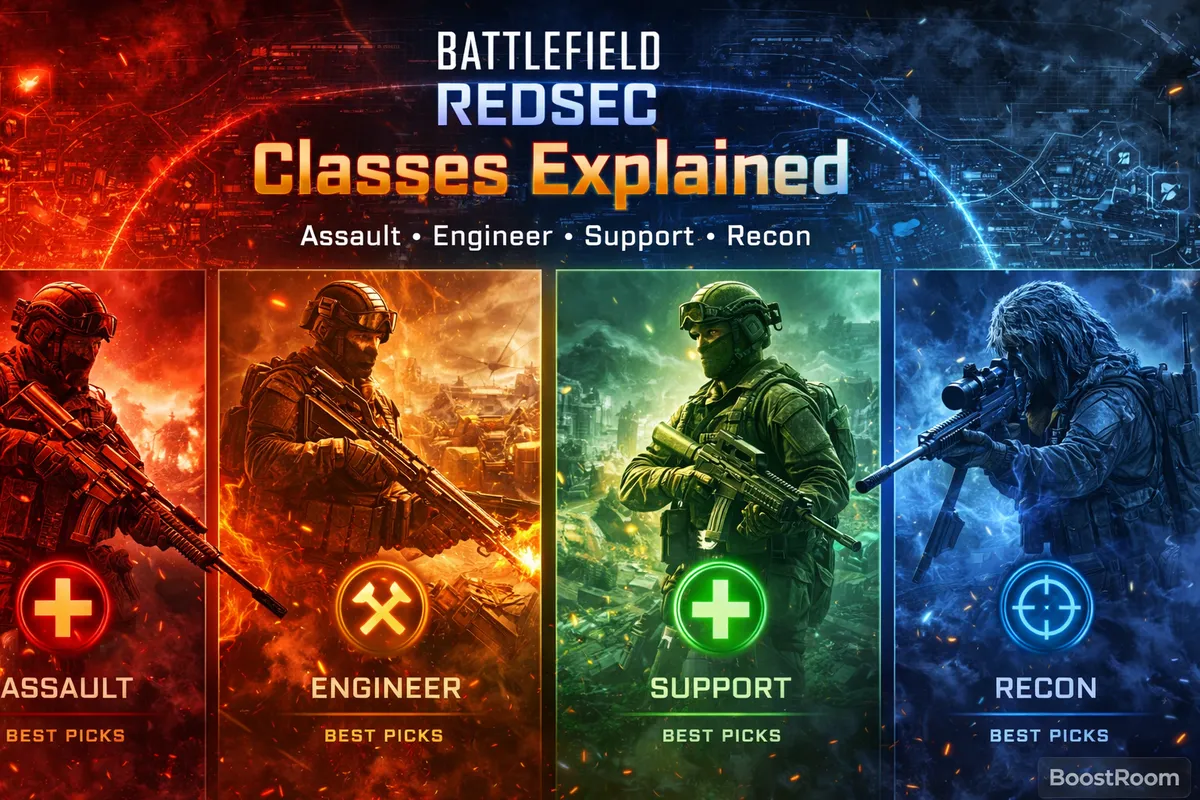
The Quick Answer: Best Class Picks in REDSEC (By Playstyle)
If you want the fastest recommendations before the deep breakdown:
- Best overall for most matches: Engineer (because vehicles and late-game armor pressure are real)
- Best for solo survival and mobility: Assault (ladder + injector style tools are huge for resets)
- Best for squads who want consistent wins: Support (fast revives + sustain = fewer wipes)
- Best for controlling endgame information: Recon (motion tracking + drone tools shine late)
If you play with random teammates, the best “carry” choice is usually Engineer or Support, because they solve the problems your squad will fail to solve on their own (vehicles, plates/ammo, revives).
Class Crates and Loot Flow (Why Your Class Changes Your Landing Strength)
REDSEC rewards squads that gear quickly and rotate early. Class-based crates help you do that because they often give class-appropriate weapons and tools based on who opens them.
Practical takeaway:
- If you’re Assault, class crates tend to push you toward assault rifles and tools that help you take fights early.
- If you’re Support, class crates can lean toward LMGs and Support-friendly tools (including revive-focused items like defibrillator-style gear in some drops).
- If you’re Engineer, class crates commonly favor SMGs and close-mid weapons, plus equipment that supports vehicle play and explosives.
- If you’re Recon, class crates often favor DMRs/snipers and information tools.
You don’t need to “save” class crates for someone else, but you should understand this: who opens the crate matters, so if your squad is trying to build a specific role (like “Recon needs a sniper now”), it can be smart to let that player open the class crate first.
Training Paths and REDSEC Upgrades (The BR Twist You Must Use)
Battlefield REDSEC brings over Training Paths (class specializations) and then adds a BR progression twist: Training Path progress can be advanced mid-match through intel caches and missions.
Why this matters in real matches:
- If you ignore Training Path progression, you’re playing a weaker version of your class.
- If you prioritize missions and intel early, you unlock more value and sometimes transform a “good” tool into a “match-winning” tool.
- Some class tools can be upgraded in REDSEC beyond their multiplayer counterpart—like Engineers improving rocket functionality and Recons upgrading drones for offensive utility.
Your simplest habit: do one mission early (once you have basic gear) and grab intel caches when they’re safe. It’s one of the cleanest ways to gain power without hot-dropping.
Assault Class Explained (Mobility, Tempo, and Solo-Friendly Survival)
Assault is REDSEC’s pace-setter. If your instinct is to move fast, take angles, and create openings, Assault will feel natural. It’s also one of the best classes for newer players who want a clear plan: get in, get out, reset, repeat.
What makes Assault special in REDSEC is not “more damage.” It’s the ability to choose how fights happen—especially with tools like the ladder and tactical spawning options.
Assault Signature Set (What You Get and Why It Works)
Assault’s core identity is breach-and-clear and frontline pressure:
- Signature Weapon Focus: assault-rifle-centered benefits that support quick transitions into fights (useful for aggressive rotations and sudden close-mid engagements).
- Signature Gadget: Adrenaline Injector-style utility that improves survivability under pressure (movement and resistance-style benefits).
- Active Ability: an “awareness spike” style effect that can reveal nearby audible threats and rewards aggressive chaining.
In REDSEC specifically, Assault is frequently recommended for solo play because key Assault tools let you escape losing fights, reposition to unexpected angles, and re-enter fights on your terms.
Assault Gadgets That Matter Most in REDSEC
Assault has standout utility options that translate perfectly into battle royale:
- Assault Ladder: One of the best mobility tools in REDSEC. It creates rooftop access, unexpected entries, and fast escapes.
- Deploy Beacon: Gives your squad tactical respawn positioning, but it’s designed as a limited resource rather than an always-on advantage.
- Grenade launcher options (including fire/thermobaric and high-explosive styles): Strong for clearing tight rooms, breaking cover, and forcing movement.
How to think about these tools:
- Ladder is for winning positioning.
- Beacon is for reducing punishment when something goes wrong.
- Explosives are for ending fights quickly so you don’t get third-partied.
Assault Training Paths (Best Picks and When to Use Them)
Assault generally leans into one of two directions:
- Frontliner-style Assault: Better regeneration and “stay alive while moving” value. This is often the best pick for beginners and for players who take frequent fights.
- Breacher-style Assault: More explosive-oriented value—faster grenade launcher tempo, extra explosive pressure, and stronger breach play.
Best practical choice for most REDSEC players:
- Pick Frontliner if your goal is consistent survival and stable fight results.
- Pick Breacher if your squad plays heavy destruction and building clears and you trust your team to follow your entries.
How to Play Assault in Fort Lyndon (The Winning Loop)
Use this simple Assault loop:
- Take height with ladder entries (or deny height by taking it first).
- Force a fast down with coordinated entry damage.
- Reset instantly after the fight (plate, reload, reposition).
- Don’t linger—rotate before the next team arrives.
Assault players who overstay after a fight die more often than Assault players who “win and leave.”
Assault Mistakes That Lose Matches
- Using ladder as a “toy” instead of a plan (placing it where everyone expects).
- Pushing alone without beacon or backup angles.
- Turning every fight into a long brawl (third parties love Assault chaos).
- Forgetting that survival is still the goal—Assault is strongest when it chooses fights, not when it accepts every fight.
Engineer Class Explained (Vehicles, Safes, Anti-Armor, and Late-Game Power)
Engineer is the class that quietly wins REDSEC matches because it solves the two biggest BR threats:
- Vehicles and armor pressure (including tanks as rare power weapons)
- Sustaining mobility and utility through repairs and explosives
In many matches, Engineer is the difference between “we got rolled by a tank in the last circles” and “we survived, repositioned, and won.”
Engineer Signature Set (What You Get and Why It Works)
Engineer is built around destruction and vehicle control:
- Signature Weapon Focus: SMG-centered handling benefits that support strong close-range and hip-fire-friendly fighting.
- Signature Trait: reduced explosive damage helps you survive the exact things that often kill squads in REDSEC—explosive spam, vehicle splash pressure, and chaotic third parties.
- Signature Gadget: Repair Tool / welding-style multitool that repairs friendly vehicles and can also interact with certain objectives in a “utility” way (including safe-style interactions in REDSEC).
- Active Ability: a “repair overdrive” style burst that increases vehicle repair efficiency when timed correctly.
This is why Engineer is so dominant in practical play: it’s useful in calm matches, and it’s even more useful in messy matches.
Engineer Gadgets That Matter Most in REDSEC
Engineer toolkits are loaded with options that have BR value:
- Launchers: Your answer to vehicles and to squads hiding behind “too-safe” cover.
- Mines: Zone denial tools that become stronger the smaller the circle gets.
- Supply crate options: Team sustain for longer engagements and holding positions.
In REDSEC, an Engineer who understands timing can:
- deny a tank push,
- force vehicles to back off,
- punish aggressive squads who chase into mined routes,
- and keep your own transport alive long enough to reposition into the winning zone.
Engineer Training Paths (Best Picks and When to Use Them)
Engineer commonly splits into two roles:
- Anti-Armor: Built for killing enemy vehicles—rockets that reduce repair effectiveness, extra launcher ammo, faster launcher reload tempo.
- Combat Engineer: Built for sustaining friendly armor and awareness—vehicles can regenerate health while you occupy them, repair tool overheats slower, and you gain mine-spotting style awareness.
Best practical choice for most REDSEC matches:
- Anti-Armor is the safe pick because vehicles become a real endgame problem, and your squad will love you for having answers.
- Combat Engineer becomes incredible if your team actually uses vehicles intelligently and you plan to play around them.
REDSEC Engineer Upgrades (Why You Should Do Missions Early)
In REDSEC, Training Paths and class power can progress through intel caches and missions, and Engineers can gain upgraded functionality that changes how threatening they are against vehicles (including upgrades that turn standard rocket pressure into more consistent anti-vehicle threat).
Practical takeaway:
If you’re Engineer, you should be one of the most mission-aware players on the team. Early intel and mission progress can decide whether vehicles are a late-game nightmare or a late-game opportunity.
How to Play Engineer in Fort Lyndon (The Winning Loop)
Engineer wins by doing three things well:
- Stay alive into mid/late game (because that’s when vehicles and rotations matter most).
- Control routes with mines and denial so squads can’t freely chase you.
- Be the anti-vehicle “insurance policy.” Even if you don’t see tanks often, when you do, you’ll be glad you’re Engineer.
If you want a clean Engineer routine:
- early game: gear + one mission
- mid game: mines on likely rotation routes and cover lanes
- late game: save anti-vehicle tools for the moment that matters (don’t waste everything early)
Engineer Mistakes That Lose Matches
- Using all launcher ammo on long-range harassment instead of saving for real vehicle threat.
- Placing mines randomly instead of on forced movement routes (bridges, choke roads, narrow entrances, endgame cover paths).
- Repairing in unsafe positions and getting picked mid-animation.
- Treating Engineer like “just a guy with rockets” instead of a denial/control role.
Support Class Explained (Sustain, Fast Revives, and Squad Win Consistency)
Support is the class that turns “we should have lost” into “we’re still in the match.” In battle royale, the most valuable resource is not ammo—it’s teammates alive at the same time. Support directly increases that resource.
Support is also one of the strongest classes for climbing placement consistently because it reduces the number of matches that end to a single bad moment.
Support Signature Set (What You Get and Why It Works)
Support’s core identity is healing, ammo sustain, and rapid revives:
- Signature Weapon Focus: LMG-centered benefits that reduce movement penalties and make sustained fire more practical.
- Signature Trait: faster drag-and-revive capability (huge in chaotic fights where revives are normally too risky).
- Signature Gadget: Supply Bag that heals allies and resupplies weapon and gadget ammo.
- Active Ability: temporarily increases the supply area effect and improves revive speed.
In REDSEC, Support becomes even more important because fights often turn into resource wars: who has more plates, who can reset faster, and who can keep pressure without running dry.
REDSEC also gives Support extra relevance in squad play through durability-style benefits that help teams survive longer in sustained engagements.
Support Gadgets That Matter Most in REDSEC
Two gadget choices define Support play:
- Defibrillator paddles: Faster revives and better “save the squad” tempo.
- Deployable cover: Adds protection when your team needs to revive, plate, or hold an endgame position.
How to choose:
- If your squad fights often and gets downed often, pick defibs.
- If your squad plays slower and positions for endgame, deployable cover can be match-winning.
Support Training Paths (Best Picks and When to Use Them)
Support generally goes one of two directions:
- Combat Medic: Strongest for most squads—team healing value and personal survivability while reviving.
- Fire Support: More focused on mounted control and ammo-focused value.
Best practical choice for most REDSEC squads:
- Combat Medic is the default “best pick” because revives happen in every match, and the ability to revive more safely and more often is one of the strongest powers in a BR.
How to Play Support in Fort Lyndon (The Winning Loop)
Support wins by being disciplined:
- Stay close enough to revive without suiciding.
- Control reset timing: after a fight, immediately resupply and stabilize, then move.
- Be the calm player: your job is to turn panic into a reset.
A perfect Support habit:
- After any fight, your team regroups for 10–15 seconds behind cover: plate up, resupply, reload, then rotate. This prevents the classic third-party wipe.
Support Mistakes That Lose Matches
- Reviving instantly without cover control (you become a free down).
- Sitting too far back (you can’t revive or resupply when it matters).
- Treating Supply Bag like a “sometimes tool” instead of a constant value engine.
- Forgetting to use deployable cover when the circle gets small and every revive is exposed.
Recon Class Explained (Information Control, Endgame Vision, and Fight Setup)
Recon is not “the sniper class.” Recon is the information class. Sniping is just one way it cashes in on information.
In REDSEC, Recon becomes terrifying when played correctly because information is the one advantage that scales into the final circles. Guns get upgraded. Plates get found. Vehicles get used. But knowing where the enemy is remains the strongest advantage in the game.
Recon Signature Set (What You Get and Why It Works)
Recon is built around spotting and precision:
- Signature Weapon Focus: sniper rifle bonuses that reduce sway, improve rechamber timing, and make long-range aim control more stable.
- Signature Trait: aim-spotting—enemies can be automatically spotted for teammates when you aim at them, turning Recon into a constant information engine.
- Signature Gadget: Motion Sensor that tracks enemy movement in range.
- Active Ability: calls in a UAV to a marked position for passive spotting.
In REDSEC, Recon’s motion-tracking style tools are especially powerful late because circles get smaller and flanks become predictable. A well-placed tracker can stop a push before it begins.
Recon Gadgets That Matter Most in REDSEC
Recon has some of the most BR-relevant tools in the game:
- Recon Drone: scouting, watching rotations, checking rooftops, scanning buildings before a push.
- Motion Sensor / motion tracking tools: endgame detection and anti-flank control.
- C4 explosives: disruption and trap potential, especially around cover and vehicles.
- Additional recon utilities (like decoys, mines, tracer-style tools): strong in specific playstyles.
Recon is also one of the best “anti-ambush” classes because it helps your squad avoid walking into full teams holding corners.
Recon Training Paths (Best Picks and When to Use Them)
Recon tends to split into two identities:
- Sniper-style Recon: improves spotting speed/range/duration and enhances how your shots mark and disrupt enemies. In some setups, sniper performance can also affect revive outcomes in certain situations, making long-range picks more punishing.
- Spec Ops-style Recon: quieter takedowns and stronger stealth movement, with gadget-awareness and faster out-of-combat resets (especially while prone).
Best practical choice for most REDSEC teams:
- Sniper if your map has open lanes, rooftops, and you want consistent scouting and pick potential.
- Spec Ops if you prefer close-mid fights, stealth flanks, and information through movement rather than long-range duels.
REDSEC Recon Upgrades (Why Recon Can Become a Late-Game Monster)
REDSEC allows class ability upgrading through Training Path progression and match actions like missions and intel. Recon can gain upgrades that make drones more impactful—turning a “scouting tool” into a pressure tool that can influence fights directly.
Practical takeaway:
If you play Recon, you should treat intel caches and safe missions like power-ups. The more you progress your Recon tools, the more control you gain over endgame decisions.
How to Play Recon in Fort Lyndon (The Winning Loop)
Recon wins by setting fights up, not by forcing fights:
- Scan the next rotation area (drone or tracking).
- Ping and mark threats so your squad doesn’t walk into a trap.
- Force enemies to move (sniper/DMR pressure or UAV-style spotting).
- Convert info into action—either push a weak team or rotate away from a strong hold.
A Recon who only scouts but never converts will feel “useful” but won’t win games. A Recon who scouts and converts creates easy fights.
Recon Mistakes That Lose Matches
- Treating Recon like “I sit far away and snipe all match” while your squad fights 3v4.
- Using drone in unsafe positions and getting caught mid-scan.
- Placing motion tools too early where the fight never goes.
- Forgetting that endgame is about angles and cover—Recon should help the team pick the best one.
Best Class Compositions for Squads (The 4-Class Puzzle That Wins)
If you can coordinate even a little, this is the cleanest winning squad setup:
- Assault: entry + mobility + angle creation
- Engineer: anti-vehicle + denial + explosives insurance
- Support: revives + sustain + stabilizing resets
- Recon: information + endgame control
Why this comp wins:
- It has answers to every phase of the match.
- It reduces “auto-loss” scenarios (tank shows up, no ammo, no plates, no info, no way up).
- It lets each player specialize without making the squad fragile.
If you can’t get all four, prioritize based on your common loss condition:
- Dying to vehicles late? Add Engineer.
- Getting wiped after one down? Add Support.
- Walking into ambushes? Add Recon.
- Struggling to take buildings and height? Add Assault.
Best Class Picks by Playlist (Solos, Duos, Squads)
Solos aren’t always available as a dedicated queue in REDSEC, but many players still think in “solo survival” terms (random squads, split moments, clutch situations). Here’s how to choose:
- Best for solo survival moments: Assault (mobility + reset potential)
- Best for duos: Assault + Support (fast pushes + fast saves) or Engineer + Support (control + sustain)
- Best for squads: one of each class (or at least Support + Engineer as the backbone)
If you’re playing with randoms and want the highest impact:
- Choose Support if your random teammates over-fight and get downed often.
- Choose Engineer if your lobbies regularly feature vehicles and you hate losing late to armor.
Best Class Picks for Beginners (The Easiest Way to Improve Fast)
If you’re new or returning and want a smooth learning curve:
- Beginner best pick: Assault (easy to understand, strong tools, flexible play)
- Best beginner squad “carry” pick: Support (you’ll save matches you “should” lose)
- Best beginner late-game insurance: Engineer (vehicles and explosive chaos won’t end your run as often)
- Beginner Recon tip: Only pick Recon if you genuinely like information play—Recon is powerful, but it punishes players who don’t convert info into action.
Practical Rules (Play Your Class Like a Win Condition)
- Pick your class before you drop and commit to the role for that match.
- Use class crates intentionally—let the teammate who needs the role weapon open them first.
- Do one safe mission early to progress Training Path power.
- Assault players: ladder for angles, beacon for resets, leave fights quickly after winning.
- Engineer players: save anti-vehicle tools for real threats, mine forced routes, repair only from cover.
- Support players: stabilize after every fight—revive, resupply, plate, then rotate.
- Recon players: scout the next zone, mark threats, and help your squad pick the safest power position.
- Don’t stack the same role unless you have a plan—mixed squads survive more situations.
- In the final circles, information and resets matter more than kills—Support + Recon value skyrockets.
- If you keep losing to the same cause, swap class to solve that cause (vehicles → Engineer, wipes → Support, ambushes → Recon, mobility/entries → Assault).
BoostRoom Promo (Get Better Faster With a Role-Based Plan)
If you want to improve in Battlefield REDSEC without grinding blind, BoostRoom can help you build a role-based plan that actually fits how you play. Instead of copying random “best class” opinions, you can focus on what wins matches on Fort Lyndon:
- Choosing the best class for your playstyle (aggressive, defensive, info-focused, or support-heavy)
- Building a squad composition that covers every late-game problem
- Learning when to prioritize missions and intel for Training Path power
- Turning class tools into repeatable win patterns (ladder entries, safe revives, denial routes, motion control)
When you stop guessing and start playing a clear role, your placements become consistent—and your wins stop feeling like luck.
FAQ
Which class is the best overall in Battlefield REDSEC?
There isn’t one “best” in every situation, but Engineer and Assault are often the most universally useful because they help in common REDSEC problems: vehicles, mobility, and surviving chaotic fights.
What class should I pick if I’m playing with random teammates?
Support is usually the best “random squad carry” because faster revives and constant sustain can prevent wipes. Engineer is a close second if your matches frequently include heavy vehicle pressure.
Is Recon only good if I’m sniping?
No. Recon is best when you use information tools—motion tracking, drones, UAV-style spotting—to prevent ambushes and set up pushes. Sniping is optional.
Do Training Paths matter in REDSEC?
Yes. REDSEC allows Training Path progression through intel caches and missions, and class abilities can be upgraded for more functionality. Treat Training Paths like part of your match power, not an afterthought.
Why do people say Support is “must-have” for squads?
Because squads lose when they can’t reset. Support speeds up revives, keeps ammo and healing flowing, and helps your team survive third parties and endgame pressure.
How do I stop losing to tanks and vehicles late game?
Run Engineer more often, save anti-vehicle tools for the moment that matters, and use denial (mines, cover, line-of-sight breaks). Vehicles are strongest when teams panic in the open.
What’s the best squad composition for consistent wins?
One of each class (Assault, Engineer, Support, Recon) is the most complete setup because it covers mobility, vehicle control, sustain, and information.
What class helps most in the final circle?
Support and Recon often have the biggest endgame impact: Support keeps the squad alive and stabilized, and Recon’s information tools can prevent flanks and reveal rotations.



