What Patch Notes Actually Change in REDSEC
Every update changes one (or more) of these three “winning levers”:
- Tempo: How fast fights start, end, and reset (armor availability, revive tools, call-in timing).
- Information: How quickly squads can read threats (ping reliability, audio directionality, recon tools, UI clarity).
- Punishment: How hard the game punishes mistakes (ring pressure, vehicle frequency, weapon consistency, “cheap” exploits removed).
If you want patch notes to improve your results, stop thinking “buff/nerf.” Start thinking:
- Does this update make fights longer or shorter?
- Does this update make resources easier or harder to replace?
- Does this update increase or reduce third-party pressure?
- Does this update change how safe it is to rotate?
- Does this update change what endgame looks like (respawns, vehicles, cover)?
That’s strategy.
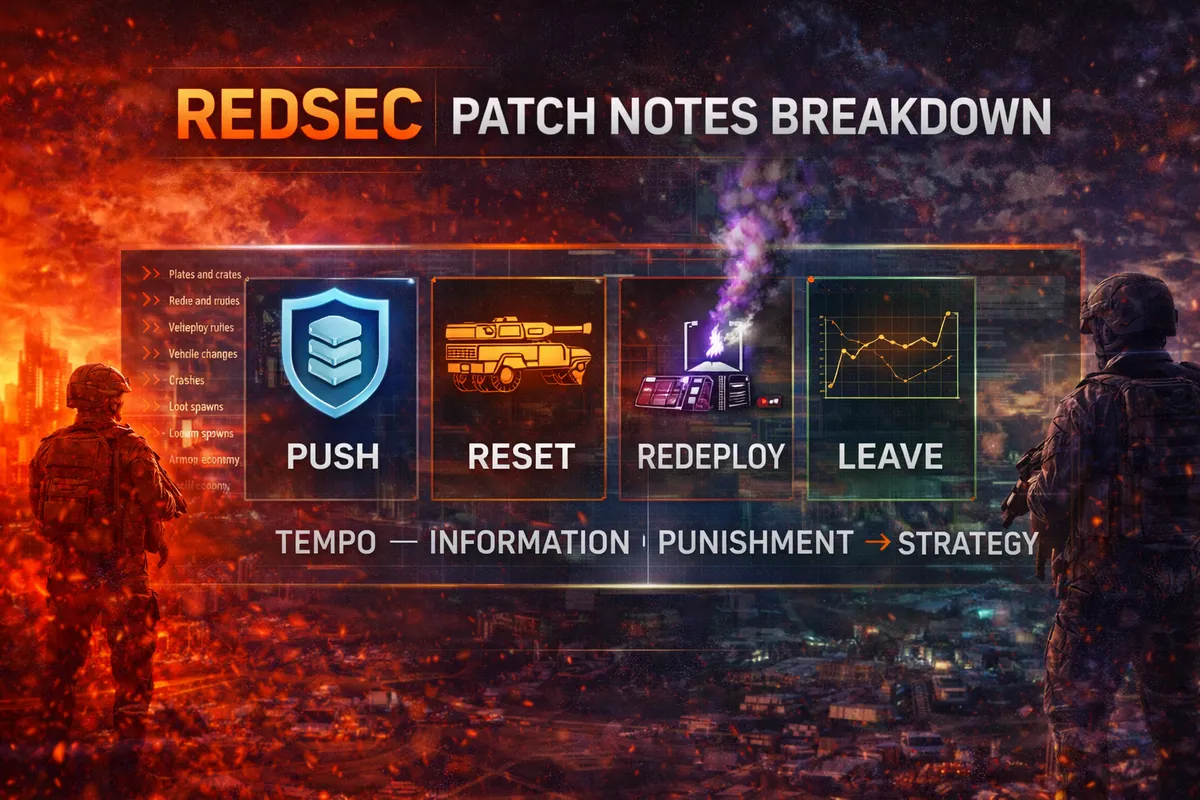
The Patch Notes Categories That Matter Most
Most patch notes are long. You don’t need to obsess over every line. You do need to pay attention to the categories that consistently change your win rate:
- Armor and looting economy (plates, crate behavior, loot reliability)
- Respawn and redeploy systems (Second Chance, redeploy towers, mobile redeploy)
- Vehicles and anti-vehicle pacing (tank access, keycards, mission rewards, counterplay tools)
- Weapon handling consistency (dispersion, recoil, sprint-to-fire, ADS stability)
- Call-ins / strike packages (how fast they land, how they deny space, how they create noise)
- Audio, ping, and UI (directionality, marker reliability, clarity during chaos)
If you only read these categories every update, you’ll still adapt faster than most players.
Your Post-Patch 15-Minute Update Routine
After every patch (big or small), do this once and you’ll feel “caught up” without grinding.
- 5 minutes: Find the 5 lines that change tempo
- Anything that changes armor drops, loot containers, redeploy timing, vehicle access, or call-in speed changes tempo.
- 5 minutes: Build a “one-match test plan”
- Example: “We’re going to hunt Ambulances, test Mobile Redeploy placement rules, then play inside-edge and watch for tank frequency.”
- 5 minutes: Update one loadout and one route
- One primary gun setup + one early loot route = you’re ready to win again. Don’t rebuild your whole identity in one night.
This is how good squads adapt faster than the meta.
Update Timeline: The Changes That Shaped REDSEC Strategy
To make this easy, here’s the timeline of major changes and what they meant:
- Season 1 launch update (late Oct 2025): big “feel” improvements—movement, weapon behavior, visibility, audio, UI clarity.
- Early stability patches (Nov 2025): major exploit removal and gunplay fixes; REDSEC match flow and redeploy issues addressed.
- Portal progression crackdown (Oct–Nov 2025): bot-farm XP nerfs, verified experience rules, bot backfill changes.
- Winter Offensive update (Dec 2025): important REDSEC systems tweaks (redeploy beacon behavior), weapon tuning (railgun), loot placement reliability improvements.
- Armor economy changes (Dec 2025 → Season 2): minimum plate drops and additional plate sources to reduce “armor drought.”
- Season 2 update (mid Feb 2026): mobile redeploy tools, tank pacing adjustments, loot container identity, call-in speed improvements, more reliability fixes.
Now let’s break down what each one changed for how you should play.
Season 1 Launch Update: The “Feel” Patch That Changed Every Fight
Season 1’s launch era patches were about making REDSEC feel stable and readable. The big strategic consequences came from changes like:
- More predictable weapon behavior (dispersion and handling consistency)
- Visibility and lighting improvements (interiors and transitions felt clearer)
- Audio overhaul (better battlefield readability)
- Movement refinements (vaulting, landings, stance transitions)
- UI/HUD clarity improvements (better feedback and consistency)
What this changed for strategy:
When a game becomes more readable and more consistent, the “smart” playstyle gets stronger. Why? Because the fewer random-feeling moments you have, the more you can rely on fundamentals: early rotations, tight teamfights, quick resets, and controlled pushes.
How to adapt (still true today):
- Build your identity around repeatable systems (loot fast, rotate early, fight short, reset fast).
- Favor positions with cover and escape routes rather than gambling on aim duels.
- Use clearer visibility/audio to play like you have “extra information” (catch pushes earlier, stop getting surprised).
Update 1.1.1.5: Exploits Removed, Gunplay Stabilized, REDSEC Flow Fixed
This patch era mattered because it removed “unfair wins” and cleaned up key systems:
- The infamous drone-based elevation exploit was fixed, removing unintended rooftop/skybox plays.
- Lock-guided missiles and countermeasures interaction issues were addressed (huge for vehicle balance and fairness).
- Soldier gunplay issues involving dispersion and sprint-to-ADS behavior were fixed.
- REDSEC-specific match flow and redeploy bugs were fixed (matches ending properly, Second Chance/UI transitions behaving).
What this changed for strategy:
- High-ground cheese became less reliable, so real rotations and real power positions mattered more than glitch spots.
- Vehicles became more predictable to counter, so squads with a real anti-vehicle plan stopped feeling helpless.
- Gunfights became more consistent in those “first second after sprint” moments, which made CQB and entry play feel less random.
How to adapt:
- Stop hunting “broken” angles and start claiming legitimate power pockets early.
- If you play vehicles, assume counterplay works more reliably—don’t overextend.
- If you hate vehicles, start carrying at least one anti-vehicle answer more often because your tools now behave more predictably.
Portal Progression Changes: Why Patch Notes Changed the Playerbase
Portal changes aren’t “just XP.” They change who is in your lobbies and how fast the average player improves.
When XP farming was heavily targeted, and Verified Experiences / bot rules were adjusted, a lot of players shifted back into standard matchmaking for progression. That affects REDSEC indirectly:
- More players queue standard playlists to level gear, so matchmaking pools shift.
- Portal becomes more “training and fun” and less “progression factory.”
- The average player may show up with stronger fundamentals over time (because practice modes still exist, but progression isn’t the only reason to use them).
Strategic effect inside REDSEC:
More players take fights faster and rotate earlier when they’ve trained mechanics elsewhere. That increases third-party pressure in popular zones and makes “slow, messy fights” even more dangerous.
How to adapt:
- End fights faster or disengage faster.
- Rotate earlier than you used to, because more squads collapse on noise.
- Treat Portal as warm-up and drills, not as your core grind plan.
Winter Offensive Update 1.1.3.0: Redeploy Rules, Call-Ins, and Weapon Tuning
This update mattered because it included the kind of “small line” changes that alter real matches:
- A major weapon tuning point (railgun damage behavior versus armored targets) changed how safe it was to peek certain mid-range lanes.
- A redeploy rule change meant triggering a redeploy tower/beacon could disable or destroy another active one for the same team—this reduced “stacked safety nets.”
- Call-in reliability fixes (like smoke cover timing) and UAV behavior changes affected how teams cross open ground and deny space.
- Loot box placement and some match stability issues were improved.
What this changed for strategy:
- Redeploy became a commitment decision. You couldn’t treat towers/beacons like casual “spam it whenever.” You had to choose the right moment and place.
- Smoke and call-in timing became more reliable, which makes smart rotations and safe resets stronger.
- Weapon tuning changes forced players to respect certain sightlines differently.
How to adapt:
- Treat redeploy triggers like an objective: clear area, commit, defend, then move.
- Save smoke cover or equivalent utility for the moments you must cross—don’t waste it early if late-match activation reliability is a known variable.
- If a weapon becomes a “peek punisher” after a buff, stop offering it free lines: rotate through cover, not open lanes.
Armor Economy Changes: Why Midgame Stopped Feeling Like a Plate Lottery
Armor is the most important currency in REDSEC because it determines how many mistakes you can survive and how many fights you can win in a row.
When the dev team moved toward minimum plate drops on death and later expanded plate availability (including plates appearing in class crates), it changed the entire rhythm of the match:
- Winning fights started to reliably “refuel” squads instead of leaving them plate-negative.
- More squads had plates in mid/late circles, which increased fight length and reduced the “one crack = win” feel.
- More resets became possible, which increased third-party frequency and made discipline more important.
What this changed for strategy:
- You can take slightly more fights without your entire match collapsing from one bad reset.
- But you must expect enemies to re-plate more often, meaning you need better conversion: focus fire, fast pushes off cracks, and revive denial.
How to adapt:
- Run larger mags more often. Long fights punish small magazines.
- Convert cracks into position or downs quickly—chip damage matters less when plates are more available.
- Carry at least one “fight closer” tool (smoke, flash, breach options) so you can actually finish fights instead of trading forever.
Season 2: The Update That Changed Endgame Strategy the Most
Season 2’s REDSEC changes focused on four areas that directly rewrite strategy:
- Squad survivability: new redeploy options that can bring teammates back even when towers are scarce.
- Armor predictability: more reliable plate availability and restock routes.
- Vehicle pacing: less back-to-back tank chaining via mission reward timing adjustments.
- Loot identity: containers and vehicles having clearer “roles” in what they reward.
This is one of those updates where “small lines” change everything.
Mobile Redeploy Strike Package: The New Endgame Magnet
A portable redeploy tool changes endgame in a way players often underestimate: it creates a visible, defendable objective in the middle of BR chaos.
Key characteristics (as described in Season 2 coverage and community update summaries):
- It must be placed outdoors with a clear view overhead.
- It produces visible purple smoke while active.
- It has a delay before teammates can return, creating a window where enemies can push or destroy it.
- It’s found in specific loot sources (often tied to certain vehicles/containers and missions).
What this changes for strategy:
- Endgame squads can recover from a wipe scenario more often, meaning “one down” doesn’t always snowball into a full win.
- Purple smoke becomes a new “third-party signal.” If you see it, a squad is temporarily weak and distracted—or baiting you.
- Holding a safe pocket becomes even more valuable because you can redeploy from control rather than searching the map.
How to use it correctly:
- Place it only when you already have a defendable pocket (hard cover, limited angles, a fallback reset spot).
- Don’t place it the moment someone dies. First: clear threats, reposition, then deploy.
- Assign roles during the redeploy window: two watch lanes, one watches flank, one manages the device/loot.
How to punish enemy redeploy safely:
- Don’t sprint at smoke solo. Treat it like a fight: approach with cover, look for the weakest angle, delete one player, then collapse.
- If you can’t finish quickly, leave. A stalled redeploy fight attracts multiple squads.
Vehicle Keycard Cooldowns: The “Tank Wave” Meta Instead of Tank Spam
When vehicle access becomes less chainable through mission reward loops, vehicle pressure changes shape:
- Tanks and heavy armor show up in more defined windows (“waves”) instead of feeling constant.
- Destroying an enemy tank has more value because replacement isn’t instant.
- Anti-vehicle planning becomes more strategic: you can time your resources around expected armor windows.
What this changes for strategy:
- Engineers become even more valuable in endgame, but you don’t always need “everyone anti-vehicle all match.”
- If you control a tank, you must use it for a purpose (break a position, force rotation, secure an objective) because the lobby is more likely to focus you when tanks are rarer and more impactful.
How to adapt:
- Always keep one anti-vehicle answer in a squad, but don’t waste it early on low-value pokes. Save for the actual armor window.
- If you kill a tank, immediately rotate and take space—there’s a moment where the enemy’s “armor threat” is gone and they must play infantry.
Looting Changes: Container Identity and Why Routes Matter More Than Ever
Season 2 emphasized looting as “nested in physical containers” and more themed sources. The practical gameplay effect is simple:
Loot is becoming more predictable if you learn the sources.
That rewards squads who plan routes.
Examples of how “loot identity” changes strategy:
- Certain vehicles lean toward CQB tools and shotgun-focused kits.
- Ambulances become a high-value target because they can reliably provide revive-related utility and certain key items.
- Anti-vehicle sources become more important when tank pacing is tuned: you can route to them when you expect armor pressure.
How to adapt:
- Stop looting random buildings for 4 minutes. Build a 2–3 stop route: one “plates + ammo” stop, one “utility” stop, one “mission” stop.
- Decide your match identity early: CQB bully, mid-range beam team, recon pick team, vehicle team. Then loot routes should match that identity.
- If your squad is weak on plates midgame, route toward class crates and known restock sources rather than gambling on random floor loot.
Ping, Audio, and UI Fixes: Small Patch Notes, Huge Win Rate
Players underestimate quality-of-life patch notes because they don’t sound “meta.” But they change your ability to coordinate.
When ping reliability improves (especially at range), long-lane fights get cleaner:
- faster focus fire
- fewer “he’s on my screen” comms
- better coordinated third parties
When vehicle and footstep directionality improves, your survival improves:
- fewer surprise pushes
- faster reads on approaching armor
- better rotation decisions (you hear the fight lane before you see it)
When UI fixes remove weird Second Chance widgets/timers or fix markers, you make better decisions under pressure.
How to adapt:
- Ping earlier and more often, then shoot. Information first.
- Build a habit: whenever pings feel more reliable after an update, your squad should widen spacing slightly to create better crossfires because coordination is easier.
- Re-check audio mixes after big updates. If directionality improves, you may benefit from a more dynamic mix again (rather than heavy compression).
Weapon Handling and Recoil Updates: How to Rebuild Your Loadouts After Any Patch
A lot of “weapon meta” changes aren’t a single gun buff. They’re changes to how recoil compensation, dispersion, sprint-to-fire, or ADS stability behaves across whole categories.
What that changes strategically:
- Mid-range beams become more consistent, so rotating in open lanes becomes more dangerous.
- Close-range weapons become more decisive, so building pushes become more rewarding—if you have smokes and trade spacing.
- If recoil becomes more predictable overall, “comfort guns” win more because skill and repetition matter more than randomness.
The post-patch loadout rule:
Don’t rebuild everything. Rebuild one primary and one secondary.
- Pick one gun category for your main range (mid-range AR/LMG/DMR).
- Pick one gun category for “save me” fights (SMG/shotgun/fast AR).
- Then adjust attachments for the new feel: if recoil is stronger, go stability; if recoil is smoother, go handling.
Your fastest meta test:
In your first two matches after a patch, intentionally take:
- one CQB fight
- one mid-range fight
- one long-range peek
- If any category feels off, adjust one setting or one attachment—not your whole identity.
Call-Ins, Drop Speed, and Denial: Why Timing Became More Important
Updates that change drop speed of rewards (custom weapon drops, supply drops, mission rewards) or introduce new strike packages change match tempo.
Faster drop speed means:
- less “standing in the open waiting”
- more reliable contest moments
- faster third-party spikes (because more squads converge on consistent timing)
Gas/area-denial strike packages (and similar tools) change how you hold and clear pockets:
- You can deny a stair, deny a roof, deny a final pocket, or force a rotation.
- That increases the value of having a “clean escape route” and increases the value of holding inside-edge cover.
How to adapt:
- Don’t treat strike packages like “damage.” Treat them like “movement forcing.” Use them to make enemies leave cover, not to farm hits.
- When drops become faster/more reliable, stop arriving late to contest moments. Either arrive early and own the area—or skip and rotate for placement.
Rotation Meta After These Updates: Safe Pockets Beat Loud Fights
As armor and redeploy tools become more available, fights become more survivable—but also more likely to attract multiple squads.
That pushes the rotation meta toward:
- earlier rotations
- inside-edge pocket control
- short fights with fast resets
- avoiding “middle-of-nowhere” poke wars
How to adapt:
- Plan your rotate around where you can reset, not where you can shoot.
- Fight only when the fight upgrades position, plates, or time.
- Assume every fight creates a third party. Win fast or leave fast.
How Different Playstyles Should Adapt After Any Patch
Aggressive squads (hot drops, constant pushes)
- Armor buffs mean enemies reset more: you must push off cracks faster and deny revives better.
- Mobile redeploy means you must confirm wipes and control the area longer after a win.
Smart squads (rotations, power pockets, endgame)
- You benefit the most from predictable loot and better comm tools.
- Your goal becomes even clearer: rotate early, claim pocket, punish late movers.
Vehicle squads (armor-first identity)
- Vehicle pacing changes mean each tank window matters more.
- Don’t “exist in the open.” Use armor to break a position, then transition to foot play.
Recon/pick squads (sniping, scouting, overwatch)
- Better ping/audio means your value increases—information converts faster.
- But redeploy tools mean one pick doesn’t always end a squad; you need conversion plans.
Practical Rules: Patch-Proof Strategy Checklist
- After every update, identify what changed tempo: armor, redeploy, vehicles, loot, call-ins.
- If plates become easier, expect longer fights—bring bigger mags and stronger conversion.
- If redeploy gets easier, expect more endgame squads—confirm wipes and defend pockets.
- If vehicle pacing changes, time your anti-vehicle resources for the “armor window.”
- If loot becomes more container-themed, build 2–3 stop loot routes instead of random looting.
- If ping/audio/UI improves, use it: ping earlier, create crossfires, stop getting surprised.
- If a fight stalls, leave. Modern REDSEC punishes stalled fights harder every season.
- Endgame rule stays the same: arrive early, micro-rotate, save smoke, don’t panic sprint.
BoostRoom: Stay Ahead of the Meta Instead of Chasing It
Patch notes can either make you feel behind—or they can become your advantage. The difference is whether you turn changes into a plan.
BoostRoom helps players and squads adapt fast after updates by building:
- a post-patch checklist tailored to your role (Entry, Anchor, Scout, Support)
- updated loot routes based on current container identity and economy
- redeploy and endgame plans that account for mobile redeploy tools and plate availability
- vehicle pacing counters (when to run anti-vehicle, when to rotate away, when to punish)
- “first week of a patch” practice routines so your muscle memory catches up quickly
If you want your squad to feel confident after updates instead of confused, a patch adaptation system is one of the fastest ways to win more.
FAQ
How often do REDSEC updates change strategy?
Even small patches can change strategy when they touch armor, redeploy systems, vehicles, or loot reliability. Those systems decide tempo and survivability.
What’s the biggest mistake players make after patch notes?
They keep playing the old tempo. If plates are easier and redeploy is stronger, fights last longer and third parties arrive more often—so you must finish fast or leave fast.
How does Mobile Redeploy change endgame?
It creates a defendable respawn objective that can extend fights and bring squads back late. You must either defend it properly or punish it as a unit, not solo.
If armor is more available, should I play more aggressive?
You can, but only if you convert faster. More plates means more resets for everyone, so chip damage matters less and clean pushes matter more.
Do vehicle pacing changes mean Engineers are less important?
No. Engineers stay important because a single tank window can still decide a match. The change is you may have clearer “armor waves” instead of constant spam, so timing and resource saving matter more.
What should I test first after a big update?
Test one close fight, one mid-range fight, and one rotation crossing. Then adjust one loadout and one route—not your whole game.
Where should I look for the real “meta changes” in patch notes?
Look for economy changes (plates/loot), redeploy rules, vehicle access rules, weapon handling consistency changes, and call-in timing changes. Those move the win conditions.



