Fort Lyndon Map Layout in One Mental Picture
Fort Lyndon has 21 named points of interest (POIs): Marina, Evac Alpha, Ocean Park, Lighthouse, Downtown, Boutique District, Evac Bravo, Vista Hills, Crash Site, Defense Nexus, Security Gate, Golf Course, Ground Zero, Lyndon Oilworks, Redline Storage, Treatment Plant, Area 22B, Chemical Storage, Combat Training, The Seal, and Radar Site.
Instead of memorizing everything as 21 separate places, you’ll rotate better if you group Fort Lyndon into four big zones:
- Coast + Beach Line (west/southwest feel): Marina, Ocean Park, Lighthouse, Evac Alpha
- Urban Core (dense buildings): Downtown, Boutique District, Vista Hills, Crash Site
- Industrial Belt (wide lanes + hard structures): Lyndon Oilworks, Redline Storage, Chemical Storage, Treatment Plant
- High Ground + Secure Zones (elevation, military, ridges): Radar Site, The Seal, Area 22B, Defense Nexus, Security Gate, Combat Training, plus the “mountain side” routes
This matters because rotations are different in each zone:
- Coastal rotations are safer with boats and long sightlines.
- Urban rotations are safer through buildings and vertical routes.
- Industrial rotations are safer when you create cover pockets and avoid long open yards.
- High-ground rotations are safer when you don’t get trapped on elevation without exits.
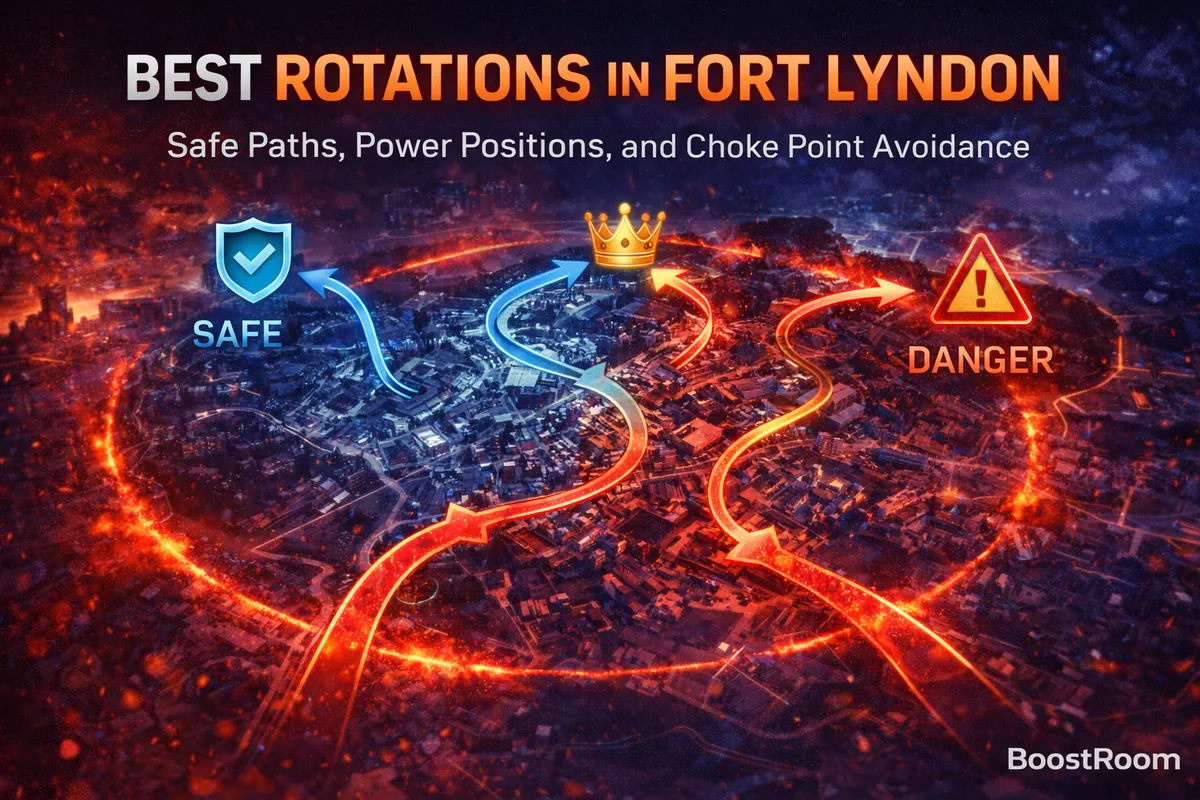
Rotation Wins in REDSEC Because the Ring Is Instant Death
Most BR players learn “storm discipline” over time. REDSEC forces you to learn it now because the firestorm boundary is instantly lethal on contact. You can’t make heroic late plays through the ring. If you get stuck, you die.
This changes rotation fundamentals:
- You rotate earlier than you think you should.
- You fight shorter than you think you should.
- You treat choke points like actual death zones, not “maybe we can squeeze.”
- You build “escape routes” into your rotation plan from the start.
A strong REDSEC rotation plan is not “we’ll figure it out later.” It’s:
Loot fast → choose lane → claim power pocket → move in short steps → win endgame.
The Rotation Stack: 5 Decisions That Make Rotations Easy
When a rotation feels chaotic, it’s usually because you skipped one of these decisions.
Decision 1: Edge or center style
- Inside-edge (safer): rotate early, keep one side protected by the circle edge, punish late movers.
- Center power (riskier): take a strong central pocket early, defend multiple angles, survive third parties.
Decision 2: Your lane
Pick a lane and commit: coastal lane, urban lane, industrial lane, or ridge lane. Switching lanes late creates exposure.
Decision 3: Your next pocket
Don’t rotate to “the zone.” Rotate to a specific cover pocket inside the zone: a building cluster, a ridge dip, an industrial wall line, a compound edge.
Decision 4: Your crossing tool
If your lane includes open ground, your plan must include a tool: smoke, vehicle taxi, boat, destruction-made cover, or a longer covered path.
Decision 5: Your fight rule
You must decide what fights are allowed during rotation. The best default rule is:
If the fight can’t end fast, don’t start it.
Reading Circle Behavior Early (So You Stop Guessing)
You don’t need perfect circle prediction to rotate well. You need early information and early positioning.
Here’s a simple routine:
- After first safe zone appears: choose your lane and your next pocket immediately.
- After the first collapse starts: watch which direction the circle “leans” and adjust your lane once (at most).
- Before second collapse: stop looting and begin movement if your lane will funnel through open ground.
Practical takeaway: you only get a few minutes where you have multiple safe options. Use that time. If you wait until the last warning, your “options” become one desperate funnel.
The Four Fort Lyndon Rotation Lanes
These are not strict roads — they’re the most repeatable safe concepts for movement across the map.
Coastal Lane: Marina → Ocean Park → Lighthouse → Evac Alpha
What it’s good for
- safer movement with long sightlines
- boat rotations along the coast
- fewer “surprise” angles (you can see more of the approach)
What it’s risky for
- open beaches and exposed crossings
- squads posted on inland high ground shooting toward the coast
How to play it safely
- Hug hard cover (buildings, walls, rocks) rather than running shoreline open.
- Use boats for distance, then dismount behind cover — don’t “drive into the fight.”
- If you’re being beamed from inland, rotate behind structures instead of ego-peeking the same line.
Best use case
You want a safe start, then a clean rotate into midgame without getting caught in urban chaos.
Urban Lane: Downtown ↔ Boutique District ↔ Vista Hills ↔ Crash Site
What it’s good for
- the most cover density on the map
- the easiest micro-rotations through buildings
- the best opportunities to avoid long sightline beams
What it’s risky for
- third parties (urban gunfights attract squads fast)
- getting trapped in a building with a bad exit when the ring forces movement
- destruction changing your “safe” holds
How to play it safely
- Rotate building-to-building, not street-to-street.
- Create an extra exit in any building you plan to hold (breach a safe-side wall).
- Don’t loot in the open after fights; loot plates fast, then reposition to a new building block.
Best use case
You want consistent endgames because you can always find cover, and you like close-mid fights.
Industrial Lane: Lyndon Oilworks ↔ Redline Storage ↔ Chemical Storage ↔ Treatment Plant
What it’s good for
- predictable structures and hard cover walls
- strong mid-range fights if you control angles
- vehicle availability for faster rotates
What it’s risky for
- long open yards that punish late movement
- “lane traps” where multiple squads can watch one crossing
- loud fights that draw third parties from far away
How to play it safely
- Rotate from structure pocket to structure pocket (containers, walls, buildings).
- Avoid crossing open industrial yards unless you have smoke or vehicle cover.
- Use destruction to create rubble berms and crossing pockets when natural cover is weak.
Best use case
You want to play smart, beam at mid-range, and punish rotations with controlled angles.
Ridge and Secure Lane: Radar Site ↔ The Seal ↔ Combat Training ↔ Area 22B / Defense Nexus / Security Gate
What it’s good for
- elevation control and recon visibility
- strong overwatch on forced rotation lanes
- safer early scouting and “information advantage”
What it’s risky for
- high ground turning into a trap when zone pulls away
- getting gatekept during descent
- being targeted by multiple squads because you’re visible
How to play it safely
- Treat high ground as a temporary tool: get info, get picks, then move early.
- Always plan your descent route before you take a ridge.
- If multiple squads start shooting toward your ridge, leave — don’t become the lobby’s target.
Best use case
You want to control the lobby with information and picks, then rotate into endgame with a positioning advantage.
Power Positions: Where to Rotate To, Not Just Where to Survive
A “power position” in Fort Lyndon is not simply “high ground.” It’s a location that gives you:
- hard cover
- multiple exits
- sightlines onto forced rotation routes
- safe reset pockets for plating and revives
- the ability to disengage if third-partied
Below are the most reliable power positions by phase, using named POIs so your squad can call them quickly.
Early Power Positions (Get Stable Without Getting Forced)
Vista Hills (residential cover)
- Houses provide fast loot and safe resets.
- Multiple exits reduce trap risk if you don’t overcommit to one building.
- Good “warm start” that transitions into urban or golf course rotates.
Evac Bravo / Combat Training (edge stability)
- Good for players who like calmer starts and early rotation discipline.
- Works best when you rotate early (edge drops become dangerous if the circle pulls away).
Marina (loot + boats + exits)
- Strong for squads that want coastal control and options.
- Be careful: open areas can punish you if you rotate late or take long fights.
Radar Site / The Seal (early information + picks)
- Great for scouting and early picks.
- The key is leaving early if circle pulls away.
Midgame Power Positions (Where Rotations Start Getting Deadly)
Golf Course (mixed cover + sightlines)
- Open greens punish movement, but buildings and edges can be strong.
- Great for squads that want to control mid-range with clear vision.
Defense Nexus / Security Gate (control points)
- Often become rotation funnels because they feel like “important” map features.
- Strong if you arrive early and control entrances, risky if you arrive late.
Redline Storage / Oilworks edges (industrial control)
- Strong for squads that beam mid-range and like hard cover.
- Best played with disciplined crossings and quick resets.
Downtown roofline blocks (urban lane control)
- Powerful when you can rotate roof-to-roof and avoid skyline exposure.
- Risky if you stay static and get third-partied.
Endgame Power Positions (Final Circles, Final 3 Squads)
Endgame power isn’t always one POI. It’s often a pocket that exists where the last circles land. Your job is to recognize power pocket types:
- Inside-edge building cluster: easiest to defend, reduces angles.
- Ridge dip with hard cover: great sightlines, safe reset behind terrain.
- Industrial wall + rubble berm: strong mid-range control with safe crouch cover.
- Compound corner with two exits: lets you survive if the last pull shifts.
If you learn to play pockets rather than “names,” your endgame improves dramatically.
Choke Points: The 7 Places Rotations Go to Die
Choke points aren’t only bridges. A choke point is any place where multiple squads are forced through the same small space with limited cover.
Here are the most common choke point types in Fort Lyndon (and what to do about them):
1) Bridges and narrow crossings
- These become kill funnels when the circle forces water or canal crossings.
- Fix: rotate earlier, cross before pressure, or use boats to choose a safer crossing angle.
2) Gates and controlled entrances (Security Gate style)
- Entrances attract squads because they “feel like the only way through.”
- Fix: arrive early and hold, or avoid completely by taking longer cover routes.
3) Valley passes and ridge descents (Seal/Radar side)
- High ground becomes a trap when everyone must descend through the same pass.
- Fix: never wait until last second to drop; choose a descent while you still have options.
4) Open industrial yards
- They look “short,” but they are exposed and get watched by multiple angles.
- Fix: cross only with smokes, vehicles, or after clearing angles and taking an off-angle first.
5) Urban street lanes between tall blocks
- These feel like “safe city streets,” but they become crossfire zones from windows and rooftops.
- Fix: rotate through buildings and alleys; cross streets only after checking angles.
6) Evac points when active (Evac Alpha / Evac Bravo zones)
- When evac objectives activate, squads converge.
- Fix: treat evac like a power position battle: arrive early or skip and rotate for placement.
7) Post-fight loot piles
- The “body pile” is the deadliest choke point because you stop moving.
- Fix: plate, reload, loot plates fast, then move to a safer pocket before sorting gear.
Choke Point Avoidance: The “Two Route” Rule
The easiest way to stop dying in choke points is to follow one rule:
Never start a rotation unless you have two routes.
- Route A is your primary covered path.
- Route B is your fallback if you hear a fight, see a vehicle, or spot a gatekeep.
You don’t need to fully run Route B, but you must know what it is before you move. If you only have one route, you’re rotating into a trap.
Safe Paths: How to Move Without Getting Beamed
“Safe pathing” in Fort Lyndon means you move through cover and reduce the angles that can see you.
Use these three safe-path habits:
Habit 1: Move cover-to-cover, not point-to-point
Instead of “we’re going to Downtown,” think “we’re going to that wall, then that building, then that alley, then that roof pocket.”
Habit 2: Keep one side protected
Inside-edge rotations are powerful because the ring edge protects one side from being shot. You reduce the number of threats.
Habit 3: Use micro-rotations
In late circles, moving 10–20 meters at the right moment is safer than sprinting 80 meters under pressure.
Micro-Rotations: The Most Important Skill in Final Circles
A micro-rotation is a small planned move between cover pockets, usually 5–20 meters. Most endgame losses happen because squads don’t micro-rotate — they panic sprint.
How to micro-rotate correctly
- Ping a specific pocket (not “over there”).
- Move as a unit in trade distance.
- Smoke the enemy sightline if needed.
- Plate only after you reach cover.
When to micro-rotate
- when another team starts fighting (eyes off you)
- when the ring forces other squads to move first
- when your Scout confirms the next pocket is clear
- when you have smoke ready and the crossing is short
What not to do
- stop mid-lane to shoot
- split into different pockets
- loot mid-move
- Micro-rotations win because they keep you alive long enough to take the final fight from advantage.
Vehicle Rotations Without Feeding: Taxi, Ditch, Win
Vehicles are a core Battlefield advantage, but in REDSEC they’re also a loud signal flare.
The vehicle rotation rule:
Use vehicles to buy time early, then ditch them before the map becomes small.
Best vehicle rotation pattern
- Use a vehicle to cover the long distance early.
- Park behind hard cover (not in open).
- Dismount and finish the last part on foot so you don’t announce your position in endgame.
When vehicles are a mistake
- when you’re already in zone with good cover
- when the circle is small and roads become funnels
- when multiple squads can focus you from rooftops or ridges
Boat rotations (coastal advantage)
Coastal movement becomes safer when you use boats for distance and avoid exposed shoreline sprints. Boats are strong for repositioning along Marina/Ocean Park/Lighthouse lines — just don’t drive straight into the loudest fight.
How to Break a Gatekeep (Without Throwing Your Match)
Eventually you will be gatekept: a squad holds the only good route, the ring is closing, and you must move.
Use one of these solutions:
Solution 1: Take the long route early (prevention)
The best gatekeep counter is not being late. Rotate early so you can choose a safer route.
Solution 2: Smoke and cross in one clean move
Smoke the enemy sightline (not your feet), move as a unit, and commit to one pocket. Don’t stagger.
Solution 3: Create cover with destruction
If you’re crossing a lane with no cover, create cover by destroying structures that form rubble pockets and half walls.
Solution 4: Use vehicle taxi + dismount
If the lane is too open, vehicle speed can reduce exposure time. Dismount behind cover and continue on foot.
Solution 5: Fight for an off-angle, not the main angle
Don’t push into the gatekeep’s strongest line. Take a side angle through buildings, terrain dips, or industrial walls, then cross when the gatekeeper must split attention.
Gatekeeps are won by timing and angle changes, not by ego sprinting through the funnel.
Squad Roles for Rotations: IGL, Scout, Anchor, Entry
Rotations improve instantly when jobs are clear:
IGL (caller)
- calls lane choice and leave timing
- calls “stop looting, rotate now”
- decides when to disengage
Scout (information)
- checks the next pocket before the squad crosses
- pings enemy squads and vehicles
- warns of third-party risk and gatekeeps
Anchor (safety)
- watches back angles during movement
- protects resets and revives
- holds the “don’t get wiped while moving” angle
Entry (space maker)
- clears the first building or first cover pocket
- pushes off advantages when you must fight through a rotation
- creates space without overextending
You don’t need perfect comms. You need one person calling timing, one person scanning, one person protecting, and one person taking space.
Rotation Templates From Each Major Zone
Use these as “default ideas” — not rigid rules. The goal is to give you a starting plan every match.
If You Start Coastal (Marina / Ocean Park / Lighthouse / Evac Alpha)
Safe rotate plan
- Move inland early unless the circle clearly favors coast.
- Use boats for distance, then transition to hard cover pockets.
- Avoid exposed beach sprints when midgame squads take inland high ground.
Power position goal
- Secure a building cluster or ridge-adjacent pocket where you can punish late movers.
Common mistake
- staying too long on the shoreline and getting forced into a late crossing.
If You Start Urban (Downtown / Boutique District / Vista Hills / Crash Site)
Safe rotate plan
- Rotate building-to-building, then exit the block before the ring forces you into a street funnel.
- Create a safe-side breach exit in any building you plan to hold.
- After fights, reset and move — urban fights attract third parties fast.
Power position goal
- Control a block edge with inside-edge protection and multiple exits.
Common mistake
- looting too long in the same building after a wipe.
If You Start Industrial (Oilworks / Redline Storage / Chemical Storage / Treatment Plant)
Safe rotate plan
- Avoid crossing open yards without smoke or vehicle taxi.
- Use hard cover walls and structures as your stepping stones.
- Treat industrial lanes as “beam zones” — don’t be the squad running in the open.
Power position goal
- Own a structure pocket that watches forced crossings.
Common mistake
- taking long mid-range poke wars that drain plates and invite third parties from far away.
If You Start High Ground / Secure (Radar Site / The Seal / Area 22B / Defense Nexus / Security Gate / Combat Training)
Safe rotate plan
- Use high ground for information and picks, not for permanent camping.
- Plan your descent early and avoid being forced down late.
- If the circle pulls away, leave early and take the next pocket first.
Power position goal
- Transition from height into a strong midgame pocket with cover and exits.
Common mistake
- “high ground greed” — dying because the circle forced a bad descent.
Smokes and Rotations: The Most Reliable Crossing Tool
If your squad wants instant improvement in rotations, carry smokes more often and use them intentionally.
Best smoke uses for rotation
- crossing an exposed street or yard
- reviving safely during movement
- plating safely after being cracked mid-rotate
- blocking a gatekeep sightline long enough to reach cover
Smoke rule
Smoke the enemy’s sightline and your crossing lane — not your own feet. If you blind your own squad, you turn a safe rotation into chaos.
Smart Fight Selection During Rotations
The biggest rotation throw is starting a fight that lasts too long.
Use this fight filter:
Take the fight if
- you can down someone quickly (surprise, off-angle, third party)
- the fight gives you a stronger power position
- the ring timing is safe and you won’t be forced mid-fight
Avoid the fight if
- it’s a long mid-range poke war with no conversion
- it delays your rotate into a choke
- it drains plates without giving position
- you hear another squad nearby (third-party risk spikes)
A simple rule:
If a fight hasn’t produced a down or clear advantage quickly, change the angle or disengage and rotate. Endgames are won by squads that arrive early, not squads that “almost won a long fight.”
Practical Rules: Fort Lyndon Rotation Checklist
- Rotate early because the firestorm is instant death.
- Choose a lane (coast, urban, industrial, ridge) and don’t switch late.
- Rotate to a cover pocket, not “the zone.”
- Always have two routes.
- Avoid choke points: bridges, gates, valley passes, open industrial yards.
- Use vehicles as taxis early; ditch before endgame.
- Use boats for coastal distance, then transition to cover.
- Micro-rotate in late circles (5–20 meters) instead of panic sprinting.
- Save at least one smoke for the final forced move.
- After any fight: plate, reload, watch angles, loot plates fast, then move.
BoostRoom Promo: Get a Fort Lyndon Rotation Plan Built for Your Squad
Most squads don’t lose because they “can’t shoot.” They lose because they rotate late, hit a choke, and get forced into a fight they didn’t choose. A real rotation system fixes that fast.
BoostRoom can help you build a repeatable Fort Lyndon rotation plan that matches your playstyle:
- safe-start routes (coast, edge compounds, calmer POIs)
- aggressive routes (hot drops into fast power positions)
- midgame lane choices that avoid the most common choke traps
- vehicle and boat rotation timing (when to taxi, when to ditch)
- role-based rotation calls (IGL timing, Scout route checks, Anchor safety, Entry space creation)
- endgame micro-rotation routines so your last two moves become consistent instead of panic
If you’re tired of “we got pinched” or “we got forced through a gate,” a structured rotation plan is one of the fastest upgrades you can make.
FAQ
What are the safest rotations in Fort Lyndon?
The safest rotations are cover-heavy lane moves: building-to-building in urban zones, structure-to-structure in industrial zones, and early planned descents from high ground. Coastal rotations can be safe if you avoid open beach sprints and use boats wisely.
What is the best “power position” in Fort Lyndon?
There isn’t one permanent best spot because circles move, but Radar Site and The Seal are powerful for early scouting and picks, while dense building clusters (Downtown/Boutique/Vista Hills blocks) and industrial wall pockets (Oilworks/Redline areas) can dominate midgame and endgame if you arrive early.
How do I avoid choke points when the circle shrinks?
Rotate earlier, plan two routes, and avoid funnels like bridges, gates, valley passes, and open yards. If you must cross, use smokes, vehicles, or a longer covered route.
When should we rotate in REDSEC if the ring kills instantly?
As soon as the next safe area appears, plan your lane and move before you’re forced. The earlier you rotate, the more route choices you keep, and the less likely you get trapped in a funnel fight.
Should we use vehicles for rotations?
Yes, especially early and midgame for long distances — but treat them as taxis. Park behind cover and finish rotations on foot in late circles to avoid becoming a loud target.
How do we beat gatekeepers holding a choke?
Don’t arrive late if you can avoid it. If you must fight through, use smokes and cross as a unit, take an off-angle instead of the main lane, or create cover with destruction before you cross.
What’s the biggest rotation mistake squads make?
Looting too long and rotating too late. Fort Lyndon punishes late moves harder than most maps because the firestorm boundary is instantly lethal and funnels squads into predictable chokes.



