The 6 Fundamentals That Win Almost Every Teamfight
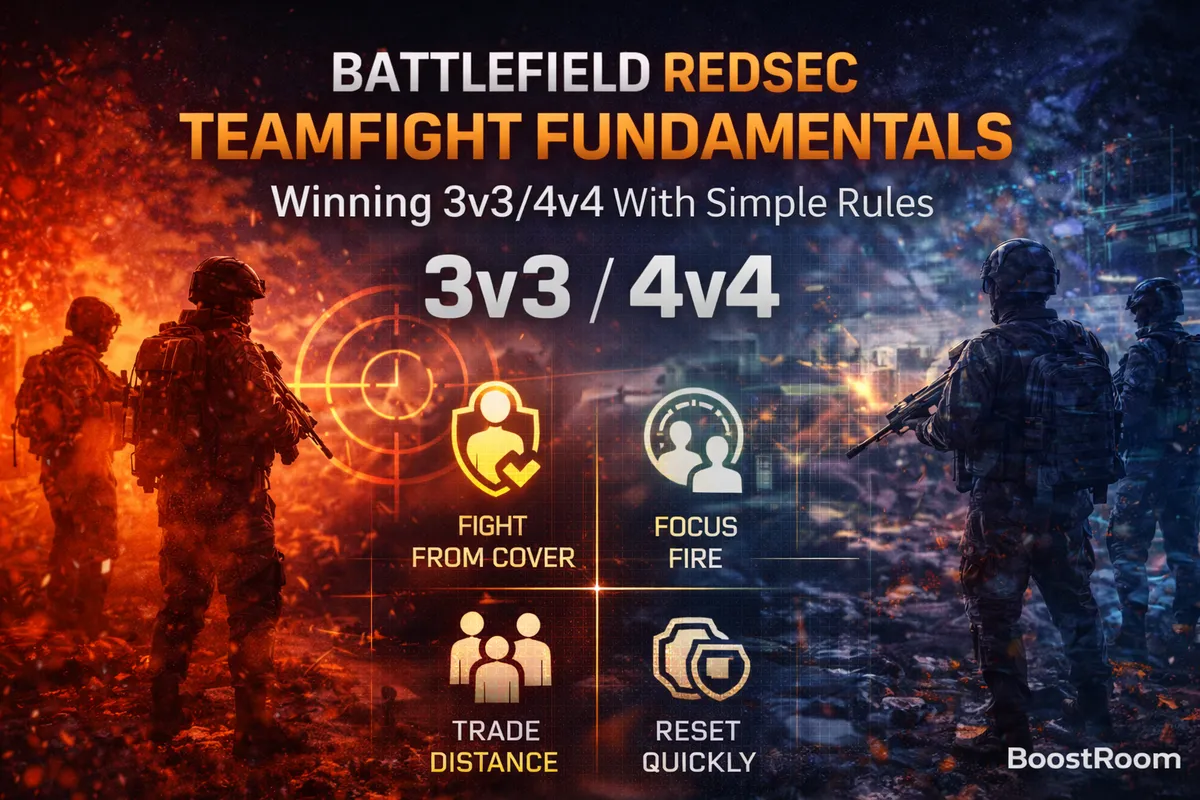
If you want the “simple rules” version, it’s these six. Everything else in this guide is just explaining how to execute them under pressure.
1) Cover first, bullets second
If you shoot while you’re exposed, you give the enemy free damage and force yourself into an early plate reset. Start every fight by taking a position where you can shoot and instantly duck behind hard cover.
2) Same target, same time
Four players shooting four targets is how fights stall and third parties arrive. The fastest way to win is to delete one player as a squad.
3) Trade distance always
If your teammate goes down and you can’t instantly trade the shooter, you’re playing too far apart. Trade distance means you are close enough to punish any enemy who commits.
4) Reset fast or die fast
In REDSEC, plates decide whether you survive the next 10 seconds. Your squad must have a reset routine: plate, reload, reposition, then re-peek.
5) Convert advantage immediately
A crack is not a win. A down is not a win. Advantage only matters if you turn it into a wipe or a position upgrade before another team arrives.
6) End fights before they become loud magnets
Long fights are third-party bait. If the fight isn’t moving toward a wipe, disengage or change the angle. The best teamfights are short, decisive, and boring.
Keep these six on a mental sticky note. Now let’s make them automatic.
The Teamfight Phases: Setup → Opening → Break → Wipe → Reset
Most squads lose because they treat a fight as one continuous blur. Winning squads treat it like phases:
Setup (before shots): position, cover, spacing, utility ready
Opening (first damage): poke for cracks, force movement, don’t overcommit
Break (first down): accelerate, collapse, deny revive
Wipe (finish): isolate remaining players, pinch exits, secure the full clear
Reset (after): plates, reload, watch angles, loot fast, reposition
If your squad learns to recognize these phases, teamfights stop feeling random.
Setup Phase: The 10-Second Checklist Before You Shoot
Most fights are decided before the first bullet because of bad setup. Use this checklist every time you suspect a fight is about to happen.
1) Are we all plated enough to take a real fight?
If two players are half-armored, don’t take a fair engagement. Either reset first or force a quick third-party finish.
2) Are we in trade distance?
In 4v4, your default spacing should look like two buddy pairs: two players close enough to trade for each other, and the two pairs close enough to collapse together.
3) Do we have hard cover and a fallback pocket?
A fallback pocket is a second piece of cover where you can plate and revive. If you don’t have one, you’re gambling.
4) Is our reload state clean?
Entering a fight with a half mag is a classic throw. Reload before you peek.
5) Do we have at least one “crossing tool”?
Smokes are the most universal. They don’t just help pushes—they save you when you get cracked and must rotate.
6) Do we know if another team is nearby?
If you hear another fight close or a vehicle rotating in, assume third party risk. That changes how long you can stay in the fight.
The 10-second rule: If you can’t answer these quickly, you shouldn’t start the fight yet. Reposition first.
Opening Phase: How to Start a Fight Without Throwing It
The opening phase decides whether you fight with advantage or fight from panic.
Your opening goal is not “damage.”
Your opening goal is a crack that can’t be reset easily or a down that can be converted.
Here are the simplest opening patterns that work in REDSEC:
Pattern A: Two angles, one target
- One buddy pair holds the main angle
- The other buddy pair takes a slight off-angle (even 10–20 meters)
- Both pairs shoot the same target when they peek
This creates “no safe cover” for the enemy. They can hide from one angle, but not both.
Pattern B: Hold fire, then focus
If you shoot too early, you warn the enemy and let them take cover. Instead:
- let them step into the open
- call the target
- all guns fire together
- You win by deleting one player before they can react.
Pattern C: Crack → push to better cover
Sometimes the best opening isn’t a full send. It’s using a crack to move.
- crack one player
- advance into stronger cover
- take control of the next pocket
- This wins fights while spending fewer plates.
Opening mistakes to avoid:
- spraying at long range for 40 seconds (noise + plate drain)
- peeking the same corner repeatedly after taking damage
- splitting targets because everyone is “shooting what they see”
Focus Fire: The Simplest Rule With the Biggest Win Rate Impact
Focus fire isn’t complicated. It’s just rare.
The focus fire rule:
If two or more teammates can shoot the same enemy, you should all shoot that enemy until they are down.
Why it wins:
- it removes one gun from the enemy team
- it creates a numbers advantage
- it forces panic revives and bad movement
- it ends fights fast (reducing third-party risk)
How to call focus fire with minimal comms:
- “Focus blue roof.”
- “Focus left door.”
- “Same guy, cracked!”
- “Shoot the pings.”
If you don’t have voice: spam ping the target and shoot only that ping.
The “no hero shots” rule:
Don’t swap targets because you saw a “low guy.” Low guys are bait. The best target is the target your team is already deleting.
Trade Distance: The Rule That Stops Full Squad Wipes
Trade distance means that if your teammate is shot, you can immediately shoot the shooter.
In practical terms:
- if Entry swings a door, Anchor is close enough to shoot the defender
- if Scout takes an off-angle, the off-angle is still within quick collapse distance
- if one player gets downed, the enemy who pushed should die for it
Common trade distance failures:
- one player is sniping 80 meters away while the team pushes indoors
- one player is looting while the team fights
- two teammates chase different angles and both get isolated
The buddy-pair solution (works in every match):
Split into two pairs:
- Pair 1: Entry + Support (push + revive safety)
- Pair 2: Anchor + Scout (hold flank + info + crossfire)
Pairs move together. Pairs shoot together. Pairs reset together. Then the pairs collapse together when the fight breaks.
Crossfires: How to Make Enemies Feel Like They Have No Cover
Crossfire is the secret that makes average aim feel like pro aim.
A crossfire is simply: two angles that punish the same enemy cover.
If the enemy hides behind a wall:
- Angle A hits them if they peek left
- Angle B hits them if they peek right
- Now they are trapped.
Crossfire building blocks you can use every fight:
- one player takes height (roof, stairs, window)
- one player stays ground level holding the exit
- one player holds a long lane to deny escape
- one player anchors behind for third-party protection
Crossfire rule:
Never put all four players on the same line. If you do, one wall blocks all your damage.
Reset Speed: Why Fast Plates Win More Than More Kills
In REDSEC, fights are rarely “one and done.” You crack, plate, re-peek, re-angle, then finish. The squad that resets faster wins.
Your reset routine should be automatic:
- break line of sight
- plate behind hard cover
- reload
- reposition a few steps
- re-peek from a new angle
The plate efficiency trick that saves lives:
When you equip armor, keep holding the armor button through the full animation so you apply multiple plates in one continuous action instead of stopping and raising your weapon between plates. This reduces your vulnerable time and makes resets faster.
Reset mistake: plating in doorways or windows.
Doorways and windows are “bullet magnets.” Plate behind solid corners.
Conversion: Turning a Crack Into a Down (Without Feeding)
Cracks are valuable only if you convert them.
Conversion rule:
If you crack one enemy and you can safely advance to a better position, do it immediately.
Conversion can be one of three things:
- Collapse push: you flood the room because they’re weak
- Angle improvement: you take height or a flank angle
- Exit denial: you block their retreat route so they can’t reset
What not to do:
- chase a cracked player across open ground
- sprint into a doorway where the rest of the team is pre-aiming
- forget your trade distance
The best conversion pattern:
- crack the target
- throw utility to force them to move (smoke/frag/breach)
- push as two players while two hold exits/flanks
- That gives you speed without chaos.
Conversion: Turning a Down Into a Wipe (The “3-Step Collapse”)
Most squads throw after the first down because they get greedy. The best squads use a simple 3-step collapse.
Step 1: Deny the revive lane
The downed player’s teammates must do one of two things: revive or run. Your job is to make revive impossible.
- hold the downed body from cover
- hold the doorway/staircase
- use explosives if they’re behind a predictable wall
Step 2: Pinch the living players
Two angles, one squad.
- one pair holds the main exit
- the other pair takes a side angle
- You’re not chasing. You’re trapping.
Step 3: Finish fast and reset immediately
Once the wipe happens: plate, reload, reposition. Do not become a loot statue.
The “don’t thirst like a bot” rule:
Finishing the down is great—unless finishing exposes you to getting traded. In many cases, holding the downed body is safer than sprinting out to thirst.
Interrogation/Shakedown: How to Use the Reveal Without Throwing
REDSEC’s interrogation/shakedown can reveal enemy squadmates briefly. This is huge in teamfights—but only if you use it safely.
When interrogation is worth it:
- you have hard cover and control
- you are not being pushed by another team
- your squad is close enough to convert immediately
- the enemy is likely split or hiding
How to convert the reveal:
The moment the reveal happens, pick one plan:
- Collapse the nearest isolated player for a quick wipe
- Reposition to avoid a pinch or third party
When not to interrogate:
- you’re in the open
- your squad is weak or split
- you hear another team close
- the ring timing is about to force movement
Interrogation is a power tool, not an obligation.
Utility Rules: Smokes, Explosives, and “Don’t Waste Your Win Button”
Teamfights are easier when utility is timed, not spammed.
Smokes (your best teamfight utility)
Use smokes for:
- crossing open lanes to reach better cover
- reviving safely
- plating safely
- closing distance for a building push
- breaking an enemy’s long sightline hold
Smoke rule: smoke the enemy’s sightline, not your own feet.
If you smoke yourself, you blind your team and make your push chaotic.
Explosives (movement forcing)
Explosives win fights when they force movement into your crosshair.
- clear corner campers
- deny revives behind thin cover
- force rooftop players off head-glitches
- break stair holds
Explosive rule: throw with a purpose, then punish the forced movement.
Random explosives without follow-up are just noise.
Destruction as utility
In REDSEC, buildings can be reshaped. If a door push is a trap, create a new entry. If the enemy’s cover is too strong, delete it.
Simple Comms That Win 4v4s (Even If Your Squad Isn’t Talkative)
You don’t need long comms. You need a shared vocabulary.
The only calls that matter most fights:
- “Focus ping.”
- “Cracked (location).”
- “One down (location).”
- “Reset here.”
- “Push now / don’t push.”
- “Two teams” (third-party warning).
- “Hold exits.”
If your squad only says these, you’ll win more teamfights.
The Anti–Third Party System: How to Win a Fight and Survive the Next One
REDSEC punishes long fights because third parties arrive fast. The best teams treat third-party prevention as part of teamfighting fundamentals.
Rule 1: Finish quickly or disengage
If you don’t get a down or a major position advantage within a short window, change something:
- rotate to a new angle
- fall back
- stop shooting and reposition
- Don’t keep firing forever.
Rule 2: Don’t loot where you fought
After a wipe, move to a nearby cover pocket to reset. Bodies are magnets.
Rule 3: Anchor always watches the approach lane
Your anchor player should have one job after every fight: watch the most likely third-party lane while others plate and loot quickly.
Rule 4: Use suppressors and discipline when possible
If your teamfight can be won without broadcasting your exact position across the map, you reduce the chance of a third party. You don’t need silence—just less chaos.
3v3 Fundamentals: What Changes When You’re Down a Player
3v3s happen constantly in REDSEC: someone redeploys late, someone is separated, someone is downed early. The rules shift slightly:
3v3 rule: you cannot afford a solo death.
Every pick matters more, so you play tighter and trade harder.
Best 3v3 plan:
- stay grouped
- take one crossfire angle (don’t split into two distant angles)
- delete one target fast
- deny revive
- finish
3v3 conversion is faster:
A single down turns into a 3v2, which is often a wipe if you don’t throw. Don’t overcomplicate it—collapse quickly and don’t chase into open ground.
3v3 mistake: trying to “out-flank” too hard.
In 3v3, long flanks create 2v3s. You want short off-angles, not long solo missions.
4v4 Fundamentals: How to Use More People Without Creating More Chaos
4v4 is the default squad fight. The advantage is more utility, more crossfire, and better revive power. The downside is more ways to throw.
4v4 rule: you win by structure, not by stacking.
Four people stacked on one doorway is a grenade wipe waiting to happen. Four people spread across four buildings is four isolated deaths waiting to happen.
The best 4v4 spacing:
- Two buddy pairs
- One pair takes the main fight line
- One pair takes an off-angle within fast collapse range
- One player (usually Anchor) is responsible for the third-party lane
4v4 wipe pattern:
- get first down
- deny revive
- pinch exits
- reset fast
- That’s it.
Role-Based Teamfighting: Entry, Anchor, Scout, Support in One Fight
Even if you don’t formally assign roles, fights get easier when someone owns each job.
Entry (space maker)
- takes first space in buildings
- pushes after down/crack
- must stay within trade distance
Anchor (stabilizer)
- watches flank/third-party lane
- protects resets and revives
- holds the “don’t get wiped” angle
Scout (information)
- identifies enemy count and positions
- pings the target for focus fire
- warns “two teams” early
Support (reset engine)
- revives quickly
- stabilizes after damage
- helps the squad reset and keep pressure
Teamfights are won when these jobs are covered—by any class or any player.
Vehicles and Teamfights: When Armor Helps and When It Gets You Focused
Vehicles can influence teamfights in two ways:
- they can create pressure and destroy cover
- they can attract attention and make you the lobby’s target
Vehicle rule in teamfights:
Use vehicles to create a short advantage window, then transition to foot control. If you sit in the vehicle too long, you get focused by multiple squads.
Engineer impact:
If armor is involved, Engineer anti-vehicle tools become part of teamfight fundamentals. A squad with no anti-vehicle plan often loses fights before they start.
Redeploy Towers and Mobile Redeploy: Fighting Around “Comeback” Tools
Teamfights often happen near redeploy towers or around mobile redeploy attempts.
Redeploy tower fight rule:
Treat the tower like an objective.
- one player interacts only if the area is controlled
- two players hold angles
- one player anchors the flank
Mobile redeploy rule:
Mobile redeploy creates visible risk. When it’s active, it can produce noticeable smoke that can attract enemies, and it takes time to complete. If you start it without cover control, you’re inviting a push while your team is distracted.
How to punish enemy mobile redeploy (smartly):
If you see the tell (like visible smoke) and you’re close enough:
- push as a unit
- focus fire one target quickly
- end the fight before other squads arrive
- Don’t sprint in one-by-one. That’s how you feed into a trap.
The Teamfight “Simple Rules” Playbook
If you want a pure, repeatable playbook, copy this. It works in 3v3 and 4v4.
Rule A: Fight from cover
If you can’t shoot from hard cover, reposition first.
Rule B: First crack decides tempo
The team that cracks first chooses: push, reposition, or disengage.
Rule C: One target at a time
Delete one player, then move.
Rule D: Two angles beat one angle
A small off-angle wins fights without needing a full flank.
Rule E: Two up, two hold
When you push, only two players enter deep; the other two hold exits/flank and protect trades.
Rule F: Reset immediately after damage
Plates, reload, new angle.
Rule G: After a down, deny revive first
Don’t chase kills; trap the revive lane.
Rule H: Win fast or leave
If the fight stalls, you’re becoming third-party bait.
Scenario Training: 7 Common Teamfights and the Winning Response
Scenario 1: You crack one enemy but they duck behind cover
Winning response: don’t keep spraying. Take better cover, throw utility to force movement, or reposition to a second angle.
Scenario 2: Your Entry gets downed in the doorway
Winning response: trade instantly. Two players focus the shooter, Support revives only after the trade is secured.
Scenario 3: You down an enemy but their teammate is holding the body
Winning response: don’t overpeek. Pinch the holder from a new angle or use explosives to deny the revive attempt.
Scenario 4: You’re being third-partied mid-fight
Winning response: stop chasing. Pull back to hard cover, reset, and choose whether to disengage or punish the third party if they overextend.
Scenario 5: You need to cross open ground to finish a wipe
Winning response: smoke the enemy’s sightline, move as a unit to one pocket, then re-engage. Never stagger one-by-one.
Scenario 6: The ring is forcing movement during a teamfight
Winning response: prioritize position and survival. Rotate first if needed; don’t die trying to finish a down while the firestorm forces panic.
Scenario 7: You win the wipe but hear footsteps/vehicles approaching
Winning response: plate, reload, move. Loot plates only if safe, then reposition to a better pocket.
Practice Routine: How to Build Teamfight Muscle Memory in 10 Matches
If you want real improvement fast, use a 10-match routine with one focus per match. Keep it simple and repeatable.
Match 1–2: Focus fire only
Goal: every time someone pings a target, you shoot that target. No target switching.
Match 3–4: Trade distance
Goal: never be more than a few seconds away from your buddy pair. If you can’t trade, you reposition.
Match 5–6: Reset speed
Goal: plate behind hard cover immediately after damage. Practice holding the plate input through the animation.
Match 7: Conversion discipline
Goal: crack → push or reposition. Don’t stall fights. End them quickly or disengage.
Match 8: Anti–third party
Goal: after every fight, reset and relocate instead of looting like it’s safe.
Match 9: Utility timing
Goal: use at least three “purpose” smokes (crossing, revive, safe plate) and three “purpose” explosives (force movement).
Match 10: Full playbook
Goal: run the phases: Setup → Opening → Break → Wipe → Reset. Keep comms short.
Practical Rules
- If you don’t have cover, you don’t have a fight.
- If you don’t have trade distance, you don’t have a push.
- If you’re not shooting the same target, you’re not focus firing.
- If you got cracked and re-peeked the same angle, you donated your plates.
- If you got a down and chased instead of denying revive, you risked the wipe.
- If the fight lasts too long, you are inviting a third party—finish or leave.
- If you won the fight and started looting before plating, you’re about to lose.
- If you are near ring pressure, rotate first and fight second.
- If you have an interrogation reveal, convert immediately or reposition immediately.
- If you’re pushing a building, two go in and two hold exits/flank.
BoostRoom Promo
If you want these rules to become automatic (instead of something you remember only after you die), BoostRoom helps you build a teamfight system that fits your squad:
- role-based teamfight plans (Entry/Anchor/Scout/Support) so fights aren’t chaotic
- focus-fire and trade-distance routines that win 4v4s consistently
- post-fight reset habits that prevent third-party wipes
- utility timing practice (smokes, explosives, breaching) for clean pushes
- conversion playbooks (crack → down → wipe) tailored to your squad’s comfort
- endgame teamfight setups so you stop losing the last fight to panic movement
Teamfights aren’t about being perfect. They’re about being consistent. Once your squad runs the same simple rules every match, wins stop feeling lucky.
FAQ
What’s the #1 rule to win 4v4 fights in REDSEC?
Focus fire. Four players shooting one target ends fights fast and prevents third parties from cleaning you up.
How close should we stay to “trade” properly?
Close enough that if a teammate gets downed, you can immediately shoot the enemy who did it. The easiest structure is two buddy pairs that can collapse together quickly.
We crack enemies but never get downs—what are we doing wrong?
You’re not converting. After a crack, either push to a better position, take a second angle, or use utility to force movement. Don’t stall and spray the same wall.
How do we stop dying after we win a fight?
Run a reset protocol: plate first, reload, watch angles, loot plates quickly, then move. Don’t stack loot boxes as a full team.
Should we interrogate downed enemies every time?
No. Interrogate only when safe. If you can’t do it behind cover with your squad ready to convert, just finish the down and keep tempo.
What’s the best way to avoid third parties during teamfights?
End fights quickly, don’t take long standoffs, and relocate after the wipe. The longer you stay loud in one spot, the more squads arrive.
How do we win 3v3s when we’re down a player?
Play tighter, trade harder, and prioritize the first down. A single down in 3v3 often becomes a wipe if you deny the revive lane.
Do smokes matter in teamfights even when we’re not rotating?
Yes. Smokes win resets (safe plates and revives) and win pushes (crossing a sightline to reach a better pocket). They’re one of the strongest teamfight tools.



