How Vehicles Work in WARDOGS
Vehicles Are Purchased Assets With Their Own Fuel, Cargo, Crew and Battlefield Role
A vehicle is not simply an extension of your infantry loadout. Ground vehicles and helicopters have different seat counts, cargo capacities, fuel ranges, armor levels and specialist functions, while many armed vehicles require multiple players to reach their full potential. Vehicles also do not automatically arrive with unlimited ammunition or fuel, so long-term use depends on FOB logistics and team support.
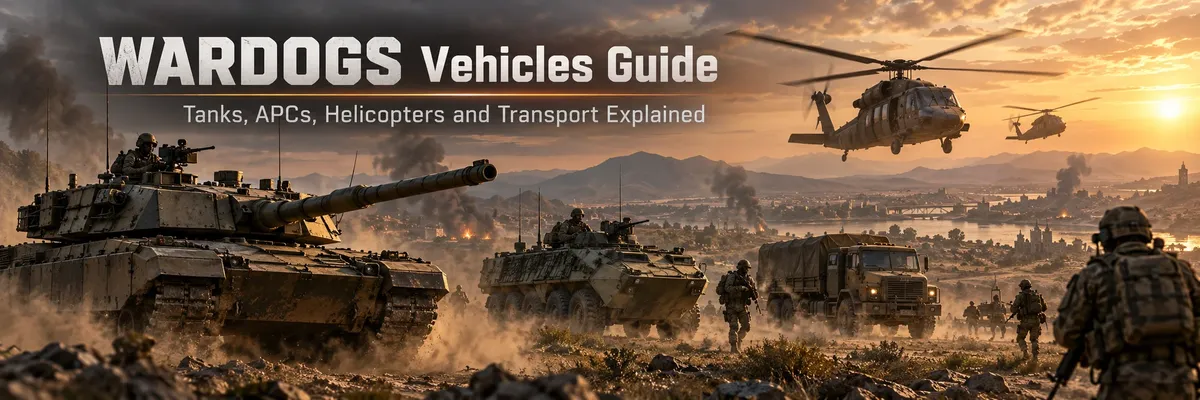
The current Early Access roster includes wheeled transports, tracked armor, helicopters, artillery, anti-air vehicles and stationary defensive systems.
Current community data tracks 28 vehicle entries, including 11 wheeled vehicles, six tracked vehicles, six rotary-wing aircraft and several stationary emplacements.
Prices currently range from:
$500 for the Bobcat.
$1,500 for a Dune Buggy.
$2,500 for a Kodiak.
$3,000 for a standard Humvee.
$5,000 for a URAL.
$6,250 for an MH-6.
$7,400 for a Z20 Lakota.
$8,000–$10,000 for specialist tracked vehicles.
$14,000 for the L2A6 heavy tank.
$18,000 for the Havoc attack helicopter.
Those are vehicle purchase prices.
Many vehicles also require a separate permanent unlock fee.
That means reaching the required level is only one part of getting access.
Driver vs Pilot vs Career Vehicle Unlocks
Different Vehicle Families Are Progressed Through Different Systems
Ground transportation and the Heavy Tank are strongly connected to Driver progression, helicopters are connected to Pilot, while specialist equipment can also be gated behind overall WARDOG Career progression. Season 1 changed several important vehicle unlocks, so old beta guides can be misleading.
BULKHEAD officially changed the Driver ladder for Season 1.
The URAL moved to Driver 3.
Kodiak Assault moved to Driver 6.
Dune Buggy moved to Driver 8.
Kodiak Flatbed moved to Driver 10.
Large Supply Crate moved to Driver 16.
URAL Covered moved to Driver 18.
URAL Attack moved to Driver 25.
Humvee Minigun moved to Driver 30.
Most importantly, the Heavy Tank moved from Career 35 to Driver 35.
One especially important correction concerns artillery.
The SPH-2 Artillery Tank was moved to Career level 90 for Season 1, not Career 55 as some older guides still show.
Always prioritize the current live progression menu and official Season 1 changes over pre-launch information.
WARDOGS Transport Vehicles
Transport Vehicles Win Matches by Moving More Friendly Players Into Useful Positions Faster
Transport is one of the most underrated vehicle roles because one vehicle can alter the Control Zone player count in seconds. A Driver who delivers five teammates to a useful approach may create more objective value than an expensive combat vehicle hunting isolated infantry far away from the fight.
BULKHEAD officially lists transporting friendlies as a cash-generating teamplay action.
That means transport creates value in several ways.
You gain Driver or Pilot progression.
You can earn cash.
Your passengers reach the objective faster.
Your faction increases objective presence.
You preserve teammates who would otherwise cross exposed terrain on foot.
This is why cheap vehicles remain relevant even after heavy armor unlocks.
Not every problem needs a tank.
Sometimes the correct answer is simply:
Get six people there faster.
Bobcat
The Bobcat Is the Cheapest Mobility Option but Has Very Limited Strategic Capacity
At roughly $500, the Bobcat is the lowest-cost ground vehicle in current databases. It seats only two people, making it useful for personal mobility or a quick two-player move but poor for actual squad transportation.
Community tracking currently lists the Bobcat at two seats and a low hull value compared with larger vehicles.
Use it when:
You and one teammate need to move.
You need cheap personal transport.
Losing the vehicle does not matter.
Do not buy it expecting to solve faction-level transport problems.
It simply does not carry enough people.
Dune Buggy
The Dune Buggy Trades Protection for Speed and Cheap Three-Person Mobility
The Dune Buggy is an early Driver unlock that provides three seats for about $1,500. It is useful for small flanks and quick travel, but the lack of meaningful protection makes it unsuitable for repeatedly driving through defended approaches.
Season 1 moved the Dune Buggy to Driver level 8 and reduced its permanent unlock cost from $35,000 to $25,000.
Current community tracking lists:
Three seats.
$1,500 per purchase.
Use terrain and speed.
Do not expect armor.
If enemies are already watching the road, the Buggy is a transport problem waiting to happen.
Kodiak
The Kodiak Is One of the Best General Transport Vehicles for Small Squads
The standard Kodiak currently costs about $2,500, carries four players, has useful trunk capacity, and is tracked as one of the fastest normal ground transports. It is a strong middle ground between cheap personal vehicles and expensive logistics trucks.
Current Field Manual data lists the Kodiak around 154 km/h, making it exceptionally quick compared with heavier ground platforms.
Current cargo data tracks:
Four seats.
12 trunk slots.
A small logistics bed.
$2,500 purchase price.
That makes the Kodiak excellent for:
Four-player squads.
Fast Control Zone rotations.
Returning small groups after a wipe.
Recon or Medic repositioning.
Light cargo movement.
It is one of the most useful everyday ground vehicles because it is cheap enough to replace without feeling catastrophic.
Kodiak Pickup
The Pickup Variant Sacrifices Some Storage Efficiency for More Passenger Capacity
The Kodiak Pickup is currently tracked at roughly $3,000 and six seats, making it better when passenger count matters more than maximizing protected cargo or combat capability.
Current cargo tracking lists:
Six seats.
Six trunk slots.
A small logistics bed.
$3,000 price.
This makes it a strong infantry transport.
If you have five teammates waiting at HQ, the Pickup can be more useful than sending two separate vehicles.
Kodiak M249
The Armed Kodiak Adds Defensive Firepower Without Becoming a True Combat Vehicle
The M249 variant gives the Kodiak a mounted machine gun and an extra crew position, allowing the vehicle to suppress infantry or defend itself during transport. It remains a relatively light platform, so its weapon should support movement rather than encourage the Driver to fight enemy armor.
Current tracking lists:
About $3,750.
Five seats.
The gun is useful when:
Dropping infantry.
Covering a retreat.
Suppressing an enemy doorway.
Protecting a supply run.
It is not a replacement for a tank.
Do not treat mounted firepower as permission to park in the open.
URAL
The URAL Is the Main Ground Logistics Truck
The URAL is one of the most strategically important ground vehicles because it combines transportation with serious cargo capacity. A Driver running Build, Fuel, Ammo or Mechanical Supplies to an active FOB can keep an entire defensive network operational.
Season 1 moved the URAL to Driver level 3 and reduced its permanent unlock cost to $35,000.
Current community tracking lists:
$5,000 purchase price.
Three normal seats.
Large 8×2 logistics bed.
Six-slot trunk.
The low listed seat count does not tell the entire story because the truck's main value is logistics.
The URAL should be used for:
FOB supply.
Construction materials.
Fuel.
Ammo supplies.
Mechanical supplies.
Heavy logistics loops.
If a FOB is running mortars, anti-air, repair infrastructure or drills, someone eventually needs to move resources.
That is where the URAL becomes more important than another gun truck.
Ural Defender
The Defender Gives the Logistics Platform More Survivability
Current databases list the Ural Defender at around $6,000, giving players a more protected version of the logistics truck for dangerous supply routes.
A machine-gun version is also tracked around $6,750.
This makes the Defender useful when:
Enemy Recon is watching supply roads.
Infantry ambushes are common.
The FOB is deep inside contested territory.
The supply run is worth protecting.
But protection does not make the truck invulnerable.
A dedicated launcher team can still ruin the run.
Route selection remains more important than simply upgrading the vehicle.
Humvee
The Humvee Is the Main Armored Ground Transport Family
The Humvee line provides one of the strongest combinations of protection, passenger movement and affordability. Current community data describes it as the main fully armored transport family, making it much better for contested routes than a Kodiak or Buggy.
The base Humvee is currently tracked around:
$3,000.
Four seats.
500 hull HP in community data.
Nine trunk slots.
Community progression places the standard Humvee around Driver 15.
The biggest advantage is simple.
Small-arms fire becomes much less threatening than it is in light transports.
That does not mean you should drive directly into:
RPGs.
MAAWS.
Mines.
Tanks.
Attack helicopters.
Armored transport buys you safety against ordinary infantry fire.
It does not remove anti-vehicle threats.
Humvee M249
The M249 Variant Adds Useful Infantry Suppression
At roughly $3,750, the M249 Humvee combines armor with a mounted machine gun and five seats. It is an excellent escort or infantry-support vehicle when you need transport that can defend its own approach.
Current cargo tracking confirms:
Five seats.
$3,750 purchase price.
This is especially good for:
FOB reinforcement.
Convoy escort.
Control Zone approach security.
Covering passengers as they dismount.
Use the gunner.
A mounted weapon that nobody occupies adds little value.
Humvee Minigun
The Minigun Humvee Is the Late Driver Combat-Transport Upgrade
Season 1 moved the Minigun Humvee from Driver 35 down to Driver 30, creating a strong late-role reward before the Heavy Tank. It retains transport functionality while gaining much heavier anti-infantry firepower.
Current tracked price is approximately:
$4,500.
Five seats.
This is one of the more attractive combat vehicles for players who cannot yet field heavy tracked armor.
But it still has a clear weakness.
Launchers.
Do not sit still.
Move.
Suppress.
Reposition.
APCs in WARDOGS
The M113 APC Is More Important as a Forward Deployment Asset Than as a Normal Purchased Transport
WARDOGS currently uses an M113 APC-based spawn vehicle as a special faction deployment asset. Current player reports consistently describe it appearing once a faction reaches 20 match points, after which somebody must physically drive it forward and protect it so teammates can use it as an advanced deployment point.
Current community reports describe:
The M113 appearing at faction HQ after reaching 20 points.
A radar or deployment component mounted on top.
The vehicle needing to stop before becoming useful as a spawn asset.
Enemies being able to disable its spawn function by damaging the exposed equipment.
The entire APC also being destroyable.
Exact deployment cooldown details are less consistently documented and can change.
The strategic rule is much more important:
Do not waste the M113.
How to Use the M113 Spawn APC
Hide It Close Enough to Matter but Far Enough Away That the Enemy Cannot Easily Destroy It
The best M113 position is not directly inside the most obvious firefight. The vehicle's purpose is shortening reinforcement time. If it is parked in open view where enemy tanks, helicopters, launchers or artillery can immediately identify it, the team loses that advantage.
Ideal locations include:
Behind a FOB.
Behind hard terrain.
Inside a protected compound.
Below a ridgeline.
Behind buildings near the Control Zone.
You want players to spawn close.
But the enemy should need to work to find the APC.
Protect the top deployment equipment.
Protect the vehicle itself.
Losing an infantry player is temporary.
Losing the forward deployment point can shift the entire scoring battle.
Tanks and Tracked Combat Vehicles
Heavy Tracked Vehicles Trade Mobility and Cost for Protection and Specialized Firepower
WARDOGS tracked armor currently includes the L2A6 heavy tank, Flakpanzer Gepard anti-air platform, SPH-2 artillery vehicle and faction M113 deployment APCs. The three major combat vehicles are resistant or immune to normal small-arms fire, making dedicated launchers, explosives, other armor and air assets much more important once they appear.
Current community databases list:
L2A6 – $14,000.
Flakpanzer Gepard – about $10,000 in current Wardogs Zone data.
SPH-2 – $8,000.
These are not simply three different tanks.
Each exists for a completely different battlefield problem.
L2A6 Heavy Tank
The L2A6 Is the Main Direct Ground-Combat Tank
The L2A6 is built to fight other vehicles, punish exposed infantry positions and control open approaches. Current game-data tracking lists an 800 HP hull, three crew seats, a 120 mm main cannon, coaxial machine gun, secondary M249 and smoke countermeasures.
The current live data lists:
Driver unlock: Driver level 35.
Permanent unlock: approximately $500,000.
Purchase price: $14,000.
Top speed: around 65 km/h.
Crew: three.
Hull: 800 HP.
20-slot trunk.
Small-arms immunity.
This makes the L2A6 one of the largest personal purchases in the game.
It should not be used like a Humvee.
How to Use the Heavy Tank
Fight From Positions Where Infantry Cannot Easily Surround You
The tank's biggest advantage is frontal combat power. Its biggest weakness is isolation. A heavy tank inside dense terrain with no friendly infantry can be attacked from several sides by launcher players, mines and other anti-vehicle threats.
The strongest tank position usually has:
Long sightlines.
Friendly infantry nearby.
Recon spotting.
Support repair access.
An escape route.
Terrain that protects the sides.
Use the main gun against important targets.
Do not chase one infantry player between buildings.
A $14,000 tank has bigger jobs.
Never Solo the Heavy Tank if You Can Avoid It
Multi-Crew Vehicles Become Much Stronger When Different Players Handle Driving, Weapons and Awareness
Current game data lists three L2A6 seats because the vehicle is designed around multiple crew responsibilities. A solo player cannot simultaneously drive, watch every approach and maximize every weapon system as effectively as a coordinated crew.
Current Field Manual guidance explicitly warns that expensive tanks are poor solo investments because no one is watching your flanks.
Use:
Driver.
Main weapon operator.
Additional crew/support.
Communication matters.
A tank crew with voice coordination is much harder to ambush than one player constantly changing seats.
Flakpanzer Gepard
The Gepard Is the Dedicated Anti-Air Tracked Vehicle
The Gepard exists primarily to answer helicopters. Its twin autocannon setup and small-arms immunity make it a strong area-denial asset when enemy Pilots are repeatedly attacking FOBs or transport routes, but it is much less efficient if the enemy has little air presence.
Current community tracking places it around:
$10,000 in Wardogs Zone data.
Two seats.
Around 65 km/h.
20-slot trunk.
Small-arms immunity.
This is a specialist purchase.
If enemy Havocs, rocket helicopters or armed transports are dominating:
Gepard makes sense.
If no helicopters are active:
You may have spent $10,000 on a vehicle whose main job barely exists.
Match the vehicle to the battlefield.
SPH-2 Artillery Tank
The SPH-2 Is a Long-Range Support Vehicle, Not a Frontline Tank
The SPH-2 carries a heavy artillery cannon capable of attacking fortified positions from long distance. Its role is indirect fire support, meaning it should generally operate behind friendly lines with Recon or another spotter providing accurate target information.
Current live game-data tracking lists:
Career level 90.
Permanent unlock approximately $500,000.
Vehicle cost $8,000.
Three crew.
650 HP.
155 mm artillery.
Small-arms immunity.
This is one of the most important current corrections.
Old Season 1 previews and older community material may still place artillery much earlier.
The official current Season 1 track moved the Artillery Tank to Career 90.
What Should Artillery Target?
Shoot Infrastructure and Concentrated Strategic Targets, Not Random Individuals
The SPH-2 becomes most valuable against targets that are expensive, static or strategically important. Firing a heavy artillery round at one random infantry player is usually worse than attacking the systems keeping an enemy position alive.
High-value targets include:
Enemy FOBs.
Drills.
Mortars.
Anti-air.
Spawn APC positions.
Repair infrastructure.
Large infantry concentrations.
Vehicle staging areas.
A fortified Hot Zone.
Artillery changes the battle when it forces an entire defensive system to move.
WARDOGS Helicopters
Helicopters Trade Cost and Difficulty for the Fastest Mobility in the Game
Air transport can ignore roads, mountains and many ground chokepoints, giving Pilots the ability to deliver players or supplies directly between strategically important areas. The tradeoff is that helicopters are expensive, difficult to fly well, vulnerable to dedicated anti-air and capable of killing several friendly players at once when a bad landing becomes a crash.
Current air vehicles include:
MH-6.
AH-6M Miniguns.
AH-6R Rockets.
Z20 Lakota.
Z20 Lakota Miniguns.
Havoc.
These fall into three broad roles.
Transport.
Armed transport.
Attack.
Do not treat them as interchangeable.
MH-6
The MH-6 Is the Best Entry Helicopter and Small Air Transport
The MH-6 is currently the cheapest helicopter at roughly $6,250 and seats six. It is well suited to moving a small squad quickly without committing the cost of a larger transport helicopter.
Current data tracks:
Six seats.
$6,250.
Nine-slot trunk.
Two crate positions in community cargo tools.
Use it for:
Squad insertion.
Extraction.
Small cargo.
Pilot training.
Rapid reinforcement.
It is fast enough to be valuable.
Cheap enough to be the correct helicopter for learning.
But still expensive enough that crashing every flight will destroy your economy.
AH-6M Miniguns
The Minigun Variant Converts the Light Helicopter Into a Dedicated Two-Seat Combat Platform
The AH-6M currently costs about $7,000 and is tracked as a two-seat aircraft with no normal passenger role. That makes it an attack helicopter rather than a transport with extra weapons.
Current databases list:
$7,000.
Two seats.
Pilot role progression.
Use it against:
Exposed infantry.
Light vehicles.
Unprotected routes.
But stay aware of:
Gepard.
SAM systems.
Support anti-air.
Other helicopters.
The aircraft's job is combat.
Do not buy it when the team actually needs transport.
AH-6R Rockets
The Rocket Variant Provides Much Heavier Ground Attack at a Much Higher Price
At approximately $12,500, the AH-6R represents a major financial jump from the minigun model. Its rockets make it much more dangerous to ground targets, but every aggressive pass risks losing one of the most expensive aircraft outside the Havoc.
Current databases list:
$12,500.
Two seats.
Nine-slot trunk.
Use terrain.
Attack from angles.
Do not hover in open air.
Dedicated anti-air exists specifically to punish predictable helicopters.
Z20 Lakota
The Z20 Is the Main High-Capacity Air Transport
The Z20 is the strongest current passenger helicopter for large-scale transport because it carries thirteen total seats and substantial cargo capacity. One successful run can move a large part of a team into the Control Zone far faster than ground vehicles.
Current game-data tracking lists:
$7,400.
13 seats.
20-slot trunk.
Large cargo bed.
Top speed around 445 km/h in current community data.
That is enormous transport power.
But it also means enormous risk.
If the helicopter crashes with a full passenger load, the team does not lose one player.
It may lose an entire squad plus multiple expensive loadouts.
A good transport Pilot is therefore an objective asset.
A bad one can damage their own team's push.
Z20 Lakota Miniguns
The Armed Z20 Keeps Large Transport Capacity While Adding Defensive Firepower
The minigun Z20 currently costs around $8,000 and retains the thirteen-seat capacity while adding two mounted M134D miniguns. This makes it one of the most flexible aircraft because it can move a large group while providing meaningful defensive fire.
Current live data tracks:
Pilot 25.
$75,000 permanent unlock.
$8,000 purchase.
13 seats.
Four crew plus nine passengers in the detailed crew breakdown.
20-slot trunk.
Two miniguns.
Flares.
The key word is:
Transport.
The miniguns should protect the mission.
They should not cause the Pilot to fly away from the objective chasing infantry.
Deliver passengers first.
Fight when necessary.
Havoc
The Havoc Is the Premium Attack Helicopter
The Havoc is the highest-priced current aircraft and a serious late-Pilot investment. It combines an autocannon, rocket pods, high speed, flares and a heavily reinforced airframe, making it a major threat to ground forces when the crew understands terrain and anti-air avoidance.
Current game-data tracking lists:
Pilot 35.
$500,000 permanent unlock.
$18,000 purchase.
Two crew.
400 km/h top speed.
800 hull HP.
Autocannon.
Rocket pods.
Flares.
This is not a learning helicopter.
Do not buy the Havoc because:
You just unlocked it.
You have enough cash for exactly one.
You want to test the controls.
Practice in cheaper aircraft.
The Havoc is a battlefield investment.
Transport vs Attack Helicopters
The Better Helicopter Is the One That Solves Your Team's Current Problem
A Havoc is not automatically more valuable than an MH-6. If your team needs twelve players moved onto an objective, a transport aircraft can have more immediate impact than an attack helicopter. If enemy armor is controlling the battlefield, combat aviation becomes more attractive.
Buy transport when:
Your team is far from the objective.
The Control Zone changed.
A tower needs reinforcements.
A FOB needs supplies.
Buy attack aircraft when:
Enemy vehicles dominate.
Infantry positions are exposed.
Air superiority is weak.
You have a crew.
You have enough cash.
Do not measure usefulness only by firepower.
Vehicle Cargo and Logistics
Cargo Capacity Is One of the Biggest Differences Between Vehicles
WARDOGS vehicles do not simply carry players. Trucks and helicopters can move crates and supplies, and the amount they carry changes which vehicle is best for a logistics run. Large transports therefore have strategic value even without weapons.
Current cargo data tracks:
URAL – large 8×2 logistics bed.
Z20 – 4×2 cargo area and large trunk.
MH-6 – limited crate slots.
Kodiak – smaller bed.
Humvee – smaller logistics capacity.
Heavy tanks – large trunk but no normal logistics bed.
Choose the vehicle based on cargo.
One supply pallet?
Small transport may work.
Multiple FOB pallets?
URAL or Z20.
The best logistics vehicle is the one that minimizes total trips while surviving the route.
Fuel Matters
Vehicles Cannot Operate Indefinitely Without Support
Fuel is a real operational constraint in WARDOGS. Long-lived vehicles need access to refueling, and tracked combat vehicles can consume fuel significantly faster than ordinary transport platforms.
Current Field Manual data warns that tanks and anti-air platforms consume fuel much faster than transports.
That means successful vehicle play includes:
Planning refuel points.
Using FOB refuel stations.
Avoiding unnecessary idling.
Returning before the tank is stranded.
A tank with no fuel is not a tank.
It is very expensive cover.
Repairs and Vehicle Recovery
A Damaged Vehicle Is Often More Valuable Repaired Than Replaced
Support players and FOB repair infrastructure can preserve expensive assets after combat. A $14,000 tank or $18,000 helicopter should not be abandoned simply because it survived one fight with heavy damage.
FOBs can support repair stations, while Support players have repair equipment.
This creates strong combinations.
Tank + Support.
Convoy + mechanic.
Helicopter + forward service FOB.
The vehicle retreats.
Repairs.
Returns.
That is much better for the faction's economy than repeatedly purchasing replacements.
Small Arms vs Vehicles
Different Vehicle Classes Have Very Different Resistance to Infantry Weapons
Light transports can still be threatened by ordinary gunfire, while heavy tracked vehicles are currently immune to small arms. Helicopters generally take heavily reduced small-arms damage rather than full immunity, meaning massed rifle fire can sometimes matter but dedicated anti-air remains far more effective.
Current data tracks:
L2A6 – small-arms immune.
SPH-2 – small-arms immune.
Gepard – small-arms immune.
Z20 – roughly 95% reduction.
Havoc – roughly 95% reduction.
MH-6 – less protected than the larger helicopters.
That means infantry must recognize when normal weapons are no longer the right answer.
If the tank arrives:
Stop firing your rifle at it.
Get Support.
Get launcher.
Get another vehicle.
Spot it for artillery or aviation.
Use the right tool.
Anti-Vehicle Weapons Matter
Expensive Vehicles Become Much Less Dominant Once the Enemy Organizes Dedicated Counters
Tanks and helicopters are strongest against teams that fail to adapt. WARDOGS includes RPGs, MAAWS, anti-air launchers, mines, stationary AA, the Gepard, artillery and other vehicles specifically so combined-arms threats have counterplay.
The most dangerous mistake a vehicle crew can make is assuming:
“They cannot hurt us.”
They can.
Tank crews should watch for:
Launcher teams.
Mines.
Enemy armor.
Attack helicopters.
Artillery.
Pilots should watch for:
Gepards.
SAMs.
Support AA.
Enemy helicopters.
Predictable routes.
Vehicles are powerful because opponents need specialized tools.
Not because vehicles are invulnerable.
Vehicle Positioning
The Strongest Vehicle Is Usually One Fighting From the Correct Distance
Vehicles become weaker when they enter terrain that removes their mobility or sightline advantages. Tanks hate being surrounded in dense buildings. Helicopters hate predictable hover positions. Logistics trucks hate exposed chokepoints. Every vehicle has terrain where its strengths disappear.
Tanks prefer:
Long lanes.
Open approaches.
Friendly infantry support.
Helicopters prefer:
Terrain masking.
Flexible altitude.
Several escape directions.
Trucks prefer:
Safe routes.
Cover at destination.
Multiple possible approaches.
Humvees prefer:
Fast infantry-support movement.
The correct battlefield position matters more than having the most expensive platform.
Do Not Drive Tanks Into Dense Infantry Areas Alone
Close Terrain Gives Launcher Players Too Many Angles
Heavy armor dominates open ground because it can identify threats before infantry reaches effective anti-tank positions. Dense streets reverse that advantage by allowing enemies to attack from windows, rooftops, alleys and rear angles.
If the objective is inside dense urban terrain:
Let infantry move first.
Support them from outside.
Use buildings as boundaries.
Avoid getting boxed in.
The tank should pressure the area.
Not become trapped inside it.
Do Not Hover Helicopters Over the Objective
A Stationary Helicopter Makes Every Anti-Air Player's Job Easier
The best air defense is often predictability. If the Pilot stays in the same position, enemy launchers and vehicle AA can prepare the exact angle needed.
Transport helicopter:
Land.
Unload.
Leave.
Attack helicopter:
Pass.
Fire.
Break sightline.
Reposition.
Do not float over one hill forever.
A $18,000 Havoc should not become a stationary target.
Protect Logistics Vehicles
Killing a Supply Truck Can Hurt a FOB More Than Killing Several Infantry Players
A truck carrying Build, Ammo, Fuel or Mechanical Supplies can represent the next phase of an enemy base's survival. Destroying that truck can stop construction, prevent repair, interrupt drill operation or silence heavy weapons.
This is why convoy protection matters.
If your URAL is carrying valuable supplies:
Use another vehicle as escort.
Change routes.
Ask Recon to watch ahead.
Avoid predictable roads.
Losing the truck is not only losing $5,000.
It can also mean losing the supplies and the strategic plan they supported.
WARDOGS Vehicle Economy
The Vehicle Price Is Only the Beginning of the Real Cost
An expensive vehicle can also require a large permanent unlock, ammunition, fuel support and additional crew. The true cost of operating high-end armor or aviation is therefore much larger than the number shown beside the vehicle itself.
Examples:
L2A6:
$500,000 permanent unlock.
$14,000 each purchase.
Havoc:
$500,000 permanent unlock.
$18,000 each purchase.
SPH-2:
$500,000 permanent unlock.
$8,000 each purchase.
That is before:
Ammo.
Personal gear.
Repair requirements.
Potential crew costs.
The more expensive the vehicle, the more important survival becomes.
Ride Before You Buy
Learning From Another Player's Vehicle Is Much Cheaper Than Learning With Your Own Cash
New players should spend time as passengers, gunners and secondary crew before investing in the most expensive platforms. Current community beginner guidance explicitly recommends riding in other players' vehicles first because every purchased vehicle represents real persistent cash.
Learn:
Where tank weak situations occur.
How Drivers approach the zone.
How Pilots land.
How gunners communicate.
How supply trucks unload.
Then buy.
This is especially important for helicopters.
Practicing with passengers inside your first expensive helicopter is one of the fastest ways to become unpopular and poor simultaneously.
Which Vehicle Should Beginners Use?
Start With Simple Transport Instead of Combat Vehicles
The best beginner vehicle teaches movement without creating massive financial risk. Ground transport is easier to learn, cheaper to replace and still creates useful Driver progression and objective value.
Good beginner options:
Kodiak.
Dune Buggy.
Bobcat for minimal risk.
Ride inside Humvees before buying them repeatedly.
For aviation:
Practice with the MH-6.
Avoid starting with:
Havoc.
Heavy Tank.
Artillery.
Those platforms punish mistakes far more severely.
Best Vehicle for Squad Transport
Kodiak for Small Groups, Humvee for Dangerous Routes, Z20 for Large Air Movement
There is no one universal transport winner because capacity, protection, speed and terrain all matter.
Use Kodiak when:
You need fast cheap ground transport.
Use Humvee when:
Small-arms threats are heavy.
Use Z20 when:
You need to move a large squad very quickly.
Use URAL when:
The mission is really logistics.
Vehicle choice should match the mission.
Best Vehicle for FOB Logistics
The URAL Is the Main Ground Choice, While the Z20 Provides the Fast Air Alternative
The URAL's large bed makes it extremely efficient for repeated supply runs, while the Z20 can bypass dangerous roads and terrain when Pilots control the air.
Ground logistics is generally:
Cheaper.
Easier.
Safer from anti-air.
Air logistics is:
Faster.
More direct.
More vulnerable to dedicated AA.
Use both when the faction is coordinated.
One route can continue even if the other is being camped.
Best Vehicle Against Helicopters
The Gepard Is the Dedicated Mobile Anti-Air Platform
When enemy helicopters are repeatedly dominating the battlefield, the Flakpanzer Gepard is the clearest tracked-vehicle answer. Its role is specifically anti-air rather than general-purpose tank combat.
The specialist nature matters.
Buy it because:
Air is the problem.
Not because:
You want a cheaper tank.
If the enemy stops flying, reposition or rethink the investment.
Best Vehicle Against Ground Armor
The L2A6 Is the Main Direct Heavy-Armor Platform
The L2A6 combines heavy protection with a 120 mm main weapon and multiple crew stations, making it the strongest current direct armored-combat vehicle for fighting enemy ground assets.
But even the best tank needs:
Crew.
Recon.
Support.
Repair.
Infantry protection.
A coordinated $14,000 tank is terrifying.
An isolated $14,000 tank is a target.
Best Long-Range Vehicle
The SPH-2 Is Built for Indirect Fire
If the problem is a fortified enemy position rather than a moving frontline vehicle, artillery can achieve things a direct-fire tank cannot.
Use it against:
Super FOBs.
Drills.
Heavy emplacements.
Spawn positions.
Dense defensive positions.
The artillery crew should not be sitting on the frontline.
It should be behind the team with good information.
Best Air Combat Vehicle
The Havoc Is the Premium Attack Platform
At Pilot 35, the Havoc combines the strongest current high-end airframe with heavy weapons, speed and countermeasures, but its $18,000 purchase price and $500,000 permanent unlock make it a serious investment.
It is only “best” if:
You can fly it.
You have a crew.
Enemy AA is manageable.
The battlefield actually needs attack aviation.
Otherwise a cheaper transport helicopter may contribute more to winning.
Common WARDOGS Vehicle Mistakes
Buying a Vehicle Without a Mission
If you do not know what problem the vehicle is solving, do not buy it yet.
Identify the need first.
Using a Tank as an Infantry Taxi
Heavy armor should control important ground, not waste time transporting one player across the map.
Use actual transports.
Chasing Kills With a Supply Truck
The supplies are more important than one random enemy.
Complete the delivery.
Landing Helicopters Directly in Enemy Fire
Passengers reaching the objective dead provides no strategic value.
Land near cover.
Soloing Multi-Crew Vehicles
Expensive vehicles have several seats because different players are supposed to handle different responsibilities.
Use a crew.
Ignoring Fuel
Every long-lived vehicle eventually becomes useless without refueling.
Plan around FOB support.
Ignoring Damage
Surviving a fight does not mean the vehicle is ready for the next one.
Repair.
Reusing the Same Route
Enemies learn transport and supply paths.
Change approach.
Buying the Highest Unlock Automatically
The newest vehicle is not always the right vehicle.
A Kodiak may be better than a Humvee.
A Humvee may be better than a tank.
An MH-6 may be better than a Havoc.
Mission first.
Parking the Spawn APC in the Open
The M113's value comes from allowing reinforcements to arrive closer.
Hide it.
Protect it.
Do not advertise it.
Treating Small-Arms Immunity as Invincibility
Launchers, mines, enemy vehicles and aviation exist specifically to destroy armor.
Adapt.
WARDOGS Vehicles FAQ
How Many Vehicles Are in WARDOGS?
Current community game-data tracking lists 28 vehicle entries across wheeled vehicles, tracked armor, helicopters and stationary systems. Because WARDOGS is in Early Access, that roster can expand or change.
What Is the Cheapest Vehicle?
Bobcat
The Bobcat is currently tracked around $500 and has two seats, making it inexpensive personal transport rather than a major squad vehicle.
What Is the Best Ground Transport?
Kodiak or Humvee Depending on Threat Level
The Kodiak gives excellent speed and value, while the Humvee provides much better protection for contested routes.
Use Kodiak for efficiency.
Humvee for danger.
What Is the Best Logistics Vehicle?
URAL
The URAL's large logistics bed and Driver progression role make it one of the strongest dedicated ground supply vehicles. Current Season 1 progression places it at Driver 3.
What Is the Best Transport Helicopter?
Z20 Lakota
Current game-data tracking gives the Z20 thirteen seats and substantial cargo capacity, making it the strongest large passenger transport in the present air roster.
When Does the Heavy Tank Unlock?
Driver Level 35
BULKHEAD officially moved the Heavy Tank from Career 35 to Driver 35 for Season 1. Current databases identify the vehicle as the L2A6 with a $500,000 permanent unlock and $14,000 purchase price.
How Much Does the L2A6 Cost?
Approximately $14,000 Per Purchase
Current game-data tracking lists the L2A6 at $14,000 after a $500,000 Driver unlock.
What Is the Best Anti-Air Vehicle?
Flakpanzer Gepard
The Gepard is the current dedicated tracked anti-air option, built around twin autocannons and heavy protection. Current Wardogs Zone tracking lists it at roughly $10,000.
When Does the Artillery Tank Unlock?
Career Level 90 in Season 1
BULKHEAD officially moved the Artillery Tank from Career 55 to Career 90. Current live databases identify it as the SPH-2.
How Much Does the Havoc Cost?
Approximately $18,000
Current game-data tracking places the Havoc at Pilot 35 with a $500,000 permanent unlock and an $18,000 purchase price.
Can You Spawn on an APC?
The Faction M113 Can Function as a Forward Deployment Vehicle
Current live player reports describe an M113 appearing once a faction reaches 20 match points. When positioned and deployed correctly, it acts as a forward reinforcement asset, but enemies can disable or destroy it.
Do Vehicles Run Out of Fuel?
Yes
Vehicles have fuel limits, and current FOB systems include refueling infrastructure. Long-lived vehicles should plan around resupply rather than assuming they can operate indefinitely.
Do Vehicles Come With Unlimited Ammo?
No
Current beginner vehicle guidance notes that vehicle ammunition must be purchased and logistics maintained rather than treating every armed vehicle as infinitely supplied.
Can Rifles Damage Tanks?
Heavy Tracked Vehicles Are Currently Immune to Normal Small Arms
Current game-data tracking lists the L2A6, SPH-2 and Gepard as small-arms immune, so infantry needs proper anti-vehicle tools rather than wasting rifle ammunition.
Final WARDOGS Vehicle Tips
WARDOGS vehicles are not a simple progression ladder where every expensive unlock replaces the vehicle below it.
Each platform solves a different problem.
A Bobcat gives cheap two-player movement.
A Dune Buggy gives faster small-team movement.
A Kodiak moves a squad efficiently.
A Humvee moves players through more dangerous infantry fire.
A URAL keeps the logistics network alive.
The M113 can become one of the most important strategic vehicles in the match because it shortens faction reinforcement distance.
The L2A6 dominates direct armored combat when supported correctly.
The Gepard punishes enemy helicopters.
The SPH-2 attacks fortifications from long range.
The MH-6 moves a small squad rapidly.
The Z20 moves a large one.
The AH-6 variants trade transport utility for attack capability.
The Havoc provides premium late-Pilot air power.
None of them is universally best.
That is what makes the vehicle system interesting.
Ask one question before every purchase:
What does my team need this vehicle to accomplish?
If the answer is transport:
Do not buy a tank.
If the answer is FOB resupply:
Do not buy a minigun Humvee and forget the cargo.
If enemy helicopters are dominating:
Think anti-air.
If an enemy Super FOB is controlling the battlefield:
Think artillery.
If the Control Zone moved and thirty teammates are running on foot:
Transport may be the strongest purchase available.
Also remember the economy.
A current L2A6 costs around $14,000 per deployment.
A Havoc around $18,000.
Those vehicles also require enormous permanent unlock investments.
Losing them recklessly does not only affect the current fight.
It affects your persistent cash.
That makes preservation part of good vehicle play.
Refuel before empty.
Repair before the next fight.
Use crew on multi-seat combat vehicles.
Protect logistics routes.
Do not follow predictable paths forever.
Use terrain.
Keep infantry near tanks.
Keep tanks away from dense ambush terrain when possible.
Keep helicopters moving.
Keep spawn vehicles concealed.
Most importantly:
Do not confuse firepower with value.
A $2,500 Kodiak full of teammates reaching the Hot Zone can contribute more to winning than a $14,000 tank fighting somewhere irrelevant.
A $5,000 URAL delivering fuel to the FOB drill can matter more than several combat vehicles.
A Z20 dropping a full group onto a tower objective can change the entire match.
WARDOGS is built around combined arms.
The infantry needs vehicles.
Vehicles need infantry.
FOBs need logistics.
Tanks need repairs.
Helicopters need airspace.
Artillery needs information.
When those systems work together, vehicles stop being expensive toys.
They become the systems that allow your faction to control the battlefield.
Because WARDOGS remains in Early Access, exact prices, unlocks, vehicle health, fuel usage, ammunition costs and some deployment mechanics can continue changing. The Season 1 Driver changes, Heavy Tank at Driver 35 and Artillery Tank at Career 90 are officially confirmed by BULKHEAD, while many detailed seat counts, vehicle statistics and purchase prices are currently maintained from live game data by community databases. Use the current in-game vendor and progression menu whenever a later patch conflicts with these values.
Players who want help progressing Driver or Pilot, reaching higher vehicle unlocks, or building enough cash for tanks and helicopters can also explore WARDOGS services through BoostRoom.



