How the Medic Role Works in WARDOGS
Medic Is a Progression Track Built Around Healing, Reviving and SMG Combat
WARDOGS does not force you to select Medic from a class screen and remain locked into it. The Medic role develops when you perform medical actions and use equipment associated with the track. Current Early Access data identifies bandages, IFAK treatments, manual revives, defibrillator revives, medical equipment and SMG combat as the core activities surrounding Medic progression.
The role becomes useful almost immediately because every large infantry fight creates casualties.
When an Assault player gets downed, somebody has to decide whether that expensive rifle, armor and utility kit returns to the fight or disappears with the player's death.
That somebody can be you.
Current Medic mastery data taken from the game's Early Access role text includes improvements to:
Base revive speed.
Buff application speed.
Defibrillator charge speed.
Switching to medical equipment.
Self-healing speed.
Healing teammates faster.
Reducing the weight penalty from medical items.
Reducing damage taken while reviving.
Increasing medkit uses.
Giving revived teammates temporary movement benefits.
Unlocking additional medical inventory capacity.
That tells us exactly what Medic is designed to become.
Not a passive healer hiding at the back.
A mobile frontline support specialist who can move between combat, treatment and revives quickly.
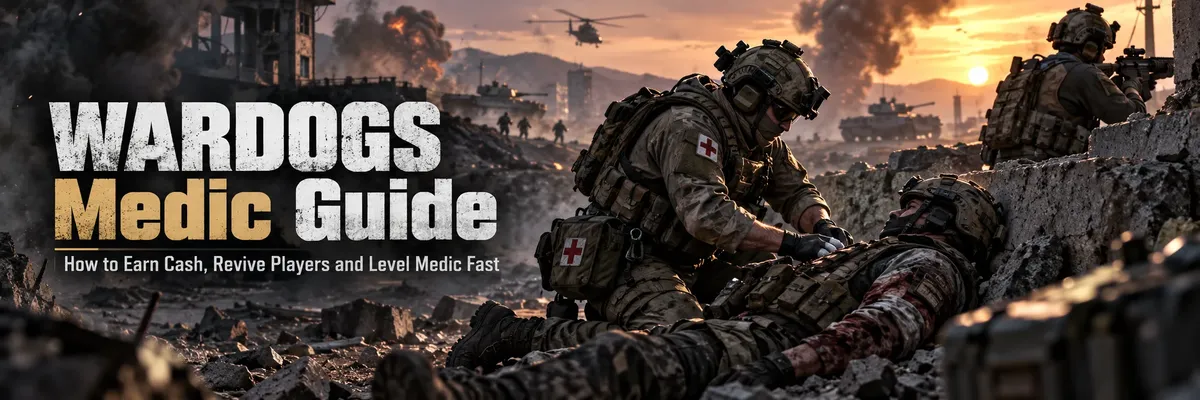
Why Medic Is So Important in the Control Zone
Every Successful Revive Can Put Another Body Back Into the Area That Decides the Match
WARDOGS scores its main mode based on player presence inside the Control Zone. The team with the most players inside the active area earns points toward victory, so reviving somebody near an important objective can restore both combat power and scoring presence instead of forcing that player to respawn and travel back.
WARDOGS supports up to 100 players divided between three teams fighting over a randomized 2x2 km Control Zone. The team with the strongest presence earns points, and the first to reach 100 wins.
This makes a Medic especially valuable in dense objective fights.
Imagine your group loses four players during an enemy push.
Without medical support, those players may need to:
Respawn.
Rebuy or rebuild equipment.
Find transport.
Travel back.
Regroup.
By the time they return, your team may already have lost the position.
A Medic who safely returns several of them to the fight can prevent that collapse.
This is why a revive should not be viewed as a small side action.
In the right place, it can preserve an entire push.
How to Earn Cash as a Medic
Reviving Is Officially a Cash-Rewarding Teamplay Action
BULKHEAD explicitly confirms that reviving squadmates rewards cash. That makes Medic one of the clearest examples of WARDOGS rewarding useful play rather than forcing every player to earn through kills. The exact live payout can depend on game conditions and balance changes, so the safest strategy is to focus on repeatable successful revives rather than planning around one fixed dollar figure.
WARDOGS' official Steam description states that teamplay actions reward cash and specifically names reviving squadmates, transporting friendlies and controlling the objective as examples.
This is important because many players make a mistake when evaluating Medic.
They think:
“I am not getting enough kills.”
But your economic value can come from:
Revives.
Healing.
Objective presence.
SMG kills when necessary.
Staying alive long enough to complete more support actions.
Helping teammates avoid losing their own expensive equipment.
The strongest Medic money loop therefore does not depend on becoming the best shooter in the lobby.
It depends on staying near active friendly infantry.
That is where the revive opportunities are.
Medic Profit Depends on Loadout Cost
A Cheap Medic Who Completes Several Revives Can Be More Profitable Than a Premium Medic Who Dies Immediately
WARDOGS cash persists between matches, so Medic income should be judged against the cost of the loadout you are risking. Buying expensive armor, the strongest SMG, a large backpack, every medical tool and premium utility may feel powerful, but every death raises the amount of cash you need to earn before the life becomes profitable.
Current community-tracked vendor prices place several common Medic items around:
Bandage: approximately $200.
Field Resuscitator: approximately $500.
Individual First Aid Kit: approximately $800.
Defibrillator: approximately $1,600.
Medical Bag: approximately $2,000.
Current tracked SMG prices are roughly:
AMP-9: $900.
PP-19 Vityaz: $1,200.
MP5: $1,500.
Super-45: $2,600.
These equipment prices are community-reported unless separately verified in the live buy menu, so treat them as a current Season 1 reference rather than a permanent official price sheet.
The principle does not change:
The more your Medic kit costs, the more work the life needs to perform before losing it.
Best Place to Make Money as Medic
Stay Near the Largest Productive Friendly Fight, Not Far Behind It and Not at the Very Front
Medic earns best when casualties happen frequently but you remain protected enough to reach them. That usually means staying one layer behind the main Assault players around the Control Zone, Hot Zone or another heavily contested position rather than leading every entry or hiding several buildings away from the fight.
The official game confirms that the Hot Zone offers double cash, which makes it naturally attractive to economy-focused players.
For a Medic, that creates opportunity and danger at the same time.
More players fighting means:
More wounded teammates.
More downed teammates.
More cash opportunities.
More Medic XP.
But also:
More grenades.
More sniper angles.
More enemy pushes.
More third-party attacks.
More vehicles.
Do not run into a Hot Zone simply because cash is doubled.
Get there with friendly infantry.
Let them establish the fight.
Then operate close enough to rescue people without becoming the first target.
How Reviving Works for Medic Progression
Manual Revives and Defibrillator Revives Both Feed Medic, but the Defibrillator Is Currently the Better XP Event
BULKHEAD does not publish a full official XP-per-action table, so exact Medic action values are community-tested rather than guaranteed. Current Season 1 testing consistently reports roughly 80 Medic XP for applying a bandage to a teammate, around 200 XP for a manual revive and around 250 XP for a Defibrillator revive.
The WARDOGS Field Manual clearly labels these action values as community estimates, while its cumulative level thresholds come from official Season 1 anchors.
Current community-tested values commonly used are:
Bandage teammate: about 80 Medic XP.
IFAK treatment: about 120 Medic XP.
Manual revive: about 200 Medic XP.
Defibrillator revive: about 250 Medic XP.
SMG kill: community guides commonly track approximately 250 Medic XP.
These values can change.
Do not build your entire leveling plan around exact arithmetic.
The useful conclusion is simpler:
Healing, reviving and fighting with Medic-associated weapons all move the same progression track.
Why the Defibrillator Is the Most Important Medic Milestone
Medic Level 11 Changes How Aggressively You Can Rescue Players
Current Season 1 guides consistently place the Defibrillator at Medic level 11. It requires a substantial one-time unlock investment, but it dramatically changes the Medic role because revives become much faster and therefore much more practical during active frontline combat.
Current progression tracking places the Defibrillator at:
Medic level 11.
Reported one-time unlock cost: $50,000.
Community-tracked per-life purchase price: approximately $1,600 plus battery requirements.
The exact economy can still change during Early Access.
But the gameplay importance is clear.
A slow revive requires the area to remain safe for longer.
A fast revive gives you more opportunities to save someone before:
An enemy pushes.
Another grenade lands.
A sniper adjusts.
A vehicle returns.
The third faction appears.
That is why Medic 11 is a much more meaningful milestone than many weapon attachments.
Field Resuscitator – Your First Major Medical Unlock
The Field Resuscitator Gives Early Medics a Dedicated Revive Tool Before the Defibrillator Becomes Available
Current live progression guides place the Field Resuscitator at Medic level 2 with a relatively low repeated purchase price. It is slower and less forgiving than the Defibrillator, but it gives new Medics an early dedicated method of bringing teammates back and learning proper revive positioning.
Current tracking lists:
Medic level: 2.
Reported one-time unlock: $10,000.
Per-life purchase: around $500.
Weight: approximately 0.39 kg in current item data.
Do not treat the Field Resuscitator as permission to revive anywhere.
The slower the revive tool, the safer the position needs to be.
Use it behind:
Walls.
Terrain.
Vehicles.
Destroyed structures.
Smoke.
Friendly covering fire.
The early Medic grind teaches patience.
That patience remains useful even after you unlock faster tools.
Bandages Are Still Important
Cheap Basic Healing Remains Useful Even After You Unlock Better Medical Equipment
Higher-tier medical gear does not make bandages irrelevant. Bandages are light, inexpensive and easy to carry, making them useful for topping up teammates, generating repeated medical actions and preserving more valuable equipment for situations where it creates greater value.
Community item tracking currently lists a Bandage at around $200 and only about 0.08 kg.
That tiny weight matters.
Medic loadouts can become heavy surprisingly quickly.
Add:
SMG.
Armor.
Helmet.
Backpack.
Defibrillator.
Batteries.
Medical Bag.
IFAK.
Smoke.
Extra magazines.
Then wonder why your supposedly mobile Medic feels slow.
Bandages give you medical depth without adding much weight.
Do not assume every medical problem requires the most expensive tool.
Individual First Aid Kit
The IFAK Is a Strong Mid-Progression Medical Upgrade for Players Who Want More Efficient Healing
Current progression guides place the Individual First Aid Kit at Medic level 9. It offers stronger treatment than relying only on repeated bandages and fits naturally into a dedicated Medic build once your cash reserve can support the one-time unlock and per-life cost.
Current community tracking lists:
Medic level: 9.
Reported unlock cost: $25,000.
Per-life price: approximately $800.
Weight: approximately 0.16 kg.
That gives you a useful decision.
Budget Medic?
Stay simple.
Dedicated Medic?
Start building a deeper medical kit.
The key is not buying every medical tool simultaneously.
Bring what you actually use.
Medical Bag
The Medical Bag Turns You From a Single-Target Medic Into a Stronger Position-Support Specialist
Current guides place the Medical Bag much deeper in the track at Medic level 24 with a large one-time unlock cost. This is no longer a tiny utility purchase: it is a dedicated Medic investment that makes the most sense around active infantry positions where multiple teammates can benefit from sustained medical support.
Current tracking places it around:
Medic level: 24.
Reported one-time unlock: $75,000.
Per-life vendor cost: approximately $2,000.
Weight: approximately 3.45 kg.
That weight is significant.
A Medical Bag plus Defibrillator already adds a meaningful amount before armor, weapon and ammunition are included.
This is why high-level Medics must think carefully about mobility.
More medical capability does not automatically create a better build if it makes you too slow to reach casualties.
Smoke Is One of the Best Medic Tools
Smoke Does Not Revive Anyone Directly, but It Can Turn an Impossible Revive Into a Safe One
Medic players should treat smoke as part of the medical kit. The greatest revive tool in the game still cannot save you if an enemy sniper, machine gun or rifleman has an uninterrupted view of the body. Smoke removes information from the enemy and buys the seconds needed to move, revive and withdraw.
Current progression guides place the white M18 Smoke Grenade at Medic level 5, with community tracking around a $100 per-use vendor price after unlock.
Good smoke usage is not simply:
Throw grenade directly at your feet.
Instead, identify the dangerous sightline.
Place the smoke between the enemy and the casualty when possible.
This can preserve visibility around your own cover while denying the shooter.
Smoke is especially useful against:
Snipers.
LMGs.
Long roads.
Open courtyards.
Vehicle gunners.
Multiple windows.
Another faction entering the fight.
For only a small equipment cost, smoke can protect an entire expensive squad.
How to Revive Players Safely
Every Revive Should Begin With One Question: What Killed This Player?
The most important Medic skill is not pressing the revive button quickly. It is identifying whether the threat that caused the casualty is still active. If you ignore the original danger, you frequently turn one downed teammate into a downed teammate plus a dead Medic.
Before committing, identify the likely cause.
Was it:
A sniper?
An enemy behind the doorway?
A machine gun?
A vehicle?
A grenade?
An enemy squad?
The third faction?
If the answer is unknown, assume danger remains.
Clear or block the threat.
Then revive.
Revive From Cover Whenever Possible
Move Your Body, Camera and Position So the Enemy Has to Expose Themselves to Stop the Revive
A strong Medic does not stand in exactly the same position where the teammate was shot. Use the nearest wall, terrain feature, vehicle, rubble pile or smoke screen to reduce the number of enemies who can see you while the revive is happening.
A small positional change can completely alter the engagement.
If your teammate fell beside a doorway:
Do not kneel in the doorway.
Move behind the wall.
If they fell on a ridge:
Use the reverse slope.
If they fell beside a vehicle:
Use the vehicle as temporary cover while remaining aware that vehicles can be destroyed.
The revive animation does not make you invincible.
Your positioning matters.
Do Not Revive Players Into Immediate Death
Bringing Someone Back With an Enemy Already Aiming at the Body Wastes Your Time and Often Gives the Enemy Another Easy Elimination
A technically successful revive is not automatically a good revive. The player needs enough cover or concealment to regain control, heal and move. If you revive somebody directly into an active firing lane, both of you may be worse off than before.
Sometimes the best sequence is:
Smoke.
Suppress.
Revive.
Heal.
Move.
Not:
Revive.
Hope.
Die.
Medic is a decision-making role.
Finish the Medical Job After the Revive
Returning a Player to Their Feet Is Only the First Half of the Rescue
A recently revived teammate may still be extremely vulnerable. When the situation allows it, follow the revive with healing so the player can survive the next burst instead of immediately returning to the downed state. This also creates another legitimate Medic progression opportunity.
Community Medic testing tracks healing and reviving as separate actions that can contribute to Medic XP.
That makes complete treatment efficient for both:
The squad.
Your progression.
But battlefield safety remains more important.
If enemies are pushing, help the player move first.
Heal somewhere safer.
Best Weapons for Medic
SMGs Fit the Role Because Medic Needs Close-Range Firepower Without Carrying a Heavy Primary
Medic spends much of the match near infantry, buildings and downed teammates, so compact automatic weapons fit the role naturally. More importantly for progression, current community documentation consistently tracks SMG kills as feeding Medic rather than Assault, making weapon choice relevant when you are deliberately leveling the Medic track.
The main current SMGs are:
AMP-9.
PP-19 Vityaz.
MP5.
Super-45.
The best choice depends heavily on progression and cash.
AMP-9 – Best Starting Medic Weapon
The AMP-9 Is Cheap, Light and Available Without Waiting for a Deep Medic Unlock
Current item data makes the AMP-9 one of the most practical Medic starter weapons. At roughly $900 and only around 1.4 kg, it keeps both financial and weight costs low while giving the Medic enough close-range firepower to defend revives and move with infantry.
Current tracked statistics include:
Approximately 22 base damage.
Around 900 RPM.
Approximately 1.4 kg.
Community price around $900.
That low weight is especially useful.
Every kilogram saved on your gun creates more room for:
Medical equipment.
Batteries.
Smoke.
Armor.
Healing supplies.
Medic is one of the roles where weapon weight competes directly with role equipment.
PP-19 Vityaz – Strong Early Medic Progression Choice
The PP-19 Becomes Available Early and Eventually Gains a Large Magazine Option, Making It Useful for Revive-Adjacent Firefights
Current Season 1 progression guides place the PP-19 Vityaz at Medic level 4. BULKHEAD also officially moved its 50-round drum magazine from Medic level 33 down to level 29 for Season 1, making the larger-capacity setup accessible earlier than it was in previous progression.
Current community tracking places the PP-19 around $1,200 and approximately 800 RPM.
The official Season 1 changelog confirms:
PP-19 50-round drum magazine: level 33 → level 29.
That larger magazine can matter for Medics because fights around casualties are often messy.
You may need to:
Fight one player.
Smoke.
Revive.
Fight another player.
Move.
Having more ammunition before needing to reload can help.
MP5 – Strong Mid-Progression Medic Weapon
The MP5 Gives Medic Players Another Conventional 9mm Option Once They Reach Deeper Into the Track
Current progression guides place the MP5 at Medic level 15. At that point the Season 1 XP curve has become significantly slower, so it functions as a meaningful mid-track reward rather than an immediate beginner weapon.
Current tracking places the MP5 around:
22 base damage.
800 RPM.
Approximately 2.54 kg.
Community price around $1,500.
Current guide data places its base unlock at Medic level 15 with further magazine progression later.
The MP5 is useful if you prefer a more conventional SMG feel without waiting until the Super-45.
Super-45 – Best Premium Medic SMG
The Super-45 Is the High-End Medic Combat Reward, Combining Heavy Close-Range Damage With an Extremely High Fire Rate
Current progression tracking places the Super-45 at Medic level 35, meaning it requires a substantial Season 1 grind. Its 30 base damage and approximately 1,200 RPM fire rate make it exceptionally dangerous at close range, but the gun is also more expensive and burns ammunition quickly.
Current tracked stats list:
30 damage.
1,200 RPM.
50 m effective range.
3 kg weight.
Community purchase price around $2,600.
Current progression references place the weapon at Medic 35 with a large one-time unlock cost, followed by its 30-round magazine at level 38 and additional progression later.
The Super-45 is powerful.
But remember:
You are still a Medic.
Do not unlock the strongest SMG and suddenly stop reviving anyone.
Best Beginner Medic Loadout
New Medics Should Prioritize Mobility, Cheap Equipment and Enough Medical Tools to Learn the Role
The best beginner Medic build is not packed with every item available. You need a controllable SMG, basic healing, an early revive option, smoke when unlocked and enough armor to survive normal infantry pressure without turning the kit into an expensive heavy loadout.
Primary Weapon: AMP-9.
Armor: Light Armor.
Helmet: Light Helmet.
Backpack: Small or Field Backpack.
Medical: Bandages.
Revive Tool: Field Resuscitator after Medic 2.
Utility: White smoke after Medic 5.
Ammunition: Enough for several close-range engagements.
This build teaches everything that matters.
Stay near teammates.
Watch who takes damage.
Use cover.
Revive safely.
Fight only when needed.
Move constantly.
And keep the cost low.
Best Mid-Progression Medic Loadout
The PP-19 or MP5 With Medium Protection and a Defibrillator Creates a Strong Dedicated Combat Medic
Once the Defibrillator is unlocked, the Medic role becomes much more capable in active fights. Pairing it with a practical SMG, Medium or Light protection, smoke and enough medical depth creates a setup that can fight, revive and remain mobile without carrying unnecessary specialist equipment.
Primary Weapon: PP-19 Vityaz or MP5.
Armor: Light or Medium Armor.
Helmet: Light or Medium Helmet.
Backpack: Operator or Field Backpack.
Medical: Bandages plus IFAK.
Revive Tool: Defibrillator.
Power: Required battery supply.
Utility: Smoke.
The exact armor choice depends on weight.
Medium protection gives more confidence in frontline fights.
Light protection makes it easier to run between casualties.
Do not automatically choose heavier gear.
Best High-Level Medic Loadout
High-Level Medic Builds Should Add Medical Depth Without Sacrificing the Ability to Reach Teammates
Late Medic progression gives you access to expensive and heavier tools, but the goal is not carrying all of them simultaneously. A Super-45, Defibrillator, Medical Bag, batteries, armor, magazines and smoke can create a very strong support kit, but weight quickly becomes the limiting factor.
Primary Weapon: Super-45.
Armor: Light or Medium.
Helmet: Matching protection.
Revive Tool: Defibrillator.
Medical: IFAK plus Medical Bag where appropriate.
Utility: Multiple smoke grenades.
Backpack: Capacity appropriate to your actual medical inventory.
Ammunition: Controlled reserve.
Medic mastery includes reducing the weight penalty from medical items, which helps deeper specialization, but it does not make equipment weight irrelevant.
Stay fast enough to reach people.
That is more valuable than carrying medical equipment you never use.
How to Level Medic Fast
The Fastest Legitimate Medic Progression Comes From Dense Infantry Fights Where You Can Chain Healing, Revives and SMG Combat
Medic XP efficiency is driven by action frequency. You want to spend as little time as possible walking through empty terrain and as much time as possible around friendly infantry that is actively fighting. Every safe bandage, revive and SMG engagement creates another opportunity to move the Medic bar.
Current community testing tracks approximately:
80 XP for bandaging a teammate.
120 XP for IFAK treatment.
200 XP for manual revive.
250 XP for Defibrillator revive.
SMG kills also feeding Medic progression.
This makes the main leveling strategy very straightforward.
Follow the largest useful friendly group.
Do not lead them.
Do not stay 300 meters behind them.
Operate around the point where injured players naturally fall back.
That is your workspace.
Use SMGs if Medic Progression Is the Goal
Weapon Choice Can Determine Which Role Receives Your Combat Progression
If you are specifically grinding Medic, use weapons associated with Medic rather than spending most of the match getting kills with another role's weapon line. Current progression references consistently associate SMG combat with Medic, while assault rifles feed Assault, marksman and sniper weapons feed Recon, and LMGs, shotguns and launchers feed Support.
This is important for hybrid players.
You can carry whatever WARDOGS allows.
But if your specific goal is Medic progression, make the loadout support that goal.
An M4 might feel comfortable.
But an AMP-9 or PP-19 better aligns your direct combat with Medic leveling.
Season 1 Medic XP Requirements
Medic Progression Slows Significantly Through the Middle Levels
Season 1 deliberately increased the role XP curve from level 6 onward. This affects Medic just as much as every other role, which means beta guides that describe extremely fast Medic 20 or Medic 35 progression are no longer reliable for the current Early Access build.
The official Season 1 thresholds include:
Level 10: 35,000 cumulative XP.
Level 15: 110,000 XP.
Level 20: 250,000 XP.
Level 25: 325,000 XP.
Level 30: 400,000 XP.
Level 35: 500,000 XP.
Level 40: 650,000 XP.
Level 45: 800,000 XP.
Level 50: 1,000,000 XP.
That makes several Medic milestones particularly important:
Field Resuscitator early.
Smoke shortly after.
IFAK.
Defibrillator at 11.
MP5 around 15.
Medical Bag later.
PP-19 50-round magazine at 29.
Super-45 at 35.
Do not try to unlock everything in one sitting.
Save Cash for the Defibrillator
Reaching Medic 11 Without Enough Money for the Unlock Can Delay the Biggest Improvement to Your Role
Progression and economy are separate systems. Reaching the required Medic level makes an item available, but current progression guides report one-time unlock costs on top of the repeated vendor price. That means efficient Medics should build cash while leveling instead of spending everything on weapon attachments they may barely use.
Current guides place the Defibrillator unlock around $50,000.
That is a serious early investment.
Consider delaying less important purchases if Medic is your main focus.
Ask:
Do I need this optic?
Do I need this suppressor?
Do I need the larger magazine right now?
Or am I better keeping that money for the tool that changes my entire revive game?
Progression planning and cash planning should work together.
Medic Positioning
Stay Close Enough to Help but Far Enough Back That the First Enemy Burst Does Not Hit You Too
The ideal Medic position is usually behind the leading Assault players, not beside them and not several buildings away. You need enough distance to avoid becoming the first casualty while remaining close enough to reach a body before the fight moves on.
Think of the infantry group in layers.
First layer:
Entry fighters.
Second layer:
Medic and support.
Further back:
Recon or other specialists depending on the situation.
If you move too far forward, you die first.
If you move too far back, the revive window disappears before you arrive.
Finding that distance is one of the most important Medic skills.
Let Teammates Fight for You
Your Life Often Has More Long-Term Value Than Taking One Unnecessary Duel
A Medic does need to fight, but you should not volunteer for every engagement when several healthy Assault players are already covering the same angle. Your ability to return those players to the fight can be more valuable than adding one more rifle or SMG to an already crowded gunfight.
This does not mean hide.
It means choose battles.
Fight when:
An enemy threatens your casualty.
Your position is being pushed.
Your squad needs another gun.
You need to create space for a revive.
Do not fight because you are bored.
Every unnecessary duel risks removing your team's medical support.
Use Voice Communication
A Simple “Medic Here” or “Smoke Then Revive” Can Prevent Teammates From Giving Up or Exposing Your Rescue
WARDOGS uses local voice communication, and Medic benefits enormously from it. Telling a downed teammate that you are approaching can stop them from making a bad decision, while asking healthy teammates to cover an angle can turn a dangerous revive into a coordinated rescue.
Useful calls include:
“Cover the door.”
“Smoke going out.”
“Reviving.”
“Sniper watching the road.”
“Do not push yet.”
“Heal here.”
Short information is enough.
You do not need military radio terminology.
Common Medic Mistakes
Trying to Revive Every Downed Player
Not every body is recoverable immediately. Some players die in open streets, directly below enemy windows, underneath vehicle fire or inside rooms already controlled by opponents. A strong Medic recognizes when the risk is unreasonable and waits for the situation to change.
Your job is saving teammates.
Not dying beside them.
Running Heavy Armor on Every Medic Build
Protection helps, but Medic relies on movement. You need to reach casualties, reposition around smoke, escape vehicles and follow infantry as the Control Zone shifts. A heavily overloaded build may survive an extra hit yet fail at the actual job because it cannot move quickly enough.
Medium can work.
Heavy can work in specific defensive setups.
Neither should be automatic.
Carrying Too Much Medical Equipment
More medical items are only useful if you actually consume them. Overpacking adds weight, increases loadout cost and occupies inventory space that could hold ammunition, batteries or smoke.
Track what you use during normal lives.
Build around reality.
Becoming an Assault Player With a Defibrillator
One of the easiest ways to waste Medic progression is unlocking a strong SMG and then forgetting the medical role entirely. Combat is part of Medic, but the role becomes powerful because you combine combat with healing and reviving.
Get kills.
Then look around.
Someone probably needs help.
Reviving Before Using Smoke
If the casualty is exposed to an active sightline, beginning the revive first and thinking about smoke afterward reverses the correct order.
Block the threat.
Then work.
Forgetting Batteries or Required Medical Supplies
A high-value medical tool with no supporting consumable becomes dead weight. Before leaving the vendor, verify that the equipment you purchased can actually function for the number of revives or treatments you expect to perform.
A Medic loadout should be checked before deployment.
WARDOGS Medic FAQ
How Do You Earn Cash as Medic?
Reviving teammates is officially confirmed as a cash-rewarding teamplay action. Medic can also participate in objective control and combat, allowing several income sources to overlap during the same life.
The exact revive payout can vary with live balance and conditions, so do not rely on old beta dollar values.
What Gives Medic XP?
Healing, Reviving and Medic-Associated Combat
Current community-tested progression data tracks bandaging teammates, IFAK treatments, manual revives and Defibrillator revives as direct Medic XP sources. Current progression guides also associate SMG combat with the Medic track.
BULKHEAD does not publish a complete official XP event table, so exact per-action numbers should be treated as current community observations.
What Is the Fastest Way to Level Medic?
Stay Around Dense Friendly Infantry and Chain Support Actions
The fastest practical approach is staying around active objective fights where teammates repeatedly take damage. Heal after engagements, revive whenever it is safe, use an SMG for defensive combat and minimize travel or respawn downtime.
More teammates nearby means more medical opportunities.
What Is the Best Beginner Medic Weapon?
AMP-9
The AMP-9 is inexpensive, light and fast-firing, making it an excellent starter weapon for a Medic who needs to preserve weight and cash for medical equipment.
Current tracking lists it around $900, 1.4 kg and 900 RPM.
When Do You Unlock the PP-19 Vityaz?
Current Season 1 Guides Place It at Medic Level 4
The PP-19 becomes one of the first meaningful weapon milestones in the Medic track. Its 50-round drum was officially moved down from Medic 33 to Medic 29 for Season 1.
When Does the Defibrillator Unlock?
Current Guides Place the Defibrillator at Medic Level 11
Medic 11 is one of the most important milestones in the role because the Defibrillator makes frontline reviving much faster and current community testing awards more Medic XP per Defibrillator revive than a standard manual revive.
When Does the Super-45 Unlock?
Current Progression References Place It at Medic Level 35
The Super-45 is the premium high-level Medic SMG, offering 30 base damage and approximately 1,200 RPM in current tracked data. Reaching Medic 35 requires 500,000 cumulative role XP under the official Season 1 curve.
What Is the Best Medic Loadout?
A Mobile SMG Build With Smoke, Revive Equipment and Practical Healing
For most dedicated Medic players, a light or medium armor setup with a Medic-associated SMG, Defibrillator once unlocked, medical supplies, batteries and smoke offers the strongest balance between survivability, mobility and actual support capability.
Do not overload the kit with items unrelated to the role.
Should Medic Use Heavy Armor?
Usually Only for a Specific Defensive Job
Medic normally benefits from Light or Medium Armor because reaching downed teammates is central to the role. Heavy protection becomes more reasonable when your squad is defending a fixed position and long-distance mobility matters less.
Is Medic Good for Beginners?
Yes
Medic is one of the best roles for new players because it allows meaningful contribution without requiring an exceptional kill count. Healing and reviving teach positioning, awareness and team movement while SMGs keep the combat side relatively straightforward.
It also keeps you close to teammates, which is extremely useful while learning WARDOGS.
Is Medic Good for Making Money?
Yes, if You Stay Alive and Keep the Kit Efficient
Revives officially generate cash, and Medic naturally operates around objectives where other profitable actions occur. The role becomes especially economical when you avoid overbuying gear and complete several medical actions before losing the loadout.
Final WARDOGS Medic Tips
Medic can be one of the most rewarding roles in WARDOGS because almost everything you do has multiple benefits.
Heal a teammate.
You help the squad and progress Medic.
Revive a teammate.
You earn cash, build Medic progression and restore a friendly player to the battlefield.
Fight with an SMG.
You protect yourself while continuing to work within the Medic playstyle.
Stay near the Control Zone.
You create more opportunities for every one of those actions.
But the role only works when you stay alive.
Do not be the first person through the door.
Do not revive blindly.
Do not stand in the exact place where your teammate was just shot.
Carry smoke.
Use cover.
Bring enough medical equipment, but not so much that your mobility disappears.
Use the AMP-9 when you need a light and economical starting weapon.
Target the PP-19 early if you want a dedicated Medic SMG progression option.
Treat Medic level 11 and the Defibrillator as a major milestone.
Use the MP5 as a stronger mid-track option if you like its handling.
Treat the Super-45 at Medic 35 as a premium combat reward rather than an excuse to stop healing people.
Season 1 also means the progression grind is real.
Level 20 now requires 250,000 XP.
Level 35 requires 500,000 XP.
Level 50 reaches 1,000,000 XP under the official role curve.
That is why the best Medic leveling strategy is not looking for one magical XP exploit.
It is creating as many legitimate medical actions as possible during every life.
Stay with populated friendly groups.
Operate near meaningful fights.
Bandage teammates.
Revive safely.
Use the Defibrillator when you unlock it.
Get your combat kills with Medic-associated weapons when Medic progression is the goal.
Reduce the amount of time spent walking through empty terrain.
And protect your own life.
A Medic who stays alive long enough to save five players is more useful—and usually more profitable—than a Medic who sprints into the first casualty and becomes the second casualty.
That is the role in one sentence.
Keep yourself alive so you can keep everyone else alive.
Because WARDOGS remains in Early Access, exact prices, one-time unlock costs, action XP and equipment behavior can continue changing. The Season 1 changelog already reworked the role XP curve and moved the PP-19 50-round magazine from Medic level 33 to 29, so use current live information instead of relying on beta-era numbers.
Players who want help progressing Medic, reaching the Defibrillator or Super-45 unlocks, or building enough cash to fund stronger medical equipment can also explore WARDOGS services through BoostRoom.



