How Classes and Roles Work in WARDOGS
WARDOGS Uses Role Progression Without Locking Your Character Into a Class
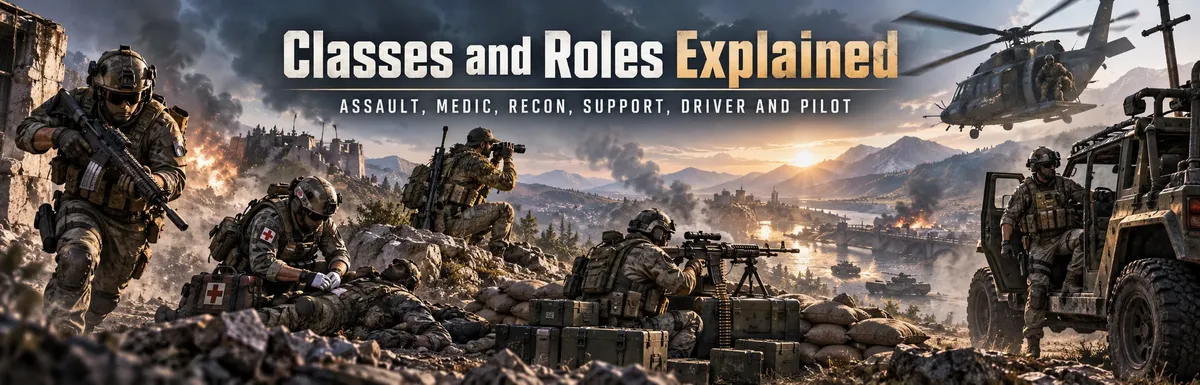
Assault, Medic, Recon, Support, Driver, and Pilot are progression disciplines rather than permanent character identities. Your equipment and battlefield actions define your role during each life, so you can play Assault in one deployment, switch to Medic after dying, drive supplies on the next life, and later fly a helicopter without creating a different character.
The official FAQ explicitly says roles do not come in the form of preset classes. Players can purchase whatever equipment or vehicles they want and mix responsibilities when practical. BULKHEAD even gives an example of someone carrying medical equipment and building tools together by using a larger backpack.
That freedom means there are effectively two layers to the system.
The first is your current battlefield role.
That is what you are doing right now.
The second is your progression track.
Actions associated with Assault, Medic, Recon, Support, Driver, or Pilot build progression in those areas and unlock additional capabilities.
Current progression references organize the six disciplines broadly like this:
Assault: assault rifles, sidearms, direct infantry combat, and weapon-handling improvements.
Medic: SMGs, bandages, medical treatment, and revives.
Recon: marksman rifles, sniper rifles, bows, spotting, and reconnaissance abilities.
Support: LMGs, shotguns, launchers, construction, FOB work, fortifications, and vehicle repair.
Driver: ground transportation, passenger delivery, supply movement, and ground-vehicle capability.
Pilot: helicopter operations, aerial transport, sling loading, aviation support, and air-vehicle mastery.
The key takeaway is simple:
You are not choosing who your character permanently is. You are choosing what job this particular life needs to accomplish.
Assault Role Explained
Assault Is the Main Frontline Infantry Role
Assault is the most straightforward combat-focused WARDOGS role. It is designed around assault-rifle fighting, direct objective pressure, infantry engagements, and the weapon-handling skills needed to move quickly between cover and win repeated firefights. It suits players who want to spend most of their time directly attacking or defending contested positions.
Assault is often the easiest role for players coming from Battlefield, Call of Duty, Squad, or other FPS games to understand.
You have a rifle.
There is an enemy position.
Your team needs that position.
You fight for it.
But effective Assault play is much deeper than simply running toward gunfire.
Your real job is to create or maintain infantry presence where it matters.
That can mean:
Pushing into the Control Zone.
Clearing buildings.
Defending a road.
Protecting a Medic.
Removing enemy infantry threatening a FOB.
Escorting Support players.
Securing a landing or drop area.
Helping a vehicle crew move through infantry-heavy terrain.
Current role-mastery references based on the in-game Season 1 text associate Assault with assault-rifle and sidearm handling, including improvements related to aiming movement, ready-to-fire speed after movement actions, recoil behavior, and other direct combat mechanics.
This reinforces an important point:
Assault progression is built around becoming a stronger frontline gunfighter, not simply unlocking progressively more expensive rifles.
Who Should Play Assault?
Assault is ideal for players who enjoy direct combat, aggressive objective play, general-purpose rifles, and constantly moving with the main infantry fight. It is also one of the easiest starting roles because its purpose is immediately understandable and useful in almost every match.
Choose Assault if you enjoy:
Rifle combat.
Clearing buildings.
Holding corners.
Pushing contested ground.
Medium-range engagements.
Supporting objective captures.
Playing near the main concentration of teammates.
Assault is particularly good for beginners because learning it teaches several universal WARDOGS skills:
Positioning.
Cover usage.
Armor awareness.
Recoil control.
Movement between buildings.
Understanding where the Control Zone battle is actually happening.
Recognizing vehicle threats.
Knowing when to push and when to wait.
Common Assault Mistake
The biggest Assault mistake is confusing “frontline infantry” with “run directly toward the enemy every life.” Assault players create value by winning important ground, not by feeding expensive loadouts into the same defended doorway repeatedly.
A strong Assault player asks:
Where does my team need infantry?
Can I enter from another angle?
Is Recon watching the route?
Is smoke available?
Do we have a Medic nearby?
Can Support suppress the position?
Do I actually need to fight this enemy, or am I chasing someone away from the objective?
Kills are useful.
Useful kills are better.
Medic Role Explained
Medic Keeps the Infantry Fight Alive
Medic is much more than the person carrying bandages. A strong Medic preserves the team's battlefield presence by healing wounded players, reviving downed teammates, supporting close-range infantry fights, and preventing successful enemy attacks from turning into a complete collapse of the frontline.
Medic gameplay revolves around one incredibly powerful idea:
A teammate who gets back up does not need to respawn, rebuild a loadout, travel back to the battle, and reestablish position.
That affects everything.
Team strength.
Objective pressure.
Cash.
Time.
Momentum.
The official WARDOGS FAQ specifically uses medical items as an example of how players define their own role, while current role-mastery information identifies bandaging, IFAK treatments, manual revives, and defibrillator revives as core Medic activities.
Medic mastery also includes improvements such as faster base revives, quicker application of buffs, and faster defibrillator charging according to the current in-game skill text reproduced by the Field Manual.
That means Medic progression directly reinforces the job you already want to perform.
Medic Is Still a Combat Role
Playing Medic does not mean standing far behind the team waiting for someone to fall over. You need to stay close enough to the main infantry fight to reach casualties quickly, which means you must also be capable of defending yourself and understanding close-range combat.
SMGs fit naturally into this job.
They provide:
Good close-range firepower.
Fast handling.
Useful building-clearing performance.
A manageable weapon option while carrying additional medical equipment.
A Medic should normally be close enough to help the Assault players without standing directly beside the first person through every doorway.
Think:
One layer behind the entry players.
Close enough to react.
Far enough back that one grenade does not kill everyone at once.
The Most Important Medic Skill Is Knowing When Not to Revive
A revive is only useful if you can complete it without immediately creating another casualty. Good Medics use cover, smoke, positioning, and basic threat awareness before committing to the revive rather than blindly running toward every downed icon.
Ask why the teammate went down.
Sniper?
Machine gun?
Vehicle?
Grenade?
Enemy inside the same room?
If the threat remains active, deal with the danger first.
A Medic who survives can revive multiple teammates.
A dead Medic revives nobody.
Who Should Play Medic?
Medic is excellent for team-oriented players who like staying near the action but do not want their entire contribution measured by kills. It is also a strong role for players who want useful progression and cash opportunities while their mechanical aim is still improving.
Medic is a strong choice if you enjoy:
Helping teammates.
Close-range combat.
SMGs.
Objective pushes.
Smoke usage.
Reading the battlefield.
Keeping a squad together.
Making clutch saves.
Recon Role Explained
Recon Is an Intelligence Role First and a Sniper Role Second
Recon is often misunderstood as “the sniper class,” but current WARDOGS mastery systems show that the role is broader. Marksman rifles, sniper rifles, bows, spotting, target identification, concealment, and information gathering all belong to Recon. The strongest Recon player is not necessarily the person with the longest-range kill—it is the player giving their team information it could not otherwise see.
Current Recon mastery includes DMR and sniper weapon handling alongside spotting-related capabilities. The in-game skill text includes longer enemy-spot duration, the ability to spot enemy buildables and deployables, reduced infrared visibility, quieter interactions, lockpicking, improved focus behavior, and even the ability to hear nearby enemy squad chat as Recon develops.
That makes Recon one of the most interesting roles strategically.
You are gathering information about:
Where infantry is moving.
Where vehicles are approaching.
Where enemy fortifications exist.
Which routes are exposed.
Where an enemy sniper is operating.
Whether another faction is about to enter the fight.
Remember that WARDOGS battles involve three teams.
That makes reconnaissance especially valuable.
You might be watching Team B while Team C is already moving around your flank.
A good Recon player helps prevent that surprise.
Sniping Without Information Is Only Half the Role
Sitting on a distant hill and collecting occasional kills may look like successful Recon gameplay, but if your position provides no useful information and your kills do not affect the objective, you may be contributing less than a Recon player who is closer, actively spotting, and covering a relevant approach.
The best Recon positions offer:
A view of active roads.
Observation over the Control Zone.
Sightlines across common approaches.
Coverage of enemy vehicle routes.
A way to reposition.
Protection from easy flanks.
Distance is not the objective.
Information is.
Recon Needs to Reposition
Every shot, spot, and repeated engagement can reveal your position. A Recon player who refuses to move eventually becomes predictable, especially when enemy Recon players are also watching for muzzle flashes, silhouettes, and repeated lines of fire.
Do not become attached to one hill.
If the Control Zone fight moves, move with it.
If enemies begin approaching your flank, leave.
If you have killed several players from the same building, assume somebody is coming to remove you.
Recon rewards patience.
It does not reward stubbornness.
Who Should Play Recon?
Recon suits players who enjoy information gathering, deliberate positioning, accurate shooting, patience, spotting, and understanding how the entire battlefield is moving rather than concentrating only on the enemy directly in front of them.
Choose Recon if you enjoy:
DMRs.
Sniper rifles.
Spotting.
Overwatch.
Flanking information.
Counter-sniping.
Watching vehicle routes.
Helping teammates understand enemy movement.
Support Role Explained
Support Is the Most Diverse Infantry Role
Support combines heavy weapons, fortifications, construction, anti-vehicle capability, supply work, FOB development, and vehicle repair. It can function as a machine gunner, combat engineer, builder, anti-armor specialist, defensive anchor, or logistics assistant depending on the equipment you bring.
Current mastery descriptions connect Support to:
LMGs.
Shotguns.
Launchers.
FOB construction.
Hesco placement.
Vehicle repair.
This makes Support much broader than simply “the LMG class.”
One Support player might carry a PKM and defend a road.
Another may carry a MAAWS and hunt enemy armor.
Another may spend most of the match building an important FOB.
Another might repair vehicles.
Another can combine construction tools with an inexpensive rifle and stay focused on infrastructure.
That flexibility makes Support one of the roles most capable of changing the shape of a battle without needing the highest kill count.
Support Builds the Battlefield Other Players Fight On
A useful fortification can create safe firing positions, protect a spawn area, block an exposed approach, support logistics, and make an important location significantly harder to attack. Poor construction, however, consumes time and resources without helping anyone.
Build because the location matters.
Not because the hammer is in your inventory.
Strong construction supports:
Active objectives.
FOBs.
Chokepoints.
Important roads.
Vehicle positions.
Defensive compounds.
Supply areas.
Infantry staging positions.
WARDOGS Season 1 also changed Support progression and economy. The Large Hammer moved from Support level 7 to level 8, while its Support unlock price and vendor price were increased, reinforcing that advanced construction equipment represents a meaningful investment rather than something to buy casually.
Support Is Also the Anti-Vehicle Role
When enemy armor starts controlling the battle, another rifle may not solve the problem. Support players carrying launchers and related equipment can remove threats that ordinary infantry cannot efficiently handle.
This is where team composition matters.
If ten teammates are carrying assault rifles but an armored vehicle is dominating the approach, the team probably does not need rifle number eleven.
It needs somebody to change jobs.
That is the strength of WARDOGS' open role system.
Respawn.
Buy the correct equipment.
Become anti-vehicle Support.
Solve the actual problem.
Who Should Play Support?
Support is ideal for players who enjoy problem-solving, construction, heavy weapons, defensive positions, anti-vehicle combat, logistics, and changing the battlefield rather than simply reacting to it.
Choose Support if you enjoy:
LMGs.
Shotguns.
Launchers.
FOBs.
Fortifications.
Repair work.
Defensive play.
Anti-armor fighting.
Helping create positions for other players.
Driver Role Explained
Driver Is a Logistics and Ground-Vehicle Role, Not Simply Someone Who Found a Car
Driver progression is built around useful ground transportation and vehicle activity. Transporting infantry, delivering supplies, running logistics, and operating combat vehicles can all become central parts of the role. A good Driver reduces the amount of time teammates spend walking and increases how quickly troops and resources reach the places that decide the match.
Current Driver mastery describes the role around wheeled transport distance, passenger delivery, and supply runs. Its skill improvements include areas such as fuel efficiency, faster vehicle startup, refueling and repair functions, and other ground-vehicle benefits.
The role becomes particularly important because WARDOGS battles operate across large spaces.
Walking costs time.
Thirty seconds walking.
Then another minute.
Then another long trip after dying.
Multiply that by several players and transportation starts affecting the entire team's ability to maintain pressure.
A useful Driver turns:
Five players walking separately
into
Five players arriving together.
That can change a fight.
Transport Is Only Useful When the Destination Makes Sense
Dropping passengers in front of an enemy machine gun is not good Driver gameplay simply because the trip was fast. Drivers need enough battlefield awareness to choose safe drop points, avoid obvious vehicle threats, and put teammates close enough to the objective to matter without delivering them directly into a kill zone.
Good transport means:
Useful destination.
Safe approach.
Reasonable dismount point.
Vehicle survival where possible.
Then returning for more passengers.
Driver gameplay is therefore partly about map knowledge.
You gradually learn:
Which roads are exposed.
Where anti-vehicle players wait.
Where Recon can see you.
Which terrain vehicles can cross.
Where infantry can safely dismount.
Which FOBs need supplies.
Driver Progression Unlocks Important Vehicles
Season 1 places several major vehicle unlocks directly inside Driver progression, so players interested in ground vehicles have a strong reason to invest in this track rather than treating driving as an occasional side activity.
Official Season 1 changes include:
URAL moved to Driver level 3.
Kodiak Assault moved to level 6.
Dune Buggy moved to level 8.
Kodiak Flatbed moved to level 10.
Large Supply Crate moved to level 16.
URAL Covered moved to level 18.
URAL Attack moved to level 25.
Humvee with Minigun moved to level 30.
Heavy Tank moved from Career level 35 to Driver level 35.
That last change is especially important.
If armored warfare is what attracts you to WARDOGS, Driver is not a side role.
It is a major progression commitment.
Who Should Play Driver?
Driver suits players who enjoy vehicles, transportation, logistics, route planning, helping teammates reach the fight, and operating ground platforms rather than spending every life as infantry.
Choose Driver if you enjoy:
Transport trucks.
Utility vehicles.
Armored vehicles.
Supply runs.
Vehicle logistics.
Moving squads.
Supporting FOBs.
Learning road networks.
Eventually progressing toward heavier combat vehicles.
Pilot Role Explained
Pilot Controls the Air Mobility of the Team
Pilot is the aviation role, covering helicopter operation, aerial transport, sling loading, aviation logistics, and air-combat capability. A strong Pilot can move troops and supplies across terrain much faster than ground movement allows, but mistakes are expensive because one bad crash can destroy the aircraft and everybody inside it.
Current Pilot mastery includes helicopter flight time, passenger delivery, and sling loading. Its progression skills include reduced fuel use, faster engine startup, quicker refueling and repairs, reduced impact damage, stronger dropped supply crates, and improvements to mounted air-vehicle weapons.
This makes Pilot a highly specialized role.
Flying is not simply another version of driving.
You need to understand:
Aircraft handling.
Landing.
Approach angles.
Terrain.
Enemy anti-air threats.
Passenger safety.
Fuel.
Where infantry actually needs to go.
The ability to move a squad rapidly is extremely powerful.
But only if they survive the flight.
A Good Pilot Does Not Need to Fight Constantly
Transportation and logistics can be more valuable than chasing every enemy aircraft or infantry target. The role becomes strongest when the Pilot understands the mission of the aircraft instead of treating every helicopter as a personal gunship.
Sometimes the correct mission is:
Insert infantry.
Leave.
Pick up another group.
Sometimes:
Move supplies.
Sometimes:
Extract players.
Sometimes:
Support another aircraft.
Sometimes combat is necessary.
The important part is knowing what the helicopter was purchased to accomplish.
Season 1 also reduced the official XP reward for killing a player with an air vehicle from 300 to 250 XP, reinforcing that Pilot progression should not be understood only through air-to-ground kills.
Who Should Play Pilot?
Pilot is best for players who enjoy mastering vehicles, learning flight mechanics, transporting squads, performing logistics, and accepting greater responsibility for expensive equipment and the teammates riding inside it.
Choose Pilot if you enjoy:
Helicopters.
Air transport.
Supply movement.
Landing under pressure.
Vehicle mastery.
Team logistics.
Learning difficult mechanical systems.
Do not choose Pilot only because helicopters look exciting.
Practice matters.
Which WARDOGS Role Is Best for Beginners?
Assault and Medic Are the Most Natural Starting Points
Assault provides the clearest introduction to normal WARDOGS infantry combat, while Medic lets new players remain close to the frontline and contribute meaningfully through healing and revives even before their aim becomes exceptional. Both roles teach positioning, objective awareness, teamwork, and the rhythm of a normal battle.
Assault teaches:
Weapons.
Cover.
Movement.
Objective pressure.
Infantry threats.
Medic teaches:
All of that plus:
Team awareness.
Smoke.
Revive timing.
Frontline positioning.
Both roles also keep you close to other players.
That is useful when learning.
Recon can also work early, but beginners sometimes develop bad habits by sitting too far away from meaningful combat.
Support introduces more systems.
Driver requires map and vehicle awareness.
Pilot adds the steepest mechanical learning curve.
That does not mean you cannot start with them.
It simply means Assault and Medic usually expose you to the game's fundamentals more quickly.
Which WARDOGS Role Is Best for Solo Players?
Assault and Recon Offer the Most Independence, but No Role Is Completely Self-Sufficient
Solo players usually benefit from roles that can operate without waiting for passengers, wounded teammates, construction supplies, or aircraft availability. Assault offers straightforward independence, while Recon can gather information and choose fights carefully. However, WARDOGS strongly rewards teamplay, so even a “solo” player should operate around friendly activity whenever possible.
Assault can fight alone.
Recon can observe alone.
But both become better near teammates.
Medic naturally needs other players.
Driver becomes more valuable with passengers.
Pilot becomes more valuable with cargo or passengers.
Support construction becomes stronger when the team actually uses it.
WARDOGS' official FAQ says every role is viable, while noting that roles contributing to teamplay are expected to be the most profitable.
So even if you queue alone, play with the team.
That distinction matters.
Which Role Is Best for Making Money?
Supportive Roles Can Be Extremely Profitable Because WARDOGS Rewards Useful Team Actions
There is no official permanent ranking declaring one role the richest, but the game's economy intentionally rewards team contribution. Revives, transportation, objective activity, logistics, and other support actions give players ways to earn without depending entirely on kills, making Medic, Driver, Pilot, and Support especially attractive to economy-focused players in the right match.
The official FAQ states that roles centered on teamplay are intended to be particularly profitable.
But profitability depends on execution.
A Driver with no passengers earns little from transportation.
A Medic hiding away from teammates cannot revive anyone.
A Support player building somewhere irrelevant wastes resources.
A Pilot who crashes immediately loses value.
The role does not create profit automatically.
Useful actions do.
Do You Need One of Every Role in a Squad?
No—WARDOGS Is Designed Around Battlefield Needs Rather Than a Fixed Team Composition
WARDOGS does not require a traditional six-person composition containing exactly one Assault, Medic, Recon, Support, Driver, and Pilot. Your squad needs whatever jobs the current battlefield requires, and that can change dramatically from one life to the next.
A small infantry group may need:
Two Assault players.
One Medic.
One Support player.
No Pilot.
No Driver.
A different situation may require:
A Driver.
Several infantry passengers.
A Support player with anti-vehicle equipment.
Recon watching the route.
There is no universal formula.
A community role checklist summarizes the philosophy well: squads do not need one of every role every life; they need players willing to fill the missing job.
That is how you should think about team composition.
Fill the problem, not the spreadsheet.
Can You Mix Roles?
Yes, but Every Extra Job Adds Weight, Cost, and Complexity
The open equipment system lets you combine responsibilities. A Medic can carry some building equipment. A Recon player can bring extra healing. An Assault player can carry anti-vehicle utility. The danger is building a loadout that tries to perform six jobs and becomes too expensive or too heavy to perform any of them efficiently.
The official FAQ explicitly supports hybrid playstyles.
The best hybrid builds usually have:
One primary role.
One secondary capability.
For example:
Assault + basic medical support.
Medic + close-range combat.
Recon + light medical equipment.
Support + anti-vehicle.
Driver + logistics.
Pilot + supply movement.
Avoid:
Assault + Medic + Recon + builder + anti-tank + giant backpack + maximum armor.
That is not versatility.
That is an overloaded character.
How Role Progression Affects Your Character
Progression Improves More Than Your Equipment Selection
WARDOGS role advancement is not only an unlock ladder for weapons and vehicles. Current in-game mastery text shows role-specific improvements covering handling, mobility, medical speed, spotting, construction-related gameplay, ground vehicles, and aviation. As you invest in a role, you increasingly specialize in performing that job better.
Assault mastery can improve combat handling.
Medic mastery improves medical efficiency.
Recon develops spotting and marksman capabilities.
Support improves heavy-weapon and construction-related performance.
Driver develops ground-vehicle capability.
Pilot develops air-vehicle capability.
This makes role choice more meaningful over time.
You can always change jobs.
But a heavily developed Recon progression naturally provides advantages when returning to Recon work.
The system therefore creates specialization without permanently imprisoning you inside a class.
That is the balance WARDOGS is aiming for.
Season 1 Progression Matters for Every Role
The Live XP Curve Is Slower Than the Beta
Season 1 significantly changed role progression compared with the short beta tests. BULKHEAD explained that beta progression was accelerated so testers could access content quickly, while Early Access uses a longer-term XP curve that becomes much more demanding through the middle levels.
Official Season 1 cumulative thresholds include:
Level 6: 9,250 XP.
Level 10: 35,000 XP.
Level 15: 110,000 XP.
Level 20: 250,000 XP.
Level 25: 325,000 XP.
Level 30: 400,000 XP.
Level 35: 500,000 XP.
Level 40: 650,000 XP.
Level 45: 800,000 XP.
Level 50: 1,000,000 XP.
This matters when choosing a role to specialize in.
Getting several tracks into their early levels is relatively accessible.
Pushing one track deeply becomes a much more serious investment.
That is why players should decide whether they want:
Broad flexibility across several roles.
Or deep specialization toward a specific vehicle, weapon, or capability.
Choosing the Right WARDOGS Role for Your Playstyle
Choose Assault If You Want Constant Infantry Combat
Assault is the natural choice for players who want rifles, objective pressure, aggressive movement, building clearing, and frequent gunfights without managing too many specialized systems.
You are the frontline.
Stay useful.
Stay near the objective.
Choose Medic If You Want Combat and Team Support Together
Medic gives you close-range fighting while adding one of the strongest team abilities in the game: returning downed teammates to the battle.
You still fight.
But your awareness of teammates matters as much as your crosshair.
Choose Recon If You Want Information and Precision
Recon rewards players who enjoy understanding the battlefield, spotting threats, creating long sightlines, and taking deliberate shots rather than constantly rushing into close combat.
Be the team's eyes.
Not just its sniper.
Choose Support If You Want Heavy Weapons and Battlefield Control
Support is ideal for players who enjoy building, defending, destroying vehicles, maintaining positions, carrying heavy weapons, and solving problems that ordinary riflemen cannot handle.
You shape the fight.
Choose Driver If You Love Ground Vehicles and Logistics
Driver is for players who understand that getting five teammates into the right position quickly can matter more than personally killing five enemies.
Transport is strategy.
Logistics is strategy.
Vehicles are not just toys.
Choose Pilot If You Want the Highest-Mobility Specialist Role
Pilot gives you access to an entirely different layer of the battlefield, but that freedom comes with greater mechanical difficulty and greater responsibility for expensive aircraft, passengers, and cargo.
Learn to fly properly.
Then the role becomes extremely valuable.
Common WARDOGS Role Mistakes
Thinking Assault Is the Only “Real” Combat Role
WARDOGS is designed so transport, medicine, Recon information, construction, logistics, vehicles, and aviation can all contribute directly to the match. Measuring usefulness entirely through infantry kills ignores much of the game's actual design.
A Medic saving five players matters.
A Driver delivering five players matters.
Recon identifying armor matters.
Support destroying that armor matters.
A Pilot inserting a squad behind the fight matters.
The scoreboard never tells the entire story.
Playing Recon Like a Completely Separate Game
Recon should support the main battle, not disappear to a distant hill and spend the entire match taking unrelated shots at targets that do not affect the objective.
Stay connected to what your team is trying to accomplish.
Playing Medic Like Assault With Extra Bandages
If you carry medical equipment but repeatedly die at the front before helping anyone, you are effectively paying for tools you never use.
Stay close.
Not first.
Building Because You Have a Hammer
Support construction should solve a battlefield problem. Random walls, irrelevant FOBs, and unnecessary structures waste resources and time.
Build where the team benefits.
Driving Empty Vehicles Around
Driver value comes from transportation, supplies, logistics, or combat-vehicle effectiveness. Moving an empty truck for no tactical reason is not meaningful team support.
Find passengers.
Find cargo.
Find a mission.
Flying Without a Mission
Pilot is too expensive and too strategically valuable to spend an entire life circling aimlessly. Decide whether you are transporting infantry, moving supplies, extracting players, or performing combat support.
Every sortie should have a purpose.
WARDOGS Classes and Roles FAQ
Does WARDOGS Have Classes?
Not in the traditional locked sense. BULKHEAD has explicitly said WARDOGS has roles to play rather than a fixed class system. Players choose their equipment and vehicles freely, and those choices determine the role they perform during a deployment.
What Are the Six WARDOGS Roles?
Assault, Medic, Recon, Support, Driver, and Pilot
These are the six main role-progression disciplines currently used to organize infantry combat, medicine, reconnaissance, heavy support, ground vehicles, and aviation.
Can I Change Roles?
Yes
You are not permanently locked into a role. Changing your loadout, equipment, vehicle, and battlefield activity allows you to perform a completely different job on another life.
That flexibility is a core part of WARDOGS' design.
Can I Be Medic and Support at the Same Time?
Yes, Within the Limits of Your Loadout
The official FAQ specifically describes hybrid play as possible. You can carry medical and building equipment together if your inventory, weight, cost, and chosen backpack allow it.
The question is whether combining them actually makes the build better.
What Is the Best WARDOGS Role for Beginners?
Assault or Medic
Assault is the easiest introduction to frontline gunplay, while Medic combines simple close-range combat with healing and reviving that lets new players contribute even before they master every weapon mechanic.
What Is the Best Role for Snipers?
Recon
Recon progression covers sniper rifles, marksman weapons, spotting, focus-related improvements, concealment, and other information-focused abilities.
Which Role Uses LMGs and Launchers?
Support
Support covers LMGs, shotguns, launchers, building, fortifications, FOB activity, and vehicle repair, making it the main heavy infantry and engineering role.
Which Role Unlocks Ground Vehicles?
Driver
Driver progression is focused on ground transportation and logistics, and Season 1 places several major vehicles—including the Heavy Tank at level 35—inside the Driver track.
Which Role Is for Helicopters?
Pilot
Pilot covers helicopter flight, aerial transportation, sling loading, and air-vehicle mastery, with progression benefits focused on aircraft operation and mounted systems.
Do Roles Reset Every Life?
Your Job Can Change Every Life, but Your Progression Does Not Disappear Simply Because You Change Equipment
The equipment you buy determines what role you perform on that deployment. You can return to another role later and continue using the progression you have already built in that discipline.
Seasonal progression rules can change between seasons, so players should check current Season information rather than relying permanently on older progression documentation.
Which Role Should My Squad Have?
The One Your Team Is Currently Missing
WARDOGS is not designed around a mandatory one-of-each composition. Look at the battlefield instead. If nobody can revive, add a Medic. If armor is dominating, add Support. If everyone is walking, get a Driver. If nobody knows where attacks are coming from, Recon becomes valuable.
That flexibility is one of the biggest advantages of the game's role system.
Final Verdict – How WARDOGS Roles Really Work
WARDOGS does not ask you to choose one class forever.
It asks you to choose a job.
Assault brings direct infantry pressure.
Medic keeps that infantry alive.
Recon gives the team information and precision fire.
Support provides heavy weapons, construction, fortifications, repair, and anti-vehicle capability.
Driver moves troops, supplies, and ground vehicles.
Pilot provides aerial transport, logistics, and aviation support.
None of those jobs exists completely alone.
An Assault player becomes stronger when a Medic survives behind them.
The Medic survives more easily when Recon identifies threats before they arrive.
Recon benefits when Support controls enemy vehicles and protects useful positions.
Support needs supplies and transportation.
Driver moves those supplies.
Pilot can bypass terrain entirely and reposition people or cargo from the air.
That is what makes WARDOGS a combined-arms game rather than simply a shooter with six colored class icons.
And because there is no traditional locked class system, you can respond to the battle.
Enemy armor appears?
Switch into Support.
Your team has nobody reviving?
Buy medical equipment and become the Medic.
The objective is too far away?
Get a transport vehicle.
Your team cannot see where attacks are coming from?
Take Recon equipment and start spotting.
A squad needs to cross the battlefield quickly?
Fly.
The best WARDOGS role is not permanently Assault, Medic, Recon, Support, Driver, or Pilot. It is the role that solves the problem your team has right now.
For individual players, however, specialization still matters.
If you love rifles and objective pushes, develop Assault.
If you enjoy saving teammates, build Medic.
If you prefer intelligence and precise shooting, progress Recon.
If you enjoy heavy weapons, fortifications, and problem-solving, invest in Support.
If ground vehicles are your main interest, Driver should become a priority.
If you want aviation, commit to Pilot and learn the aircraft properly.
WARDOGS gives you the freedom to switch jobs.
Understanding when to switch is what separates simply having six progression tracks from actually using the role system well.
Players who want help advancing Assault, Medic, Recon, Support, Driver, Pilot, or overall WARDOG progression can also explore WARDOGS services through BoostRoom.



