Practical rules
- Stealth is for control. Loud is for tempo. Choose based on what you need: safe extraction or fast clearing.
- Silence prevents fights. Speed ends fights. Both reduce risk—just in different ways.
- Never “half-commit.” If you’re stealthing, don’t panic-dump magazines. If you’re going loud, don’t freeze and creep while enemies reposition.
- Plan your “noise budget.” One loud fight can be fine. Three loud fights in a row usually becomes a swarm problem.
- Use tools to shape enemy behavior. Suppressors shrink your alert radius; totems shrink your movement noise; smoke breaks line-of-sight.
- Extract after your win condition. “One more room” is how stealth runs become loud runs—and loud runs become wipe runs.
- The best playstyle is the one that preserves your stash. A “cool” fight that costs you your kit is not cool.
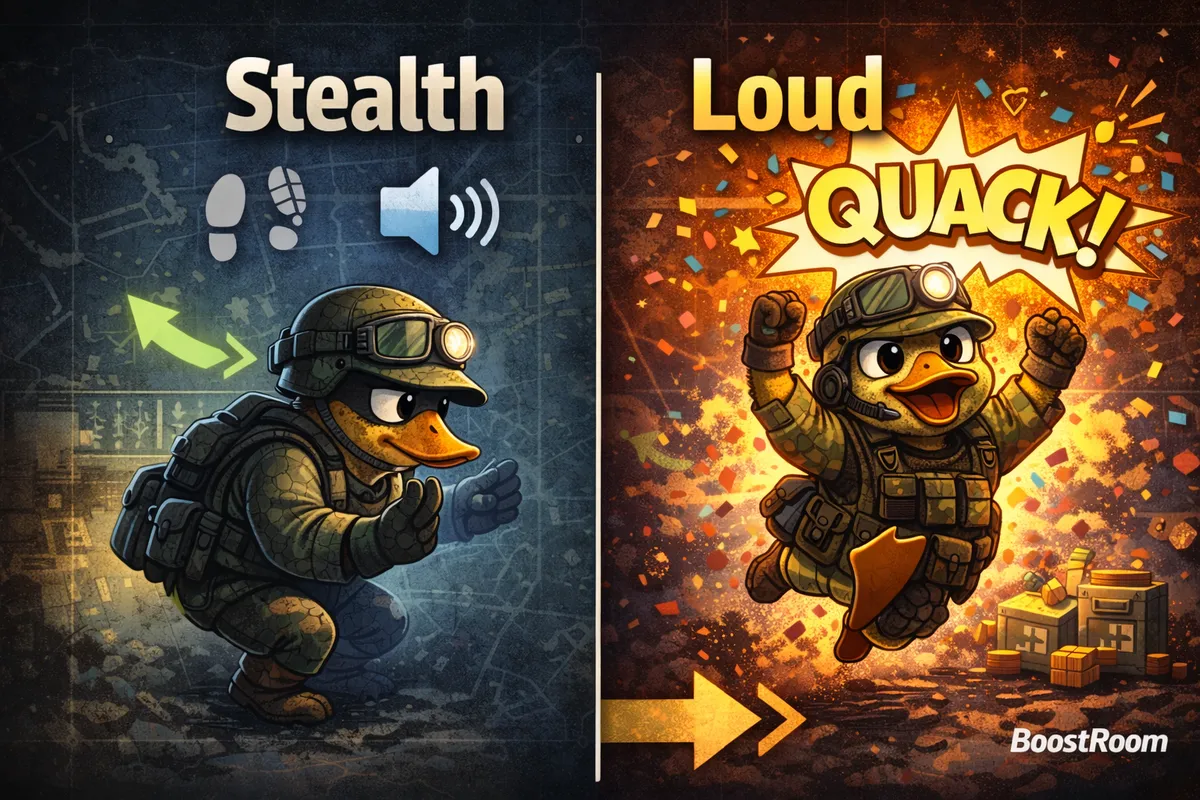
Stealth vs. loud: what the game is actually rewarding
Duckov’s combat loop rewards one thing above all: reducing the number of enemies you fight at once.
You can do that in two ways:
Stealth reduces how many enemies get alerted.
You don’t “win” stealth by being invisible. You win stealth by keeping fights small: one enemy, then another, then another—without waking the whole neighborhood.
Loud play reduces how long enemies are alive to become a problem.
You don’t “win” loud by shooting everything. You win loud by keeping tempo high: delete threats quickly, reposition fast, and prevent enemies from surrounding you.
So the real question isn’t “Which one is better?”
It’s: Do you want fewer fights… or faster fights?
Sound Range 101: the stat that decides whether you get swarmed
Duckov quietly tells you the most important stealth/loud mechanic through weapon stats: Sound Range.
Sound Range is the “alert radius” created by firing your gun.
A high Sound Range means your shots can wake up enemies from farther away. A low Sound Range means fewer enemies hear you, so fights stay smaller.
This is why two weapons can feel “equally strong” but produce totally different raid outcomes. You can delete an enemy with either weapon—but one weapon creates a chain reaction and the other doesn’t.
A simple comparison that explains everything:
- A typical unsuppressed rifle like an AK-47 has a very high Sound Range (big alert radius).
- Integrated suppressed weapons like the VSS or AS Val have much lower Sound Range, making them naturally better for controlled raids.
Once you understand Sound Range, you stop blaming luck. You start managing attention.
Suppressors: the best stealth investment (with real tradeoffs)
Suppressors are not “damage upgrades.” They’re problem reducers.
The most common mistake is buying a suppressor and expecting your gun to feel stronger. Often it feels slightly worse in raw performance—but your raid feels safer because you stop pulling the entire map.
Example tradeoff that matters:
A common rifle suppressor can reduce Sound Range massively (huge stealth win), but it may reduce Range and Bullet Speed (meaning your shots feel worse at distance). That’s not a flaw. That’s the cost of not getting swarmed.
How to think about suppressor value:
- If you’re dying because fights turn into 4-enemy chaos, a suppressor is worth more than a damage upgrade.
- If you’re farming a boss camp and you want everything to come to you, suppressors may slow your clear speed and reduce “tempo.”
Practical suppressor rule:
- Stealth plan → suppressor is priority.
- Loud plan → suppressor is optional (sometimes you even prefer not to use one if you want maximum range/feel and don’t care about alerting nearby enemies).
Bonus note for sniper suppressors:
Some suppressors don’t only reduce Sound Range—they may also boost critical damage multipliers. That makes them a stealth-friendly way to keep kills clean without turning every shot into a dinner bell.
Built-in suppressed weapons: why they feel “easy mode” for controlled raids
Weapons with integrated suppressors are popular for one reason: their Sound Range stays low without needing extra attachments.
That low Sound Range changes the entire pacing of a run:
- You shoot, and you don’t immediately get a parade of enemies.
- You can fight in the same area without the whole map showing up.
- You have time to loot, heal, and reset.
These weapons are especially strong for:
- early progression
- quest steps that require survival
- runs where you carry rare items
- learning new routes safely
They aren’t automatically the “best weapons,” but they are often the best weapons for not losing everything.
Movement noise: stealth isn’t only about gunshots
A huge community lesson in Duckov is this: enemies often react to what they hear more than what they see.
That means your stealth doesn’t start when you shoot—it starts when you move.
Here’s what consistently makes you louder:
- sprinting everywhere
- being overweight
- moving with your weapon out when you could move faster with it holstered
- running straight through open space without cover pauses
Stealth movement is not crawling.
Stealth movement is controlled pace + smart angles + avoiding obvious sound traps.
If you want one “pro habit” that improves both stealth and loud play:
Holster your weapon during repositioning (then re-draw when you’re about to take an angle). You move faster and conserve stamina, which matters for dodging, re-angles, and escaping bad pulls.
Totems and stealth builds: Ninja totems are the quietest “upgrade” you can equip
If suppressors reduce the sound of your shots, totems can reduce the sound of your movement.
The Ninja totem line is the most direct stealth tool because it reduces both running and walking sound range. That’s huge because it shrinks the distance where enemies “wake up” just because you’re moving.
How to use Ninja totems correctly:
- Wear Ninja when your goal is survival, scouting, or controlled pulls.
- Consider swapping away from Ninja when your goal is pure clearing speed and you don’t care about being noticed.
Important totem slot behavior that trips people up:
Even if you unlock multiple totem slots, you can’t stack duplicates of the same totem tier in a way that breaks the system. Plan around one main stealth totem, not “double Ninja forever.”
Also, don’t be stingy with totems. If your build relies on being quieter, totems are not a luxury—they’re your core kit.
Talents that affect noise: Berserker isn’t only a “fight” talent
One of the most practical balance changes is that the Berserker talent was updated to reduce both Running Sound Range and Walking Sound Range.
That matters because it makes Berserker a stealth-friendly talent even for players who mostly think of it as combat-related. If your style is “aggressive but controlled,” Berserker can support that by lowering how much your movement pulls enemies while you reposition.
How to use this in real raids:
- If you go loud, you still spend most of your time moving between fights. Reducing movement sound helps prevent fights from stacking on top of each other.
- If you go stealth, it makes your repositioning safer when you need to rotate after a shot.
Line-of-sight and the “quack cue”: the stealth alarm you should respect
Duckov has a very readable stealth signal: sound + vision cues.
A common observation in reviews and player experiences is:
- enemies can stay “hidden” until they enter your direct line-of-sight
- enemy footsteps can be heard while they patrol
- when you hear a quack, it often means an enemy has spotted you (or at least an enemy is alerting others)
You don’t need to overthink this. Treat it like a red light:
If you hear the quack and you’re in stealth mode, stop looting.
Reset your position. Break line-of-sight. Get ready to either:
- re-engage from a better angle, or
- disengage entirely
Players die in stealth runs because they keep looting while the game is telling them “you’ve been made.”
Smoke grenades: the stealth tool that turns loud situations back into stealth
Smoke is one of the best “adaptation” tools in Duckov because it changes the fight without needing more damage.
At minimum, smoke creates a dense cloud that obscures vision. In practice, players use it for three things:
1) Break line-of-sight so you can heal/reload
If you’re hurt, smoke buys you time without needing to win the fight first.
2) Cross danger lanes
Open ground is where raids end. Smoke makes those transitions survivable.
3) Force enemies to commit to the wrong side
A community tip is that entering smoke from a specific side can “bias” enemy targeting toward that side, giving you a window to reset.
Smoke rule that keeps you alive:
Smoke doesn’t make you invisible forever. It creates a brief decision advantage. Use it to reposition, then re-take control.
Also remember: if you attack in smoke, enemies can still become alerted. Smoke is best when paired with a plan: reset → angle → finish.
When to choose stealth: the five best stealth situations
Stealth is best when your “cost of failure” is high.
Choose stealth when you’re doing any of these:
1) Carrying progression items
Blueprints, keys, rare crafting parts, quest bottlenecks—anything that would hurt to lose should push you toward a stealth plan.
2) Learning a new map or a new route
You want information, not chaos. Stealth reduces accidental chain fights while you’re still building your mental map.
3) Playing with limited meds or limited ammo
Stealth keeps fights small so your supplies last.
4) You need to survive more than you need to profit
Some quests are “extract with X” or “do X and live.” Stealth is the correct answer.
5) Night, rain, or low-visibility conditions
When sightlines are unreliable, loud fights become messy. Stealth lets you control engagements.
The stealth playbook: how to sneak without wasting your whole raid
Stealth isn’t “go slow.” Stealth is “go smart.”
Use this repeatable stealth loop:
Step 1: Pick a quiet weapon plan
- Prefer low Sound Range weapons or a suppressor
- Avoid high Sound Range guns unless you’re intentionally baiting fights
Step 2: Move in short bursts
- walk between cover pieces
- stop briefly to listen
- avoid crossing large open lanes unless you must
Step 3: Isolate targets
Instead of shooting the first thing you see, ask:
- “If I shoot now, who else will hear it?”
- Then reposition until the answer is “not many.”
Step 4: Win fast, then relocate
Stealth isn’t about staying in one place forever. It’s about making small fights and then rotating before the next patrol walks in.
Step 5: Loot like a professional
Looting is loud because it makes you stationary and greedy.
- loot only what fits your plan
- if you get a big value item, consider extracting immediately
- if you hear quack cues or footsteps closing, stop looting and reset
Step 6: Extract while you still control the raid
The stealth win is leaving with value before “random” becomes “inevitable.”
The stealth build checklist: what matters most
If you want a stealth build that actually works, focus on these levers:
- Lower Sound Range shots (suppressor or integrated suppressed weapon)
- Lower movement sound (Ninja totem line, noise-reducing talents)
- Vision control (enough sight/scouting to avoid walking into patrols)
- Emergency reset tools (smoke, enough meds to survive one mistake)
- Weight discipline (overweight stealth isn’t stealth)
A stealth build that ignores weight and escape tools is just a slow loud build.
When to choose loud: the five best loud situations
Loud is best when your “cost of hesitation” is high.
Choose loud when you’re doing any of these:
1) Clearing a dangerous camp or a fixed enemy location
If you know enemies are concentrated, “slow-peeking” can get you pinched. Loud clearing keeps tempo and prevents surround.
2) Boss farming or elite fights
Bosses and elite enemies are often better handled with tempo: delete threats, break line-of-sight, re-engage. Half-stealth often fails here.
3) Time pressure raids
If you have limited raid time or you’re chasing an objective quickly, loud movement + fast kills can be safer than creeping into late chaos.
4) You have strong armor/med sustain and enough ammo
If your kit can support extended fights, loud is a valid “control by force” plan.
5) You want enemies to come to you
Sometimes loud is bait: you take a strong position and let enemies path into your kill zone. That’s loud strategy done correctly—controlled, not messy.
The loud playbook: how to go full quackers without getting swarmed
Loud play is not “spray and pray.” It’s tempo management.
Use this loop:
Step 1: Choose a weapon that ends fights quickly
- high stability
- comfortable recoil
- enough ammo capacity to finish a push without panic reloading
Step 2: Create a kill zone
Pick a position where enemies are forced to enter through a predictable lane:
- doorways
- corners
- narrow corridors
- cover gaps
Step 3: Use a “two-fight rule”
After two loud engagements in the same area, assume the area is getting hot.
Relocate before you get surrounded.
Step 4: Reset aggressively
Loud raids are won by repositioning:
- shoot → rotate → heal/reload → shoot again
- If you stand still, loud becomes a swarm.
Step 5: Use utility to control chaos
Stun, smoke, and other utility grenades aren’t “extra.” They’re how you survive the moments where loud attracts too much attention.
Step 6: Extract once your goal is done
Loud raids burn supplies. Your profit is not “clearing everything.” Your profit is finishing the objective and leaving before attrition wins.
Hybrid is the real meta: how good players swap modes mid-raid
Most successful Duckov players aren’t stealth-only or loud-only. They are hybrid:
- Stealth to enter (avoid pulling early fights, reach objective clean)
- Loud to clear (when the map forces contact or a boss is present)
- Stealth to exit (protect your loot and avoid pointless fights)
Here are three powerful hybrid patterns:
Pattern 1: Quiet entry, loud finish
Best for: objectives in a hot area
- sneak to the target
- then clear aggressively once you must fight
- smoke/reset and extract
Pattern 2: Loud entry, quiet exit
Best for: farming a fixed camp
- clear fast
- stop shooting once the area is safe
- leave quietly to avoid extra patrol pulls
Pattern 3: Silent shots, loud movement
Best for: maps where movement speed matters
- move quickly between cover
- take suppressed shots when needed
- never stand still long enough to get boxed in
Hybrid is also the easiest way to keep raids consistent when loot and weather swing unpredictably.
Map-style decisions: open maps vs indoor maps
Different map types push you toward different default choices.
Open maps (long sightlines, wide lanes)
- Stealth shines because you can avoid pulling multiple patrols across open ground.
- Loud can work if you have a strong range setup, but you must rotate constantly.
Indoor-heavy maps (tight corridors, corners, rooms)
- Loud clearing often becomes safer because slow-peeking can get you flanked.
- Stealth still works, but it’s about isolating rooms and using sound cues, not “staying far away.”
Mixed maps (yards + buildings)
- Hybrid is king: stealth across open lanes, loud inside hotspots, then stealth out.
If you’re unsure what to pick:
- Open space you don’t control → stealth.
- Tight space where you can control angles → loud.
Decision tree: choose stealth or loud in 10 seconds
Ask these in order:
1) What’s my goal?
- survival / quest / rare item → lean stealth
- clear / boss / fast objective → lean loud
2) What’s my kit like?
- light ammo, limited meds → stealth
- strong sustain, enough ammo → loud is viable
3) What’s the environment?
- open lanes, low visibility, rain/night → stealth
- tight interiors, predictable lanes → loud can be safer
4) What happens if I get swarmed here?
- if swarm = death → suppress and stealth
- if swarm = manageable (good position + utility) → loud can be efficient
5) What’s my exit plan?
- if you’re carrying value and the exit is far → stealth
- if your exit is close and your goal is done → you can afford loud
Make the choice once, then play that choice with commitment.
Loadout ideas: one stealth kit, one loud kit, one hybrid kit
These are principles, not strict items. Build around your economy and comfort.
Stealth kit (cheap, safe, effective)
- suppressed weapon or naturally low Sound Range weapon
- Ninja totem equipped
- enough meds for one mistake
- smoke grenade for resets
- weight kept low on purpose
Loud kit (tempo and control)
- stable high-damage or high-rate weapon you can control
- enough ammo to finish multiple engagements without panic
- utility that stops swarms (stun/smoke depending on your style)
- armor/meds to survive an extended fight
- you accept attention and manage it with movement
Hybrid kit (best for most players)
- suppressor if affordable (or a quieter platform)
- one smoke as a guaranteed escape tool
- totem choice depends on goal (Ninja for survival runs, other totems for specialized farming)
- enough ammo for loud moments, but not so much that you become overweight
Totem reminder: build around one main totem choice per raid. If you try to be everything at once, you end up being loud, slow, and fragile.
Common mistakes that make stealth fail
Mistake 1: Crawling everywhere
Slow doesn’t equal quiet if you’re still in enemy sound range. Stealth is route + timing, not snail speed.
Mistake 2: Looting while “alert cues” are happening
Footsteps closing, quack cue, patrol pathing—stop looting and reset.
Mistake 3: Shooting from the same spot repeatedly
Even suppressed shots can eventually bring trouble. Rotate after kills.
Mistake 4: Being overweight and calling it stealth
Overweight movement is louder and slower. If you’re heavy, extract sooner.
Mistake 5: No reset tool
If you don’t bring smoke or a plan to break contact, one mistake ends your run.
Common mistakes that make loud fail
Mistake 1: Standing still after a loud fight
Loud raids require rotation. Standing still is how you get surrounded.
Mistake 2: Fighting in open ground
Loud doesn’t mean reckless. Pick angles, cover, and lanes where enemies must commit.
Mistake 3: Running out of ammo mid-fight
If your plan is loud, your ammo plan must match it.
Mistake 4: Turning every enemy into a chase
If you chase everything, you lose control and drag fights into bad terrain.
Mistake 5: Forgetting the objective
Loud raids burn supplies. If your objective is done, extract. Don’t “victory lap” into a wipe.
BoostRoom promo
If you want your raids to feel consistent instead of chaotic, BoostRoom helps you build a playstyle system you can repeat: the best stealth-to-loud swap points for each map type, suppressor and totem priorities for your current progression, and a simple “noise budget” plan so you don’t accidentally turn a safe loot run into a swarm festival. Whether you’re trying to survive with rare items, farm bosses efficiently, or stop bleeding kits while learning routes, BoostRoom’s Duckov guides are built to keep you extracting more—and losing less.
FAQ
Is stealth always better for beginners?
Stealth is usually safer early because it keeps fights small, but loud can be safer in tight interiors if you control angles. Beginners should learn both, then play hybrid.
What’s the biggest difference between stealth and loud in Duckov?
Stealth reduces how many enemies get alerted. Loud reduces how long enemies stay alive. Both are risk management.
Do suppressors actually matter, or is it just preference?
They matter because they reduce Sound Range, which reduces the number of enemies you wake up when firing. The tradeoff is often reduced range or bullet speed on some suppressors.
What’s the easiest stealth upgrade I can equip early?
A Ninja totem is one of the most direct stealth upgrades because it reduces running and walking sound ranges, making it easier to move without pulling extra enemies.
How do I know if I should switch from stealth to loud mid-raid?
Switch when stealth stops giving you control—like when you get spotted, a boss fight triggers, or enemies start stacking. Loud tempo + repositioning can regain control faster.
Does smoke actually help, or is it gimmicky?
Smoke is extremely useful for breaking line-of-sight, healing/reloading safely, and repositioning. It doesn’t make you invisible forever, but it creates a decision advantage.
Why do I feel like enemies “hear everything”?
Enemy detection often leans heavily on sound. Your running/walking noise, being overweight, and firing loud weapons can all increase how many enemies respond.
What’s the safest “default” strategy for most raids?
Hybrid: stealth entry, loud only when needed, stealth exit—especially when carrying valuable loot.