How The Forge World Is Organized (So You Stop Getting Lost)
The Forge is structured like a ladder:
- Islands (major worlds) are the big progression steps (Stonewake’s Cross → Forgotten Kingdom → Frostspire Expanse → Crimson Sakura Isles).
- Sub-areas inside each island are the “real content” (caves, depths, dungeons, secret rooms, boss portals).
- Services repeat on most islands (Forge, Seller, Pickaxe Shop, Potion Shop, Enhancer, Runemaker, Wizard).
- Locks control pacing (level requirements, questlines, keys, race-specific doors, expensive donations).
Once you understand this structure, you can predict where things are:
- If you need pickaxes, look for Miner Fred or a Pickaxe Shop near the spawn hub.
- If you need rune sockets, look for the Runemaker and Enhancer.
- If you need new islands, you’re thinking about the Portal Tool and its level gates.
- If you found a locked gate, the answer is almost always a quest reward (key) or a long questline (like Goblin King, Raven, or Maze chains).
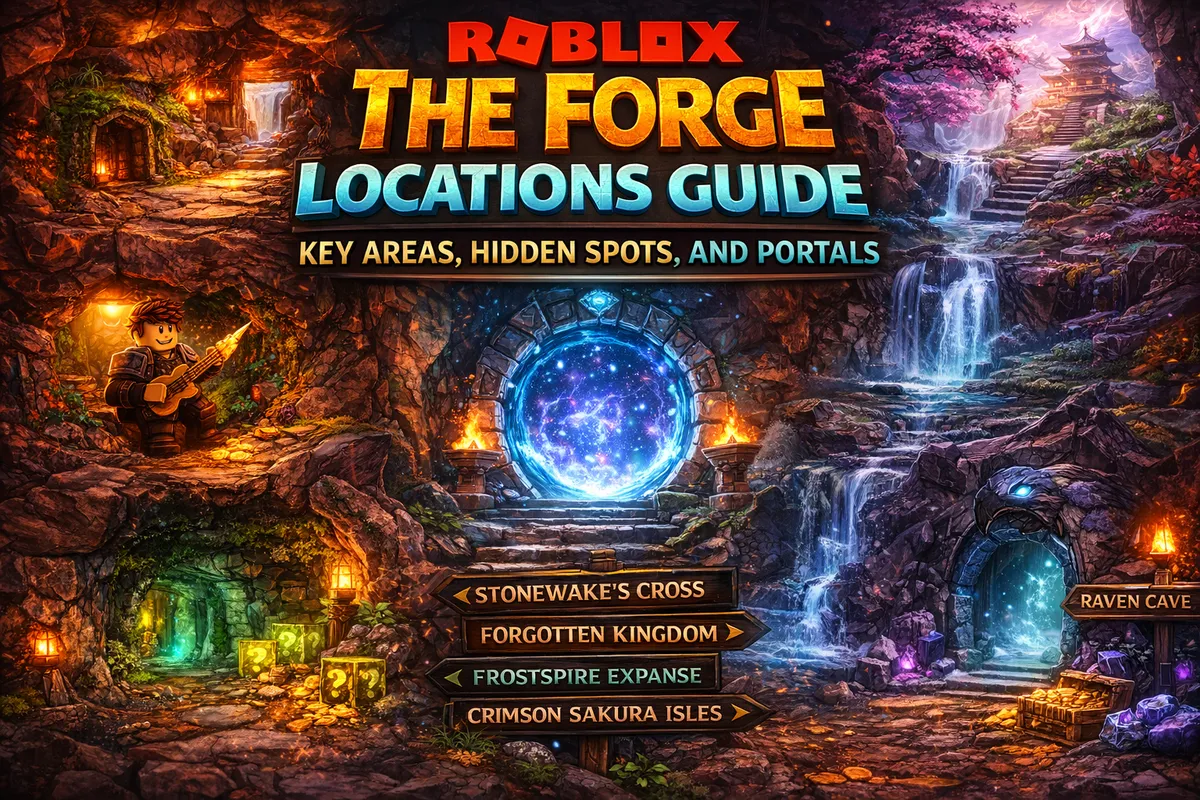
Your Navigation Toolkit (The 6 Places You’ll Use Constantly)
No matter what island you’re on, you’ll return to these “core hubs” constantly. Memorize them and your gameplay becomes smoother immediately.
- Forge Area: craft weapons and armor; some islands have unique forge pools.
- Seller (equipment/ore/essence): turn loot into gold; best used in batches.
- Pickaxe Shop: upgrades mining speed and unlocks new rock tiers (the biggest time saver).
- Potion Shop: heals + stamina tools; boss and deep-cave insurance.
- Enhancer: upgrades gear and unlocks more rune-slot potential over time.
- Runemaker: attaches/detaches runes; where builds become “real loadouts.”
Your goal in every new island: find these six spots first. Once you know where they are, you can explore the rest without losing your “home base.”
Portals and Fast Travel (How It Works, How to Unlock It, How Not to Mess It Up)
Portals are the difference between a fun grind and a painful walk simulator.
How to Get the Portal Tool
You unlock the Portal Tool by completing the early tutorial questline from Sensei Moro in Stonewake’s Cross, then talking to the Wizard to receive the portal tool reward. Many players receive the portal around levels 7–9, but you’ll still need to meet level requirements for the next islands.
Level Gates (The Three Big Travel Locks)
In 2026, travel is gated by level:
- Forgotten Kingdom: typically requires Level 10 to access.
- Frostspire Expanse: typically requires Level 70 to access.
- Crimson Sakura Isles: requires Level 100 to access.
If your portal menu shows “Locked,” it usually means you haven’t met the level or quest requirement yet.
How to Use the Portal Tool (Simple Steps)
- Equip the Portal Tool from your hotbar.
- Place it down in a valid spot.
- Interact with it to open the travel menu.
- Choose your destination island.
Portal Placement Rules (Why It Sometimes Won’t Work)
Portals have restrictions that frustrate new players until you know them:
- If you attacked an enemy or got attacked, you cannot place a portal until you’re out of combat.
- There is a cooldown before you can place another portal after using one.
- Some locations show as Locked until requirements are met.
The “Pro” Portal Habit (Saves Hours Over a Week)
Don’t place portals randomly. Place them with purpose:
- Place a portal right after you finish a long mining batch and want to sell/forge.
- Place a portal when you’re done with a quest chain and need to turn in rewards.
- Place a portal before a risky cave push so you can reset quickly if you run out of healing.
Portals are not just travel — they’re an efficiency tool that turns the world into a set of repeatable loops.
Stonewake’s Cross Locations Guide (Island 1 – The Starter Hub)
Stonewake’s Cross is where every player begins. It’s designed to teach the game loop and gently introduce secrets.
Stonewake’s Cross: The Must-Know Landmarks
These are the places you should find and mentally “pin” in your head in your first session:
- Sensei Moro (Tutorial Quests): your starting questline; unlocks core systems and leads into portal access.
- Marbles (Weapon shop / selling): a key early selling point for equipment.
- Miner Fred (Pickaxes): early pickaxe progression; your first “speed upgrade.”
- Maria (Potions): early healing and stamina tools.
- Greedy Cey (Sell ores/essences): converts your farming into gold.
- Runemaker: rune system access once you have slots.
- Enhancer: upgrades; a long-term power multiplier.
- Bard (Lost Guitar quest giver): early secret chain that unlocks an important key.
- Tomo the Explorist: tied to a later quest chain that becomes important once you unlock Goblin Cave.
When you first spawn, your best route is simple: complete Sensei Moro’s quests while learning where these NPCs sit relative to the cave entrance.
The Cave (Stonewake’s Main Mine)
The Cave is the large mining area connected to Stonewake’s Cross. It has multiple layers and multiple exits.
Inside The Cave, you’ll generally find:
- Starter rocks and ores for early crafting practice.
- Early enemies if you wander deeper.
- Hidden entrances that blend into the cave walls.
Your early goal is not to “clear the whole cave.” Your goal is to build a short loop: mine a batch → return to forge → sell → repeat.
Inner Cave and Deep Cave (Stonewake’s Progression Layers)
As you push deeper:
- Inner Cave is the next difficulty step.
- Deep Cave is the “serious” starter cave where enemies hit harder and ore value rises.
These areas are where many players slow down because they wander too far without planning. A better approach:
- Push deeper only after crafting one stable weapon and one stable armor set.
- Use Deep Cave as a “batch mining” zone, not a “live there forever” zone.
Secret Cave (Hidden Entrance + Early Quest Power Spike)
The Secret Cave is one of the most important early hidden locations because it ties directly into:
- the Bard’s early quest chain, and
- the key that unlocks another hidden area.
How it feels in-game:
- It’s a hidden drop-down chamber inside The Cave.
- The entrance is disguised as a mossy/green wall section.
- Many players walk past it multiple times because it looks like normal cave decoration.
Why it matters:
- The Secret Cave is the main location for the Bard’s Lost Guitar quest.
- Completing that quest rewards the Unknown Key, which unlocks Fallen Angel’s Cave (a major early hidden area).
If you care about fast progression, do the Bard quest early. It’s one of the best “time invested → value gained” secrets in Stonewake.
Fallen Angel’s Cave (Locked Gate + Key Requirement)
Fallen Angel’s Cave is a locked area inside The Cave.
- It is locked behind a gate that requires the Unknown Key.
- The Unknown Key is earned by completing the Bard’s Lost Guitar quest.
Navigation tip:
- The locked entrance is located deeper in The Cave and is easy to recognize once you’ve seen it: it’s a clear “locked interaction” point rather than a hidden wall.
Why it matters:
- Fallen Angel’s Cave is part of the early chain that players connect to advanced pickaxe goals later.
- It’s also a clean example of how The Forge hides progression behind quests rather than random luck.
Hidden Roof (Lucky Blocks + Fichillium Easter Egg)
The Hidden Roof is a famous Stonewake secret because it contains Lucky Blocks.
- Lucky Blocks can drop Fichillium, a relic-style ore that is mainly an Easter egg item (not a power ore).
- The Hidden Roof is accessed by clipping through a specific roof/wall spot using movement (jump/roll timing).
Important advice:
- Hidden Roof is fun, but it’s not a “power farm.”
- Treat it as a collectible/secret discovery, not something you grind early instead of progressing.
Stonewake’s Cross: The Best “First Hour” Route
If you want to be efficient:
- Finish Sensei Moro tutorial quests.
- Find Marbles, Miner Fred, Maria, Greedy Cey, Enhancer, Runemaker.
- Do Bard’s Lost Guitar quest → get Unknown Key.
- Unlock Fallen Angel’s Cave when you’re ready.
- Hit Level 10 and prepare to portal into Forgotten Kingdom.
That route gives you early power, early knowledge, and the travel tool you need to leave the starter island quickly.
Forgotten Kingdom Locations Guide (Island 2 – Ruins, Basalt, Volcano, Goblins)
Forgotten Kingdom is where The Forge feels like a real RPG: more enemies, stronger ores, deeper cave structure, and multiple “secret economy” systems.
Forgotten Kingdom: Spawn Layout and First Steps
You spawn near the docks on a road leading into an autumn forest village.
Your first job:
- Locate the Seller, Pickaxe Shop, Potion Shop, Forge Area, Enhancer, and Runemaker.
- Identify Captain Rowan’s Camp, because it becomes a major quest hub.
The Cannon (Instant Travel to Progression Zones)
Near the spawn area, there is a Cannon that launches you toward the main progression region (near Captain Rowan’s Camp and the Ruined Cave approach). This is one of the easiest “time saver” tools in the entire island.
Use the cannon when:
- you’re doing repeated cave runs,
- you’re farming basalt routes, or
- you’re turning in quests at the camp.
Captain Rowan’s Camp (Quest Hub)
Captain Rowan’s Camp sits in front of the Ruined Cave approach and acts like a mission center.
Why it matters:
- Captain Rowan and nearby NPCs offer quests that guide your Forgotten Kingdom progression.
- Many players waste time because they try to “explore everything” before starting Rowan’s content. Doing Rowan’s quests early usually accelerates progress.
Ruined Cave (The Main Dungeon Structure)
The Ruined Cave is the main cave of Forgotten Kingdom, built like a broken castle that descends into deeper and more dangerous zones.
Inside, you’ll see multiple named sub-areas. These names matter because:
- quests reference them,
- ore pools shift by area,
- enemy types change by zone.
Descents Beginning (Entry Zone)
Descents Beginning is the first major area inside the Ruined Cave.
What it’s for:
- baseline basalt farming,
- early Forgotten Kingdom enemy drops,
- learning the cave layout before deeper pushes.
If you’re new to Forgotten Kingdom, this is where you should build your first “midgame mining loop.”
Crumbling Halls (Early Combat + Hidden Route Potential)
Crumbling Halls is an early zone that introduces more pressure and more enemy density.
Why it’s important:
- it’s connected to multiple routes inside Ruined Cave,
- it’s also a name you’ll see in guides and quest references,
- and it’s tied to at least one famous hidden objective once you unlock Goblin Cave secrets.
The Sunken Cells (Basalt Rocks + Reliable Farming)
The Sunken Cells is a strong early-mid location because it’s a clear basalt zone with a stable loop potential.
Many players use it for:
- basalt rock and basalt core mining,
- grinding levels toward the next gates,
- farming enemy drops and essence while mining.
Ashen Passage (The Route to Volcanic Content)
Ashen Passage is the connective tissue between early basalt areas and the volcanic late zone.
It’s often described as:
- a path filled with enemies,
- a place where mistakes start to cost time,
- the route you take when you want to reach Volcanic Depths.
If your goal is volcanic ore and stronger rune drops, Ashen Passage is the “bridge.”
Volcanic Depths (Lava Zone + High-Tier Farming)
Volcanic Depths is the underground “closest to the core” area of Forgotten Kingdom.
You’ll notice:
- lava pools that damage you if you walk into them,
- stronger enemies (including elites),
- and a major secret: a metallic door associated with a special pickaxe room.
Volcanic Depths is where players begin farming some of the most famous trait ores and rune sources, but it’s also where undergeared players get punished hardest. If you’re dying repeatedly here, step back, upgrade armor, then return.
Goblin Village (Safe Quest Hub)
Goblin Village is the goblin residential area and the home of the Goblin King.
Key detail:
- It’s a safe hub (no mining, no hostile inhabitants), but it’s a progression gate because the Goblin King questline starts here.
Goblin Cave (Locked Crystal Dungeon)
Goblin Cave is one of the most important hidden dungeons in The Forge economy, because it contains valuable crystal mining.
Access is locked behind the Goblin King questline, which is:
- long,
- expensive,
- and requires multiple rare gem turn-ins (plus large gold donations).
Why Goblin Cave matters:
- It becomes one of the best places to farm crystal ores.
- It unlocks additional hidden objectives (including a famous waterfall secret).
- It becomes a “money zone” for players who forge and sell high-quality items.
Forgotten Kingdom Hidden Spots (The Secrets Worth Knowing)
Forgotten Kingdom has multiple secrets that either save time or unlock upgrades.
Crumbling Halls Waterfall Secret (Tomo’s Cat Path)
Inside Goblin Cave, there is a famous hidden route behind a waterfall that leads to Tomo’s Lost Cat objective.
Why it matters:
- It rewards XP and a title, and it’s one of the best “hidden path” examples in the game.
- It teaches you a core Forge rule: if you see a suspicious wall near a waterfall, it might be an illusion.
Demonic Pickaxe Room (Race-Locked Door)
In the Volcanic content path, there is a black door area described as the Demonic Pickaxe Room.
- It is locked behind a requirement (commonly described as requiring the Demon race).
- It contains a high-tier pickaxe upgrade.
Practical advice:
- Don’t plan your entire progression around this room unless you already meet the requirement.
- Treat it as a “bonus upgrade path” rather than a mandatory step for everyone.
Monke’s Island (Dock Secret + Trade Reward)
A fun Forgotten Kingdom secret:
- From the docks, you can swim to a small island and find Monke.
- The reward is tied to bringing Monke a specific ore (commonly Bananite).
This is not a core progression step, but it’s an easy secret to grab once you’re comfortable moving around the kingdom.
The “Giant Cat Face” Easter Spot
Near the Volcanic Depths path, there is a hidden giant cat-face location described in some secret guides.
It’s mostly a discovery moment rather than a progression gate, but it’s a useful example of how The Forge places hidden visuals near important routes.
Goblin Cave Deep Guide (How to Navigate It Without Wasting Hours)
Goblin Cave is a late-game dungeon within Forgotten Kingdom.
It’s famous for crystals and hidden routes, but it’s also where players lose time because they don’t treat it like a system.
Goblin Cave Access Requirements (Plan Your Money Before You Start)
Goblin Cave requires completing five Goblin King quests that can cost roughly $75,000–$85,000 total and require multiple rare gems such as Topaz, Diamond, Emerald, and Ruby.
That’s why players often “feel stuck” here:
- they start the questline too early,
- spend their gold on random upgrades,
- then can’t afford the required turn-ins.
If you want Goblin Cave fast:
- follow a money loop (mine → forge → sell),
- keep your best gems until the quest asks for them,
- avoid impulse spending until the cave is unlocked.
Goblin Cave Navigation Tips
- Treat it like a loop: mine a batch → exit → forge → sell → return.
- Watch for waterfall and illusion walls (secrets often hide near them).
- Don’t go deep when your inventory is almost full — Goblin Cave is a “big value per minute” zone, so losing drops to a full bag is painful.
Frostspire Expanse Locations Guide (Island 3 – Snow, Spiders, Peak, Boss Portals)
Frostspire Expanse is where The Forge becomes more dangerous and more rewarding. It also introduces major questlines tied to endgame pickaxes and boss materials.
Frostspire Expanse Travel Requirement
You typically unlock Frostspire Expanse through the Portal Tool after meeting the level requirement (commonly Level 70). If your portal says “Locked,” you’re missing that gate.
Frostspire Expanse: The Spawn Hub Services
Frostspire Expanse has most of the core services you already know:
- Seller area (often referenced on the right side of spawn)
- Pickaxe shop (Miner Fred)
- Greedy Cey selling point near the mountain road
- Runemaker and Enhancer
- Wizard and Potion shop
- Forge area (notable because some unique weapons and armor can be forged in this island’s forge pool)
Your first job when you arrive:
- locate these hubs,
- stock potions,
- and decide whether you’re going Spider Cave first (safer) or climbing toward Summit content (riskier).
Spider Cave / Frozen Webs (Your First Frostspire Cave)
The Spider Cave is often the first “real” progression cave in Frostspire.
Why it matters:
- It’s a great place to farm levels and gear readiness.
- It contains spider-type enemies tied to important drops and quest objectives.
- It’s a natural stepping stone before Summit’s Edge.
Summit’s Edge (The Mountain Cave Route)
Summit’s Edge is a major Frostspire area connected to climbing the mountain.
What you’ll see here:
- ice crystal rock types (small, medium, large, floating crystals)
- orc enemies (common and elite)
- golem-type enemies and yetis in higher pressure routes
Summit’s Edge is where you either become comfortable with endgame pacing… or you get reminded to upgrade armor.
The Peak (High-Value Zone + Multiple Side Rooms)
The Peak is a key Frostspire location and acts like a late-game hub.
It is tied to:
- boss portal content,
- goblin-side content,
- and multiple questline unlocks.
If you’re trying to farm endgame ores and pushes, you will spend a lot of time around The Peak.
Ice Canon (Fast Launch to The Peak)
Frostspire has an Ice Canon that launches you toward Peak content.
- It is tied to an NPC questline (commonly the Ice Man NPC).
- Once unlocked, it becomes one of the best time savers for repeating Peak runs.
If you’re doing Peak content regularly, unlock the Ice Canon as soon as you can. The travel time savings add up fast.
Boss Portal (Ice Golem / Golem Entry)
At the end of Summit’s Edge routes, you can find a portal that leads into boss content.
Practical tip:
- don’t treat it like a casual doorway — treat it like a “prep point.”
- clear inventory, bring potions, and ideally party up if your build is still developing.
Raven Cave (Major Questline Unlock + Endgame Rewards)
Raven Cave is a major Frostspire unlock tied to completing Raven’s questline.
Why it matters:
- It’s linked to high-value endgame gear goals.
- It’s part of the route toward specific pickaxe progression (notably the Dragon Head Pickaxe path in many guides).
- It introduces “long chase” drops and deeper progression quests.
If you like long-term progression goals, Raven Cave is one of the most important location unlocks in Island 3.
Goblin Cave (Frostspire Expanse Variant) and Goblin Lord Room
Frostspire includes goblin-related content separate from Forgotten Kingdom’s Goblin Cave:
- A goblin cave area where you can find the Goblin Lord.
- The Goblin Lord questline involves multiple donation steps (gold and specific ores) and rewards crafting recipes such as the Goblin Crown armor recipe.
Treat this as a “long questline investment” location:
- You don’t rush it on your first Frostspire day.
- You schedule it when your money route is stable.
Secret Maze (Frostspire’s Side-Progression Zone)
Frostspire includes a Secret Maze location tied to its own quest chain (including Pirate-style enemies in some guides).
Why it matters:
- It’s a separate content branch that can be missed if you only focus on Peak and spiders.
- If you like structured quest progression, the maze chain is worth adding to your route plan.
Corruption’s Heart, Crimson Depths, and Other Named Zones
Frostspire includes additional named zones referenced by location guides (such as Corruption’s Heart and Crimson Depths).
Practical use:
- If a quest mentions them, they’re not “optional lore rooms” — they’re often connected to a chain you’re expected to progress through.
- When you see the name on your screen, treat it like a checkpoint: remember how you entered, and note nearby services or safe exits.
Frostspire Hidden Spots (Secrets That Are Actually Worth Your Time)
Frostspire has several secrets that are not just “cool.” They unlock real power.
Prismatic Pickaxe Secret (Frozen Lake Iceberg)
One of the best-known Frostspire secrets is the Prismatic Pickaxe location behind a large iceberg in the Frozen Lake.
Key detail:
- You generally need a strong enough pickaxe (commonly the Void Pickaxe or similar tier) to break the iceberg.
- Once you can break it, this becomes a major pickaxe progression jump.
If your mining feels slow in Frostspire, upgrading toward this path can change your entire account pace.
Christmas Event Area (Seasonal Side Zone)
Frostspire has a seasonal event location accessible by boat and a Santa NPC during event periods.
If it’s active:
- it can include new quests and a special store currency.
- If it’s not active:
- it’s still a useful landmark so you don’t get turned around near the spawn shoreline.
Raven Questline Unlock Flow (Why Your Door Won’t Open)
Players often reach Raven Cave and think it’s “bugged.” Usually it’s not — it’s quest gated.
If Raven Cave isn’t opening:
- confirm you’ve started Raven’s questline,
- confirm you’ve completed required steps (often spider kills + ore turn-ins),
- then return to the cave entrance.
Crimson Sakura Isles Locations Guide (Island 4 – 2026 Expansion)
Crimson Sakura Isles is the fourth major island and a big 2026 expansion step.
Crimson Sakura Isles Entry Requirements
- Requires Level 100 to access through portal travel.
- Released on February 22, 2026 in its initial state, with additional content rolling out after release.
If you can’t access it:
- check your level,
- confirm your portal menu unlocks,
- and make sure you’re not in combat when trying to place your portal.
Crimson Sakura Isles: What Makes It Different
This island introduces:
- new rock types (Bamboo Pebble/Rock/Boulder, Hana Pebble, Glowy Rock, Blossom Boulder),
- new pickaxe progression (Bamboo, Sakura, Wolf, Holy, Oni, Kitsune pickaxes),
- new questlines (including Sensei Moro and Shogun questlines in many guides),
- and new boss content (commonly referenced as Asura’s Incarnate in early Island 4 coverage).
The island is designed to feel like a late-game region. If you enter undergeared, you’ll feel it instantly.
Bamboo Cave (Crimson Sakura’s Early Farming Zone)
Bamboo Cave is the “entry mining zone” for Crimson Sakura content.
You’ll typically interact with:
- Bamboo-themed rocks (Bamboo Pebble, Bamboo Rock, Bamboo Boulder)
- ore pool tied to Bamboo rocks (multiple new ores and trait options)
Navigation mindset:
- treat Bamboo Cave like early Forgotten Kingdom basalt loops: short, repeatable circuits beat random wandering.
- your first goal is building a stable ore supply so your recipes are repeatable.
Holy Tree (Crimson Sakura’s Advanced Sub-Area)
Holy Tree is a major sub-area for Island 4, tied to:
- Hana Pebble and Glowy Rock mining,
- rare and higher-value new ores,
- and trait options that support both tank builds and high-end weapon builds.
If your goal is efficiency:
- don’t jump to Holy Tree immediately unless you can mine quickly and survive consistently.
- stabilize in Bamboo Cave first, then move into Holy Tree once your gear is ready.
Crimson Sakura NPCs (Who You’ll Hear About in Quest Chains)
Crimson Sakura Isles has multiple NPCs referenced in early island info, including names such as:
- Daichi, Akane, Merfarukier, Shogun, Kage, Tsukiyo, Tetsuya, and Inverted
Not every NPC is always relevant for every player, but the Shogun and Sensei Moro questlines are commonly highlighted as key Island 4 progression chains.
Crimson Sakura: The Smart First-Day Route
If this is your first time in Island 4, use this practical route plan:
- Find services first (seller, pickaxes, potions, forge-related services if present).
- Run Bamboo Cave loops until you can craft repeatable upgrades.
- Start the core questline(s) you see near the hub (Shogun/Sensei Moro content).
- Move toward Holy Tree when you’re no longer dying to routine enemies.
- Save rare drops until your forging quality is consistent (Island 4 materials are too valuable to waste).
Hidden Spots Checklist (Every “Secret Type” The Forge Uses)
The Forge hides secrets in consistent ways. If you learn the patterns, you’ll start finding hidden areas without guides.
Illusion Walls
- Often look like mossy walls, plant-covered walls, or “too smooth” rock.
- You walk through them rather than interacting with them.
- Many early secrets use this (Secret Cave, certain waterfall paths).
Waterfall Entrances
- If a cave has a waterfall, check behind it.
- This is one of the most repeated secret patterns in The Forge (including a famous Goblin Cave path).
Locked Gates
- Usually require a quest reward key (like the Unknown Key for Fallen Angel’s Cave).
- If you see a lock prompt, stop and ask: “Which quest chain gives the key?”
Race-Locked Doors
- Some doors require a specific race (example: Demon race doors in volcanic content).
- These are not mandatory for basic progression, so don’t let them trap your plan.
Hidden Roof / Clip Entrances
- These are movement-tech secrets (jump/roll into a specific triangle/spot).
- Fun to discover, but rarely the fastest progression path unless the reward is a major tool.
Fast Travel and Farming Loops (Best Routes by Island)
Use these loops as “default routes” when you don’t know what else to do.
Stonewake Loop (Beginner Efficient Loop)
- Mine The Cave for a short batch → return to Forge → sell to Greedy Cey → repeat.
- Add Secret Cave / Bard quest early to unlock key progression gates.
Forgotten Loop (Basalt + Quest Stacking)
- Cannon near spawn → Captain Rowan’s Camp → Ruined Cave entry → Sunken Cells basalt loop → return to hub → forge/sell.
- When ready: do Goblin King questline in the Goblin Village to unlock crystal farming.
Goblin Cave Loop (Crystal Money Loop)
- Enter Goblin Cave → mine crystal nodes in a tight circuit → exit before bag fills → forge high-quality crafts → sell in batches.
Frostspire Loop (Safe → Peak Progression)
- Spider Cave farming (safer) → upgrade armor/pickaxe → Ice Canon to Peak (once unlocked) → Summit’s Edge pushes → boss portal when prepared.
- Add Prismatic Pickaxe iceberg secret when your pickaxe tier allows it.
- Start Raven questline for Raven Cave when you’re ready for long-term progression.
Crimson Sakura Loop (Bamboo → Holy Tree)
- Bamboo Cave circuits for stable ore supply → craft repeatable upgrades → push Holy Tree when survival is stable → return to Bamboo if you need safer farming.
BoostRoom: Faster Navigation, Cleaner Progression
If you want to move through The Forge faster in 2026, the real advantage isn’t “luck” — it’s having the right route, the right quest order, and the right upgrade timing. BoostRoom helps you do that without wasting hours.
BoostRoom can help with:
- A personalized route plan for your current level and pickaxe tier
- Which portals and questlines to prioritize so you unlock islands faster
- How to clear hidden gates (keys, quest chains, donation paths) without getting stuck
- Efficient “loop building” so your mining → forging → selling cycle stays fast
If you want your account to feel smoother and your progression to feel intentional, BoostRoom is built for that.
FAQ
How do I unlock the Portal Tool in The Forge?
Complete Sensei Moro’s tutorial questline in Stonewake’s Cross, then talk to the Wizard to receive the Portal Tool.
Why does my portal say “Locked” for an island?
You’re missing a requirement, usually a level gate (Level 10 for Forgotten Kingdom, Level 70 for Frostspire, Level 100 for Crimson Sakura Isles) or a quest completion requirement.
Why can’t I place my portal sometimes?
You can’t place it if you recently attacked or were attacked (combat state), and you may also be on portal cooldown.
Where is the Secret Cave in Stonewake’s Cross?
It’s inside The Cave, hidden behind a mossy/green wall area that you can walk through to drop into a secret chamber.
How do I unlock Fallen Angel’s Cave?
Complete the Bard’s Lost Guitar quest to obtain the Unknown Key, then use it to open the locked gate to Fallen Angel’s Cave inside The Cave.
Where is Goblin Cave and how do I open it?
Goblin Cave is in Forgotten Kingdom near the Goblin Village area. It opens after you complete the Goblin King questline, which involves expensive donations and rare gem turn-ins.
How do I reach The Peak in Frostspire faster?
Unlock the Ice Canon by completing the Ice Man NPC questline, then use it as a shortcut to Peak access.
How do I unlock Raven Cave?
Follow Raven’s questline in Frostspire Expanse. Once requirements are met, the cave becomes accessible and the progression chain continues inside.
When should I go to Crimson Sakura Isles?
When you’re Level 100 and your gear is stable enough that you can survive and mine efficiently. Start in Bamboo Cave before pushing Holy Tree.
What’s the fastest way to stop getting lost?
Find the service hubs first (seller, pickaxes, potions, forge, enhancer, runemaker), then explore sub-areas one at a time with a clear goal (quest, ore, or unlock).



