Why Skilling Is Important in OSRS Hardcore Worlds
Skilling is one of the most reliable ways to develop your character without constantly exposing yourself to combat.
However, not every skilling activity is completely safe.
Some resource areas contain aggressive monsters, environmental hazards, or dangerous routes.
The important advantage is that many gathering and production methods can be performed in relatively controlled locations.
You can collect resources, gain experience, and build useful supplies while keeping combat risks low.
Hardcore Worlds Has Normal XP Rates
Hardcore Worlds uses the same standard experience rates as regular OSRS.
There are no special XP multipliers or increased drop rates.
This means familiar training methods still work.
However, you should evaluate them differently.
A method offering slightly better experience isn't automatically worth using if reaching the location exposes your character to dangerous enemies.
For Hardcore Worlds, reliable progression is often more important than maximum XP per hour.
Skilling Reduces Your Dependence on the Marketplace
Hardcore Worlds has its own economy, separate from regular OSRS.
Players can trade resources and use the Grand Exchange, but prices and item availability depend on the activity of Hardcore Worlds participants.
That means you cannot assume every supply will be cheap or readily available.
For example, cooked food may become expensive when many players are preparing for dangerous combat.
Potions might also become valuable if fewer players have trained Herblore.
Learning to produce some of these supplies yourself can reduce your dependence on market availability.
Skilling Can Support Your Survival
Useful skills provide more than experience.
They can help you:
Produce food for healing.
Gather ingredients for potions.
Create ammunition and equipment.
Earn GP from tradeable resources.
Unlock transportation and shortcuts.
Prepare materials for quests.
Reduce the need to visit dangerous farming locations.
Develop a reliable supply reserve for future content.
You don't need to train every skill equally.
Prioritize the ones that directly support your current progression goals.
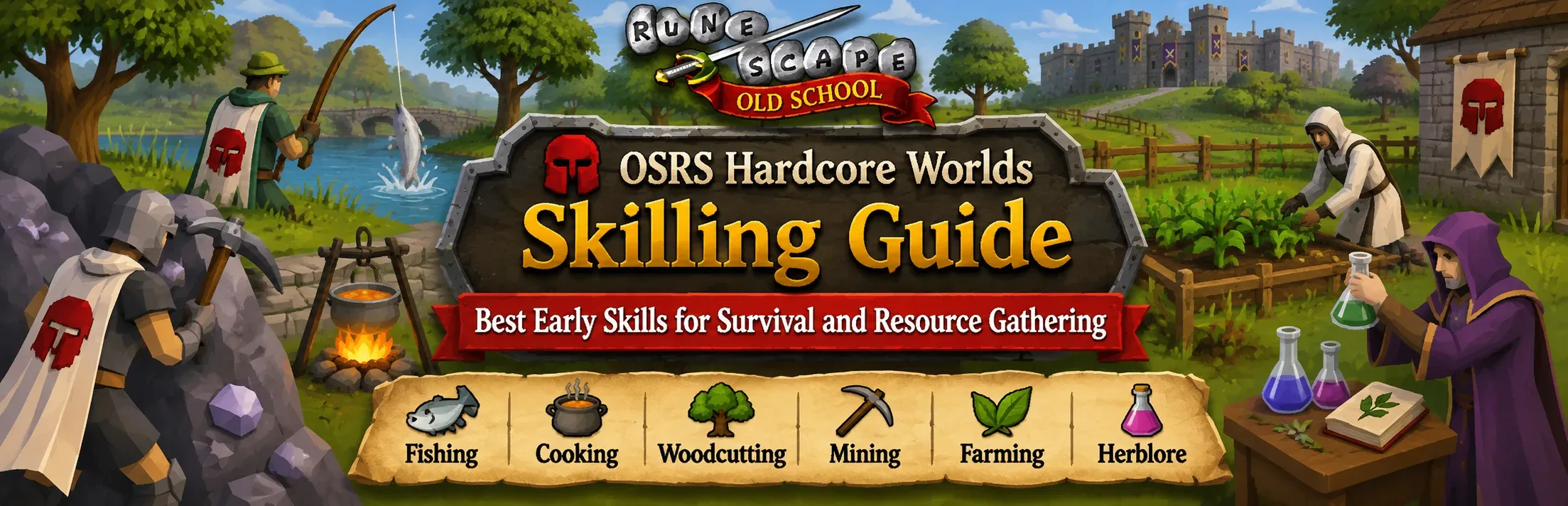
Best Early Skills to Prioritize in Hardcore Worlds
The following skills provide some of the most practical benefits for new Hardcore Worlds characters.
Highest Priority: Fishing and Cooking
Fishing and Cooking work together to create a renewable food supply.
These are excellent starting skills because food remains useful throughout almost every stage of your adventure.
High Priority: Woodcutting
Woodcutting provides logs used for Firemaking, Fletching, Construction, and other activities.
It also offers accessible resource-gathering opportunities.
High Priority: Agility
Agility improves movement efficiency and unlocks useful shortcuts.
This can reduce travel inconvenience and help when navigating the world.
However, Agility does not make dangerous areas automatically safe.
High Priority: Mining
Mining allows you to gather ores used in Smithing and other activities.
Early ores can also be sold to other players if demand exists.
Medium Priority: Smithing and Crafting
These production skills help convert materials into useful items.
They become more valuable when you need equipment, quest materials, or tradeable products.
Medium to High Priority: Farming and Herblore
Farming and Herblore become increasingly valuable as your character develops.
They support potion production, resource gathering, and long-term preparation.
Additional Priority: Hunter and Fletching
Hunter can provide useful resources and passive training opportunities once the necessary locations are unlocked.
Fletching helps convert logs into bows, arrow shafts, and other equipment.
Your ideal priorities may change depending on whether you're focusing on combat, quests, resource selling, or general survival.
Fishing – The Best Early Skill for Reliable Food
Fishing is one of the most useful starting skills in Hardcore Worlds.
It allows you to gather food without relying entirely on shops, monster drops, or the Grand Exchange.
Since healing food is essential for survival, Fishing provides an immediate practical benefit.
You can begin training at level 1.
Levels 1–20: Shrimps and Anchovies
At level 1 Fishing, you can catch shrimps using a small fishing net.
At level 15, you can also begin catching anchovies from suitable net fishing spots.
Useful starting locations include:
Draynor provides convenient banking, but players should remain aware of dangerous NPCs in the surrounding region.
Avoid unnecessary travel away from the fishing spots.
Levels 20–40: Trout and Salmon
At level 20 Fishing, you can catch trout using a fly fishing rod and feathers.
Salmon becomes available at level 30 Fishing.
These fish are useful because they provide better healing than shrimps once cooked.
Trout heals 7 Hitpoints, while salmon heals 9 Hitpoints.
Popular fly fishing areas include the river near Barbarian Village and suitable locations around Lumbridge.
If you're collecting food for personal use, bank your catches rather than dropping them for faster experience.
Level 40 and Beyond: Lobsters
At level 40 Fishing, you can catch lobsters using a lobster pot.
Cooked lobsters restore 12 Hitpoints.
They are a useful food option for players progressing into more demanding combat.
However, you also need level 40 Cooking to prepare them.
Make sure you can cook the fish before relying on them as your main healing supply.
Should You Sell or Keep Your Fish?
Early in Hardcore Worlds, keeping a personal food reserve is often more valuable than selling every fish.
Consider separating your catches into two groups.
Keep enough food for your own combat and quest progression.
Sell excess supplies when the Hardcore Worlds market offers a worthwhile price.
Don't assume regular OSRS Grand Exchange prices apply.
Your best decision depends on your current needs and the availability of other food sources.
Cooking – Turn Gathered Resources Into Survival Supplies
Fishing provides raw materials, but Cooking converts many of them into useful food.
This makes Cooking one of the strongest complementary skills for Hardcore Worlds.
Without sufficient Cooking levels, you may struggle to prepare the fish you catch.
You can also burn food while training, especially at lower levels.
Therefore, your Cooking level should develop alongside Fishing.
Best Early Cooking Methods
Several useful foods can be cooked at low levels.
Level 1 Cooking:
Shrimps.
Raw chicken.
Raw beef.
Other basic foods.
Level 15 Cooking:
Level 25 Cooking:
Level 40 Cooking:
These milestones provide practical food upgrades.
However, Cooking success rates improve as your level rises.
You may still burn food after reaching its minimum Cooking requirement.
Best Early Cooking Locations
Lumbridge Castle is useful because of its accessible kitchen.
Completing Cook's Assistant gives you access to the Cook-o-matic 100 range's reduced burn chance for applicable foods.
Other convenient cooking locations can become useful as you unlock additional transportation and banking options.
Try to cook in locations where you can bank your finished food without traveling through dangerous areas.
Why Cooking Is So Valuable for Survival
A reliable supply of cooked food reduces the number of supplies you need to purchase.
It also allows you to prepare before combat rather than searching for emergency food at the last moment.
For example, if you're planning to train combat against cows or Sand Crabs, you can prepare your food before traveling.
This creates a simple progression cycle:
Gather fish, cook them, bank your supplies, and use them when needed.
The method may not always provide maximum experience efficiency, but it gives you useful items while training two skills.
Woodcutting – Best Early Resource Gathering Skill
Woodcutting is one of the easiest gathering skills to begin.
You only need an appropriate axe and access to suitable trees.
Many early Woodcutting locations are close to towns and banks.
This makes the skill attractive for Hardcore Worlds players who want to gather resources without fighting monsters.
Levels 1–15: Regular Trees
Begin by cutting normal trees.
Regular trees require level 1 Woodcutting and provide ordinary logs.
You can find them throughout Gielinor.
Convenient locations include:
Each normal log provides 25 Woodcutting experience.
You can keep the logs for Firemaking or Fletching rather than dropping them.
Levels 15–30: Oak Trees
At level 15 Woodcutting, you can begin cutting oak trees.
Oak logs provide 37.5 Woodcutting experience each.
Unlike regular trees, oak trees can produce multiple logs before being depleted.
This makes them useful for longer gathering sessions.
Oak logs can be used for Firemaking and eventually Construction-related materials.
They may also have demand in the Hardcore Worlds economy.
Levels 30+: Willow Trees
At level 30 Woodcutting, willow trees become available.
Willow logs provide 67.5 Woodcutting experience each.
Draynor Village is a familiar location for willow training because trees grow near the bank.
However, monitor nearby NPCs and your route when traveling.
The skill itself may be peaceful, but the surrounding area still matters.
Should You Train Forestry in Hardcore Worlds?
Forestry provides additional Woodcutting activities and rewards.
It can be useful for players interested in gathering resources alongside other players.
However, prioritize familiar and controlled locations before participating in events you haven't learned.
Hardcore Worlds includes a dedicated Forestry world, but that doesn't mean every related activity has protected death mechanics.
Understand the location and event before participating.
Firemaking – Useful Early Levels and Future Unlocks
Firemaking is closely connected to Woodcutting.
You can train it by burning logs gathered through gameplay.
At lower levels, this provides straightforward experience without requiring expensive equipment.
Early Firemaking Progression
Useful milestones include:
Level 1: Normal logs.
Level 15: Oak logs.
Level 30: Willow logs.
Level 45: Maple logs.
You can train these levels in suitable open areas by using a tinderbox on logs.
However, Firemaking has fewer immediate survival benefits than Fishing or Cooking.
It is often more useful as a supporting skill for quests and later content.
Should You Rush Wintertodt?
Wintertodt is a popular Firemaking activity that becomes available at level 50 Firemaking.
It can provide experience and rewards.
However, Hardcore Worlds characters should be careful before entering.
Wintertodt is not included among the official general safe-death exceptions.
Its mechanics involve managing warmth and encounter-specific hazards.
Do not assume it is completely safe simply because it is a skilling boss.
Understand the encounter before attempting it.
For beginners, ordinary log burning is a more straightforward way to establish early Firemaking levels.
Mining – Gather Ores Without Depending on Combat Drops
Mining is another excellent resource-gathering skill.
You can begin at level 1 using a suitable pickaxe.
The skill provides ores used in Smithing and other production activities.
It can also generate tradeable resources.
However, some mining areas contain aggressive enemies, so choosing the right location is important.
Levels 1–15: Copper and Tin
Copper and tin rocks are available from level 1 Mining.
They provide the materials needed to create bronze bars.
Each ore provides 17.5 Mining experience.
The Lumbridge Swamp mining area is a familiar starting location.
Other options include suitable rocks around Varrock.
Before mining, make sure you've checked the area for aggressive monsters.
Level 15: Iron Ore
At level 15 Mining, you can begin gathering iron ore.
Iron is an important early resource because it is used in Smithing and may have demand in the Grand Exchange.
You can gather iron at several locations.
Choose a mining spot with manageable travel routes and convenient banking.
Avoid assuming every mine is safe.
Some locations contain scorpions or other aggressive monsters.
Should You Bank Your Ore?
If you're focusing entirely on Mining XP, dropping ore may be faster than banking it.
However, Hardcore Worlds provides additional reasons to keep gathered resources.
You can use ores for Smithing or sell them to other players.
Because the economy is separate, even basic resources can have different demand from regular OSRS.
Check market prices before deciding whether to drop or keep everything.
Smithing – Create Useful Equipment and Materials
Smithing allows you to turn ores into metal bars and equipment.
It works naturally alongside Mining.
However, you don't need to train Smithing at exactly the same rate as Mining.
Early Smithing is most useful for learning the production system and preparing equipment or quest materials.
Start With Bronze Bars
Bronze bars are available at level 1 Smithing.
You need:
One copper ore.
One tin ore.
Use the ores at an appropriate furnace to create bronze bars.
You can then use bars with a hammer on an anvil to create eligible equipment.
This provides an introduction to the skill without requiring difficult encounters.
Iron Smithing at Level 15
At level 15 Smithing, you can begin smelting iron bars.
Ordinary furnace smelting has a chance of failing and consuming the iron ore.
Alternative methods and unlocks can improve efficiency later.
If you're gathering iron yourself, decide whether it's more valuable to sell the ore or use it for Smithing.
Is Blast Furnace Worth Using Early?
Blast Furnace is a popular production activity, and Hardcore Worlds launched with a dedicated Blast Furnace world.
However, it isn't essential for a fresh character.
You should first understand the access requirements, costs, and mechanics.
The existence of a dedicated activity world does not automatically establish safe-death protection.
For basic early progression, conventional furnaces and anvils are easier to learn.
Farming – Build a Renewable Supply of Valuable Crops
Farming is one of the best long-term support skills in Hardcore Worlds.
Unlike many gathering skills, it allows you to grow useful resources in farming patches.
These can include vegetables, herbs, and trees.
Farming is particularly valuable because it works alongside Herblore.
However, new players don't need high Farming levels to begin benefiting from the skill.
Levels 1–9: Basic Allotment Crops
You can begin growing potatoes at level 1 Farming.
Other early crops include:
Onions at level 5.
Cabbages at level 7.
Tomatoes at level 12.
To grow allotment crops, you'll generally need seeds, a rake, a seed dibber, and access to a suitable patch.
Many farming locations also have nearby compost bins and tool leprechauns.
Be sure to check the surrounding area before traveling.
Level 9: Start Growing Guam Herbs
At level 9 Farming, you can begin growing guam herbs.
This is an important early milestone because guam leaves are used in Herblore.
As your Farming level increases, additional herbs become available.
For example:
Level 14: Marrentill.
Level 19: Tarromin.
Level 26: Harralander.
Level 32: Ranarr.
These resources can support potion production or be sold to other players.
Use Compost to Protect Your Crops
Compost reduces the risk of crops becoming diseased.
Higher-quality compost provides stronger benefits.
For herb patches, supercompost and ultracompost are particularly useful.
They improve expected yields and reduce disease risk.
This helps you obtain more resources from your seeds.
Why Farming Is Valuable for Hardcore Worlds
Farming provides a renewable supply of materials without requiring constant monster combat.
It also creates opportunities to earn GP through the Hardcore Worlds economy.
However, not every Farming patch is equally accessible or safe to reach.
Begin with convenient locations and unlock more distant patches as your character becomes prepared for the journey.
Herblore – Produce Potions That Support Survival
Herblore is one of the most useful long-term skills for Hardcore Worlds.
Potions can improve combat performance, remove dangerous status effects, restore Prayer, and provide other benefits.
However, Herblore requires specific ingredients and quest progression.
Unlock Herblore With Druidic Ritual
Before training Herblore normally, you must complete Druidic Ritual.
The quest awards 250 Herblore experience, bringing a fresh character to level 3.
It also unlocks the ability to make potions.
Although it's a novice quest, it involves traveling through Taverley Dungeon.
The quest includes a potentially dangerous animated suit of armour that can be avoided with careful routing.
Do not rush the quest without checking its requirements and hazards.
Level 3: Attack Potions
At level 3 Herblore, you can create Attack potions.
You need:
A guam leaf.
An eye of newt.
A vial of water.
Attack potions temporarily increase your Attack level.
They're useful for some combat situations, although their importance depends on your equipment and goals.
Level 5: Antipoison Potions
At level 5 Herblore, you can produce basic Antipoison potions.
The ingredients include:
Marrentill.
Unicorn horn dust.
A vial of water.
Antipoison potions cure poison and provide temporary poison immunity.
This is especially useful when exploring areas containing poisonous enemies.
However, basic Antipoison should not be confused with anti-venom protection.
Different status effects require different remedies.
Level 12: Strength Potions
At level 12 Herblore, you can make Strength potions.
These require tarromin, limpwurt root, and a vial of water.
Strength potions temporarily increase melee Strength.
They can help improve combat performance during appropriate encounters.
Should You Train Herblore Early?
Yes, but you don't need to rush extremely high levels immediately.
Unlocking basic potion production is a useful goal.
Later, you can work toward more advanced potions as your character develops.
Because Hardcore Worlds supports trading, you can also purchase eligible potions instead of producing every one yourself.
Training Herblore gives you more independence when market supply is limited.
Agility – Improve Movement and Unlock Helpful Shortcuts
Agility is often overlooked by players focused on combat and money making.
However, it's a valuable skill for Hardcore Worlds.
Agility supports movement efficiency and unlocks shortcuts throughout Gielinor.
This can make travel more convenient and sometimes provide alternative routes around obstacles.
However, higher Agility doesn't guarantee escape from aggressive monsters or PvP encounters.
Levels 1–10: Gnome Stronghold Agility Course
The Gnome Stronghold Agility Course is available from level 1.
It provides a straightforward introduction to Agility obstacles.
However, reaching the Gnome Stronghold requires travel.
If you're unfamiliar with the route, prepare accordingly.
Levels 10–20: Draynor Village Rooftop Course
At level 10 Agility, you can use the Draynor Village Rooftop Course.
This is a useful early course for gaining experience and collecting Marks of Grace.
Marks of Grace can eventually be exchanged for Graceful equipment.
The Graceful outfit reduces run energy consumption and is useful for travel-heavy gameplay.
Levels 20–30: Al Kharid Rooftop Course
At level 20 Agility, the Al Kharid Rooftop Course becomes available.
This provides another accessible training option.
As your Agility level rises, additional courses and shortcuts unlock.
Is Agility Training Completely Safe?
No.
Some Agility courses have obstacles that can cause damage when failed.
Others are located near dangerous enemies or in risky regions.
You should also avoid rushing to Wilderness Agility activities without understanding the PvP danger.
Choose appropriate courses, monitor your Hitpoints, and bring food when needed.
Crafting – Turn Common Resources Into Useful Items
Crafting is a versatile production skill.
It allows players to create items from leather, gems, glass, and other materials.
For Hardcore Worlds, early Crafting can support basic equipment production and quest progression.
Start With Leather Equipment
Cowhide can be obtained from cows or purchased from other players.
You can take cowhide to an appropriate tanner to convert it into leather.
Once prepared, leather can be used with a needle and thread to create basic Ranged equipment.
Leather gloves are available at level 1 Crafting.
Additional leather equipment becomes available as your skill improves.
Why Crafting Is Worth Training
Crafting helps you:
Produce basic equipment.
Complete skill requirements for quests.
Create useful jewelry.
Prepare materials for later unlocks.
Convert gathered resources into tradeable products.
However, not every crafted item is profitable.
Check material prices and selling demand before investing heavily in production.
Fletching – Convert Logs Into Ranged Supplies
Fletching works well alongside Woodcutting.
It allows players to create bows, arrow shafts, and other Ranged-related items.
This can be especially helpful for players who want to develop Ranged without relying entirely on marketplace supplies.
Begin With Arrow Shafts
At level 1 Fletching, you can use a knife on regular logs to produce arrow shafts.
These are used in ammunition production.
Higher Fletching levels unlock additional items.
Level 5: Shortbows
At level 5 Fletching, you can begin making unstrung shortbows from regular logs.
You'll need a bow string to finish a standard shortbow.
Higher levels unlock stronger bow types and additional equipment.
Should You Sell or Keep Your Fletching Materials?
That depends on your plans.
If you're training Ranged, producing some of your own ammunition and equipment can be useful.
If you're focusing on money making, selling logs or crafted items may provide better value.
Compare the input and output prices in the Hardcore Worlds economy before choosing.
Hunter – Useful Resource Gathering After Early Unlocks
Hunter provides access to various gathering activities and valuable resources.
However, it may not be your highest priority immediately after leaving Tutorial Island.
Several efficient Hunter methods require traveling to specific areas or completing quests.
Start With the Varrock Museum Quiz
The Natural History Quiz in Varrock Museum provides 1,000 Hunter experience.
This raises a fresh character from level 1 to level 9 Hunter.
It's a useful way to unlock early levels without relying on trapping monsters.
The quiz also provides Slayer experience.
Unlock Bird House Trapping Later
Bird house trapping is a popular Hunter training method on Fossil Island.
It requires completing Bone Voyage.
Once unlocked, you can place bird houses, fill them with seeds, and collect rewards after the traps have filled.
Bird house trapping produces Hunter experience and useful items such as bird nests.
However, Fossil Island access requires significant preparation and quest progress.
Don't rush potentially dangerous routes just to unlock a gathering method.
Why Bird Nests Matter
Bird nests can contain useful rewards.
They also have value in Herblore progression, particularly for producing certain restorative potions later.
This gives Hunter an indirect role in your long-term supply chain.
How to Make GP Through Skilling in Hardcore Worlds
Skilling can provide a way to earn GP without depending entirely on combat.
However, the most profitable method depends on current market prices.
Hardcore Worlds has a separate economy, so regular OSRS price lists should not be used as guaranteed profit calculations.
Selling Logs
Logs are used in Firemaking, Fletching, Construction, and other activities.
Normal logs, oak logs, and higher-tier logs may have demand from players training those skills.
Convenient Woodcutting spots near banks can make gathering and selling relatively straightforward.
Selling Ores
Copper, tin, iron, and other ores are used in Smithing.
Some players prefer purchasing ores rather than gathering them.
This can create demand for miners.
However, profitability depends on the current prices of ores and finished bars.
Selling Food
Cooked fish can be useful to players training combat or preparing for quests.
A steady supply of cooked food may be valuable in a one-life environment.
However, the cost of raw ingredients and the Cooking burn rate must be considered if you're buying supplies.
Selling Herbs
Herbs are useful for Herblore training and potion production.
Higher-level herbs can become valuable, especially when the economy has limited supply.
Farming provides an opportunity to produce some of these resources yourself.
Selling Potions
Potions support combat and survival.
However, producing them may require expensive ingredients.
Compare the price of unfinished potions, secondary ingredients, and finished products before deciding whether potion making is profitable.
The best Hardcore Worlds skilling method is often one that provides useful experience and valuable resources while keeping risk manageable.
Dangerous Skilling Activities to Avoid Without Preparation
Not every non-combat activity is safe.
Hardcore Worlds uses strict death rules, and some activities involve hazards that can end your run.
Fishing Trawler
Fishing Trawler is explicitly listed among the unsafe activities in Hardcore Worlds.
Do not assume its deaths are protected because the activity focuses on Fishing.
Wilderness Resource Gathering
The Wilderness contains valuable resource locations, but also exposes eligible players to PvP.
Mining, resource collection, and other skilling methods in the Wilderness can become dangerous even when the gathering activity itself is straightforward.
Wintertodt
Wintertodt is not included among the general safe-death exceptions.
Learn its encounter mechanics before attempting it.
Dangerous Mining Areas
Some mines contain scorpions, aggressive monsters, or difficult routes.
Check the area before gathering ores.
Risky Agility Courses
Some Agility courses include damaging obstacles.
Wilderness courses add PvP danger.
Never assume an obstacle course is safe simply because it awards skilling experience.
For a complete breakdown of protected and dangerous activities, read OSRS Hardcore Worlds Death Rules: Every Safe and Unsafe Minigame Explained.
Best Resource Management Tips for Hardcore Worlds
Gathering resources is only part of the challenge.
You also need to organize and use them effectively.
Keep a Food Reserve
Don't sell all your cooked fish simply because prices look attractive.
Keep enough food for your next progression goals.
This reduces the need to make emergency purchases before dangerous activities.
Store Useful Materials
Consider keeping materials used for important quests and skill unlocks.
Some basic resources may be difficult or expensive to replace if supply is limited.
Avoid Carrying Your Entire Bank
Only carry what you need for your current activity.
Banking excess resources reduces the value exposed during a dangerous encounter.
However, remember that a full Hardcore Worlds Reset removes banked possessions as well.
Check Grand Exchange Prices
The Hardcore Worlds economy is independent from the main game.
Check actual offers and market activity before purchasing large quantities of supplies or committing to a particular money-making method.
Train Complementary Skills Together
Several skills work naturally as pairs.
For example:
Fishing supplies materials for Cooking.
Woodcutting supplies logs for Firemaking and Fletching.
Mining supplies ores for Smithing.
Farming supplies herbs for Herblore.
Hunter can provide materials used in later potion production.
Training these skills together can reduce waste and improve your overall resource independence.
Best Early Skilling Goals for Hardcore Worlds
You don't need to rush toward level 99 in every skill.
Instead, focus on meaningful unlocks.
Food Production Goals
Work toward:
These unlocks help develop a reliable food supply.
Gathering Goals
Useful early milestones include:
15 Woodcutting for oak logs.
30 Woodcutting for willow logs.
15 Mining for iron ore.
15 Smithing for iron bars.
These allow you to work with more valuable materials.
Survival Support Goals
Consider:
10 Agility for Draynor Rooftop Course.
20 Agility for Al Kharid Rooftop Course.
Completing Druidic Ritual to unlock Herblore.
5 Herblore for basic Antipoison.
9 Farming for guam herbs.
32 Farming for ranarr herbs.
These milestones provide useful foundations for longer-term progression.
Don't treat them as mandatory requirements for every character.
Choose the unlocks that support your current goals.
Common Hardcore Worlds Skilling Mistakes
Even experienced players can lose progress through poor preparation.
Avoid these mistakes.
Choosing XP Over Safety
The fastest training method isn't always the most appropriate one.
Avoid traveling through dangerous areas simply to gain slightly more experience.
Selling Every Resource
Selling all your food, herbs, or ores may leave you without useful supplies later.
Keep a practical reserve.
Ignoring Production Skills
Gathering raw materials is useful, but production skills allow you to convert them into equipment, food, and potions.
Balance gathering with relevant processing skills.
Assuming All Skilling Is Safe
Some activities involve combat, environmental damage, or PvP.
Always check the risks before entering.
Buying Supplies Without Checking Prices
Hardcore Worlds prices may differ significantly from regular OSRS.
Confirm current market conditions before making expensive purchases.
Rushing High-Level Unlocks
Some valuable skilling activities require dangerous quests or travel.
Complete the required preparation before attempting them.
OSRS Hardcore Worlds Skilling FAQ
What Is the Best Early Skill in Hardcore Worlds?
Fishing and Cooking are excellent starting choices because they provide a reliable source of healing food.
However, the best skill depends on your goals.
Which Skill Is Best for Survival?
Cooking is particularly valuable because it allows you to prepare food.
Agility and Herblore also provide important supporting benefits as your character develops.
Can You Make GP Through Skilling?
Yes.
You can gather and sell logs, ores, fish, herbs, and other tradeable resources.
However, profits depend on the Hardcore Worlds economy.
Are Hardcore Worlds XP Rates Increased?
No.
Hardcore Worlds uses normal OSRS experience rates without special multipliers.
Can You Trade Skilling Materials?
Yes.
Hardcore Worlds supports trading and the Grand Exchange within its separate economy.
Is Fishing Safe in Hardcore Worlds?
Ordinary fishing at a controlled location is generally low-risk.
However, nearby aggressive monsters and dangerous travel routes can still create risks.
Fishing Trawler is specifically listed as unsafe.
Should You Train Farming Early?
Farming is useful for long-term resource production, particularly herbs used in Herblore.
You can begin with basic crops and expand as your levels increase.
Is Herblore Worth Training?
Yes.
Herblore unlocks important potions used for combat, poison protection, Prayer restoration, and other purposes.
However, training costs depend on ingredient availability.
Is Wintertodt Safe?
Wintertodt is not among the official general safe-death exceptions for Hardcore Worlds.
Do not assume fatal deaths are protected.
What Is the Best Skill for Making Your Own Equipment?
Smithing, Crafting, and Fletching are useful production skills.
Each creates different types of equipment or supplies.
Should I Train Agility Before Combat?
You don't need high Agility levels before beginning combat.
However, early Agility progression can make travel more convenient.
Can You Use Regular OSRS Skilling Guides?
Yes, for ordinary skill mechanics and requirements.
However, account for Hardcore Worlds death rules and its separate economy before following training routes or profit estimates.
Are Skilling Supplies Expensive in Hardcore Worlds?
Prices depend on supply and demand.
The separate economy may have different item availability and costs compared with regular OSRS.
Check current listings before making purchases.
Final Thoughts: Build Your Skills Before Taking Bigger Risks
OSRS Hardcore Worlds rewards players who prepare carefully.
Combat levels and equipment are important, but resource-gathering and production skills provide the foundation that supports your entire adventure.
Fishing and Cooking allow you to prepare food.
Woodcutting provides logs for multiple useful skills.
Mining and Smithing help you gather and process equipment materials.
Farming and Herblore create opportunities to produce valuable potions and other supplies.
Agility supports movement and access to useful shortcuts.
Crafting, Fletching, and Hunter contribute additional equipment and resources.
The best approach is to focus on the skills that directly support your goals rather than attempting to train everything at once.
Keep a practical reserve of food and materials, choose manageable locations, and avoid unnecessary risks while traveling.
Remember that Hardcore Worlds uses normal XP rates.
There is no need to sacrifice your character for a small increase in training efficiency.
If you're still learning the fundamentals of the mode, explore our OSRS Hardcore Worlds Beginner Guide for the essential starting rules and progression basics.
You can also explore gaming services and support options through BoostRoom and check whether a suitable service supports the Hardcore Worlds game mode before ordering.
Every log gathered, fish cooked, herb grown, and item crafted contributes to your progress.
But the greatest achievement in Hardcore Worlds isn't how quickly you reach level 99.
It's how long you manage to keep your adventure alive.
Gather smarter, prepare better, and survive longer in OSRS Hardcore Worlds.