Ocarina of Time Original vs Switch 2 Remake – Quick Overview
The Nintendo 64 original was released in 1998.
Ocarina of Time 3D arrived on Nintendo 3DS in 2011.
The newest version launched on Nintendo Switch 2 on November 5, 2026.
Each version provides a different experience.
Original Nintendo 64 Version – 1998
The original introduced the core adventure.
It featured early 3D character models, fixed and context-sensitive camera controls, automatic jumping, traditional button-based ocarina songs, and the original dungeon designs.
The game also introduced Z-targeting, which became an important foundation for 3D action combat.
Its visual presentation was limited by Nintendo 64 hardware, but its exploration, puzzles, characters, and music made a lasting impression.
Nintendo 3DS Version – 2011
Ocarina of Time 3D improved the original game's graphics and interface.
It introduced updated character models, redesigned textures, touch-screen equipment management, gyroscope aiming, and other quality-of-life improvements.
It also included Master Quest, which provided more challenging versions of the dungeons.
However, the underlying game remained closely connected to the original Nintendo 64 design.
Nintendo Switch 2 Remake – 2026
The Switch 2 remake is a much larger technical reconstruction.
It includes:
Completely rebuilt environments and character models.
Gameplay targeting 60 frames per second.
Full right-stick camera control.
Manual jumping and faster movement.
Streamlined equipment selection and shortcuts.
Fully voiced major cutscenes.
Expanded character dialogue.
Symphonic orchestral music.
The Threads of Time quest tracker.
The Hall of Fallen Foes boss rematch feature.
New Fairy's Thoughts interactions.
Microphone-based ocarina performance.
Additional items and revised collectible rewards.
Zelda Notes companion functionality.
The biggest distinction: The Nintendo 64 original preserves the historic experience, while the Switch 2 remake makes the same adventure feel like a modern action-adventure game.
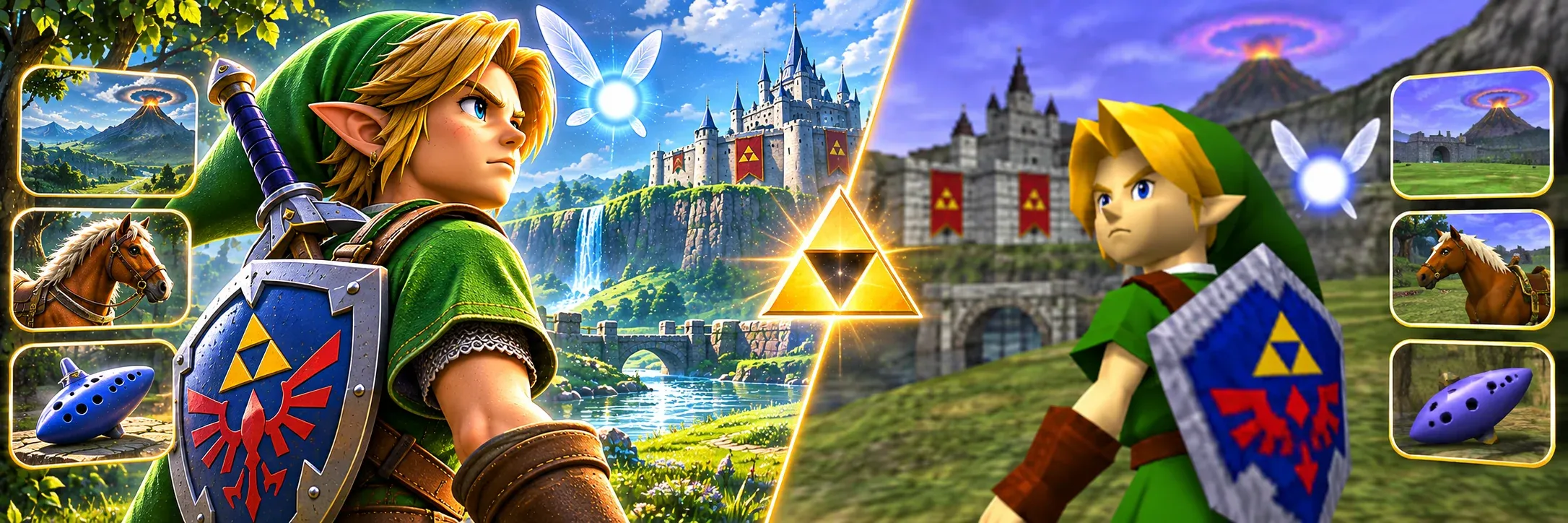
Graphics Comparison – A Completely Rebuilt Hyrule
Visual presentation is the most immediately noticeable difference.
The original Nintendo 64 game used low-polygon character models, simple textures, and environments built around the technical limitations of the late 1990s.
The Switch 2 remake recreates Hyrule with much greater environmental detail.
New Character Models
Link, Zelda, Ganondorf, the Gorons, Zoras, Gerudo, and other characters have been redesigned.
Their faces, clothing, equipment, and animations feature much more detail.
Link's tunic includes visible stitching and accessories.
Characters use more expressive facial animations during conversations and story scenes.
The remake keeps the recognizable appearance of the original cast rather than completely redesigning everyone.
Rebuilt Environments
Hyrule Field feels more natural thanks to improved vegetation, terrain, lighting, and environmental effects.
Kokiri Forest contains richer plant life, wooden structures, and atmospheric lighting.
Death Mountain features more dramatic volcanic effects.
Lake Hylia and the Water Temple benefit from improved reflections and water rendering.
Even smaller areas have been redesigned with additional environmental details.
Hyrule Castle Town Is More Detailed
In the original Nintendo 64 game, portions of Castle Town relied on pre-rendered backgrounds.
The remake presents the town as a more fully realized three-dimensional environment.
You can move the camera around and examine buildings, characters, and scenery more naturally.
This makes Castle Town feel more like a living settlement rather than a series of static scenes.
Improved Lighting and Weather
The remake introduces more sophisticated lighting, shadows, fog, and environmental effects.
Sunlight behaves more naturally as it passes through trees and buildings.
Dark caves feel more atmospheric.
Fire, lava, and magical attacks have stronger visual effects.
These improvements make familiar locations feel new without replacing their original identities.
Graphics winner: Nintendo Switch 2 remake.
Performance Comparison – 60 FPS vs the Original
The Switch 2 remake also delivers a major performance improvement.
The Nintendo 64 release typically ran around 20 frames per second.
The Nintendo 3DS remake increased the target to 30 FPS.
The Nintendo Switch 2 version targets 60 FPS.
Independent technical testing reports that it maintains this target very consistently.
What Does 60 FPS Change?
A higher frame rate makes movement and combat appear smoother.
It's especially noticeable when:
The controls also feel more responsive because movement updates more frequently.
Is the Remake Native 4K?
Not necessarily.
Technical analysis reports a dynamic resolution range of approximately 1080p to 1440p during docked gameplay, with handheld rendering generally ranging from 720p to 1080p.
The game can be displayed through a compatible television setup, but that doesn't mean every frame is rendered internally at native 4K.
The remake prioritizes a smooth frame rate alongside its visual improvements.
Are There Any Performance Drawbacks?
Some reviewers have noticed softer distant scenery and occasional shimmering.
These effects can be more apparent in handheld mode.
However, the visual and performance improvements remain substantial compared with the older versions.
Performance winner: Nintendo Switch 2 remake.
New Movement Controls – Manual Jumping and Dashing
One of the biggest gameplay changes is the introduction of direct jumping controls.
In the original game, Link automatically jumped when running off certain ledges.
Players couldn't simply press a button to jump whenever they wanted.
The Switch 2 remake changes that.
Manual Jumping
Press X using the default control layout to jump.
This gives you direct control over when Link leaves the ground.
It's especially useful when crossing gaps or navigating platforms.
However, the remake doesn't turn Ocarina of Time into a completely different platforming game.
Most routes are still designed around the same general traversal challenges.
New Dash Mechanic
Hold A while moving to transition from a roll into a dash.
This allows Link to travel more quickly on foot.
In the original version, players often relied on repeated rolling to move faster.
The new movement system makes travelling through Hyrule more comfortable.
Updated Combat Controls
The remake preserves targeting, blocking, dodging, jumping attacks, and Spin Attacks.
However, these actions feel different because of the updated controller layout and smoother animation.
You can still use directional inputs to change how Link swings his sword.
Does Manual Jumping Make the Game Easier?
In many situations, yes.
You have more direct control over difficult movement challenges.
However, jumping doesn't automatically bypass the equipment requirements of dungeon puzzles.
You'll still need the Hookshot, Hover Boots, Iron Boots, and other items where appropriate.
Gameplay improvement: Link is easier to control without removing the original adventure's core mechanics.
Free Camera – One of the Biggest Quality-of-Life Changes
The original Nintendo 64 version didn't provide the kind of free camera control players expect from modern third-person games.
Instead, players relied heavily on Z-targeting and camera recentering.
The remake introduces full right-stick camera movement.
Why Is the New Camera Important?
You can look around while exploring villages, forests, and dungeons.
This helps with spotting hidden objects, examining scenery, and understanding the layout of complicated rooms.
It's particularly useful in places with vertical puzzles.
For example, you can inspect Hookshot targets above Link without constantly repositioning the character.
Does Z-Targeting Still Exist?
Yes.
The classic targeting system remains part of combat.
Using the default layout, ZL locks onto supported enemies and targets.
You can switch between free exploration and focused combat controls.
What About Motion Aiming?
The remake supports optional motion aiming.
This can help with weapons such as the Fairy Slingshot, Fairy Bow, and Hookshot.
Players who prefer traditional stick controls can continue using them.
Recommendation: Spend some time practicing the camera and movement controls before entering the first dungeon.
Equipment Controls – Much Faster Item Switching
Equipment management is another major improvement.
In the original Nintendo 64 release, players assigned items to the C-buttons.
The Nintendo 3DS version introduced touch-screen shortcuts.
The Switch 2 remake takes a different approach.
New Quick-Select Menu
Hold R to open the item selection interface.
You can move through available equipment without navigating several traditional inventory screens.
This is useful when switching between Bombs, Hookshot, Fairy Bow, and other frequently used tools.
Boots Have Dedicated Shortcuts
The Iron Boots and Hover Boots can be accessed through directional shortcuts.
This is a major improvement for the Water Temple.
In the original game, repeatedly opening the equipment screen to switch boots was one of the most frustrating parts of dungeon exploration.
The remake makes the process much faster.
Lenses of Truth Replace the Old Lens Design
The original Lens of Truth was a handheld magical lens.
The remake redesigns it as wearable Lenses of Truth.
The equipment still reveals invisible walls, hidden platforms, and concealed enemies.
However, its appearance and activation controls are more convenient.
Equipment winner: Nintendo Switch 2 remake.
Ocarina Changes – Play Songs Using Your Voice
The ocarina itself receives one of the remake's most unusual additions.
In the original game, every song was performed using controller buttons.
The Switch 2 remake preserves button input but introduces microphone support.
Hum Songs Into the Nintendo Switch 2 Microphone
After learning a song, you can hum its melody into the console's microphone.
The game recognizes the tune and performs the corresponding action.
This can activate familiar abilities such as Zelda's Lullaby and the Song of Time.
Play a Real Musical Instrument
The microphone feature also supports suitable real-world instruments.
You can perform a melody outside the game and have Link reproduce it.
It's an optional feature rather than a requirement.
New Ocarina Songbook
The remake includes an easier way to check learned songs.
Open the ocarina interface and hold ZL to review the songbook.
This shows the note sequences you've learned.
It's helpful for longer melodies such as the Bolero of Fire and Nocturne of Shadow.
Are There More Than 12 Standard Songs?
No.
The game retains the 12 traditional ocarina songs.
You can also create the optional Scarecrow's Song.
The changes focus on how you perform the melodies rather than replacing the song list.
Can You Unlock a Song by Humming It Early?
No.
Link must still learn the song through its intended story or side-quest event.
Microphone input offers another way to perform an unlocked melody.
Music interaction winner: Nintendo Switch 2 remake.
Voice Acting – Characters Speak During Cutscenes
The original Ocarina of Time relied primarily on text boxes, character expressions, and short vocal sounds.
The Switch 2 remake introduces fully voiced major cutscenes.
This changes how players experience important story moments.
Expanded Zelda and Ganondorf Dialogue
Characters such as Princess Zelda, Ganondorf, Sheik, and other major figures receive additional dialogue and more expressive story scenes.
The main plot remains recognizable.
However, conversations provide extra characterization and background details.
Navi Has Updated Dialogue and Presentation
Navi returns as Link's fairy companion.
Her interactions have been adjusted to reduce some of the more repetitive interruptions associated with the original.
The remake also introduces other ways to deliver useful hints.
Are All Conversations Fully Voiced?
Not every small interaction should be treated like a major cinematic scene.
Nintendo confirms voiced cutscenes and expanded dialogue.
Players will still encounter written conversations and gameplay prompts.
Story presentation winner: Nintendo Switch 2 remake, although fans of the original may prefer its simpler approach.
Music and Sound – Symphonic Orchestral Soundtrack
Ocarina of Time is famous for its soundtrack.
Melodies such as Zelda's Lullaby, Saria's Song, Gerudo Valley, and the Song of Storms have become closely associated with the Zelda series.
The remake preserves the recognizable music while updating its presentation.
Orchestral Arrangements
Many tracks feature richer instrumentation and symphonic arrangements.
This gives familiar areas a new atmosphere.
Kokiri Forest feels livelier.
Death Mountain sounds more dramatic.
The temples benefit from more detailed ambient audio.
Updated Sound Effects
Sword attacks, magical abilities, environmental interactions, and enemy movements all feature refreshed audio.
The stronger feedback makes combat feel more impactful.
Is the Original Music Completely Replaced?
The remake keeps the musical identity of the original.
The melodies and themes remain recognizable, even though their arrangements and sound quality have changed.
Audio winner: The remake offers greater production quality, while the N64 soundtrack remains appealing to players who enjoy its original sound.
Threads of Time – New Quest Tracking System
One of the biggest improvements for new players is Threads of Time.
The original game often expected players to remember conversations and decide where to travel next.
That could become confusing after a long break.
The remake introduces a built-in progress tracker.
What Does Threads of Time Do?
Threads of Time records important story milestones and current objectives.
It presents Link's adventure through a visual tapestry.
As you progress, new events are added.
You can review the tracker when you're unsure what to do next.
Does It Track Side Quests?
The feature also provides guidance for important optional activities.
This makes it easier to return to unfinished objectives without relying entirely on memory.
Does It Reveal Every Puzzle Solution?
No.
Threads of Time is mainly designed to help with progression.
You'll still need to explore dungeons, observe your surroundings, and solve individual puzzles.
Why Is This a Big Improvement?
It's especially useful for players who return to Ocarina of Time after several days or weeks.
Instead of wandering around Hyrule trying to remember the latest story event, you can review your progress.
New feature: Threads of Time is exclusive to the Switch 2 remake.
Fairy's Thoughts – New Secrets and Environmental Hints
The remake introduces Fairy's Thoughts, sometimes described as Fairy Messages or Fairy Sentiments.
These are optional interactions scattered throughout Hyrule.
They provide hints, additional details, or clues connected to hidden rewards.
How Do Fairy's Thoughts Work?
While exploring, Navi may draw attention to an unusual location.
Interact with the relevant clue.
You'll receive additional information about the area.
Some interactions provide minor rewards.
Others help solve larger secrets.
New Time-Travel Puzzles
Certain Fairy's Thoughts connect the two eras of Link's adventure.
For example, a clue discovered as Adult Link can provide the information needed to claim a hidden Piece of Heart as Child Link.
This creates optional puzzles that weren't part of the original release.
Do Fairy's Thoughts Replace Gossip Stones?
No.
Gossip Stones remain part of Hyrule's world.
Fairy's Thoughts add a separate layer of environmental storytelling and discovery.
New feature: Fairy's Thoughts provide additional exploration rewards and side-quest clues.
Hall of Fallen Foes – New Boss Rematches
The Hall of Fallen Foes is one of the remake's most exciting optional features.
The original Nintendo 64 game didn't include a built-in boss rematch mode.
The Switch 2 version adds an area dedicated to enemies and major boss encounters.
What Is the Hall of Fallen Foes?
It's a special location where you can review enemies you've encountered.
The hall displays information and models associated with defeated foes.
It also allows you to challenge major bosses again.
Can You Replay Bosses?
Yes.
Available boss encounters can be replayed without completing their entire dungeons again.
This is useful for practicing difficult fights such as Phantom Ganon, Bongo Bongo, Twinrova, and other major bosses.
The feature also includes additional challenges for players who enjoy testing their combat skills.
Do You Lose Resources in Boss Rematches?
Resources spent during the Hall's rematches are restored when you return to the main adventure.
This makes it a convenient place to experiment with different strategies.
How Is It Different From Ocarina of Time 3D?
The Nintendo 3DS version included a Boss Challenge feature.
The Switch 2 remake offers its own expanded presentation through the Hall of Fallen Foes, with enemy information and rematch activities.
New feature: A dedicated enemy collection and boss rematch hall.
Dungeon Changes – What Has Been Redesigned?
One of the most important questions is whether the Switch 2 remake changes the original dungeons.
The answer is yes, but not in the way a completely different Zelda game would.
The main dungeon structure remains familiar.
You'll still explore the Great Deku Tree, Dodongo's Cavern, Jabu-Jabu's Belly, and the five Adult Link temples.
However, several rooms, puzzles, item locations, and enemy encounters have been adjusted.
Great Deku Tree
The opening dungeon has improved environmental detail and revised collectible access.
Certain Gold Skulltulas can be collected earlier than in the original.
The dungeon still teaches jumping, targeting, combat, and environmental puzzle-solving.
Queen Gohma remains the final boss.
Dodongo's Cavern
The main Bomb-based puzzles return.
However, some Gold Skulltula locations and minor room details have changed.
This means original walkthroughs may not always identify the correct collectible position.
Lord Jabu-Jabu's Belly
The dungeon retains its distinctive organic design and Princess Ruto storyline.
Some enemy placements and collectible requirements have changed.
The Boomerang remains an important dungeon item.
Forest Temple
Several puzzles and environmental details have been adjusted.
The temple still features its haunted atmosphere, Poe Sisters, Fairy Bow, and Phantom Ganon.
However, some collectible routes and room interactions differ.
Fire Temple
The Fire Temple preserves its lava-filled chambers, Goron rescues, Megaton Hammer, and Volvagia encounter.
The improved visuals make the volcanic environment much more dramatic.
Some treasure and Gold Skulltula routes have been changed.
Water Temple
The Water Temple receives some of the most noticeable quality-of-life improvements.
The original's complicated layout remains recognizable, but navigation is clearer.
The Iron Boots shortcut reduces repeated menu interruptions.
Color-coded route markings help identify the different water-level mechanisms.
Some walls and room connections have been adjusted so players can understand nearby areas more easily.
The Small Key progression and several collectible placements have also been revised.
Shadow Temple
The Shadow Temple retains its invisible passages, traps, Hover Boots, Ghost Ship, and Bongo Bongo encounter.
Its visual presentation is significantly more atmospheric.
Some hidden collectible locations have moved, requiring players to explore different passages.
Spirit Temple
The Spirit Temple still requires both Child Link and Adult Link.
The Silver Gauntlets, Mirror Shield, Iron Knuckles, and Twinrova remain central to the dungeon.
However, certain puzzles and Gold Skulltula locations have changed.
Ganon's Castle
The final dungeon continues to feature six Sage barriers, a tower climb, and the final confrontations.
Some puzzles and combat encounters have been revised.
The remake's improved controls also change how the final challenges feel.
Important: An original Nintendo 64 walkthrough can still help you understand the main objective, but an updated Switch 2 walkthrough is more reliable for exact puzzle and collectible locations.
Water Temple Remake vs Original – Why Is It Easier?
The Water Temple deserves special attention because it was one of the most frustrating dungeons for many original players.
The main problem wasn't necessarily the difficulty of an individual puzzle.
It was the amount of backtracking and equipment management required.
Original Water Temple Problems
In the Nintendo 64 version, players needed to repeatedly open the equipment menu to equip and remove the Iron Boots.
The dungeon also had a complicated network of passages connected to three water levels.
Finding a missed Small Key could require revisiting many rooms.
Switch 2 Improvements
The remake adds several helpful changes:
Faster Iron Boots switching through a shortcut.
Clearer environmental markings.
Better camera control.
Improved visibility between certain rooms.
Revised puzzle details and key progression.
More convenient navigation through the dungeon.
Does the Water Temple Still Have Three Water Levels?
Yes.
You still use Zelda's Lullaby to adjust the temple's water level.
The main objective remains reaching Dark Link, obtaining the Longshot, collecting the Boss Key, and defeating Morpha.
Is the Water Temple Completely Redesigned?
No.
It's still recognizable as the Water Temple.
The changes aim to reduce unnecessary frustration without removing its main identity.
Improvement: The Water Temple remains challenging, but it requires less fighting with menus and navigation.
Boss Fight Changes – Familiar Enemies, Updated Combat
The remake retains the major bosses from the original adventure.
Queen Gohma, King Dodongo, Barinade, Phantom Ganon, Volvagia, Morpha, Bongo Bongo, Twinrova, Ganondorf, and Ganon remain important encounters.
However, updated animations and changes to several attack patterns make combat feel different.
Improved Boss Animations
Enemies move more naturally.
Their attacks have stronger visual effects.
Improved lighting makes important moments more dramatic.
This is particularly noticeable during Volvagia and the final Ganondorf encounters.
Revised Enemy Behavior
Certain enemies have updated attack patterns.
For example, Skulltulas behave differently in the remake.
Some mini-bosses and major bosses also have altered timing or additional defensive behavior.
Does Every Boss Have a Completely New Strategy?
No.
The major weaknesses remain recognizable.
You still use Bombs against King Dodongo, the Boomerang against Barinade, and the Megaton Hammer against Volvagia.
The remake changes how some encounters unfold rather than replacing every classic mechanic.
Are Bosses Easier or Harder?
That depends on the encounter.
Modern controls and clearer animations can make some battles easier.
However, updated enemy movements may catch returning players off guard.
Recommendation: Learn each boss's weak point rather than assuming every original attack pattern behaves identically.
Collectibles – Same Main Totals, Different Locations
The remake preserves the main collectible totals from the original game.
However, several collectibles have moved.
Some require new puzzles or different equipment.
Pieces of Heart
The original game contains 36 Pieces of Heart.
The remake also contains 36 Pieces of Heart.
These still provide nine additional Heart Containers when fully collected.
However, some rewards are in different locations.
For example, a Piece of Heart originally found in the Ice Cavern has been replaced by a Business Scrub reward in Death Mountain Crater.
Two Hyrule Field rewards now involve clues discovered through different time periods.
Gold Skulltulas
There are still 100 Gold Skulltulas.
However, several spiders have moved.
Notable examples include the relocated Zora's River spider and changes to collectible placements in Lake Hylia, Hyrule Field, and multiple dungeons.
Dungeon Heart Containers
The eight main dungeon bosses still provide full Heart Containers.
Combined with the starting hearts and Heart Pieces, players can reach the same maximum health total.
Six Great Fairy Fountains
All six Great Fairy Fountains return.
However, the remake changes how their rewards are obtained.
Main takeaway: The completion totals remain familiar, but the exact route to 100% completion has changed.
Great Fairy Changes – Rewards Now Cost Rupees
The original game allowed players to receive Great Fairy upgrades without paying a Rupee fee.
The Switch 2 remake adds a new cost.
Each of the six Great Fairy Fountains requires a one-time offering.
The amounts are:
Death Mountain Summit – 25 Rupees.
Hyrule Castle Grounds – 50 Rupees.
Zora's Fountain – 100 Rupees.
Death Mountain Crater – 200 Rupees.
Desert Colossus – 300 Rupees.
Ganon's Castle Grounds – 500 Rupees.
Total cost: 1,175 Rupees.
The reward progression has also changed.
Din's Fire is obtained alongside the Magic Meter at Death Mountain Summit.
The upgraded Spin Attack is obtained at the Hyrule Castle fountain.
Why Does This Matter?
Rupee management is more important than it was in the original game.
Players who want every magical upgrade should save money for the fountains.
Fortunately, the remake also increases wallet capacity.
Wallet Changes – Carry More Rupees
The original Nintendo 64 game began with a maximum wallet capacity of 99 Rupees.
The Switch 2 remake increases it to 200.
The wallet upgrades are also larger.
Starting Wallet
Original: 99 Rupees
Switch 2 remake: 200 Rupees
Adult's Wallet
Original: 200 Rupees
Switch 2 remake: 500 Rupees
Giant's Wallet
Original: 500 Rupees
Switch 2 remake: 1,000 Rupees
Why Are Wallet Upgrades More Valuable?
The remake introduces additional costs for upgrades and side activities.
A larger wallet allows you to save more Rupees for Great Fairy offerings, Magic Beans, and expensive equipment.
Recommendation: Collect Gold Skulltula Tokens early to unlock the wallet upgrades.
Five Empty Bottles Instead of Four
One of the most useful equipment changes is the addition of a fifth Empty Bottle.
The original Nintendo 64 game had four.
The Switch 2 remake has five.
Where Does the New Bottle Come From?
Visit the Potion Shop in Hyrule Castle Town.
Complete the shopkeeper's insect-catching activity.
You'll earn the additional Bottle as a reward.
Why Is a Fifth Bottle Useful?
Bottles allow Link to carry:
An extra Bottle provides more freedom during difficult dungeons and boss battles.
It also makes managing collection quests more convenient.
New equipment reward: Five Empty Bottles are available in the remake.
Big Poe Quest – Only Five Required for the Bottle
The Big Poe Hunting side quest has been adjusted.
In the original version, players needed to deliver all ten Big Poes to obtain the Empty Bottle reward.
The Switch 2 remake reduces that requirement.
Original Big Poe Quest
Collect and deliver ten Big Poes.
Reach the required point total.
Claim the Empty Bottle.
Switch 2 Remake
Deliver five Big Poes to receive the Empty Bottle.
You can still hunt the remaining Big Poes.
Completing the full ten provides an additional Rupee reward.
Why Is This Better?
The Bottle becomes available earlier.
Players no longer need to finish the entire ghost-hunting quest just to obtain the useful equipment reward.
However, collecting all ten still matters if you're pursuing full completion.
Echo Gem – A New Gold Skulltula Detection Item
The Stone of Agony was an unusual item in the original Nintendo 64 game.
It used controller feedback to indicate nearby hidden secrets.
The Nintendo 3DS version replaced it with the Shard of Agony.
The Switch 2 remake introduces the Echo Gem instead.
How to Unlock the Echo Gem
Collect 20 Gold Skulltula Tokens.
Return to the House of Skulltula in Kakariko Village.
Speak with the appropriate family member.
Claim the Echo Gem.
What Does It Do?
The Echo Gem detects nearby Gold Skulltulas.
It provides visual and audio feedback when Link approaches one.
The signal becomes stronger as you get closer.
Why Is This Important?
Collecting all 100 Gold Skulltulas is one of the game's longest completion activities.
The Echo Gem makes searching for hidden spiders significantly easier.
The 40-token reward has also been increased from 10 Bombchus to 20.
New collectible tool: The Echo Gem is one of the most useful changes for completion-focused players.
Business Scrub Seed – New Portable Merchant Item
The Business Scrub Seed is a new item introduced in the remake.
It wasn't available in the original Nintendo 64 game.
What Does the Business Scrub Seed Do?
Using the seed summons a travelling Business Scrub merchant.
The merchant offers items for sale.
This provides an additional way to access supplies while exploring.
Can You Use It Inside Dungeons?
Yes, the item supports summoning merchants in eligible locations, including dungeon areas.
That can be useful when you need supplies without returning to a town.
Does It Replace Normal Shops?
No.
Regular shops remain part of Hyrule.
The Business Scrub Seed provides an additional convenience feature.
New item: Business Scrub Seeds give players more flexible access to merchants.
Time of Day – Towns Now Have a Living Day-Night Cycle
Another notable change involves the passage of time.
In the original Nintendo 64 game, time behaved differently depending on the area.
Hyrule Field used a day-night cycle, but many towns paused the clock.
The remake expands the time system.
Time Continues in Towns
The day-night cycle now progresses through more areas, including settlements.
This means players can observe more natural changes in NPC activity.
It's particularly noticeable in Castle Town.
Does the Sun's Song Still Work?
Yes.
The Sun's Song still allows Link to change between day and night.
It's especially useful when hunting nighttime Gold Skulltulas or completing time-dependent activities.
Can You Sleep to Change Time?
The remake also includes beds that can be used to rest and adjust the time.
This provides an additional way to manage exploration.
World improvement: Hyrule feels more dynamic because time continues beyond the original outdoor areas.
Zelda Notes – New Companion App Features
The remake supports Zelda Notes, a game-specific feature accessed through the Nintendo Switch App on compatible mobile devices.
This adds several activities outside the game itself.
Track Your Adventure
Zelda Notes provides information about your play activity and accomplishments.
You can review progress and certain gameplay records.
Gossip Quests
Gossip Quests challenge you to find locations using hint images.
Successfully identifying a location earns points.
These can be exchanged for musical rewards.
Play a Virtual Ocarina
You can create music using the companion feature.
Certain musical scores can also be shared through QR codes.
This adds another way to interact with the game's music.
Ocarina of Time Quiz
The app includes a quiz covering Zelda knowledge.
Nintendo says the question collection contains more than 2,000 questions.
Is Zelda Notes Required?
No.
It's an optional companion feature.
You can complete the game's main story without using it.
Some connected functions require a compatible mobile device, Nintendo Account, and internet access.
New feature: Zelda Notes adds optional challenges, records, quizzes, and music sharing outside the main adventure.
Amiibo Support – Extra Items and Cosmetic Content
The remake also supports compatible Legend of Zelda amiibo.
Scanning supported figures can provide additional in-game supplies.
These may include consumable items such as hearts, Bombs, or arrows.
Are Amiibo Required?
No.
The main story and major completion objectives do not require amiibo.
The bonuses are optional.
What About Special Ocarina of Time Amiibo?
Nintendo has announced new Young Link and Young Zelda amiibo for 2027.
These are intended to unlock special retro-style masks.
Because those figures are scheduled for 2027, they should not be treated as content that every player can obtain at the November 2026 launch.
Saving and Checkpoints – More Modern but Fewer Manual Files
The remake changes how saving works.
In the original game, players could maintain multiple separate adventure files.
The Switch 2 remake provides one manual save file per profile, alongside autosave functionality.
Improved Save Position
Reloading can return Link closer to the exact position where progress was saved.
This reduces the need to travel back from a default starting location.
Autosaves
The remake supports automatic saving at supported points.
This provides additional protection against losing progress.
However, players should still save manually before important encounters.
Can You Have Multiple Playthroughs?
You can use separate Nintendo Switch 2 system profiles for different playthroughs.
However, the game doesn't provide the same multiple-manual-file arrangement as the original.
Main tradeoff: More convenient checkpoints, but fewer manual save slots within one profile.
What Has Not Changed in the Remake?
Despite the many improvements, the Switch 2 remake remains faithful to the original adventure.
These major elements are still present.
The Main Story
Link begins in Kokiri Forest.
He travels through Hyrule collecting the Spiritual Stones.
He draws the Master Sword and awakens seven years later.
He then travels across the kingdom to awaken the Sages and confront Ganondorf.
The remake expands the presentation but preserves this core storyline.
The Two Time Periods
Both Child Link and Adult Link remain central to the adventure.
You still need to return between the two eras for important quests and temple progression.
The Main Dungeon Lineup
The Great Deku Tree, Dodongo's Cavern, Jabu-Jabu's Belly, Forest Temple, Fire Temple, Water Temple, Shadow Temple, and Spirit Temple all return.
Ganon's Castle remains the final major challenge.
The Core Equipment
The Master Sword, Hookshot, Longshot, Fairy Bow, Megaton Hammer, Mirror Shield, Silver Gauntlets, and Golden Gauntlets are still part of Link's progression.
The Major Bosses
The original lineup of major bosses remains recognizable.
Queen Gohma, King Dodongo, Barinade, Phantom Ganon, Volvagia, Morpha, Bongo Bongo, Twinrova, Ganondorf, and Ganon continue to define the story.
The Classic Ocarina Songs
The 12 standard songs remain.
Their uses and destinations are recognizable, even though the controls and performance options have changed.
The Main Collectible Totals
The game still contains 36 Pieces of Heart, 100 Gold Skulltulas, and six Great Fairy Fountains.
The heart of Ocarina of Time remains intact.
Is Master Quest Included in the Switch 2 Remake?
No.
As of the November 2026 release, Master Quest isn't available in the Switch 2 remake.
This is one of the most notable omissions for experienced players.
What Is Master Quest?
Master Quest is an alternative version of Ocarina of Time featuring more challenging and rearranged dungeon puzzles.
It became available through later releases of the original game.
The Nintendo 3DS version included Master Quest as an unlockable mode.
Why Does Its Absence Matter?
Longtime players who know every original dungeon may find the Switch 2 remake relatively familiar.
While several puzzle details have changed, the overall adventure remains close to the original.
Master Quest would provide a more substantial additional challenge.
Will Master Quest Be Added Later?
Nintendo has not confirmed a release date or a future update adding the mode.
Players shouldn't purchase the remake expecting Master Quest to become available later.
Comparison advantage: Ocarina of Time 3D retains Master Quest.
Ocarina of Time Switch 2 vs 3DS – Which Is Better?
The Nintendo 3DS version remains an excellent way to experience Ocarina of Time.
However, the Switch 2 remake improves several major areas.
Choose Switch 2 for Modern Presentation
The Switch 2 remake offers better graphics, smoother performance, a free camera, manual jumping, orchestral music, and voiced cutscenes.
It also includes new optional content and improved navigation.
Choose 3DS for Master Quest
Ocarina of Time 3D includes Master Quest.
It's a good option for players who want a version of the original with updated graphics and a more challenging alternative dungeon mode.
Choose Nintendo 64 for the Original Experience
The 1998 version provides the historic controls, visuals, audio, and original puzzle layouts.
It's especially interesting if you want to experience the game as it first appeared.
Which Version Should New Players Choose?
For players who own a Nintendo Switch 2, the remake is the strongest starting point.
Its movement controls, quest tracking, and equipment shortcuts make the adventure easier to understand.
Overall recommendation: Nintendo Switch 2 remake for most new players; Nintendo 3DS for those specifically interested in Master Quest.
Is the Switch 2 Remake Worth Playing If You Finished the Original?
Yes, although the answer depends on what you're looking for.
Reasons to Replay
The improved graphics make familiar locations feel new.
The full camera changes how you explore.
Voice acting gives important story moments a different presentation.
The orchestral soundtrack makes revisiting Hyrule especially enjoyable.
New optional activities provide additional reasons to search for secrets.
Reasons You Might Prefer the Original
Some players prefer the Nintendo 64 art style and soundtrack.
Others enjoy the original controls and historical presentation.
Veteran players may also find the remake's main puzzles too familiar.
The lack of Master Quest limits the additional challenge available at launch.
Does the Remake Replace the Original?
Not completely.
The original remains important as a historic release.
The 3DS version offers its own advantages.
The Switch 2 remake provides the most modern presentation and controls, but that doesn't make every older version irrelevant.
What Should Returning Players Do Differently?
If you've already completed Ocarina of Time on Nintendo 64 or 3DS, there are several useful changes to remember.
Learn the New Controls First
Practice jumping, dashing, free camera movement, and quick item switching.
These changes have the greatest effect on everyday gameplay.
Check Threads of Time
Use the quest tracker when you're unsure what objective comes next.
It can save time during complicated side quests.
Don't Rely on Old Collectible Locations
Several Pieces of Heart and Gold Skulltulas have moved.
Use a remake-specific checklist for 100% completion.
Save Rupees for Great Fairies
Great Fairy rewards now require offerings.
Plan your spending before attempting to unlock every ability.
Collect the Echo Gem Early
The 20-token Skulltula reward is more useful for tracking Gold Skulltulas than the original Stone of Agony was for that specific purpose.
It helps with the remaining collection route.
Explore the Hall of Fallen Foes
Don't skip the new boss rematch feature.
It's one of the most interesting optional additions for experienced players.
Use Updated Water Temple Guidance
The water-level mechanics remain familiar, but the faster equipment controls and altered puzzle details make modern guides more useful.
Ocarina of Time Switch 2 Remake vs Original FAQ
Is Ocarina of Time on Switch 2 a Full Remake?
Yes.
It's a ground-up remake of the 1998 Nintendo 64 adventure, not simply an emulated version with increased resolution.
When Was the Remake Released?
November 5, 2026, exclusively for Nintendo Switch 2.
Is the Story Different?
The main story remains faithful to the original.
However, the remake adds voiced cutscenes, expanded dialogue, and additional character details.
Are the Graphics Completely New?
Yes.
The remake uses rebuilt environments, character models, textures, lighting, and visual effects.
Does the Switch 2 Remake Run at 60 FPS?
Yes.
It targets 60 FPS, and independent technical testing reports consistently smooth performance.
Does It Run at Native 4K?
Its internal rendering uses dynamic resolution rather than maintaining native 4K throughout gameplay.
Can Link Jump Manually?
Yes.
The remake adds a dedicated jump button.
Can Link Sprint?
Yes.
Holding the appropriate movement button allows Link to roll into a dash.
Does the Remake Have a Free Camera?
Yes.
You can use the right stick to move the camera during exploration.
Are the Controls Different From Nintendo 64?
Yes.
The remake introduces modern movement, targeting, and item selection controls.
Can You Switch Iron Boots Without Opening the Equipment Menu?
Yes.
The remake provides shortcuts that make switching boots much easier.
Can You Sing Ocarina Songs Into the Microphone?
Yes.
The Switch 2 microphone can recognize learned ocarina melodies through humming and supported instrument input.
Are There New Ocarina Songs?
The 12 fixed songs remain.
The optional Scarecrow's Song also returns.
The main changes involve how melodies are performed and accessed.
Is There Voice Acting?
Yes.
Major cutscenes feature voice acting, and character dialogue has been expanded.
Is the Water Temple Easier?
The remake improves navigation and equipment switching.
Some puzzles and collectible routes have also been revised, making the experience less frustrating for many players.
Are the Dungeons Completely Different?
No.
The main dungeon structure remains recognizable, although several puzzles, treasure locations, and enemy encounters have changed.
Are There New Bosses?
The main boss lineup remains the same.
The remake adds a Hall of Fallen Foes where you can revisit defeated bosses.
What Is Threads of Time?
It's a progress-tracking feature that helps you review story milestones and current objectives.
What Are Fairy's Thoughts?
They're additional environmental interactions that provide hints, secrets, and occasional rewards.
What Is the Echo Gem?
It's a new reward from the House of Skulltula that helps detect nearby Gold Skulltulas.
How Many Empty Bottles Are There?
Five in the remake, compared with four in the original.
How Many Gold Skulltulas Are There?
There are still 100, although some locations have changed.
How Many Pieces of Heart Are There?
There are still 36.
Several locations and puzzle requirements differ from the original.
Do Great Fairies Cost Rupees?
Yes.
All six Great Fairy Fountains require offerings in the remake.
How Many Big Poes Do You Need for the Bottle?
Five Big Poes in the remake, compared with ten in the original.
What Is the Business Scrub Seed?
It's a new item that summons a travelling merchant when used in eligible locations.
Does Time Move in Towns?
Yes.
The remake expands the day-night cycle into areas where time was previously paused.
Is Master Quest Available?
No.
Master Quest is not included in the Switch 2 remake at launch.
Does the Remake Support Amiibo?
Yes.
Compatible Zelda amiibo can provide optional in-game bonuses.
Does Zelda Notes Require a Separate Device?
Yes.
Zelda Notes is accessed through the Nintendo Switch App on a compatible mobile device.
Is the Switch 2 Remake Better Than Ocarina of Time 3D?
It's better for modern graphics, performance, controls, and new features.
The 3DS version remains valuable because it includes Master Quest.
Is the Remake Worth Playing for Nintendo 64 Veterans?
Yes, especially if you want to revisit Hyrule with modern visuals and controls.
However, don't expect a completely different story or a fully redesigned dungeon lineup.
Final Thoughts – Is the Switch 2 Remake the Best Version of Ocarina of Time?
The Nintendo Switch 2 remake takes one of gaming's most important adventures and gives it a major technical overhaul.
The improved graphics make Hyrule more detailed than ever.
The free camera and manual jumping modernize exploration.
Faster equipment switching removes frustrating menu interruptions.
Voice acting and orchestral music strengthen the presentation.
Threads of Time provides clearer progression guidance.
And additions such as Fairy's Thoughts, the Echo Gem, Business Scrub Seeds, Zelda Notes, and the Hall of Fallen Foes offer new reasons to explore.
However, Nintendo hasn't replaced the original adventure with something entirely different.
The main storyline, dungeons, bosses, songs, and collectible totals remain familiar.
The biggest achievement of the remake is making Ocarina of Time feel modern while preserving what made it special in 1998.
If you're playing for the first time, the Switch 2 remake is an excellent way to experience the Hero of Time's journey.
If you've completed the original, it's worth revisiting Hyrule to experience the rebuilt environments, updated combat, new character dialogue, and additional optional content.
For the complete story route, read our Ocarina of Time Switch 2 Complete Walkthrough.
If you're planning your temple progression, explore the Ocarina of Time Dungeon Order Guide.
New players can also begin with our Ocarina of Time Switch 2 Beginner's Guide.
For help with a specific dungeon, boss encounter, or completion objective, visit Zelda Ocarina of Time Boosting on BoostRoom to review available services and check current offer availability.
1998 created the legend. 2026 brings it to a new generation.
With rebuilt graphics, modern controls, new secrets, and the original adventure still at its heart, Ocarina of Time remains a journey worth experiencing.
The Hero of Time has returned to Hyrule!