What “Insurance” Means in Star Citizen (The Simple Definition)
In Star Citizen, insurance is the game’s ship replacement system. If your ship becomes unavailable—destroyed, lost, stolen, bugged, stranded, or otherwise unusable—insurance is how you get a replacement ship back into your hangar.
Think of it as three separate ideas that players often mix together:
- Replacement: “I need my ship back.”
- Timer: “How long until I can fly it again?”
- Coverage: “What exactly do I get back—just the hull, or also parts?”
In Alpha (what you play today), the system is mostly about replacement and timers. Coverage details become more important later.
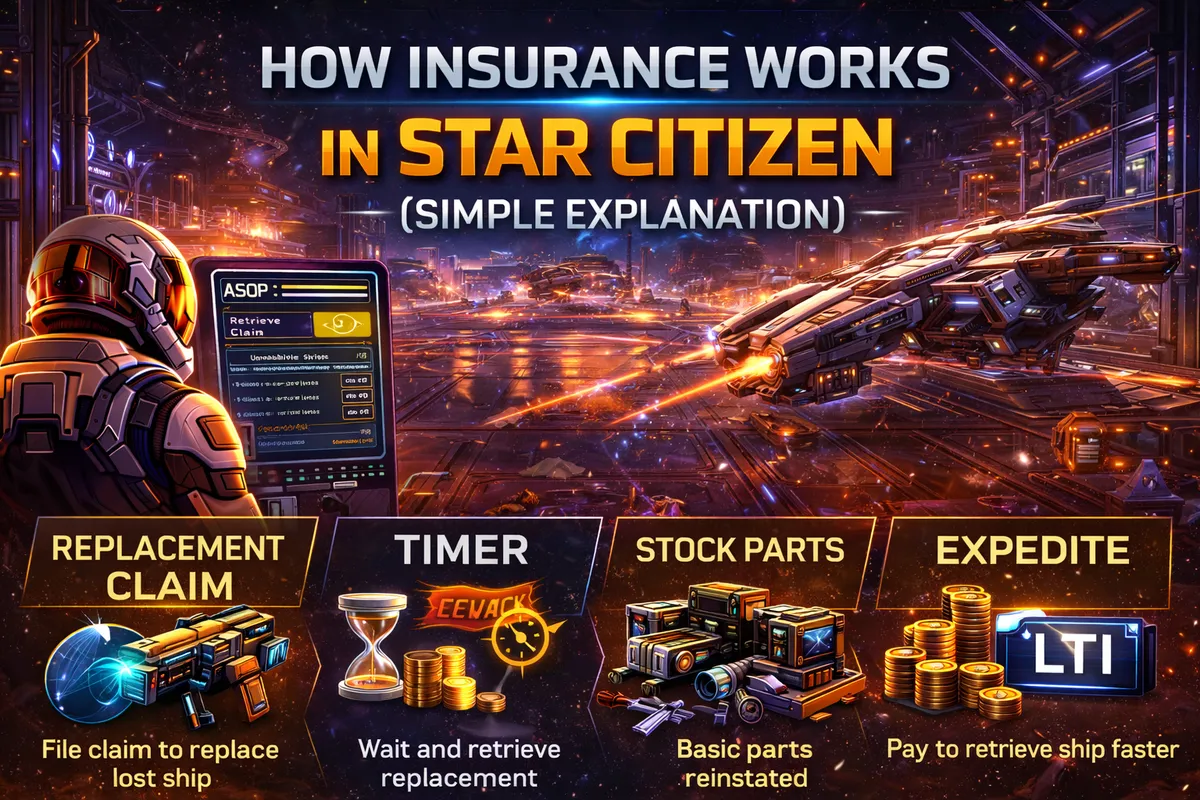
How Insurance Works Right Now in 2026 Alpha
In the current Alpha environment, ships and vehicles are effectively given basic insurance coverage to support testing. That means:
- You can file a claim to replace your ship when it’s gone or unusable.
- You’ll usually see a claim timer.
- You may have the option to expedite (pay in-game currency to reduce the wait).
- You do not need to manage long-term premium payments like a real insurance plan during Alpha testing.
Practical takeaway for new players:
If your ship disappears or breaks in a way you can’t fix, insurance claim is the normal “reset” button.
Where You Use Insurance: ASOP Terminals and “Claim” Options
You interact with insurance through ASOP terminals (ship retrieval terminals). The process is usually:
- Go to the ASOP terminal.
- Find your ship.
- If it’s not available, you’ll see a “claim” option.
- Start the claim timer.
- Wait, or pay to expedite.
- Once the timer is done, retrieve the ship normally.
A common newbie confusion is thinking “claim” is only for “ship destroyed.” In practice, players use claims for many reasons:
- Ship destroyed
- Ship lost somewhere far away
- Ship stuck and inaccessible
- Ship bugged (doors won’t open, systems broken, status glitched)
- You want the ship at your current location without flying it over
Claim Timers: Why They Exist and What Affects Them
Claim timers exist to make ships feel meaningful and prevent “instant infinite respawn” gameplay. In general:
- Smaller ships tend to have shorter claim timers.
- Larger ships tend to have longer claim timers.
- Some circumstances and locations can affect your overall downtime, but the big driver is usually ship class.
The important mindset:
Claim time is part of the “cost” of losing your ship, even if the ship itself is insured.
Expedite: Paying to Reduce the Timer
Expediting a claim is the game’s “pay to reduce waiting” option using in-game currency.
- You pay a fee.
- Your claim timer drops.
- You get your ship back sooner.
This is extremely useful when:
- You only have a short time to play
- You’re running a money loop and downtime kills your profit
- You’re stuck after a bug and want to reset quickly
- You need your ship back for a group operation
A smart habit:
Expedite when time matters more than money. Don’t expedite every single claim out of impatience—use it as a tool.
Insurance vs Repair: The Difference That Saves You Money
New players often “claim” when they should “repair,” and vice versa.
- Repair is for a ship you still have access to. You landed, you’re alive, the ship exists. You use repair/rearm/refuel services and keep going.
- Claim is for a ship you no longer have access to, or when the ship is so bugged you can’t reasonably recover it.
Practical rule:
- If you can land safely and your ship still exists, repair is usually cheaper and faster than losing it and claiming.
- If you cannot access the ship or it’s broken in an unrecoverable way, claim is the correct move.
Does Insurance Give You a “Brand New” Ship Every Time?
In the long-term vision, Star Citizen does not intend insurance to be a “free factory refresh button” that lets you blow up a damaged ship and instantly replace it as a strategy. The goal is that insurance protects your ship from permanent loss, not from normal operating costs.
In Alpha, the system is simplified and designed for testing. But even now, the intended mindset is:
- Repairs, rearming, refueling, docking—those are normal costs.
- Insurance is for replacement after loss, not for everyday maintenance.
So if your ship is damaged: repair it. If it’s gone: claim it.
What Insurance Covers: Hull, Stock Parts, and the Big Confusion
When players talk about insurance, they usually mean one of these:
- Hull (the ship chassis)
- Stock components (the default parts the ship comes with)
- Upgraded components (parts you swapped in)
- Cargo (what you’re carrying)
- Personal inventory (your armor, guns, tools)
These do not all behave the same way, and not all of them are intended to be “insured the same” long term.
The easiest way to think about it:
- Hull coverage: “I get my ship back.”
- Stock component coverage: “I get the basic default version back.”
- Everything else: “Depends on future systems and what you had installed or carried.”
What Happens to Ship Upgrades When You Claim?
In Alpha, the behavior you see depends on current patch behavior and what systems are implemented. But the safest player assumption is:
- If you claim a ship, expect to get the ship back and be prepared that installed upgrades may not always behave exactly the way you expect across patches and bugs.
The “smart player” approach is to treat upgrades as valuable:
- Don’t claim a ship casually if you can repair it.
- Keep your component purchases organized.
- If you use expensive components, consider storing backups or keeping notes of your builds so you can re-equip efficiently if needed.
What About Cargo? Is Cargo Insured?
Cargo is the biggest misconception.
Insurance for your ship is not the same as insurance for what your ship is carrying. Historically, the design messaging has been clear that cargo is not automatically protected the same way as your ship’s hull.
Practical gameplay meaning:
- If you’re hauling valuable cargo, your biggest risk is not “ship loss.”
- Your biggest risk is losing the cargo value you invested.
That’s why experienced traders use rules like:
- Never invest your full wallet into one run
- Cash out more often
- Run shorter routes
- Avoid selling at hot locations when overloaded
Cargo risk is a separate gameplay challenge from ship replacement.
What Is LTI (Lifetime Insurance) — The Simple Explanation
LTI stands for Lifetime Insurance. It’s a label attached to some pledge ships or promotions that indicates the ship has insurance that does not expire in the long-term game vision.
In plain language:
- LTI means you won’t have to renew that ship’s insurance coverage time limit.
- It does not mean you never pay repair costs, rearm costs, fuel costs, or operating costs.
- It does not mean your cargo is protected.
- It does not mean you can “suicide refresh” a damaged ship for free forever.
The best way to treat LTI emotionally:
- It’s convenience and peace-of-mind for long-term ownership, not a combat advantage button.
What Does “6 Months,” “24 Months,” or “120 Months” Insurance Mean?
Many pledge ships include a stated insurance duration, like 6 months, 24 months, or 120 months. This creates confusion because in Alpha, you do not play the final “full insurance economy” yet.
The simplest explanation is:
- Those durations are meant for the persistent, released game economy where insurance is a real ongoing system.
- In Alpha testing, ships commonly have non-expiring basic coverage to support gameplay testing.
So right now:
- Don’t panic about your pledge having “only X months” during Alpha play.
- Learn the claim system and focus on time management, not expiration anxiety.
Insurance, Warranty, and “Stock Loadout” (A Useful Mental Model)
A clean way to understand the intended structure is:
- Insurance: protects the ship’s hull from permanent loss.
- Warranty / stock replacement concept: you can get the ship back in a standard configuration.
- Upgrades and cargo: are separate value streams you manage through gameplay and risk choices.
This mental model prevents disappointment when you assume insurance equals “everything I had is guaranteed forever.”
“My Ship Says Unknown at ASOP” and Other Insurance-Related Bugs
Sometimes ships show odd statuses in terminals or become inaccessible after a bad landing, hangar door issues, or general server weirdness. In those cases, filing an insurance claim can act as a workaround to restore access to the ship.
The correct mindset is:
- If your ship is “stuck in limbo,” you’re not doing something wrong.
- Claiming is the normal recovery tool in Alpha.
Best Practices: How to Use Insurance Like a Pro
Here are the habits that make insurance feel painless instead of annoying.
Keep a Backup Ship for Short Downtime
If your main ship has a long claim timer, keep a backup ship you can use during downtime:
- A cheap runabout
- A starter ship
- A small shuttle
- Anything you can spawn quickly and use to keep playing
This turns claim time from “session ruined” into “switch ships and continue.”
Use Claim as a Tool, Not a Habit
Claiming constantly can become a crutch. It’s better to:
- Repair when possible
- Claim when necessary
- Use expedite when time matters
That keeps your gameplay loop stable and your wallet healthier.
Don’t Build Your Entire Night Around One Ship
Many “insurance frustration” stories are really “single point of failure” stories:
- One ship, one loop, one plan
- Ship lost → player feels stuck
Instead:
- Build two loops you enjoy (combat + cargo, salvage + deliveries, mining + bounties, etc.)
- Keep at least one “low-dependency” ship available
- Store basic gear at your main hub so you can restart quickly
Plan Around Claim Timers (Especially for Big Ships)
If you’re running a large ship:
- Assume you might lose it at some point
- Know the claim timer is part of your risk profile
- Don’t start a long operation if losing the ship will end your session and you’re not okay with that
Pro tip:
- Use big ships when you can afford downtime or have a group to support recovery.
- Use smaller ships when you want consistent short-session progress.
Insurance and Playstyle: What Changes for Combat, Cargo, Salvage, and Mining
Insurance feels different depending on what you do.
Combat players
- Claim time is your “death penalty” more than your money loss.
- Having a backup fighter or a multi-role ship reduces frustration.
- Repair discipline matters: surviving fights saves you more time than any upgrade.
Cargo traders
- The ship being insured is not the main risk; cargo investment is.
- Claiming after a loss hurts because you lost both time and cargo.
- Your best protection is risk management: smaller loads, safer routes, frequent cash-outs.
Salvagers
- Salvage ships can have meaningful claim times, and salvage cargo can be valuable.
- You want to cash out frequently rather than holding everything “for one big run.”
- Keep your salvage tools and kits stocked so a claim doesn’t stall you.
Miners
- Mining often involves setup time and sometimes refining logistics.
- A ship loss can break your rhythm, so backup plans matter.
- Treat claim time as a “cooldown” and use it to manage inventory, sell, or switch loops.
Common Myths About Insurance (And the Real Truth)
Myth: “LTI makes you stronger than other players.”
Truth: LTI is convenience for insurance duration; it doesn’t remove operating costs or magically make combat easy.
Myth: “Insurance means my cargo is safe.”
Truth: Cargo is a separate risk stream and is not automatically protected the same way as the hull.
Myth: “If my ship is damaged, I should blow it up and claim a fresh one.”
Truth: The long-term design explicitly discourages using insurance as a free refresh strategy. Repairs are part of ownership.
Myth: “Claiming is only for destroyed ships.”
Truth: Players claim ships for many reasons in Alpha, including bug recovery and relocating ships.
Myth: “Insurance expiration matters right now in Alpha.”
Truth: In Alpha testing, the system is structured to allow players to keep playing and testing; the final economy details are meant for later.
How to Explain Insurance to a New Player in One Minute
If you ever need the simplest “tell your friend” version:
- Your ship is replaceable. If it’s gone, you file a claim at ASOP.
- Claims have a timer; you can pay to speed it up.
- Insurance covers the ship replacement, not necessarily your cargo or everything you had inside.
- LTI means the ship’s insurance duration won’t expire later, but it doesn’t remove repair and operating costs.
That’s it. If they understand that, they won’t panic.
BoostRoom: Make Insurance and Recovery Feel Effortless
A lot of Star Citizen frustration comes from “recovery downtime”: you lose a ship, you lose gear, you lose your plan, and suddenly your session becomes logistics instead of fun. BoostRoom helps you avoid that by building a simple recovery system around your playstyle.
With BoostRoom, you can set up:
- A two-ship plan (main ship + fast backup) so claim timers never end your session
- A hub inventory routine (spare suits, meds, tools) so death doesn’t reset your night
- A money loop that fits your claim timer reality (short loops when timers are long)
- A risk plan for cargo/salvage/mining so you don’t lose everything in one mistake
Insurance is easiest when your entire routine is built to absorb failure. BoostRoom is built to help you do exactly that.
FAQ
How do I file an insurance claim in Star Citizen?
Go to an ASOP terminal, select the ship that’s unavailable, and choose the claim option. After the timer completes, you can retrieve it normally.
Why is there a claim timer?
It’s a gameplay cost that keeps ships meaningful and discourages instant infinite replacement. Bigger ships usually mean longer timers.
What does “expedite” do?
Expedite lets you pay in-game currency to reduce the claim timer and get your ship back faster.
Is insurance free in Alpha?
In Alpha testing, ships generally have basic non-expiring coverage so players can keep testing and playing. You may still see costs related to claim/expedite.
Does insurance replace my cargo too?
No—cargo is a separate value stream and is not automatically protected the same way as the ship’s hull. Treat cargo hauling as its own risk management game.
What happens to my upgrades when I claim a ship?
In Alpha, behavior can vary with patches and bugs. The safest approach is to assume you may need to re-equip upgrades and keep your builds organized.
What is LTI and should I care?
LTI is Lifetime Insurance—long-term coverage that doesn’t expire. It’s mostly convenience and peace-of-mind, not a direct gameplay advantage, and it doesn’t remove normal operating costs.
What does “120 months insurance” mean?
It’s a long-duration insurance period intended for the released game’s insurance economy. During Alpha testing, expiration periods generally aren’t something you need to manage for normal play.
My ship is stuck or “Unknown” in ASOP—what do I do?
If your ship is inaccessible, bugged, or status-glitched, filing an insurance claim is often the simplest way to restore access.



