Why PvE Feels “Hard” (And Why It’s Usually Not Your Aim)
Most PvE struggles aren’t caused by “bad reflexes.” They’re caused by one of these issues:
- You’re fighting at the wrong speed band (too fast to track, too slow to evade).
- Your engagements are built around jousting, which wastes time and exposes you to free damage.
- Your ship is under-upgraded in the wrong place (for example: you upgraded weapons but ignored shields, power, or cooling).
- Your PIP/aim settings are working against your brain (lead indicator and aim assist mismatched to your habits).
- You’re taking fights that are above your current ship + skill tier without a disengage plan.
The fix isn’t “get stronger.” The fix is building a repeatable combat routine where you control distance, limit exposure, and upgrade the pieces that give you the biggest real performance boost.
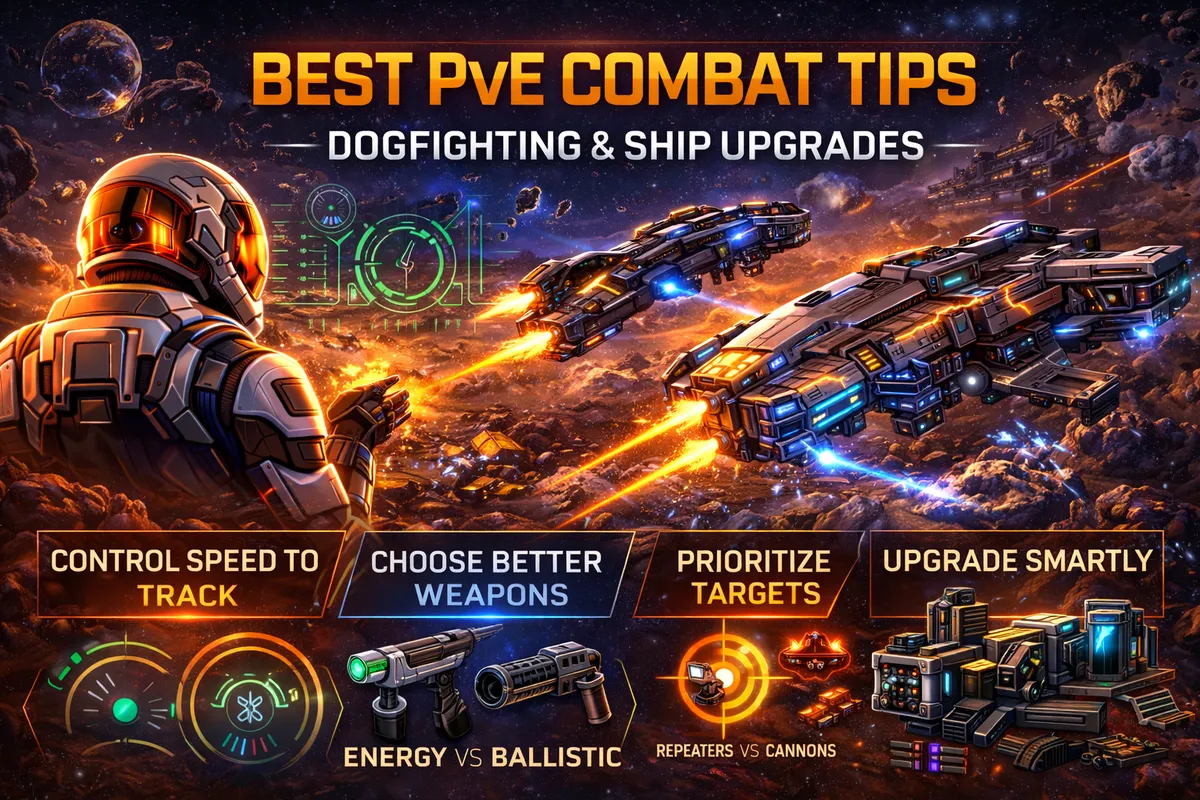
Master Modes and SCM: The New Dogfight Reality
Modern Star Citizen dogfighting is designed to bring ships closer and make combat more deliberate. The key concept is the SCM combat space—a speed/handling zone where ships can maneuver effectively for fighting instead of just blasting past each other at high speed. RSI’s Master Modes guidance explains that SCM is intended to create closer, more intense engagements rather than endless long-range passes.
Practical takeaway for PvE:
- If you treat every fight like “full throttle forever,” you’ll lose more time and take more damage.
- Your goal is to stay in a controllable speed range, keep your nose on target longer, and force the NPC to fight on your terms.
The #1 PvE Dogfighting Skill: Speed Control (Not Turning)
If you learn one thing, learn this:
Speed control is accuracy. Speed control is survivability.
New pilots often do this:
- Boost in → overshoot → flip → boost in again → overshoot → repeat.
That pattern:
- reduces time-on-target
- increases time spent turning around
- makes you eat free hits on every pass
Instead, build a “sticky” fight:
- Keep your speed in a range where you can track
- Use strafe to maintain position rather than constantly re-approaching
- Let the target drift through your forward arc instead of racing past it
A simple training drill:
- Pick one easy PvE target.
- Limit yourself to “no full boost unless disengaging.”
- Try to keep the target in front of you for as long as possible.
- You’ll feel your kill time drop almost immediately.
Stop Jousting: The Anti-Joust Routine
Jousting happens when both ships fly straight at each other, pass, and re-engage. It feels dramatic but it’s inefficient.
Replace it with this routine:
- Approach until you’re inside your comfortable weapon range
- Reduce speed slightly before the merge
- Start a gentle orbit/offset strafe rather than going nose-to-nose
- Maintain lateral movement so you’re harder to hit
- Keep the target near your forward arc, not behind you
Why it works:
- You keep firing longer
- Your shields take fewer sudden bursts
- The NPC has fewer “free shots” during your turn-around
PIP and Aiming: How to Hit More Without Becoming a Spreadsheet Pilot
Your PIP (aim indicator) and aim assist settings matter more in Star Citizen than in many games because targets move in 3D and velocities stack. Many players improve quickly simply by understanding and tuning PIP behavior and ESP/aim assistance to match their input style.
Practical aiming improvements that work for most PvE players:
- Pick one PIP style and stick with it for at least a week of sessions.
- Keep your bursts short and controlled instead of spraying continuously.
- Don’t chase the PIP with frantic micro-corrections—lead smoothly.
- If you’re missing constantly, your speed is usually too high for your control.
A high-value tip:
- Tune your fight speed to your accuracy, not your ego.
- If you lower speed slightly and land 2× more shots, your time-to-kill improves even if your ship “feels slower.”
Coupled vs Decoupled in PvE (When to Use Which)
Coupled mode is easier for most players because it helps manage velocity and stabilizes movement. Decoupled mode can be powerful once you understand momentum control, but it can also make you drift past targets if you don’t actively manage your vector.
Practical PvE guidance:
- Use coupled for most early and mid-tier PvE. It’s stable and consistent.
- Use decoupled as a tool, not a lifestyle—great for quick lateral slides, unpredictable vector changes, and specific maneuvers.
- If decoupled makes you miss more than it helps you evade, it’s not helping yet.
A clean “hybrid” habit:
- Stay coupled for general fighting.
- Tap into decoupled briefly for an evasive move or drift shot.
- Return to coupled for control and tracking.
Target Priorities: How to Make Multi-Target PvE Easy
Many PvE contracts become chaotic because you shoot the wrong thing first.
Use this priority order:
- Ships that are currently dealing the most damage to you
- Ships that are easiest to delete quickly (fast reduction in incoming DPS)
- Ships that are interrupting your tracking (high mobility annoyers)
- The “big target” last, unless it’s an immediate threat
Why it works:
- When you remove small threats quickly, your shields stabilize
- You reduce random chip damage that forces repairs
- You stop being overwhelmed and start controlling the fight
Power Management: The Fastest “Free Upgrade”
Before spending aUEC on components, learn power discipline:
- When you’re taking heavy fire: push power toward shields
- When you’re finishing a target quickly: push toward weapons (if your ship benefits)
- When you’re repositioning or escaping: ensure engines respond cleanly
Even if you don’t micromanage constantly, doing it at key moments:
- prevents shield collapse
- increases your effective time-on-target
- gives you a better disengage window
Power management is “free performance.” It often matters more than a small component upgrade.
Shield Discipline: How to Stop Taking Hull Damage
In PvE, hull damage usually happens because:
- you stayed in the fight after shields collapsed
- you chased too aggressively during a bad shield state
- you took repeated jousts and ate head-on bursts
Shield discipline rule:
- When shields drop, treat it as a timer, not a suggestion.
- Back off, reset, and re-engage.
A simple reset pattern:
- Break away at an angle
- Use lateral movement while your shields regenerate
- Re-enter at your preferred range with control
You’ll finish more missions and spend less time repairing.
Weapon Choice in 2026: Energy vs Ballistic
Weapon choice is a comfort decision as much as a DPS decision. RSI’s own vehicle weapons overview frames the broad difference: energy vs ballistic behavior and types are built for different scenarios.
Practical PvE differences:
Energy weapons
- No ammo logistics (usually)
- Consistent across long sessions
- Great for chaining bounties without rearming constantly
- Often easier for beginners to maintain a clean routine
Ballistic weapons
- Can feel stronger in burst and “finisher” moments
- Often demands rearm planning
- Can reduce your “contracts per hour” if you’re constantly restocking
If your goal is fast PvE money:
- Energy is usually the easiest path to consistent profit per hour.
If your goal is maximum kill speed and you’re okay with logistics:
- Ballistics can be powerful, but you must include rearm downtime in your plan.
Repeaters vs Cannons: What to Pick for PvE
A simple rule that stays true for most players:
- Repeaters are easier to hit with, especially on smaller or faster targets.
- Cannons reward accuracy and range discipline, and can feel better against larger targets if you can land shots consistently.
You’ll see lots of patch and community discussion around weapon effectiveness and target size interactions, especially as balance evolves in the 4.6–4.7 era.
PvE-focused recommendation:
- If you miss a lot: use repeaters first.
- If you already hit consistently and want stronger “chunk” impact: test cannons.
- Don’t swap every session. Pick one setup and master it.
The Best PvE Loadout Philosophy: One Rhythm, One Range
A common mistake is mixing weapon types that require different lead timing and engagement ranges. That makes you feel inconsistent.
A better approach:
- Choose one “rhythm”: all repeaters or all cannons
- Choose one preferred range and fight there
- Use missiles to shorten fights when needed (not to replace your guns)
Consistency beats “perfect theory DPS” in real PvE.
Missiles in PvE: How to Use Them Without Living at the Rearm Pad
Missiles can turn slow fights into fast fights, but only if you use them like a tool.
Use missiles for:
- Targets that are wasting your time (high evasion, annoying orbiters)
- Breaking a tough shield phase faster
- Finishing a fight when you want to chain contracts quickly
- Stopping runners
Don’t use missiles:
- As your default opener on every single target
- When you’re already winning cleanly with guns
- If rearm downtime will slow your profit loop more than the missile saves
Missile discipline makes PvE feel smooth:
- You become the one choosing how long fights last.
Flight Positioning: The “45-Degree Rule”
A very practical PvE positioning habit:
- Avoid sitting directly in front of the enemy’s nose.
- Instead, aim to stay at an offset angle where:
- you can still track them
- they struggle to keep you centered
- you reduce incoming hits
Many NPC ships will try to face-tank or face-track. Offset positioning makes you harder to hit while keeping your guns in play.
Distance Control: The Fight Is Won Before the First Shots
A surprising number of PvE failures come from starting fights at the wrong range.
Simple distance rules:
- Too close: you overshoot, lose tracking, and eat bursts
- Too far: you miss, waste capacitor/heat time, and extend the fight
Pick a comfort band and commit to it:
- Stay in that band unless you are disengaging or finishing.
This turns PvE from “chaos” into a predictable routine.
Ship Upgrades: The Priority Order That Actually Improves PvE
Here’s the upgrade truth:
A ship’s performance is a system. Upgrading the wrong part first can feel like “I spent money and got nothing.”
Use this priority order for PvE:
- Weapons (only if you can hit)
- Shields (survivability and downtime reduction)
- Power plant (stability under load)
- Coolers (sustained performance and fewer performance drops)
- Quantum drive (profit per hour via travel speed)
- Missile racks / ordinance tuning (optional style choice)
Why quantum drive is not #1 for combat:
- It doesn’t help you win fights directly
- But it does help you earn faster overall by reducing travel time between contracts.
Weapon Upgrades: What Actually Matters
Weapon upgrades matter most when:
- you can already track targets well
- your speed control is stable
- you’re choosing engagements wisely
If you’re missing constantly, upgrading guns won’t feel like much.
A great PvE weapon strategy:
- Pick a reliable energy weapon family (repeaters or cannons)
- Match sizes correctly to your ship hardpoints
- Install, then run the same bounty tier for a full session and measure time-to-kill
This “test in one lane” approach prevents placebo spending.
Shield Upgrades: The PvE Comfort Multiplier
Shields are often the best “quality-of-life” PvE upgrade because they:
- reduce repair frequency
- allow you to make small mistakes without dying
- shorten the time you spend limping back to a station
- increase confidence, which increases performance
PvE is a repetition game. The fewer times you stop to repair, the richer you get.
Power Plant and Cooling: The Hidden Stability Upgrades
Power and cooling upgrades rarely feel flashy, but they often remove the “my ship feels weird under pressure” problems.
They help with:
- sustaining fire
- keeping systems stable under combat load
- preventing awkward performance dips mid-fight
- reducing the feeling that your ship is “fighting your inputs”
If you’ve ever felt like:
- “I’m losing power when things get intense,”
- this is often where the solution lives.
Quantum Drive: The Profit Upgrade for PvE Grinders
If you chain bounties, quantum travel time is one of your biggest “real costs.”
A better quantum drive can:
- reduce travel time between missions
- reduce the downtime between kills
- make your PvE loop feel faster even if combat is unchanged
This is the upgrade that makes:
- “I did 6 bounties this hour” become “I did 9.”
Don’t Over-Upgrade Too Early: The Replaceable Ship Principle
If you’re still learning PvE fundamentals, spend like a professional:
- Upgrade what you can feel immediately (weapons if you hit, shields for survivability)
- Keep your build simple
- Avoid turning your ship into a “museum” that makes you afraid to fight
The best early ship is one you’re not scared to risk. Fear slows learning.
PvE Combat by Mission Tier: What to Practice When
VLRT–MRT (Learning Tier)
Focus on:
- speed control
- PIP comfort
- stopping jousts
- finishing fights with minimal shield loss
Ship choice matters less here than discipline.
HRT–VHRT (Efficiency Tier)
Focus on:
- time-to-kill
- weapon consistency
- target prioritization
- clean disengages before hull damage
This is where upgrades start to matter a lot, because fights get longer and mistakes become costly.
ERT (Endgame Tier)
Focus on:
- choosing the right ship for the job
- sustained damage output
- survival and reset discipline
- group coordination if needed
ERTs are where “bravery” gets punished. Efficiency wins.
The PvE Dogfighting Checklist (Use This Every Fight)
Before the fight:
- Are shields healthy?
- Is ammo/missile state acceptable?
- Do you have a disengage path?
During the fight:
- Control speed (don’t joust)
- Stay at your chosen range
- Prioritize targets that reduce incoming DPS fastest
- Disengage when shields collapse
After the fight:
- Don’t immediately chain into the next contract if your ship is damaged
- Repair before damage becomes expensive
- Re-arm only if it improves your next hour’s efficiency
This checklist is boring—and that’s why it makes you rich.
Common PvE Combat Mistakes (And the Fix That Works)
- Mistake: Full throttle jousting
- Fix: lower speed, orbit/strafe, stay on target longer
- Mistake: Constantly changing loadouts
- Fix: run one build for a full week and learn it
- Mistake: Fighting until hull damage
- Fix: disengage earlier, reset, re-engage
- Mistake: Upgrading random components
- Fix: follow the upgrade priority order and measure results
- Mistake: Looting every wreck mid-grind
- Fix: loot only if it clearly beats another contract in profit per minute
BoostRoom: Turn PvE Combat Into Fast Progression
If PvE dogfighting feels inconsistent—some sessions you melt targets, other sessions you get shredded—what you need is a repeatable plan that matches your ship and skill level.
BoostRoom can help you:
- Build a PvE-ready loadout that’s simple, stable, and effective
- Create a dogfighting routine (speed band + range + target priority) you can repeat
- Choose upgrades that matter first so your aUEC converts into real performance
- Set up an efficient bounty loop so you spend more time fighting and less time commuting/repairing
The goal is simple: faster kills, fewer deaths, and a combat setup you actually enjoy flying.
FAQ
What’s the fastest way to improve PvE dogfighting?
Stop jousting. Control speed so you can keep the target in front of you longer, land more shots, and take less free damage on pass-bys
.
Should I use repeaters or cannons for PvE?
Repeaters are usually easier for consistent hits on smaller targets. Cannons can feel stronger if you already track well and control range. Pick one and master it.
Energy or ballistic weapons for PvE grinding?
Energy is usually best for long sessions because you avoid constant ammo rearm downtime. Ballistics can be strong but require logistics discipline.
What upgrades should I buy first?
For most PvE players: weapons (if you can hit), then shields, then power/cooling stability upgrades, then quantum drive for faster mission chaining.
Why do I keep taking hull damage in easy missions?
Usually because you stayed in too long after shields collapsed or you’re jousting and eating head-on bursts. Disengage earlier and reset.
Is decoupled flight required for good PvE?
No. Coupled is great for consistent PvE. Decoupled is a tool you can learn later for specific maneuvers and drift control.
How do I make bounties feel “faster” without changing ships?
Upgrade quantum drive for travel time, stabilize your weapon choice for reliable kills, and reduce downtime by repairing before hull damage stacks.
Do missiles matter in PvE?
Yes, if used with discipline. Use missiles to shorten inefficient fights or stop runners, not as a default opener that forces constant rearming.



