Diablo IV Materials Farming Guide: How to Upgrade Gear Efficiently
Materials are one of the biggest hidden progression systems in Diablo IV. Many players focus only on finding stronger items, but finding an item is only the first step. A good item still needs the right Aspect, the right Temper, the right socket, the right gem, the right Masterworking progress, and sometimes the right reroll before it becomes part of a serious build. Every one of those steps costs materials.
This is why material farming matters so much. A player with good items but no materials cannot finish the build. A player with materials but no plan can waste them on gear that gets replaced an hour later. A player who farms the wrong activity may collect thousands of materials they do not need while staying stuck because they are missing one important bottleneck. Efficient progression is not only about farming harder. It is about farming the right thing at the right time.
Diablo IV materials fall into several categories. Some come from salvaging gear. Some come from Helltides. Some come from Nightmare Dungeons. Some come from Infernal Hordes. Some come from World Bosses, Treasure Goblins, The Butcher, War Plans, Whispers, Legion Events, Kurast Undercity, and other endgame activities. Some materials are used for basic upgrades, while others are used for endgame systems like Masterworking, adding sockets, crafting gems, and rerolling powerful gear.
The most important material for endgame gear upgrading is usually Obducite because it is tied to Masterworking. Forgotten Souls are also a major bottleneck because they are used in important Ancestral gear upgrades, imprinting, Tempering, and Masterworking costs depending on the system stage. Veiled Crystals are needed constantly for enchanting, imprinting, Tempering, and Masterworking. Legendary salvage materials such as Coiling Wards, Baleful Fragments, and Abstruse Sigils are tied to armor, weapons, and jewelry. Scattered Prisms matter because sockets are a major source of character power. Gem Fragments matter because strong gems require huge fragment amounts and gold.
The best material farming approach is simple: identify your bottleneck, farm the activity that gives that material, salvage intelligently, avoid wasting upgrades on temporary items, and use stacked activities so every run gives more than one reward. A Nightmare Dungeon can give Obducite, gear, gold, Sigils, and dungeon progress. A Helltide can give Forgotten Souls, gear, Tortured Gifts, Veiled Crystals, and Whisper progress. Infernal Hordes can convert Burning Aether into materials, gold, gear, or gem fragments. War Plans can connect several activities and reward Obducite, salvage, spoils, and activity progress. The strongest routes are the ones that give multiple useful rewards at once.
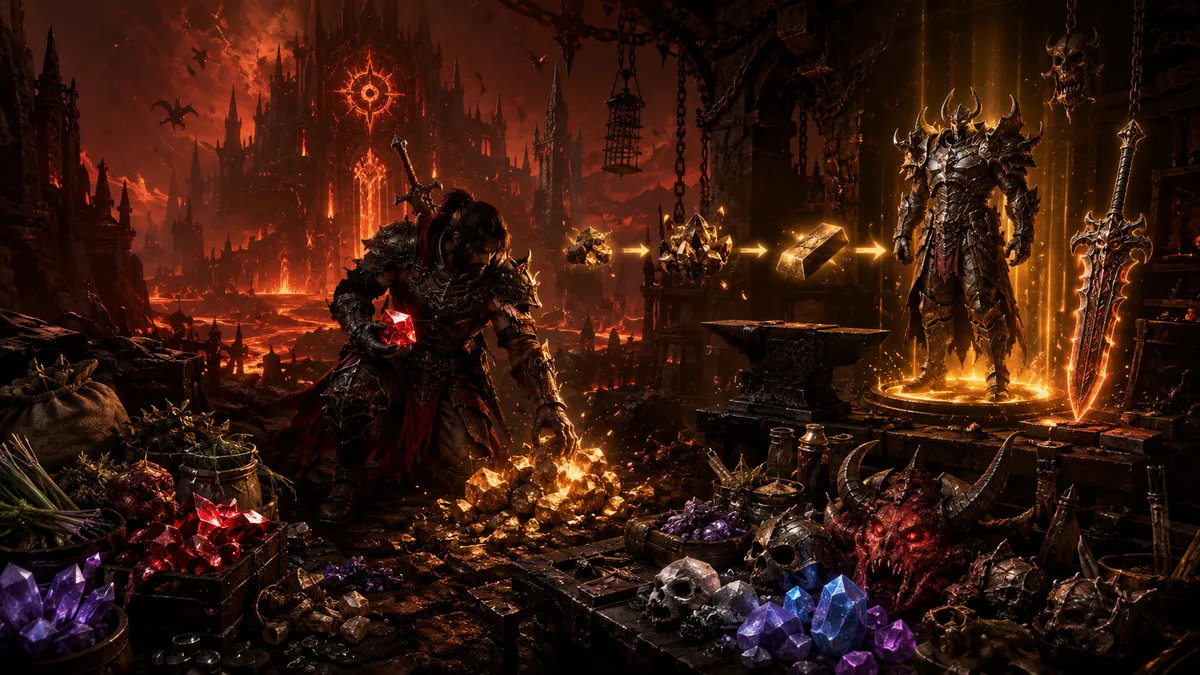
Why Materials Matter for Gear Progression
Materials matter because Diablo IV gear progression is built around several upgrade layers. A strong drop is not complete until it is shaped into a build-ready item.
Materials Power Tempering:
Tempering lets you add a chosen affix from learned Tempering recipes. Modern Tempering is more controlled than older random versions, but it still costs materials. This means you can target the affix you want, but you still need enough materials to apply and adjust gear properly.
Materials Power Masterworking:
Masterworking improves the quality of endgame items and is one of the main ways to push gear higher. This system consumes Obducite, gold, and other crafting materials, making material farming essential for serious endgame players.
Materials Power Imprinting:
Legendary Aspects make many builds work. Imprinting those Aspects onto items costs gold and materials. If you replace gear often, imprinting costs add up quickly.
Materials Power Enchanting:
Enchanting lets you reroll an affix, but repeated attempts can drain gold and materials. This is one of the easiest ways to waste resources on mediocre gear.
Materials Power Sockets and Gems:
Sockets and gems add important stats such as life, resistances, armor, damage, or build-specific bonuses. Adding sockets requires Scattered Prisms and other materials, while crafting stronger gems requires large amounts of Gem Fragments and gold.
Materials Give Build Freedom:
A player with enough materials can test upgrades, fix weak gear, and transition builds more easily. A player with no materials is often stuck waiting for perfect drops.
The Main Gear Upgrade Materials
Understanding the main materials helps you farm with purpose instead of collecting random resources.
Obducite:
Obducite is the key Masterworking material. It is one of the most important endgame materials because Masterworking improves item quality and overall gear strength. Nightmare Dungeons, Infernal Hordes, and Kurast Undercity are among the most important sources.
Forgotten Souls:
Forgotten Souls are legendary crafting materials used in important Ancestral item improvement systems. They are commonly tied to Helltide farming, salvaging Legendary items, elite monsters, and certain reward systems.
Veiled Crystals:
Veiled Crystals are used constantly for enchanting, imprinting, Tempering, and Masterworking. The most reliable source is salvaging Rare, Legendary, and Unique gear.
Rawhide:
Rawhide comes mainly from salvaging armor and off-hand items. It is used for armor-related Tempering and Masterworking.
Iron Chunks:
Iron Chunks come from salvaging weapons and jewelry or gathering ore. They are used for weapon and jewelry-related upgrades.
Coiling Wards:
Coiling Wards come from salvaging Legendary armor. They are used for armor-related Tempering, imprinting, and Masterworking.
Baleful Fragments:
Baleful Fragments come from salvaging Legendary weapons. They are important for weapon upgrades and imprinting.
Abstruse Sigils:
Abstruse Sigils come from salvaging Legendary jewelry. They are used for jewelry upgrades, imprinting, and some Masterworking steps.
Scattered Prisms:
Scattered Prisms are used to add sockets to gear. They are rarer than common salvage materials and come from World Bosses, Treasure Goblins, and The Butcher.
Gem Fragments:
Gem Fragments are used to craft gems. Higher-quality gems can require very large amounts, so collecting fragments steadily matters.
Sigil Powder:
Sigil Powder is used to craft Nightmare Sigils and can be earned from Whisper Caches, chests, elite enemies, and salvaging unwanted Nightmare Sigils.
Runeshards:
Runeshards support access to The Pit and can come from Nightmare Dungeon completion chests, Legion chests, Tortured Gifts, World Boss caches, and Tree of Whispers caches.
The Simple Rule for Material Farming
The best material farming rule is simple: farm the material you are missing, not the activity everyone else is talking about.
Many players ask for the “best farm” without checking their own bottleneck. That is a mistake. If you are missing Obducite, Nightmare Dungeons or Infernal Hordes may be the answer. If you are missing Forgotten Souls, Helltides and salvaging Ancestral or Legendary gear may matter more. If you are missing Veiled Crystals, salvage more gear instead of selling everything. If you are missing Scattered Prisms, World Bosses and Treasure Goblins become more important. If you are missing Gem Fragments, Infernal Hordes, Whispers, Mercenary Bartering, and gem-related sources can matter.
Check Your Material Tab First:
Before farming, open your Materials and Stats panel and look at what is actually low. Do not guess.
Choose the Activity That Fixes the Bottleneck:
Every activity has different reward strengths. Nightmare Dungeons are great for Obducite. Helltides are strong for Forgotten Souls and gear volume. Infernal Hordes are useful for Obducite, Gem Fragments, and reward conversion. War Plans are strong for chaining activities and reducing downtime.
Do Not Waste Materials on Bad Items:
Farming faster helps, but wasting less is just as important. Do not Masterwork random gear. Do not enchant weak items endlessly. Do not imprint every item during leveling.
Stack Rewards Whenever Possible:
The best material route gives materials plus gear, gold, Whispers, boss keys, activity progress, or seasonal rewards.
Material Rule:
Efficient farming starts with knowing which material is blocking your next upgrade.
Best Overall Material Farm: Nightmare Dungeons
Nightmare Dungeons are one of the best overall material farms because they provide Obducite, gear, gold, Nightmare Sigils, elite drops, and dungeon progression. They are especially important for players who want to Masterwork gear.
Why Nightmare Dungeons Are Strong:
Nightmare Dungeons give a steady mix of materials, loot, and progression. They are repeatable, predictable, and easy to chain if you have Sigils.
Obducite Value:
One of the main reasons to run Nightmare Dungeons is Obducite. Since Obducite is needed for Masterworking, Nightmare Dungeons naturally fit into endgame gear improvement.
Gear to Salvage:
Every run gives gear that can become Veiled Crystals, Coiling Wards, Baleful Fragments, Abstruse Sigils, Forgotten Souls, or gold depending on whether you salvage or sell.
Sigil Loop:
Nightmare Dungeons reward more Sigils, and unwanted Sigils can be salvaged into Sigil Powder. This keeps the dungeon loop going.
Strongrooms and Extra Rewards:
Horadric Strongrooms and dungeon reward events can increase the value of a run. These optional challenge areas can be worth doing when they are fast and reward-rich.
Best Strategy:
Choose fast dungeons, avoid slow or dangerous affixes, salvage gear when materials are low, and stack Nightmare Dungeons with Whispers or War Plans when possible.
Nightmare Dungeon Rule:
Run Nightmare Dungeons when Obducite, gear testing, Sigil Powder, and steady salvage materials are your main needs.
Best Obducite Farming Strategy
Obducite is one of the most important endgame materials because it powers Masterworking. The best way to farm it depends on your build strength and what content you can clear quickly.
Nightmare Dungeons:
Nightmare Dungeons are one of the most reliable Obducite farms. They are especially useful if you also want gear drops, dungeon rewards, Sigil Powder, and a repeatable activity loop.
Infernal Hordes:
Infernal Hordes can be very strong for Obducite because Torment-level runs let you spend Burning Aether on material rewards. If your build clears waves quickly, this can be a strong material route.
Kurast Undercity:
Kurast Undercity can also provide Masterworking materials, especially when using the right Tributes and targeting the right reward type. It is most useful for players with expansion access and a clear farming plan.
War Plans:
War Plans can reward Obducite and let you chain activities like Nightmare Dungeons, Infernal Hordes, Helltides, and other endgame systems. This reduces downtime and helps you farm multiple resource types.
Do Not Farm Too High:
A higher difficulty is only better if you clear fast. Slow clears reduce materials per hour.
Obducite Rule:
Farm Obducite through the fastest activity your build can clear repeatedly without dying or wasting time.
Best Forgotten Souls Farming Strategy
Forgotten Souls are often a major bottleneck because they are tied to important gear upgrades. Many players run out of Forgotten Souls before they run out of common materials.
Helltides:
Helltides are one of the most important Forgotten Soul farms. Screaming Hell Veins, Tortured Gifts, elite monsters, and Helltide chests can all help build your supply.
Salvaging Legendary Gear:
Salvaging Legendary and Ancestral items can provide important legendary materials and Forgotten Souls. This makes high-loot activities valuable even if the direct drop is not a Forgotten Soul.
Elite Monsters and Chests:
Forgotten Souls can come from elite monsters and chests, so high-density activities naturally help.
War Plans Salvage Rewards:
War Plans can reward salvage and activity spoils. When your route includes Helltides or other high-loot activities, it can help with Forgotten Souls indirectly and directly.
Alchemist Conversion:
The Alchemist can help modify and refine materials in the Lord of Hatred era, which gives players another way to support gear upgrading when certain materials are out of balance.
Do Not Waste Them:
Forgotten Souls disappear quickly if you Temper, imprint, enchant, and Masterwork every piece of gear. Save heavy spending for items that are worth keeping.
Forgotten Soul Rule:
Farm Helltides and salvage Legendary gear when Forgotten Souls are your upgrade wall.
Best Veiled Crystal Farming Strategy
Veiled Crystals are used in many upgrade systems, which makes them one of the most common long-term bottlenecks.
Salvage Rare, Legendary, and Unique Gear:
The most reliable way to get Veiled Crystals is by salvaging gear. If you sell everything, you may run out quickly.
Farm High-Loot Activities:
Helltides, Nightmare Dungeons, Infernal Hordes, Whispers, War Plans, and boss farming all produce gear that can be salvaged into Veiled Crystals.
Use Whisper Caches:
Whisper Caches can provide materials and gear, helping you maintain crystals while also earning gold and other rewards.
Avoid Selling During Crystal Shortages:
If Veiled Crystals are low, salvage most unwanted gear until your supply recovers.
Do Not Over-Enchant:
Enchanting consumes Veiled Crystals. Do not spend hundreds of crystals trying to fix a weak item.
Crystal Rule:
When Veiled Crystals are low, stop selling gear and start salvaging almost everything you do not need.
Legendary Salvage Materials: Armor, Weapons, and Jewelry
Legendary salvage materials are tied to item slot types. This means the best farm depends on what kind of gear you need to upgrade.
Coiling Wards for Armor:
Coiling Wards come from salvaging Legendary armor. They are used for armor-related Tempering, imprinting, and Masterworking.
Baleful Fragments for Weapons:
Baleful Fragments come from salvaging Legendary weapons. They are important for weapon upgrades and Aspect imprinting.
Abstruse Sigils for Jewelry:
Abstruse Sigils come from salvaging Legendary jewelry. They matter for rings and amulets, and jewelry often becomes a major upgrade bottleneck.
Target the Right Helltide Chest:
If you need weapon materials, open weapon chests. If you need jewelry materials, open jewelry chests. If you need armor materials, open armor chests. Helltides let you steer loot toward the salvage type you need.
Use Purveyor of Curiosities Carefully:
Gambling can help target certain slots, which can indirectly help farm the Legendary salvage material tied to that slot.
Salvage Duplicates:
If a Legendary item is not useful and does not sell for much, salvage it for slot-specific materials.
Legendary Salvage Rule:
Farm and salvage the item type that matches the material you are missing.
Scattered Prism Farming for Sockets
Scattered Prisms are important because sockets add real character power. A strong item without a socket may still need Jeweler work before it is complete.
World Bosses:
World Bosses are one of the most important sources of Scattered Prisms. They are scheduled events, so check the map and arrive early.
Treasure Goblins:
Treasure Goblins can drop Scattered Prisms. They are not always reliable, but they are worth chasing when found.
The Butcher:
The Butcher is another source of Scattered Prisms. He is not something you can always force, but defeating him can reward useful socket materials.
Do Not Waste Prisms on Temporary Gear:
Adding sockets to gear you will replace soon is one of the easiest ways to waste Scattered Prisms.
Socket Best Items First:
Prioritize weapons, armor, and jewelry that are already strong enough to keep. Add sockets when the item supports your build and will stay equipped.
Prism Rule:
Farm World Bosses and save Scattered Prisms for gear that is actually worth socketing.
Gem Fragment Farming
Gem Fragments become more important as your character progresses because stronger gems require large fragment totals. They are also connected to socket planning and endgame stat balancing.
Infernal Hordes:
Infernal Hordes are useful for Gem Fragments because material reward choices can support fragment farming alongside Obducite.
Whisper Caches:
Tree of Whispers rewards can help with Gem Fragments while also giving gold, gear, and other materials.
Helltide Chests:
Tortured Gifts can provide fragments along with gear and other materials.
Mercenary Bartering:
Mercenary Rapport and Bartering can help with certain reward caches, including materials that support gear progression.
Do Not Craft Every Gem Too Early:
Higher-tier gems cost a lot. Focus on the gems that your build actually uses.
Gem Rule:
Farm fragments through normal endgame activities, then craft only the gems that directly support your build.
Infernal Hordes for Materials
Infernal Hordes are a strong material activity because the final reward lets you spend Burning Aether on useful reward types. This makes them especially good when you want to convert combat performance into materials.
Why Infernal Hordes Work:
Infernal Hordes are wave-based, enemy-dense, and reward-focused. The faster your build clears, the more Burning Aether you collect.
Spoils of Materials:
At Torment difficulty, Infernal Hordes can let you choose material rewards such as Obducite and Gem Fragments. This makes them one of the clearest material farming routes.
Spoils of Greater Equipment:
Sometimes gear rewards are better than raw materials because gear can be salvaged into Veiled Crystals, Forgotten Souls, Coiling Wards, Baleful Fragments, and Abstruse Sigils.
Choose the Right Final Boss:
If your main goal is materials, choose the reward path that gives the best material value instead of chasing only boss-specific drops.
Build Requirements:
Infernal Hordes reward builds with area damage, mobility, survivability, and enough single-target damage for the final encounter.
Infernal Hordes Rule:
Use Infernal Hordes when your build can collect high Burning Aether and convert it into Obducite, Gem Fragments, gear, or gold efficiently.
Helltides for Materials
Helltides are one of the best all-around material activities because they provide enemies, elites, events, chests, Forgotten Souls, gear, and targeted loot opportunities.
Tortured Gifts:
Tortured Gifts are chests opened with Aberrant Cinders. They provide gear and materials, and they can be targeted by item category.
Forgotten Souls:
Helltides remain one of the strongest sources for Forgotten Souls because of Helltide chests, elite monsters, and Screaming Hell Veins.
Slot-Specific Farming:
Need Baleful Fragments? Open weapon chests. Need Abstruse Sigils? Open jewelry chests. Need Coiling Wards? Open armor chests.
Blood Maiden and Events:
Blood Maiden fights and local events generate enemy density and loot. More loot means more salvage materials.
Do Not Die With Cinders:
Dying can cost time and temporary progress. If you are carrying many Cinders, play safely until you open your chests.
Helltide Rule:
Run Helltides when you need Forgotten Souls, slot-specific salvage materials, gear volume, and chests.
Tree of Whispers for Materials
Whispers are valuable because they reward caches that can contain gear, gold, materials, and useful progression items. They are especially good when stacked with other activities.
Why Whispers Are Efficient:
Whispers reward you for doing activities you may already want to run. You can farm Helltides, dungeons, bosses, and events while earning Grim Favors.
Material Caches:
When you need materials, choose caches that support your current bottleneck. Whispers can also help with Sigil Powder, Runeshards, gear, gold, and general resources.
Good for Early Endgame:
Whispers are excellent when you are still building your first material bank. They give predictable rewards and guide your activity route.
Stack With Helltides:
Helltide Whispers are especially useful because they combine Cinders, chests, enemy density, Forgotten Souls, gear, and Whisper cache progress.
Turn In Regularly:
Do not keep running around after reaching enough Grim Favors. Turn in and claim the cache so your farming loop stays efficient.
Whisper Rule:
Whispers are best when they are not separate farming. Let them overlap with your normal material route.
War Plans for Efficient Material Farming
War Plans are useful because they turn endgame farming into a chain. Instead of running one random activity, you can build a route that includes multiple reward types.
War Plans Reduce Downtime:
Less time deciding what to do means more time farming. War Plans help you move from one activity to the next.
Different Activities Give Different Rewards:
War Plan activities can reward Obducite, salvage, spoils, and activity experience. This lets you choose a route based on your material goals.
Activity Skill Trees Matter:
Progressing activity trees unlocks better chaining and stronger customization. This can improve long-term material farming.
Generated Keys Help:
War Plans can generate activity keys such as Nightmare Dungeon Sigils or Infernal Horde Compasses when needed, reducing farming interruptions.
Best Material War Plans:
A strong material plan often includes Nightmare Dungeons for Obducite, Helltides for Forgotten Souls and salvage, Infernal Hordes for Obducite and Gem Fragments, and Whispers for caches.
War Plan Rule:
Use War Plans when you want materials from several activities without wasting time between them.
Kurast Undercity for Materials
Kurast Undercity is useful for players with expansion access who want targeted rewards and efficient runs. It can support Masterworking material farming when used with the right goal.
Why Undercity Helps:
Undercity runs can provide materials, gear, and targeted reward options depending on Tributes and progression.
Tributes Matter:
The value of an Undercity run depends heavily on the Tribute or reward setup you use. Do not run randomly if you are trying to farm one specific material.
Good for Focused Players:
Undercity is best when you understand what reward you want. It is less useful if you enter without a plan.
Combine With War Plans:
When Undercity appears inside a War Plan route, it can become more efficient because you reduce downtime and stack rewards.
Expansion Value:
Players with Vessel of Hatred or Lord of Hatred access can use Undercity as part of a broader material route.
Undercity Rule:
Use Kurast Undercity when your Tribute and reward plan match the materials you need.
Salvage vs Sell: The Most Important Material Decision
Many players ask where to farm materials, but their real problem is that they sell too much gear when they should salvage or salvage too much gear when they need gold. You need both.
Salvage When Materials Are Low:
If you are missing Veiled Crystals, Legendary salvage materials, or Forgotten Souls, salvage more gear. This is especially important in early and mid-endgame.
Sell When Gold Is Low:
If materials are comfortable but gold is blocking upgrades, sell unwanted gear instead. Enchanting, Masterworking, gem crafting, and socket work can become expensive.
Salvage Legendaries Early:
Early on, Legendary salvage is often more important than selling because it improves your material bank and Codex options.
Sell Junk Later:
Once you have enough materials, selling extra gear helps maintain gold for upgrades and rerolls.
Check Valuable Drops First:
Do not instantly salvage Ancestral items, Greater Affix items, good bases, or useful Uniques. Check whether they help your build.
Salvage Rule:
If your upgrade material count is low, salvage. If your gold is low and materials are healthy, sell.
How to Upgrade Gear Efficiently
Efficient upgrading means using materials on items that deserve them. The biggest material waste comes from upgrading gear too early or too randomly.
Step 1: Choose a Build Direction:
Before upgrading, know what your build needs. A random item is not worth expensive upgrades if it does not support your main skill, damage type, defense, or resource plan.
Step 2: Check the Item Base:
Good affixes, Greater Affixes, item type, and stat alignment matter. Do not invest heavily into gear with weak affixes.
Step 3: Enchant Before Heavy Masterworking:
If one affix is bad, fix it before pushing expensive endgame upgrades. Heavy Masterworking on an item you still need to reroll can become wasteful.
Step 4: Temper With Purpose:
Choose the Temper affix that supports your build. Modern Tempering lets you select the desired affix, so do not apply random upgrades without a plan.
Step 5: Imprint the Right Aspect:
A strong Aspect can make the item build-ready. Make sure you use the right power for the slot.
Step 6: Add Sockets Only to Keepers:
Scattered Prisms are valuable. Add sockets when the item is good enough to keep.
Step 7: Masterwork Endgame Items:
Use Obducite and other materials on Ancestral Legendary or Unique items that are close to final or strong enough for long-term use.
Upgrade Rule:
Do not fully upgrade an item until it has the right affixes, the right role, and a real place in your build.
Masterworking Materials and Efficiency
Masterworking is one of the biggest material sinks in Diablo IV. It can make gear much stronger, but it can also drain your Obducite, Forgotten Souls, gold, and salvage materials quickly.
Masterworking Improves Quality:
Modern Masterworking improves item quality, increasing base stats and affix values. At maximum quality, a final Capstone-style upgrade can strongly boost one affix.
Obducite Is the Core Material:
Obducite is the material most players farm specifically for Masterworking. Nightmare Dungeons, Infernal Hordes, and Kurast Undercity are key sources.
Forgotten Souls Matter Too:
Do not focus only on Obducite. Masterworking and related upgrades also consume Forgotten Souls and slot-specific salvage materials.
Final Rolls Are Expensive:
Trying to perfect the final boosted affix can be costly. Do not chase perfection on every item immediately.
Salvage Old Masterworked Gear:
When replacing Masterworked gear, salvage it to recover much of the invested material value. This helps reduce waste.
Masterworking Rule:
Masterwork strong items first, perfect items later.
Tempering Materials and Efficiency
Tempering is important because it adds a chosen affix that can strongly support your build. The current system is more player-friendly because you can choose the specific affix from learned recipes, but it still costs materials.
Learn Tempering Recipes:
Tempering depends on recipes you have learned. Keep progressing and collecting manuals so more options become available.
Only Temper Useful Items:
Do not spend materials Tempering items you will replace soon unless the upgrade helps you progress immediately.
Choose the Right Affix:
Because you can choose the affix, the mistake is no longer only bad luck. The mistake is choosing an affix that does not match your build.
Watch Temper Charges:
Tempering charges matter, and restoration systems can help, but every adjustment still has a resource cost.
Ancestral Items Deserve More Care:
Ancestral Legendary items can be worth bigger investments, especially if they have good affixes or Greater Affixes.
Tempering Rule:
Temper to support your main skill, damage type, resource flow, defense, or activity goal.
Enchanting Materials and Efficiency
Enchanting can be powerful, but it is one of the easiest ways to waste materials. Many players run out of gold, Veiled Crystals, Forgotten Souls, and other resources because they chase a perfect roll on a mediocre item.
Enchant Only Good Items:
If an item has one good affix and several bad ones, do not spend heavily rerolling it. Wait for a better base.
Set a Spending Limit:
Before enchanting, decide how much gold and material you are willing to spend. Stop when the cost becomes unreasonable.
Fix the Worst Affix:
Enchanting is best when an item is almost good and needs one fix. It is bad when the item needs three fixes.
Enchant Before Final Masterworking:
It is usually better to settle the item’s affix plan before heavy Masterworking investment.
Do Not Chase Perfection Too Early:
Early endgame gear gets replaced. Save heavy rerolling for gear with long-term value.
Enchanting Rule:
Enchant to complete a good item, not to rescue a bad one.
Imprinting Materials and Efficiency
Imprinting Legendary Aspects is essential for many builds. However, imprinting every temporary upgrade can burn through materials quickly.
Imprint Build-Defining Aspects First:
Some Aspects are required for your build to function. Prioritize those over small bonus Aspects.
Do Not Imprint Every Leveling Item:
While leveling, gear gets replaced quickly. Imprint only when the power boost is worth the cost.
Use the Right Slot:
Some Aspects are stronger or only available on certain item types. Place important Aspects carefully.
Salvage for Codex Progress:
Salvaging Legendaries can upgrade your Codex if the Aspect roll is better than what you already have. This gives long-term value beyond the item itself.
Avoid Duplicate Waste:
Do not imprint an Aspect on a temporary item if you will need to move it again immediately.
Imprinting Rule:
Imprint when the item will stay equipped long enough to justify the material cost.
Sockets and Gems: Upgrade Efficiently
Sockets and gems are easy to overlook, but they are one of the simplest ways to increase character power. The problem is that socketing also costs materials.
Use the Jeweler:
The Jeweler handles adding sockets, crafting gems, unsocketing gems and Runes, Rune reforging, targeted Mythic Unique crafting, and jewelry caches.
Add Sockets to Important Gear:
Do not add sockets to every item immediately. Prioritize gear that is already good.
Use Gems That Solve Problems:
If resistances are weak, use defensive gems. If life is low, use life-supporting gems. If damage is the goal, use gems that match your build’s scaling.
Craft Higher Gems Carefully:
High-tier gems can cost huge amounts of Gem Fragments, Forgotten Souls, and gold. Craft what your build actually needs.
Unsocket When Needed:
Do not lose gem value by replacing gear carelessly. Use Jeweler services to manage socketables properly.
Socket Rule:
Sockets are powerful, but Scattered Prisms and gem materials should be saved for meaningful gear.
Materials for New Players
New players should focus on building a material foundation. The goal is not perfect gear. The goal is enough resources to keep progression smooth.
Salvage Often Early:
Early salvaging builds your supply of common materials, Veiled Crystals, and Legendary salvage materials.
Do Not Overupgrade:
Leveling gear is temporary. Avoid heavy enchanting, imprinting, and socketing unless the item gives a major power boost.
Complete Whispers:
Whispers provide caches, gear, gold, and materials. They are a good guide for new players who do not know where to farm.
Run Helltides When Available:
Helltides help with gear, Forgotten Souls, materials, and general progression.
Do Class and Build Progress First:
A better build and higher level make farming easier. Do not stop leveling for hours just to farm small materials early.
New Player Rule:
Build your material bank first and save expensive upgrades for gear that lasts.
Materials for Returning Players
Returning players need to update old habits because Diablo IV’s upgrade systems have changed over time. Tempering, Masterworking, itemization, and material costs are not the same as they were in earlier seasons.
Check Current Upgrade Rules:
Do not assume old Masterworking or Tempering behavior still applies. Modern systems are more direct but still require careful material planning.
Review Salvage Changes:
Salvage values and material yields have changed through updates. Salvage important item types when you need their materials.
Use Loot Filters:
The loot filter helps you avoid wasting time on items that do not matter. It also helps identify gear worth salvaging, selling, or upgrading.
Try War Plans:
If you have Lord of Hatred access, War Plans can make material farming smoother by chaining activities.
Do Not Upgrade Old Habits:
A strong build from a previous season may need different materials, gear, affixes, and upgrade priorities now.
Returning Player Rule:
Treat material farming as a current-system problem, not something solved by old routes.
Materials for Casual Players
Casual players need efficient material routes because limited playtime makes waste more painful. The best casual strategy is simple, reliable, and stacked.
Use Whispers Daily or Weekly:
Whispers are easy to understand and reward caches that help with materials, gold, and gear.
Farm Helltides for Broad Value:
Helltides are excellent for short sessions because you can collect Cinders, open chests, fight events, and salvage gear.
Run a Few Nightmare Dungeons:
Nightmare Dungeons help with Obducite and gear testing. They are a strong way to build Masterworking materials without complex planning.
Use Infernal Hordes When Ready:
If your build clears waves smoothly, Infernal Hordes can quickly turn activity performance into materials.
Do Not Chase Perfect Rolls:
Casual players lose progress by spending everything on tiny improvements. Upgrade strong gear, not average gear.
Casual Rule:
Farm broad activities, salvage often, and avoid expensive perfection chasing.
Materials for Endgame Players
Endgame players need to target bottlenecks precisely. At this stage, random farming is less efficient.
Track Your Upgrade Plan:
Know which items need Tempering, which need sockets, which need Masterworking, and which need enchanting.
Farm Obducite Intentionally:
Nightmare Dungeons, Infernal Hordes, and Kurast Undercity should be part of your Obducite plan.
Farm Forgotten Souls Intentionally:
Helltides, Legendary salvage, and high-density reward activities should be part of your Forgotten Soul plan.
Use War Plans:
War Plans are excellent for endgame because they combine multiple activities and reward types.
Do Not Masterwork Everything:
Endgame players should be selective. Masterwork items that are close to final or central to the build.
Use Boss Farming for Gear and Salvage:
Boss routes can produce Uniques, Legendaries, and valuable drops. Unwanted items can become materials or trade value.
Endgame Rule:
Endgame material farming should be planned around your next upgrade, not your general inventory.
Best Material Farming Route for Most Players
A strong general route should cover Obducite, Forgotten Souls, Veiled Crystals, Legendary salvage materials, gold, and gear upgrades.
Step 1: Start With Whispers:
Check which Whisper objectives overlap with Helltides, dungeons, bosses, or events.
Step 2: Run Helltides When Active:
Farm events, Blood Maiden, Tortured Gifts, Screaming Hell Veins, and elite packs. Open chests that match the slot-specific materials you need.
Step 3: Run Nightmare Dungeons:
Use fast Sigils and focus on Obducite, gear, Sigil Powder, and salvage value.
Step 4: Run Infernal Hordes:
If your build is strong enough, use Burning Aether on materials, gear, gold, or fragments depending on your bottleneck.
Step 5: Use War Plans:
Chain your best activities so you waste less time traveling and deciding.
Step 6: Salvage or Sell Based on Need:
After each loop, salvage when materials are low and sell when gold is low.
Step 7: Upgrade Only Good Items:
Spend materials only on items that help your build right now or have long-term value.
How BoostRoom Helps With Material Farming
Material farming is easier when your character clears content quickly. A weak character earns fewer materials because it clears slowly, dies more often, opens fewer chests, earns less Burning Aether, struggles in Nightmare Dungeons, and cannot farm higher difficulty efficiently. A stronger character farms more materials in less time.
BoostRoom helps Diablo IV players progress faster through the content that produces upgrade materials. Whether you need Obducite from Nightmare Dungeons, Forgotten Souls from Helltides, gear to salvage, boss drops, Scattered Prisms, Gem Fragments, War Plan progress, or seasonal catch-up, BoostRoom can support the farming path around your character.
Material Farming Support:
BoostRoom can help players run content that produces upgrade materials more efficiently.
Gear Farming Support:
Better gear means faster clears, and faster clears mean more materials per hour.
Nightmare Dungeon Support:
BoostRoom can help with dungeon farming for Obducite, Sigils, gear, and salvage materials.
Helltide Support:
BoostRoom can help players farm Helltides for Forgotten Souls, chests, gear, Cinders, and materials.
Infernal Hordes Support:
BoostRoom can help with wave-based farming where stronger builds earn more Burning Aether and better reward choices.
Boss Farming Support:
Boss runs can provide gear upgrades, Uniques, salvage value, and progression materials.
Seasonal Catch-Up:
If you start late in a season, BoostRoom can help with leveling, gear, objectives, and material routes so your character reaches real progression faster.
Common Material Farming Mistakes
Many players lose materials because of bad habits, not because the game gives too few resources.
Mistake 1: Upgrading Temporary Gear:
Do not spend expensive materials on items you will replace quickly.
Mistake 2: Selling Everything:
Selling gives gold, but it does not give Veiled Crystals, Forgotten Souls, or Legendary salvage materials.
Mistake 3: Salvaging Everything Forever:
Salvaging is important, but gold matters too. Switch to selling when your material bank is healthy and gold is low.
Mistake 4: Ignoring Helltides:
Helltides are one of the best sources of Forgotten Souls and broad salvage value.
Mistake 5: Ignoring Nightmare Dungeons:
Nightmare Dungeons are one of the most reliable Obducite sources for Masterworking.
Mistake 6: Wasting Scattered Prisms:
Do not socket weak gear. Save Prisms for important items.
Mistake 7: Over-Enchanting Bad Items:
Enchanting should finish good items, not rescue bad ones.
Mistake 8: Masterworking Too Early:
Masterworking is expensive. Use it on serious gear.
Mistake 9: Not Using War Plans:
War Plans can reduce downtime and improve reward stacking. Ignoring them can slow material farming.
Mistake 10: Refusing Help When Progress Slows:
If material farming feels slow because your character is weak or your route is inefficient, BoostRoom can help.
Practical Rules for Upgrading Gear Efficiently
These rules help every player save materials and upgrade smarter.
Rule 1: Identify the Bottleneck First:
Check whether you need Obducite, Forgotten Souls, Veiled Crystals, Prisms, gold, or slot-specific salvage.
Rule 2: Farm the Right Activity:
Nightmare Dungeons for Obducite, Helltides for Forgotten Souls, salvage for Veiled Crystals, World Bosses for Scattered Prisms, and Infernal Hordes for materials and fragments.
Rule 3: Salvage Based on Need:
Salvage when materials are low. Sell when gold is low.
Rule 4: Do Not Upgrade Bad Bases:
If the item does not support your build, do not invest heavily.
Rule 5: Temper With Purpose:
Choose the affix your build actually uses.
Rule 6: Enchant Before Heavy Investment:
Fix the item before expensive Masterworking.
Rule 7: Socket Only Keepers:
Scattered Prisms are valuable. Use them carefully.
Rule 8: Masterwork Strong Gear First:
Do not chase perfect Masterworking on every piece immediately.
Rule 9: Stack Activities:
Combine Whispers, Helltides, dungeons, Infernal Hordes, and War Plans when possible.
Rule 10: Use BoostRoom When Time Matters:
BoostRoom can help with material routes, gear farming, bosses, dungeons, Helltides, and seasonal progress.
Material Farming Checklist
Use this checklist before starting a farming session.
Main Bottleneck:
Do you need Obducite, Forgotten Souls, Veiled Crystals, Scattered Prisms, Gem Fragments, gold, or Legendary salvage?
Activity Choice:
Are you farming the activity that actually drops your missing material?
Difficulty:
Are you on the highest difficulty you can clear quickly and safely?
Helltide:
Is Helltide active, and can you open chests that match your material needs?
Nightmare Dungeons:
Do you have fast Sigils for Obducite and salvage farming?
Infernal Hordes:
Can your build clear waves fast enough to make material rewards worth it?
War Plans:
Can you chain activities to reduce downtime?
Inventory:
Do you have enough space to collect gear for salvage?
Salvage Plan:
Are you salvaging the right item types for your missing materials?
Upgrade Plan:
Are you spending materials only on gear that supports your build?
BoostRoom:
Would help with farming, gearing, bosses, or endgame routes save you time?
Final Advice for Diablo IV Materials Farming
Material farming in Diablo IV is not about one perfect activity. It is about matching your farming route to your upgrade goal. If you need Obducite, run Nightmare Dungeons, Infernal Hordes, Kurast Undercity, and War Plans that support Masterworking materials. If you need Forgotten Souls, farm Helltides, open Tortured Gifts, salvage Legendary gear, and use high-density reward routes. If you need Veiled Crystals, stop selling everything and salvage Rare, Legendary, and Unique items. If you need Coiling Wards, Baleful Fragments, or Abstruse Sigils, salvage the matching Legendary armor, weapons, or jewelry. If you need Scattered Prisms, prioritize World Bosses, Treasure Goblins, and The Butcher when possible.
The second half of efficient material farming is spending discipline. Do not Masterwork weak gear. Do not add sockets to temporary items. Do not enchant a bad item twenty times. Do not imprint every small upgrade while leveling. Do not chase perfect upgrades before your character has a stable build. Materials are valuable because they let you shape strong items. They are wasted when used to force bad items into being average.
For new players, salvage often and avoid expensive upgrades too early. For returning players, learn the current Tempering and Masterworking systems before spending. For casual players, use Whispers, Helltides, Nightmare Dungeons, and simple salvage rules. For endgame players, target bottlenecks precisely and chain activities through War Plans. For everyone, the best route is the route that gives materials, gear, gold, and progression at the same time.
If farming materials feels slow, your route, build, or difficulty may be the problem. BoostRoom can help with leveling, Helltides, Nightmare Dungeons, Infernal Hordes, boss runs, gear farming, and endgame support so your character can earn upgrade materials faster and use them more effectively.
FAQ
What are the most important materials in Diablo IV?
The most important materials include Obducite, Forgotten Souls, Veiled Crystals, Coiling Wards, Baleful Fragments, Abstruse Sigils, Scattered Prisms, Gem Fragments, Sigil Powder, Runeshards, Rawhide, Iron Chunks, and gold.
What is the best way to farm Obducite?
Nightmare Dungeons, Infernal Hordes, and Kurast Undercity are the most important Obducite sources. Choose the one your build clears fastest.
What is Obducite used for?
Obducite is used for Masterworking gear, making it one of the most important endgame upgrade materials.
What is the best way to farm Forgotten Souls?
Helltides are one of the best ways to farm Forgotten Souls. Open Tortured Gifts, collect from Screaming Hell Veins, kill elites, and salvage Legendary gear.
How do I farm Veiled Crystals?
The most reliable way to farm Veiled Crystals is salvaging Rare, Legendary, and Unique gear.
Should I sell or salvage gear?
Salvage when materials are low. Sell when gold is low. The best strategy changes depending on your current bottleneck.
How do I farm Coiling Wards?
Salvage Legendary armor. Helltide armor chests and armor-focused gear farming help you collect more armor pieces to salvage.
How do I farm Baleful Fragments?
Salvage Legendary weapons. Weapon chests in Helltides and weapon-focused farming help generate more salvage targets.
How do I farm Abstruse Sigils?
Salvage Legendary jewelry. Jewelry chests in Helltides and jewelry rewards from gambling or caches can help.
How do I get Scattered Prisms?
Scattered Prisms come from World Bosses, Treasure Goblins, and The Butcher. They are used to add sockets to gear.
Are Infernal Hordes good for materials?
Yes. Infernal Hordes can be very good for Obducite, Gem Fragments, gear, gold, and material reward conversion.
Are Nightmare Dungeons good for materials?
Yes. Nightmare Dungeons are especially useful for Obducite, gear, Sigil Powder, salvage materials, and steady endgame progression.
Are Helltides good for materials?
Yes. Helltides are excellent for Forgotten Souls, gear, Tortured Gift rewards, slot-specific salvage, and general farming.
When should I Masterwork gear?
Masterwork gear when the item is strong enough to keep and supports your build. Avoid heavy Masterworking on temporary items.
Can BoostRoom help with material farming?
Yes. BoostRoom can help with Helltides, Nightmare Dungeons, Infernal Hordes, boss farming, gear farming, leveling, seasonal catch-up, and endgame routes that produce materials faster.



