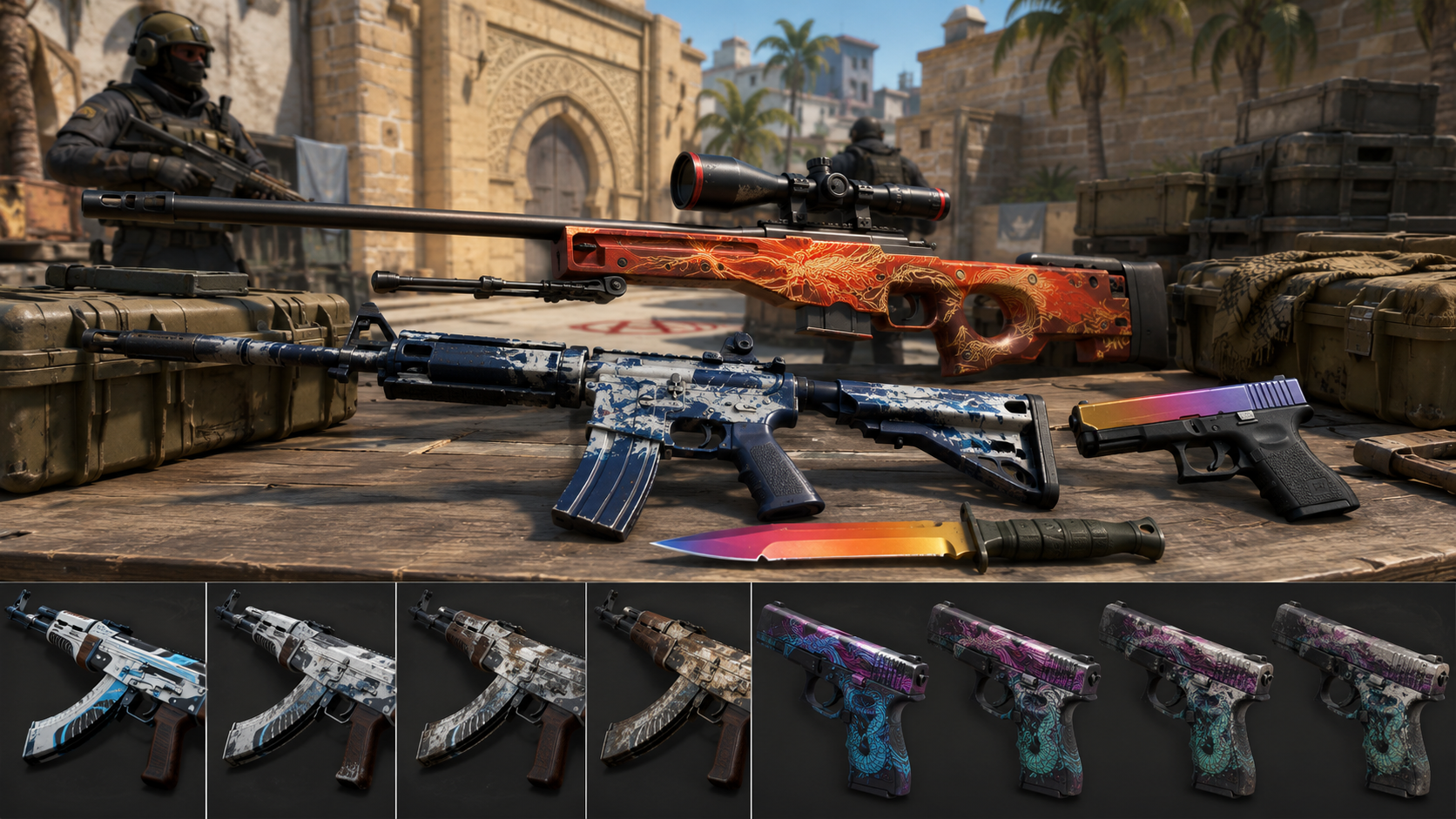
What Are CS2 Skins?
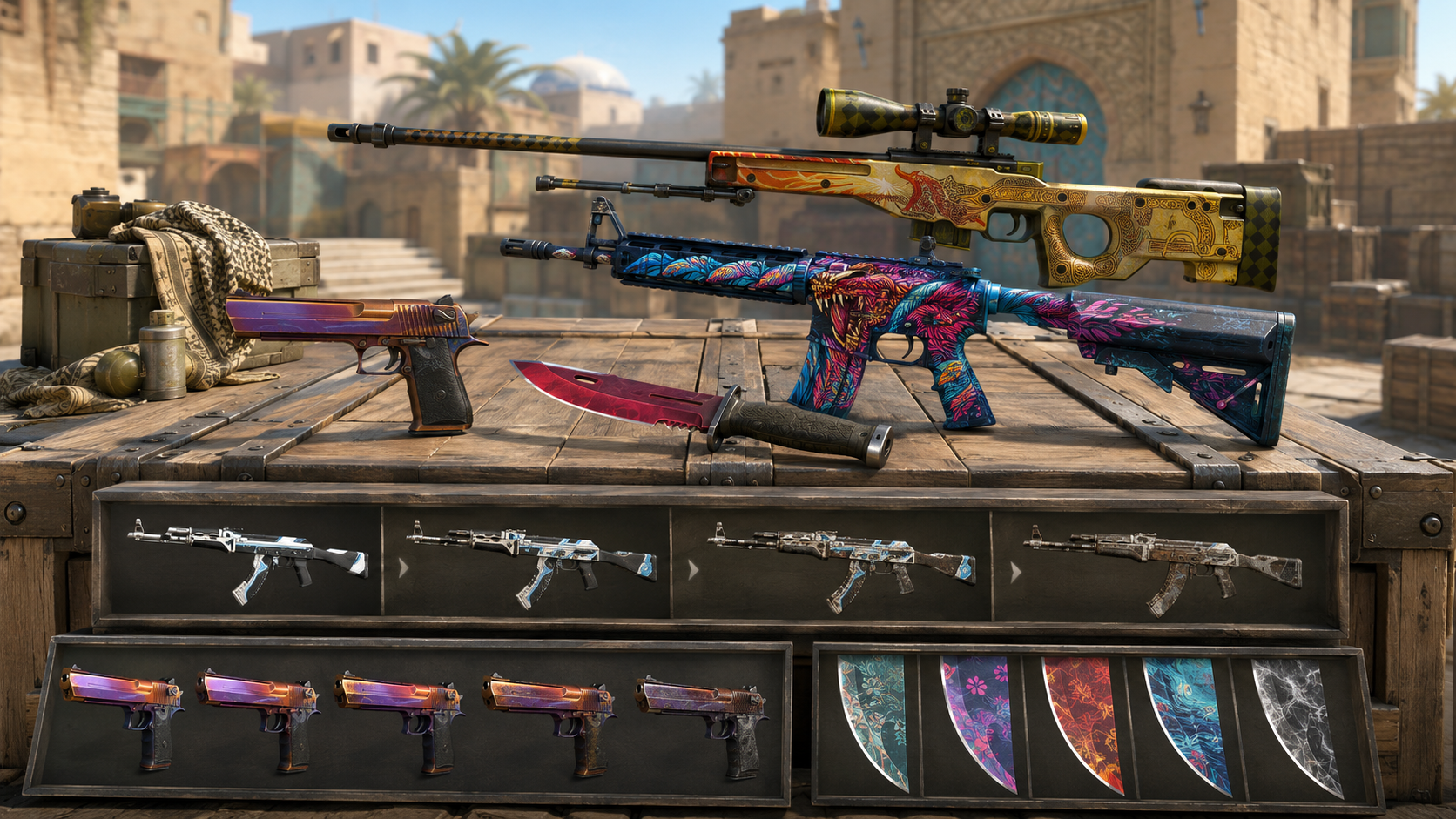
CS2 skins are cosmetic finishes for in-game items. A skin changes appearance but not gameplay power. If two players use the same in-game weapon type, one with a skin and one without, the competitive behavior is the same. The skin is visual.
Skins exist across many item types, including rifles, pistols, SMGs, shotguns, machine guns, knives, gloves, stickers, agents, patches, cases, and other inventory items. This guide focuses mainly on weapon finishes because floats and patterns are easiest to understand there.
A skin has a name and usually belongs to a collection or case. For example, a skin may come from a specific case, map collection, operation-style collection, or event-related drop pool. This origin can affect availability and demand. Some items are common and easy to find. Others are rare, discontinued, or tied to specific collection history.
Skins are stored in your Steam inventory. Some can be sold on the Steam Community Market. Some can be traded. Some may be temporarily restricted from trading or marketing depending on how they were acquired, Steam account security, trade protection, market restrictions, or other Steam rules.
For beginners, the best way to think about skins is simple: they are collectible cosmetics. Some players collect by color theme. Some collect by favorite map. Some collect by favorite in-game item. Some build sticker crafts. Some care about rare patterns. Some just want a clean-looking loadout without spending much. There is no single correct way to enjoy skins.
The only bad way to approach skins is blindly: buying without understanding float, trusting strangers, gambling with cases or external sites, clicking suspicious links, or treating cosmetics as guaranteed profit. Skins can be fun, but they should be handled carefully.
Do CS2 Skins Affect Gameplay?
No. CS2 skins do not increase damage, reduce recoil, improve accuracy, change movement speed, or give direct competitive power. They change appearance. A skin can feel satisfying, and confidence can matter mentally, but the game mechanics do not become stronger because of a cosmetic item.
This matters because beginners sometimes think expensive skins are linked to skill. They are not. A player with a simple inventory can have excellent crosshair placement, strong movement, and good utility. A player with a rare inventory can still make basic mistakes. The scoreboard is decided by gameplay, not cosmetics.
That said, skins can affect personal enjoyment. If a clean visual setup makes you enjoy the game more, that can be part of your experience. Some players like matching colors across their loadout. Others like bright skins that stand out. Others prefer dark, subtle, simple finishes. Some players enjoy inspecting items between rounds. That is all fine as long as it stays healthy and controlled.
BoostRoom’s advice is simple: use skins as motivation, not distraction. A nice inventory can make CS2 feel more personal, but it will not replace practice. If your goal is to rank up, focus first on warm-up, aim routine, movement, map knowledge, economy, and communication. Skins are the style layer. Skill is the performance layer.
The Most Important Skin Terms for Beginners
Before learning floats and patterns in detail, beginners should understand the core vocabulary.
Skin:
A cosmetic finish applied to an in-game item.
Wear:
The general condition category of a skin, such as Factory New, Minimal Wear, Field-Tested, Well-Worn, or Battle-Scarred.
Float value:
The specific decimal number that represents how worn a skin is. Lower usually means cleaner. Higher usually means more worn.
Pattern seed:
A number that affects how the artwork or texture is placed on certain skins. Some skins are very pattern-dependent, while others barely change.
Rarity tier:
The color-coded rarity level of a skin, such as Consumer Grade, Industrial Grade, Mil-Spec, Restricted, Classified, Covert, and special rare items.
StatTrak:
A special version of some skins that tracks in-game eliminations made with that item by its current owner.
Souvenir:
A special version of a skin connected to professional event drops or packages, usually with special stickers or event markings.
Sticker craft:
A skin customized with stickers. Sticker placement, sticker rarity, and visual matching can affect appeal.
Marketable:
An item can be listed on the Steam Community Market.
Tradable:
An item can be traded with another Steam account once any restrictions are gone.
Trade hold / market hold / restriction:
A Steam security or timing delay that prevents instant movement, sale, or trade of some items.
These terms are the foundation. Once you understand them, skin listings become much easier to read.
How CS2 Wear Levels Work
Wear level is the visible condition category of a skin. It tells you roughly how clean or worn the skin looks. CS2 uses five main wear categories for most weapon finishes:
Factory New:
Usually the cleanest category. These skins often show minimal scratches, fading, or wear.
Minimal Wear:
Still clean, but with slightly more visible wear than Factory New.
Field-Tested:
A middle wear category. Many Field-Tested skins are popular because they can look good while costing less than cleaner versions.
Well-Worn:
More visible wear, scratches, fading, or darkness depending on the skin.
Battle-Scarred:
Usually the most worn category. Some Battle-Scarred skins look heavily scratched or faded, while others develop a unique style that some players like.
Wear category is useful, but it is not precise enough by itself. A low-float Field-Tested skin can look much cleaner than a high-float Field-Tested skin. That is why float value matters.
CS2 Float Values Explained
Float value is the specific wear number assigned to a skin. It usually ranges from 0.00 to 1.00. Lower float generally means the skin appears cleaner. Higher float generally means the skin appears more worn.
The standard wear ranges are commonly understood as:
Factory New: 0.00 to 0.07
Minimal Wear: 0.07 to 0.15
Field-Tested: 0.15 to 0.38
Well-Worn: 0.38 to 0.45
Battle-Scarred: 0.45 to 1.00
This means two skins can both be Field-Tested but still look different. A 0.16 Field-Tested item is close to Minimal Wear. A 0.37 Field-Tested item is close to Well-Worn. Both may show the same wear category name, but the float tells the more accurate story.
Float is usually assigned when the item is created through a drop, case opening, trade-up, or similar system. Once assigned, the float does not decrease from playing. A skin does not get more worn because you use it in matches. This is a common beginner myth. Your skin does not become Battle-Scarred after enough games. The float is fixed.
Beginners should always inspect or check the float before comparing skins. The name and wear label are not enough. A better float can affect appearance, demand, and sometimes price. But lower float is not always automatically the best choice for every player. Some skins look nearly identical across wear levels. Others change dramatically. The smart beginner looks at the item, not only the label.
Why Float Does Not Always Mean the Same Thing on Every Skin
Float affects different skins in different ways. Some skins show scratches clearly as float increases. Others mainly become darker, duller, or faded. Some finishes wear down to the base material. Others retain much of their design even at higher floats. This happens because skins use different finish styles and material rules.
For beginners, this creates an important lesson: do not judge every skin by the same float logic. On one skin, the difference between 0.12 and 0.22 might be obvious. On another skin, the difference may be barely noticeable in normal gameplay. Some Battle-Scarred skins look rough in a stylish way. Some Field-Tested skins look almost clean. Some Minimal Wear versions cost much less than Factory New while looking close enough for most players.
This is why inspecting matters. A skin’s category gives you a general idea. Float gives you a precise number. But your eyes should make the final judgment. If a cheaper version looks good to you, it may be the better beginner choice.
BoostRoom’s practical advice is to avoid buying purely because of the cleanest label. Many players overspend for a condition difference they barely notice in actual matches. Learn how the specific skin wears before making a choice.
What Are Float-Capped Skins?
Not every skin can exist across the full 0.00 to 1.00 float range. Some skins have restricted float ranges, often called float caps. That means a skin may not be available in every wear condition.
For example, if a skin’s minimum possible float is higher than the Factory New range, then a Factory New version cannot exist. If a skin’s maximum possible float is low, it may not exist in Well-Worn or Battle-Scarred. This is why beginners sometimes search for a condition that does not appear on the market. It may not exist for that item.
Float caps can also affect rarity. If a skin has a very narrow range, certain conditions may be more common or impossible. If a skin has a minimum float just above a category boundary, some wear labels may never happen. This is why checking the specific skin’s float range is important before assuming a missing condition is rare or hidden.
For beginners, the simple rule is: some skins cannot exist in all wear levels. Before chasing a specific condition, confirm whether that condition is possible.
What Are CS2 Patterns?
Pattern refers to how a skin’s artwork, colors, or texture are placed on the item. A pattern seed is the number that controls this placement for pattern-based skins. Some skins look almost the same regardless of pattern. Others can look very different from one pattern seed to another.
Pattern is separate from float. Float controls wear. Pattern controls placement. Two items can have the same skin name and the same float but different pattern seeds, causing different color distribution or artwork placement.
Pattern matters most on skins where the design is not fixed in exactly the same place every time. The most famous examples include pattern-dependent finishes where certain color areas or artwork placements are more desirable. Beginners often hear terms like “Blue Gem” because some Case Hardened-style patterns can show more blue in valuable locations. Other pattern-based skins have rare placements, centered artwork, special color distribution, or cleaner visual balance.
The important beginner lesson is not to memorize every rare pattern immediately. The important lesson is to know that pattern can matter. If a skin is known for pattern variation, inspect it before buying or trading. Do not assume every item with the same name is equal.
Float vs Pattern: The Simple Difference
Float and pattern are different systems.
Float answers:
How worn is the skin?
Pattern answers:
Where is the design placed?
A low-float skin can still have an ordinary pattern. A high-float skin can have a desirable pattern. A skin can be valuable because of float, pattern, stickers, rarity, or a combination of all of them.
For example, a clean-looking skin might be desirable because it has a very low float. A pattern-based skin might be desirable because its artwork placement is rare. A sticker craft might be desirable because the applied stickers are visually matched or historically interesting. A Souvenir skin might be desirable because of event connection. A StatTrak item might be desirable because some players like tracked eliminations.
Beginners should avoid the mistake of thinking there is one single value factor. CS2 skins are visual collectibles, and different collectors care about different details. For normal players, the easiest approach is to ask: do I like how it looks in-game, and am I comfortable with the price?
How Pattern Seeds Work
A pattern seed is a number that helps determine how the texture or artwork is placed on certain skins. Pattern seeds are often discussed as numbers from 1 to 1000 or 0 to 1000 depending on tool and context. The exact seed can matter on pattern-heavy skins, but many skins are not strongly affected.
For pattern-dependent skins, collectors may search for specific seeds because those seeds create desirable appearances. A pattern may place a bright color on the most visible side. Another pattern may place a special artwork element in the center. Another may create a cleaner or rarer look.
For non-pattern-dependent skins, the pattern seed may not matter much. Some skins use fixed artwork or finish styles where variation is small or not important for normal players. Beginners should not pay extra for a pattern unless they understand why the pattern matters.
A safe beginner rule: if you do not know why a pattern is special, do not pay a special-pattern price. Inspect first, compare examples, and avoid rushing.
CS2 Skin Rarity Tiers Explained
CS2 skins also have rarity tiers. Rarity is usually color-coded and helps show how uncommon an item is within its source system.
Common weapon skin rarity tiers include:
Consumer Grade:
Usually the lowest rarity tier for many collection skins.
Industrial Grade:
Still relatively common, often simple or lower-tier collection items.
Mil-Spec:
A common case rarity tier and a popular starting point for many players.
Restricted:
Less common than Mil-Spec.
Classified:
Higher rarity and usually more expensive than lower tiers from the same case.
Covert:
One of the highest regular weapon skin tiers.
Special Rare Items:
Knives and gloves fall into special rare categories when obtained from certain cases.
Rarity does not automatically mean a skin looks better. Some lower-tier skins look excellent. Some high-rarity skins are expensive because of rarity, not because every player likes the design. Beginners should choose based on taste and budget, not only rarity color.
Rarity affects supply, but demand also matters. A popular skin for a popular in-game item can cost more than a rarer skin that fewer players want. Item popularity, collection history, float, pattern, and stickers can all influence demand.
What Are Collections and Cases?
Skins usually come from sources such as cases, collections, drops, event packages, or operation-style content. A case contains a set of possible items. A collection is a themed group of skins. Some collections are tied to maps or events. Some cases stay popular because they contain desirable rare items or iconic designs.
Beginners should understand the difference between owning skins and opening cases. Buying a specific skin means you choose the exact item you want. Opening a case is randomized. Randomized openings can be exciting, but they can also lead to spending more than expected and usually do not guarantee the item you want.
For safety, beginners should treat case opening as risky entertainment, not a smart way to get skins. If you want a specific skin, direct purchase through legitimate platform systems is usually easier to understand than chasing random outcomes. Avoid skin gambling, betting, and case-opening sites outside Steam. These can create financial risk, scams, and unhealthy habits.
Skins should be fun cosmetics, not pressure. Set a budget, stay within it, and never spend money you cannot afford to lose.
StatTrak Skins Explained
StatTrak is a special feature available on some skins. A StatTrak item tracks in-game eliminations made with that item by the current owner. Many StatTrak skins include a small counter display on the item.
StatTrak versions are often more expensive than non-StatTrak versions of the same skin because some players like the tracking feature. However, not everyone prefers StatTrak. Some players like the cleaner look of normal skins. Others like seeing the number grow over time. It is personal preference.
Beginners should know that StatTrak count is tied to use by the owner and does not make the item stronger. It is cosmetic and personal. A high StatTrak count may be meaningful to the owner, but it does not improve gameplay. If you trade or sell a StatTrak item, understand how the counter and item history work within the game’s systems before assuming value.
A smart beginner choice is to buy StatTrak only if you actually enjoy the feature. Do not pay extra just because it sounds premium.
Souvenir Skins Explained
Souvenir skins are special versions of skins connected to professional event packages or event drops. They often include special stickers or event-related details. Souvenir items can appeal to collectors because they connect to tournament history, teams, players, maps, or specific events.
Souvenir does not mean automatically valuable. Some Souvenir items are common. Others are more desirable because of skin, collection, event, sticker combination, condition, or rarity. Like other skins, float and appearance still matter.
Beginners should inspect Souvenir items carefully. Stickers can affect appearance. Some players like the event history. Others prefer normal versions because they want different sticker crafts. There is no universal best choice.
If you are new, do not buy a Souvenir item only because the word sounds rare. Look at the skin, wear, float, stickers, source, and your own taste. Collecting should be informed and comfortable.
Stickers and Sticker Crafts
Stickers are cosmetic items that can be applied to skins. They can represent teams, events, designs, logos, autographs, or artistic graphics. Stickers can change the look of a skin dramatically.
A sticker craft is the combination of a skin and stickers. Some crafts are simple color matches. Others are expensive because the stickers are rare, old, event-linked, or visually famous. Sticker placement matters because CS2 items have specific sticker slots. The same sticker can look better or worse depending on where it is placed.
Beginners should understand that applied stickers usually do not add their full separate market price to a skin. A skin with expensive stickers is not automatically worth the skin price plus every sticker’s full price. The value of sticker crafts depends on demand, placement, skin choice, sticker condition, theme, and buyer interest.
If you want to make your own craft, start small. Use affordable stickers. Match colors. Inspect the result before applying. Once a sticker is applied, decisions may not be reversible in the way beginners expect. Do not apply expensive stickers unless you fully understand the result.
How Stickers Wear and Scrape
Stickers can be scraped to change how they look. Scraping can make a sticker appear worn, damaged, or partially removed. Some players use scraping creatively to create a specific visual style. Others avoid it because they want stickers to stay clean.
Beginners should be careful with scraping. Do not scrape rare or expensive stickers casually. Do not scrape because someone told you it will “look better” unless you have inspected examples and understand the risk. Sticker appearance is part of the craft, and changes can affect appeal.
If you want to experiment, use cheap stickers first. Learn how scraping looks. Practice on low-value items before making changes to anything you care about.
Name Tags and Personalization
Name Tags allow players to rename certain in-game items. This is another cosmetic personalization layer. A renamed item can feel more personal, but the custom name usually does not make the item more valuable to other players. In many cases, buyers may ignore the name or prefer no name at all.
Beginners should use Name Tags for fun, not value. Pick something you like, keep it appropriate, and remember that personalization is mostly for your own enjoyment.
How Steam Community Market Works for Beginners
The Steam Community Market is the official Steam marketplace where users can buy and sell certain marketable items using Steam Wallet funds. Not all items are marketable. Market access can be affected by account status, Steam Guard, purchase history, restrictions, holds, and security rules.
A key beginner detail is that Steam Community Market transactions use Steam Wallet. Steam Wallet funds from Market sales are used within Steam and are not treated like normal withdrawable cash. Beginners should avoid thinking of Steam Wallet balance as money they can freely cash out. It is primarily for purchases inside Steam.
Market prices can change. A skin that is popular today may drop later. A skin that is cheap now may rise later. But beginners should not treat skins like guaranteed investments. Cosmetic markets are volatile, and prices can change because of updates, supply, demand, cases, trade-up changes, collection availability, player trends, and outside attention.
The safest beginner mindset is: buy only what you enjoy, with money you are comfortable spending, and do not assume profit.
Tradable, Marketable, and Trade Restrictions
A skin can be tradable, marketable, both, neither, or temporarily restricted. These words matter.
Tradable:
You can send it in a Steam trade when restrictions are gone.
Marketable:
You can list it on the Steam Community Market when restrictions are gone.
Not tradable or not marketable:
The item cannot be traded or sold on the Market, depending on its properties.
Temporary restriction:
Some items have a waiting period before they can be traded or marketed.
Steam also has trade holds, market holds, mobile authenticator rules, account restrictions, and Trade Protection systems. These are designed to reduce fraud and give users more time to notice suspicious activity. Beginners should not try to bypass these restrictions. If an item says it is locked until a certain date, wait.
A common beginner mistake is buying or trading without checking whether an item can be moved later. Always read the inventory labels before making decisions.
Trade Protection and Account Safety
Steam has added security systems around trading, including Trade Protected items for CS2. Trade Protection means certain items received in trade are protected for a period, and there are rules around reversing eligible trades and temporary restrictions afterward.
Beginners do not need to master every technical detail immediately, but they should understand the purpose: item movement is restricted or delayed to reduce damage from account theft and scams. This can be annoying when you want to trade quickly, but it also adds protection.
Account safety matters because CS2 inventories can attract scammers. Secure your Steam account with Steam Guard Mobile Authenticator, use strong unique passwords, avoid suspicious links, never share Steam Guard codes, never share API keys, and carefully confirm trade details. Steam Support warns about confidence scams and trade scams because attackers often impersonate trusted people, fake support, fake trading services, or urgent security messages.
The safest trading habit is slow verification. If someone pressures you to act fast, that is a warning sign.
Common CS2 Skin Scams Beginners Must Avoid
Scams are one of the biggest dangers for beginners. Many scams target players who do not yet understand floats, patterns, trades, or Steam security.
Fake Steam login pages:
A scammer sends a link that looks like Steam but is not. If you log in, they may steal your account information.
Fake support messages:
Someone claims your account is in trouble and says you must trade items for safety. Real Steam Support will not ask you to trade skins to a “safe account.”
API key scams:
Attackers may use stolen login access and API key tricks to manipulate trade offers. Most normal players do not need to create or share Steam Web API keys.
Middleman scams:
A stranger claims to be a trusted middleman. Beginners should avoid this. Use official systems and never trust random intermediaries.
Pattern check scams:
Someone says they need you to log into a site to check float or pattern. Many fake sites use this as phishing bait.
Overpay pressure scams:
A stranger offers a suspiciously high value but requires unusual steps first. If it sounds too good to be true, be careful.
Trade swap scams:
A scammer may change an item in a trade window or use a similar-looking item. Always confirm item name, wear, float, stickers, and details before accepting.
Gambling and betting sites:
Avoid skin gambling, betting, roulette, jackpot, coinflip, and case-opening sites outside the official game systems. They can be risky, manipulative, and unsafe, especially for younger players.
The best rule is simple: never click links from strangers, never rush trades, never share login details, and never treat skins as free money.
Cases, Randomness, and Safe Spending
Cases are a major part of CS2 skin culture, but beginners should approach them carefully. Opening cases is randomized. You pay for a chance at an item, not a guarantee of the skin you want. This can feel exciting, but it can also lead to overspending.
For beginners, the safest approach is to avoid chasing rare items through repeated case openings. If you want a specific skin, it is usually clearer to compare existing listings and choose the item directly from legitimate systems. Randomized openings can become expensive quickly, especially if you keep trying to “make back” previous spending.
Set a strict budget. Do not spend money you need for real-life priorities. Do not use skins as gambling. Do not use external case-opening or betting sites. Do not let streamers, clips, or rare opening videos make you think rare outcomes are normal. Highlight videos show exciting moments, not the usual cost behind them.
Skins should be entertainment, not pressure. If spending stops feeling fun, stop.
How to Choose Your First CS2 Skin
Your first skin does not need to be expensive. It should be something you like, understand, and can afford comfortably.
Choose an item you actually use:
If you play a certain rifle, pistol, or SMG often, a skin for that item may feel more enjoyable than a cosmetic for something you rarely equip.
Choose a style you like:
Bright, clean, dark, realistic, colorful, simple, patterned, metallic, or sticker-heavy. Your taste matters more than hype.
Check wear and float:
Compare several listings of the same skin. Look at Factory New, Minimal Wear, Field-Tested, and other conditions to see how much the appearance changes.
Inspect pattern if relevant:
If the skin is pattern-dependent, inspect before buying. Do not assume all patterns look the same.
Avoid overpaying for unknown details:
If you do not understand why a pattern, sticker, or float is special, do not pay extra for it yet.
Start with a safe budget:
There are many good-looking low-cost skins. Beginners do not need expensive items to enjoy customization.
A good first skin teaches you how the system works without creating stress.
Best Beginner Approach to Floats
Beginners should not obsess over the absolute lowest float immediately. Extreme low floats can be rare and expensive. For normal gameplay, you usually want a skin that looks good in your hands and inventory.
A practical beginner approach:
Compare the same skin in different wears.
Open several listings or inspect examples. Look for scratches, color fading, and darkening.
Look for low float within your chosen wear.
A low Field-Tested item may look better than an average Field-Tested item without costing as much as Minimal Wear.
Do not pay for invisible differences.
If two floats look the same to you in-game, do not overspend just because one number is lower.
Understand float caps.
Some skins cannot exist in the condition you expect.
Prioritize appearance over label.
A good-looking Field-Tested skin can be better for you than an overpriced Factory New version.
Float matters, but your eyes matter too.
Best Beginner Approach to Patterns
Beginners should learn patterns slowly. Pattern collecting can get complicated, especially with items where specific seeds are famous or expensive.
A practical beginner approach:
Know whether the skin is pattern-dependent.
If the pattern barely changes the item, do not worry too much.
Inspect the skin in-game.
Look at the visible side, inspect animation, and overall color placement.
Avoid paying rare-pattern prices without research.
Some sellers may claim a pattern is rare. Do not accept that claim without understanding why.
Start with appearance, not rarity.
If you like the pattern, that is enough for normal use. You do not need a famous seed.
Do not confuse pattern with float.
A clean float does not guarantee a desirable pattern. A desirable pattern does not guarantee clean wear.
Pattern knowledge becomes more useful over time. Beginners only need the basics first.
Budget Skins vs Expensive Skins
A skin’s price does not always match how much you will enjoy it. Some budget skins look excellent. Some expensive skins are expensive because of rarity, age, hype, float, pattern, or market conditions, not because every player personally likes them.
Budget skins are great for beginners because they let you explore different styles. You can build a themed loadout without risking too much. You can learn how wear works. You can test stickers. You can discover what colors you like.
Expensive skins require more caution. Before buying something expensive, understand float, pattern, stickers, market restrictions, account security, and long-term risk. Do not buy expensive items because someone pressured you, because a video hyped them, or because you think price will definitely rise.
BoostRoom’s advice is to build skill first and inventory second. A clean budget inventory plus strong gameplay feels better than an expensive inventory with weak fundamentals.
What Makes a Skin More or Less Valuable?
Skin value can be influenced by many factors:
Item popularity:
Skins for commonly used in-game items often get more attention.
Rarity tier:
Higher rarity can mean lower supply.
Case or collection source:
Some sources are more available than others.
Float:
Cleaner or extreme floats can be more desirable.
Pattern:
Certain pattern seeds can be rare or visually preferred.
Stickers:
Rare, old, event-related, or well-matched stickers can affect appeal.
StatTrak or Souvenir status:
Special versions can attract certain buyers.
Visual demand:
Some skins are simply popular because players like how they look.
Market timing:
Updates, case changes, events, and trends can affect prices.
Beginners should remember that value is not fixed forever. Skin prices can move up or down. Never treat cosmetics as guaranteed investments.
Why Skins Do Not Replace Practice
Skins are fun, but they do not fix gameplay mistakes. A new skin will not stop you from dying first, missing counter-strafes, forgetting utility, or forcing bad economy. If you want better CS2 results, practice still matters more.
A strong player with default cosmetics will beat a weak player with rare cosmetics. Aim routine, warm-up, movement, map knowledge, crosshair placement, utility, economy, and communication are the real rank-up tools.
That does not mean skins are bad. They can make the game more enjoyable. They can motivate you to play. They can make your loadout feel personal. But the best mindset is to enjoy skins while still focusing on improvement.
BoostRoom helps players keep that balance. You can enjoy the cosmetic side of CS2 while also building the habits that win ranked matches.
How BoostRoom Helps Beginners Understand CS2 Beyond Skins
BoostRoom is built around helping CS2 players improve with structure. Skins are part of the culture, but performance comes from gameplay. Beginners often get pulled into cosmetics before they understand the basics of ranked improvement. BoostRoom helps players stay focused.
BoostRoom helps with aim and movement:
Better mechanics make every match feel more controlled, no matter what skin you use.
BoostRoom helps with map knowledge:
Knowing where to stand, how to rotate, and how to use utility matters more than inventory value.
BoostRoom helps with economy and decision-making:
Buying correctly in-game wins more rounds than buying expensive cosmetics outside the match.
BoostRoom helps with confidence:
A player who understands both gameplay and CS2 culture feels less lost.
BoostRoom helps beginners avoid distractions:
Skins can be fun, but they should not become the main measure of progress.
A smart CS2 journey includes both enjoyment and improvement. BoostRoom helps players build the improvement side.
Beginner Skin Safety Checklist
Before buying, selling, or trading a CS2 skin, use this checklist.
Do I understand the skin’s wear and float?
Have I inspected the item visually?
Is the pattern important for this skin?
Are there stickers, and do I understand their effect?
Is the item marketable or tradable?
Are there trade or market restrictions?
Am I using official Steam systems or a trusted, safe process?
Did I avoid clicking links from strangers?
Did I check every trade detail before confirming?
Am I spending within a safe budget?
Am I avoiding gambling, betting, and risky case-opening sites?
Do I actually like the skin, or am I buying because of hype?
If you cannot answer these questions, slow down. Skins will still be there later.
Common Beginner Mistakes With CS2 Skins
Mistake 1: Thinking skins improve gameplay
Skins are cosmetic. Skill still decides matches.
Mistake 2: Buying by wear label only
Float matters. A skin’s exact float can affect appearance.
Mistake 3: Ignoring patterns
Some skins can look very different depending on pattern seed.
Mistake 4: Overpaying for stickers without understanding crafts
Applied stickers do not always add full sticker value.
Mistake 5: Trusting strangers in trades
Scammers target beginners. Verify everything.
Mistake 6: Clicking pattern-check links from random users
This is a common phishing setup. Do not log into unknown sites.
Mistake 7: Opening cases to chase one item
Randomized openings can become expensive. Buy directly if you want a specific skin.
Mistake 8: Treating skins as guaranteed investment
Prices can change quickly. Cosmetics are not guaranteed profit.
Mistake 9: Not securing the Steam account
Use Steam Guard and protect login details.
Mistake 10: Spending more than comfortable
A skin is not worth financial stress.
Practical Rules for CS2 Skins Beginners
Rule 1: Skins are cosmetic only.
They change appearance, not competitive power.
Rule 2: Float controls wear.
Lower usually means cleaner, higher usually means more worn.
Rule 3: Wear category is not enough.
Check the exact float before comparing items.
Rule 4: Pattern controls placement.
Some skins are pattern-dependent, others are not.
Rule 5: Inspect before buying.
Your eyes should confirm the item looks good to you.
Rule 6: Start with budget skins.
Learn the system before buying anything expensive.
Rule 7: Avoid gambling and betting sites.
Do not risk your inventory or money chasing random outcomes.
Rule 8: Secure your Steam account.
Use Steam Guard, avoid suspicious links, and never share codes.
Rule 9: Do not rush trades.
Scammers create urgency. Take your time.
Rule 10: Focus on gameplay first.
A better player gets more value from every match than a better inventory alone.
FAQ
What are CS2 skins?
CS2 skins are cosmetic items that change how in-game items look. They do not change damage, accuracy, movement, recoil, or competitive performance.
What is float in CS2 skins?
Float is the specific wear number of a skin, usually from 0.00 to 1.00. Lower float usually means cleaner appearance, while higher float usually means more wear.
What are the CS2 wear levels?
The main wear levels are Factory New, Minimal Wear, Field-Tested, Well-Worn, and Battle-Scarred. Each category corresponds to a float range.
Do CS2 skins wear down over time?
No. A skin’s float does not get worse from playing matches. The wear value is fixed when the item is created.
What is a pattern seed in CS2?
A pattern seed controls how certain skin textures or artwork are placed on the item. Some skins are heavily pattern-dependent, while others barely change.
What is the difference between float and pattern?
Float controls how worn the skin looks. Pattern controls where the design appears. They are separate features.
Are StatTrak skins better?
StatTrak skins are not stronger. They track in-game eliminations made with that item by the owner. Some players like the feature, while others prefer normal skins.