Best CS2 Warm-Up: 10 Minutes Before You Queue
The best CS2 warm-up is not the longest warm-up. It is the warm-up that prepares the exact skills you need in a match. CS2 rewards clean movement, controlled aim, good crosshair placement, calm recoil control, fast but accurate reactions, smart utility, and clear decision-making. If your warm-up only trains random flicks, you may feel fast but still lose real match duels because your movement, angle clearing, and discipline are not ready.
A strong 10-minute warm-up should do five things. It should wake up your hand, remind you to stop before shooting, bring your crosshair back to head level, refresh your spray control, and prepare your mind for ranked pacing. That is enough. You do not need a one-hour routine before every queue. Long routines can be useful for dedicated practice sessions, but a pre-queue warm-up should be short and efficient.
Many players confuse practice with warm-up. Practice is where you build new skills. Warm-up is where you activate skills you already have. If you try to learn a new sensitivity, a new recoil pattern, three new smokes, and a new movement habit right before queueing, you may enter the match thinking too much. A warm-up should make your game simpler, not more complicated.
The best 10-minute CS2 warm-up uses a simple order: first precision, then movement, then recoil, then match-speed duels, then a short mental reset. This order matters. Starting with pure chaos can make you over-flick and rush. Starting with slow precision helps your hand and eyes connect before you add pressure.
BoostRoom helps CS2 players improve by making training more structured. A lot of players play ranked without a routine, then wonder why the first match feels slow. A consistent warm-up gives your brain a clear start signal. When you warm up the same way before queueing, you enter matches with more confidence and less panic.
Why a 10-Minute Warm-Up Works
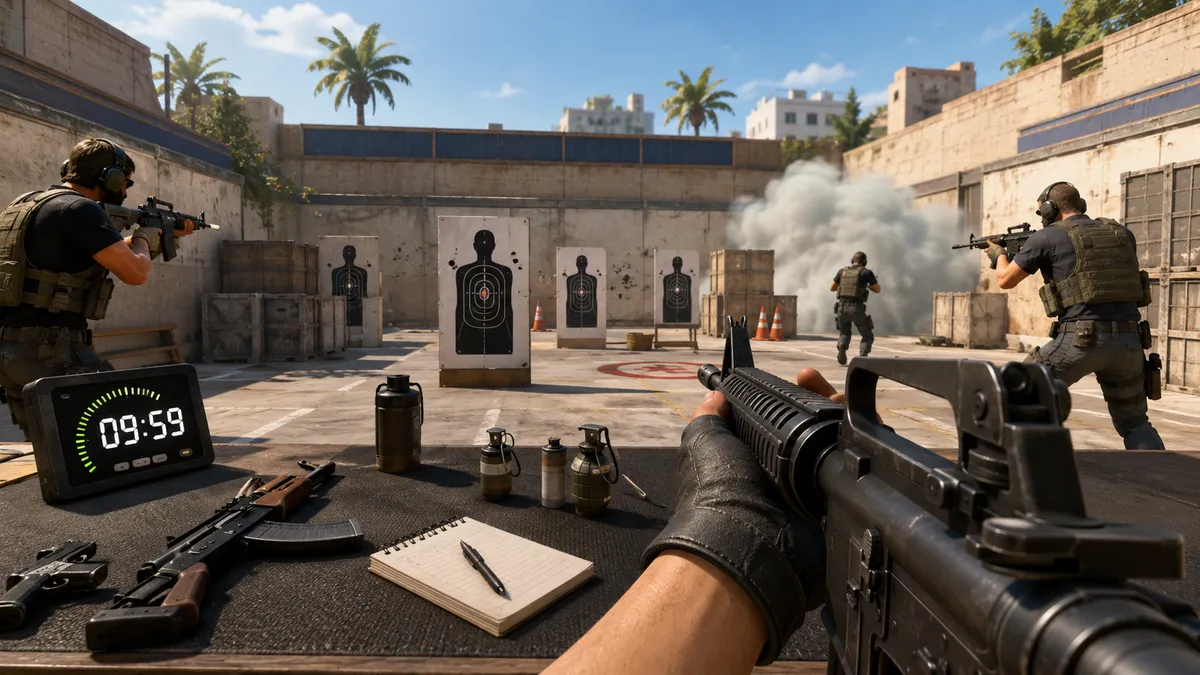
A 10-minute warm-up works because ranked readiness is not about exhausting yourself. It is about switching from normal mode into match mode. Your hand needs to feel comfortable, your eyes need to track targets, and your mind needs to remember the core habits that win duels.
A long warm-up can help if you are doing a serious training session, but it can also hurt if you overdo it before ranked. If you play 45 minutes of intense deathmatch before queueing, your aim may feel sharp at first, but your patience can drop. You may start taking every fight like it is deathmatch. Ranked is different. In ranked, you need timing, sound, utility, economy, patience, and discipline.
A 10-minute routine is long enough to warm up the important mechanics but short enough to avoid fatigue. It also makes the routine easier to repeat. A warm-up only helps if you actually do it consistently. A complicated routine that you skip half the time is not useful.
The goal is simple: start the match already awake. Many players need three or four rounds to feel normal. In CS2, those early rounds matter. Pistol round, second round economy, early gun rounds, and first CT setups can shape the entire half. A good warm-up helps you avoid throwing the first important duels because your hand was cold.
Warm-Up vs Practice: Know the Difference
Warm-up and practice are not the same thing. This is one of the biggest mistakes players make.
Warm-up is preparation:
A warm-up gets you ready for the match you are about to play. It should be short, familiar, and focused on skills you already use. You should finish feeling comfortable, not mentally overloaded.
Practice is improvement:
Practice is where you work on weak skills. That can include long spray training, new utility lineups, prefire routes, movement practice, demo review, deathmatch sessions, or learning new maps. Practice can be longer and more difficult because the goal is growth, not immediate match readiness.
Do not turn warm-up into a test:
If you miss shots during warm-up, it does not mean you will play badly. Warm-up is not a scoreboard. It is a reset. Focus on movement, crosshair placement, and calm shots.
Do not change settings before queueing:
Changing sensitivity, crosshair, resolution, or viewmodel right before ranked can make you uncomfortable. Test changes during practice, not before a real match.
Do not learn new mechanics right before queueing:
Trying a new recoil method or movement trick right before queueing can make you think too much. Warm up with familiar habits.
The best players separate practice from warm-up. They practice to improve over time, then warm up to perform today.
The 10-Minute CS2 Warm-Up Routine
This is the full routine. It is simple, repeatable, and designed for players who want to queue quickly without feeling unprepared.
Minute 0:00–1:00 — Hand and focus reset
Open your game, check that your settings feel normal, and take a few seconds to relax your grip. Your goal is not to squeeze the mouse. Your hand should feel controlled and loose. Move your crosshair around slowly, stop cleanly, and remind yourself that accuracy comes before speed.
Minute 1:00–3:00 — Static aim and head-level precision
Use a bot map, aim trainer, or simple practice environment. Focus on clean head-level taps. Do not spam. Stop, aim, shoot, reset. This wakes up precision and reminds you not to panic-flick.
Minute 3:00–5:00 — Movement and counter-strafing
Practice moving left and right, stopping, and shooting only when accurate. This is one of the most important parts of CS2. Warm-up should remind you that movement and aim are connected.
Minute 5:00–6:30 — Recoil control refresh
Use a recoil practice map or wall practice. Spray short bursts and a few controlled longer sprays with your main in-game rifles. The goal is not to master recoil in 90 seconds. The goal is to remind your hand of the pattern and reset timing.
Minute 6:30–8:30 — Deathmatch or live-duel speed
Play a short deathmatch segment or a bot routine with faster target switching. Focus on real match habits: crosshair placement, stopping before shooting, and clean first bullets. Do not chase score.
Minute 8:30–9:30 — One map-specific action
Refresh one useful grenade, one pre-aim route, one common angle, or one site entry for a map you expect to play. Keep it simple. One useful reminder is enough.
Minute 9:30–10:00 — Mental reset before queue
Stop shooting. Breathe normally, relax your hand, and enter the queue with one goal. Examples: “avoid free first deaths,” “trade teammates,” “use utility early,” or “communicate calmly.” One goal is better than ten.
This routine prepares your mechanics and your mindset without wasting energy.
Minute 0–1: Hand, Grip, and Focus Reset
The first minute is not glamorous, but it matters. Many players start warming up by immediately spraying or flicking as fast as possible. That can create tension. If your grip gets tight before queueing, your aim can feel shaky and your movement can become rushed.
Start by checking that your mouse, keyboard, headset, and game settings feel normal. Do not change anything unless something is clearly wrong. Move your mouse slowly across your mousepad. Make a few small movements, then a few wider movements. Your hand should feel loose. Your wrist and arm should not feel locked.
Then focus on stopping. In CS2, shooting while moving incorrectly can ruin accuracy. Even in warm-up, remind yourself to stop before firing. Move left, stop, place the crosshair, shoot. Move right, stop, place the crosshair, shoot. Do this slowly before adding speed.
This minute also helps your mental state. You are not trying to prove anything yet. You are preparing. A calm start makes the rest of the warm-up more useful.
Minute 1–3: Static Aim and Head-Level Precision
The next two minutes should be simple precision. Use a workshop aim map, bot practice, or any controlled environment where you can shoot targets without match chaos. Aim Botz is popular for this because it gives players a controlled training environment with bots, moving-bot options, armor toggles, peek and spray walls, unlimited ammo settings, and weapon access. The exact tool matters less than the goal: controlled, accurate shots.
For these two minutes, do not spray wildly. Use taps and short bursts. Focus on placing the crosshair at head level before shooting. If your crosshair starts drifting down to the floor or chest level, slow down. The warm-up is already doing its job because it is showing you what to correct.
Use this rhythm: aim, stop, shoot, reset. Try to make every shot intentional. You are not trying to hit the most bots possible. You are trying to wake up clean mechanics.
This part prepares your first bullet accuracy. In ranked, many duels are decided by the first few bullets. If your first bullet is rushed, your whole duel becomes harder. Static precision teaches patience before speed.
A good rule for this section is: no panic shots. If you miss, reset calmly. Warm-up should build control, not frustration.
Minute 3–5: Movement and Counter-Strafing
Movement is one of the most important parts of CS2 warm-up because aim and movement are connected. A player with good aim but poor stopping timing can still lose duels. A player who stops cleanly before shooting will feel much more consistent.
For two minutes, practice side-to-side movement. Move left, stop, shoot. Move right, stop, shoot. Do not hold movement keys while firing. Pay attention to the moment your character becomes accurate. Your goal is to feel the timing between movement and the first shot.
Start slowly. Then increase speed. If your bullets become inaccurate, slow down again. Warm-up is about control first.
You can combine movement with targets. Strafe out, stop, tap a target, move back. This simulates a simple peek without turning the routine into a full prefire practice session.
Focus on these habits:
Stop before shooting:
Your first bullet should happen after your movement stops, not during the slide.
Do not over-swing every target:
Small controlled peeks matter. Not every duel needs a huge wide swing.
Keep crosshair at head level while moving:
Many players aim correctly while standing still but drop their crosshair while moving. Fix that during warm-up.
Reset after every shot:
Do not let one miss turn into five rushed shots.
This section makes your ranked duels feel cleaner because it connects your hands, movement, and timing.
Minute 5–6:30: Recoil Control Refresh
Recoil control should be part of the warm-up, but it should not dominate the entire routine. You only have 10 minutes, so spend about 90 seconds refreshing recoil with your main in-game rifles and common buys.
Recoil Master is a popular CS2 Workshop map for spray practice because it includes ghosthair and spray-pattern training, automatic reset options, different ranges, and weapon practice tools. It is useful for dedicated recoil practice, but in a pre-queue warm-up you should keep it short.
Start with short sprays. Fire 5–8 bullets, reset, and repeat. Then do a few longer sprays. Focus on control and reset timing. You do not need to spray full magazines every time. In real matches, many fights are won with taps, bursts, and controlled sprays, not endless spraying.
Practice the weapons you actually use. If you normally rifle, warm up your main rifles. If you often play SMGs in anti-eco rounds, add a short burst with one common SMG. If you often use pistols, include a few clean pistol shots earlier in the precision section.
Since CS2 updates can change gameplay details over time, always think of recoil warm-up as a current-feel check. You are reminding your hand how the game feels today.
The goal is not to become a recoil master in 90 seconds. The goal is to avoid entering ranked with your spray feeling completely cold.
Minute 6:30–8:30: Deathmatch or Live-Duel Speed
Now add pressure. For two minutes, use deathmatch, fast bot switching, or another live-duel style routine. This is where you warm up reaction timing and target transitions.
Deathmatch is useful because it gives unpredictable fights. However, it can also teach bad habits if you treat it like a scoreboard. Do not care about your deathmatch score. Do not chase every sound. Do not sprint around spraying because it feels exciting. Use deathmatch to practice match habits.
Focus on three things:
Crosshair placement:
Keep your crosshair where an enemy head would appear, not at the floor, not at random walls, and not too far from the angle.
Stopping before shooting:
Even in deathmatch, do not skip movement discipline. If you warm up bad movement, you may bring bad movement into ranked.
Clean first bullets:
Try to win fights with controlled first shots instead of panic sprays.
If deathmatch makes you angry, skip it and use a faster bot routine instead. The purpose of warm-up is readiness. If a tool makes you tilt before queueing, it is the wrong tool for that moment.
Two minutes is enough to raise your speed without draining your focus.
Minute 8:30–9:30: One Map-Specific Reminder
The final practice minute should connect your mechanics to real CS2 maps. Aiming well is useful, but ranked rounds are played on maps with angles, utility, timings, and positions. Use this minute to refresh one practical map action.
Choose only one of these:
One smoke:
Refresh a smoke you commonly use in ranked. Examples include a site-entry smoke, mid-control smoke, or defensive delay smoke.
One flash:
Practice a flash that helps a teammate entry or stops a rush.
One pre-aim route:
Move through a small part of a map and pre-aim common angles.
One retake idea:
Think through where enemies usually hold after planting and how you would clear the site.
One CT anchor setup:
Remind yourself what angle you will hold and where you will fall back if pressured.
This section prevents your warm-up from becoming pure aim training. CS2 is not only about clicking targets. It is about applying aim inside map structure.
Yprac-style tools and Workshop training collections can be useful for map practice because they include modes for aim, movement, utility, prefire, and map awareness. For a 10-minute warm-up, you do not need to run a full map course. Just refresh one useful action.
Minute 9:30–10:00: Mental Reset Before Queue
The final 30 seconds may be the most underrated part of the warm-up. Stop shooting. Relax your hand. Take your fingers off the keys for a moment. The goal is to leave practice mode and enter match mode.
Pick one ranked focus for the match. Do not pick five. One is enough.
Good focus examples:
“Avoid free first deaths.”
This helps you stop taking low-value early fights.
“Trade teammates.”
This keeps you close enough to create impact.
“Use utility before entering.”
This reminds you not to dry swing every angle.
“Call calmly.”
This helps solo queue communication.
“Buy with the team.”
This prevents economy mistakes.
“Play for the round, not the scoreboard.”
This stops you from chasing low-impact fights.
A short mental reset helps because many players enter ranked still thinking like they are in deathmatch. Ranked needs patience. You want to start the match ready to think, not only ready to shoot.
Best Tools for a 10-Minute CS2 Warm-Up
You can warm up in several ways. The best tool is the one you use consistently and correctly.
Aim Botz:
Aim Botz is useful for static aim, target switching, head-level precision, and simple warm-up shots. Its CS2 Workshop version includes training options such as moving bots, armor toggles, peek and spray walls, unlimited ammo options, weapon access, and configurable map sections.
Recoil Master:
Recoil Master is useful for spray control. Its CS2 Workshop version includes ghosthair and spray-pattern practice, reset options, different ranges, and settings like infinite ammo and no spread. It is best for recoil refresh and longer dedicated recoil sessions.
Yprac-style practice maps:
Yprac Hub and similar CS2 practice tools are useful for aim, reaction speed, movement, utility drills, and map practice. They are especially helpful when you want to learn prefire routes or utility outside of ranked.
Deathmatch:
Deathmatch is useful for live-duel speed, target switching, and reaction warm-up. It should be used carefully before queueing because it can make some players impatient.
Offline map practice:
Loading into a map alone can be useful for one smoke, one route, one pre-aim path, or one retake idea. This is great when you want a calm warm-up.
Do not think you need every tool every day. A strong warm-up can be built from one aim tool, one recoil tool, and a short deathmatch or map reminder.
The Best Warm-Up for Aim
Aim warm-up should be simple. You are not trying to build your entire aim skill in 10 minutes. You are waking it up.
Start with slower shots. Make sure your crosshair is placed properly. If you start by flicking wildly, your hand may become tense. Slow precision teaches your eyes to find the target and your hand to stop cleanly.
Then add small target switches. Move from one target to another with control. Do not overshoot every movement. If your sensitivity feels too fast during warm-up, do not instantly change it. Slow down and focus on control.
End aim warm-up with a little speed. This can be deathmatch or faster bot shots. But speed should come after precision. If you reverse the order, you may enter ranked feeling fast but inaccurate.
Good aim warm-up is not about hitting crazy highlights. It is about making normal shots feel automatic.
The Best Warm-Up for Crosshair Placement
Crosshair placement is one of the most important warm-up skills because it reduces how much you need to flick. A player with strong crosshair placement often looks faster because their aim is already close to the target.
During warm-up, keep your crosshair at head level. When you move between targets, do not let the crosshair drop. When you strafe, do not look at the ground. When you clear angles, imagine where the opponent’s head would appear.
Leetify’s performance metrics include crosshair placement as a measured concept, described around how far the crosshair is from the opponent when they are spotted before the shot. That idea is useful for warm-up: the closer your crosshair starts to the target, the less correction you need.
To warm up crosshair placement, move through a map or practice environment slowly and pre-aim common angles. Do not rush. The goal is to make your crosshair feel attached to likely enemy positions.
A simple habit: every time you catch yourself aiming at nothing, correct it. Warm-up is the best time to rebuild that discipline.
The Best Warm-Up for Movement
Movement warm-up is about accuracy timing. CS2 is not a game where you should run and shoot randomly. You need to move, stop, and fire with control.
Practice counter-strafing in a simple way. Move left, stop, shoot. Move right, stop, shoot. Then combine it with a target. Strafe out from cover, stop, shoot, return. Repeat.
Do not overcomplicate movement warm-up. You do not need advanced movement tricks before every queue. You need your basic stopping timing to feel clean.
Movement warm-up also helps with peeking. Many players lose fights because they peek too wide, stop too late, or shoot before accuracy returns. A two-minute movement section can fix a lot of first-match awkwardness.
The goal is to enter ranked with your movement and aim connected. If those two feel separate, your duels will feel inconsistent.
The Best Warm-Up for Recoil
Recoil warm-up should be short and focused before queueing. Long recoil practice is useful, but not necessary every time.
Use a wall, Recoil Master, or a controlled practice map. Fire short bursts first. Then fire a few longer sprays. Watch whether your bullets stay controlled. Reset after each spray.
Focus on common situations:
Short burst:
Useful for medium-range fights where full spray is not needed.
Ten-bullet control:
Useful for many rifle fights where the first burst does not finish the duel.
Spray transfer feeling:
Useful if you often fight multiple targets, but keep it controlled.
Reset timing:
Know when to stop shooting and let accuracy recover.
Avoid spraying endlessly until your hand gets tired. Warm-up recoil is a reminder, not a workout.
The Best Warm-Up for Pistol Rounds
Pistol round matters because it can shape early economy. You do not need a long pistol routine, but you should include a few pistol shots during your warm-up.
Practice clean taps. Focus on movement, stopping, and head-level crosshair placement. Do not spam every shot as fast as possible. Pistol fights reward calm accuracy, especially in the first few bullets.
Add a few side-to-side movement shots. Strafe, stop, tap. Repeat. This helps you avoid panic shooting in pistol round.
If you often miss pistol shots because you rush, your warm-up goal should be patience. If you often aim too low, your goal should be head level. If you often stand still too long, your goal should be small movement and clean stopping.
One minute of pistol awareness can make your first round feel much better.
The Best Warm-Up for Rifles
Rifle warm-up should include taps, bursts, and controlled sprays. Do not practice only one style. CS2 rifle fights change depending on distance, enemy movement, and map position.
Start with taps at head level. Then use two- to four-bullet bursts. Then use a few controlled sprays. This mirrors real matches better than only spraying.
Use your main rifle choices. If you are likely to play both T and CT sides, warm up both common rifle feelings. The goal is not to compare them. The goal is to make both feel familiar before queueing.
Rifle warm-up should also include movement. A rifle shot after a clean stop is very different from a rifle shot while still moving. Train the correct habit.
A good rifle warm-up makes your first gun round feel natural instead of awkward.
The Best Warm-Up for AWP Players
If you use the AWP in CS2, your warm-up should include a small amount of scoped timing, flick control, and repositioning. Keep it short if you are only doing a 10-minute routine.
Practice holding an angle, unscoping or repositioning, then holding another angle. Do not only practice flashy flicks. Real AWP impact often comes from positioning, timing, and not over-peeking.
Practice a few shots after movement. Move, stop, scope, shoot. Make sure you are not rushing the shot before you are ready.
Also practice patience. AWP players often lose value when they re-peek too much after being spotted. During warm-up, remind yourself that one good shot and reposition can be better than chasing another duel.
If you are not planning to AWP in the match, do not spend half your warm-up on it. Warm up what you will actually use.
Deathmatch Warm-Up: How to Use It Correctly
Deathmatch is one of the most common warm-up tools, but many players use it badly. They chase score, get annoyed by spawns, spray constantly, and enter ranked tilted.
Use deathmatch with a purpose. Two to five minutes can be useful. More is optional, but be careful not to burn out.
Good deathmatch habits:
Ignore score:
Score does not matter. Ranked impact matters.
Practice head-level crosshair placement:
Do not run around with your crosshair low.
Stop before shooting:
Do not warm up bad movement.
Take realistic fights:
Do not only chase chaotic fights that never happen in ranked.
Reset after deaths:
Deathmatch deaths are not important. Do not tilt from them.
Leave while you feel sharp:
Do not keep playing until your hand feels heavy.
Deathmatch should make you ready, not angry.
Warm-Up Mistakes That Hurt Your Ranked Matches
A bad warm-up can make your ranked match worse. Avoid these common mistakes.
Mistake 1: Warming up too long
If you warm up until you are tired, your first match may feel worse. Stop when you feel ready.
Mistake 2: Only flicking
Flicks are useful, but CS2 also needs crosshair placement, movement, recoil, and decision-making.
Mistake 3: Ignoring movement
Aim without stopping timing is inconsistent. Always include movement.
Mistake 4: Chasing deathmatch score
Deathmatch score does not matter. Do not turn warm-up into ego practice.
Mistake 5: Changing settings before queue
Do not change sensitivity, crosshair, or resolution right before ranked unless something is broken.
Mistake 6: Practicing new utility under pressure
Learn new lineups during practice, not during your pre-queue warm-up.
Mistake 7: Entering queue tilted from warm-up
If a warm-up tool frustrates you, change the tool or reduce the time.
Mistake 8: Skipping the mental reset
Ranked is not deathmatch. Take a few seconds to switch into match mode.
Warm-Up for Low-End PCs
If your PC struggles with CS2, your warm-up should also check smoothness. A warm-up is a good time to notice stutter, FPS drops, or input delay before you queue.
Start with a light practice map or offline environment. Move around, shoot, and check whether the game feels stable. If the game stutters badly, avoid jumping straight into ranked until you fix the issue.
Low-end PC warm-up should be simple. Do not load extremely heavy maps if they make performance worse. Use a stable environment that lets you focus on mechanics.
In deathmatch, FPS may be more demanding because many players and effects appear at once. If deathmatch runs poorly, use bots or offline practice instead. A smooth warm-up is better than a chaotic one with bad performance.
The goal is confidence. If your setup feels unstable, ranked will feel stressful before the match even starts.
Warm-Up for High-End PCs
If your PC runs CS2 smoothly, your warm-up should still focus on discipline. High FPS does not automatically create good mechanics. It only gives you a better environment to perform.
Use your stable setup to practice clean movement and aim. Do not overuse speed just because the game feels smooth. Many high-FPS players still lose duels because they over-peek, shoot before stopping, or ignore crosshair placement.
A high-end setup is useful for deathmatch because the experience may feel smoother under pressure. But the same rule applies: do not chase score. Use the smoothness to practice real match habits.
Good hardware helps, but warm-up still needs structure.
Warm-Up for Beginners
Beginners should keep the warm-up even simpler. Do not try to do everything. Focus on the fundamentals that appear in every round.
Beginner 10-minute routine:
Two minutes of head-level taps
Use bots or a practice map. Aim at head level and shoot slowly.
Two minutes of movement stops
Move left and right, stop, shoot. Learn accuracy timing.
Two minutes of short bursts
Practice short controlled rifle bursts.
Two minutes of simple deathmatch or fast bots
Add a little pressure without caring about score.
One minute of one grenade or map angle
Learn one useful map action.
One minute of mental reset
Choose one focus, such as “do not die first for free.”
Beginners should not worry about advanced routines. The best beginner warm-up builds consistency.
Warm-Up for Intermediate Players
Intermediate players usually understand the basics but need consistency. Your warm-up should focus on reducing sloppy habits.
Intermediate goals:
Tighter crosshair placement
Your crosshair should already be near the target before the duel starts.
Better counter-strafing
Your first bullet should be accurate more often.
Cleaner burst control
Do not turn every missed shot into a panic spray.
Useful utility reminder
Refresh one grenade that helps a real ranked situation.
Better mental start
Avoid entering queue frustrated or distracted.
Intermediate players benefit most from repeating the same routine daily. Consistency is the point.
Warm-Up for Advanced Players
Advanced players should use the 10-minute warm-up as a performance activation routine. The goal is not to learn basics. The goal is to sharpen timing and decision quality.
Advanced warm-up can include:
Precision under speed
Targets should be hit quickly but without sloppy movement.
Micro-corrections
Small aim adjustments matter more than huge flicks.
Short recoil refresh
Spray only enough to check control.
Map-specific pre-aim
Refresh a route or timing for likely maps.
Mental performance cue
Choose one high-level focus: trading, spacing, utility timing, or avoiding unnecessary duels.
Advanced players should avoid over-warming. If you already feel ready, do not keep grinding until you lose sharpness.
Solo Queue Warm-Up
Solo queue warm-up should include mechanics and mindset because solo queue is unpredictable. You need to be ready to carry, support, and stay calm.
Before solo queue, pick one communication goal. Examples: “make short calls,” “do not argue,” or “call economy clearly.” This matters because solo queue games often become harder mentally than mechanically.
Mechanically, focus on self-sufficient skills. You cannot rely on teammates to flash you, trade you, or smoke for you. Warm up your own entries, your own crosshair placement, and your own utility.
A solo queue warm-up should not make you aggressive in a bad way. Do not enter the match thinking every round must be your hero play. Warm up to be useful, not reckless.
Duo or Stack Warm-Up
If you queue with friends, warm-up can include one shared action. You do not need a full team practice session. Just refresh one simple combo.
Examples:
One flash-peek combo
One player flashes, the other peeks.
One site entry smoke
Refresh a smoke that helps your group execute.
One trade pattern
Practice entering together instead of one by one.
One pistol-round plan
Decide whether you will rush, default, or play slow.
One CT setup
Agree who anchors and who supports.
A group that warms up one shared idea can start the match with better teamwork than most ranked teams.
How to Warm Up Without Overthinking
Some players ruin warm-up by analyzing every miss. Do not do that. Warm-up should be focused, but not stressful.
If you miss shots, slow down. If your spray feels bad, do a few controlled bursts. If movement feels off, practice stopping. Do not spiral into panic.
Your warm-up is not predicting your match. You can miss in warm-up and play well. You can hit everything in warm-up and still need smart decisions in ranked.
Use simple feedback:
Crosshair too low?
Raise it.
Missing because you move?
Stop cleaner.
Spraying too much?
Use bursts.
Feeling tense?
Relax grip.
Feeling tilted?
Take a short pause before queue.
Warm-up should solve small problems, not create big worries.
Should You Warm Up Every Time Before Queueing?
Yes, but the warm-up can be shorter depending on how ready you feel. If you already played a match recently and still feel sharp, you may only need three to five minutes. If it is your first match of the day, use the full 10 minutes.
The key is consistency. A warm-up routine gives your brain and body a repeatable start. It reduces the feeling of entering ranked cold.
You do not need to be extreme. Missing one warm-up does not ruin your game. But if you regularly queue with no preparation, your early rounds may be weaker than they should be.
Think of warm-up as a habit that protects your first match.
What to Do If You Still Feel Cold After 10 Minutes
Sometimes 10 minutes is not enough. Maybe you are tired, distracted, or returning after a break. If you still feel cold, do not instantly queue a serious ranked match.
You have options:
Play a few more minutes of controlled aim
Do not jump into chaotic deathmatch if that makes you frustrated.
Practice movement slowly
Cold aim is often connected to bad stopping timing.
Play one non-ranked match or casual mode
Use it to settle in without rating pressure.
Take a short break
If your hand feels tense, forcing more practice may not help.
Lower expectations for the first match
Focus on smart decisions while mechanics wake up.
Do not chase the perfect feeling forever. At some point, you queue. But if you feel clearly unready, give yourself a few more calm minutes.
What to Do If Warm-Up Makes You Tilt
If warm-up makes you angry, the routine is wrong. Warm-up should make you calmer. Deathmatch is the most common cause of pre-queue tilt because spawns, third parties, and chaotic fights can annoy players.
If that happens, remove deathmatch from your warm-up. Use bots, recoil practice, or map pre-aim instead. You do not need deathmatch to be ready.
Also stop judging warm-up performance. A missed shot in Aim Botz is not a ranked loss. A deathmatch death is not a real mistake. The point is activation.
If you feel tilt rising, stop shooting for 30 seconds. Relax your grip. Remind yourself of your match goal. Queue only when you feel stable.
A warm-up that protects your mental state is better than one that gives slightly faster aim but worse mood.
The Best 10-Minute Warm-Up for Ranked Consistency
Ranked consistency comes from repeating reliable habits. Use this final version as your default routine:
1 minute: hand reset, slow mouse movement, clean stopping.
2 minutes: head-level taps and short target switches.
2 minutes: counter-strafing and movement shots.
1.5 minutes: recoil refresh with short sprays and controlled longer sprays.
2 minutes: deathmatch or fast target switching with match habits.
1 minute: one map-specific smoke, flash, route, or angle.
30 seconds: mental reset and one ranked focus.
This routine is short enough to repeat every session and broad enough to prepare real CS2 skills. It warms up precision, movement, recoil, live-duel speed, map thinking, and mindset.
If you want to make it even simpler, remember this phrase: precision first, speed second, ranked mindset last.
How BoostRoom Helps You Build Better Warm-Up Habits
BoostRoom helps CS2 players improve by turning random practice into structured progress. A warm-up is one of the easiest habits to fix because it takes only 10 minutes and can immediately improve how prepared you feel before queueing.
BoostRoom helps with consistency:
Many players warm up differently every day or skip it completely. A consistent routine helps players enter matches with a clear starting point.
BoostRoom helps with focused improvement:
Instead of shooting bots randomly, players can connect warm-up to real goals: better crosshair placement, cleaner movement, recoil confidence, utility reminders, and calmer ranked decisions.
BoostRoom helps with ranked confidence:
A player who enters the queue prepared is less likely to panic after an early miss. Confidence comes from routine.
BoostRoom helps reduce tilt:
A short, controlled warm-up can stop players from jumping into ranked cold, frustrated, or distracted.
BoostRoom supports long-term CS2 progress:
Warm-up does not replace practice, but it supports performance. Combined with aim training, map study, utility work, and smart ranked habits, it helps players become more consistent over time.
FAQ
What is the best CS2 warm-up before queueing?
The best CS2 warm-up before queueing is a short routine that includes precision aim, movement, counter-strafing, recoil refresh, a little live-duel speed, one map-specific reminder, and a short mental reset.
Is 10 minutes enough to warm up for CS2?
Yes. Ten minutes is enough to prepare for ranked if the routine is focused. The goal is not to build new skills in 10 minutes. The goal is to activate your aim, movement, recoil, and focus.
Should I play deathmatch before CS2 ranked?
Deathmatch can be useful, but only if you use it correctly. Do not chase score or tilt from deaths. Use it to practice crosshair placement, stopping before shooting, and clean first bullets.
Should I use Aim Botz for CS2 warm-up?
Aim Botz is useful for controlled aim, head-level shots, target switching, and simple pre-queue preparation. It is especially good when you want a calm warm-up instead of chaotic deathmatch.
Should I use Recoil Master before queueing?
Recoil Master is useful for a short spray-control refresh. Use it for about one or two minutes before queueing, or longer during dedicated practice sessions.
What should beginners warm up first in CS2?
Beginners should warm up head-level aim, movement stopping, short bursts, and simple map awareness. Do not overcomplicate the routine with too many drills.
How long should I deathmatch before ranked?
Two to five minutes can be enough for a pre-queue warm-up. Longer deathmatch sessions can be useful for practice, but they may cause fatigue or impatience before ranked.
Should I change sensitivity during warm-up?
Avoid changing sensitivity right before queueing. Test new settings during practice sessions, not before ranked matches.
What should I do if I still feel cold after warming up?
Spend a few more calm minutes on controlled aim or movement. If you still feel unfocused, take a short break or play a lower-pressure mode before ranked.
Can BoostRoom help me improve my CS2 warm-up routine?
Yes. BoostRoom can help CS2 players build better warm-up habits, improve consistency, reduce tilt, and connect practice routines to ranked performance.



