Why Squad Roles Matter More in Battlefield REDSEC
REDSEC is built around squad decision-making. It’s a 100-player battle royale with Squads and Duos at launch, which means most fights you take are against organized teams—even if they’re not talking much. Fort Lyndon is huge, and the ring of fire is instantly lethal, so “we’ll figure it out later” turns into “we’re dead” quickly.
Roles matter because REDSEC’s core mechanics punish indecision:
- Instant-kill ring means late rotations are not “risky,” they’re basically guaranteed throws.
- Weapon upgrade kits and missions create power spikes; a squad that coordinates who upgrades what and when gets stronger faster.
- Interrogation/shakedown reveals remaining squad members for a few seconds, which is massive—but only if someone converts that information into a push or a reposition.
- Redeploy towers take time and make noise, so a redeploy attempt without a plan is often a free wipe for enemies listening nearby.
- Class chests (class-specific loot crates) reward squads who let the right role grab the right loot first, instead of “first come first serve.”
A role system is how you turn all that into consistency. You stop playing “four solos near each other” and start playing a squad that can rotate, fight, reset, and close matches.
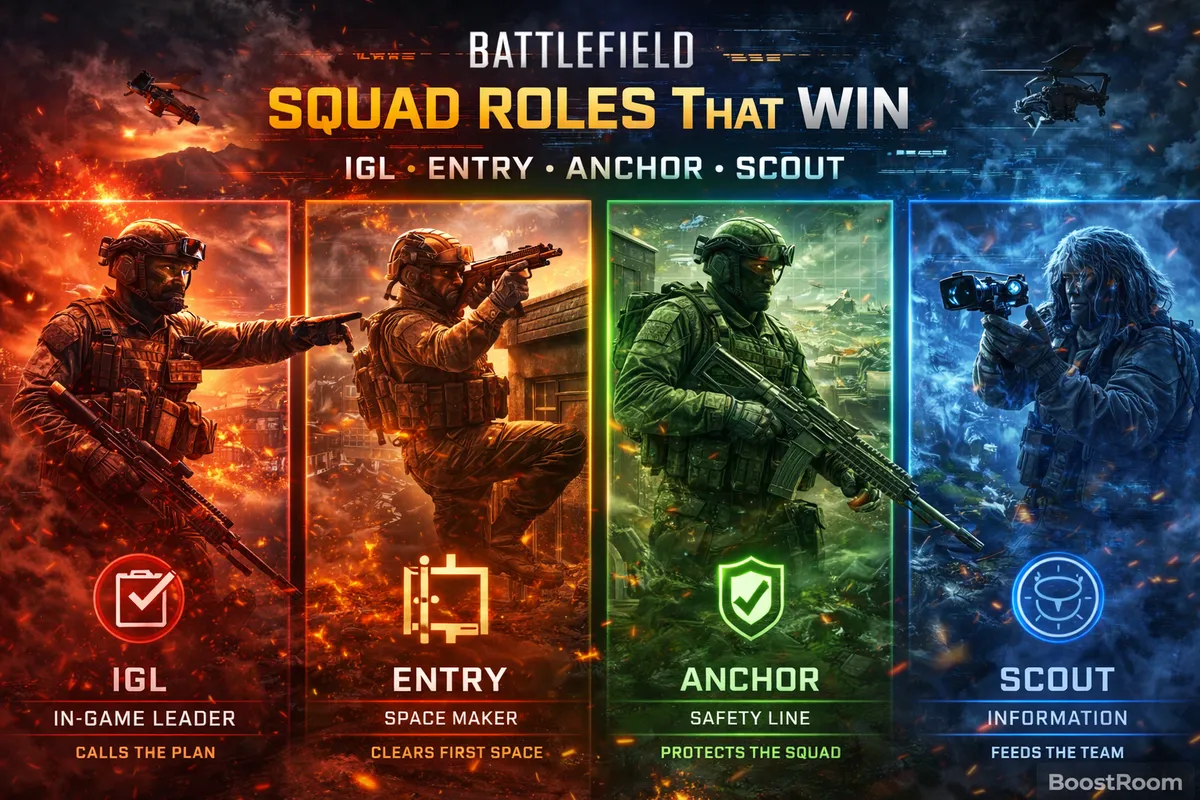
The Simple 4-Role System That Wins: IGL, Entry, Anchor, Scout
Here’s the system in one sentence:
- IGL (In-Game Leader): calls the plan and timing—drop, mission, rotate, fight, disengage, redeploy.
- Entry: takes first space—clears rooms, climbs roofs, forces the first knock, starts pushes.
- Anchor: holds the team together—watches flanks, protects resets, prevents third parties, keeps the squad alive.
- Scout: gets information—drone, motion tools, angles, pings, shakedown intel, safe route scouting.
This isn’t rigid. You can swap mid-match. But you need someone owning each job, or the match gets chaotic.
Role-to-Class Matchups (Assault, Engineer, Support, Recon)
REDSEC classes don’t lock your weapons, but they do give signature gadgets and traits that naturally fit roles. A good squad role system uses classes to make each role easier.
Entry (best fit: Assault)
Assault’s ladder and aggressive tools are perfect for taking height, forcing entries, and creating unexpected angles. Entry loves mobility and tempo.
Anchor (best fit: Support or Engineer)
Support is the classic “keep the team alive” class—revives, sustain, and defensive resets. Engineer is a strong anchor when vehicles are involved and when explosives start shaping fights.
Scout (best fit: Recon)
Recon has the most direct information tools. A Scout who can drone, track, and ping correctly turns chaos into clean fights.
IGL (best fit: anyone with a calm brain, often Support or Recon)
IGL isn’t a class—it’s a mindset. But Support and Recon often do well because they’re already thinking about resets and information.
If your squad can coordinate even a little, a “complete” team often looks like: Assault (Entry), Support (Anchor), Recon (Scout), Engineer (flex/anti-vehicle). If you can’t coordinate, you can still assign roles by behavior: who calls rotations, who pushes first, who holds, who scouts.
How to Assign Roles in 15 Seconds (Even With Random Teammates)
Before you jump, do this quick assignment:
- Who talks the most calmly? That’s your IGL.
- Who loves pushing first? That’s Entry.
- Who naturally watches flanks / plays safe? That’s Anchor.
- Who uses pings, drones, motion tools, or likes sniping/DMRs? That’s Scout.
If nobody talks, still assign roles silently:
- One person marks the drop and rotates early (IGL).
- One person stays slightly behind to watch the back (Anchor).
- One person pushes rooms first (Entry).
- One person scouts the next building/route (Scout).
Even in quiet squads, this makes you feel instantly more coordinated.
IGL Role Explained: The Decision Engine
The IGL’s job is not to get the most kills. The IGL’s job is to stop the team from dying to bad timing, bad routes, and bad fights.
IGL responsibilities (what you must own):
- Choose the drop style: hot, warm, or safe.
- Set a loot timer: “60–90 seconds, then we move.”
- Pick one mission objective and stop the squad from stacking three at once.
- Call rotations early to avoid the instant-kill ring.
- Decide when to fight and when to disengage.
- Decide when to attempt redeploy towers (and when to abandon the idea).
- Control tempo after a win: plate, reload, upgrade, then rotate—no over-looting.
What makes a good REDSEC IGL:
- You keep the squad moving before the ring forces movement.
- You don’t start “ego fights” that take 60 seconds and invite a third party.
- You manage risk around loud mechanics (redeploy towers, vehicle rotations, global drops).
- You communicate in short, clear calls.
IGL comms that actually work (short scripts):
- “Loot 30 more seconds, then rotate.”
- “We’re not fighting that—rotate now.”
- “Hold fire, let them cross, then focus the left guy.”
- “Reset: plate up behind this wall. Anchor watch back.”
- “Scout check next building. Entry get roof. Then we move.”
IGL timing rule that saves matches:
If your squad is still arguing about what to do, you’re already late. Make a call and commit.
Entry Role Explained: The Space Maker
Entry is your squad’s fight starter. Not “starter” as in “runs in alone.” Starter as in “creates the opening so the team can safely follow.”
Entry responsibilities:
- Clear the first room.
- Take the first roof or the first head-glitch position.
- Force enemies off power positions with pressure, explosives, or aggressive angles.
- Convert cracks into downs quickly (finish the first knock).
- Lead the push when the IGL says “go.”
Entry tools that win in REDSEC:
- Height access (ladders, climbs, roof routes) to break predictable door pushes.
- Close-range weapon confidence so you actually win inside buildings.
- Utility discipline: smoke, grenades, and quick resets—because fights are loud and third parties come fast.
Entry spacing rule:
You are always one cover step ahead, not three buildings ahead. Your squad must be able to trade your fight. If you push beyond trade distance, you’re gambling.
Entry checklist for every push:
- Do we have plates?
- Do we have at least one smoke for crossing?
- Does Anchor have a safe angle behind us?
- Did Scout identify where the enemies are?
- Are we pushing because we have advantage (a down, a crack, or position)?
Entry is strongest when it pushes off information and advantage—not when it pushes because it’s bored.
Anchor Role Explained: The Stabilizer Who Prevents Wipes
Anchor is the least flashy role and the most important role for consistent wins. Anchor is why your team survives third parties, survives after messy fights, and survives redeploy attempts.
Anchor responsibilities:
- Watch the flank while Entry and IGL focus forward.
- Hold the “safe reset” cover so your team can plate, reload, and upgrade.
- Prevent your squad from getting pinched by another team.
- Secure vehicles or deny vehicles (depending on match flow).
- Be the voice of survival: “We need to reset. Don’t chase.”
Anchor positioning rule:
Anchor plays half a step behind the squad, but always within trade distance. You are the last line that stops a wipe.
Anchor’s best habit:
After every fight, Anchor immediately does two things:
- checks the back/side angles for a third party
- calls “reset here” behind hard cover if safe
Anchor weapon mindset:
- Prioritize consistency and ammo economy.
- If you run an LMG or stable AR, your job is to punish peeks and protect resets, not chase.
- You win fights by making enemies regret pushing your squad during a reset.
Scout Role Explained: The Information Engine
Scout makes REDSEC feel easy. Without Scout, you rotate blind. You push blind. You get ambushed. With Scout, you choose fights instead of stumbling into them.
Scout responsibilities:
- Scan the next area before the squad rotates into it.
- Mark enemies and call how many teams are nearby.
- Identify power positions (roofs, strong buildings, head-glitches).
- Use motion tools and drones at the right time—especially late game.
- Convert shakedown intel into action: push, pinch, or reposition.
Scout discipline rule:
Information is only useful if it arrives early. If you ping enemies after your squad is already exposed in the open, it’s too late.
Scout’s high-value mechanics in REDSEC:
- Shakedown/interrogation of a downed enemy reveals their squadmates briefly. That is a massive “where are they?” answer—perfect for finishing the wipe or avoiding an ambush.
- Drone and motion tools become more valuable as the circle shrinks, because late game is about preventing flanks and punishing forced movement.
Scout comms that win fights:
- “Two on roof, one inside, left stair.”
- “Another team 80 meters east—third party risk.”
- “They’re rotating right-to-left across open; wait, then shoot.”
- “We can push: one isolated behind the truck.”
Scout is not “a sniper who sits far away.” Scout is a teammate who makes every fight cleaner.
Early Game Playbook: First 3 Minutes (Drop → Loot → Stabilize)
Early game in REDSEC starts with limited gear—you drop in with a pistol and must loot for primaries, gadgets, and power-ups. That makes your first minutes all about structure.
IGL job early:
- Pick a drop style based on squad comfort.
- Set the loot timer.
- Choose a first mission only after the squad is playable.
Entry job early:
- Secure a close-range weapon fast.
- Clear the nearest building for the squad.
- If contested, take the first fight but don’t tunnel—win fast or disengage.
Anchor job early:
- Hold the back door and watch for late landers.
- Call out if another squad lands nearby and is creeping in.
- Protect the team while they grab plates and ammo.
Scout job early:
- Mark nearby landing squads.
- Identify the safest exit route from the drop zone.
- Look for class chest density areas if your squad wants faster role loot.
The 60–90 second loot rule (the simplest early-game win):
Once the squad has:
- two usable weapons each (even if not perfect)
- plates/armor resources
- one utility option (smoke is the universal best)
- you rotate or take one controlled fight. Over-looting is how you get third-partied or forced late into the deadly ring.
Where this matters on Fort Lyndon:
Fort Lyndon’s POIs are diverse—Marina and Lighthouse can be calmer starts, Downtown and Boutique District can be chaos, Chemical Storage often pulls fights, and Golf Course is a classic hot zone. Your role system lets you survive any of them because you always have someone scouting, someone pushing, someone anchoring, and someone calling.
Midgame Playbook: Missions, Upgrades, and Clean Rotations
Midgame is where most squads throw matches—not because they lose a fair fight, but because they take a dumb fight at a dumb time.
IGL midgame priorities:
- Rotate early so the instant-kill ring never touches your squad.
- Pick one mission with a meaningful reward (weapon upgrades, loadouts, or survival value).
- Decide whether you’re playing for power position or playing for third parties.
Scout midgame priorities:
- Scout your next rotation building before your squad commits.
- Check likely choke routes.
- Identify where the next fight will happen before it happens.
Anchor midgame priorities:
- Protect the team during mission interactions and looting.
- Deny third parties by watching the angle everyone forgets.
- Keep the squad’s reset location safe.
Entry midgame priorities:
- Only commit to fights with advantage: a down, a cracked enemy, or a positional win (height, cover, crossfire).
- Push quickly, finish, then reset—don’t turn every engagement into a 60-second war.
How weapon upgrade kits change midgame:
Weapon upgrade kits are one of the easiest power spikes in REDSEC. Treat them like “match accelerators”:
- The IGL calls who should use the first kit based on what fights are next (close range or mid range).
- Entry often benefits first if you expect building fights.
- Anchor often benefits first if you expect lane holds and rotation fights.
- Don’t hoard kits forever—using them early can win the next fight, which gives you more loot anyway.
How custom loadout drops change midgame:
Loadout drops can come from mission rewards or from global events. They’re powerful but risky because they attract attention. A good role system handles them cleanly:
- Scout checks the area first.
- Anchor holds overwatch and protects the pickup.
- Entry clears the closest building/cover pocket.
- IGL decides: “We take it” or “We skip it,” based on risk.
Redeploy Towers and Second Chance: Role-Based “Bring Back” Plans
REDSEC gives early forgiveness through an automatic redeploy (“Second Chance”), but it disappears later. After that, redeploying requires towers that take time and make noise—meaning redeploy attempts are basically a fight invitation.
IGL redeploy rules:
- Don’t redeploy if the ring timing is tight—rotate first, then redeploy.
- Don’t redeploy if you can’t defend the tower for the full channel time.
- If you’re going to redeploy, commit as a team; don’t leave one person holding the tower alone.
Anchor’s redeploy job (most important):
- Anchor watches the approach angles and calls enemy movement early.
- Anchor’s goal is to prevent the “we got wiped while staring at the tower circle” scenario.
Scout’s redeploy job:
- Scout checks for nearby squads before you start the tower.
- Scout monitors third-party paths (roads, rooftops, open lanes).
Entry’s redeploy job:
- Entry clears the nearest threat and creates space so the squad can finish the redeploy safely.
If you want one simple redeploy sentence for your squad:
“We only redeploy when we can hold the area like we’re defending a site.”
Endgame Playbook: Top 10 Roles Become Even More Important
Endgame in REDSEC is smaller circles, fewer safe positions, and higher punishment for mistakes. Roles don’t become less important—they become more important.
IGL endgame priorities:
- Choose your final cover and reduce angles.
- Call micro-rotations early (small moves before you’re forced).
- Decide whether you’re playing to gatekeep forced rotators or playing to hold a power position.
Scout endgame priorities:
- Motion tools and drones become your best friend.
- Identify flanks before they happen.
- Call “two teams” early so the squad doesn’t commit into a third party trap.
Anchor endgame priorities:
- Hold the safe reset cover.
- Protect plates and revive attempts.
- Prevent the squad from chasing kills into open ground.
Entry endgame priorities:
- Wait for the real moment: a down, a forced rotate, a cracked enemy moving cover.
- Push only when the IGL calls it, because one bad push is often instant death in final circles.
Endgame truth:
The team that survives the last two forced moves usually wins. Roles make those moves controlled instead of panicked.
Minimal Comms That Win (Even If Your Squad Isn’t “Talkative”)
You don’t need essays. You need a shared language.
The 10 comms that matter most:
- “One cracked” (and where)
- “One down” (and where)
- “Two teams” (third party warning)
- “Reset here” (hard cover ping)
- “Rotate now” (IGL call)
- “Hold” (stop shooting, stop revealing)
- “Entry go” (push call)
- “Anchor watch back” (flank discipline)
- “Scout check next” (info request)
- “No plates / low ammo” (resource truth)
The ping rule that upgrades your squad instantly:
Ping first, then shoot—especially at range. If everyone shoots different targets, you lose fights you should win.
Role System in Duos (Same Idea, Smaller Version)
Duos are simpler but still benefit massively from roles:
- Player 1: IGL + Entry (calls + pushes)
- Player 2: Scout + Anchor (info + reset protection)
Duos win by being fast and clean:
- Scout identifies the safest route and enemy count.
- Entry takes the first space.
- Both reset quickly after the fight and rotate early.
Role System With Randoms (How to “Soft Lead” Without Being Annoying)
If you’re solo-queuing into Squads, you can still use the system:
- Be the IGL with minimal calls: “Rotate now,” “Reset here,” “Skip this fight.”
- If nobody scouts, you become Scout: ping enemies and call third parties.
- If everyone pushes, you become Anchor: hold back angle and save the wipe.
- If everyone is passive, you become Entry: take first roof, create space, and force momentum.
The fastest way to make randoms follow you is not shouting. It’s consistency: ping routes, move early, and keep the squad alive through resets. Players naturally follow the teammate who prevents wipes.
Common Role Mistakes (And the Fix That Solves Them)
Mistake: Two Entries, no Anchor
Result: you win the first fight, then get third-partied and wiped while looting.
Fix: assign one player to always watch the back angle until the team is plated and ready.
Mistake: Scout drones too long
Result: the Scout gets downed while scanning and the squad collapses.
Fix: drone from hard cover, short scans only, then reposition. Information is useless if you die getting it.
Mistake: IGL hesitates
Result: late rotates, forced choke fights, ring pressure panic.
Fix: make a call early, commit, and adjust later. Early decisions beat perfect decisions.
Mistake: Entry pushes without advantage
Result: coin-flip fights and no trade distance.
Fix: Entry pushes off a down, crack, or positional win—always.
Mistake: Anchor plays too far back
Result: the squad fights 3v4 and loses.
Fix: Anchor stays within trade distance—close enough to shoot, far enough to protect resets.
Practical Rules (Copy This and Your Squad Will Feel Better Immediately)
- Assign IGL, Entry, Anchor, Scout before you land.
- IGL sets a loot timer (60–90 seconds) and enforces early rotation.
- Scout pings enemies before shots start; call “two teams” the moment you suspect it.
- Entry only pushes when the squad can trade and when you have advantage.
- Anchor always holds the back/flank angle during looting, missions, and redeploys.
- After every fight: plate → reload → upgrade → reposition. No over-looting.
- Use weapon upgrade kits early enough to win the next fight; don’t hoard them forever.
- If you get a shakedown/interrogation reveal, convert it immediately: push the isolated target or reposition away from the stacked side.
- Don’t redeploy late or in the open. Redeploy only when you can defend the tower for the full channel.
- In endgame, reduce angles: pick hard cover, play inside edge, and save utility for forced moves.
- The squad that moves first with a plan usually wins against the squad that moves late with panic.
BoostRoom Promo: Turn This System Into a Repeatable Win Routine
If you like the simplicity of IGL–Entry–Anchor–Scout but want it tailored to your squad, BoostRoom helps you turn role theory into a real Fort Lyndon playbook.
With BoostRoom, you can build:
- a role-based drop pool (safe, warm, hot) that fits your squad’s comfort level
- rotation routes for your preferred POIs (Downtown, Boutique District, Golf Course, Chemical Storage, Marina, Lighthouse, and more)
- role-specific fight plans (how Entry pushes, where Anchor holds, what Scout scans, when IGL calls disengage)
- endgame routines (micro-rotations, cover selection, forced-move timing)
- practical review habits so every loss becomes a fix, not frustration
The goal isn’t to copy “pro strats.” The goal is to make your squad consistent—so you stop dying to the same mistakes and start closing matches on purpose.
FAQ
What does IGL mean in Battlefield REDSEC?
IGL stands for In-Game Leader. In REDSEC, the IGL is the teammate who calls drop decisions, mission priorities, rotation timing, and whether the squad fights or disengages.
Which role is most important for winning?
Anchor is often the role that separates “fun fights” from “consistent wins,” because Anchor prevents third-party wipes and protects resets. But the best squads have all four roles covered.
Who should be Entry on the team?
Entry should be the player who’s confident taking first space, clearing rooms, and winning close-range fights—without pushing so far that the squad can’t trade.
How does Scout help if we already have good aim?
Scout prevents ambushes and wasted pushes. REDSEC fights are often decided before shots are fired—by who has better info, better positioning, and better timing.
How do we use the shakedown/interrogation mechanic well?
Only do it when it’s safe. If you secure the shakedown and reveal squadmates, immediately convert: push the isolated enemy, pinch the revealed position, or reposition to avoid a trap.
When should we use redeploy towers?
Use them when you can defend the area and when ring timing gives you enough buffer. Redeploy towers are loud and take time, so role discipline matters: Scout checks, Anchor holds
angles, Entry clears threats, IGL commits or cancels.
Does this role system work in Duos?
Yes. Duos can combine roles: one player does IGL + Entry, the other does Scout + Anchor. The idea is the same—decisions, space, info, and reset protection.
What’s the fastest change that improves our squad instantly?
Assign Anchor and enforce early rotations. Most squads don’t lose because they can’t shoot—they lose because they get third-partied while looting or forced late into the deadly ring.



