What Gauntlet Mode Is in Battlefield REDSEC (And Why It Feels So Different)
Gauntlet is a tournament-style, objective-driven mode inside Battlefield REDSEC where multiple squads compete at the same time to score points. Unlike Battle Royale, you aren’t looting for weapons and racing the firestorm ring. Instead, you spawn into a focused combat space with a mission objective, and you have a short window to score enough to avoid elimination.
That difference changes the entire mindset:
In Battle Royale, “staying alive” can be a win condition.
In Gauntlet, staying alive without scoring is how you get knocked out.
Gauntlet also pushes a very “Battlefield” skill set: coordinated pushes, team utility, revives, objective timing, and map control. It’s not purely about K/D. You can top-score a round with smart objective play even if your squad isn’t winning every gunfight—because Gauntlet scoring heavily rewards doing the mission and preventing other squads from doing it.
If you want the simplest definition:
Gauntlet is a race to score points through objectives and smart combat, with eliminations happening at the end of each round.
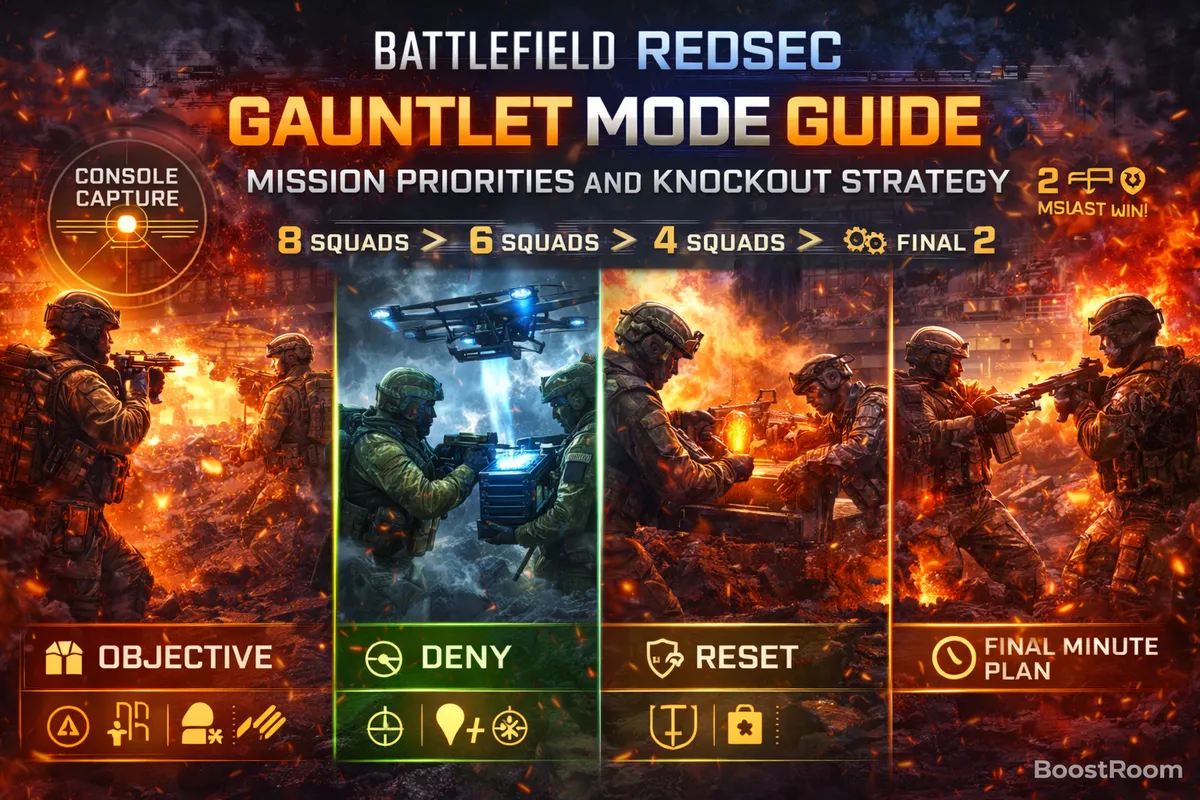
Gauntlet Format: The Knockout Flow You Must Understand
Gauntlet uses a four-round knockout structure with eight squads of four players at the start.
The flow is simple and brutal:
Round 1: 8 squads compete → bottom squads get eliminated
Round 2: 6 squads compete → bottom squads get eliminated
Round 3: 4 squads compete → bottom squads get eliminated
Round 4: 2 squads compete head-to-head → winner takes the match
If you’re thinking “we need to be first every round,” that mindset often causes throws. Most rounds only require one thing: don’t be in the bottom. Your strategy should reflect that. In early rounds you can play safer, deny points, and secure “steady scoring.” In later rounds (especially Round 3 and the final), you often need to take more aggressive plays.
A key detail: Gauntlet can include a reassignment system between rounds (not in the final) that helps keep teams full if players disconnect or get dropped. That means matches can stay competitive, and you can’t assume other squads will be “free” just because you saw them lose earlier.
Round Length and the “Double Points” Final Minute
Each Gauntlet round is short—built to create fast decision-making. The most important scoring mechanic in the entire mode is this:
The final minute awards double points for scoring events.
This changes how you should play the clock:
If you’re slightly behind, the last minute is your comeback window.
If you’re slightly ahead, the last minute is where you can get knocked out if you panic and give up easy points.
If the mission rewards objectives heavily, the last minute becomes “objective-or-die.”
If the mission includes kill and revive scoring, the last minute becomes “trade smart, don’t feed.”
Many squads lose Gauntlet rounds because they play the last minute like normal time. It isn’t. The last minute is a different game.
Scoring Basics: Why Objectives Matter More Than Kills
Across Gauntlet missions, you’ll see a scoring pattern that repeats:
Kills and revives typically award points.
Objectives award points faster than chasing fights in most missions.
Revives are a hidden “two-point swing” in practice because you gain a point and you deny the enemy an easy finish/kill point and momentum.
This is why Support is so powerful in Gauntlet and why squads that revive quickly often climb the scoreboard even when fights are messy. It’s also why “thirsting” (overcommitting to finish downs) can backfire: you expose yourself, you lose positioning, and you get wiped while the other team racks objective points.
Your default Gauntlet rule should be:
Score the objective, then take fights that protect the objective or deny enemy scoring.
The Real Win Condition: Advancing vs Dominating
Gauntlet is not always about being #1 every round. It’s about making the final and winning it.
So your strategy changes by round:
Round 1 (8 squads): prioritize consistency and avoid full wipes; score safely; don’t take “coin flip” fights
Round 2 (6 squads): start denying top squads; protect revives; secure stronger objective control
Round 3 (4 squads): shift more aggressive; you can’t “hide” from the scoreboard anymore
Final (2 squads): everything becomes about execution, trades, and objective timing under pressure
A squad that tries to “dominate” too early often throws by feeding points and losing tempo. A squad that plays too safe late often gets outpaced. The skill is knowing when to switch gears.
Mission Priorities: A Simple System That Works for Every Gauntlet Round
If you want to stop guessing, use this priority system in every mission:
Priority 1: Objective scoring actions
The fastest path to points is almost always doing the mission. If the mission rewards holding consoles, capturing zones, decrypting terminals, extracting drives, carrying bombs, or moving objectives—those actions should be your default plan.
Priority 2: Deny enemy objective scoring
In Gauntlet, denying can be as valuable as scoring. If you can contest a zone for a few seconds, interrupt a decryption, steal a drive, force a carrier to drop, or push an enemy off a console, you can swing the scoreboard without even getting a wipe.
Priority 3: Win fights that protect the objective
You don’t need every kill. You need the kills that stop enemy scoring and protect your scoring window.
Priority 4: Avoid full wipes unless the mission rewards it heavily
Some missions strongly reward squad wipes or sudden-death eliminations. In those missions, wipe potential becomes a priority. In most missions, a wipe is great—but dying trying to force it is how you lose.
Priority 5: Plan your last minute early
Because points double late, you should be setting your last-minute position at the 1:30–2:00 remaining mark, not at 0:59 when everyone is already crashing the objective.
This system is simple, but it’s what separates “we’re fighting” from “we’re winning.”
Best Classes and Squad Comps for Gauntlet (Simple Picks That Win More)
You can win Gauntlet with any class, but the mode rewards certain strengths more than others: revives, objective control utility, denial tools, and information.
Here’s the most reliable approach for most squads:
Support: your scoring engine (revives + sustain + safer resets)
Assault: your entry and objective breaker (fast pushes, strong close-mid tempo)
Engineer: your denial and anti-vehicle answers (mines, launchers, trap control)
Recon: your information advantage (spotting, drone scouting, preventing ambush pushes)
If you only remember one thing:
Support is the class that “wins ugly rounds.” Gauntlet rounds get messy. The team that revives and resets faster usually out-scores.
When to stack classes
There are moments where double-stacking a class makes sense:
Double Support: when the mission is zone-based and fights are constant (you win by staying alive on the objective)
Double Assault: when the mission rewards fast entries and wipe tempo (you win by forcing trades and taking space first)
Engineer-heavy: when the mission includes vehicles or chokepoint objectives (you win by denial and anti-armor)
Recon-heavy: when the mission requires safe scouting and preventing surprise flanks (you win by information and controlled fights)
But don’t stack mindlessly. Stacking is only good if you know why you’re stacking for that mission.
Gauntlet Roles: Who Does What (So You Stop Playing Like Four Solos)
Even if you don’t want “comp roles,” you need a basic assignment so the mission gets done.
Use this simple Gauntlet role setup:
Caller (IGL-lite): chooses the first objective route, calls disengages, and calls the final-minute plan
Runner/Carrier: handles mission items (beacon, drives, bombs, objective handoffs) and plays survival-first
Anchor: holds the safest reset position, watches flanks, protects revives
Breaker/Entry: pushes first into contested objective space and clears defenders
You can rotate roles between rounds depending on mission type, but don’t leave them “unowned.” Many knockouts happen because nobody wants to be the carrier, or everyone pushes while nobody anchors.
Round-by-Round Knockout Strategy (How to Advance Consistently)
Round 1: The “Don’t Feed” Round
You don’t need first. You need to not be bottom.
Round 1 priorities:
secure early objective points quickly
avoid unnecessary full wipes and risky chases
stabilize with revives and sustain
scout who the top squads are
Round 1 is where you should play clean and controlled. If you’re ahead, deny. If you’re behind, take objective risks—but don’t coin flip your entire run on one ego push.
Round 2: The “Deny the Lobby” Round
Round 2 is where smart squads start denying the strongest teams.
Round 2 priorities:
contest objectives that top squads rely on
choose fights that interrupt their scoring
keep your squad alive and together
set up the last-minute double-points plan early
Round 2 is where you should stop “free farming” easy objectives if it means letting one squad run away with a lead. Denial matters more now.
Round 3: The “Top Two or Go Home” Round
At 4 squads, you can’t hide. Every objective is contested. Every mistake gets punished.
Round 3 priorities:
take space early and force other squads into bad routes
protect your Runner/Carrier (mission points are the difference)
pick one enemy squad to deny if scoreboard requires it
keep resources for the last minute (smokes, revives, explosives)
Final: The “Execution” Round
The final is head-to-head. You must know what the mission rewards and play it perfectly.
Final priorities:
control the objective space first
force favorable trades (revives and resets matter massively)
deny enemy scoring windows
win the final-minute double-points window by controlling position
In finals, “style points” don’t matter. Make every action score points or deny points.
Mission Guide: Circuit (Consoles Capture and Hold)
What Circuit is
Circuit is an objective-control mission where squads capture consoles and earn points by holding them for intervals. The number of active consoles can scale down as rounds advance, which increases contest intensity.
What wins Circuit
early console capture
quick rotations between consoles
crossfires that punish pushes
denial plays that contest consoles before the enemy earns their tick
Best squad plan
Split into 2–2 for the opening: two players capture your nearest console while two secure the next closest route and cover angles.
Once captured, regroup into a 3–1 pattern: three hold and rotate as a unit while one anchors your safest console and calls pushes.
Rotate before the console fight becomes a war. Circuit is a rhythm game: capture, hold, rotate, repeat.
Common Circuit mistakes
Overstacking one console while enemies farm the others
Fighting off-objective while points tick elsewhere
Holding a console too long when the next one is about to become the new priority
Ignoring denial (contesting stops points)
Last-minute Circuit strategy
Because points double, you want to hold the most valuable console(s) at the moment double points starts. That usually means rotating into the best console position at around 1:30 remaining and setting crossfires, instead of arriving at 0:50 and panic-running into bullets.
Mission Guide: Contract (Sudden-Death Combat Round)
What Contract is
Contract is a combat-focused mission where kills and revives matter, and squad wipes can matter enormously. Some versions also include anti-camping measures like periodic spotting.
What wins Contract
How to play Contract without throwing
Treat every down as a resource decision: push to finish only if you can do it from cover without exposing your whole team.
Revives are huge. A team that revives faster often wins the scoreboard even if kills are even.
Avoid splitting. Contract punishes scattered squads because you get isolated, traded, and wiped.
Kill discipline that matters
In a kill-focused mission, many teams make the same error: they chase one low enemy into open lanes and give up multiple deaths. Your goal is to secure points while denying them. If chasing a kill will expose you to two angles, don’t chase. Hold the better position and force them to come back into you.
Last-minute Contract strategy
Double points makes late pushes dangerous. You want to enter the last minute with:
If you’re ahead, the best play is often to slow down and deny—make them push you. If you’re behind, you need a clean fight plan (smoke push, crossfire pinch, or coordinated entry) rather than random solo hero plays.
Mission Guide: Deadlock (Rotating Zones / King of the Hill)
What Deadlock is
Deadlock is a rotating zone control mission. Zones move, and the number of zones can reduce as rounds advance, eventually becoming one major final zone.
What wins Deadlock
arriving early to the next zone
holding with strong cover and angles
smokes and utility for crossing
constant revives and resets (Support shines here)
How to play Deadlock correctly
Your IGL-lite should call the next zone rotation early. If you rotate late, you’re forced into open pushes and you bleed points.
Anchor should hold the “back angle” to prevent a third party pinch while the team holds zone.
Entry should clear the best cover inside zone (a corner, head-glitch, or interior route), then stop pushing too far—Deadlock rewards holding, not chasing.
Zone contesting is denial
Even if you aren’t winning the fight, contesting can stop enemy points. A single player sliding in to contest while the rest cover can deny a full scoring tick and swing the scoreboard.
Last-minute Deadlock strategy
The last minute often becomes one brutal zone fight. Save your best utility for it. If you waste smokes and explosives early, you lose the final-minute crash where points double.
Mission Guide: Decryption (Beacon/Terminal Hold and Process)
What Decryption is
Decryption missions revolve around securing a device or terminal and keeping it active while data processes. In some versions, your squad must find and secure a beacon, then hold it as it calibrates. Movement can be restricted—sprinting can pause progress—and the carrier can become an obvious target.
What wins Decryption
protecting the decrypting player
controlling the immediate area around the device
trapping the most likely push routes
using Recon information tools to pre-spot attacks
Best squad plan
Assign a Carrier (Runner) who plays survival-first and does not ego-chase kills.
Entry takes space slightly ahead and clears the nearest hard cover.
Anchor holds the “safe reset” angle so revives can happen without losing the objective.
Recon/Scout calls incoming pushes early so you can pre-aim and deny.
How to score efficiently
Decryption is often won by squads who treat it like a “hold the hill” mission: your goal is to build a defensive shell around the decrypting position. Every time you reset the defense, you’re buying more progress time and denying other squads their chance to score.
Last-minute Decryption strategy
Double points encourages desperate crashes. If you’re ahead, don’t chase kills—hold the decrypt position and farm denial. If you’re behind, you must break the hold quickly with coordinated utility (smokes, breach angles, explosives) and immediately start your own decryption window.
Mission Guide: Extraction (Collect Data Drives and Extract to Drones)
What Extraction is
Extraction requires gathering data from consoles and delivering drives to extraction drones/points. Drives can often be carried in stacks, turning the carrier into a high-value target.
What wins Extraction
Best squad plan
Assign a Carrier who focuses on movement and survival.
Two players escort close (trade distance).
One player scouts ahead and denies ambush points.
The biggest Extraction mistake
Teams often split: one player runs drives alone while the squad fights somewhere else. That’s how carriers get deleted and you lose both points and tempo. If you’re extracting, escort as a unit.
Denying wins Extraction
If you see a team carrying drives, you don’t always need a full wipe. You need to stop the extraction. A quick down on the carrier can force dropped drives, stalled scoring, and a swing in momentum.
Last-minute Extraction strategy
This is where smart teams win. Because points double, you want to time at least one high-value extraction during the final minute. That means setting your route and controlling the drone area before double points begins, so you aren’t trying to extract while being shot from five angles.
Mission Guide: Vendetta (High-Value Target Pressure and Survival Points)
What Vendetta is
Vendetta revolves around a high-value target dynamic: once a player becomes the target, their location can be visible, and keeping them alive can score points over time. Some versions add extra pressure through limited respawn pacing, making every down more meaningful.
What wins Vendetta
choosing the right player to become/hold the target
tight team protection around the target
denial of enemy target survival time
clean, safe resets after each fight
How to play Vendetta smart
If your squad becomes the HVT early, don’t panic. Your job is now “survive and score,” not “take every fight.”
Move the HVT through strong cover lanes, not open pushes.
Anchor and Support should stay close: revives and sustain are the difference between scoring and losing your target instantly.
Hunting the enemy HVT
You don’t always need to full wipe. You need to end their survival scoring window. A focused push to down the HVT can swing points dramatically—especially in the last minute when points double.
Last-minute Vendetta strategy
If you have the HVT and you’re ahead, your best play is often to turtle in the best defensible space and deny pushes with utility. If you’re behind, you need a coordinated collapse on the enemy HVT—random solo pushes feed points.
Mission Guide: Wreckage (Bomb Carry, Plant, Detonate)
What Wreckage is
Wreckage missions center around carrying bombs to marked locations and successfully detonating them. Bombs can spawn in different places, are limited (often one at a time per carrier), and failing to deliver in time can punish the carrier.
What wins Wreckage
Best squad plan
Runner picks up bomb and plays survival-first.
Entry clears the plant approach.
Anchor watches the flank and holds a reset corner.
Scout calls enemy approach routes early so you aren’t surprised mid-plant.
Plant defense wins rounds
Most Wreckage throws happen after planting—teams run off chasing kills and get wiped, or they leave the plant undefended and lose the detonation. Planting is not the end. The plant is the start of the defense window.
Last-minute Wreckage strategy
Because points double, the last minute is often decided by:
a final successful plant/detonation
a final denial on the enemy’s plant
Plan for that. Save enough utility to defend or crash the last plant.
Mission Guide: Heist (Final Round Head-to-Head Objective Race)
What Heist is
Heist is typically a final-round mission played squad vs squad, centered around retrieving objects from the enemy side and bringing them back to score. Each capture can be worth a large point chunk, which makes the mode swingy and execution-heavy.
What wins Heist
controlling mid-map lanes so carriers can move
winning the first clean fight without overcommitting
using smokes and cover to escort the carrier
denial: stopping the enemy carrier is often more valuable than chasing extra kills
A reliable Heist plan
Opening: Scout identifies enemy approach; don’t sprint into the first trap.
First fight: take a clean trade fight near cover, not in the open.
Carrier route: choose the safest route, even if it’s longer.
Escort discipline: never let the carrier go alone; you win by completing the run, not by chasing.
Reset rule: after every engagement, plate and reload before moving the objective again.
When to play aggressive
If you’re down in points, you can’t “wait it out.” You must force a carrier stop or secure your own capture quickly. The best aggressive play is coordinated: one player pressures, one flanks, one holds denial, one protects your carrier path.
Final-minute Heist strategy
This is often the most intense minute in Gauntlet. If you can set up a capture attempt during double points, it can decide the match instantly. But if you rush without control, you’ll get wiped and lose the game. Plan your double-points push before the last minute starts.
Rodeo Mission (Tank-Focused Gauntlet Addition) and How to Approach It
Rodeo is a Gauntlet mission built around tank-centric combat where squads earn points while occupying heavily armored vehicles in the playable area. The key is that vehicle control becomes mission priority: if you treat Rodeo like a normal infantry objective round, you’ll lose to squads that secure armor first and keep it active.
What wins Rodeo
controlling tank access early
keeping your squad together (vehicles amplify team splits)
Engineer value (repair, anti-vehicle tools, denial)
smart dismount timing (don’t die inside a doomed vehicle)
Simple Rodeo game plan
Engineer and Support pair: keep armor alive longer and keep the squad alive longer.
Recon/Scout calls where tanks are and where enemy squads are collapsing from.
Assault/Entry plays “cleanup” around armor—finish weakened enemies and protect repair windows.
Rodeo mistake that gets squads knocked out
Overstaying in a tank that is being focused. In Gauntlet, feeding points loses rounds. If the vehicle is about to go down, dismount behind cover, reset, and re-enter with a plan.
Limited-Time Gauntlet Variations (What Changes and How to Adapt)
Gauntlet sometimes appears with limited-time rule twists during seasonal events.
Ice Lock Gauntlet (Freeze Ruleset)
In event versions, mission selection can be limited (example: a locked set of missions) and the ruleset can add survival pressure like “freeze” mechanics. In these versions, your priorities shift:
stay objective-focused
manage survival resources tied to the event
avoid long open rotations where the event mechanic punishes you
hold stronger cover positions and rotate earlier
Gauntlet: Altered State (Psychoactive Smoke Variant)
Some limited-time variants add psychoactive smoke zones that require protective masks and filter management. In these versions:
objective areas can become “contaminated” and force gear management
pushing becomes harder if your squad mismanages protection resources
holding becomes stronger if you can sustain inside pressure zones
your Scout and IGL should track where smoke zones are and avoid fighting blind
The core Gauntlet truth remains: missions win, but event mechanics punish sloppy timing even harder.
Knockout Strategy: How to Read the Scoreboard and Make the Right Call
A major Gauntlet skill is knowing when to play for safe advancement and when to force a swing.
Use this simple scoreboard logic:
If you’re clearly above the bottom: deny and stabilize. Don’t feed. Keep the squad alive and keep scoring steady objective points.
If you’re near the cutoff line: you need a controlled high-value play—usually an objective push during a strong timing window.
If you’re clearly below: you must take a bigger scoring risk—usually a last-minute objective crash or a high-value denial play that flips momentum.
The biggest mistake is treating every moment like “must win.” If you’re safe, don’t throw. If you’re behind, don’t delay.
The Last-Minute Plan: How to Win Double Points Without Panicking
Double points is where Gauntlet rounds get decided. Here’s a simple routine that works in almost every mission:
At 2:00 remaining, stop taking random fights. Start positioning for the last-minute objective window.
At 1:30 remaining, secure your reset cover and your best angle on the objective.
At 1:00 remaining, commit to the plan: hold, crash, extract, plant, escort—whatever the mission requires.
During the last minute, prioritize the highest scoring actions and don’t chase low-value kills that pull you off objective.
A squad that treats the last minute like a planned phase will beat a squad that treats it like chaos.
Reassignment Between Rounds: How to Use It Without Losing Your Mental
Gauntlet can include reassignment between rounds (not in the final), meaning eliminated or abandoned players may be placed onto another squad to keep matches competitive. If this happens to you:
Immediately ask: “What mission is next and what role do they need?”
Fill the gap: become Support if they lack revives, become Recon if they lack info, become Engineer if they lack denial, become Assault if they lack entry.
Don’t argue about what “should have happened” in the previous round. Gauntlet rewards fast adaptation.
If you’re the receiving squad, treat the reassigned teammate like an asset: ping objectives clearly, keep them in trade distance, and give them a simple job.
Common Gauntlet Mistakes That Get Squads Knocked Out (And the Fix)
Mistake: Playing Gauntlet like Battle Royale
Fix: Stop “survival-only” thinking. You must score points, and objectives are usually the fastest scoring path.
Mistake: Taking long fights off-objective
Fix: Fight on or near the objective. If you can’t convert a fight quickly, disengage and return to scoring.
Mistake: No carrier discipline
Fix: Assign a Runner/Carrier every round. Carriers must prioritize survival and mission completion over kill chasing.
Mistake: Ignoring revives
Fix: Revives aren’t just “nice.” They are points and tempo. Support value is massive in Gauntlet.
Mistake: Wasting utility before the last minute
Fix: Save smokes, explosives, and key abilities for the double-points window when it matters most.
Mistake: Overcommitting to wipes
Fix: In most missions, denial and objective points matter more than forcing a full wipe. Wipe only when it’s safe or heavily rewarded.
Practical Rules (Copy This and Win More Gauntlet Runs)
Always ask: “What scores fastest in this mission?” Then do that first.
Assign roles every round: Caller, Runner/Carrier, Anchor, Breaker/Entry.
Play objectives first, fights second—unless the mission is purely combat-focused.
Don’t chase kills that pull you off objective or expose your squad to wipe risk.
Revive fast and reset behind cover—Support is a Gauntlet multiplier.
Rotate early into the last-minute objective plan; don’t panic-crash at 0:50.
Deny enemy scoring: contest zones, interrupt decrypts, down carriers, stop plants.
In Round 1 and Round 2, avoid “coin flip” fights—advancing is the goal.
In Round 3, play faster and more decisive—there are fewer squads, so every point swing matters more.
In the final, focus on execution: coordinated pushes, clean trades, objective timing, and denial.
If you’re ahead during double points, slow down and deny—make them take the risk.
If you’re behind during double points, commit to the highest-value objective play with a coordinated plan, not random solo pushes.
BoostRoom Promo: Turn Gauntlet Into a Consistent Win Mode
Gauntlet rewards structure. If your squad is tired of getting knocked out on Round 2 or barely missing finals, BoostRoom can help you build a repeatable Gauntlet system that fits your strengths:
mission-by-mission priorities (what to do first, what to ignore, what to deny)
role assignments that match your squad (Carrier discipline, Anchor resets, Entry timing)
class picks per mission type (when Support stacks win, when Engineer denial matters, when Recon scouting decides rounds)
last-minute double-points planning (positioning, utility timing, denial routes)
final-round execution routines (how to win Heist-style finals without feeding points)
The difference between “random Gauntlet” and “consistent Gauntlet” is a plan you can repeat. With the right structure, you’ll reach finals more often—and you’ll start winning them.
FAQ
Is Gauntlet the same as Battle Royale in Battlefield REDSEC?
No. Gauntlet is an objective-based knockout mode with short rounds. Battle Royale is survival-based with an instant-kill ring. Gauntlet is about scoring points and advancing through rounds.
How many squads are in Gauntlet?
Gauntlet starts with eight squads of four players and eliminates squads each round until the final is a 2-squad showdown.
How long is each Gauntlet round?
Rounds are short, and the last minute is especially important because it awards double points.
What matters more: kills or objectives?
In most Gauntlet missions, objectives score faster and more reliably than kill chasing. Kills matter most when they protect the objective or deny enemy scoring.
Why is Support so strong in Gauntlet?
Revives and sustain keep your squad alive on objectives and can also contribute to scoring. Support helps your team survive messy rounds and win the “reset war.”
What’s the best way to avoid getting knocked out in Round 1?
Play for consistent objective points, avoid full wipes, and don’t chase long off-objective fights. Advancing matters more than topping the scoreboard early.
How do I win the double-points final minute?
Plan it early. Position around the objective before the last minute starts, save utility, and commit to the highest-value scoring actions while denying enemy scoring.
What should we do if we’re behind late in the round?
Stop taking random fights and commit to a coordinated high-value objective play: a zone crash, a decryption break, a drive extraction push, or a plant/defuse swing—depending on mission type.
Does Gauntlet include reassignment?
Some matches can reassign players between rounds to keep squads full, but reassignment does not occur during the Final Mission. If reassigned, adapt fast and take a clear role.



