Why 4-Player Dungeons Are the Fastest “Real Progress” Content
Aion 2 has multiple content sizes, but 4-player dungeons are where progression becomes predictable. Here’s why they matter so much:
- They create gear spikes without requiring a huge roster like raids.
- They teach mechanics that prepare you for harder difficulties and endgame encounters.
- They reward consistency: the more clean your runs are, the more upgrades you can target weekly.
- They build your network: the players you clear with today become your faster groups tomorrow.
If you want to progress quickly, treat 4-player dungeons as your “upgrade engine” and everything else (quests, solo modes, gathering, PvP) as support that feeds that engine.
What “Dungeon Progression” Really Means
Most players think dungeon progression is “run dungeons until I get drops.” That approach is slow and frustrating.
Real dungeon progression is a loop:
- Enter prepared (correct loadout + consumables + role plan)
- Clear cleanly (few deaths, stable pacing)
- Convert rewards into upgrades (gear, enhancement materials, growth currency, or sellables)
- Repeat with a purpose (farm runs for stability, push runs for better tiers)
When you run dungeons with intention, your character improves every week—even when RNG isn’t perfect.
The 4 Roles in a 4-Player Dungeon
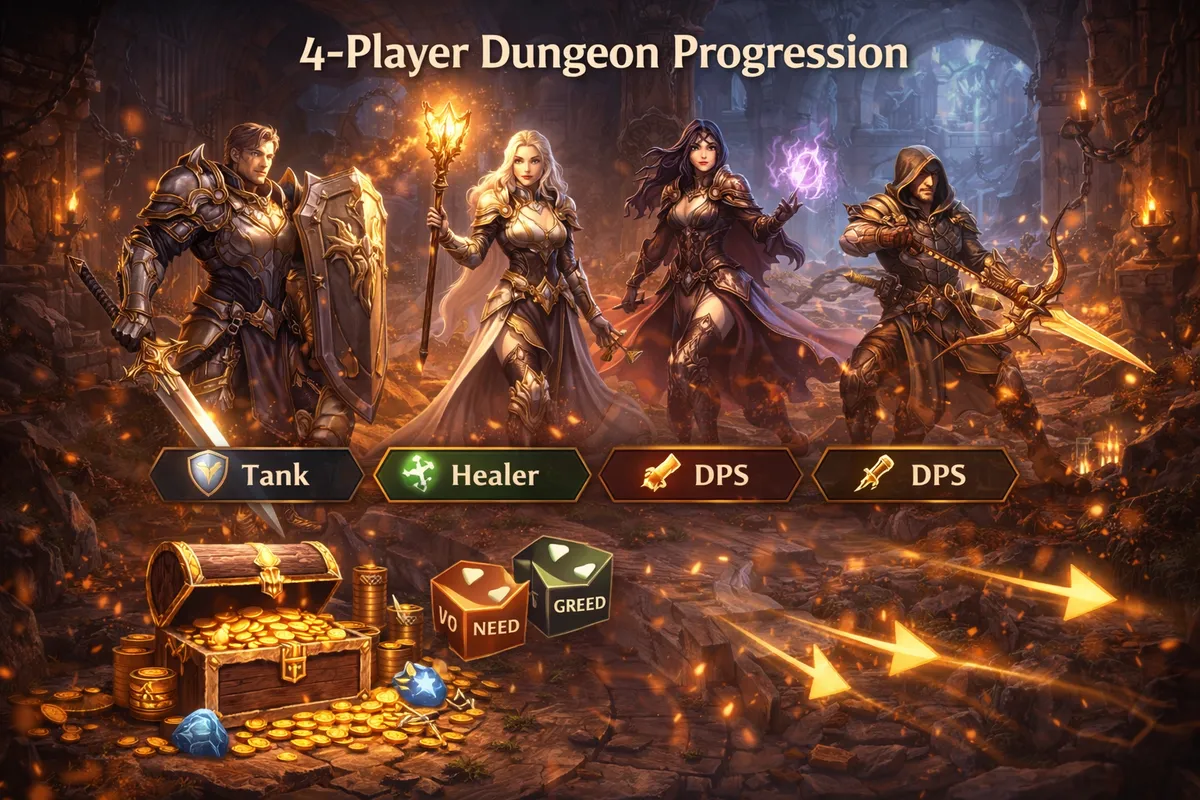
Even though classes differ, 4-player dungeon success is basically built on four “jobs.” Sometimes a class covers more than one job, but every good group has all four.
- Tank / Pace Setter
- Healer / Stabilizer
- Primary DPS / Boss Finisher
- Flex Slot (DPS + Utility) / Problem Solver
In most groups, you’ll see 1 tank, 1 healer, and 2 DPS. But what makes the best groups different is the flex role: the player who brings interrupts, crowd control, dispels/cleanses, or emergency utility that prevents wipes.
Tank Role: The Pace Setter
The tank decides whether a run feels smooth or chaotic. Tanking isn’t just “don’t die”—it’s controlling time.
What a tank must do to speed progression
- Set pull size based on the healer, not based on ego.
- Group mobs tightly so DPS cleave/AoE is efficient.
- Face enemies safely (avoid cleaves into party).
- Use defensives proactively on dangerous packs and boss burst windows.
- Control chaos: pull the “danger mobs” first (casters, healers, stun mobs).
The tank’s #1 speed secret
Your job is not to go as fast as possible. Your job is to go as fast as the group can go without dying. A single wipe often deletes the time you saved by rushing.
Healer Role: The Stabilizer
Healers make dungeon progression consistent. The difference between an average healer and a great healer is efficiency and timing.
What a healer must do to speed progression
- Heal early, not late: burst damage windows are predictable—prepare for them.
- Use efficient heals as default: big heals are for big danger, not for every scratch.
- Track debuffs: a cleanse at the right moment can prevent a wipe.
- Communicate when resources are low: a simple “slow one pull” saves the run.
The healer’s #1 speed secret
If your tank never has to stop pulling because you’re comfortable, you are effectively increasing the group’s “damage per hour” even if you never deal damage yourself.
DPS Role: The Finisher
DPS progression is about turning pulls into speed while staying safe.
What DPS must do to speed progression
- Focus priority targets (casters, healers, enraged mobs, dangerous elites).
- Interrupt when assigned (don’t assume “someone else will do it”).
- Use burst at the right time (boss vulnerability windows, big pulls, add phases).
- Avoid damage (dead DPS is zero DPS, and deaths slow the entire run).
The DPS #1 speed secret
Clean mechanics and uptime beat “big numbers.” If you survive and keep hitting, your real output over a full dungeon is higher than a glass-cannon who dies twice.
Flex Role: Utility Wins More Dungeons Than Gear
In 4-player content, one player with strong utility can carry a run through bad RNG, weak gear, or messy mechanics.
Flex utility examples
- Reliable interrupts on key casts
- Crowd control for add waves
- Dispel/cleanse support
- Emergency defensive buffs
- Pull control (knockbacks, roots, slows, zone control)
- Extra off-heals or shields during heavy damage windows
If you want faster dungeon invites and smoother progression, becoming a “flex utility DPS” is one of the best reputations you can build.
The Best 4-Player Party Compositions for Fast Progression
You don’t need perfect meta comps to progress. You need comps that reduce wipes and increase pace.
The safest, fastest general comp
- 1 Tank (Templar-style)
- 1 Healer (Cleric-style)
- 1 AoE-friendly DPS (Gladiator/Sorcerer-style)
- 1 Utility DPS (Marksman/Spiritmaster/Assassin/Chanter-style depending on tools)
The “busy player” comp
- Strong tank + strong healer + two consistent DPS (not fragile)
- This comp isn’t always the fastest on paper, but it’s the fastest in real life because it avoids resets.
The “push hard mode” comp
- Tank + healer + one burst DPS + one control/utility DPS
- Harder content rewards interrupt discipline and mechanic control more than raw damage.
Dungeon Difficulty: Farm Runs vs Push Runs
Treat dungeon progression like training.
Farm runs
- Purpose: steady rewards, stable clears, learning routes
- Setup: safe builds, budget consumables
- Goal: clean completion, low deaths, consistent clear time
Push runs
- Purpose: clear harder difficulty, chase higher-tier rewards
- Setup: stronger builds, better consumables, more communication
- Goal: successful clear, even if slower at first
A progression mistake is trying to “push” every run. That burns time and morale. The fastest gearing players usually do mostly farm runs and schedule push runs when they’re focused.
Pre-Run Checklist That Prevents Wipes
Before you queue or enter, do this:
- Repair gear and clear inventory space
- Confirm you’re in the correct loadout (PvE dungeon loadout, not PvP)
- Bring basic consumables (recovery + any low-cost buffs you always use)
- Identify your role plan in one sentence:
- Tank: “Small pulls first, then bigger once we’re stable”
- Healer: “Call if you need slow pulls”
- DPS: “I’ll interrupt X cast / I’ll focus casters”
- Flex: “I’ll handle adds / dispels / extra interrupts”
This checklist is boring, but it’s what makes your dungeon time convert into real upgrades.
Hotbars and Loadouts for Dungeon Success
Dungeons punish slow reactions. Your hotbar should be built around function, not aesthetics.
A clean dungeon hotbar includes
- Core rotation (what you press constantly)
- Defensive tools (easy keys)
- Utility tools (interrupt, cleanse, CC)
- Burst package (grouped together)
Dungeon loadout rule
If a skill doesn’t help you clear the dungeon faster or safer, it probably doesn’t belong in the dungeon loadout. Dungeon bars should be simpler than open-world bars because mechanics require attention.
Pulling and Pacing: Where Speed Actually Comes From
Most dungeon time is not spent on bosses. It’s spent on trash packs, walking, and recovering from mistakes.
Fast groups do these things
- Pull continuously with minimal downtime
- Group mobs tightly
- Avoid overpulling when healer resources are low
- Use cooldowns strategically on the most time-consuming packs
- Skip unnecessary fights when the dungeon allows it
Slow groups do these things
- Stop after every pack
- Pull inconsistently
- Fight extra mobs “just because”
- Wipe on trash due to messy interrupts
- Argue about loot mid-run
If you want to speed up your gearing, you need to become the player who makes trash packs clean.
Interrupt Discipline: The #1 Skill That Separates Good Groups
Many dungeon wipes happen because a dangerous cast goes off. The fix is simple: assign interrupts.
A beginner-friendly interrupt plan
- DPS 1 interrupts the first dangerous cast
- DPS 2 interrupts the second dangerous cast
- Tank interrupts backup if needed
- Healer calls out if they see a cast that must be stopped
Even if you don’t have voice chat, you can type one line at the start: “I’ll take first interrupt.” That alone improves success rates.
Boss Mechanics: How to Learn Fast Without Wasting Runs
If a boss keeps killing groups, don’t brute force it. Use the “three-mechanic method.”
- Identify the wipe mechanic
- What actually ends the run? (big cast, stacking debuff, add phase, arena hazard)
- Identify the survival response
- Is it a dodge, an interrupt, a cleanse, or a defensive cooldown window?
- Assign responsibility
- Who interrupts? Who cleanses? Who saves defensives? Who handles adds?
Most bosses become easy once you stop treating them as chaos and start treating them as a pattern.
Speed Tips That Don’t Cause Wipes
Speed is real progression, but only if it’s safe. These are the best speed tips that don’t sacrifice consistency.
- Use “big cooldowns” on big pulls, not on random small packs.
- Chain pulls into cooldown windows: when AoE burst is ready, pull more.
- Save defensives for predictable danger, not after HP is already low.
- Move as a group: running ahead alone creates extra mobs and messy pulls.
- Loot fast: don’t leave people behind sorting bags mid-dungeon.
- Reset quickly after mistakes: if someone dies, stabilize and move on—don’t tilt.
A good run is not the one where everyone is sweating. It’s the one where everything feels controlled.
Dungeon Loot Rules: What to Agree Before You Start
Loot drama kills dungeon progression. The fastest groups avoid loot drama by setting rules before the first pull.
Here’s the key idea: your run should end with everyone feeling it was fair, even if RNG wasn’t perfect.
The three most common loot systems you’ll see
- Roll-based loot for valuable items (a dice/roll system decides the winner)
- Need/Greed style rules (players declare intent, then roll)
- Leader-managed rules (party leader controls or distributes certain drops)
Your version of Aion 2 may present these rules differently depending on region or patch, so the smart approach is:
- Always check the current party loot settings at the start
- Always clarify what “need” means in that group
- Always clarify if anyone is reserving a specific item (better to leave early than argue later)
Dungeon Loot Etiquette That Builds a Good Reputation
If you want more invites and faster progression, follow these loot etiquette rules:
- Need only for upgrades you will equip now (or your agreed main build)
- Greed for materials, selling, or future projects
- Pass when you’re unsure
- Ask before rolling on items outside your role
- Don’t change loot settings mid-run
- If you made a mistake, admit it quickly
- A single “my bad, I misclicked—how do we fix it?” saves friendships and future groups.
Your reputation is a progression stat. People remember who loots fairly.
What to Do When Two Players Need the Same Drop
This is common and it can be handled cleanly.
Fair ways to handle shared-need situations
- Both roll and accept the result
- If one player already won a major drop earlier, they choose greed this time (only if everyone agrees)
- If the item is tradable, the winner trades it to the person who benefits most (again, only if agreed)
The important part is consistency. If the rule changes every time a good item drops, people get frustrated.
Daily Limits and Why You Should Plan Your Runs
Many versions of Aion 2 use daily caps for certain dungeon categories. That means:
- your best runs are the ones you do while focused,
- and wasted runs hurt more than in games with unlimited entries.
A simple planning approach:
- Do your “most important dungeon” first each day (when your brain is fresh)
- Use farm runs to build consistency and materials
- Schedule push runs when your group is stable and you have time
If you treat daily entries like valuable resources, your weekly upgrades become much more reliable.
Matchmaking vs Premades: Which Gears You Faster
Both can work, but they produce different progression results.
Matchmaking
- Best for: quick runs, learning dungeons, filling short sessions
- Risk: random skill levels, inconsistent interrupts, more wipes
Premade groups
- Best for: faster clears, harder modes, farm efficiency
- Benefit: consistent roles, predictable pacing, better communication
If you want the fastest dungeon progression, do both:
- Use matchmaking to practice and keep momentum
- Build a small list of reliable players for “serious runs”
How to Stop Wiping in PUGs
If you mostly run with random groups, your job is to reduce chaos.
- Type one simple plan at the start: “Interrupt casts, focus casters first.”
- Mark priority targets if your UI allows.
- Don’t overpull to “speed it up” when the group is shaky.
- Save one defensive cooldown for emergencies.
- If someone keeps dying, slow down slightly—finishing is faster than wiping.
The fastest PUG progress is boring progress: clean, stable, repeatable.
Upgrade Planning: Turning Dungeon Runs Into Gear Breakpoints
A lot of players run dungeons and then waste rewards on tiny upgrades that don’t change gameplay. Instead, aim for breakpoints.
Examples of meaningful breakpoints:
- Weapon upgrade level that noticeably reduces kill-time
- A survivability upgrade that stops you from dying to boss burst
- A set bonus that changes how your rotation performs
- An enhancement threshold that makes hard mode manageable
A practical method:
- Pick one upgrade target for the week
- Use dungeon runs to feed that target
- Do not spend resources on side upgrades until the main target is complete
This is how you avoid the “I ran dungeons all week but I’m still weak” feeling.
Kinah and Dungeon Progression: How to Stay Funded
Dungeon progression is faster when you’re not broke. You need Kinah for:
- repairs,
- consumables,
- enhancements,
- and market support when you miss a drop.
Simple Kinah habits for dungeon players
- Sell regularly, don’t hoard random junk
- Don’t overspend on consumables for farm runs
- Convert unwanted drops into value (sell, dismantle, or trade if allowed)
- Budget your enhancements so you don’t go broke after one bad streak
The goal is not to be rich. The goal is to always afford your next upgrade step.
How to Become the Player Everyone Wants in Their Dungeon
If you want faster invites, become reliable.
- Show up prepared (correct loadout, repaired gear)
- Know your role (tank controls, healer stabilizes, DPS respects mechanics)
- Communicate simply (“I’ll interrupt first”)
- Don’t tilt after mistakes
- Loot fairly
Even if your gear isn’t perfect, reliability makes you valuable—and valuable players gear faster because they get more runs.
Practical Rules
- Treat 4-player dungeons as an upgrade engine: plan farm runs and push runs instead of running randomly.
- Roles win dungeons: tank sets pace, healer stabilizes, DPS follows priority targets, flex brings utility.
- Assign interrupts before the first pull; missed interrupts cause most wipes.
- Agree on loot rules at the start and never change them mid-run.
- Use cooldowns on the biggest time sinks (large pulls and boss windows), not on tiny packs.
- Upgrade for breakpoints: one meaningful improvement is better than many tiny upgrades.
- If you have daily limits, run your most important dungeon first while focused.
- Reputation matters: fair loot and calm communication lead to more invites and faster gearing.
BoostRoom Promo
If you want faster, cleaner 4-player dungeon progression, BoostRoom helps you turn runs into a real plan: role coaching (tank/heal/DPS), build and loadout setup for dungeon efficiency, boss mechanic practice, and a weekly upgrade roadmap so your rewards convert into real power. Whether you’re stuck in slow PUGs, struggling with hard mode consistency, or just want to gear faster without wasting daily entries, BoostRoom support is built to make your dungeon time count.
FAQ
What is the best party setup for 4-player dungeons in Aion 2?
Most groups succeed fastest with 1 tank, 1 healer, and 2 DPS, ideally with at least one DPS bringing strong utility like interrupts and crowd control.
How do I get faster dungeon clears without wiping?
Speed comes from clean trash packs: tight mob grouping, assigned interrupts, and using AoE cooldowns on big pulls while saving defensives for danger windows.
What loot rules should we use in dungeons?
Agree before the first pull. Common rules are roll-based distribution for valuable items, need/greed etiquette for upgrades, and clear rules about off-role rolls.
Why do groups wipe so often on trash packs?
Usually missed interrupts, pulling too much for the healer’s resources, or failing to focus dangerous targets like casters and stun mobs.
Should I run dungeons while leveling or wait for endgame?
Run them when your leveling pace slows or when you need a gear spike. Dungeons can smooth progression by giving you power and materials earlier.
How do I improve as a DPS in dungeons?
Prioritize uptime and survival, interrupt when assigned, and focus priority targets. Avoiding damage often increases your real DPS over the full run.
How do I improve as a tank for faster progression?
Set a stable pace, group mobs tightly, pull based on healer comfort, and use defensives proactively. A wipe costs more time than a slightly smaller pull.
How do I improve as a healer in dungeons?
Use efficient heals by default, save major cooldowns for predictable burst windows, and communicate when you need a slower pull pace.
What should I upgrade first for better dungeon performance?
Usually your weapon or main damage slot for speed, plus one survivability upgrade if you’re dying to burst mechanics. Then upgrade toward your next breakpoint.
How do I avoid loot drama that ruins runs?
Clarify loot settings at the start, follow need/greed etiquette, never switch loot rules mid-run, and resolve mistakes calmly and quickly.



