Understanding Power Spikes in LoL (2026)
A power spike is any moment where your champion (or your team) becomes meaningfully stronger relative to the last minute of the game. It can be obvious (you just bought a full item) or subtle (you hit level 6 first, or your opponent just used Flash).
Power spikes decide fights because League is not a turn-based game. If two teams collide at random, the team with the bigger spike usually wins—even if the “overall” game is close. The secret is to stop treating fights like accidents and start treating them like appointments you schedule around spikes.
A clean power-spike mindset sounds like this:
- “We don’t fight until our next item.”
- “We can fight right now—they just recalled.”
- “Back off for 20 seconds—enemy mid is about to hit 6.”
- “We win this dragon because we recalled first and hit our spike.”
When you think like that, your fights get cleaner and your win rate becomes less random.
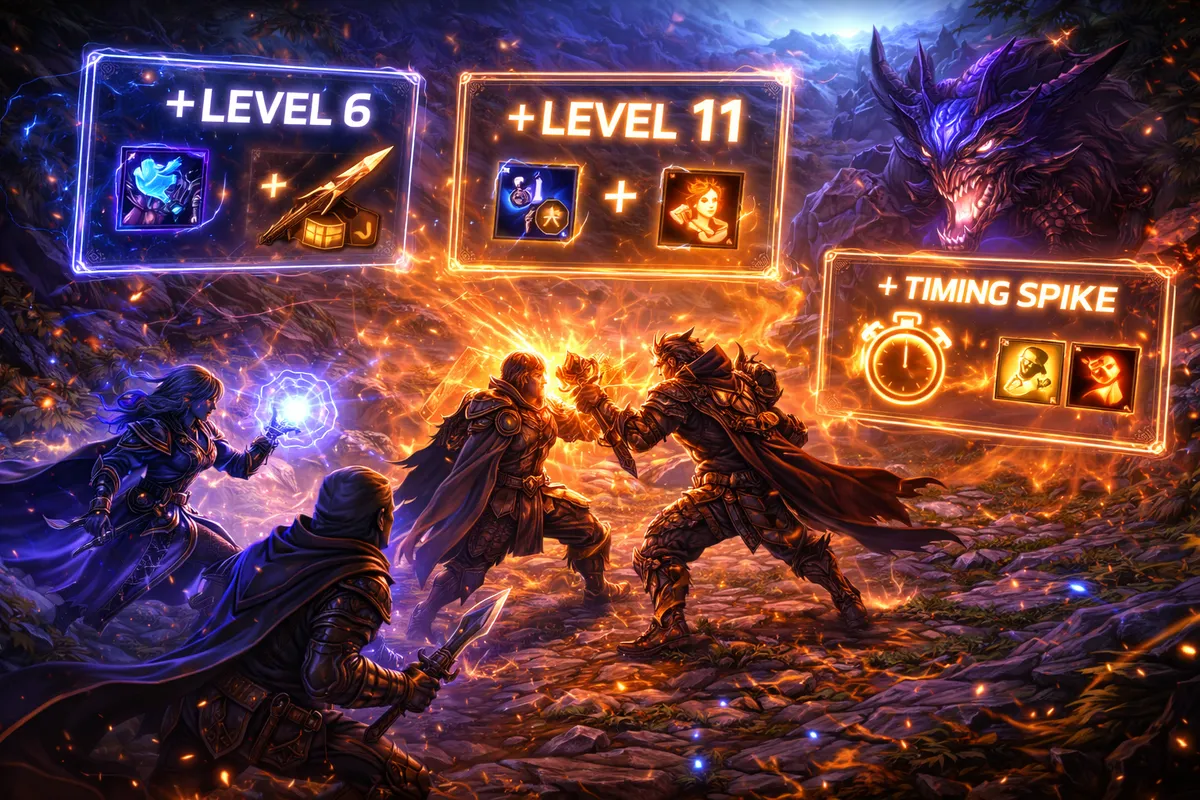
The Three Types of Power Spikes
Most spikes fall into three categories. If you can label a spike quickly, you can act on it quickly.
1) Level spikes
New ability points, ult unlocks, ult ranks, maxed abilities, and raw stats (HP, resist, base damage).
2) Item spikes
Key components that unlock waveclear or sustain, completed items that change fight patterns, and breakpoints like “two items on a carry.”
3) Timing spikes
Windows created by tempo: recalls, wave crashes, vision control, summoners down, and objective timers (especially in 2026 with earlier action and earlier Baron).
Most players only notice item spikes. Climbers notice all three—and plan fights to stack them together.
Level Spikes You Can Plan Around
Levels are the most universal spikes because they happen in every match. The strongest level spikes are the ones that change what your champion is allowed to do.
Level 1 spike (lane identity starts immediately)
Level 1 isn’t “downtime” anymore. In 2026 minions arrive sooner, so level 1 wave control and trading start quickly. If your champion is strong level 1, use it to gain wave control. If your champion is weak level 1, your job is to avoid losing 30% HP for free.
Level 2 spike (first real advantage window)
Level 2 is the first moment where you can threaten a meaningful trade pattern change (two abilities vs one). The team that hits level 2 first in lane often controls the next 1–2 minutes:
- bot lane can force a heavy trade, burn summoners, or deny wave control
- mid lane can secure priority to ward or roam
- top lane can threaten a strong short-trade/all-in depending on matchup
Practical rule:
If the enemy hits level 2 first, back up before it happens. Don’t wait to see the “ding.”
Level 3 spike (full kit access)
For many champions, level 3 unlocks their full trade cycle: damage + mobility + defense/CC. This is when:
- assassins get real kill threat
- mages can play safer with a full ability set
- bruisers can begin stronger extended trades
- supports can unlock engage + follow-up patterns
Level 6 spike (ultimate changes the lane)
Level 6 is the biggest lane breakpoint for most matchups. If you hit 6 first, you gain:
- kill threat
- wave control threat (many ults force recalls)
- dive threat (especially with a stacked wave)
- objective threat (you can move first because your opponent must respect all-in)
Practical rule:
Always check who hits 6 first and play 10 seconds safer if it’s the enemy.
A lot of “random deaths” happen in the 10 seconds after the enemy hits 6.
Level 9 spike (first maxed basic ability)
Level 9 often means:
- waveclear becomes fast and consistent
- poke/trade patterns become more oppressive
- jungle clears and duels become cleaner
- you can set up objectives faster because you clear waves faster
If your champion’s power is tied to one primary ability, level 9 is your “lane becomes easy” moment.
Level 11 spike (second ultimate rank)
Level 11 is a massive mid-game teamfight spike. Many ultimates scale strongly with rank, and level 11 often coincides with:
- first or second major objective fights
- first major tower breaks
- teams grouping more often
If your champion’s ultimate defines fights, you should actively plan fights around level 11.
Level 13 spike (second maxed ability)
Level 13 is often a “damage and utility” spike:
- ADCs and fighters get more consistent output
- mages often get stronger control or cooldown patterns
- supports may hit important cooldown breakpoints that decide mid-game fights
Level 16 spike (third ultimate rank)
Level 16 is the classic late-game spike that turns many champions into win conditions. If your champion scales hard with ult rank (or has a game-ending teamfight ultimate), level 16 is often when the game becomes easier—if you’re not already too far behind.
2026 top lane note
Top lane has a unique 2026 spike because the top lane role quest can increase the level cap to 20 and increase future XP gains. That means top laners can reach deeper scaling breakpoints faster and can out-level other roles in long games. If you’re top, your “I scale” moment is stronger than it used to be—and if you’re fighting a top laner, you must respect that they may be a level ahead more often.
Ability Rank Spikes and Skill Order Power
Not all levels are equal. A level is only a spike if the ability point changes what you can do.
The most important skill-order spikes
- First point in a mobility/escape tool: suddenly you can trade safely or dodge ganks
- Second point in your main damage ability: early lane pressure increases sharply
- First point in hard CC: gank setups become real
- Max rank in waveclear: you gain priority, roams, and safer recalls
A simple skill-order rule for timing fights:
If your champion’s power is in one spell, fight when that spell is maxed or when you just put a new point into it—avoid fights right before the enemy’s matching spike.
Example pattern (conceptual):
- You are level 8, enemy is level 8. You are about to hit level 9 and max your waveclear spell.
- That means you can soon crash waves faster and rotate first.
- Don’t take a risky fight at level 8 when your best spike is 30 seconds away.
Summoner Spell and Cooldown Spikes
Summoners are mini power spikes because they change whether fights are “possible.”
Flash spike (and Flash disadvantage)
Flash is the most important spell for fight timing. If your opponent’s Flash is down:
- your engage becomes more reliable
- your ganks become more lethal
- their positioning must become more defensive
- objective fights become easier because they can’t escape your first catch
Practical rule:
The moment someone burns Flash, your team has a 5-minute window to punish it—especially around the next objective.
Ignite spike
Ignite creates kill windows and reduces sustain. If you have Ignite and the enemy took a scaling summoner, you should look for:
- level 2/3 all-ins bot lane
- level 6 burst windows mid
- early skirmishes where anti-heal matters
Teleport spike
Teleport is a tempo spike. It allows:
- safer recalls
- returning to lane without losing waves
- faster joining of objective fights
In 2026, top lane’s role quest interacts with Teleport in a major way (either granting Unleashed Teleport if you didn’t take it, or giving a large shield on arrival if you did). That makes top lane fight timing more flexible and more punishing if you ignore TP windows.
Cleanse/QSS-style spike
Anti-CC tools create a “you can’t pick me anymore” spike. If the enemy’s win condition is hard CC onto your carry, the moment you buy a cleanse tool is often the moment fights become winnable.
Practical rule:
If one CC chain keeps ending fights, your real spike is not damage—it’s anti-CC.
Item Spikes: Components vs Completed Items
Many players only respect completed items. Good players respect components too—because components often unlock lane control.
Component spikes (early control spikes)
Components matter when they change one of these:
- waveclear speed
- sustain (stay on map longer)
- mana stability (cast spells without running dry)
- dueling durability (you survive the all-in)
- burst threshold (your combo now kills)
Examples of component-style spikes (by function, not hype):
- Mana + AP component spike: your waveclear becomes reliable, so you can crash and roam
- Big AD component spike: your short trades and last-hit pressure increase
- Armor/MR component spike: you stop dying to the lane’s main damage type
- Attack speed/crit component spike: your DPS becomes smoother for longer trades
Completed item spikes (fight-shaping spikes)
A full item usually changes fight patterns in one of these ways:
- you can burst faster (kill window opens)
- you can sustain longer (extended fights become yours)
- you can engage more reliably (picks become consistent)
- you can survive the first 3 seconds (damage uptime increases)
- you can siege faster (tower and objective conversion improves)
Practical rule:
A completed item is not only “more stats.” It’s permission to change your plan.
If your plan doesn’t change after you buy a major item, you’re often wasting its timing value.
Two-Item and Three-Item Breakpoints by Class
Most mid-game fights are decided by who hits a key breakpoint first.
Marksmen (ADC)
- 1 item: lane control and early skirmish reliability improves
- 2 items: true teamfight DPS begins (front-to-back becomes real)
- 3 items: fights become “you must respect the ADC” territory
2026 note: base critical strike damage returning to 200% makes crit scaling feel sharper, and classic crit capstone items were adjusted accordingly. Practically, this means ADC timing windows around crit breakpoints are extremely important—especially if the enemy team is still on 1–2 items.
Mages
- 1 item: waveclear and rotation control become consistent
- 2 items: teamfight impact and objective control become reliable
- 3 items: one spell rotation can decide fights if you land it
Mage spikes are often tied to:
- cooldown/access (how often you can cast)
- mana stability (how long you can stay)
- and one defensive tool that prevents instant death
Assassins
- 1 item: pick threat becomes real
- 2 items: you can delete carries reliably if you get access
- 3 items: you can delete through some defensive responses (but only if you’re not behind)
Assassin spikes are often more about timing and vision than raw items. A 2-item assassin with fog-of-war control can be stronger than a 3-item assassin walking through wards.
Bruisers/Fighters
- 1 item: dueling becomes stable
- 2 items: you can frontline or split push with confidence
- 3 items: you become a true mid-game carry threat
Bruiser spikes often come from “I can stay in range” tools. If you can’t stay on targets, your spike is delayed no matter how much damage you build.
Tanks
- first resist item: you stop being burst and can take space
- second defensive item: you become fight structure (engage + survive)
- utility/threat purchases: you become unignorable
Tank spikes are about space, not DPS. Your spike is “the enemy can’t walk past me safely.”
Supports
Support spikes are often tied to:
- quest completion timing
- vision control upgrades
- cooldown access (engage or peel frequency)
- and survivability to place wards safely
In 2026, support power spikes become clearer because of quest quality-of-life: cheaper control wards after completion and storing control wards in the quest slot can dramatically change mid-game vision wars.
Role Quest Spikes in 2026
One of the biggest 2026 “new spike layers” is that role quests create predictable mid-game power moments that many players still ignore.
Top lane quest spike
When top completes quest, they gain:
- a higher level cap (up to 20)
- bonus experience and increased future XP gain
- and a Teleport-related reward (either gaining Unleashed Teleport if they didn’t take it, or gaining a large arrival shield if they did)
How to use it:
- If you’re top: plan a fight window soon after completion, because you’re about to out-level the map.
- If you’re fighting the enemy top: avoid “fair” fights when they just completed quest—kite, stall, and fight when your team can collapse.
Mid lane quest spike
Mid quest rewards include:
- upgrading tier 2 boots into tier 3 boots (free power + roaming speed)
- and empowered recall windows (shorter recall channel on a timer)
How to use it:
- Mid players can create tempo spikes by recalling faster, appearing on the map sooner, and arriving first to objectives.
- Enemy teams should respect that mid can “reset and return” faster than expected—especially before dragon/Baron setups.
Bot lane quest spike
Bot quest rewards include:
- an immediate gold reward
- increased gold income per minion kill for the rest of the game
- extra gold per takedown for the rest of the game
- and moving boots into the quest slot, effectively opening a 7th inventory slot
How to use it:
- Bot lane can hit item breakpoints faster and can fit an extra situational item later. That changes late-game fight timing: the ADC becomes a stronger win condition sooner.
- Enemy teams should punish bot before quest completion or focus on pick tools that stop the ADC from converting that scaling.
Support quest spike
Support quest improvements include:
- higher gold generation on support items
- reduced control ward cost after completion
- and storing up to 2 control wards in the quest slot (freeing inventory space)
How to use it:
- After completion, supports can maintain stronger vision denial while still building full items.
- The vision war often swings hard at this moment—if your support just completed quest, plan an objective setup window.
These quest spikes are “macro spikes.” They don’t show up as a big damage number, but they change who controls the map.
Timing Windows: Fight Clocks and Map Timers
A massive part of “timing fights” is knowing when the game naturally creates fight pressure.
Key 2026 timings that affect spikes and fights:
- Minions spawn earlier (0:30), so lane pressure and level spikes start sooner
- Early jungle camps spawn earlier (55 seconds for several camps; 1:07 for Krugs/Gromp), so jungle-to-lane timing windows shift earlier
- Scuttle spawns at 2:55, making early river fights happen sooner
- Baron spawns at 20:00, which pulls “Baron planning” earlier into the mid game
- Minion waves accelerate later (25 seconds at 14 minutes; 20 seconds at 30 minutes), creating more push windows and faster tempo swings
What this means in real ranked games:
- You can’t play the first 4 minutes on autopilot.
- You should treat 19:00–20:00 as a “Baron prep window” if the game is close.
- You must respect that pushes and rotations happen more often after 14:00 because waves arrive faster.
How to Time Fights Using Wave States
Even the biggest item spike is wasted if your wave state is terrible. Wave timing is how you turn spikes into wins.
The spike + wave rule
Fight when your wave is pushing and the enemy’s wave is crashing.
That creates two advantages:
- the enemy loses CS/XP if they leave
- you get to move first without paying a wave cost
Crash before you fight
If a big objective is coming, your best pre-fight move is often:
- push and crash mid wave
- then rotate
- A team that fights while their mid wave is dying to tower is fighting down tempo—even if they’re “stronger.”
Bounce waves create safe spike usage
A classic spike conversion:
- crash a wave → recall → come back stronger → catch the bounce → then fight
- This is how you show up to the fight with items without losing lane.
Slow push to stack a fight
A stacked slow push creates:
- a bigger wave that supports you in fights
- a forced response if the enemy ignores it
- Slow pushing before dragon or Baron can create a situation where the enemy must choose between losing tower progress and contesting the objective.
How to Read Enemy Power Spikes in Real Time
Timing fights is also about avoiding fights when the enemy just spiked.
Here’s the simplest in-game spike reading system:
1) Check levels constantly
Before any major fight, look at:
- who is level 6/11/16
- whether someone is about to ding a key level (especially 6 and 11)
- If your mid is level 10 and the enemy mid is level 11, be careful—fight windows shift hard at that moment.
2) Watch inventory, not KDA
KDA lies. Items don’t.
Before you take a fight, quickly scan:
- did the enemy just complete an item?
- are they sitting on unspent gold (stronger soon)?
- did they buy a defensive answer that stops your combo?
- did they buy anti-heal or penetration that changes your frontline value?
3) Track recalls
A recall is a spike in disguise. If the enemy just recalled and you didn’t:
- you are about to fight into items
- you should usually delay the fight or recall too
4) Track summoners
If your target has no Flash and yours is up, your “catch spike” is active.
If your Flash is down and theirs is up, your “safety spike” is gone.
5) Ask one question
Before you commit:
“Are we stronger right now, or stronger in 60 seconds after we reset?”
That one question prevents countless throws.
Role-by-Role Fight Timing Playbooks
Different roles “spike” differently, so their best fight timing habits differ.
Top lane fight timing
- Use level and wave advantage to create isolated pressure
- Fight around your strongest dueling windows (often 6, 9, and first/second item)
- Respect that top lane quest completion creates a major scaling spike
- Avoid joining random fights when your side wave is in a terrible state—fix the wave first so you join with tempo
Jungle fight timing
- Your spikes are often tempo spikes: clear speed, level 6, first item completion, and Smite upgrades
- Your best fights are usually fights you arrive to first with vision and lane priority
- If your lanes have no priority, your “fight spike” is delayed—play for counterganks and safe objectives instead of forcing
Mid lane fight timing
- Mid spikes strongly at waveclear breakpoints (often level 9 and first item)
- 2026 mid quest rewards add tempo spikes: tier 3 boots and empowered recall windows
- Your best time to fight is usually right after you crash a wave and move first
- If you can’t move first, your job is often to stabilize and avoid losing the map
ADC fight timing
- ADC spikes are heavily item-based: 1 item, 2 items, and crit breakpoints
- In 2026, bot quest rewards accelerate gold income and open an extra inventory slot later, which strengthens your scaling windows
- Your fight timing rule: fight when you can stand and hit safely (frontline + vision), not when you’re forced to face-check
Support fight timing
- Support spikes are often vision spikes: quest completion, control ward access, and roam windows
- Your best fights are fights you “set up” with vision denial
- If you’re behind, your spike is often “peel tools online” rather than engage—choose fights that protect your carry and punish overdives
Objective Fights: Turning Spikes into Dragons, Herald, Baron
The easiest way to convert a spike is to attach it to an objective. A spike that doesn’t become something permanent is often wasted.
Dragon fights
Dragon fights are usually won by:
- arriving early
- having wave control
- placing vision on entrances and flanks
- Your power spike matters most if you show up on time and with resources.
Herald fights
Herald is a tempo objective. Winning Herald fights often depends on:
- top/mid priority
- jungler tempo
- and being willing to trade rather than coinflip
- If your top just hit a major level spike or item spike, Herald becomes much easier.
Baron fights (20:00 in 2026)
Baron timing is earlier now, which changes everything:
- you must plan recalls earlier
- you must control mid wave earlier
- you must treat 19:00–20:00 as a “don’t die, don’t donate vision” window
Baron is also more durable and more punishable if you start it without setup. Your best spike conversion is often:
- clear vision
- threaten Baron
- turn and fight when the enemy face-checks
- take Baron after the fight
That is how you avoid coinflips and end games cleanly.
Common “Power Spike” Mistakes That Lose Games
These are the mistakes that keep players stuck—even with good mechanics.
Fighting on unspent gold
If you have 1500+ gold and stay on the map “just to fight,” you’re delaying your own spike and gambling.
Fighting right before your spike
If you’re one wave away from level 6 or one recall away from a completed item, don’t flip a fight early.
Ignoring enemy spike windows
If the enemy just completed an item and you didn’t, that is not the moment to “test” them.
Treating every fight like it must happen
Sometimes the correct play is to give space, reset, and fight on your timing.
Not stacking spikes
The strongest fights happen when you stack:
- item completion + level spike + wave crash + vision advantage
- If you fight with only one of those, you’re lowering your odds.
Trying to “outplay” predictable spikes
A level 6 all-in or a completed item burst threshold is not something you outplay consistently by hope. You outplay it by respecting it and choosing a better timing window.
A Simple Practice Plan to Build Spike Awareness
Spike awareness becomes automatic when you practice it like a habit, not like trivia.
Game focus #1 (10 games): level awareness
- Track who hits level 6 first in your lane
- Back up before the enemy hits it
- Force a trade when you hit it first
Game focus #2 (10 games): recall for item spikes
- Don’t fight on big gold
- Crash wave → recall → return with item advantage
- Ping your item completion timing (even if only in your head)
Game focus #3 (10 games): objective timing discipline
- Show up earlier to dragon/Baron setups
- Avoid dying in the 60 seconds before a major objective
- Practice “reset before objective” as a rule
After 30 focused games, you’ll feel something big change: fights stop being surprises.
BoostRoom: Make Power Spikes Your Win Condition
Most players know power spikes exist. The difference is that higher-rank players can use them under pressure: they recall at the right time, they avoid the wrong fights, and they convert spikes into objectives without throwing.
BoostRoom helps you build a power-spike system tailored to your role and champion pool:
- a “spike map” for your champions (exact level and item breakpoints to play around)
- recall timing routines that consistently hit those breakpoints first
- matchup-specific fight rules (when your level 6 wins vs when it loses)
- objective setup plans that turn spikes into dragons, Baron, and towers
- replay feedback that shows the exact fight you took at the wrong time—and what timing would have won it
When you stop coinflipping fights and start scheduling them around spikes, ranked becomes cleaner, calmer, and far more consistent.
FAQ
What is a power spike in League of Legends?
A moment where your champion becomes significantly stronger due to levels, items, summoner advantages, tempo, or role-quest rewards—making fights more favorable if you act immediately.
What are the most important level spikes to remember?
Level 2 (lane control), level 3 (full trade kit), level 6 (ultimate unlock), level 9 (first maxed ability), level 11 and 16 (ultimate ranks). Top lane can also reach level 20 in 2026 through role quest scaling.
What is the biggest item power spike in most games?
For many champions it’s the first completed item (lane becomes easier) and the second completed item (teamfight strength becomes reliable). ADCs often feel the biggest jump at 2–3 items, especially with crit breakpoints.
How do I know if we should fight or reset?
Ask: “Do we have unspent gold?” and “Do we hit a spike within 60 seconds?” If yes, resetting and fighting later is often stronger than forcing now.
Why do we lose fights even when we’re ahead on kills?
Kills don’t guarantee item advantage. If the enemy spent gold and you didn’t, or if they hit level 11/16 first, you may be fighting into a spike.
How do role quests change power spikes in 2026?
Role quest rewards create predictable mid-game spikes: top gets higher level scaling and TP-related power, mid gains tier 3 boots and empowered recall tempo, bot gains extra gold scaling and a boots slot, support gains stronger vision economy and control ward storage.
How do I stop taking “bad fights” automatically?
Use one rule: “No fights on unspent gold.” Then add: “No fights when we’re late to the objective.” Those two rules remove most avoidable throws.



