What a Teamfight Really Is
A “teamfight” is not just five champions pressing buttons at the same time. A real teamfight is a short sequence with three phases:
1) Setup (who arrives first, who has vision, which waves are pushed)
This phase decides how fair the fight will be. If you walk into darkness late, you’re already losing.
2) The first 3 seconds (the engage, the counter, the first target)
Most fights are decided here. Either someone gets instantly deleted, a key cooldown is burned, or the whole formation breaks.
3) Cleanup and conversion (who chases, who takes objectives, who resets)
Winning a fight only matters if it becomes something permanent—dragon, Baron, towers, inhibitors, or at minimum a map reset that keeps your tempo.
When you improve teamfighting, you’re improving all three phases—not just the “press buttons” moment.
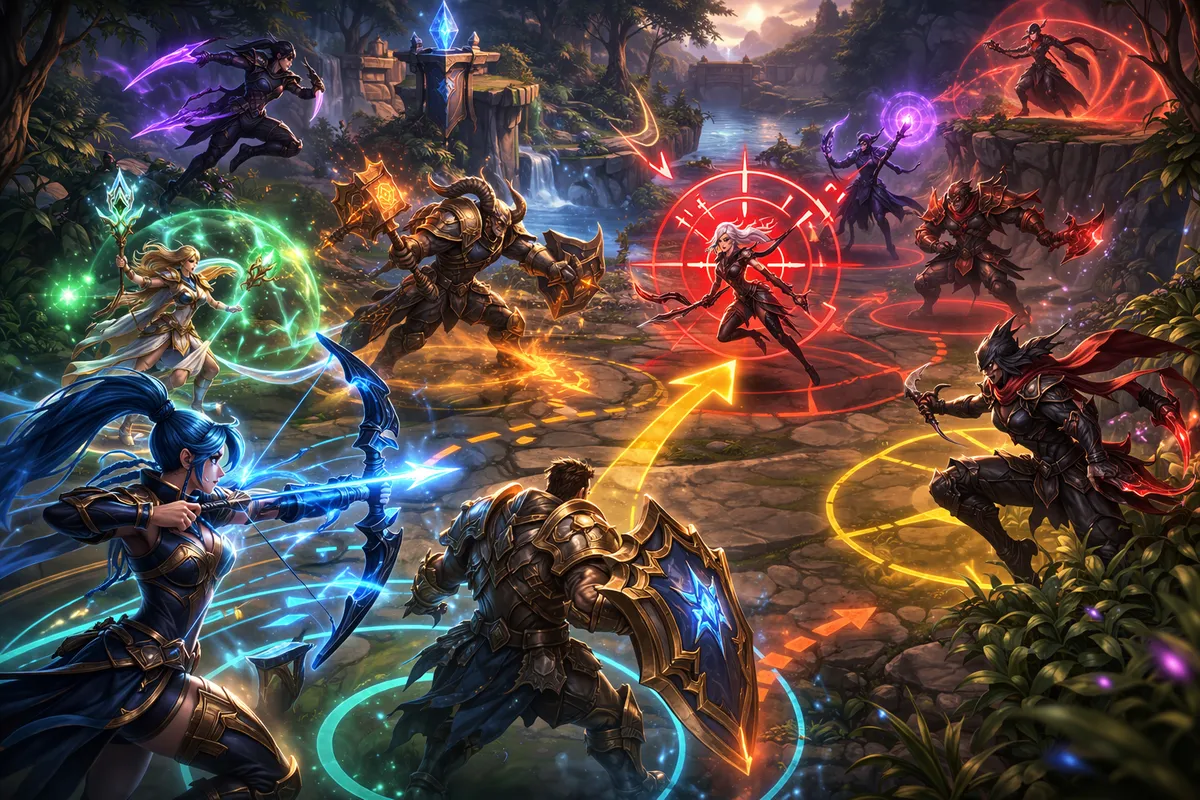
The Big Three: Target Selection, Spacing, Win Conditions
Every good teamfight can be explained by three questions:
Target selection: Who are we allowed to hit right now, and who must die first?
Spacing: Where do I stand so I can contribute without getting deleted?
Win conditions: What does “winning this fight” look like for our comp?
If you answer those three questions before the fight starts, you’ll win more fights even with average mechanics.
Win Conditions: The Most Important Teamfighting Skill
A win condition is the simplest statement of how your team wins a fight. It’s not a complicated strategy—it’s a clear direction.
Here are common win conditions you’ll see in real games:
Win condition A: Front-to-back
- Your frontline hits their frontline.
- Your backline (ADC/mage) melts whoever is closest.
- You win slowly by staying alive longer and dealing consistent damage.
Win condition B: Pick first, then fight
- You catch one enemy out of position.
- The fight starts as a 5v4.
- You secure the objective or take structures.
Win condition C: Dive the backline
- You bypass tanks with mobility/engage.
- You kill the enemy carries quickly.
- The fight ends before their damage can matter.
Win condition D: Kite back and punish
- You don’t “start” fights.
- You bait enemy engage.
- You kite backward, then re-enter after cooldowns are used.
Win condition E: Zone control
- You don’t need to kill immediately.
- You control space with AoE and threats.
- The enemy can’t walk into the objective area safely.
You don’t pick a win condition based on vibes—you pick it based on your team comp.
How to Identify Your Win Condition in 10 Seconds
Before a fight, do this quick scan:
1) Who is stronger in a straight 5v5 front-to-back?
If you have better scaling ADC + peel + frontline, your win condition is usually front-to-back.
2) Who has the better engage button?
If you have reliable engage (big AoE CC, point-and-click lock, unstoppable initiation), your win condition might be “start the fight first.”
3) Who has the better dive tools?
If you have multiple champions who can reach carries, your win condition might be “dive and delete.”
4) Who has better poke/zone?
If you have long-range damage and strong objective control, your win condition might be “soften them first, then take space.”
5) What objective is this fight about?
If it’s dragon or Baron, win condition often becomes: control entrances + deny flanks + protect your carries.
When you name your win condition, your decisions become easier:
- You stop forcing bad engages.
- You stop chasing the wrong targets.
- You stop standing in the wrong place.
Target Selection: The “Closest Safe Target” Rule
If you only learn one target selection rule, learn this:
Hit the closest safe target.
This is the core rule behind most consistent teamfight wins, especially in Solo Queue. It prevents the most common throw: walking forward through danger to hit a “better” target.
Closest safe target usually means:
- the enemy tank in front of you,
- the bruiser diving your team,
- the support stepping too far forward,
- or the first enemy who enters your damage zone.
You are not “wasting damage” by hitting frontline if that’s what you can hit safely. You are doing your job.
When You Should Break the Closest-Safe Rule
There are times where switching targets is correct, but your reason must be strong:
Switch if the new target is equally safe or safer.
Good switch examples:
- Enemy carry walks into your range without protection.
- Your team CCs a priority target in front of you.
- The enemy frontline is no longer threatening (cooldowns down, low HP, or peeled off).
- The assassin/diver has already committed and failed—now you can step forward.
Bad switch examples:
- “They’re low HP” but you must walk into CC range.
- “I want the kill” but it breaks your spacing.
- “My teammate pinged them” but the path is dangerous.
If you’re not sure, default back to closest safe target.
Target Priority by Role
Target selection changes depending on your job.
ADC
- Default: closest safe target.
- Avoid: stepping into fog or past your frontline.
- Goal: maximum damage uptime while alive.
Control mage
- Default: hit what’s in range while controlling space.
- Use AoE to punish clumps.
- Goal: zone entrances and punish dives.
Burst mage
- Default: delete whoever mispositions into your combo range.
- Goal: remove one key enemy early, then play slower.
Assassin
- Default: do not start the fight.
- Enter after key CC is used.
- Goal: kill or force out the enemy carry, then escape or reset.
Bruiser
- Default: hit whoever is contesting space.
- Goal: take space and threaten backline when safe.
Tank/engage
- Default: lock the correct enemy at the correct time.
- Goal: start fights that your team can follow, or peel if your backline is threatened.
Support
- Enchanter: protect the carry, deny divers.
- Engage support: start fights when follow-up exists.
- Mage support: create picks and control space.
When you know your role’s target job, you stop doing “everything” and start doing the part that wins fights.
Spacing: The Hidden Skill Behind Every Carry
Spacing is controlling distance. It’s the difference between:
- dealing damage safely,
- or stepping one inch too far and getting deleted.
Spacing is not only for ADCs. Everyone needs it:
- Tanks must stand close enough to block threats but not overextend alone.
- Mages must stand where they can cast without getting engaged on.
- Supports must stand where they can affect the fight without being caught.
Spacing creates “free seconds” where you damage the enemy while they can’t damage you. Those free seconds win fights.
The Three Spacing Zones
Think of spacing as three zones you move between:
Safe zone
- You are protected by teammates, terrain, and distance.
- You can play slowly and wait for cooldown windows.
Threat zone
- You are close enough to influence the fight.
- You can deal damage or apply CC.
- This is where most fights are won, but also where mistakes get punished.
Death zone
- You are inside enemy engage/burst range with no escape plan.
- If you enter this zone without a clear reason, you die.
Most players die because they drift into the death zone without noticing. Great players constantly ask: “Am I in threat zone or death zone?”
Threat Tracking: How to Make Spacing Easy
Spacing becomes easier when you track the two biggest threats to you.
Before a fight, identify:
- Threat #1: the ability that kills you (hook, stun, dive ultimate, flash engage).
- Threat #2: the follow-up that finishes you (burst combo, second CC, execute).
Then position so:
- you are not in range of both at the same time,
- you can kite toward safety,
- you are within reach of your peel (if you have it).
This is the difference between “I got one-shot out of nowhere” and “I saw it coming and lived.”
Formations: The Shape Your Team Should Be In
Most teams lose fights because they have no formation. They’re scattered, facing different directions, and easy to pick.
Here are the most common formations:
Front-to-back line
- Tanks/bruisers in front
- Damage dealers behind
- Support near carries
- This is the easiest formation to execute.
Wedge
- Engage champ at the tip
- Team behind in a tight triangle
- Good for hard engage comps, but risky if you clump into AoE.
Split formation
- Two threats from different angles
- Forces enemy to choose what to respond to
- Used by dive or flank comps, but requires coordination and vision.
Siege arc
- Team spreads slightly around a turret
- Carries maintain distance, wards protect flanks
- Prevents AoE disasters and reduces flank deaths.
A good default for most Solo Queue teams is simple:
Stay in front-to-back shape unless your comp is built to dive.
Front-to-Back Teamfighting Basics
Front-to-back is the most reliable teamfight style in ranked because it works even when your team isn’t coordinated.
Front-to-back checklist
- Frontline holds space, does not chase into fog.
- Carries hit the closest safe target.
- Support stays in range to peel/shield.
- Team retreats together when threatened, then re-enters together.
The “secret” to front-to-back is patience. You don’t win by diving the backline first—you win by surviving and dealing damage longer.
Dive Teamfighting Basics
Dive is high-risk, high-reward. It wins fast if executed well and loses instantly if your backline gets abandoned.
Dive checklist
- You identify the enemy carry you must remove.
- You enter together (not one-by-one).
- You track peel tools (shields, disengage, exhaust, CC).
- Your backline is safe enough to survive the counter-dive.
Dive teams lose when:
- they dive while their carries cannot follow,
- they dive into visionless chokes,
- or they ignore the enemy’s counter-engage.
If your team is not coordinated, front-to-back is usually safer than dive.
Peel vs Engage: The Support Decision That Changes Everything
Many fights are decided by one support decision: do you engage, or do you peel?
Peel is correct when:
- your carry is the win condition,
- the enemy has divers/assassins,
- your carry is ahead or is the only consistent damage,
- the fight is around an objective and survival matters.
Engage is correct when:
- the enemy is mispositioned,
- your team has follow-up nearby,
- you have vision control and can force a clean start,
- you can lock a priority target without overextending.
Supports who climb fast are not “always engage” or “always peel.” They choose the correct job for the fight.
The First 3 Seconds: How Teamfights Are Actually Won
The first 3 seconds of a fight decide:
- whether a carry gets deleted,
- whether key cooldowns are wasted,
- whether one team loses formation.
Your goal in the first 3 seconds is not “do maximum damage.” Your goal is:
Do not lose the fight immediately.
Practical first-3-seconds rules:
- If you are a carry, do not walk into fog or choke first.
- If you are a tank, do not engage without follow-up.
- If you are an assassin, do not reveal early—wait.
- If you are a support, do not waste your best peel tools before the enemy commits.
Winning the first 3 seconds often means the rest of the fight is easy.
Cooldown Trading: Why Some Teams Win Even When Behind
Teamfights aren’t only about HP bars. They are about cooldowns.
A teamfight often becomes:
- Team A uses big engage.
- Team B uses disengage/defensives.
- If Team B survives, Team A has no tools and loses the extended fight.
This is why “kiting back” is so powerful. If you survive the enemy’s main burst window, your win chance spikes.
A simple mindset:
If the enemy used their big cooldowns and didn’t get a kill, you are now favored.
Space Control: How Objectives Decide Where You Stand
Teamfights around objectives are not “open arena fights.” They’re fights in narrow entrances where vision and zoning matter.
Objective fights are usually won by controlling:
- entrances and chokes,
- flank routes,
- and the space your carries need to hit safely.
If your team is setting up dragon/Baron, your job is often:
- ward the entrances,
- clear enemy wards,
- and hold the area so the enemy must face-check.
Teams that start objectives without controlling entrances are basically inviting a coinflip fight.
Terrain and Chokepoints: The Spacing Traps
Terrain can win fights for you or against you.
Good terrain for your team
- Chokes when you have AoE (you punish clumps).
- Tight entrances when you have engage and follow-up.
- Corners when you have picks.
Bad terrain for your team
- Chokes when the enemy has AoE and you must walk in.
- Walls when the enemy has jump-in burst and you can’t kite.
- Fog corridors when the enemy has hooks or pick tools.
One pro-level habit:
Don’t fight where the enemy wants to fight.
If the terrain is bad, back off, push waves, and re-enter with vision.
Teamfight Win Conditions by Team Comp Type
To make win conditions practical, here are common comp types and what they want:
Team comp: Protect the carry
- Win condition: keep ADC/mage alive and front-to-back.
- Fight plan: peel, kite, re-engage after enemy commits.
Team comp: Hard engage
- Win condition: start first on a priority target.
- Fight plan: vision control → pick angle → engage together → burst quickly.
Team comp: Poke
- Win condition: force enemy low before they can start.
- Fight plan: control space → poke from safety → take objective when they can’t contest.
Team comp: Skirmish
- Win condition: messy fights with resets and mobility.
- Fight plan: split threats → punish isolated targets → avoid stationary 5v5 chokes.
Team comp: Dive
- Win condition: remove enemy carries early.
- Fight plan: flanks and angles → enter together → stop peel tools → finish fast.
If you play your comp’s win condition, your team looks coordinated even without voice chat.
Role-by-Role Teamfight Rules You Can Copy
These rules are simple on purpose. Simple rules are the ones you actually use in ranked.
ADC Rules
- Default target: closest safe target.
- Position: behind frontline, near peel, with a clear escape path.
- Movement: move between autos when threatened; micro-step when safe.
- Biggest mistake to avoid: stepping forward to “finish” a target when threats are alive.
Mid Mage Rules
- Arrive early; don’t be late to objective fights.
- Cast from a safe angle; avoid standing in the same line as your carry (AoE punish).
- Use abilities to control entrances and punish divers.
- Biggest mistake to avoid: using key CC on the wrong target and leaving your carry exposed.
Assassin Rules
- Do not start the fight.
- Wait until key CC is used or a carry is isolated.
- Enter, secure kill/force retreat, then exit or reset.
- Biggest mistake to avoid: diving into full vision and getting controlled instantly.
Top Bruiser Rules
- Take space in front of your carries.
- Threaten enemy backline only when your team can follow or you have a safe exit.
- If you can’t reach carries safely, hit whoever is in front and win slowly.
- Biggest mistake to avoid: chasing too deep and leaving your team without frontline.
Tank/Engage Rules
- Engage only when your team is in range.
- If you miss engage or get countered, back up and reset formation.
- Protect carries if the enemy dive is stronger than your engage.
- Biggest mistake to avoid: “hero engage” that your team can’t follow.
Support Rules
- Your job is either to start the fight or protect the win condition—pick one based on comp.
- Track enemy threat abilities and save peel tools for the moment they commit.
- Control vision and stop facechecks before objectives.
- Biggest mistake to avoid: dying first and removing your team’s structure.
Spacing Exercises: How to Stop Dying for Free
You don’t need perfect mechanics to improve spacing. You need awareness habits.
Habit 1: Always keep one retreat path open
Before the fight starts, decide where you will kite if danger appears.
Habit 2: Don’t stand in front of your frontline
If you’re a carry, your frontline is your shield. Let them be the first contact point.
Habit 3: Respect fog
If you can’t see a threat, position as if it’s nearby. Fog is how flanks and picks happen.
Habit 4: Keep fights “wide” when you’re the carry
Instead of hugging walls and tight corners, fight in open space where you can move.
These habits instantly reduce “random deaths,” which increases your damage and impact.
Target Selection Mistakes That Lose Fights
Most target selection mistakes come from ego or impatience.
Mistake: Tunneling the enemy carry through danger
Fix: hit what is in front of you until a safe window opens.
Mistake: Splitting damage
Fix: focus the same target your team is focusing, unless you have a clear reason to hit something else.
Mistake: Switching targets just because someone is low
Fix: only switch if the new target is safe and valuable.
Mistake: Ignoring the diver
Fix: if a diver is on your carry, the diver becomes the priority target, because they’re the immediate threat.
Teamfights are often won by killing the threat, not the “most valuable champion.”
Fight Start Basics: How to Start on Your Terms
Not every fight should be started immediately. Many winning fights are created by forcing the enemy into a bad approach.
Ways to create a good fight:
- Push waves first so you arrive earlier.
- Own vision so the enemy must walk blind.
- Hold a choke so you can punish entry.
- Threaten the objective so the enemy is forced to contest.
If you start fights because you’re bored, you will lose fights you should have won.
The “Turn” Concept: Objective to Fight to Objective
One of the cleanest teamfight patterns is:
Threaten objective → enemy walks in → turn and fight → take objective
This avoids coinflip Smites and punishes face-checkers. Turning works best when:
- your team is grouped,
- your vision is stronger,
- and the enemy must enter through predictable paths.
If your team is stronger, turning is often safer than rushing.
Teamfight Communication Without Typing
You can win more fights just by pinging the right thing at the right time.
High-value pings:
- On my way to signal you’re rotating (prevents teammates from fighting early).
- Danger on flank routes when enemies are missing.
- Target ping on the correct first target (diver, frontline, or mispositioned carry).
- Assist me on a vision setup area before objectives.
Even one correct ping can stop a disaster fight.
Post-Fight Basics: How to Convert a Win
This is where many teams throw. They win a fight, then do nothing or chase too far.
After you win a fight, choose one:
- Dragon/Baron
- Tower
- Inhibitor
- Enemy jungle vision and camps
- Reset to spend gold and keep tempo
A simple rule:
If you win a fight and the objective is available, take the objective. If not, take towers. If towers aren’t safe, take vision and reset.
Chasing kills into fog is the classic throw because it turns a win into a shutdown donation.
Teamfighting From Behind: How to Win Without Being Stronger
When you’re behind, you usually can’t win a fair 5v5. Your goal is to make fights unfair.
Comeback fight strategies:
- Fight in tight chokes if you have AoE and can punish clumps.
- Pick someone with vision traps and CC.
- Kite and punish if the enemy has to dive into you.
- Trade objectives instead of forcing a losing contest.
Your comeback win condition is often:
survive, catch waves, stop giving free deaths, then win one clean fight around vision.
Teamfighting When You’re Ahead: The “Don’t Throw” Rules
Most throws happen from greed.
If you’re ahead:
- Don’t face-check.
- Don’t chase deep without vision.
- Don’t start coinflip fights when you can set up first.
- Don’t let your carry be isolated.
Ahead teams win by being boring:
setup, force them to enter, punish, convert.
The 10 Most Common Teamfight Errors
If you want a quick self-checklist, these are the mistakes that show up in nearly every rank:
- Fighting when your wave is shoved into your tower (you’re late).
- Starting before your team arrives.
- Face-checking without vision.
- Carry walking into a choke first.
- Tank engaging with no follow-up.
- Assassin revealing too early.
- Support using peel tools before the enemy commits.
- Everyone chasing different targets.
- Winning the fight then chasing instead of taking objectives.
- Taking a “second fight” immediately while low and sitting on unspent gold.
Fixing even three of these will make your fights feel dramatically easier.
Simple Drills to Improve Teamfighting Fast
You improve teamfights through repetition and review.
Drill 1: Role rule repetition
Go into games with one sentence:
- ADC: “closest safe target.”
- Assassin: “enter second.”
- Tank: “engage only with follow-up.”
- Repeat it every fight.
Drill 2: Threat list
Before each fight, name two threats that can kill you. Position accordingly.
Drill 3: One-fight review
After a game, review only the biggest fight and answer:
- What was our win condition?
- Did we follow it?
- Who died first and why?
- What single change prevents that next time?
One-fight review is fast and effective.
BoostRoom: Turn Teamfights Into a Repeatable System
If you want to climb faster, teamfighting is a perfect focus because it impacts every role and every game. The challenge is that most players “know” general tips but don’t have a repeatable plan in real fights.
BoostRoom helps you build that plan:
- Clear win-condition identification for your champion pool
- Role-specific teamfight rules you can apply instantly
- Target selection training (when to hit frontline vs when to swap)
- Spacing and threat tracking habits tailored to your role
- Replay feedback that pinpoints the exact moment your fight broke
When teamfights stop being guesswork, your rank stops feeling random.
FAQ
What does “win condition” mean in a teamfight?
It means the simplest way your comp wins the fight—front-to-back, pick first, dive carries, kite back, or zone space. Knowing it tells you how to position and who to focus.
Who should I focus in teamfights?
Most of the time: the closest safe target. Only switch when a priority target becomes equally safe or safer to hit.
How do I stop dying instantly in fights?
Identify the two biggest threats to you, avoid their combined range, stay near peel, don’t face-check fog, and keep an escape path open.
How do assassins teamfight without inting?
They enter after the fight starts—after key CC is used or a carry is isolated—then they exit or reset. Starting the fight as an assassin is usually a throw.
How do tanks know when to engage?
Engage when your team is in range to follow and when you can lock a meaningful target. If your carry is threatened, peeling can be better than engaging.
How do we win objective teamfights more often?
Set up earlier: push waves, place vision on entrances, clear enemy wards, and force them to walk into you. Most objective fights are won before the objective is touched.
What should we do after winning a teamfight?
Convert immediately into something permanent: dragon, Baron, towers, inhibitors, or vision + reset. Don’t chase deep and donate shutdowns.



