Recon Shell Identity: What You’re Really Playing
Recon is often misunderstood as “the scout who stays back.” In Marathon, Recon is closer to an intel hunter: you locate threats, force movement, and then track fleeing targets until the fight ends. Your kit is built around three ideas:
- Reveal: Echo Pulse tells you what’s inside the fog—players, bots, and hidden threats.
- Pressure: Tracker Drone forces enemies to reposition, and punishes them with overheat when it connects.
- Finish: Stalker-style tracking turns a shield break into a chase you can win.
If you love controlling the tempo of a run—deciding when the squad rotates, when you take the fight, and when you extract—Recon is one of the best Shells to main.
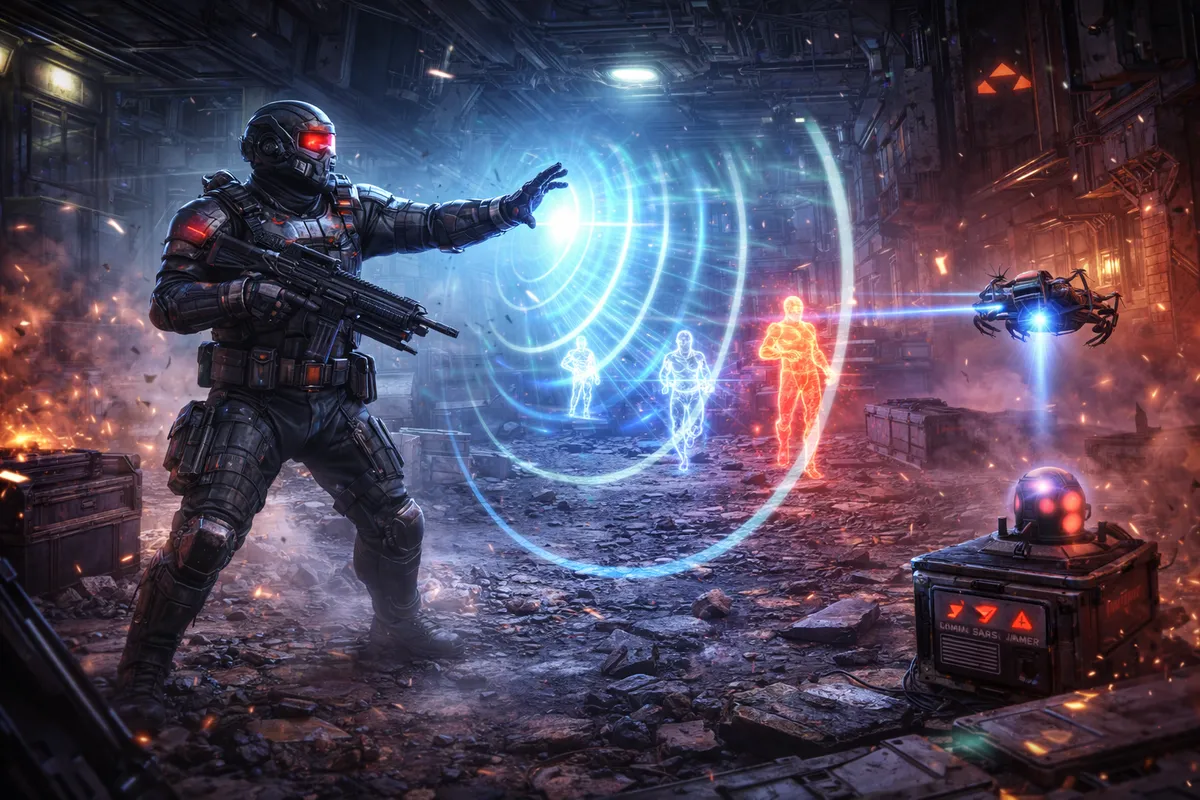
Recon’s Full Kit Overview (So You Know What You’re Building Around)
Recon’s kit revolves around a Prime, a Tactical, and two Traits:
- Prime Ability: Echo Pulse
- A burst of sonar pulses that reveals nearby hostiles in range. It’s your “board state” button.
- Tactical Ability: Tracker Drone
- A deployable microbot that hunts nearby hostiles and explodes, overheating targets caught in the blast. It’s your “make them move” tool.
- Trait: Interrogation
- Alerts you when you’re pinged by a hostile Runner, and finishing a Runner pings their crew. It’s your “don’t get surprised + snowball the wipe” trait.
- Trait: Stalker Protocol
- After you break someone’s shields, they leave a lingering holographic trail for a short time. It’s your “no escape” tracking tool.
Recon is not about doing the most damage. Recon is about making sure your team fights only the fights that are worth taking—and finishes the fights you start.
Echo Pulse Explained: What It Does (And What It Does Not Do)
Echo Pulse is the ability that makes Recon feel like a “big brain” Shell—because it gives you information that other teams don’t have.
What Echo Pulse does well
- Reveals hostiles inside a radius, giving you immediate awareness.
- Helps you avoid walking into stacked rooms or contested objectives.
- Gives you a “rotation check” before crossing open space or entering a high-value area.
What Echo Pulse does not do
- It is not permanent tracking. It’s a snapshot (or a short series of pings), not a live GPS.
- It doesn’t win fights by itself. You still need positioning and timing.
- It won’t save you if you pulse too late—after you’ve already been shot and boxed in.
The beginner misconception: “If I pressed Echo Pulse, I’m safe.”
The truth: “If I pressed Echo Pulse, I now have a decision to make.”
Smart Scans: The Recon Scan Cycle That Wins Runs
Most Recon players don’t fail because their scans are wrong. They fail because they don’t scan with a purpose. A smart Recon plays a simple cycle all match:
Scan → Decide → Move → Rescan
Here’s what that looks like in real gameplay:
- Scan: Use Echo Pulse before a commitment (entering, crossing, extracting).
- Decide: Choose one of three outcomes:
- Push with advantage
- Rotate away
- Hold and bait
- Move: Reposition immediately. Don’t stand where you pulsed.
- Rescan: Pulse again only when a new commitment is coming (not on cooldown panic).
If you do nothing else as Recon, do this: pulse before decisions, not after mistakes.
When to Use Echo Pulse: 9 High-Value Scan Moments
Echo Pulse is on a long cooldown compared to your Tactical. You want to spend it on moments that change the run.
1) Spawn stabilization
Right after you settle in, pulse if you suspect a nearby spawn fight. Early information prevents early wipes.
2) Before entering a high-value building
If you’re about to go inside where loot and contracts are concentrated, Echo Pulse prevents you from walking into a trap.
3) Before crossing a dangerous lane
Pulse, then cross. If you pulse after you cross, it’s usually too late.
4) When a fight goes quiet
Silence is often a reset, a heal, or a flank. Pulse to see whether they disengaged or rotated for an angle.
5) Before committing to a revive
Revives are “time-locked.” Pulse to confirm you’re not about to get pushed mid-revive.
6) Before starting extraction
Extraction is a contested objective. Pulse first to reduce “finish line” deaths.
7) After your team downs one enemy
Pulse to see if the remaining teammates are holding, flanking, or running.
8) When you hear third-party pressure
If two teams are near, pulse to avoid getting sandwiched.
9) When you’re carrying the run
If you have the most value in your bag, scan like your inventory matters—because it does.
Echo Pulse Mistakes That Get Recon Players Deleted
Echo Pulse is powerful, but it can also get you killed if you treat it like a magic shield.
Mistake: Pulsing and then standing still
Good teams punish predictable Recon behavior. After you pulse, move.
Mistake: Pulsing only after you’re already losing
Echo Pulse is best when you’re still in control. Use it before you get boxed in.
Mistake: Pulsing in the wrong position
If you pulse from a bad angle, you don’t gain advantage—you gain anxiety. Pulse from cover or safe elevation.
Mistake: Pulsing too early and then taking 20 seconds to act
Echo Pulse is most valuable when your action is immediate: rotate, push, hold.
Mistake: Using Echo Pulse as a “hunt button” with no exit plan
Recon isn’t a mobility Shell. If you chase without routes, you get collapsed on.
Echo Pulse Updates and Counterplay: What Smart Teams Will Do to You
Marathon’s Recon kit has been actively tuned post-launch, including changes announced for Echo Pulse that improve its information clarity and reduce how obvious it is to enemies that they’re being scanned. At the same time, counterplay exists—especially through items designed to disrupt scanning and pings.
What this means for Recon players
- You should expect some enemies to mask or mislead your scans.
- You should always confirm with positioning and audio—never rely on one scan alone.
- You should plan your pushes to succeed even if one ping is imperfect.
The Recon mindset: Treat scans as an advantage, not as truth. Your job is to reduce uncertainty, not eliminate it.
Tracker Drone Explained: What It’s For and Why It’s Deadly in Tight Fights
Tracker Drone is your Tactical ability, meaning you should use it often—because it creates pressure that wins fights.
What Tracker Drone does
- Deploys a tracking microbot that hunts nearby hostiles.
- Forces enemies to react (shoot it, run from it, or get punished).
- Explodes near targets, applying overheat effects and dealing damage.
Why overheat matters
Even without perfect aim, overheat pressure can:
- reduce enemy movement freedom
- punish mobility-based escapes
- interrupt “smooth” pushing and repositioning
- create a window for your team to finish the fight
Tracker Drone is not only damage—it’s movement control, and movement control wins more fights than raw DPS in Marathon.
How to Use Tracker Drone: 8 Practical Plays That Work at Any Skill Level
1) Drone-first entry
Before walking into a room or hallway, deploy the drone. If it finds something, you learned without face-checking.
2) Doorway denial
Send drone when enemies are holding a door angle. They either back up (giving you space) or they get punished.
3) Flush-and-punish
Drone forces movement. Your squad holds the exits and punishes the reposition.
4) “Cover tax” play
When enemies are stuck behind a single piece of cover, drone makes that cover unsafe.
5) Chase lock
After you crack shields, use drone to pressure their retreat path. Stalker Protocol trail + drone pressure is how you secure finishes.
6) Revive protection
If your teammate is reviving, drone can act like a temporary guard dog that discourages a direct push.
7) PvE efficiency
Use drone to clear clusters of UESC bots during objectives so you save ammo and consumables for the real fight.
8) Exfil stabilization
Deploy drone before or during extraction pressure to force a team off a close push timing.
Tracker Drone Mistakes (The Ones That Make It Feel “Useless”)
Mistake: Throwing drone into open space with no follow-up
Drone pressure works when your team is ready to punish the forced movement.
Mistake: Using drone too late
If you deploy after your team is already losing the angle war, the drone often arrives into chaos with no value.
Mistake: Using drone as a “solo duel tool”
It helps solos, but it shines when combined with your angle control and teammate crossfire.
Mistake: Forgetting the drone reveals your intent
Drone use signals aggression. Use it with a plan, not as a habit.
Recon Traits That Make the Shell Snowball: Interrogation and Stalker Protocol
Recon’s traits are how you convert “one good moment” into a full win.
Interrogation (warning + crew ping on finisher)
- If an enemy pings you, you get warned—meaning your team can stop walking blind.
- If you finish a downed Runner, their crew gets pinged—meaning you can immediately hunt the remaining teammates.
Stalker Protocol (trail after shield break)
- The moment you break shields, you don’t lose the target in smoke, shadows, or panic movement.
- Trails let you cut off routes, predict exits, and force the finish.
The Recon win pattern
- Pulse to find → damage to crack → trail to chase → finisher to ping crew → wipe or disengage safely.
That’s why Recon is strongest when you play “close enough” to confirm downs and secure finishers—not sitting so far back you can’t capitalize.
The Recon Combo Playbook: Echo Pulse + Drone + Push (Without Overcommitting)
Recon feels best when your kit has a rhythm. Use this simple combo structure:
Step 1: Echo Pulse for the board state
Where are they? How many? Which side?
Step 2: Set your crossfire
Before the drone goes out, your team should already have angles.
Step 3: Tracker Drone to force movement
Drone creates pressure that breaks their hold.
Step 4: Crack shields and activate the chase
Once shields break, Stalker Protocol gives you the trail.
Step 5: Finish one target
Interrogation pings the crew, turning the rest of the fight into a cleanup.
Step 6: Extract value or disengage
Recon wins runs by knowing when to stop. If the fight becomes messy, you rotate—your kit helps you leave safely.
Solo Recon: How to Survive Without Mobility
Solo Recon is very viable—but you must play like a strategist because you don’t have a built-in escape tool like Thief or Assassin.
Solo Recon rules
- Avoid fair fights. If you can’t explain your advantage, rotate away.
- Pulse before entering and before extracting. Those are the two moments solos die most.
- Drone as a safety check. Use it to avoid face-checking rooms and stairwells.
- Take finishes only when safe. Finisher pings are powerful, but greed kills solos.
Solo Recon run plan
- Start with a safe loot loop to stabilize ammo and healing.
- Use Echo Pulse before entering a high-value POI.
- If you get a down, decide quickly: finish for crew ping or disengage for loot safety.
- Extract earlier than you feel like—solo profit comes from consistent exits, not highlight fights.
Squad Recon: Your Role Isn’t “Top Kills”—It’s “Win Condition”
In squads, Recon is a force multiplier. You make every teammate stronger because you reduce uncertainty.
Your best roles as Recon
- Rotation caller: you decide where the team moves next.
- Angle organizer: you tell teammates where to hold to punish drone movement.
- Closer: you secure finishers when safe to trigger crew pings.
Three Recon callouts that instantly improve a team
- “Pulse shows X” (how many, where, which side)
- “Drone forcing left/right” (where they’ll move)
- “Trail heading to exit” (where the chase is going)
A simple trio composition that feels amazing
- 1 space-taker (Destroyer or Vandal)
- 1 stabilizer (Triage)
- 1 decision-maker (Recon)
This setup covers entry, sustain, and information—the three pillars of consistent extractions.
Best Starter Loadouts for Recon: Cheap Kits That Support Your Job
Recon doesn’t need fancy weapons. Recon needs reliable guns that let you crack shields and confirm finishes.
Primary weapon priority
- Stable mid-range weapon for lanes, bots, and consistent shield pressure.
Secondary weapon priority
- Close-range insurance for interior pushes and finishing.
Utility that fits Recon
- Smoke: helps you rotate and reset when you get pressured.
- Frag: pairs with drone pressure to punish enemies forced off cover.
- Bubble/defensive utility: stabilizes revives and exfil countdowns.
The Recon budget kit rule
Bring a kit you can rebuild immediately. Recon improves fastest when you play more runs—not when you hoard your best gear.
Recon Build Direction: What to Prioritize in Cores and Implants
Recon customization should do one of two things:
- Make your tracking more reliable
- Make your kit more forgiving when you’re forced into combat
Common Recon core directions include upgrades that:
- make Tracker Drone travel faster/further or detonate more effectively
- extend or enhance Stalker Protocol trails
- improve how Interrogation triggers (so you get more actionable info)
- add “early warning” style detection that reduces surprise deaths
Implant priorities for Recon tend to be simple:
- survivability and recovery consistency
- weapon handling comfort (because cracked shields are your trigger)
- ping/scan effectiveness if your setup supports it
- heat and movement comfort so you can reposition efficiently without being a mobility Shell
Beginner build rule
If you can’t replace the build after one loss, it’s too expensive for learning. Build consistency first, upgrades later.
Map Flow for Recon: How to Rotate Like a Shell That Sees the Board
Recon players win more runs by rotating smarter, not by fighting harder.
Recon rotation principles
- Move from cover to cover. Your kit gives information, not invincibility.
- Pulse before chokepoints. Chokepoints are where squads farm eliminations.
- Avoid being “in the middle.” Middle routes get sandwiched. Edge routes reduce third parties.
- Use drone to check the next room, not the room you’re already in.
The Recon economy trick
If you pulse and see heavy activity, don’t “test your luck.” Rotate to a quieter loop, finish your objective, and extract. Recon is one of the best Shells for choosing the run you want.
Extraction as Recon: How to Stop Losing Runs at the Finish Line
Recon is built to make extraction safer—if you treat it as a mission.
Recon exfil checklist
- Pulse 30–60 meters before exfil to see if it’s occupied.
- Take a safe angle with cover or elevation.
- Deploy Tracker Drone if you suspect a close push.
- Trigger exfil, then reposition immediately—don’t stand where you activated.
- If you down someone, only finish if it’s safe; otherwise, prioritize extraction.
The Recon advantage at exfil
Other Shells guess whether exfil is held. You check first. Use that advantage every time.
How to Counter Stealth and “Rats” With Recon
Recon is one of the best answers to stealth-heavy play because your kit can reveal and track, even when enemies want to disappear.
How to beat stealth players
- Pulse before entering interiors. Don’t give stealth a free first shot.
- Crack shields with safe damage, then follow the trail (Stalker Protocol).
- Drone tight spaces to force movement. Stealth players hate being forced to relocate.
How to beat “rats” (campers)
- Pulse when approaching high-value loot rooms.
- Clear angles methodically and avoid looting posture.
- If you detect a hold, don’t push into it—drone it and rotate to a better angle.
Recon doesn’t eliminate stealth. It makes stealth work harder to succeed.
Training Drills: 25 Minutes That Makes You a Better Recon Immediately
Drill 1: The scan discipline drill (10 minutes)
In one run, force yourself to use Echo Pulse only for:
- entering a POI
- crossing a lane
- starting exfil
- No “random pulses.” This teaches purposeful scans.
Drill 2: The drone follow-up drill (10 minutes)
Every time you deploy Tracker Drone, you must do one follow-up action:
- take an angle to punish movement
- push a specific doorway
- rotate to cut off escape
- This teaches you to convert pressure into value.
Drill 3: The shield-break chase drill (5 minutes)
Your goal is not elimination—it’s tracking:
- crack shields once
- follow the trail safely
- stop if the chase becomes risky
- This teaches smart pursuit instead of reckless chasing.
Run these drills for a few sessions and Recon will start feeling “stronger” because your timing becomes sharper.
Common Recon Mistakes (And the Fixes That Actually Work)
Mistake: Using Echo Pulse too late
Fix: pulse before entering, crossing, extracting.
Mistake: Gathering info and doing nothing with it
Fix: after every pulse, choose one action: push, rotate, hold.
Mistake: Drone without angles
Fix: drone only when your team is ready to punish movement.
Mistake: Playing too far back to secure finishers
Fix: stay mid-line—close enough to finish safely, far enough to avoid being the first target.
Mistake: Chasing because you saw a ping
Fix: pings are guidance, not commands. Chase only with routes and advantage.
BoostRoom: Recon Coaching That Turns Scans Into Wins
Recon players often know what they should do, but struggle with the “when” and “how” under pressure—especially in extraction fights where timing and third parties decide everything. BoostRoom helps you build a Recon system you can repeat every run.
BoostRoom can help you with:
- Echo Pulse timing coaching (when to scan, when to save it, how to reposition after)
- Tracker Drone setups (angles, follow-ups, and pressure plays that create guaranteed value)
- Team comms and callouts so your intel instantly becomes squad action
- Recon loadout planning that stays cheap while you learn and scales as you improve
- VOD reviews to fix the exact habits causing surprise deaths and failed extractions
The goal is simple: make Recon feel like control instead of chaos—and extract more often because you’re making smarter decisions than the lobby.
FAQ
Is Recon good for beginners in Marathon?
Yes. Recon is excellent for learning map flow, avoiding ambushes, and building strong extraction habits. Beginners just need to remember that information must become action.
What’s the best way to use Echo Pulse?
Use it before commitments: entering a POI, crossing an open lane, reviving, or extracting. Pulse, decide, move, and rescan only when a new commitment is coming.
Does Echo Pulse track enemies live?
No. Treat it as a snapshot or short series of reveals. Enemies can move quickly after the pulse, so act fast and reposition.
How do I get value from Tracker Drone?
Use it to force movement and punish that movement with angles and crossfire. Drone is strongest when your team is ready to capitalize.
Why do I struggle in solo with Recon?
Recon lacks built-in mobility escapes, so solos must avoid fair fights and rely on smart scanning and positioning. Extract earlier and rotate away from chaotic areas.
What’s the point of Stalker Protocol?
It turns a shield break into tracking advantage, letting you chase intelligently and prevent escapes—especially against stealthy players.
Should I always go for finishers as Recon?
Only when it’s safe. Finishers can ping the enemy crew, which is powerful, but dying for a finisher is one of the most expensive mistakes in Marathon.



