Why Team Roles Matter in Marathon
Marathon is a PvPvE extraction shooter where the map punishes indecision. The moment your team makes noise, starts a contract objective, activates an exfil, or wins a fight, the lobby reacts. That reaction is what creates most losses: a third party hears you, AI pressure stacks, and suddenly you’re trying to heal, loot, and watch angles at the same time.
Roles solve this by creating predictable responsibilities:
- Entry creates openings and decides how fights start.
- Anchor protects resets and controls space so your team doesn’t get collapsed.
- Scout gathers information and route control so your team isn’t surprised.
You don’t need perfect teammates to benefit from roles. Even with randoms, roles reduce chaos because one person is always doing each “job” that otherwise gets forgotten.
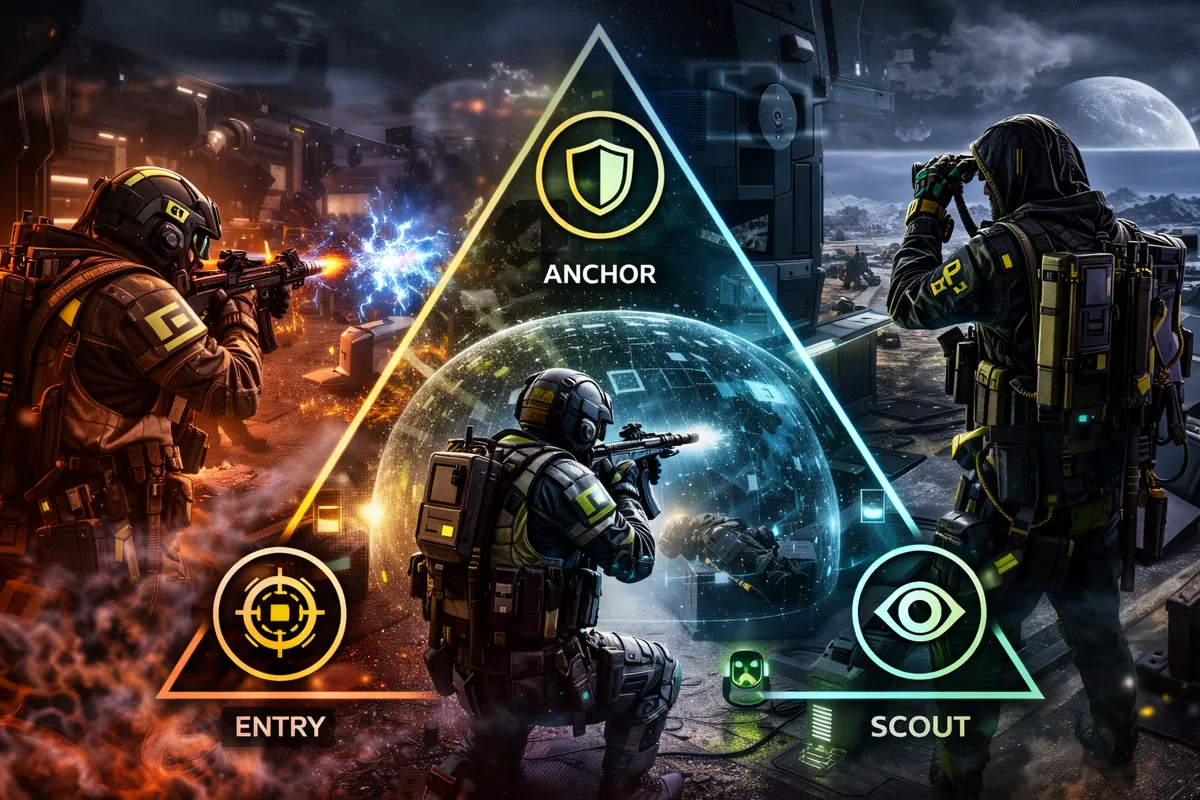
The Three Roles at a Glance
Think of your team like a triangle. Each point covers a different kind of risk.
- Entry (Front)
- Starts fights, forces movement, creates first down, sets tempo.
- Anchor (Back)
- Holds safe angles, covers heals/revives, denies flanks, stabilizes exfil.
- Scout (Side)
- Spots threats first, checks routes, pings rotations, calls when to disengage.
If you want the simplest truth:
Entry wins seconds. Anchor wins minutes. Scout wins the whole run.
When to Pick Each Role
Many squads accidentally pick “three Entries” because it feels fun. Then everyone dies while reloading and screaming “where are they?” The real decision is: what role is your default when you’re trying to extract consistently?
Pick Entry if:
- You’re confident taking first contact.
- You can commit quickly when advantage appears.
- You can stop chasing when the fight is already won.
Pick Anchor if:
- You’re calm under pressure and rarely tunnel vision.
- You keep track of teammate health and reset timing.
- You enjoy holding angles and denying pushes.
Pick Scout if:
- You notice audio cues early and read the map well.
- You like flanks, pings, and route calls.
- You’re good at disengaging and re-engaging on your terms.
A balanced trio is usually:
And yes—roles can swap mid-run. The best teams swap roles based on the situation without panicking.
Entry Role: The Job, Not the Ego
Entry is not “the best aimer.” Entry is the teammate who makes the fight easier for everyone else.
Your real Entry job is to create one of these outcomes:
- A quick shield break that forces enemies to heal.
- A forced reposition (they leave cover).
- A clean down that turns the fight into a numbers advantage.
- A route denial that prevents enemies from getting their preferred angle.
If you play Entry like an ego role, you die first and your team loses. If you play Entry like a job, you lead fights and survive long enough to reset.
Entry Timing: When to Push and When to Pause
Entry timing is everything. You should be aggressive only when one of these “green lights” is true:
- Green light 1: You have information
- Scout confirmed positions, or you heard a clear cue (zipline, door, revive, drone).
- Green light 2: You have utility advantage
- EMP, smoke, denial grenades, or a strong angle setup is ready.
- Green light 3: You have reset cover
- Anchor is holding a safe angle and can protect your retreat if the push fails.
- Green light 4: You have a reason
- Protecting exfil, clearing a contract zone, third-partying a fight, or preventing a pinch.
If none of these are true, your Entry “push” is usually just gambling.
Entry Positioning: The Two-Layer Push
Entry shouldn’t be “in front of the team.” Entry should be one layer in front—close enough to pressure, far enough to retreat behind Anchor coverage.
Use the two-layer rule:
- Layer 1: Your Entry position (pressure and peeks)
- Layer 2: Your Anchor position (reset and punish)
If you push so far forward that Anchor can’t cover you, you’re not entering—you’re donating.
Entry Micro-Skills That Win Fights
If you want to level up Entry performance fast, focus on these habits:
- First burst discipline
- Your opening shots decide tempo. Even if you don’t down someone, you must force healing or movement.
- Angle trading instead of wide swinging
- Wide swings are for when you already have advantage. Early in fights, take short peeks, deal damage, reset.
- Commit on advantage, not emotion
- Once you crack an enemy or get a down, commit quickly and cleanly. Hesitation is how you get third-partied mid-fight.
- Stop chasing at the edge of your kit
- If your kit is built for mid-range, don’t chase into tight interiors without your team.
- Finish with utility, not hero aim
- Use denial tools to secure downs and block revives rather than sprinting into a crossfire.
Entry Utility: What You Should Carry
Entry wants tools that start fights and close them:
- EMP to win the opening seconds and break holds.
- Frag/Heat to punish cover and stop pushes.
- Smoke only if your role includes crossing open lanes or protecting your own retreat.
- A fast close-range answer (SMG/shotgun or a reliable sidearm plan) so you don’t lose when someone swings you.
Entry is also the best role to carry a “fight-ending” consumable mindset: you are the person who uses resources to win quickly, not the person who hoards them.
Entry Comms: What to Say
Entry comms should be short and actionable. Your team doesn’t need a story. They need a decision.
Good Entry calls:
- “Cracked left, push now.”
- “Down one—collapse.”
- “No advantage, reset.”
- “They’re holding door—EMP then swing.”
- “Stop chase—third party coming.”
Bad Entry calls:
- “He’s one shot!” (without direction)
- “I’m pushing!” (without timing)
- “Where are they?” (that’s Scout’s job)
Anchor Role: The Team’s Insurance Policy
Anchor is the role that makes Marathon feel easy. When teams say “we always extract,” it’s often because they have a great Anchor.
Anchor’s job is to maintain:
- Space control (enemy can’t freely push or flank)
- Reset safety (your team can heal, reload, revive)
- Fight stability (the push doesn’t collapse if Entry gets slowed)
Anchor doesn’t need flashy kills. Anchor needs clean decisions.
Anchor Positioning: The “Cover the Reset” Rule
Anchor should almost always position with one goal:
Can I protect a teammate healing or reviving right now?
That means:
- You prioritize angles that watch the most likely push route.
- You avoid positions that require you to reload in the open.
- You choose cover that lets you re-peek quickly.
A strong Anchor position is usually:
- slightly behind Entry,
- with a lane that punishes anyone chasing Entry,
- and an escape route that doesn’t require crossing open ground.
Anchor Responsibilities During a Fight
When bullets start, Anchor runs a checklist:
- Watch the flank, not the duel
- Entry is dueling. You are preventing the surprise collapse.
- Call the reset
- If you hear your team needs to heal or reload, you call “reset” and hold the angle.
- Punish overcommit
- Many teams lose because they chase too hard. Anchor punishes the chaser.
- Hold the revive window
- If a teammate is down, your job is to hold the lane that prevents the enemy from pushing the revive.
Anchor is the reason “we got a down” becomes “we won the fight” instead of “we traded and died.”
Anchor Utility: What Makes Anchors Unfair
Anchor utility is about denial and safety:
- Smoke for safe heals/revives and breaking long angles.
- Chem/Heat for doorway and stair denial (stop the push).
- Sensors for early warning so you can hold the correct lane.
- Mines to punish predictable flanks or protect your back during resets.
- Bubble Shield (when available) as a premium reset tool for revives and final exfil seconds.
Anchor should be the teammate most likely to “save” a piece of utility for the last 20 seconds of an exfil warmup, because that’s when pushes get desperate.
Anchor Weapons: The Uptime Preference
Anchor doesn’t need the highest burst damage. Anchor needs uptime and control.
Anchor weapon traits that matter:
- consistent recoil at mid-range,
- magazines that don’t force constant reloads,
- predictable optics,
- ammo economy that supports longer holds.
This is also why many Anchors love reliable ARs, stable precision rifles, and LMGs in certain exfil hold scenarios. It’s not about “best DPS.” It’s about “staying dangerous without panicking.”
Anchor Comms: The Calm Voice
Anchor comms should reduce chaos.
Good Anchor calls:
- “Reset behind me.”
- “Hold—don’t chase.”
- “I’m watching stairs.”
- “Revive safe in smoke.”
- “Third party angle right—back up.”
Anchor should also call “leave” more often than Entry. If your score target is hit, Anchor’s job is to protect the exit plan, not to chase kills.
Scout Role: The Run-Winner
Scout is the role most teams don’t respect until they lose to it. A good Scout prevents ambushes, prevents third parties, and makes your fights advantaged before they start.
Scout’s job is:
- Information: where enemies are and where they’re moving.
- Route control: where your team can rotate safely.
- Timing: when to fight and when to leave.
Scout is the reason your team feels like it always chooses the right moment.
Scout Positioning: The Safe Angle That Sees Everything
Scout is not “the loner.” Scout is the teammate who takes a slightly different angle to expand the team’s awareness.
Scout positioning rules:
- You stay close enough that the team can help within seconds.
- You stay far enough that one grenade doesn’t hit everyone.
- You prioritize high-visibility angles: elevation, long corridors, open lanes.
- You avoid being the first to take damage unless you’re intentionally baiting.
A Scout should constantly ask:
- “If a third party arrives right now, do we see it first?”
Scout Responsibilities During a Run
Scout does more than “spot enemies.” Scout builds the whole run.
- Early run: identify nearby spawns and likely enemy routes.
- Mid run: watch contract zones, listen for distant fights, and call timing windows.
- Late run: scout exfil approaches and guarded exfil patrol risk.
Scout is also the best role to ping:
- high-value routes,
- safe rotations,
- danger zones where fights are already happening.
If your team often gets surprised at exfil, your Scout’s timing and positioning is the first place to improve.
Scout Utility: Information and Escape Tools
Scout utility is about seeing threats first and keeping options open:
- Proximity sensor for early warnings.
- Signal jammer for anti-scan and safer rotations (especially against Recon pressure).
- Smoke for crossing and breaking sightlines during disengages.
- EMP as a flexible “start or stop” tool: start a fight with advantage or stop a push during retreat.
Scout also benefits from consumables that support movement and survival because Scout often has to rotate quickly:
- mobility consumables,
- cleanses if your routes include hazard areas,
- stamina/heat management mindset.
Scout Comms: What to Say
Scout comms should be specific, directional, and timing-based.
Good Scout calls:
- “Shots east, moving closer—third party risk.”
- “Two on roof, one bottom.”
- “Route clear left, rotate now.”
- “Exfil approach watched—use smoke.”
- “Recon scan likely—jam before crossing.”
Bad Scout calls:
- “They’re here!” (no direction)
- “I think…” (uncertainty without action)
- “We should…” (when a decisive call is needed)
Scout doesn’t need to be loud. Scout needs to be accurate.
Who Does What and When: The Run Timeline
Roles change slightly depending on what phase of the run you’re in. Here’s the practical timeline.
Early Run: Survive the First Collision
Early run is where most “random” deaths happen because teams collide near points of interest.
- Scout checks likely approach routes and listens for early fights.
- Anchor chooses a safe reset location and avoids overcommitting to looting.
- Entry only takes fights with a clear advantage (bad early fights are expensive).
Early run rule that saves kits:
- If you haven’t looted enough healing and ammo yet, don’t take a full commitment fight unless you must.
Mid Run: Build Value Without Becoming Loud
Mid run is where contracts, loot routes, and PvE pressure shape the match.
- Scout calls timing windows: where fights are happening and where they aren’t.
- Anchor protects looting and contract interactions by holding the right angles.
- Entry clears threats quickly when contact happens, then stops chasing.
Mid run goal:
- Finish your score target or contract step with minimal resource drain.
If you leave mid run with most of your heals and utility intact, you are much more likely to extract later even if a third party appears.
Late Run: Exfil Warmup Is a Role Test
Exfil is where roles become obvious because everything is predictable.
- Scout scouts the exfil area and identifies the approaches other teams will use.
- Anchor sets up safety: holds the most dangerous lane, places sensors/mines, saves smoke/bubble for resets.
- Entry stays ready to punish the first push and finish the fight fast if someone commits.
Important exfil fact for role play: exfils take about a minute to warm up after activation, and you don’t need to stand in the circle the whole time. That means roles matter even more: Anchor and Scout should own the area while Entry prevents a free collapse.
Guarded Exfils: Role Adjustments Against UESC Patrols
Guarded exfils can spawn a UESC patrol when activated. That adds PvE threat during the most dangerous PvP moment.
Role adjustments:
- Entry clears the highest immediate threat quickly (don’t get stuck shooting forever).
- Anchor protects heals and prevents enemy teams from exploiting your AI distraction.
- Scout watches for human pushes while your attention is split by PvE.
The biggest guarded exfil mistake is treating it like a normal exfil. Your team must assume another crew will hear the activation and arrive during the warmup.
Role Swaps: When Entry Becomes Anchor (and Vice Versa)
In real fights, roles aren’t static. The best teams swap roles based on who has health, who has angle control, and who has utility.
Role swap rules:
- If Entry is low on health, Entry becomes Anchor temporarily (hold safe angle, heal) and Anchor or Scout becomes Entry.
- If Anchor loses position, Anchor calls “reset” and Scout may take Anchor duty while Anchor repositions.
- If Scout gets pinned, Scout becomes Anchor (hold and survive) while Anchor or Entry takes route info duty.
A simple callout that makes swaps easy:
- “I’m low—swap Entry.”
- “I’m holding—Anchor now.”
- “I’m scouting—don’t push yet.”
Swaps are a sign of a strong team, not a sign of confusion.
Role-Based Loadout Principles
You don’t need specific “best weapons” to run roles correctly. You need loadouts that match the job.
Entry Loadout Principles
- Fast time-to-pressure
- Reliable close-to-mid range
- Utility that starts fights (EMP) or finishes fights (frag/heat)
- Enough healing to survive a trade and keep pushing
Entry should avoid kits that require slow setup if the plan is to create tempo.
Anchor Loadout Principles
- Sustained damage and control
- Clean sight picture (stable optics)
- Utility that denies pushes and protects resets (smoke, chem, sensors, mines)
- Extra healing, because Anchors often “spend” healing to stay alive while holding lanes
Anchor should avoid kits that demand constant reloads and constant repositioning.
Scout Loadout Principles
- Mobility and flexibility
- Weapons that remain usable while moving and peeking
- Information and escape utility (sensor, jammer, smoke)
- Enough healing to survive being the first to spot and take initial chip damage
Scout should avoid overly heavy, slow kits that prevent fast rotations and route control.
Team Role Comms Pack: Copy-Paste Callouts
These are simple, consistent phrases your team can use without thinking.
Entry callouts:
- “Crack—push.”
- “Down—collapse.”
- “No advantage—reset.”
- “Stop chase—leave.”
Anchor callouts:
- “Reset behind me.”
- “Hold angle—heal now.”
- “Don’t chase—watch flank.”
- “Smoke revive.”
Scout callouts:
- “Contact left—two.”
- “Third party east—rotate.”
- “Exfil watched—use smoke.”
- “Route clear—move now.”
If your comms get shorter, your team will extract more often.
Common Mistakes That Break Roles
Even good players sabotage roles with these habits:
- Three Entries syndrome
- Everyone pushes, nobody holds, everyone dies while reloading.
- Anchor tunnel vision
- Anchor watches the duel instead of the flank, and the team gets collapsed.
- Scout drifting too far
- Scout becomes a solo player and gets deleted before they can feed info.
- No one owns the reset
- Healing and revives happen in the open without utility, and fights get thrown after being won.
- Chasing after the score target is already hit
- Teams die to greed because they forget the run’s purpose.
Fixing these mistakes is more important than changing weapons.
Drills: How to Practice Roles Fast
If you want to get better without grinding forever, practice with simple drills.
Entry drill:
- In 3 fights, focus on one goal: crack someone and stop. Don’t chase. Reset after advantage.
- Practice committing only when Anchor confirms coverage.
Anchor drill:
- In 3 fights, never be the first to die. Hold angles and protect resets.
- Call “reset” earlier than feels necessary.
Scout drill:
- Every run, call two things early: “likely enemy route” and “safe exit route.”
- Practice taking an angle that sees third parties without separating from the team.
These drills build the habits that make roles automatic.
BoostRoom: Turn Team Roles Into Consistent Extracts
If your squad feels chaotic, roles are the fastest fix—but it’s hard to install roles mid-fight without practice. BoostRoom helps teams build role discipline in a way that actually shows up in-game:
- Entry timing that creates wins without donating kits
- Anchor positioning that protects heals, revives, and exfil warmups
- Scout routes and info calls that stop third parties before they start
- Simple comms systems that reduce arguments and increase consistency
BoostRoom is especially valuable if you’re playing with friends who have different styles, because roles let everyone play their strengths without stepping on each other.
FAQ
What is the best team role for beginners in Marathon?
Anchor is often the easiest role to learn because it rewards calm play: holding angles, protecting resets, and calling when to disengage. It also teaches exfil discipline fast.
Can two people run the same role?
Yes, but you must cover the missing job. Two Anchors can work if one of them still scouts routes. Two Entries can work if one of them also owns reset safety. The team fails when a job is missing.
How do we decide roles with random teammates?
Pick your own role and play it clearly. Use short comms (“reset behind me,” “I’m scouting left”) and ping consistently. Even silent teammates often follow structure when it’s obvious.
What role matters most at exfil?
Anchor. Exfil success depends on holding lanes, protecting heals/revives, and saving utility for the final seconds. Scout also matters because scouting approaches prevents surprise collapses.
How does Scout help if we just want to fight?
Scout makes fights advantaged. A team that knows where enemies are can choose better angles, avoid bad pushes, and third-party at the right time instead of walking into a crossfire.
What’s the fastest role fix for squads that always die after winning a fight?
Assign Anchor to own resets. Anchor holds angles while Entry loots and Scout watches routes. Most “we won then died” moments happen because nobody protected the reset window.



