What Map Awareness Really Means
Map awareness is your ability to answer these questions at any moment:
- Where are all three enemies (or where are they most likely to be)?
- Which routes are safe right now—and which routes are traps?
- If I get a takedown, what’s the next spawn and return path?
- If I disappear from the objective for two seconds, can the enemy touch/score?
- If an enemy is missing, which teammate is in danger?
When you can answer those quickly, you stop “reacting” to the match and start controlling it.
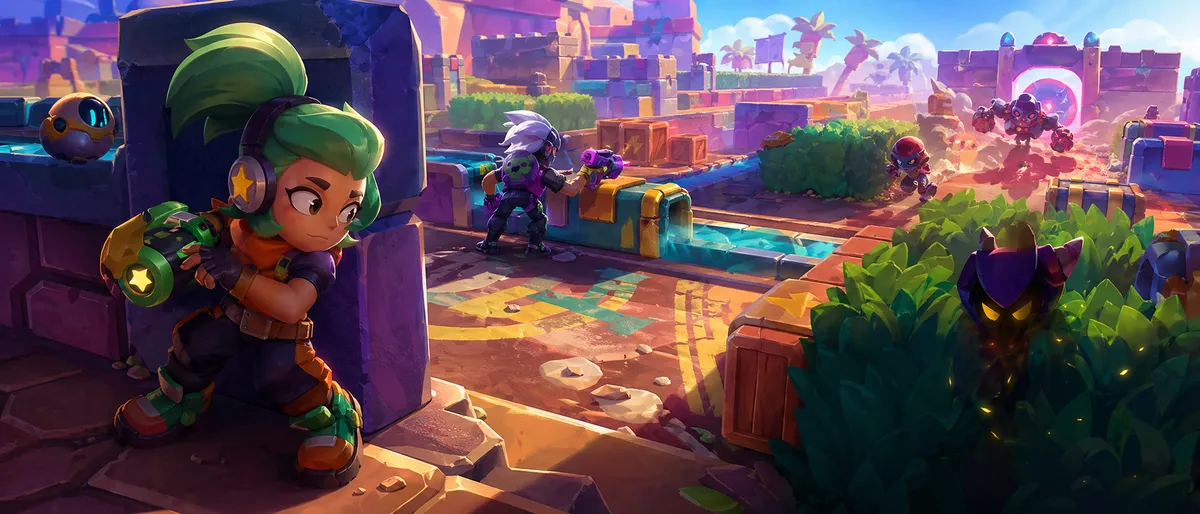
The Awareness Triangle: Information, Space, and Timing
Every strong awareness decision comes from a triangle:
- Information: what you saw last (positions, health, Supers, gadgets, movement direction)
- Space: what the map gives (walls, bushes, chokes, open lanes, objective location)
- Timing: when things change (respawns, rotations, reload cycles, “push windows”)
Most players only use information (“I saw them mid”). Better players combine information + space (“they were mid and the left choke is open”). Great players add timing (“they died, so their next approach is from base through that choke—get ready”).
The “Last Seen” System: Track Enemies Without a Minimap
Brawl Stars doesn’t give you a minimap, so you create one in your head. The simplest version is a “last seen” system:
- Every time you see an enemy, mentally tag them: Left / Mid / Right.
- If you don’t see them for a moment, assume they moved to the nearest useful place:
- a bush cluster
- a corner behind a wall
- a choke near the objective
- a flank route to your backline
- If an enemy disappears, ask: Who benefits from them being unseen?A diver benefits because they want surprise.
- A thrower benefits because they want you to walk into a choke.
- A sniper benefits because they want you to peek an open lane.
When someone is missing, the correct response is usually not panic—it’s positioning:
- step closer to cover
- avoid face-checking bushes
- hold a safer angle until you confirm where they went
Lanes Are Your Awareness GPS
Most 3v3 maps naturally play as three lanes: left, mid, right. Lanes matter because they predict:
- where enemies will travel
- how flanks happen
- where pinches come from
- which corners are dangerous
If your team is spread across lanes, your awareness becomes easier because each teammate “covers” a lane of information. If your team stacks one lane, you lose information and get surprised from the open side.
A simple lane rule that prevents ambushes:
If your team doesn’t own at least two lanes, expect a flank.
Spawn Prediction Basics: How Respawns Create “Waves”
In most 3v3 modes, defeated enemies return from their team’s side. That creates respawn waves—the rhythm of the match.
Here’s the key awareness idea:
- After you defeat one enemy, you have a short advantage window.
- If you stay deep too long, that enemy returns and you get pinched.
- If you defeat enemies one-by-one at different times, you create staggered respawns and lose control because you never get a clean team reset.
So spawn prediction isn’t about memorizing exact timers. It’s about feeling the wave:
- Right after a takedown: push objective value (zone time, gems, safe damage, goal pressure)
- As the wave returns: back to cover, reload, and hold angles
- If your teammate dies: don’t force a bad 2v3—stall and reset
Respawn Shields: Why Spawns Are Dangerous
When enemies respawn, they typically re-enter with a brief invulnerability shield (often shown with a distinct visual effect). This matters because:
- you can’t “finish” a respawning enemy immediately
- they can body-block lanes for teammates
- they can walk forward to reclaim space briefly
Practical rule:
Treat fresh spawns like temporary hazards. Don’t stand in the open expecting to win a straight trade. Back up, let the shield expire, then punish their approach.
Predicting Spawn Routes: The “Shortest Useful Path”
After respawn, most players take the shortest path to something valuable:
- the objective
- the best cover near mid
- the lane where your teammate is weak
- the flank route that reaches your backline quickly
Your awareness job is to look at the map and ask:
If I were them, what’s the fastest route that matters?
Then you prepare:
- pre-aim the choke
- take a safer cover position
- rotate so you don’t get pinched
- warn yourself not to overextend deep into their side
Avoiding Ambushes: The Four Most Common Trap Zones
Ambushes almost always happen in the same kinds of places:
- Bush corners near objectives (easy surprise and retreat)
- Choke points between walls (you must pass through, they can pre-aim)
- Side-lane flanks behind cover (you don’t see them until it’s too late)
- Your “comfortable” peek (the angle you keep repeating—enemies notice and wait)
If you want fewer surprise deaths, stop treating these spots as “normal terrain.” Treat them as trap zones that require a plan.
Safe Bush-Checking: How to Reveal Ambushes Without Dying
Face-checking bushes is one of the most expensive mistakes in the game. Safe bush-checking means you test bushes without donating your life.
Use these safe methods:
- Long-range poke: tap a bush from maximum range before stepping in
- Splash check: use wide or area attacks that cover the bush edge
- Corner slice: approach along a wall so only a tiny part of your body is exposed
- Teammate check: let the tankier teammate step first while you cover with shots
- Wait-and-hold: sometimes the safest check is not checking—hold a strong angle and make the bush player reveal themselves by needing objective value
Rule of thumb:
Never face-check a bush when you’re low HP, low ammo, or alone.
Corner Awareness: “Slice the Pie” to Stop Surprise Bursts
Corners are where close-range ambushes happen. The fix is “slicing the pie”:
- instead of stepping into the open all at once
- you move slowly so you reveal one angle at a time
This reduces surprise because:
- you can retreat instantly
- you don’t expose yourself to multiple angles
- you force the ambusher to commit into your cover
If you feel like you’re constantly getting jumped, your peeks are probably too wide.
Showdown Awareness: Predicting Spawns and Early Pinches
In Solo Showdown, everyone spawns at fixed starting positions. That means early danger is predictable:
- someone will almost always be close enough to contest your nearest boxes
- the “center rush” is a common early risk zone
- outer edges often reduce angles but can trap you if you rotate late
Early-game awareness routine:
- Identify the two nearest spawn directions (left and right of your start area).
- Assume an enemy could arrive from either direction quickly.
- If you start breaking a box, keep enough ammo to defend yourself.
- Don’t tunnel vision on boxes if you’ll be pinched.
A strong early habit:
If you can’t see the approach routes, don’t commit to a slow action.
Showdown Ambush Avoidance: Survive Without Camping
You don’t need to camp to survive; you need controlled movement:
- keep one side protected (map edge or poison cloud later)
- move cover-to-cover, not through open lanes
- avoid walking into dense bush clusters without a check
- don’t chase a low enemy into unknown bushes
Endgame awareness in Showdown:
- Track which players are alive and where the “danger cube leader” is likely positioned.
- Avoid being the easiest target in the center.
- Save ammo for forced movement moments when the poison closes space.
Duo Showdown Awareness: Respawns Change Everything
Duo Showdown adds the biggest awareness twist: defeated teammates can return if one teammate stays alive.
What this changes:
- You must track not only enemy positions but also who is close to a respawn.
- A “won fight” can flip instantly if you stay in the open when a teammate respawns with an immunity shield.
- A respawn bubble can reveal positions in bushes, so hiding near a teammate’s respawn can be risky.
Duo awareness rules that win games:
- If you defeat one enemy but the other is alive, assume the respawn will happen soon—reset your position.
- After a duel, heal before looting if you suspect a respawn wave.
- When your teammate is down, your job is survival until they return—don’t take coin-flip fights.
Gem Grab Awareness: Predicting Respawn Waves and Stopping Steals
Gem Grab is a mode where awareness wins more than aim because one carrier defeat flips everything.
Key awareness questions:
- Where is the enemy gem carrier?
- Which lane is open for a flank onto the carrier?
- If we start countdown, do we have safe retreat routes?
- If the enemy is missing, are they setting up a last-second dive?
Spawn prediction in Gem Grab:
- When you defeat an enemy during countdown defense, don’t chase deep. Their respawn wave returns from their side and can trap you.
- When you are behind, look for the moment the carrier steps too far forward—many carriers get greedy.
Ambush prevention for carriers:
- Carriers should avoid walking into unknown bushes, especially near mid chokes.
- Carriers should position so at least one teammate can peel quickly.
Brawl Ball Awareness: Spawns, Countergoals, and “Safety Position”
Brawl Ball punishes bad awareness with instant countergoals. You can dominate a fight and still lose if you leave your goal unprotected.
Awareness rules that stop countergoals:
- Always know where the ball is and where it will bounce/land.
- If your team is pushing, keep one player in a “safety position” behind the play unless the goal is guaranteed.
- After a failed shot, expect the enemy to sprint the ball forward—back up early.
Spawn prediction in Brawl Ball:
- When enemies respawn, they often take the fastest route to midfield to stop your push.
- If you push too deep while enemies are returning, you get pinched and your goal becomes open.
Ambush prevention tip:
If you can’t see two enemies, do not dribble forward alone. Pass back or reset.
Heist Awareness: Defense Rotations and Safe-Window Timing
Heist is about objective windows. Awareness is what tells you when a window is real.
Spawn prediction in Heist:
- After a takedown, you have a short window to hit the safe safely.
- If you stay too long, the respawn wave returns and turns your safe damage into a donation death.
- When your team is defending, stop pushes early—don’t wait for enemies to reach the safe.
Ambush prevention in Heist:
- Watch flank routes: many “free safe hits” happen because defenders ignored the side lane.
- If an enemy disappears, assume they’re rotating for a safe angle, not wandering.
Hot Zone Awareness: Holding Entrances and Watching Rotations
Check out some of our most popular Brawl Stars services:
Hot Zone is map awareness in its purest form because the zone forces predictable movement.
Key awareness questions:
- Which choke point is the enemy using to enter?
- Are we controlling entrances or only standing on the circle?
- If we win a fight, are we setting up retake denial or chasing?
Spawn prediction in Hot Zone:
- After you clear the zone, the next enemy wave will come through the same few entrances. Prepare your denial before they arrive.
- If your teammate dies, don’t “touch-feed” one-by-one. Reset and retake together.
Ambush prevention:
- Always keep one teammate watching the flank route into the zone.
- Don’t stack inside the zone where one area attack hits everyone.
Knockout Awareness: No Respawns Means No Mistakes
In Knockout, predicting spawns is less important because there are no respawns. Predicting positions and flanks becomes everything.
Knockout awareness rules:
- Track where each enemy last peeked; assume they’ll reposition to a stronger angle after taking damage.
- If an enemy disappears, assume they’re setting up a crossfire or bush trap.
- When you get the first takedown, stop peeking unnecessarily—make the enemy walk into you.
Ambush prevention in Knockout:
- Never face-check bushes alone.
- Hold one side safe (wall or map edge) so you don’t get pinched.
- If you’re low, reset—being alive is value.
Bounty and Wipeout Awareness: Safe Kills and Not Donating Deaths
In kill-value modes, awareness is about preventing “free points.”
Spawn prediction concept:
- After you secure a pick, expect the enemy to try a quick trade. Back up and deny the trade.
- If you’re ahead, the enemy must take risks—watch for dives and flanks.
Ambush prevention:
- Don’t chase into enemy cover.
- Hold lanes and let enemies come to you.
- If an enemy is missing, assume they’re flanking your backline.
The Ambush Pattern Library: Predict Common Enemy Behaviors
Most players repeat the same ambush behaviors. Learn these patterns and you’ll start “seeing the trap” before it happens.
Pattern 1: The bush sit
Enemy waits in a bush near a choke until you face-check.
Counter:
- Don’t face-check; check from range or rotate around.
Pattern 2: The corner burst
Enemy hides behind a wall corner and attacks the moment you step through.
Counter:
- Slice the corner slowly and keep ammo ready.
Pattern 3: The flank lane
Enemy disappears from lane to reach your backline from the side.
Counter:
- If a lane opponent vanishes, call it in your head and play one step safer until you confirm.
Pattern 4: The “fake retreat”
Enemy backs up to bait you forward, then turns when you leave cover.
Counter:
- Don’t chase past your safe cover line unless you can confirm the finish safely.
Pattern 5: The respawn punish
Enemy returns from respawn and catches you deep with low ammo.
Counter:
- After a takedown, cash objective value quickly, then reset before the wave arrives.
The “Danger Map” Habit: Mark High-Risk Zones Mentally
Every map has a few tiles that cause most deaths:
- the bush corner that touches mid
- the wall that creates a perfect ambush angle
- the open lane that snipers hold
- the choke that everyone funnels through
Your goal each match is to identify the danger zones early:
- If you die to an ambush once, remember that exact spot.
- Next time, approach it differently: check first, rotate around, or hold an angle.
This is how map awareness grows fast: you turn deaths into map knowledge.
Predicting Spawns in Practice: The “Wave Clock” Without Timers
You don’t need exact respawn seconds to predict returns. Use the wave clock:
- Right after a takedown: push forward a little, take value.
- After a short moment: back to cover, reload, prepare for the return.
- If you’re still deep and you haven’t seen the respawn wave yet: assume it’s about to hit you.
Practical rule:
If you’re deep in enemy territory and you’re not seeing enemies, you’re about to be surrounded.
Team Awareness: Make Your Teammates Safer
Map awareness isn’t only for your survival. It’s how you protect teammates—especially with randoms.
Do these to “carry with awareness”:
- If you notice an enemy missing, reposition to cover your teammate’s lane.
- If your teammate is low, body-block briefly and guide them to safer cover.
- If your team wins a fight, take the objective value first, then reset lanes.
- If your team loses a player, slow down—stall and wait for a full reset.
Teams lose because one person gets caught. Awareness reduces “free catches.”
Awareness Tools: How Builds Can Help You See More
Even with perfect habits, some maps and matchups are vision wars. Certain tools make awareness easier:
- Abilities that reveal enemies in bushes
- Wide attacks that check bushes safely
- Pets/turrets that hold a lane and give information
- Gears that help with vision or bush movement
The key is not relying on tools instead of awareness. Tools are multipliers: they make good habits stronger.
Practical Rules: Map Awareness Checklist
Use this as an in-match checklist:
- If an enemy is missing, play one step safer.
- Never cross open space without knowing at least one safe retreat path.
- Don’t face-check bushes alone; check from range or with cover.
- After a takedown, take objective value—then reset before the wave returns.
- If two enemies can see you from different angles, you’re about to get pinched—retreat or reposition.
- If you keep peeking the same corner, change your peek timing or angle.
- If your team is down a player, don’t force a fight—stall and reset.
- If you’re ahead, deny flanks and play for safe control, not chase.
- If you’re behind, look for one clean pinch or carrier pick, not three separate risky duels.
Training Plan: Build Map Awareness Fast
If you want awareness to become automatic, train one focus per session:
Session focus 1: Last-seen tracking
For several matches, actively name enemy positions in your head: left, mid, right. Your goal is fewer surprise hits.
Check out some of our most popular Brawl Stars services:
Session focus 2: Safe routes only
Play matches where you refuse to cross open lanes without cover-to-cover steps. Notice how often you stop dying “randomly.”
Session focus 3: Bush discipline
Practice checking bushes safely and never face-checking while low HP. Your survival rate jumps fast.
Session focus 4: Wave resets
After every takedown, force yourself to take objective value quickly, then reset lanes. This prevents the classic respawn pinch.
Small focused practice beats “trying to remember everything.”
BoostRoom
If you want to improve faster, BoostRoom helps you turn map awareness into a repeatable system instead of a vague idea. Awareness isn’t just “be careful”—it’s routines: where to stand, when to rotate, how to read missing enemies, and how to avoid the same ambush spots every match.
BoostRoom can help you build:
- a personal map-reading routine for open, bushy, and wall-heavy maps
- anti-ambush habits that fit your favorite Brawlers and playstyle
- mode-specific awareness plans (Gem Grab carrier safety, Brawl Ball countergoal prevention, Heist defense rotations)
- simple checklists you can apply mid-match to reduce throw moments
The goal is straightforward: fewer surprise deaths, cleaner objective wins, and more matches where you feel in control from start to finish.
FAQ
How do I predict enemy spawns without memorizing timers?
Use the respawn wave mindset: right after a takedown you get a short advantage, then the enemy returns from their side. Take value quickly, then reset before you get pinched.
Why do I keep getting ambushed from bushes?
You’re likely face-checking, walking through chokepoints without checking, or moving alone while an enemy is missing. Check bushes safely from range, keep one side safe, and play one step safer when someone disappears.
What’s the biggest map awareness mistake players make?
Overextending after a win. Many players win a fight, push too deep, then die to the returning respawn wave and lose the advantage.
How can I improve awareness if I play with random teammates?
Become the stabilizer: hold a lane, watch flanks, and reset after wins. Your positioning often “guides” teammates without needing chat.
How do I avoid getting pinched?
Keep one side protected (wall, map edge, safe retreat path) and don’t stand in open space where two enemies can see you. If you see pressure from two angles, retreat into cover immediately.
Does map awareness matter in Showdown too?
Yes—maybe even more. Early spawns create predictable pinches, bushes create ambush risk, and endgame positioning decides who gets focused first.
What should I do when an enemy disappears from my lane?
Assume a flank. Play safer, don’t face-check bushes, and position so you can defend your teammate or retreat if needed.
How do I stop “random” deaths in objective modes?
Most “random” deaths happen at chokepoints and during respawn returns. Control entrances, check bushes, and reset after takedowns instead of chasing.



