How Does Cooking Work in Loftia?
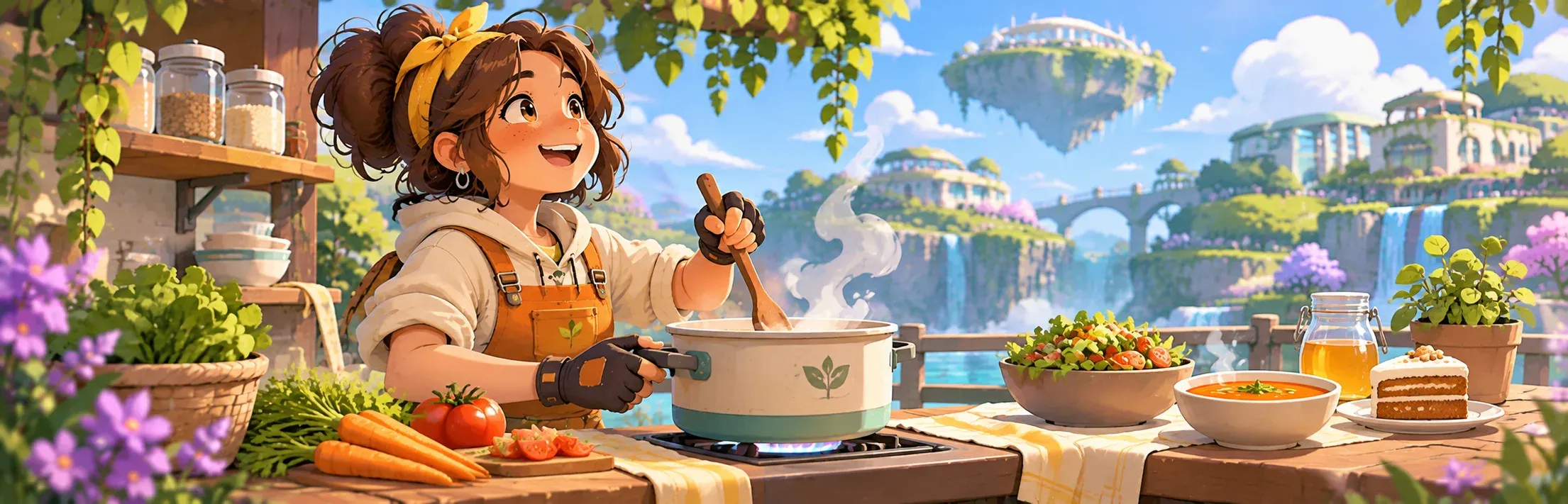
Cooking is a production activity that allows players to combine ingredients into prepared meals and drinks.
The basic process involves collecting ingredients, selecting an available recipe, and using a Cooking Station to prepare the finished dish.
Different recipes require different combinations of vegetables, gathered resources, and store-bought ingredients.
For example, some meals require vegetables grown on your own island, while others use items such as Eggs, Milk, Butter, or Cooking Oil.
Cooking also consumes energy, making your renewable energy equipment important when preparing multiple dishes.
What Can You Do With Cooking?
Cooking supports several activities throughout Loftia.
You can:
Prepare meals using harvested crops.
Make drinks using gathered ingredients.
Unlock additional cooking recipes.
Increase your Cooking proficiency.
Invest in useful Cooking perks.
Deliver food through the Shipping Bin.
Earn Dew from prepared dishes.
Donate meals to community initiatives.
Combine Cooking with Farming and Foraging.
Cooking provides a productive use for ingredients that might otherwise be sold directly.
However, a prepared dish is not automatically more profitable than selling its ingredients.
The best choice depends on the recipe, ingredient costs, and energy required.
Why Is Cooking Worth Leveling?
Cooking offers two main benefits.
First, it allows you to produce meals and drinks for quests, deliveries, and other activities.
Second, it improves your Cooking proficiency.
The documented proficiency perks can reduce ingredient consumption, increase carrying capacity, and provide chances to produce additional meals.
These improvements become more attractive when you prepare food regularly.
If you enjoy sustainable farming, cooking is a natural companion activity because it gives your harvests another purpose.
How to Unlock Cooking in Loftia
Cooking is introduced through early progression in Loftia City.
You do not need to finish the entire main story before learning how to prepare basic dishes.
However, you must gain access to the relevant equipment and recipes.
Complete The First Sprout Quest
The First Sprout is an important introductory farming quest.
It teaches players how to grow crops and introduces systems connected to food production.
The October demo's progression records link the completion of this quest with access to Cooking proficiency.
Because farming supplies many cooking ingredients, learning how to grow crops is a useful first step.
During the introductory quests, pay attention to Hazel and the activities she introduces.
You will become familiar with seeds, planting, watering, and harvesting.
These skills make it easier to maintain a reliable ingredient supply.
Meet Kun and Unlock Yes, Chef!
Kun is a chef associated with cooking and the Global Village.
One of the documented side quests is called Yes, Chef!
In this quest, Hazel asks you to check on Kun, which leads to a friendly cooking challenge.
The pre-release quest objectives include:
This quest is particularly useful for beginners because it introduces the complete cooking process.
It teaches you how to prepare food and deliver finished dishes.
How to Complete Yes, Chef!
Begin by speaking with Kun when the quest becomes available.
Follow the instructions to build a Cooking Station.
Once you have access to the station, inspect the recipes you can prepare.
Gather the required ingredients and cook two meals.
After preparing the dishes, locate the Shipping Bin and deliver the requested food.
Check whether the quest requires specific dishes or accepts any eligible meals in your current version.
The pre-release recipe database also associates the Garden Salad recipe with Yes, Chef!
Completing this introduction gives you a useful foundation for developing Cooking proficiency.
How to Craft a Cooking Station in Loftia
The Cooking Station is the primary equipment used to prepare food.
It belongs to Loftia's broader crafting system and requires materials to construct.
The October demo documents a basic Cooking Station recipe.
Cooking Station Crafting Materials
The documented recipe requires:
5 Metal Scraps
5 Scrap Wire
5 Clay
The station is created through the Project Station.
These quantities are based on the demo build and should be checked against the current crafting interface.
Where to Find the Materials
Metal Scraps and Scrap Wire are associated with salvaging.
Use the Hammer to collect resources from appropriate objects.
Clay is another early crafting material that can be obtained through gathering activities.
If you're short on resources, continue the introductory quests and collect useful materials while exploring.
Avoid spending all your Metal Scraps and Scrap Wire on unrelated equipment before checking the Cooking Station requirements.
How to Use the Cooking Station
Once the Cooking Station is available, interact with it to open the recipe interface.
Choose a recipe that you have unlocked.
Check its ingredient requirements and energy cost.
If you have the necessary resources, prepare the dish.
After the cooking action completes, collect the finished meal or drink.
The October demo database lists Cooking Station recipes as immediate crafting actions, unlike refining orders that take time.
However, the exact process may change in Early Access.
Where to Find Cooking Ingredients in Loftia
Cooking ingredients come from several different activities.
Some can be grown on your island, while others are collected from the environment or purchased from NPC shops.
Understanding where ingredients come from is one of the best ways to improve cooking efficiency.
Farming Ingredients for Cooking
Farming provides a reliable source of vegetables.
The public October demo documents several useful crops.
Carrots
Carrots are among the first crops introduced through farming progression.
They are used in recipes such as Carrot Soup and Carrot Cake.
Carrots also appear in mixed vegetable dishes.
If you want to begin Cooking without purchasing many additional ingredients, Carrots are a good starting choice.
Tomatoes
Tomatoes are used in several different recipes.
The documented dishes include Tomato Soup, Garden Salad, Shakshuka, and Power Smoothie.
Because Tomatoes appear in multiple recipes, they provide flexibility.
You can use them in simple dishes or combine them with additional ingredients.
Lettuce
Lettuce is another early crop.
It is used in Chef Salad, Garden Salad, and Veggie Egg Scramble.
Players interested in preparing several different dishes may benefit from keeping a supply of Lettuce.
Potatoes
Potatoes are used in dishes such as Fries, Potato Soup, and Mush & Chips.
Some recipes also require additional purchased ingredients.
Before growing large quantities of Potatoes, check which recipes you have unlocked.
Why Farming and Cooking Work Well Together
Farming gives you more control over your ingredient supply.
Instead of purchasing every ingredient, you can grow vegetables yourself.
This can reduce some direct expenses.
However, growing crops still requires seeds, space, and maintenance.
When choosing what to plant, consider which recipes you want to prepare.
For a deeper explanation of crops, Garden Beds, and sustainable agriculture, follow a dedicated Loftia Farming Guide.
Foraged and Purchased Cooking Ingredients
Not every cooking ingredient comes from farming.
Some recipes also use gathered resources or products purchased from NPCs.
Wild Berries
Wild Berries are an ingredient documented in several drink recipes.
The October demo includes Fruit Smoothie and Power Smoothie among the available options.
If you enjoy preparing drinks, investigate the natural gathering activities that provide Wild Berries.
Check the current gathering requirements before planning large production quantities.
Portobello Mushrooms
Portobello Mushrooms are used in the documented Mush & Chips recipe.
They are a useful example of how natural gathering connects to Cooking.
If you encounter mushroom-related gathering opportunities, check whether the collected materials are useful for any recipes you have unlocked.
Eggs
Eggs appear in several cooking recipes.
Examples include Chef Salad, Fried Eggs, Scrambled Eggs, and Shakshuka.
The demo database identifies Eggs as an ingredient available through Kun's Recipe Shop.
Do not assume that you must raise animals to obtain Eggs in the starting version.
Milk and Butter
Milk and Butter are used in certain prepared dishes.
The documented Potato Soup recipe requires Milk, while Carrot Cake and Scrambled Eggs use Butter.
These ingredients can be purchased from Kun's shop in the demo.
Cooking Oil and Sugar
Cooking Oil is used in dishes such as Fries and Fried Eggs.
Sugar appears in the Fruit Smoothie recipe.
Because these ingredients may require spending Dew, include their cost when deciding whether to cook a recipe for profit.
All Basic Cooking Recipes in Loftia
The October 2026 demo database documents 15 recipes at the first-level Cooking Station.
These include soups, salads, egg dishes, drinks, and other prepared meals.
The following recipes are useful examples for planning your cooking activities.
All ingredient quantities are from the October demo, not guaranteed launch-build values.
Carrot Soup
Ingredients:
Carrot Soup is a simple beginner recipe.
It requires only one ingredient type, making it convenient for players who already grow Carrots.
The demo lists its selling value as 35 Dew.
Because the recipe does not require additional purchased ingredients, it is worth investigating when you want to practice basic Cooking.
Tomato Soup
Ingredients:
Tomato Soup is another simple recipe.
It uses a vegetable available through basic farming.
The demo lists its selling value as 65 Dew.
However, two raw Tomatoes also have significant selling value, so consider the difference before using them purely for profit.
Garden Salad
Ingredients:
1 Tomato
1 Lettuce
1 Carrot
Garden Salad is associated with the Yes, Chef! quest.
It combines three vegetables into one prepared dish.
The demo lists a selling value of 75 Dew.
This is the highest listed selling price among the 15 basic Cooking Station recipes in that build.
However, its ingredients have their own value, so the selling price should not be confused with pure profit.
Chef Salad
Ingredients:
Chef Salad combines a farmed vegetable with a purchased ingredient.
The demo lists a selling value of 20 Dew.
It provides another option for players who want to use Lettuce without growing several different vegetables.
Carrot Cake
Ingredients:
Carrot Cake is a simple recipe that combines farming with a shop ingredient.
Its documented selling value is 25 Dew.
If you're growing Carrots regularly, this gives you another way to use your harvest.
Creamy Summer Soup
Ingredients:
Creamy Summer Soup is associated with Kun's Recipe Shop.
The demo lists its selling value as 55 Dew.
This dish uses two different crops and does not require an additional shop ingredient in the documented recipe.
Potato Soup
Ingredients:
Potato Soup combines harvested Potatoes with Milk.
Its documented selling value is 65 Dew.
Before preparing large quantities, compare the cost of the ingredients with the dish's selling value.
Fries
Ingredients:
Fries are another recipe associated with Kun's Recipe Shop.
The demo lists their selling value as 65 Dew.
This is a good example of a recipe where ingredient expenses matter.
Mush & Chips
Ingredients:
1 Portobello Mushrooms
1 Potato
Mush & Chips combines a gathered mushroom ingredient with a farmed crop.
The demo lists its selling value as 35 Dew.
This may be an interesting recipe for players who enjoy Foraging as well as Farming.
Fried Eggs
Ingredients:
Fried Eggs are associated with Kun's Recipe Shop.
The demo lists their selling value as 20 Dew.
This recipe does not require growing vegetables, but it does require several additional ingredients.
Scrambled Eggs
Ingredients:
Scrambled Eggs provide another way to use purchased cooking ingredients.
The documented selling value is 25 Dew.
Check the ingredient costs before deciding whether this recipe is suitable for regular production.
Shakshuka
Ingredients:
Shakshuka combines a farmed Tomato with an Egg.
Its documented selling value is 40 Dew.
This gives players another way to use Tomatoes beyond soup and salads.
Veggie Egg Scramble
Ingredients:
Veggie Egg Scramble is associated with Kun's Recipe Shop.
The demo lists a selling value of 60 Dew.
It combines Farming with purchased ingredients and provides another option for players growing vegetables.
Fruit Smoothie
Ingredients:
Fruit Smoothie is a drink recipe.
The demo lists a selling value of 20 Dew.
Players interested in leveling Cooking through drinks can investigate recipes like this one.
Power Smoothie
Ingredients:
Power Smoothie combines a farmed vegetable with gathered berries.
The documented selling value is 40 Dew.
It is another example of how different gathering activities support Cooking.
How to Unlock More Cooking Recipes
Not every recipe is available from the beginning.
The demo documents several different ways to obtain cooking recipes.
Some require no additional unlock, while others are connected to quests or Kun's Recipe Shop.
Buy Recipes From Kun
Kun operates a Recipe Shop associated with the Global Village.
The shop sells additional cooking recipes and ingredients.
Examples of recipes associated with Kun's shop include Fries, Shakshuka, Scrambled Eggs, and Potato Soup.
Check his available inventory as you progress.
Do not assume that buying ingredients automatically unlocks every recipe.
Recipe knowledge and ingredient ownership are separate requirements.
Complete Cooking Quests
Some recipes are associated with quest progression.
The documented example is Garden Salad, which is connected to Yes, Chef!
Completing cooking-related quests can introduce new recipes and mechanics.
If a dish is missing from your Cooking Station, check whether you have completed its associated quest.
Explore Higher-Level Cooking Stations
The demo recipe database describes additional crafting station levels beyond the first tier.
Higher-level station progression is associated with expanded Early Access content.
However, complete launch-version recipes and their requirements should be checked in-game.
Do not assume that every advanced recipe is available immediately.
Continue progressing through the story and inspect your available upgrades.
How to Level Up Cooking Proficiency in Loftia
Cooking has its own proficiency progression.
As you prepare meals and drinks, you gain experience that contributes toward increasing your Cooking level.
You can also invest points in perks as they become available.
How to Earn Cooking XP
The October demo proficiency database documents two activities that grant Cooking experience.
These values are specifically from demo data.
They provide a useful starting reference but are not independently verified for the Early Access build.
The important point is that preparing finished food and drinks contributes toward Cooking proficiency.
Simply possessing ingredients does not necessarily grant Cooking XP.
What Is the Maximum Cooking Level?
The October demo limited proficiency progression to Level 5.
Pre-release databases document a Cooking progression tree extending to Level 20.
Official Early Access information confirms that players can progress beyond the earlier Level 5 restriction.
However, the final Early Access maximum should be verified in the live proficiency interface.
Do not assume the entire pre-release progression curve remains unchanged.
Check Your Cooking XP Rewards
When preparing dishes, watch for proficiency notifications.
Compare the experience gained from different recipes.
If several dishes award the same XP, a recipe using cheaper or easier-to-obtain ingredients may be more efficient.
This is an important consideration when trying to improve Cooking without spending unnecessary Dew.
Best Recipes for Leveling Cooking Fast
The best Cooking leveling recipe is not necessarily the most expensive dish.
You should consider the XP reward, ingredient cost, availability, and energy consumption.
Start With Simple Vegetable Recipes
Carrot Soup and Tomato Soup are useful starting examples.
Both require only one type of crop.
This makes ingredient management easier.
You can grow the necessary vegetables and prepare dishes without needing several different shop ingredients.
If the live game awards equal Cooking XP for both recipes, compare your available crops before choosing.
Use Ingredients You Already Have
Before purchasing new ingredients, check your inventory.
You may already possess vegetables or gathered materials suitable for a recipe.
Using existing resources can reduce the amount of additional Dew required.
However, remember that harvested ingredients still have potential selling value.
They are not automatically free simply because you grew them yourself.
Prepare Drinks When Ingredients Are Available
The demo records Cooking XP from both meals and drinks.
If drink recipes remain eligible for the same experience rewards, smoothies may provide another way to progress.
For example, Fruit Smoothie uses Wild Berries and Sugar, while Power Smoothie uses Tomato and Wild Berries.
Choose the recipe that fits your available resources.
Avoid Expensive Ingredients Without a Reason
Some dishes require several purchased ingredients.
If your only goal is proficiency experience, these may be less efficient than vegetable-based recipes.
Do not spend large quantities of Dew on Butter, Eggs, Milk, or Cooking Oil without comparing available alternatives.
A recipe may still be worth preparing for a quest, donation, or another specific goal.
Combine Cooking With Farming
Farming and Cooking naturally support each other.
Grow vegetables that are used in several recipes.
Harvest your crops when they are ready.
Use part of your harvest for cooking and keep the rest for other objectives.
This approach can help you develop both activities without relying entirely on NPC shops.
How Energy Affects Cooking
Cooking requires renewable energy through Loftia's production systems.
This makes energy management important when preparing meals.
Cooking Station Energy Costs
The October demo recipe database lists an energy cost of two charges for each of its 15 basic Cooking Station recipes.
This means that having enough ingredients is not the only requirement.
You must also have enough available energy.
Exact launch-version energy costs may differ.
Always check the current recipe before preparing multiple dishes.
Recharge Your Battery
Loftia uses renewable energy generated through systems such as solar, wind, and other sustainable technologies.
Your energy equipment supports crafting and cooking.
If your available charge is insufficient, investigate the appropriate energy station or generation equipment.
The starter battery in the demo had limited capacity, so preparing multiple dishes could require recharging.
As your crafting options expand, energy storage upgrades may become useful.
Why Energy Efficiency Matters
Energy consumption adds another consideration when comparing recipes.
Two dishes with identical XP rewards may have different energy requirements in later builds.
Before preparing food specifically for progression, check the complete cost.
A recipe that uses common ingredients and manageable energy may be a better practical choice than a dish that consumes scarce resources.
Loftia Cooking Proficiency Perks Explained
The pre-release Cooking proficiency tree includes several perks designed to improve food production.
These focus on ingredient efficiency, carrying capacity, and additional output.
The documented perk names are Meal Pack, Ingredient Saver, and Big Meals.
Each has multiple ranks available at different proficiency levels.
The following effects and requirements are from pre-release databases and should be checked against the Early Access version.
Ingredient Saver
Ingredient Saver gives you a chance to recover an ingredient when cooking.
The documented effect provides a 20% chance to refund one ingredient.
The earlier progression data places its first rank at Cooking Level 1 and another rank at Level 6.
This perk is particularly attractive for players preparing food regularly.
Recovering ingredients can reduce the resources consumed over many cooking actions.
However, it is a chance-based effect.
Do not expect an ingredient to be refunded after every dish.
Meal Pack
Meal Pack increases your Food and Drink carrying limit.
The documented first-rank effect adds 10 to the carrying capacity.
Additional ranks appear later in the pre-release proficiency tree.
This perk is useful for players who prepare large quantities of food.
It may reduce inventory management problems when carrying meals between different locations.
However, additional carrying capacity does not directly mean that each dish awards more XP.
Big Meals
Big Meals provides a chance to produce additional food.
The documented effect gives a 20% chance of doubling the output when cooking a dish.
The earlier progression tree places Big Meals at higher proficiency levels, beginning at Level 11.
This can be particularly useful for players who prepare meals for deliveries or community contributions.
However, the effect is not guaranteed.
Check the current perk description for any restrictions on eligible recipes.
Best Cooking Perks to Unlock First
Choosing perks depends on what you want from Cooking.
A player focused on ingredient efficiency may prefer different improvements from someone preparing food in large quantities.
Best for Saving Ingredients: Ingredient Saver
Ingredient Saver is a practical option for players who cook frequently.
Its documented chance to return ingredients can reduce resource consumption.
This is particularly attractive when preparing recipes that require purchased ingredients.
If your main problem is running out of vegetables or other materials, investigate Ingredient Saver first.
Best for Carrying More Food: Meal Pack
Meal Pack is useful when you frequently carry prepared meals and drinks.
It provides additional carrying capacity.
This can make cooking deliveries and food contributions more convenient.
However, if you rarely encounter storage limitations, another perk may provide greater practical value.
Best for Additional Food Output: Big Meals
Big Meals is a higher-level perk associated with producing additional dishes.
It may be especially attractive for players making large quantities of food.
For donation-focused activities, extra output could be useful when eligible.
Remember that the exact effect and unlocking requirements may change in Early Access.
Should You Save Proficiency Points?
Before investing points, read the available perk descriptions.
Check their costs and required levels.
Do not assume that you can freely reset your choices.
The exact live rules for reallocating proficiency points should be confirmed in-game.
If you're uncertain, prioritize benefits that support your most common cooking activities.
How to Earn Dew With Cooking
Cooking can also be used to create dishes with selling value.
However, maximizing Dew requires understanding the difference between revenue and profit.
A dish that sells for a high price may use ingredients that are already valuable.
Compare Raw Ingredients With Cooked Food
The October demo provides several useful examples.
Two Tomatoes sell individually for a combined 60 Dew in the documented demo economy.
Tomato Soup sells for 65 Dew.
That creates a gross increase of five Dew before considering energy or other costs.
Garden Salad provides a different example.
Its ingredients are one Tomato, one Lettuce, and one Carrot.
The documented raw selling values total 55 Dew.
Garden Salad sells for 75 Dew, providing a gross increase of 20 Dew over selling the vegetables separately.
These examples show why the highest selling price is not always the most important number.
Consider Ingredient Purchase Costs
Some recipes require ingredients purchased from Kun.
In the demo, basic ingredients such as Eggs, Butter, Milk, Cooking Oil, and Sugar were listed at five Dew each.
If you purchase these ingredients, subtract their cost when evaluating profitability.
For example, a recipe that sells for 65 Dew may still offer a relatively small margin after purchasing seeds and additional ingredients.
Check Recipe Unlock Costs
Some cooking recipes must be purchased.
The demo database associates Kun's recipe prices with the Global Village contribution system.
Unlocking a recipe is another expense.
If you only intend to prepare one or two dishes, the recipe cost may outweigh any small advantage in selling price.
However, a useful recipe can still be worthwhile if you plan to prepare it repeatedly.
Do Not Ignore Energy
Cooking also requires energy.
Even when the energy comes from renewable sources, your equipment needs sufficient charge.
Check whether your current energy setup supports the production you want.
If you constantly interrupt cooking to recharge, your effective production efficiency may be lower.
Which Dish Makes the Most Dew?
Among the 15 basic demo recipes, Garden Salad has the highest documented selling price at 75 Dew.
However, this does not prove that it provides the highest profit or best Dew income in Early Access.
To identify the best dish in your current version, compare the complete ingredient cost, recipe unlock cost, energy requirement, and selling value.
Global Village Cooking: How Food Donations Work
Cooking in Loftia is connected to community support.
The Global Village is a food contribution system that allows players to donate prepared dishes.
Instead of cooking only for personal progression, you can help support Loftia's community.
What Is the Global Village?
The Global Village represents a shared food contribution activity.
Players donate eligible prepared meals toward community objectives.
These contributions support the wider community and can influence Kun's Recipe Shop.
This fits Loftia's broader themes of cooperation and sustainability.
The Shared Table Quest
The pre-release side quest The Shared Table introduces the Global Village.
Kun asks players to check on his brother Jun and learn how they can help.
The documented objectives include:
This quest provides an introduction to community food contributions.
If you want to learn how donations work, investigate the quest when it becomes available.
How to Donate Food
Check the Global Village contribution bins or the relevant community interface.
Look at which dishes are currently requested.
Prepare the required meals and deliver them using the appropriate interaction.
Do not assume that every dish is accepted by every contribution objective.
Confirm the requested item before cooking a large quantity.
How Community Contributions Affect Prices
The demo database describes a community system that affects prices at Kun's Recipe Shop.
When players contribute sufficient food, the shop can offer more favorable prices.
Earlier data documented different community states associated with recipe prices.
However, the exact thresholds and discount values may change.
Check the live shop before assuming a particular discount is active.
Should You Donate or Sell Your Meals?
That depends on your goals.
If you need Dew for equipment or recipes, selling food may be useful.
If you want to complete a community objective, donating food may be more valuable.
Some players may prefer balancing both activities.
Before contributing a valuable dish, inspect the available rewards and decide which option supports your progression.
How to Combine Cooking With Other Life Skills
Cooking becomes more convenient when you develop supporting activities.
You do not need to level every profession equally, but understanding their relationships can help you use resources efficiently.
Cooking and Farming
Farming provides vegetables used in Cooking.
Carrots, Tomatoes, Lettuce, and Potatoes appear in several documented recipes.
Maintaining a manageable garden gives you access to recurring ingredients.
This reduces your dependence on purchasing every resource.
Cooking and Foraging
Foraging provides opportunities to gather natural materials.
Wild Berries and Portobello Mushrooms are examples of ingredients used in pre-release recipes.
If you enjoy exploring, collecting ingredients while traveling can support later cooking sessions.
Cooking and Crafting
Crafting provides the equipment needed to prepare food.
The Cooking Station is produced through the Project Station.
Crafting and salvaging also support renewable energy equipment.
If you plan to cook frequently, understanding basic crafting can make it easier to maintain your setup.
Cooking and Community Activities
Community contributions give prepared meals another purpose.
You can use dishes to help complete Global Village objectives.
This provides an additional motivation to collect ingredients and develop Cooking proficiency.
Common Loftia Cooking Mistakes to Avoid
Several mistakes can slow down Cooking progression or waste resources.
Cooking Only the Most Expensive Recipe
A high selling price does not guarantee good XP efficiency.
Compare the actual experience gained with ingredient and energy costs.
Selling Every Crop
If you sell all your vegetables, you may have nothing left for Cooking.
Keep a reasonable supply of ingredients used by your favorite recipes.
Forgetting to Unlock Recipes
Owning the necessary ingredients does not always mean a recipe is available.
Some dishes require purchases or quest completion.
Check Kun's Recipe Shop and your active objectives.
Ignoring Energy Requirements
Cooking uses energy.
Make sure your current equipment has enough charge before preparing multiple dishes.
Spending Every Dew on Ingredients
Purchased ingredients can make Cooking more expensive.
Use available farmed and gathered resources when practical.
Ignoring Cooking Perks
Perks can improve production efficiency.
Review your proficiency points and choose upgrades that match your activities.
Donating the Wrong Dishes
Community contribution objectives may request specific meals.
Check the requirements before preparing or donating food.
Following Old Beta Recipe Values
Loftia's recipes and economy may change during Early Access.
Use demo data as a reference rather than assuming that every price and ingredient quantity is unchanged.
Loftia Cooking FAQ
How Do You Start Cooking in Loftia?
Progress through the introductory quests in Loftia City and gain access to the Cooking Station.
The documented Yes, Chef! side quest introduces cooking activities.
How Do You Craft a Cooking Station?
The October demo recipe requires five Metal Scraps, five Scrap Wire, and five Clay.
It is produced through the Project Station.
Check the current version for any recipe changes.
Where Do You Buy Cooking Recipes?
Kun's Recipe Shop sells additional cooking recipes.
Some recipes are also associated with quests.
How Do You Get Cooking Ingredients?
Ingredients come from Farming, Foraging, and NPC shops.
Vegetables can be grown on your island, while items such as Eggs, Butter, Milk, Cooking Oil, and Sugar were available through Kun's shop in the demo.
How Do You Level Cooking?
Prepare meals and drinks at a Cooking Station.
These activities are documented sources of Cooking proficiency XP.
How Much XP Does Cooking Give?
The October demo database lists 50 Cooking XP for crafting a meal or drink.
This value should be verified in the Early Access version.
What Is the Maximum Cooking Level?
The demo had a Level 5 cap.
Pre-release databases document Cooking progression up to Level 20.
The final Early Access cap should be checked in-game.
What Is the Best Cooking Recipe for Beginners?
Carrot Soup is a practical beginner example because it requires only two Carrots in the demo recipe.
Tomato Soup is another simple option.
The best recipe depends on your available ingredients and current XP rewards.
Which Cooking Recipe Sells for the Most Dew?
Garden Salad has the highest documented selling price among the 15 basic demo recipes, at 75 Dew.
That does not necessarily make it the most profitable dish in Early Access.
What Are the Best Cooking Perks?
Ingredient Saver is useful for reducing ingredient consumption.
Meal Pack improves carrying capacity.
Big Meals provides a chance of producing additional food.
Check the current perk descriptions before choosing.
Can You Cook Without Farming?
You can prepare some documented dishes using purchased or gathered ingredients.
However, Farming provides a convenient source of vegetables used in many recipes.
Can You Sell Cooked Food?
Yes. The demo includes selling values for prepared dishes and quests involving food deliveries through the Shipping Bin.
What Is the Global Village?
The Global Village is a community contribution system associated with donating prepared food.
Its progress can influence prices at Kun's Recipe Shop.
Does Cooking Require Energy?
Yes. The documented demo Cooking Station recipes consume energy.
You need sufficient charge to prepare food.
Can You Cook With Friends?
Loftia supports multiplayer gameplay and shared neighborhoods.
Players can participate in community food contributions.
However, individual station permissions and shared cooking rules should be checked in-game.
Do Meals Provide Combat Buffs?
Loftia is not designed around traditional combat-focused progression.
The confirmed Cooking systems emphasize food production, proficiency, and community contributions.
Do not assume that every meal provides a combat buff or specific character bonus.
Are More Cooking Recipes Coming?
Early Access expands proficiency progression and available crafting content.
Additional recipes and cooking features may be introduced during development.
Only treat individual dishes as available when they are confirmed in the current build.
Final Thoughts: Become a Better Cook in Loftia
Cooking is one of the most useful and enjoyable life skills in Loftia.
It connects farming, gathering, crafting, renewable energy, and community cooperation into a single progression system.
Your cooking adventure begins with simple recipes and basic ingredients.
As you progress, you can unlock additional dishes, improve your Cooking proficiency, and invest in perks that make food production more efficient.
For beginners, the most practical approach is to start with easy vegetable recipes, learn how Cooking Stations work, and maintain a reliable ingredient supply.
As your Cooking level increases, investigate useful perks such as Ingredient Saver, Meal Pack, and Big Meals.
You can also explore Kun's Recipe Shop and participate in Global Village contributions when you want to help the community.
Remember that Cooking is not only about preparing the most expensive dish.
The best results come from managing your ingredients carefully, comparing recipe requirements, and choosing activities that support your goals.
Loftia's Early Access systems may continue to evolve, so always check the latest in-game values when deciding which dishes to produce.
You don't need to rush toward maximum proficiency or prepare every available recipe immediately.
Start with a few fresh ingredients, discover your favorite dishes, and build your own cozy cooking adventure in Loftia.