

Hot Wheels Infinite RushService Info
Sell Hot Wheels Infinite Rush Accounts – Become a Seller
Sell Hot Wheels Infinite Rush Accounts – Become a Seller
Read more

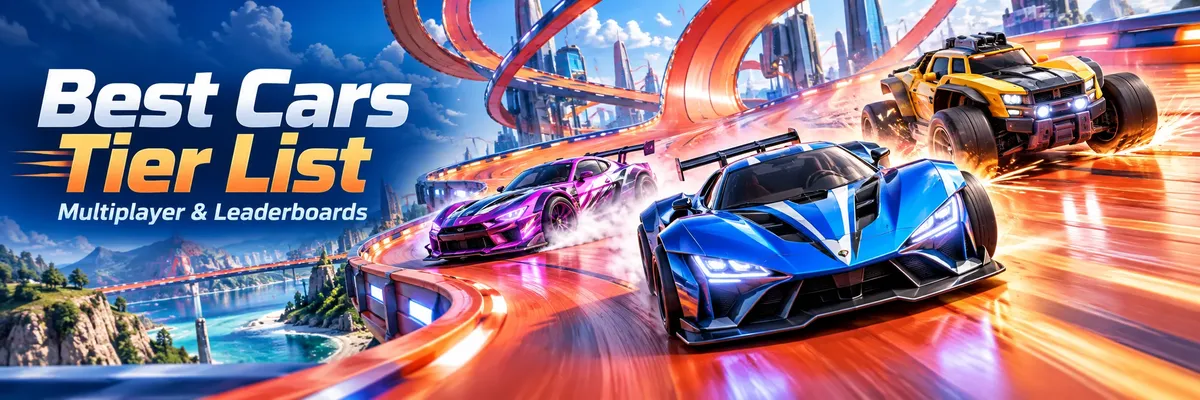
The Hot Wheels Infinite Rush best cars tier list is less about finding one vehicle that dominates everything and more about choosing the right class for the job. Speeders thrive when outright pace matters, Drifters turn corners into boost, Versatiles provide dependable all-around performance, and Titans exchange top speed for power.
The most useful tier list right now is a role-based competitive tier list.
A car can effectively be S-tier for one leaderboard and a poor choice for another because Infinite Rush intentionally gives each vehicle category a different purpose. Game Director Domenico Celenza has explained that the game's events are built around those different vehicle categories, while the Rush Squad lets players keep one vehicle from each class ready for free-roam challenges.
Our current competitive priorities are:
S Tier – Speeders for pure speed and Time Attack-style competition.
Speeders are explicitly designed around velocity. Their boost charges faster as their speed increases, creating a natural advantage whenever the objective rewards maintaining high speed and minimizing lap time.
S Tier – Drifters for technical tracks and Drift Master competition.
Drifters recharge boost while drifting, which makes controlled cornering part of their resource economy instead of merely a way to survive a turn.
A Tier – Versatiles for consistency and general multiplayer.
Versatiles balance speed, handling, and power. They may not have the extreme specialty of the other categories, but that predictability makes them extremely useful when consistency matters more than one maximum statistic.
A/B Tier – Titans depending on the event.
Titans sacrifice top speed for raw power and rapid boost recovery. They can be excellent when an activity rewards aggression or strength, but their boost has a major management condition: completely draining the charge causes a temporary slowdown.
This is not saying every Speeder is better than every Titan or Versatile.
It means the game's confirmed mechanics give Speeders and Drifters especially clear advantages in the competitive objectives most closely associated with traditional leaderboards: fastest times and drift performance.
Hot Wheels Infinite Rush deliberately avoids giving one category every advantage.
Milestone describes more than 150 launch vehicles divided across four different classes. Players build a Rush Squad consisting of one vehicle from each class, and during free-roam exploration they can instantly switch between those vehicles.
That system tells you something important about the game's design philosophy:
The game expects you to change tools instead of forcing one favorite car into every situation.
Imagine two players.
One picks the highest-speed Speeder they own and refuses to use anything else. That vehicle may be fantastic when the route opens into long straights. Put the same player into a technical activity that demands controlled slides, repeated corner exits, or heavy interaction with the environment, and the advantage becomes much smaller.
The second player builds a strong car in every category and understands when to switch.
That second approach fits Infinite Rush much better.
For multiplayer and leaderboard players, your real objective should therefore be to build four competitive specialists, not hunt for one mythical car that supposedly wins everything.
If the leaderboard measures how quickly you can finish a course, the Speeder class deserves immediate attention.
Milestone describes Speeders as vehicles built for pure velocity, with boost charging faster the quicker they are already moving.
That mechanic creates a powerful positive loop.
Drive cleanly, preserve momentum, and your high speed contributes to getting more boost. Use that boost efficiently and you maintain even more speed.
It also explains why mistakes can hurt a Speeder so badly.
A collision does not just cost the second or two spent recovering. It can also break your momentum, reduce the rate at which you rebuild boost, and leave you weaker for the next section.
For leaderboard hunting, this makes clean driving more valuable than reckless boosting.
When comparing two Speeders in your garage, do not automatically choose whichever one looks fastest.
Look for the vehicle that allows you to repeatedly produce clean runs.
Important qualities include:
Strong sustained speed.
Leaderboards usually reward average speed over an entire run, not the largest speed number you briefly reach.
Predictable high-speed handling.
A vehicle that becomes difficult to position at maximum velocity may force you to brake more often, eliminating part of its theoretical advantage.
Good recovery after small mistakes.
Multiplayer is rarely as clean as a solo practice run. Contact, missed lines, and imperfect landings happen.
Perks that complement your driving style.
Infinite Rush includes a perk system that modifies performance statistics, so two players can potentially use the same base car somewhat differently. Milestone specifically says perks are intended to fine-tune vehicles around the player's preferred racing style.
The biggest mistake is treating boost as a button that should always be held whenever available.
Instead, think about where speed creates more speed.
Use boost where you can carry the resulting velocity for long enough to benefit from it. A poorly timed burst immediately before a difficult corner may give you almost nothing if you have to brake moments later.
For competitive runs:
prioritize clean exits;
avoid unnecessary steering corrections;
learn where you can remain committed to full acceleration;
save boost when a braking zone will immediately erase the gain;
practice the same route until your lines become repeatable.
A slightly slower-looking Speeder that you can control perfectly can outperform a faster vehicle that causes repeated wall hits.
Drifters convert one of racing's normal compromises into an advantage: they recharge boost while sliding.
Officially, the class specializes in maintaining speed through corners with controlled handling, and its boost replenishes during drifting.
That makes Drifters especially attractive when a course contains repeated bends.
Rather than viewing every corner as an interruption to your speed strategy, a Drifter can use those turns as part of its boost cycle.
This is particularly relevant because Drift Master is an official game mode, alongside Quick Race, Elimination, Waypoints, Smashing Wheels, and Time Attack.
The best Drifter is not necessarily the vehicle capable of producing the wildest-looking slide.
For leaderboard racing, control usually matters more.
You want a car that lets you:
enter a drift without unpredictable rotation;
hold the required angle without excessive speed loss;
exit pointed toward the next important section;
regenerate meaningful boost while remaining on the racing line;
repeat the same sequence lap after lap.
A giant drift that looks spectacular but leaves your car facing the wrong direction is usually slower than a controlled slide that immediately transitions into acceleration.
Do not drift every corner simply because the class rewards drifting.
Some bends can be taken faster with a smaller steering input and minimal sliding.
The strongest Drifter players will learn which corners are worth converting into boost and which corners should simply be driven quickly.
That distinction becomes particularly important in multiplayer, where unnecessary sideways movement can also expose you to contact from other racers.
"Balanced" sometimes sounds like another word for average.
That is not how you should think about Versatiles.
Milestone describes the class as balancing speed, handling, and power, making it the game's all-around choice.
For multiplayer, that can be extremely valuable.
You are not always driving a perfect leaderboard attempt where you can restart immediately after one bad corner. Online competition can involve traffic, unusual situations, contact, and mistakes from other drivers.
A vehicle that behaves predictably across different sections can therefore have a practical advantage.
A specialist usually gives you a stronger ceiling in its preferred environment.
A Versatile gives you fewer obvious weaknesses.
That makes the category a good fit for players who want to learn:
track layouts;
braking points;
boost timing;
shortcut opportunities;
opponent behavior;
multiplayer positioning.
Instead of constantly fighting a highly specialized handling characteristic, you can concentrate on driving.
There are several situations where the answer is simple: when the specialist cannot use its specialty efficiently.
A Speeders' theoretical top pace means little if the course keeps interrupting momentum.
A Drifter's boost generation matters less if there are few useful corners.
A Titan's power can become unnecessary if the route rewards clean speed instead.
A strong Versatile is therefore an excellent benchmark car. Run the same course in your Versatile first. Then switch to the specialist and see whether the specialized mechanics actually improve your time.
That approach is much more reliable than assuming a class should be faster based purely on its description.
Titans trade outright speed for power and unusually aggressive boost behavior.
According to Milestone, Titans have lower top speed but strong raw power. Their boost also recharges rapidly. However, using the Boost Charge completely causes the vehicle to slow temporarily.
That creates a completely different rhythm from the Speeder.
A Speeder wants to preserve momentum.
A Titan wants to exploit powerful boost without crossing the line into a full depletion penalty.
One of the easiest mistakes with Titans is emptying the gauge simply because the boost feels strong.
That can punish you exactly when you need acceleration most.
Competitive Titan driving should therefore revolve around controlled bursts.
Use enough boost to gain the advantage you need, then preserve enough charge to avoid triggering the temporary slowdown.
That creates a higher management requirement than many players initially expect.
Titans become attractive when raw power, environmental interaction, or the nature of a particular event matters more than maximum velocity.
Infinite Rush includes varied activities rather than only traditional circuit racing. Milestone's official material highlights objectives involving smashing obstacles, stunt challenges, exploration, and other free-roam activities in addition to standard races.
That broader activity design gives the Titan a legitimate job.
For pure Time Attack leaderboards, however, the class's stated sacrifice in top speed means you should not automatically expect it to outperform a strong Speeder.
Milestone prominently features four vehicles connected to the game's Rush Master progression:
Rig Storm
2017 Aston Martin Vulcan
Sharkruiser
Mad Manga
These are confirmed vehicles shown on the official Infinite Rush page alongside the Rush Master system. Each island has a Rush Master, and defeating a Rush Master earns that rival's car and title.
That makes these four cars important progression targets.
However, there is an accuracy distinction worth making:
Being a Rush Master reward does not automatically prove that a car is S-tier for competitive multiplayer.
Milestone's public material does not currently provide an official universal performance ranking for these four against the rest of the 150+ vehicle roster.
Unlock them.
Test them.
Build perks around them.
But do not assume "boss reward" automatically equals "best leaderboard car."
The best way to discover a competitive vehicle is controlled testing.
Use the same:
event;
route;
perk setup where possible;
driving strategy;
number of attempts.
Do several runs instead of comparing one lucky result against one bad result.
A single lap tells you very little.
Repeated performance tells you whether a vehicle is genuinely helping.
Imagine Car A produces:
one incredible run;
three crashes;
two mediocre attempts.
Car B produces:
six runs very close to your personal best.
For multiplayer, Car B may be the stronger competitive choice even if Car A technically has the highest ceiling.
Leaderboards eventually reward the exceptional run.
Multiplayer rewards being fast repeatedly.
That distinction is important.
Infinite Rush is built around different boost systems.
Two cars with apparently similar performance can feel radically different once their class mechanic becomes part of the route.
Always ask:
How easily can I activate this class's advantage on this specific course?
That question is more useful than simply asking which garage number is larger.
Hot Wheels Infinite Rush officially includes several modes with different objectives.
Start your testing with a Speeder.
The objective is speed against the clock, making the class's velocity-focused boost system an obvious starting point.
From there, test a Versatile if the track contains enough technical sections to repeatedly disrupt your Speeder's momentum.
Start with a Drifter.
This is exactly where a class that regenerates boost through controlled sliding should feel at home.
Focus on smooth transitions and maintaining useful momentum rather than creating the largest possible drift angle.
Versatile, Speeder, or Drifter can all make sense depending on layout.
Quick Race is where track knowledge becomes more important than broad tier labels.
Long, fast route? Test a Speeder.
Technical corners? Test a Drifter.
Mixed layout or unfamiliar course? A Versatile provides a strong baseline.
Consistency becomes especially valuable.
Elimination punishes falling behind, so a car that has enormous peak performance but frequently crashes can be risky.
Versatiles should be taken seriously here, while Speeders become increasingly attractive on layouts where clean speed can create separation.
Handling and route knowledge can outweigh theoretical maximum speed.
Checkpoint-style racing can produce awkward approaches and transitions.
A car that reaches the checkpoint cleanly can beat a faster vehicle that constantly overshoots or needs dramatic corrections.
This mode is described by Milestone as hitting targets to score.
That changes the usual racing priorities.
Do not blindly apply your Time Attack setup to an objective where positioning and target interaction matter.
The Rush Squad is built around four cars, one from each class. During free roaming, you can switch between them immediately.
A competitive squad should therefore have four clear jobs.
Speeder – your pace specialist.
Use it as the first test for high-speed routes and timed runs.
Drifter – your technical specialist.
Bring it when controlled cornering and drift-generated boost can be exploited.
Versatile – your consistency specialist.
This is the car you can trust when you do not yet know exactly what a route demands.
Titan – your power specialist.
Use it for activities where its strength and rapid boost recharge create an advantage.
Do not neglect a category just because it is not currently your favorite.
The game has more than 150 launch vehicles and specifically encourages expanding your garage through races, activities, rival victories, Dealership purchases, Daredevil challenges, and other discoveries.
A broader collection means more opportunities to discover a vehicle that suits your exact driving style.
One major reason to be cautious with rigid launch-week rankings is the perk system.
Milestone confirms that perks can improve performance statistics and allow players to fine-tune cars toward their preferred style.
That means the question is not always:
"Which car is strongest?"
Sometimes it is:
"Which combination of car, class mechanic, perks, and driver is strongest on this route?"
A top-tier base vehicle used with an unsuitable setup may lose to a supposedly weaker vehicle whose perks complement the course perfectly.
For serious leaderboard attempts, test perk changes individually.
Do not modify several things at once and then wonder which change improved your lap.
Infinite Rush supports online multiplayer and dedicated leaderboards. Milestone also advertises full cross-play, with Nintendo Switch 2 excluded from the full cross-play pool. The game additionally supports local split-screen for up to four players on supported versions.
The presence of cross-play matters because a broader competitive pool makes small performance differences more visible.
Against AI, you may comfortably win with a wide variety of cars.
Against experienced human players chasing the same leaderboard objective, losing a little speed in every corner eventually adds up.
IGN's launch review also describes the racing itself as approachable while supporting difficulty levels suited to both beginners and experienced arcade-racing players.
That means car choice matters, but driver execution remains the bigger variable.
You still need to learn the route.
You still need to control your boost.
You still need to stop hitting walls.
No tier list fixes bad racing lines.
The game has barely entered its launch meta, and Milestone has not published an official 1-to-150 performance order.
Be skeptical when you see extremely precise claims such as exact hidden speed values, definitive global rankings, or special vehicle variants that cannot be verified through official material or reproducible player testing.
A Drifter and Speeder are not trying to accomplish the same thing.
Ranking them as though the game has one universal performance test ignores the class system.
A base-car comparison does not necessarily represent the setup players will actually use competitively.
Perks can modify performance, so testing should account for them.
Infinite Rush includes rare vehicles and special unlock methods, including a hidden Dealership that uses Secret Tokens and Daredevil vehicles earned through one-on-one challenges.
A rare unlock can be exciting without automatically becoming the fastest multiplayer option.
Rarity and racing performance are different systems unless testing proves otherwise.
A top player's choice may work because that player understands exactly how to exploit its boost mechanic.
If you cannot reproduce the driving required, the same vehicle may perform worse for you than a more forgiving alternative.
A better car helps, but large improvements usually come from cleaner execution.
Focus on these areas first:
Learn where you actually lose speed.
Watch whether your biggest losses happen entering corners, exiting them, recovering from impacts, or mistiming boost.
Use boost where the gain survives.
Boosting directly into a braking zone wastes resources. A slightly later burst can carry speed for much longer.
Reduce unnecessary movement.
Every correction can scrub speed. Smooth steering generally creates more predictable results than constantly adjusting the car.
Practice difficult sections separately in your mind.
Do not think of a run as one giant lap. Identify the two or three places where you regularly lose time and solve those first.
Test another class when progress stops.
Sometimes you have reached the practical limit of a particular vehicle on that layout.
The final point is especially important.
A tier list should help you decide what to test next, not convince you that one choice is mandatory.
No.
Multiplayer adds variables that a perfect leaderboard run does not.
You may have:
opponents occupying your preferred line;
collisions;
pressure causing mistakes;
unexpected braking;
poor positioning after a corner;
less freedom to restart after an error.
A car with slightly lower theoretical pace but better control can produce more wins.
This is why Versatiles deserve more respect in multiplayer than a pure top-speed comparison might suggest.
The best leaderboard car asks:
"What gives me the fastest possible clean run?"
The best multiplayer car asks:
"What lets me drive quickly and reliably while other players are around me?"
Those are related questions, but they are not identical.
What is the best car class in Hot Wheels Infinite Rush?
There is no confirmed universal best class. Speeders have the clearest advantage for pure velocity and timed speed objectives, Drifters specialize in cornering and drift-generated boost, Versatiles balance the main performance characteristics, and Titans trade top speed for power. The best choice depends on the event.
What is the best class for leaderboards?
For Time Attack and similar fastest-time objectives, a strong Speeder should be your first test because Speeders are built around velocity. For Drift Master competition, Drifters are the natural starting point because drifting restores their boost.
Are Speeders always the fastest cars?
They are officially the class designed for pure velocity, but that does not guarantee every Speeder will produce the fastest time on every course. Handling, corners, perks, player skill, and route design all influence actual results.
What is the best multiplayer class?
That depends heavily on the course. Versatiles provide strong consistency, while Speeders and Drifters can offer larger advantages when a route clearly favors their specialty.
Are Rig Storm, Aston Martin Vulcan, Sharkruiser, and Mad Manga the best cars?
They are confirmed prominent Rush Master reward vehicles, but official material does not establish them as the four strongest competitive cars. Defeating Rush Masters adds their vehicles to your collection.
How many cars are in Hot Wheels Infinite Rush?
Milestone states that the game launched with more than 150 vehicles spread across four classes.
Can perks change which car is best?
Yes. The game includes performance-modifying perks designed to let players tune vehicles toward their preferred driving style, so perk configuration should be considered when comparing competitive cars.
Does Hot Wheels Infinite Rush have online leaderboards?
Yes. Milestone confirms dedicated leaderboards alongside online game modes and synchronous and asynchronous challenges.
Does Hot Wheels Infinite Rush have cross-play?
Yes, full cross-play is supported across the relevant platforms except Nintendo Switch 2, according to Milestone's current official information.
The Hot Wheels Infinite Rush best cars tier list is going to become clearer as players put more time into the 150+ vehicle roster, optimize perks, and produce repeatable competitive results. Right now, the safest conclusion is that Infinite Rush rewards specialization rather than one universally dominant vehicle.
Speeders are the first class to test for raw pace and Time Attack. Drifters are built for technical cornering and Drift Master competition. Versatiles provide valuable consistency in multiplayer, while Titans bring a distinct power-focused style that becomes stronger when an event rewards their particular strengths.
More importantly, do not spend your time chasing an unsupported "number-one car" claim.
Build a strong Rush Squad. Test cars on identical routes. Learn their boost mechanics. Compare multiple clean runs. Then choose the car that produces the best results for the event you are actually trying to win.
As the competitive scene develops, that approach will remain far more useful than copying a static launch-week tier list.
For more gaming guides, progression help, and marketplace services across popular titles, visit BoostRoom
More Reads
Sell Hot Wheels Infinite Rush Accounts – Become a Seller
Read moreSell Hot Wheels Infinite Rush Game Keys – Become a Seller
Read moreSell Hot Wheels Infinite Rush Coaching – Become a Coach
Read moreHot Wheels Infinite Rush Boosting Jobs – Become a Booster
Read more