Gem Grab Rules You Must Exploit to Win More
If you want consistent wins, you have to play around how the mode actually works—not how it “feels.”
Win condition and countdown
- Your team wins by holding 10 gems long enough for the countdown to finish.
- If your gem count drops below 10, the countdown stops.
- If the enemy catches up to your gem total (or matches your total while you’re trying to count down), the countdown can reset or stop—so a “small steal” can be huge.
Gems drop on defeat
When a player carrying gems is defeated, they drop the gems where they fell. That single rule is why Gem Grab is about discipline: one bad push by the carrier can throw an entire match.
The mine and gem flow matter
Mid isn’t just an area—it’s a resource engine. When your team controls the mine area, you control:
- who picks up free gems,
- who gets pressured while holding gems,
- where fights happen,
- and how safe your carrier feels.
The big takeaway
Gem Grab is less about “winning every fight” and more about winning the right fights at the right positions so gems stay safe.
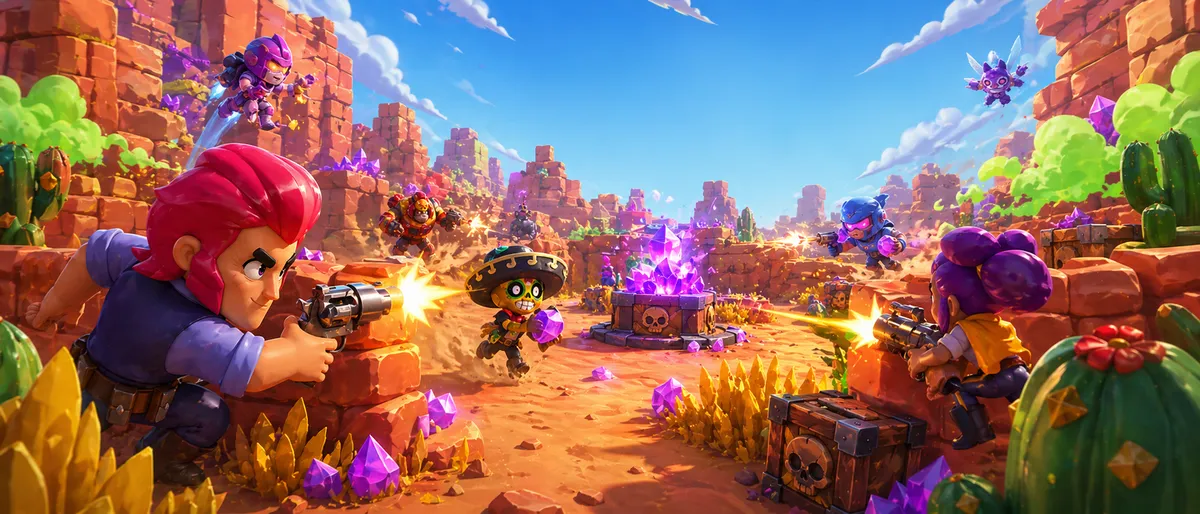
The Core Gem Grab Idea: Lanes Create Mid, Mid Creates Gems
Most players think mid control comes first. In reality, lanes create mid control.
Here’s the chain:
- Win or stabilize your lanes (left and right).
- Use the lane advantage to create a pinch on mid.
- Mid becomes unsafe for the enemy, so they lose mine access.
- Your carrier collects gems safely while your team holds space.
- You convert control into countdown, then defend intelligently.
If you skip step 1 and three players sprint mid, you usually lose to flanks, pinches, and throwers—because your lanes collapse.
Roles in Gem Grab: Mid, Lane, and Bodyguard
You don’t need perfect “meta picks” to win. You need role clarity.
Mid player (often the carrier, but not always)
Mid is the stabilizer. Their job is to:
- contest mine space safely,
- collect gems when it’s safe,
- avoid dying with a large stack,
- and keep enough pressure that the enemy can’t freely walk into mid.
Lane players (left and right)
Lane players win the map. Their job is to:
- take and hold cover positions,
- keep the enemy from flanking mid,
- win trades that force the enemy back,
- rotate when a pinch is available,
- and protect mid during countdown.
Bodyguard (sometimes a lane role, sometimes mid support)
The bodyguard’s job is to make the carrier hard to kill:
- peel divers away,
- body-block key shots,
- deny entry routes,
- and punish anyone who commits to the carrier.
In many matches, one lane becomes “the bodyguard lane” depending on matchups.
Lane Control: How to Win Left/Right Without Throwing Mid
Lane control is not just “get kills.” It’s owning better positions over time.
The lane goal: take the forward cover, then freeze
A lane is “won” when you control the best forward cover that:
- threatens enemy mid rotation,
- denies enemy flank routes,
- and keeps you safe enough to heal and repeat pressure.
A common mistake is winning lane, then chasing into enemy side and dying. That turns a lane win into a lane loss instantly.
The best lane habit: pressure, then hold
Lane control has a rhythm:
- Peek from cover → land shots → step back → heal → repeat.
- You don’t need nonstop aggression. You need repeatable pressure that slowly forces the enemy into worse spots.
Don’t mirror your teammate
If both teammates stack the same lane, mid gets pinched and your third teammate collapses. The best lane discipline rule is simple:
Start 1–1–1 (left, mid, right) almost every game.
When to rotate from lane
Rotate only when you can create a real advantage:
- 2v1 on an isolated enemy
- pinch on mid
- free gems because the enemy mid has to retreat
- countdown defense position after you gain a lead
Rotating “just because you’re bored” often opens your lane and lets the enemy walk into mid.
How to win lane when you’re countered
Sometimes your lane matchup is bad. Your job becomes:
- survive,
- waste enemy time,
- and prevent the enemy from rotating freely.
If you can’t win the lane duel, you can still win the lane job by not feeding and by forcing the enemy to stay stuck with you.
Mid Pressure: Owning the Mine Without Feeding
Mid control is the heart of Gem Grab, but it’s also where players throw games by overextending.
Mid is a “stability” job
Mid should usually be played by someone who can:
- survive pressure,
- fight while retreating,
- and reset safely after taking damage.
Even if mid is the gem carrier, they still must contribute pressure—just not in a reckless way.
The mid rule: you don’t stand on the mine; you control around it
Think of the mine as a dangerous magnet. If you stand directly on it with no cover, you become an easy target.
Instead:
- control angles around the mine,
- step in only to collect gems when safe,
- then step back behind cover.
Mid pressure is mostly about “not giving up space”
You don’t need to kill enemy mid constantly. You need to:
- force them to heal,
- deny their comfortable peeks,
- and make the mine area unsafe for them to stand in.
If enemy mid can stand there comfortably, they will farm gems and pressure endlessly.
The mid survival triangle
A strong mid position usually includes:
- cover in front,
- a retreat path behind,
- and lane support angles nearby.
If you don’t have at least two of these, mid becomes a feeding zone.
Pinches and Rotations: How Teams Actually Secure Mid
Pinching is the fastest way to turn pressure into wins.
What a pinch really is
A pinch happens when:
- your lane player pressures from one side, and
- mid pressures from the front, and
- the enemy has no safe dodge path.
Even average aim becomes deadly when dodging one direction means walking into another shot.
How to create pinches consistently
- Win a lane position first (don’t chase).
- Step forward into a threatening angle.
- Your mid stays steady and pressures the enemy’s retreat path.
- Don’t rush—just hold angles until the enemy makes a mistake.
Rotation timing that wins games
Rotate when the enemy is forced to heal or retreat. That’s when you can move without losing your lane position instantly.
The easiest rotation cue:
If the enemy lane player is low HP and backing up, rotate two steps forward and look for a pinch on mid.
You don’t need to sprint across the map. Tiny rotations create huge pressure.
Gem Carrier Mastery: How to Hold Gems Without Becoming a Target
Carrying gems changes your role. The more you hold, the more you must shift from “fight for space” to “protect the win condition.”
The carrier rule: your life is worth more than one gem
If you have the majority of your team’s gems, you must stop taking coin-flip duels. Dying with a stack is how comebacks happen.
Where carriers should stand
Carriers should stand where:
- they can still contribute pressure,
- they have immediate cover,
- and at least one teammate can protect them quickly.
Carriers should avoid:
- deep corners with no escape,
- open mid with multiple angles,
- and “solo gem pickups” in enemy-controlled space.
The carrier rhythm
A strong carrier rhythm looks like this:
- Collect gem → step back → pressure safely → collect next gem → step back again.
If you collect gems while staying exposed, the enemy will eventually burst you down.
Don’t be greedy with dropped gems
Dropped gems are often bait. Many carriers die because they run forward for one gem that doesn’t change the countdown.
Ask this before stepping forward:
- Does this gem change our countdown status?
- Does it remove the enemy countdown?
- Can I pick it up and still retreat safely?
If the answer is “no,” don’t risk your life for it.
Storing gems safely
A high-level habit is “gem safety staging”:
- If gems end up near your side and you already have enough to threaten countdown, you don’t always need to pick them up immediately.
- Keeping gems in safer areas can make it harder for the enemy to steal them with one rush.
The key idea is simple: gems are only valuable if they stay yours.
Team Comps That Win Gem Grab Without Needing Perfect Picks
Instead of naming “best” Brawlers, build comps by jobs.
Template A: Stable mid + two lane pressure
- Mid: survivable controller/support style
- Lanes: two consistent pressure picks (range, burst, or denial)
Why it works:
- Mid holds mine safely
- Lanes win positions and create pinches
- Countdown defense becomes simple
Template B: Pick tool + follow-up
- One pick-maker (pull/stun/trap style)
- One finisher (burst damage)
- One stabilizer (control/support)
Why it works:
- One confirmed pick often flips gem control immediately
- Great for comebacks and stopping countdown
Template C: Brawly core (frontline + support + control)
- Frontline space-maker
- Support sustain/peel
- Control mid denial
Why it works:
- You force enemies off mid
- You protect the carrier naturally
- Great when the map has cover and close routes
The comp mistake to avoid
Avoid three Brawlers that all want the same job:
- three squishy poke picks with no control,
- or three close-range picks with no safe approach,
- or three “selfish damage” picks with nobody protecting the carrier.
You don’t need perfect power. You need coverage.
Countdown Defense: How to Lock Wins Without Throwing
Most Gem Grab losses happen during countdown—not before it.
Countdown defense is about denial, not kills
Once you have the gem lead and the countdown starts, your job changes:
- You don’t need to rush mid.
- You need to deny the enemy’s paths to your carrier.
The correct formation
A strong countdown formation usually looks like:
- Carrier plays safer, slightly behind.
- Two teammates take forward cover positions that block flanks and entry routes.
- Everyone avoids stacking so one attack doesn’t hit all three.
The “don’t feed Supers” rule
During countdown, stop giving the enemy free Super charge. That means:
- fewer risky peeks,
- fewer open-lane trades,
- and more focus on staying healthy and denying entry.
If you feed the enemy big engagement tools during countdown, you create their comeback.
The “one teammate down” discipline
If a teammate gets defeated during countdown:
- do not panic-push for a kill,
- do not run forward alone,
- regroup and protect the carrier first.
You can win 2v3 during countdown if the carrier survives and your angles are good. You almost never win if the carrier dies trying to “make a play.”
Carrier emergency behavior
If the carrier is pressured and the timer is getting low:
- retreat behind the safest cover,
- hug walls that block angles,
- and let teammates bodyguard.
Sometimes the correct play is simply to run and live.
Comebacks: How to Flip a Losing Game
Gem Grab comebacks are real because one death can drop a whole stack of gems. The best comeback teams don’t “rush mindlessly.” They execute one clean plan.
Comeback Plan 1: Reset the countdown
If the enemy is on countdown, your #1 mission is to stop it. You can do that by:
- defeating the carrier,
- forcing them to drop gems,
- or stealing enough gems to interrupt the countdown advantage.
The smartest approach is often:
- pressure from two angles,
- force carrier to retreat,
- then collapse when they run out of safe space.
Comeback Plan 2: Build a pinch before you commit
If you run straight at the carrier, you often die before reaching them. Build a pinch:
- lane pressure from the side,
- mid pressure from the front,
- then your team commits together.
Even one second of pinch pressure can force the carrier into a mistake.
Comeback Plan 3: Turn enemy greed into your win
When teams are ahead, they often get greedy:
- stepping forward with the carrier,
- chasing kills,
- picking up risky gems,
- stacking in mid.
Your comeback job is to punish that greed:
- bait the overstep,
- burst the carrier,
- collect safely,
- then immediately swap into countdown defense yourself.
Comeback Plan 4: Win one lane hard, then rotate
If you can’t win mid directly, win a lane strongly:
- force the enemy lane to retreat or fall,
- rotate to mid,
- pinch the carrier or the mid defender.
This is the cleanest comeback style because it avoids a direct “walk into mid and die” approach.
Comeback Plan 5: Control the dropped gems
When the carrier drops gems, you don’t always need to pick them up instantly. You can:
- zone them,
- deny the enemy from collecting,
- then take them safely after the fight stabilizes.
A lot of comebacks fail because players run into open space to grab gems and get deleted.
Advanced Gem Grab Mechanics That Create Free Wins
These mechanics are the difference between “good” and “unfair.”
Gems on the ground affect gem flow
If too many gems are lying on the map uncollected, the mine can effectively slow down new gem spawns. That means:
- leaving piles of gems on the floor can change the pace of the match,
- and controlling where gems lie becomes strategic.
Practical use:
- If you’re behind, denying gem pickups can slow the enemy’s path to countdown.
- If you’re ahead, keeping dropped gems in safe zones can reduce comeback chances.
The “carrier mark” mind game
When you have the lead, enemies will naturally focus the carrier. Use that:
- let teammates take aggressive angles,
- punish divers who tunnel-vision onto the carrier,
- and force bad commits.
Staggered deaths matter
In Gem Grab, staggered deaths (dying one by one) are brutal because:
- the enemy maintains constant pressure,
- and you never get a full 3v3 retake.
If two teammates are down, it’s often better for the third to retreat and reset rather than “hero fight” and stagger the respawn cycle.
Ammo and cooldown tracking wins mid
Most mid fights are decided by:
- who has ammo at the moment of commitment,
- who has the key escape tool available,
- and who wastes resources too early.
If you want to win more mid fights:
- stop shooting “just to shoot,”
- save ammo for the moment enemies step into danger,
- and force them to commit into your full ammo.
Map Styles: How Lane Control Changes by Layout
Gem Grab strategy stays the same, but map shape changes how you apply it.
Open maps
What wins:
- consistent ranged pressure,
- safe peeks,
- and lane discipline.
How to play:
- avoid standing on the mine in open sightlines,
- use cover-to-cover movement,
- and rotate for pinches instead of forcing direct mid duels.
Wall-heavy maps
What wins:
- control,
- thrower-style pressure,
- and corner discipline.
How to play:
- don’t walk into chokes without ammo,
- win lane walls first,
- then pinch mid from safe corners.
Bush-heavy maps
What wins:
- bush control,
- safe checking,
- and anti-flank awareness.
How to play:
- treat bushes as enemy territory until proven safe,
- keep one teammate watching flank routes,
- and don’t let the carrier walk into unknown grass.
Split maps (strong side lanes)
What wins:
- lane dominance and rotations.
How to play:
- commit to winning one lane hard,
- then rotate to pinch mid,
- and deny the enemy’s ability to rotate freely.
How to Win More With Random Teammates in Gem Grab
Randoms are unpredictable, but you can still create structure.
Be the “stability” player
If your team looks chaotic, choose to be the stabilizer:
- don’t chase,
- don’t stack lanes,
- protect the carrier,
- and focus on safe objective control.
Even if teammates make mistakes, a stabilizer often prevents the one mistake that loses the match: carrier death with a huge stack.
Use movement as communication
Without voice chat, movement is how you lead:
- If you hold a lane confidently, a teammate often takes the other lane naturally.
- If you rotate at the correct time, teammates frequently follow.
- If you retreat during countdown, teammates often mirror the retreat.
Be consistent, not dramatic.
Stop “random gem pickup chaos”
One classic random problem is everyone grabbing gems and nobody playing safe. If you notice this:
- play slightly safer yourself,
- and prioritize defending the teammate who holds the most gems (even if it wasn’t planned).
A messy carrier is still your carrier.
Common Mistakes That Lose Gem Grab (Fix These First)
If you want fast improvement, fix these before anything else.
- Carrier pushes forward with a big stack and dies.
- Lane wins a fight and chases, losing the lane position and opening a flank.
- Team stacks mid early, gets pinched, and loses mine control.
- Countdown starts and the team keeps brawling, feeding Supers and throwing the lead.
- Players grab dropped gems in open space, dying and donating them back.
- Staggered deaths prevent full retakes.
- No pinch attempts, so mid becomes a pure aim duel instead of a coordinated trap.
- No one watches flanks, so the carrier gets jumped from the side.
Fixing just these usually raises your win rate immediately.
Practical Rules and Checklists
Use these rules exactly as written. They’re designed to be simple enough to remember mid-match.
Gem Grab quick rules
- Start 1–1–1: left, mid, right.
- Win lane position, then pinch mid.
- Carrier plays safer as gem count grows.
- During countdown: deny paths, don’t feed.
- After any kill: ask “what objective progress is free?”
- Heal before collecting risky dropped gems.
- If two teammates are down: reset, don’t stagger.
Lane checklist
- Am I holding forward cover without overextending?
- Am I preventing flanks into mid?
- Did I rotate only when a pinch is real?
- After winning lane, did I stop chasing and freeze the advantage?
Mid checklist
- Am I controlling around the mine, not standing on it?
- Do I have cover + retreat path?
- Am I collecting gems only when safe?
- Am I staying alive more than I’m chasing damage?
Carrier checklist
- If I die here, do we lose the match?
- Am I exposing myself for a gem that doesn’t matter?
- Are my teammates close enough to protect me?
- Am I retreating early during countdown?
Comeback checklist
- Can we create a pinch before we dive?
- Who is the enemy carrier, and where is their safest retreat?
- Are we timing our push when the enemy is low ammo or out of tools?
- If gems drop, can we zone them before collecting?
BoostRoom: Turn Gem Grab Knowledge Into Consistent Wins
If you understand Gem Grab concepts but still feel like matches slip away, the missing piece is usually execution: the small timing and positioning decisions that decide countdowns, pinches, and comebacks.
BoostRoom helps you build a simple, repeatable Gem Grab system that works with your favorite Brawlers and your real playstyle. Instead of vague tips, you focus on what actually wins:
- lane discipline and rotation timing
- mid stability under pressure
- gem carrier safety and escape paths
- countdown defense positioning
- comeback planning (resetting countdowns cleanly)
The goal is long-term improvement: smarter decisions, fewer throws, and a calm plan you can follow even with random teammates.
FAQ
What’s the most important skill in Gem Grab?
Lane control. When lanes are stable, mid becomes easier, the carrier stays safer, and pinches happen naturally.
Should the mid player always be the gem carrier?
Often, yes—but not always. The carrier should be whoever can stay alive with gems while still helping control space. Sometimes a safer kit carries better than an aggressive one.
Why do we lose even when we get more kills?
Because kills weren’t converted into gem control or countdown defense. In Gem Grab, one carrier death can erase several kills worth of progress.
How do we defend a countdown without throwing?
Stop chasing. Hold angles, deny entry routes, protect the carrier, and avoid feeding enemy Supers. Winning the countdown is about discipline, not aggression.
How do we stop an enemy countdown?
Create a pinch and focus the carrier. Don’t run straight at them. Force them into cover, then collapse together when they’re out of safe space.
What should I do if my teammates keep stacking one lane?
Hold your lane calmly and play as the stabilizer. Often teammates spread out once they see a clear lane owner. If they don’t, focus on protecting mid and preventing flanks.
Should we pick up every gem immediately?
No. Greedy pickups in open space cause throws. Pick up gems when you can do it safely, or zone them first and collect after the fight stabilizes.
What’s the fastest way to improve in Gem Grab?
Pick one role (lane or mid) and master its discipline: safe peeks, rotation timing, and objective conversion after fights.



