Practical rules for comparing these games (so you pick the right one)
- Don’t compare them by “who has better gunplay” first—compare them by how you want to feel while learning (relaxed learning vs high-stakes PvP learning).
- Compare time pressure (raid length, downtime, queueing, rebuilding kits).
- Compare loss rules (what you keep, what you lose, what you can recover).
- Compare progression pace (steady solo progression vs wipe-reset progression).
- Compare friction (inventory management, crafting complexity, economy systems).
- Compare control (single-player control over pace vs multiplayer unpredictability).
- Pick the game that matches your personality now, not the game you “wish” you were ready for.
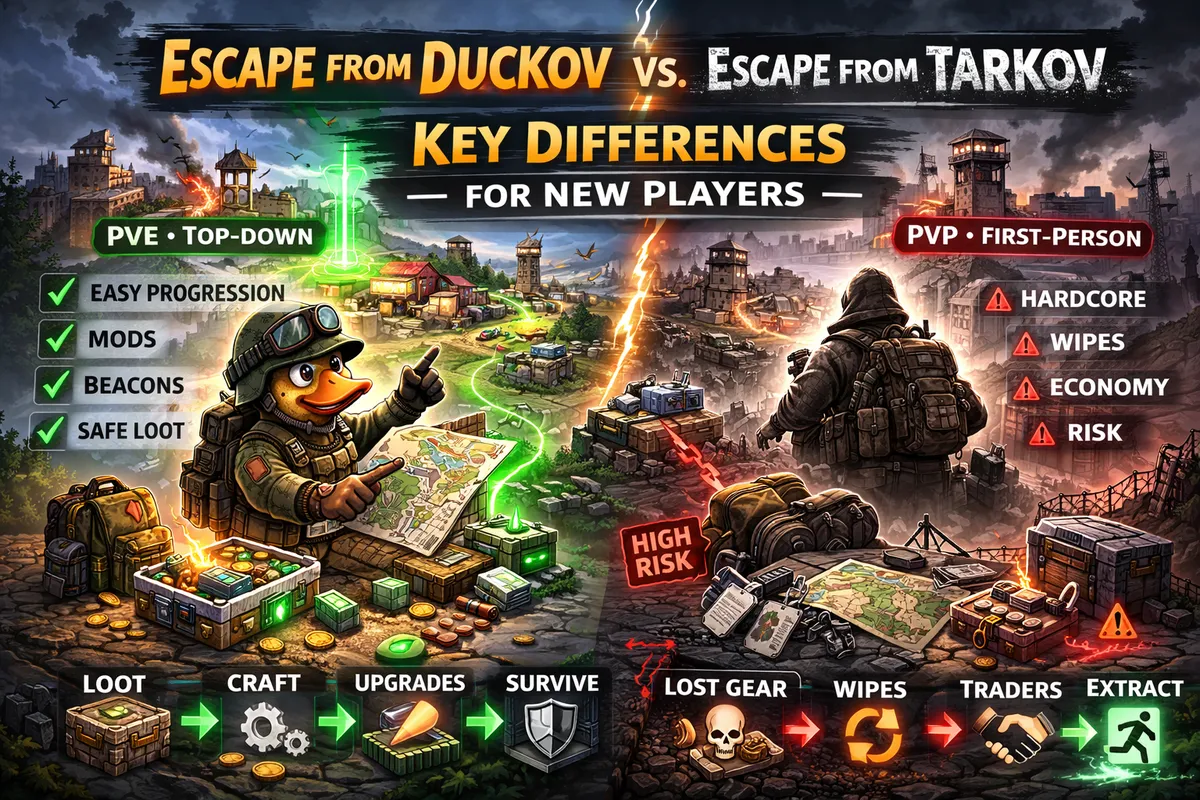
Quick verdict for new players (choose in 60 seconds)
Choose Escape from Duckov first if you want:
- a PvE-focused extraction loop you can learn without PvP stress
- shorter “learn → improve → repeat” cycles
- Steam Workshop mods that smooth quality-of-life quickly
- a lighter tone (still serious systems, but more approachable)
- a clear progression path into endgame content like Storm Zone
Choose Escape from Tarkov first if you want:
- a hardcore, competitive PvPvE extraction FPS
- a player-driven meta where other humans are the main threat
- wipe cycles that reset progression and create “fresh start” seasons
- deep economy systems (traders, flea market, insurance/secure container strategy)
- high realism + high punishment as the core identity
If you’re brand new to extraction games, a smart path is: Duckov first to learn the extraction mindset, then Tarkov when you want the full PvP pressure cooker.
Core identity: PvE single-player vs online PvPvE
This is the biggest difference, and it changes everything.
Escape from Duckov is built around PvE progression: the stress comes from AI fights, boss patterns, storms, and resource planning—not from outplaying human squads every raid. That means your improvement is more predictable: if you learn enemy behaviors and routes, your success rate climbs steadily.
Escape from Tarkov is fundamentally an online shooter where you face other players plus AI (and sometimes other modes). For new players, the hard part isn’t just learning maps—it’s learning maps while being hunted by people who already know every angle. The same route that’s “safe” in one raid can be a death trap in another because players spawn differently, choose different paths, and can camp extracts.
What this means for new players:
- In Duckov, knowledge turns into consistency quickly.
- In Tarkov, knowledge helps, but human unpredictability keeps the ceiling high and the lows brutal.
Perspective and controls: top-down readability vs first-person tension
One of Duckov’s biggest beginner advantages is readability.
Duckov’s top-down view (often described as top-down combat in coverage) makes it easier to:
- understand enemy positions
- spot movement
- manage spacing
- learn map landmarks faster
You’re still punished for mistakes, but you’re rarely confused about what killed you.
Tarkov’s first-person view is the opposite: it’s immersive and intense, but it makes learning slower because:
- sound cues matter more
- visibility is more limited
- recoil control, peeking, and aim discipline are more mechanically demanding
- a single unseen angle can erase your kit instantly
For a new player, Duckov often feels like “I can learn from this death,” while Tarkov can feel like “I died and I’m not sure why.”
Raid structure: pacing, timers, and pressure
Both games revolve around entering raids and extracting, but the pressure feels different.
In Duckov, you can often choose safer routes, do short farming loops, and extract early without feeling like you “wasted” the run. The game supports a steady loop: small wins, frequent extracts, consistent upgrades.
In Tarkov, raids are time-limited and feel like a high-stakes mission. You usually commit to a map and time-of-day, and the pressure comes from:
- other players racing to loot hotspots
- other players cutting off routes
- being forced into fights you didn’t want
- time pressure to reach extraction while carrying valuables
New player takeaway:
- Duckov rewards “short, smart, repeatable raids.”
- Tarkov often rewards “high-risk knowledge + timing + survival under PvP pressure.”
What “losing everything” really means in each game
Both games punish death, but the safety nets differ.
Duckov
- Duckov is known for systems that can protect specific progress items (new players commonly use pet storage mechanics and other safety habits).
- Many players treat “extracting with key items” as the main survival loop: get the objective, leave early.
Tarkov
Tarkov’s loss rules are famously harsh, but it offers two major safety tools:
- Secure containers: small secure slots where items are kept on death.
- Insurance: a system that can return insured items after a delay if nobody extracts with them.
What this means:
- In Duckov, your safety often comes from route discipline and “protect one key item” habits.
- In Tarkov, your safety often comes from secure container strategy + insurance strategy + knowing what is safe to risk.
Progression style: steady solo upgrades vs wipe cycles and seasonal resets
This is where many new players get shocked.
Duckov progression is usually “build upward” without a forced seasonal reset. Your bunker/hideout progression, beacon unlocks, and blueprint unlocks feel like permanent steps forward, so improvement feels stable over time.
Tarkov progression is defined by wipe cycles. Wipes reset players’ progression (levels/stashes and more, depending on the wipe), which creates a repeating seasonal arc: early wipe chaos, mid-wipe economic buildup, late wipe meta gear everywhere. Many third-party trackers show wipes averaging on the scale of months, and the community often frames gameplay around “early/mid/late wipe.”
New player takeaway:
- If you hate the idea of your progress being periodically reset, Duckov will feel more comfortable.
- If you love seasonal competition and fresh starts, Tarkov’s wipe loop can be the whole fun.
Economy and trading: stable crafting loops vs player-driven market pressure
Duckov tends to revolve around:
- selling loot to shops
- using the bunker to craft upgrades
- using systems like blueprints, workbench, and utility upgrades to convert junk into progression
- optional market-like systems that don’t fully depend on other players
Tarkov revolves around:
- traders with reputation/loyalty progression
- barters and item gating
- a player marketplace (flea market) that dramatically changes what you can access and how fast you progress
- a meta economy where prices shift based on supply, demand, and wipe phase
New player takeaway:
- Duckov money problems are often solved by route discipline and crafting priorities.
- Tarkov money problems are often solved by market awareness, trader progression, and knowing what’s valuable this wipe.
Hideout comparison: same idea, different stress
Both games have a “base/hideout” concept, but they serve different emotional roles.
Duckov bunker/hideout feels like a safety and crafting hub: you use it to stabilize runs, unlock core systems (beacons, key registration, crafting), and smooth friction.
Tarkov hideout feels like an economy engine: upgrades often matter because they unlock crafting, passive bonuses, and progression shortcuts that strongly influence your wipe success. Tarkov’s hideout is deeply tied to progression and resources.
New player takeaway:
- In Duckov, hideout upgrades help you feel safer and more consistent quickly.
- In Tarkov, hideout upgrades can feel like “homework,” but they also power your economy and wipe competitiveness.
Questing: mission planning vs survival under interference
Duckov questing is often route-based and stacking-friendly. You can plan a run where you complete multiple objectives in one loop, because the biggest variable is AI and your own decisions.
Tarkov questing is also route-based, but it has a brutal extra variable: other players. Even if you know exactly where the quest item is, you may have to fight for it, arrive before someone else, or survive an extract camp afterward.
New player takeaway:
- Duckov quests teach planning and discipline.
- Tarkov quests teach planning plus PvP survival plus patience during wipe competition.
Combat feel: realism pressure vs “readable chaos”
Duckov combat tends to be more forgiving for learning: top-down readability, clear enemy positioning, and a lot of progress coming from systems (attachments, ammo choices, hideout upgrades, storm prep, totems).
Tarkov combat leans hard into realism and punishment:
- first-person gun handling and recoil mastery
- sound-based information warfare
- extremely punishing mistakes
- other players using advanced tactics, map knowledge, and gear metas
New player takeaway:
- Duckov is often a better place to learn “extraction thinking” (risk, value, extract discipline).
- Tarkov is often the final exam where those habits are tested under PvP pressure.
Maps and extraction design: beacons and convenience vs knowledge checks
A huge beginner pain in extraction games is simply: “How do I leave?”
Duckov often gives you progression tools that reduce that pain over time, like beacons that shorten travel and make repeated routes faster once unlocked.
Tarkov forces extraction knowledge as a core skill: different maps, different extracts, different conditions, different timings, and other players competing for the same exits.
New player takeaway:
- Duckov becomes smoother as you unlock travel tools.
- Tarkov stays tense because even when you know the map, other players can punish your exit choices.
Mod support: Steam Workshop vs no official mod ecosystem
For new players, this matters more than it sounds.
Escape from Duckov has Steam Workshop support, which means you can add quality-of-life mods (inventory, UI, clarity, sorting, etc.) without complicated manual installation. It can make learning dramatically easier if you keep mods modest and focused on QoL.
Escape from Tarkov does not have an equivalent official Steam Workshop mod ecosystem for the live game experience. Your learning experience is closer to “raw Tarkov,” which is part of its identity: the grind, the friction, the intensity.
New player takeaway:
- Duckov can be customized to remove friction fast.
- Tarkov expects you to master the friction.
Time commitment: which game respects short sessions more
If you only have limited time per day, this difference is huge.
Duckov is often easier to play in short sessions because:
- PvE runs can be more consistent
- you can do short farming loops
- you can progress steadily without worrying about wipe competition
Tarkov can demand bigger session blocks because:
- queueing and online flow
- gear rebuilding after death
- intense raids that require focus
- wipe economy pressure (early wipe especially)
New player takeaway:
- Duckov can feel friendlier for casual schedules.
- Tarkov rewards long-term dedication, but can feel harsh if you can’t play regularly during a wipe.
What should you learn first in each game (first 10 hours plan)
If you want the fastest “new player ramp,” use these checklists.
First 10 hours in Duckov (fast learning curve)
- Learn one map route you can extract from consistently.
- Unlock your first beacon(s) as early multipliers.
- Build a cheap, repeatable kit you can replace instantly.
- Start blueprint discipline: if you find a blueprint, extract and register.
- Use the bunker to craft essentials and reduce downtime.
- Keep runs short until your survival rate is stable.
- Add 1–2 QoL Steam Workshop mods (inventory value/sorting, stash search) if you want a smoother learning experience.
First 10 hours in Tarkov (survival-first ramp)
- Learn one map deeply instead of jumping maps.
- Learn extraction points until they’re automatic.
- Learn what goes in your secure container (keys, meds, valuables).
- Use insurance strategically (insure what you can afford to lose, understand that it only returns if nobody extracts with it).
- Do slow, disciplined raids to build confidence and avoid “PvP panic.”
- Accept that early wipe and late wipe feel very different, and your experience depends heavily on the current wipe phase.
If you’re switching from Tarkov to Duckov: what habits to keep and drop
Keep these Tarkov habits (they transfer perfectly):
- Extraction-first thinking
- Value-per-slot looting
- Healing timing (stop bleed/ticking damage first, then stabilize)
- “Don’t fight if you don’t need to” discipline
Drop or adjust these Tarkov habits:
- Paranoia about every angle (Duckov is PvE; awareness matters, but the stress level can be lower)
- Over-investing in gear fear (Duckov rewards using your systems, crafting, and upgrades)
- Treating every raid like PvP (many fights in Duckov can be avoided or controlled through route choices)
Duckov becomes very fun when you use Tarkov discipline without Tarkov anxiety.
If you’re switching from Duckov to Tarkov: the biggest shocks and how to survive them
Expect these shocks:
- Humans are the real boss. AI is not the main threat.
- Every sound you make can become a PvP magnet.
- Wipes change the entire meta and economy rhythm.
- The learning curve is steep, and deaths can feel unfair until you build map knowledge.
Do these to survive:
- Pick one map and live there for a while.
- Play slower than you think you should.
- Use insurance and secure containers like a strategy, not an afterthought.
- Plan your quest routes around safe extraction windows.
- Stop chasing fights you didn’t start—survival is progression.
Duckov teaches you the extraction mindset, but Tarkov demands you apply it under real opponents.
Common misconceptions new players have (and the truth)
Misconception: “Duckov is just a joke game.”
Truth: the tone is playful, but the extraction systems are real. It has deep progression, hideout upgrading, and endgame content, and it’s popular enough to have a strong mod ecosystem and crossover attention.
Misconception: “Tarkov is impossible unless you’re a pro.”
Truth: Tarkov is punishing, but beginners succeed by learning one map, playing slow, and mastering basic systems (insurance, secure container, extraction discipline). You don’t need “pro aim” first—you need systems first.
Misconception: “Harder difficulty = better loot.”
Truth: In both games, loot quality and consistency are more about where you go and how you extract than about brute forcing difficulty. In Tarkov, wipe phase and market timing often matter more than difficulty.
Which one should you buy first (honest advice)
Buy Duckov first if you want a smoother on-ramp to extraction shooters: you’ll learn loot discipline, extraction planning, crafting priorities, and route repetition without PvP pressure.
Buy Tarkov first if you specifically want:
- hardcore online PvP extraction tension
- deep economy competition
- wipe-based seasonal resets
- high realism gunplay under pressure
Many players end up enjoying both—Duckov for comfortable progression and experimentation, Tarkov for adrenaline and high-stakes competition.
BoostRoom promo
If you’re choosing Duckov and you want to progress faster without wasting raids, BoostRoom helps you turn the early-game confusion into a clear plan: which upgrades matter first, how to run low-risk farming routes, how to stack quests, how to prep for J-Lab and Storm Zone, and how to stop dying with valuable items in your bag. BoostRoom is built around repeatable systems—so whether you’re brand new to extraction shooters or you’re coming from Tarkov, you can get consistent results quickly and reach endgame without hitting a “mid-game wall.”
FAQ
Is Escape from Duckov easier than Escape from Tarkov?
For most new players, yes—mainly because Duckov is PvE-focused and top-down, so learning is more readable and less punishing than online PvP pressure.
Do both games have hideouts?
Yes, both use a base/hideout concept, but Tarkov’s hideout is heavily tied to wipe economy and long-term progression, while Duckov’s bunker progression tends to feel more like a steady upgrade path.
What’s the biggest “culture shock” moving from Duckov to Tarkov?
Other players. Tarkov is a PvPvE game where humans can camp, bait, and outplay you. Your extraction and route habits matter much more.
What’s the biggest “culture shock” moving from Tarkov to Duckov?
The stress level. Duckov still punishes mistakes, but without human PvP the game rewards clean planning and consistent loops more than paranoia.
Does Tarkov still wipe?
Yes—wipes are a core part of Tarkov’s progression cycle, and community tracking shows wipe lengths on the scale of months.
Does Duckov have mods?
Yes—Duckov has Steam Workshop support, and many players use quality-of-life mods to reduce inventory and UI friction.
Which should I play if I only have short sessions?
Duckov is usually easier to enjoy in short sessions because progress is steadier and runs can be short and repeatable. Tarkov can be rewarding in short sessions too, but the online nature can make consistency harder.
If I’m totally new to extraction shooters, what should I learn first?
Extraction-first thinking: pick a route, pick a win condition, extract early. Once you can extract reliably, everything else gets easier in both games.