How the Deadlock Map Works in 2026
Deadlock’s modern map is built around three lanes with a dense city layout, vertical levels, and multiple travel systems that let you rotate quickly when you plan ahead. Instead of thinking “top/mid/bot,” think in these practical terms:
- Lane space: where Troopers create pressure and where Guardians/Walkers live.
- Neutral space: camps, power-ups, side objectives, and routes that connect lanes.
- Base space: the high-stakes endgame area where Shrines and the Patron decide everything.
The map is designed to make you choose. You can’t be everywhere at once, so winning teams learn to answer these questions constantly:
- Which lane is safest to farm right now?
- Which lane can we actually progress with an objective kill right now?
- Which neutral objective gives us the best next fight (or avoids a bad one)?
- How do we end the game instead of starting another 60-second brawl?
If you want to win consistently, your mindset must shift from “Where are enemies?” to “What is the next objective that moves us closer to the Patron?”
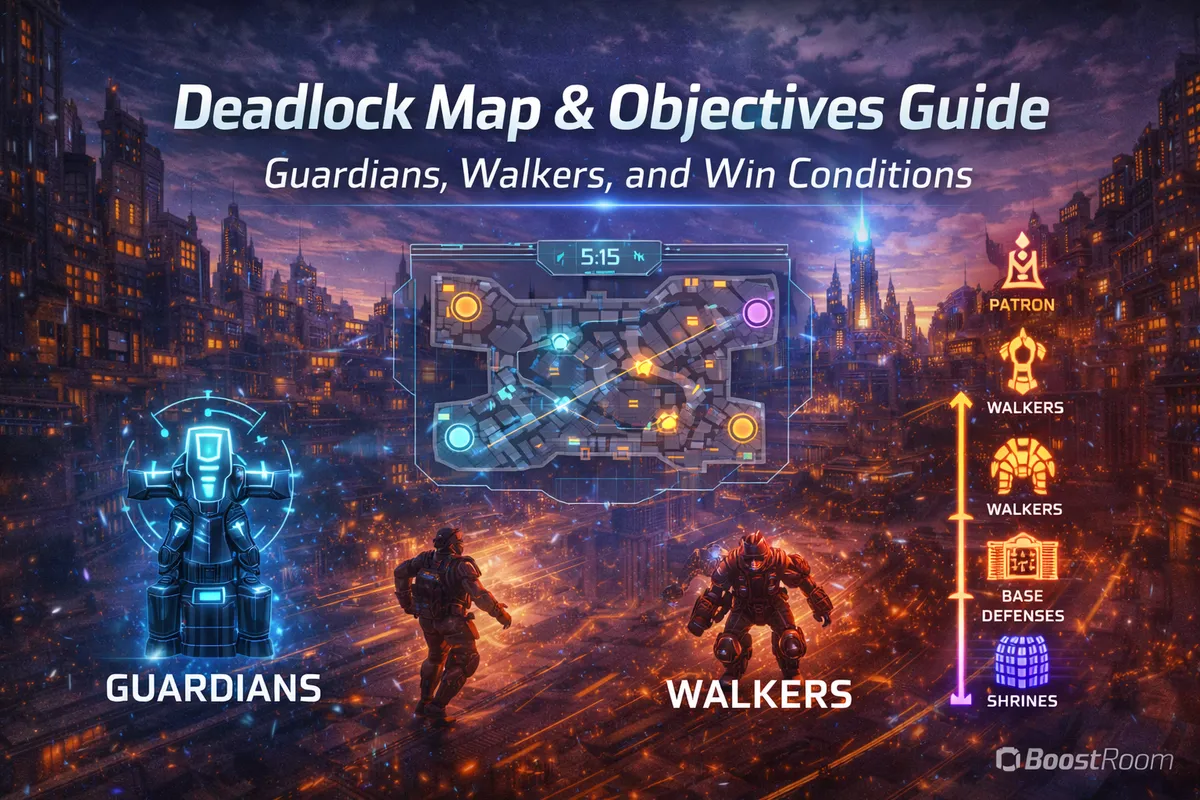
The Objective Ladder: What You Must Destroy to Win
Deadlock’s “mandatory path” is not optional. You cannot skip it, and most matches are decided by who progresses the ladder faster and safer.
A clean objective ladder looks like this:
- Guardian (outer lane defense)
- Walker (lane’s second defense and the most important midgame gate)
- Base defenses (the last defensive structures before base assault)
- Shrines (must be destroyed before the Patron can be damaged)
- Patron (final objective, often with phases/ritual rules)
Neutral objectives like Mid Boss (Rejuvenator) and the Soul Urn don’t replace this ladder. They help you win the fights and timings that let you climb it.
The biggest beginner mistake is treating objectives like “things we do later.” In Deadlock, objectives are what make later possible.
What the Minimap Is Really Telling You
Your minimap is a win-condition tool, not decoration. It shows you:
- which lanes are pushed
- which objectives are alive or dead
- where neutral objectives and power-ups are spawning
- where your next safe farm is
- where your next winning fight can happen
A simple habit that improves your map play instantly:
- Every 10–15 seconds, glance at the minimap and ask “What objective is threatened next?”
- If your Guardian is low, you don’t have a “maybe rotate” problem—you have a “lose map control” problem.
The Real Win Condition: Map Progress, Not Kills
Kills matter because they create time. But time only becomes wins when you convert it into:
- objective damage
- objective kills
- lane pressure that forces responses
- safer territory to farm and shop
- unlocked build power (like flex slots)
If you win a fight and then chase survivors for 20 seconds, you often lose the real reward: a free Walker, a free Guardian, or a free Shrine hit. The team that always chooses objective progress will beat the team that always chooses “one more kill.”
A practical rule:
- Kills are the key. Objectives are the door. If you never open the door, the key was wasted.
Guardians Explained: The First Gate in Every Lane
Guardians are the first major “stop sign” in each lane. They exist to punish mindless pushing and to force you to use Trooper waves correctly.
What Guardians do to the match:
- They create a safe zone for defenders.
- They require attackers to push with a wave, not alone.
- They force your team to learn siege basics: cover, timing, and reset discipline.
How to take a Guardian without feeding
Most Guardian failures come from two mistakes: pushing too early, or pushing with no wave.
Use this simple Guardian plan:
- Step 1: Build a wave. Clear the enemy Troopers and keep yours alive so your wave grows.
- Step 2: Crash the wave into the Guardian. Let Troopers draw the Guardian’s attention.
- Step 3: Hit the Guardian while your wave tanks. You are not the tank—your wave is.
- Step 4: Stop hitting if the wave dies. Back up, reset, and repeat next wave.
- Step 5: Secure the Souls from the objective drop. Objective Souls are a big swing and can be contested.
Why Guardians feel “tankier” early
In modern Deadlock balance, early objective defenses can have very high effective resistance that decays over time. The practical takeaway is:
- Early game Guardian pushes should be wave-based and disciplined, not brute-force.
- If you can’t keep Troopers alive at the objective, you’re not “close to taking it,” you’re donating health and time.
How to defend your Guardian correctly
Defending isn’t “stand under it forever.” It’s:
- clear the wave safely
- punish enemies who step forward without Troopers
- avoid dying in front of your own objective
- call rotations only when the enemy is committed and punishable
If you die while defending, you often give the enemy the exact thing you were trying to prevent: a free objective conversion.
Walkers Explained: The Midgame Objective That Actually Decides Games
Walkers are the second layer of lane defense and the point where matches usually shift from “laning” to “macro.” They are harder to take, more dangerous to fight near, and more likely to attract full-team rotations.
Most importantly, in 2026 Deadlock, Walkers matter because they often unlock teamwide build power through extra inventory flexibility. If your team ignores Walkers, you can end up in a late game where you have Souls you can’t efficiently convert into the right items, while the enemy team has unlocked the flexibility to counter you.
Why Walkers are harder than Guardians
Walkers typically punish attackers with:
- stronger damage patterns and area denial
- attacks that force spacing and timing
- deeper positioning (closer to enemy reinforcement routes)
- higher early resistance that decays later
That means Walker pushes must be planned. You can’t “casually” hit a Walker while the enemy team is alive and watching.
The #1 Walker mistake: starting it with no map control
If you hit a Walker while:
- your wave is not crashed
- your team is split
- enemies are missing
- your stamina and cooldowns are not ready
- you are basically announcing “please collapse on us.”
Instead, treat Walker attempts like a real objective:
- push the lane first
- force enemy heroes to show elsewhere
- win a small fight or get a pick
- then start the Walker with a clear plan to finish and secure the reward
How Walkers unlock your team’s next power spike
Modern Deadlock often ties extra “flexibility slots” to Walker progress. The details can shift with patches, but the macro truth stays the same:
- Walkers are not just lane progress. They are build progress.
- That means every Walker kill makes your entire team’s next item choices easier, stronger, and more adaptable.
If your team is ahead and you want to snowball cleanly, prioritize Walkers.
If your team is behind and you want to come back, stealing a Walker (or trading one) is one of the strongest ways to stop the enemy from choking you out.
How to Take Walkers Consistently: The 5-Point Checklist
Before your team commits to a Walker, check these five points. If you can’t say yes to most of them, you’re likely forcing a bad fight.
- Wave is crashed (Troopers are at the Walker, not dying in the middle)
- Enemy positions are known (you can see enough enemies to predict the collapse)
- Team is grouped (at least enough bodies to finish fast and fight)
- Cooldowns are ready (engage, sustain, and disengage tools available)
- Exit plan exists (you know how you leave if it goes wrong)
A clean Walker attempt is fast, decisive, and ends with a reset into the next objective. A messy Walker attempt turns into a 90-second brawl that often flips the match.
Objective Souls: How to Secure the Biggest Swing in Lane
Guardians and Walkers often drop significant Souls that can be:
- granted immediately
- then partially contested via Soul orbs (depending on the objective and current rules)
This matters because objective Souls can swing an entire lane phase. If you finally kill a Walker and then fail to secure the value, you’ve done the hard part and missed the payoff.
Practical objective Soul rules:
- Expect a contest. Enemies will try to steal/deny objective value.
- Don’t tunnel on the objective kill. The fight after the objective is often about securing the reward safely.
- Reset after you secure. Spending your Souls is how you turn the win into permanent pressure.
Shops and Map Progress: Why the Map Changes After the First Guardian
A detail many players miss: as lanes progress, the “convenience” of shopping changes. In modern Deadlock, once early lane progress happens (commonly after the first Guardian is destroyed), lane-side shopping convenience can disappear, forcing you to:
- return to base
- or use one of the dedicated map shopping locations
That changes how you plan rotations:
- You must think about shop timing as part of objective timing.
- You want to take objectives, then reset, then return stronger before the enemy can respond.
If you take a Guardian, stay on the map with low health, and don’t shop, you often throw your own progress. The best teams treat objectives as “win → shop → win again.”
Ziplines, Teleporters, and Fast Travel: How Teams Arrive First
Deadlock is not a “walk everywhere” game. You’re expected to use fast travel systems to show up on time.
Key travel tools you should master:
- Ziplines: your primary rotation highway; they help you cover distance without burning stamina.
- Teleporters: cross-map repositioning to respond to split pushes or collapse on objectives.
- Vertical routes: stairs, pads, and elevation changes that let you appear from unexpected angles.
Win-condition insight:
- Arriving first is a skill.
- If you arrive first to a Walker defense, you stop the push.
- If you arrive first to a Walker attack, you secure it before the enemy can set up.
- If you arrive first to Mid Boss area control, you force the enemy into a bad fight.
If you want to improve your map play faster than your mechanics, become the player who is always early and always ready.
Neutral Objectives That Support Win Conditions
You don’t win by neutrals alone—but neutrals often decide who wins the next objective fight.
Here are the neutral systems that matter most for map control and objective progress.
Power-Ups: Small Advantages That Create Big Fight Windows
Power-ups appear on a schedule and provide bonuses that scale as the match goes on. In modern Deadlock, power-ups can include categories like:
- casting-focused bonuses
- gun-focused bonuses
- movement/speed bonuses
- survival bonuses
Why they matter for objectives:
- A power-up can be the difference between winning a 6v6 around a Walker or losing it.
- Movement/speed power-ups can make rotations and chases cleaner, turning picks into objectives.
- Survival power-ups can allow your frontline to tank objective zones longer.
Practical habit:
- If an objective fight is likely in the next minute, grab a nearby power-up first—especially if it’s on your route and doesn’t cost you a wave.
Jungle Camps: Map Income That Also Creates Map Control
Neutral camps aren’t just “farm.” They are:
- a way to keep pace when your lane is dangerous
- a way to build a lead while enemies waste time
- a way to create routes that end at the right objective on time
Modern camp spawning usually staggers by difficulty:
- easy camps appear earlier
- medium camps appear later
- hard camps appear later still
Practical rule:
- Camps are for downtime between waves and rotations—not for missing a full wave.
- The best objective teams keep lanes pushed, then take camps while moving, then show up early to objectives.
Sinner’s Sacrifice: Risk-Reward That Fits Reset Timing
Sinner’s Sacrifice is best understood as a “reset tool” rather than a main plan. It can give meaningful bonus value, but it also introduces risk if taken at the wrong time.
Use it when:
- you’re already planning to reset to base
- enemies are showing elsewhere
- you can take it without losing a critical objective window
Skip it when:
- your team is about to contest a Walker
- you’re holding risky Souls and enemies are missing
- the map is dark and you could be collapsed on
The goal is always the same: don’t trade your life (and your tempo) for extra value.
Soul Urn: The Side Objective That Forces a Map Decision
The Soul Urn (often called Spirit Urn) is a major side objective that appears after the early game and then repeats on a schedule. It’s valuable because it can give a teamwide Souls swing and permanent benefits to the delivering player, but it also creates a risky moment where the carrier is vulnerable.
Urn is not a “bonus.” It’s a map event. When it spawns, teams must decide:
- contest it
- trade it
- or ignore it and take progress elsewhere
How to take Urn without losing the game
Urn attempts should follow a simple structure:
- Fix lanes first. Push or stabilize waves so you don’t lose objectives while running Urn.
- Escort the carrier. Urn is easiest when you treat it like a team objective, not a solo mission.
- Choose the route with map control. Running through dark space is how Urn becomes a trap.
- Be ready to fight before delivery. Many Urn fights happen at choke points near the route, not at the altar.
When to trade Urn instead of contesting
If the enemy is grouping strongly for Urn and your team is late or split, the best play is often to:
- take a Guardian/Walker in a lane
- take a power-up chain and camps
- or force structure damage that the enemy can’t ignore
The win-condition mindset:
- If you can’t win the Urn fight, take something permanent elsewhere.
Mid Boss and Rejuvenator: The Objective That Turns One Win Into the End
Mid Boss is the most important “game-ending support” objective in Deadlock. It typically becomes available after the early game and gives a powerful reward (often called Rejuvenator) that helps you:
- push into base safely
- survive risky sieges
- reset after winning a fight
- force the enemy into a do-or-die defense
The exact buff details can shift with patches, but the strategic value is consistent:
- Mid Boss is your best tool for breaking the last defensive layers and ending the match.
When Mid Boss is correct
Take Mid Boss when:
- the enemy team is missing key players (dead or forced to defend elsewhere)
- your team has enough sustained damage to finish it quickly
- you have control of the entrances and can prevent a steal
- you have a clear plan to use the reward for an objective push
The biggest Mid Boss mistake
Starting Mid Boss “because it’s up” while both teams are alive and your lanes are not pushed. That usually leads to:
- a contested fight in a tight space
- a lost boss and lost teamfight
- a match swing that feels impossible to recover from
The best teams use Mid Boss after they’ve already created the conditions for safety.
Shrines: The Base Gate You Must Break
Shrines are the final required gate before damaging the Patron. You can have a massive lead and still fail to end if you don’t handle Shrines correctly.
Shrines punish sloppy base pushes because they often have:
- dangerous zone abilities
- “punish circles” that force you to step out
- high pressure in tight base geometry
A practical base rule:
- Destroy both Shrines before you commit to Patron damage.
- If you try to force Patron early, you waste time, take unnecessary damage, and allow the enemy to stabilize.
Shrine fight fundamentals
- Go in as a group when possible; base pushes are not solo missions.
- Respect the telegraphed danger zones—step out, then re-enter.
- Use your frontline to hold space while carries focus the objective.
- If enemies respawn and you can’t finish, reset instead of donating kills in base.
Winning teams treat Shrines like a “clean operation,” not a brawl.
The Patron: Phases, Space, and Ending the Game
The Patron is the win condition, but taking it is usually harder than players expect because base geometry and respawn timers punish greed.
To end cleanly:
- Win a fight with enough enemy deaths to create time.
- Convert to Shrines (if not already destroyed).
- Push Patron with a clear formation: frontline holds space, backline hits the objective.
- Do not chase kills inside base unless it guarantees the end.
- Reset if the end is not guaranteed and the enemy is respawning.
The easiest way to throw a winning match is “we’re in base, let’s duel them.” The correct mindset is “we’re in base, finish the objective ladder.”
Win Conditions by Game Phase: What You Should Be Doing
Deadlock feels chaotic if you don’t anchor your decisions to the match phase.
Early Game Win Conditions: Lane Control and First Guardian
Early game is about building a lead that allows you to take the first Guardian without feeding.
Your early win condition checklist:
- secure consistent Souls from waves
- deny or pressure enemy farming windows
- keep your Guardian healthy while chipping theirs
- set up a wave crash to take the first Guardian
- shop and convert your Souls into real stats before forcing objectives
Early game is not “fight until someone quits.” It’s “farm, then take Guardian safely.”
Mid Game Win Conditions: Walkers, Flex Power, and Map Control
Mid game begins the moment the first Guardians fall and rotations start happening frequently.
Your midgame win condition checklist:
- prioritize Walkers as your main progress objective
- use neutral objectives to force good fights (Urn, Mid Boss setup, power-ups)
- push lanes before starting objectives to deny enemy rotations
- spend your lead often so you stay stronger than your opponents
In many matches, the team that secures more Walker progress controls the entire rest of the game.
Late Game Win Conditions: Mid Boss → Shrines → Patron
Late game is about one clean sequence, not endless fighting.
Your late-game win condition checklist:
- win a decisive fight or pick
- secure Mid Boss reward if it’s safe and helps the push
- break Shrines with discipline
- finish the Patron with a formation and clear timing
- reset if you cannot end—then repeat with the next fight window
Late-game discipline is the difference between “we were ahead for 30 minutes” and “we actually won.”
Objective Timing and Spawns: The Schedule You Should Respect
Deadlock’s map becomes more “alive” as the match progresses. Several systems appear after specific time marks (and many repeat):
Common timing ideas to remember:
- neutral camps appear in waves of difficulty over the early minutes
- power-ups start appearing after the early minutes and scale in strength
- Sinner’s Sacrifice appears after the early game
- Soul Urn appears after the early game and repeats
- Mid Boss becomes available after the early game and often defines mid-to-late transitions
You don’t need to memorize every second to win. You need one habit:
- Arrive early to the next map event that matters, or don’t contest it. Late contests lose games.
How to Convert a Won Fight Into the Correct Objective
This is the most important section for winning more matches.
After you win a fight, choose the objective conversion based on proximity and value:
- Closest Walker available → usually the best conversion in midgame
- Closest Guardian → strong if Walkers aren’t available yet
- Mid Boss → best when the enemy cannot contest and you can use it to end
- Shrines → best when you already have enough time and bodies to hit base safely
- Soul Urn → best when lanes are stable and you can escort delivery
- Lane shove + structure damage → best when your team is low and needs a reset soon
The conversion mistake:
- Winning a fight and then “looking for another fight” instead of taking the permanent progress.
A conversion that wins games:
- Win fight → take Walker → reset/shop → take next objective with item advantage.
Objective Defense: How to Stop Enemy Progress Without Dying
Good defense in Deadlock is proactive.
To defend Guardians and Walkers:
- clear the wave early so enemies don’t get free Trooper tanking
- hold angles that punish attackers who step forward without cover
- rotate before the objective is already half-dead
- avoid dying in front of the objective (death is the best siege tool for the enemy)
If the enemy groups to take an objective and you cannot defend safely, trade instead:
- push another lane and take their objective
- take a neutral objective
- secure camps and power-ups to stabilize
- reset your map position so you’re ready for the next defense
The worst defense is “we all run in one by one.” The best defense is “we arrive together, clear wave, and punish the commit.”
Split Pushing and Lane Pressure: When It Helps Win Conditions
Split pushing is powerful in Deadlock because lanes create forced responses. But it only works if you split intelligently.
Split push when:
- you can escape
- you have a clear objective target (Guardian/Walker pressure)
- your team isn’t about to fight mid boss or a major objective
- enemies are showing on the map and can’t instantly collapse
Don’t split push when:
- you will die and donate tempo
- you will be too far to join a decisive objective fight
- your team is already committing to a push and needs your damage
The best split push is not “solo hero mode.” It’s pressure that creates a numbers advantage elsewhere.
Practical Rules: The Deadlock Objective Checklist
Use this checklist every match. It’s simple on purpose.
- Objectives win games. Kills create time to take objectives.
- Never hit a Guardian or Walker without a Trooper wave (or a clear team plan).
- Walkers are the midgame gate. Prioritize them when you want real progress.
- If you win a fight, take the closest permanent objective—don’t chase forever.
- If you lose a fight, clear waves and stop bleeding. Don’t take a second bad fight.
- Push lanes before starting Urn or Mid Boss. Lanes are your safety.
- Don’t start Mid Boss unless you can control the area and finish it safely.
- Shrines require discipline—step out of danger zones, then re-enter.
- Patron ends the match. If the end isn’t guaranteed, reset instead of feeding in base.
- Arrive early to major objectives. Late contests are usually losses.
- Shop after progress. Turning Souls into items is how progress becomes unstoppable.
- If you don’t know what to do, shove the nearest safe wave and look for the next objective window.
BoostRoom: Win More by Playing the Map Correctly
Most players don’t lose because they can’t aim—they lose because they don’t convert wins into objectives. BoostRoom is built to help you improve the skills that actually decide matches: objective timing, rotations, and clean conversions.
How BoostRoom helps with map and objectives:
- Objective planning: knowing when to prioritize Guardians vs Walkers vs Mid Boss vs Urn
- Rotation discipline: arriving early, not late, and using ziplines/teleporters efficiently
- Conversion coaching: turning every won fight into the correct next objective instead of random chasing
- Base-ending structure: how to break Shrines and finish Patron without throwing
- Role clarity around objectives: who hits the objective, who holds angles, who scouts, and who protects carries
If you want faster improvement with less guessing, mastering objectives is the highest-return path—and BoostRoom focuses exactly on that.
FAQ
What is the fastest way to win in Deadlock?
Win fights that lead directly to objectives. The fastest wins usually come from taking Walkers efficiently, then using Mid Boss reward or a strong fight window to break Shrines and finish the Patron.
Are Walkers more important than Guardians?
Guardians unlock lane progress, but Walkers usually decide the midgame because they’re harder to take, attract teamfights, and often unlock teamwide build flexibility. If you can take a Walker safely, it’s often the best objective on the map.
When should we go for Mid Boss?
When you can control the area and the enemy cannot contest easily (dead, showing far away, or forced to defend). Mid Boss is strongest when you can immediately convert it into a base push.
Should we always contest the Soul Urn?
No. Contest it when lanes are stable and your team can escort. If you’re late or split, it’s often better to trade Urn by taking a Guardian/Walker or pushing another lane.
Why do we have more kills but still lose?
Because kills weren’t converted into objectives. If your team fights nonstop but doesn’t take Walkers, Shrines, or Patron progress, the enemy can win with fewer kills by taking permanent map advantages.
How do we stop throwing in the enemy base?
Go in with a clear goal (Shrines first, then Patron), respect danger zones, don’t chase unnecessary kills, and reset if the end isn’t guaranteed before the enemy respawns.
What should I do if my team refuses to group for objectives?
Play for the closest safe objective conversion you can influence: shove waves, pressure an exposed Guardian/Walker, grab a power-up, and be the player who arrives early and pings the correct next target.



