Understanding How Bullet Echo Combat Works
Bullet Echo looks simple when you first enter a match, but its combat system rewards patience and awareness more than constant movement.
Your hero's weapon, attack range, vision, movement characteristics, abilities, health, armor, and gear all influence how you should approach a fight.
Shooting Is Automatic
Unlike a traditional shooter, you do not manually press a fire button for normal weapon attacks.
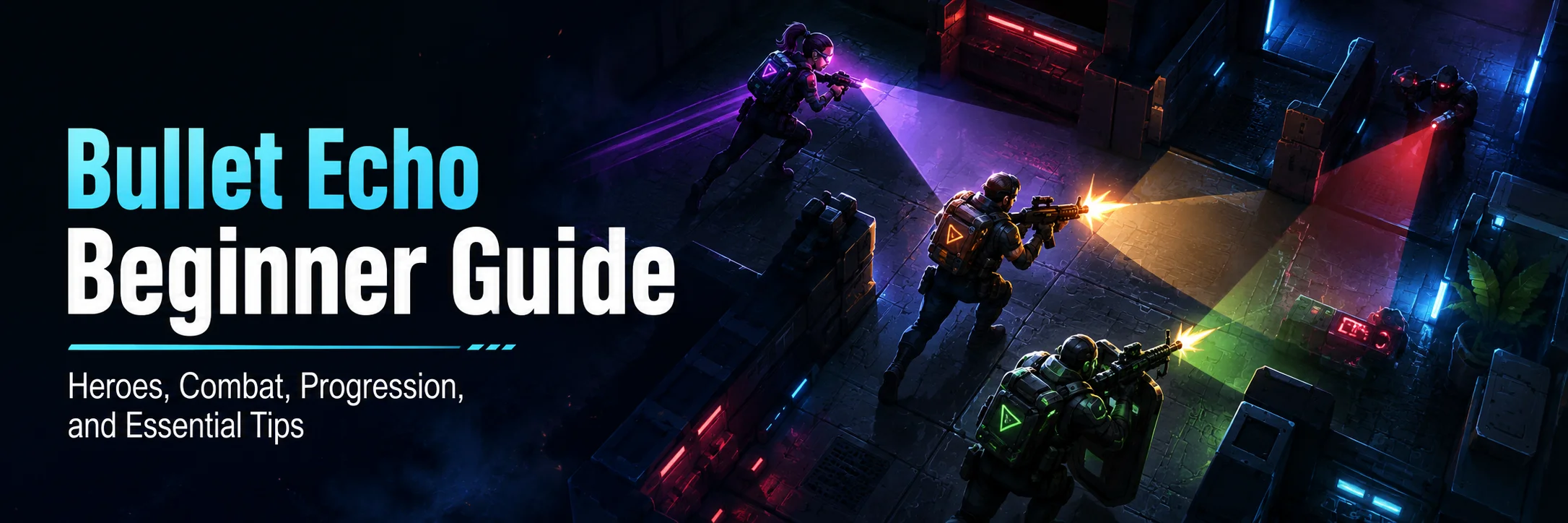
Your hero automatically fires when an enemy enters the weapon's attack area, represented by the red aiming cone. Automatic shooting is a core mechanic and cannot simply be disabled. Different weapons and heroes therefore require different positioning to bring enemies into an effective firing angle.
This makes movement and orientation extremely important.
Instead of thinking:
"How fast can I press fire?"
Think:
"How can I make the enemy enter my firing cone before I enter theirs?"
That difference is one of the foundations of good Bullet Echo play.
Stop Moving When Accuracy Matters
Movement affects accuracy.
Moving quickly widens your attack area and makes your shots less precise. Slowing down or stopping allows your hero to aim more accurately.
Beginners often lose fights because they continue running directly at an opponent while firing.
When you already have a good position, giving your weapon time to settle can be much more effective than constantly moving.
Fast movement still has an important role when escaping, repositioning, flanking, or closing distance with a hero designed for short-range engagements. The key is understanding when speed matters more than accuracy.
Learn to Control Your Noise
Sound is one of Bullet Echo's most important mechanics.
A white circle around your hero represents the noise produced by movement. Nearby enemies can detect your footsteps, including through walls. Moving more carefully reduces the information you give opponents.
Do Not Sprint Everywhere
Constantly moving at maximum speed makes you easier to locate.
There are situations where running is necessary, particularly when escaping danger or repositioning quickly. However, running through enclosed areas without considering enemy positions can announce your approach.
Slow movement can help you:
approach corners more safely;
improve your weapon accuracy;
reduce unnecessary noise;
prepare an ambush;
avoid revealing your route too early.
A good Bullet Echo player knows when to move quickly and when to become difficult to detect.
Gunfire Reveals Information Too
Shots also generate information.
Nearby players can hear shooting, while distant players may receive directional indicators pointing toward combat. Bullet trajectories may also be visible to nearby opponents.
That means every fight can attract another team.
After eliminating an enemy, do not automatically stand over the loot. Consider whether another player heard the battle and is already approaching.
Vision Is a Resource
Bullet Echo deliberately restricts what you can see.
The battlefield outside your hero's vision is dark, and enemies, supplies, and other objects may remain hidden until they enter the relevant visible area.
This makes information extremely valuable.
Check Corners Before Committing
Running blindly around corners is one of the fastest ways to lose a match.
Approach dangerous angles carefully and rotate your hero so your attack cone covers the area where an enemy is most likely to appear.
Walls, boxes, doorways, and narrow passages can all help you control engagements.
The game's penetration mechanics also mean that some heroes can shoot effectively through particular obstacles, so cover should never be treated as complete protection against every opponent.
Use Your Team's Vision
Team modes provide another major advantage: teammates share information through their field of view.
Playing close enough to support teammates can therefore reveal enemies that you personally would not otherwise see. Team modes also allow fallen allies to be revived, and some hero abilities provide benefits to nearby teammates.
Information is one of the strongest advantages a coordinated team can create.
Choosing Your First Bullet Echo Heroes
Bullet Echo has a growing roster, and heroes differ significantly in weapons, range, movement, abilities, durability, and intended combat style.
Do not choose your main hero only because someone placed them at the top of a tier list.
Balance changes happen, new heroes introduce new mechanics, and different characters demand different positioning.
Find a Playstyle You Can Execute Consistently
Consider what type of engagements you naturally prefer.
You may enjoy:
Your first objective should be finding a small selection of heroes whose gameplay you understand.
A theoretically powerful hero is not useful if you constantly position them incorrectly.
Learn Your Hero's Main Weapon
Each Bullet Echo hero has a permanently assigned main weapon. You begin a battle with a pistol and switch to that hero's main weapon after collecting ammunition. The main weapon itself cannot simply be swapped for another weapon type.
That makes understanding your hero's effective fighting distance extremely important.
Before investing heavily into a hero, learn:
how quickly they aim;
where they are strongest;
how much exposure they can survive;
whether they need space or prefer close engagements;
how their abilities support their weapon.
Weapon knowledge will improve your performance more than blindly chasing hero power.
Do Not Upgrade Every Hero
This is one of the most important progression rules for beginners.
Resources become increasingly valuable as upgrades grow more expensive. Spreading everything evenly across a large roster can leave you with many mediocre heroes but no hero capable of competing comfortably at your current progression level.
In May 2026, the developers specifically recommended that newer players focus on roughly one to three heroes and their gear instead of distributing resources across the entire roster.
That is excellent beginner advice.
Build a Small Core Roster
A practical approach is to develop:
one hero you consider your primary pick;
one alternative for a different combat style;
optionally, another hero that works well in team situations or covers a weakness in your roster.
You can expand later when your resources become more comfortable.
Specialization makes it easier to improve hero tiers, abilities, and gear without constantly running out of materials.
How Hero Progression Works
Bullet Echo hero progression contains several separate systems.
Understanding what each resource affects will prevent a lot of wasted upgrades.
Hero Levels
Coins are one of the game's basic progression resources and are used when developing heroes. Coins can be earned through matches, chests, league progression, and other reward sources.
Increasing hero levels improves their statistics and prepares them for higher progression stages.
Do not automatically level every unlocked hero just because an upgrade is available.
Concentrate spending on heroes you actually intend to use.
Hero Tiers
Heroes progress through 11 listed tiers:
Common → Rare → Epic → Legendary → Mythic → Supreme → Ultimate → Celestial → Stellar → Immortal → Divine.
Increasing tier expands the hero's available progression and helps unlock abilities.
Cards are a major part of this system. Hero cards are obtained from chests and other sources, while Joker Cards can be invested into an unlocked hero of your choice.
Because Joker Cards provide targeted progression, beginners should avoid spending them randomly.
Use them on heroes you are confident you want to develop.
Hero Abilities Explained
Every hero has four special abilities connected to their individual playstyle. The number of abilities available depends on hero progression, and increasing a hero's tier unlocks more of their kit.
Abilities can dramatically change how an engagement plays out.
Batteries Upgrade Abilities
Batteries are the primary resource used to improve hero abilities.
They can come from sources including matches, Contracts, events, certain chests, and Trophy Road rewards.
Once again, resource concentration matters.
Upgrading abilities on heroes you rarely play can delay meaningful improvements on your main characters.
Do Not Use Abilities Just Because They Are Available
Beginners frequently activate abilities immediately when they see an opponent.
Instead, ask what the ability is supposed to accomplish.
It may help you:
initiate a fight;
escape danger;
control an area;
reveal enemies;
protect yourself;
support teammates;
deny an enemy position;
finish an opponent.
Using an ability at the right moment is often more valuable than using it as soon as it becomes available.
Understanding Gear
Gear adds another layer to hero customization.
Each hero has six gear slots. Gear improves various characteristics, while gear sets can provide additional bonuses when enough matching pieces are equipped. Set bonuses are available at specific piece thresholds. Personal gear can also provide bonuses designed around a particular hero.
Nuts Are Used for Gear Upgrades
Nuts are an important gear progression resource. Gear upgrades also require the appropriate gear copies as progression increases.
Avoid upgrading random pieces simply because you have enough Nuts.
Ask whether the stat actually benefits the hero you are building.
Match Gear to the Hero
Different heroes value different characteristics.
Depending on the hero and build, useful bonuses may improve areas such as survivability, range, mobility, weapon performance, or other combat statistics.
There is no reason every hero should use exactly the same setup.
More importantly, shared gear can be used by multiple heroes, while personal gear is tied to specific characters.
For a beginner, upgrading broadly useful gear can sometimes offer better long-term value than heavily investing in niche equipment before understanding the system.
What Resources Should Beginners Care About?
Bullet Echo contains numerous currencies and materials, but several are especially relevant when building your early roster.
Coins
Used primarily for hero progression.
Spend them on heroes you actually intend to play rather than leveling your entire collection.
Hero Cards
Cards help increase hero progression and become especially important as your heroes advance.
Joker Cards are particularly valuable because they can be directed toward a chosen unlocked hero.
Batteries
Used to upgrade abilities.
Prioritize the abilities of your core heroes.
Nuts
Used for upgrading gear.
They become increasingly important as you develop better equipment.
Bucks
Bucks are the game's premium currency and can be used for certain offers, coins, and other functions.
Beginners should generally avoid spending premium currency impulsively until they understand which purchases provide value for their account.
Crypto Chips
Crypto Chips come from Contracts and can be spent on Black Market offers. They are tied to Contract seasons and do not function like a permanent general-purpose currency, so check their remaining availability in-game rather than assuming they can be saved indefinitely.
Pick Up the Right Battlefield Items
Looting is important, but spending too much time collecting every item can put you in danger.
Battlefield pickups include ammunition, armor, healing resources, ability charges, and upgrades.
Ammo Comes First
Your main weapon becomes available after collecting ammunition, making early ammo particularly important.
Do not wander deep into dangerous territory with only your starting pistol if a safer ammo pickup is available.
At the same time, avoid racing teammates for supplies they need more urgently.
Maintain Your Armor
Armor can absorb damage that would otherwise threaten your health, while armor penetration influences how effectively enemy attacks bypass it.
Entering a fight with depleted protection puts you at an immediate disadvantage.
Whenever the situation allows, recover protection before voluntarily starting another engagement.
Heal Somewhere Safe
Healing is not instantaneous.
While healing, your movement is slowed and your hero is vulnerable. The process can be interrupted manually if danger appears.
Do not heal in the middle of an exposed doorway because your health bar is low.
Move behind cover first whenever possible.
Teamwork Wins More Games Than Chasing Kills
Battle Royale uses teams of three, while other Bullet Echo modes use different team structures and objectives.
Regardless of mode, coordinated players gain advantages that three individually strong players may not.
Stay Within Supporting Distance
You do not need to stand directly beside teammates.
In fact, stacking too tightly can make your entire team vulnerable to area damage or a bad engagement.
Instead, maintain enough distance to create multiple firing angles while remaining close enough to help.
Revive Carefully
In applicable team modes, fallen teammates can be revived.
Movement interrupts the revival process, so starting a revive without checking the surrounding area can result in two deaths instead of saving one teammate.
Secure the immediate area whenever possible before committing.
Do Not Abandon the Team for Loot
A common beginner mistake is wandering away because an attractive pickup appears nearby.
If your teammates encounter another squad while you are collecting items on the opposite side of the map, the fight effectively becomes a disadvantageous encounter.
Good loot is useful.
A living team is usually more useful.
Understand the Different Game Modes
Bullet Echo includes multiple modes with different objectives.
Battle Royale places teams of three against other teams, while King of the Hill is a solo survival competition. Modes such as Squad vs Squad, Sabotage, Mimic Mode, Arcade, and the Syndicate-focused Vault add different objectives and rules. Team Deathmatch has also been added to the game, although developers stated in February 2026 that there were no plans at that time to make it a permanent mode like Battle Royale or King of the Hill.
Beginners do not need to master every mode immediately.
The transferable fundamentals remain:
Once those fundamentals become natural, adapting to different mode objectives becomes much easier.
Use Chests and Rewards to Build Your Account
Chests are one of the main sources of progression materials.
Depending on the chest, rewards can include hero cards, coins, Bucks, batteries, gear, and other resources. Some chests can also unlock heroes.
Your progression therefore comes from more than simply winning individual matches.
Do Not Judge Progress Only by New Hero Unlocks
Unlocking a new character feels rewarding, but improving a hero you already understand can be more valuable than constantly changing mains.
A stronger, properly geared hero with upgraded abilities gives you a more consistent foundation for learning advanced mechanics.
Trophy Road and Long-Term Progression
Trophies contribute to broader account progression through Trophy Road, where reaching higher milestones provides rewards. At 10,000 trophies, the standard Trophy Road reaches its limit and transitions into Bravery Road progression.
For beginners, however, trophies should not become the only measurement of improvement.
Track whether you are becoming better at:
surviving encounters;
positioning around cover;
recognizing enemy heroes;
controlling noise;
choosing favorable fights;
managing abilities;
supporting teammates.
Those skills continue to matter long after early progression rewards are gone.
Drones for Beginners
Drones add another progression and combat system to Bullet Echo.
They can use their own weapons and abilities, and different drones can be assigned to different heroes. Drones can also interact with revival mechanics; for example, a drone can revive its fallen owner, although this takes time and prevents it from shooting during the process.
Drones also have their own progression resources and modules.
For a brand-new player, however, hero fundamentals should remain the priority.
Do not let additional progression systems distract you from learning movement, positioning, aiming, and your hero's abilities.
Biggest Bullet Echo Beginner Mistakes
Avoiding a few common mistakes can dramatically improve your early experience.
Upgrading Too Many Heroes
This spreads Coins, cards, Batteries, Nuts, and gear progression too thin.
Develop a small core roster first.
Running Everywhere
Fast movement creates more noise and reduces aiming accuracy.
Slow down before entering dangerous areas.
Fighting Every Enemy You See
Not every engagement is favorable.
If another team has better positioning, disengaging may be smarter than forcing a fight.
Ignoring the Attack Cone
Facing the correct direction is essential because normal firing is automatic.
Always think about where your weapon is pointed.
Looting Immediately After a Kill
Gunfire can reveal where a fight happened.
Another enemy may already be approaching.
Check the area first.
Healing in the Open
Healing leaves you vulnerable and slows your movement.
Use cover.
Ignoring Your Team
Bullet Echo heavily rewards shared vision, coordinated abilities, revives, and crossfire.
A solo-minded player can make otherwise winnable team fights much harder.
Spending Joker Cards Randomly
Universal progression resources are valuable.
Use them on heroes you genuinely intend to develop.
Copying Builds Without Understanding Them
A strong player's gear setup may be optimized for a specific hero, playstyle, or progression level.
Understand why a piece of gear is useful before spending resources on it.
Essential Bullet Echo Tips for New Players
If you remember only a handful of lessons from this guide, make them these:
Focus progression on roughly 1–3 heroes.
Learn your hero's ideal engagement range.
Slow down when you need accurate shots.
Watch your noise circle.
Approach corners with your firing cone ready.
Do not chase every enemy.
Maintain armor and health before taking voluntary fights.
Save valuable upgrade materials for heroes you actually use.
Stay close enough to support teammates.
Learn from deaths instead of immediately blaming hero balance.
Bullet Echo is heavily knowledge-based. Every match teaches you more about map layouts, ability interactions, weapon ranges, and enemy behavior.
Mechanical progression makes your hero stronger.
Game knowledge makes you stronger.
Bullet Echo Beginner FAQ
What is the best hero for beginners in Bullet Echo?
There is no single beginner hero that will always be the best for every player or every balance update. Starter and early heroes are intentionally designed with relatively understandable mechanics, helping new players learn movement, shooting, positioning, and ability use before dealing with more complicated character kits.
Choose a hero whose weapon range and playstyle feel comfortable, then learn them properly before heavily investing elsewhere.
How many heroes should beginners upgrade?
A strong starting approach is approximately one to three heroes. This matches current developer guidance intended to help new players reach a competitive level faster instead of spreading progression resources across the whole roster.
How do you shoot in Bullet Echo?
Normal weapon firing is automatic. Your hero shoots when an enemy enters the red attack area created by the weapon.
Your job is therefore to manage positioning, orientation, range, movement, and accuracy.
Why do my shots miss while moving?
Movement widens your aiming area and reduces accuracy. Slowing down or stopping allows your hero to aim more precisely.
Can enemies hear footsteps?
Yes. The white circle around your hero represents movement noise, and enemies can detect footsteps when close enough, including through walls.
What are Batteries used for?
Batteries upgrade hero abilities. They can be acquired from several reward sources including matches, Contracts, events, certain chests, and Trophy Road progression.
What are Nuts used for?
Nuts are used to upgrade gear. Since gear upgrades become an important part of character development, avoid wasting them on equipment you do not expect to use.
Should I upgrade every hero I unlock?
Usually not at the beginning.
A concentrated roster reaches useful hero, ability, and gear progression much faster than an account that spends resources evenly on every character.
Final Thoughts
Bullet Echo becomes much easier once you stop treating it like a traditional run-and-gun shooter.
Vision, sound, attack angles, positioning, cover, team coordination, and resource efficiency are fundamental parts of the game. Strong heroes and upgraded gear certainly help, but they cannot fully compensate for poor positioning or repeatedly taking bad engagements.
Start with a small roster. Learn exactly how your heroes fight. Upgrade the abilities and gear that support them, manage your valuable resources carefully, and pay attention to why each fight was won or lost.
Once movement, aiming, noise control, positioning, and teamwork become natural, you will have the foundation needed to explore advanced heroes, specialized builds, higher-level progression, and Bullet Echo's more competitive modes.



