Why Duos Can Beat Full Squads in Marathon
A full squad has more bullets, more utility slots, and more “mistake forgiveness.” So why do strong duos still win?
Because numbers only help if the squad fights together—and most squads don’t. In Marathon, teams fall apart when:
- one player chases,
- one player loots,
- one player heals,
- and suddenly the “3v2” becomes three separate 1v2 moments.
A good duo is built to force splits and punish them fast. You win by creating:
- isolation (make their third player useless),
- tempo (win the first 3 seconds, not the last 30),
- and reset control (heal/reload/revive without getting collapsed).
Duos are also naturally better at one critical skill: speed. Two players rotate faster, reposition faster, loot faster, and extract faster. If you treat speed as a weapon—not just movement speed, but decision speed—you can beat squads who are “stronger on paper.”
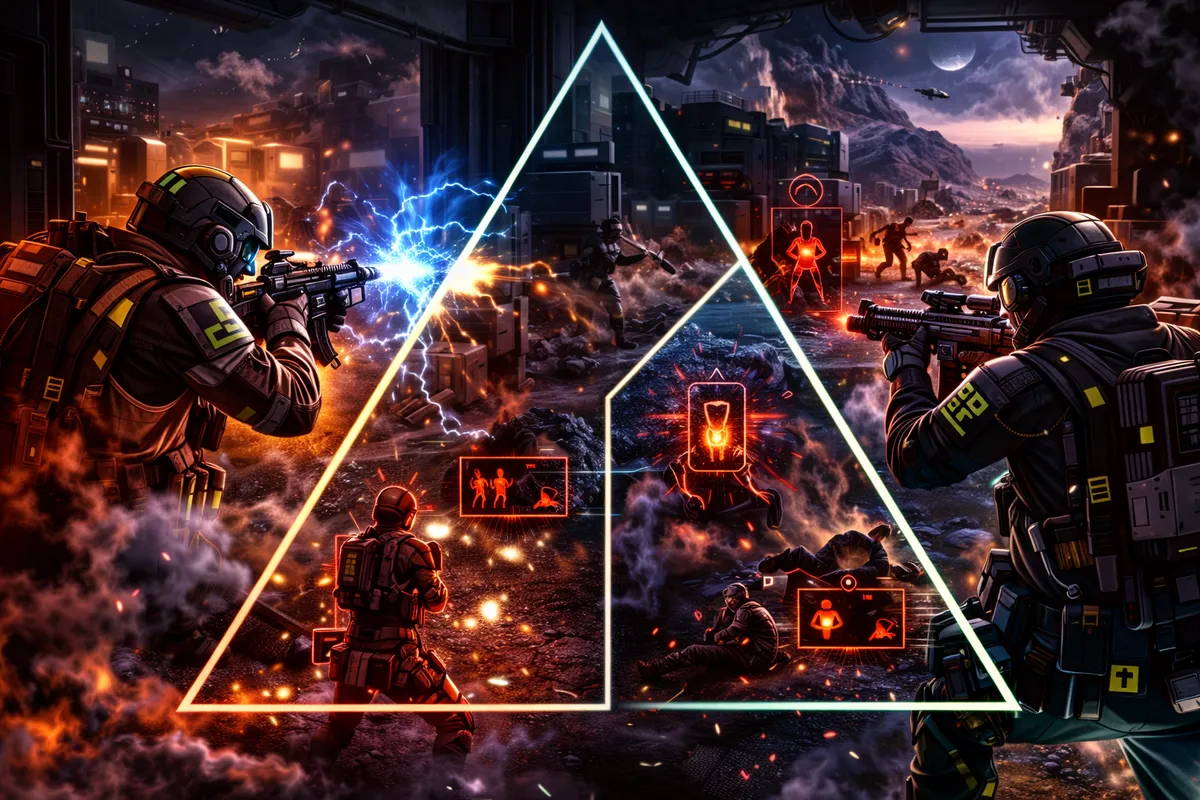
The Duo Advantage Model
Before tactics, internalize the duo model. It explains every winning decision.
A duo wins 2v3 fights when it can repeatedly do four things:
- See first
- You don’t need to shoot first every time, but you need to know what’s happening first: where they are, where they’re moving, what they’re holding.
- Hit first
- The first meaningful damage forces healing, forces cover, and steals initiative. Initiative is what lets two players fight three.
- Reset first
- The first team to reload/heal safely is the first team ready to push again. Duos lose when they win damage but die mid-reset.
- Leave first
- In Marathon, extracting is winning. A duo that leaves at the right time will “win the night” even if it avoids half the fights.
Everything else—weapon choices, utility choices, routes—supports one of these four advantages.
The Core Duo Rules That Make You Hard to Kill
These rules are the foundation. If you follow them, you’ll beat better-aim squads simply because you don’t offer them clean wins.
Rule 1: Never fight in a place you can’t reset.
If there’s no cover to heal, no corner to reload, and no route to disengage, you’re not in a fight—you’re in a coin flip.
Rule 2: Always fight with a crossfire.
If both of you are shooting the same doorway from the same angle, you’re wasting the duo advantage. One shoots, one holds the punish angle.
Rule 3: Your first goal is a down, not damage.
Damage is temporary in Marathon; healing erases it. Downs create numbers advantage. Your duo should focus fire to secure a down quickly.
Rule 4: After a down, decide instantly: finish or leave.
Duos die after downing someone because they hesitate. Either collapse to finish and take control, or disengage to reset. “Half-commit” gets you third-partied.
Rule 5: Don’t chase into unknown geometry.
Full squads bait chases. Your win condition is not proving you can sprint faster. Your win condition is controlling space and converting downs.
Rule 6: Every run needs a purpose.
A duo that plays with a plan extracts more often and gets richer faster. Pick one: value, contract, upgrade materials, or PvP practice.
Duo Role Pairings That Work
Duos don’t need three roles—they need two roles that cover all jobs. The jobs are:
- start fights,
- protect resets,
- gather information,
- and control exits.
Here are the role pairings that consistently beat full squads.
Entry + Anchor: The Most Reliable Duo Core
This is the “classic” duo: one player creates pressure, one player stabilizes the fight.
Entry responsibilities
- Starts contact and forces movement.
- Takes the first aggressive angle.
- Converts cracks into a down with fast focus fire.
Anchor responsibilities
- Holds the safe reset lane.
- Denies the chase path.
- Protects heals/reloads and prevents the third party collapse.
Why it beats squads:
Most squads don’t have a real Anchor. They have three players trying to “do everything.” Your Anchor turns their chaos into a punish window.
Entry + Scout: The “Fast Kill” Duo
This duo wins by speed and angles: the Scout feeds info and flanks, the Entry commits when advantage appears.
Scout responsibilities
- Finds the approach route and calls timing.
- Takes an off-angle that creates a crossfire.
- Tracks third-party risk and calls exits early.
Entry responsibilities
- Uses utility to start the fight.
- Focuses the target that the Scout isolates.
- Ends fights quickly, then leaves before the lobby collapses.
Why it beats squads:
Full squads often rely on slow, safe pushes. This duo punishes slow play by creating fast, multi-angle pressure that forces panic.
Anchor + Scout: The “Never Die” Duo
This duo is built for consistent extracts, contracts, and value runs. You don’t take fair fights; you take advantaged fights or you leave.
Anchor responsibilities
- Holds space, protects resets, denies pushes.
- Builds exfil setups (sensors/mines/smoke plans).
- Calls disengages early.
Scout responsibilities
- Finds safe routes and avoids hotspots.
- Calls enemy movement and third parties.
- Enables third-party fights where you enter late and clean up.
Why it beats squads:
You win with patience and information. Squads hate fighting teams that refuse to give clean openings.
Duo Loadout Philosophy: What Two Players Need
Duos don’t have a “third gun” to cover mistakes, so your loadouts must reduce risk.
Your duo kit should always cover:
- One mid-range controller (wins rotations and lane fights)
- One close-range finisher (wins building collapses and exfil chaos)
- At least one reset tool (smoke or bubble-style protection)
- At least one opener tool (EMP or a grenade that forces movement)
- At least one information layer (sensor or anti-scan tool)
If both of you build the same kit with the same range and the same utility, you lose the biggest duo strength: flexibility.
Weapon Roles for Duos
You don’t need specific “best guns” to win duos. You need role coverage.
Mid-range controller
- Reliable rifle/precision option
- Comfortable optic
- Stable recoil, consistent first burst
- Works while strafing and peeking
Close-range finisher
- SMG/shotgun-style weapon you can commit with
- Strong inside buildings and tight exfil approaches
- Low hesitation weapon (you can’t afford indecision in 2v3)
Sustain/anchor weapon
- A weapon that holds angles and punishes pushes
- Ideally less reload panic (bigger mags or consistent reload rhythm)
A practical duo rule:
- If one of you runs a close-range finisher, the other should run a weapon that can punish at mid-range so you don’t get trapped indoors.
Utility Stacking: The Duo Superpower
Full squads have more utility slots—but duos can stack utility more intelligently because coordination is simpler. The key is not “more grenades.” The key is one tool for each problem.
Here’s the duo utility checklist:
- A tool to start fights (EMP is the classic)
- A tool to deny pushes (chem/heat/door denial)
- A tool to reset (smoke or bubble-style protection)
- A tool to gather info (sensor)
- A tool to deny enemy info (signal jammer or anti-scan plan)
- A tool to sustain (ammo crate or smart restock plan)
Duos that beat squads most consistently are usually the duos that win the reset and win the information war.
The Six Two-Person Plans That Beat Full Squads
Below are six repeatable duo plans. Pick one based on your playstyle and your current stash confidence.
Plan 1: The “Isolate and Delete” 2v3
Best for: confident aim, clean comms, fast fights
- Scout spots or Entry forces first contact.
- You focus fire one target immediately.
- If you get a down, you push to finish fast—then reset and reposition.
- If you don’t get a down quickly, you disengage and change angles.
Why it works: squads often “share damage” across three players but fail to protect one player when they’re cracked. You punish the weakest link.
Plan 2: The “Crossfire Trap”
Best for: beating aggressive squads, defending POIs, exfil holds
- Anchor holds the obvious lane.
- Scout/Entry takes a side angle where enemies must expose themselves to push.
- Let them commit to the obvious lane, then punish from the cross angle.
- Use denial utility to prevent their retreat or revive.
Why it works: squads rely on stacking three guns into one lane. Crossfires punish stacking because their front player becomes free.
Plan 3: The “Third-Party Surge”
Best for: fast money runs, safe PvP, high extracts
- Scout listens for fights and routes you toward late engagement.
- You enter only after one team has downs or is mid-reset.
- You secure one down fast, then clean up.
- You extract early instead of staying loud.
Why it works: you don’t need to outgun three players at full strength. You fight them when they’re already damaged, reloading, or split.
Plan 4: The “Utility First” Push
Best for: squads that turtle, indoor fights, objective rooms
- Start fights with EMP to steal shields and create panic.
- Follow with denial (chem/heat) to block the escape door.
- Entry collapses while Anchor holds the cut-off lane.
- Reset behind smoke if needed, then re-peek to finish.
Why it works: squads often survive by resetting behind cover. Utility denies cover and makes resets expensive.
Plan 5: The “Bait and Break”
Best for: beating overconfident squads, creating 1v2 windows
- Anchor shows briefly to bait a chase.
- Anchor retreats into cover where Scout/Entry already has an off-angle.
- When the first chaser commits, you delete them.
- Immediately reposition so the remaining two can’t trade you back.
Why it works: squads chase because they think “we have three, we can run them down.” You punish that assumption.
Plan 6: The “Extract Fortress”
Best for: consistent extracts, contracts, high-value bags
- Scout chooses an exfil with good cover and fewer approach lanes.
- Anchor sets sensors/mines and holds the strongest lane.
- Entry stays ready to punish the first push attempt, then stops chasing.
- Save one reset tool (smoke/bubble) for the final seconds.
Why it works: squads often win exfil fights by forcing chaos. This plan turns exfil into a controlled space where their third body doesn’t help as much.
How to Win 2v3 Fights: The Exact Combat Sequence
Duos don’t win 2v3 by “taking more fights.” They win by making each fight short, decisive, and unfair.
Use this repeatable 2v3 sequence:
Step 1: Choose the fight location
If the squad is in a wide-open lane and you can’t create a crossfire, don’t commit. Reposition first.
Step 2: Force a mistake with pressure or utility
EMP, smoke-cross, denial grenades—anything that makes their formation messy.
Step 3: Focus fire one target until down
Split damage is how you lose. Pick one: closest, most exposed, or most isolated.
Step 4: Immediately deny the revive
- Hold the body angle
- Block the revive path with denial utility
- Or collapse and finish quickly if safe
Step 5: Reset behind cover
Reload, heal, reposition. Duos die when they stay in the “same spot” after winning the first exchange.
Step 6: Decide the end
- If you have advantage, finish fast.
- If you got your value and the fight is noisy, leave.
A pro duo doesn’t need to full wipe every time. A pro duo needs to extract.
Isolation Techniques: Turning 3 Enemies into 1 Enemy
Isolation is the heart of duo success. Here are the most reliable isolation tools:
Doorway isolation
Hold a doorway so only one enemy can swing at a time. Use denial utility to punish stacking.
Elevation isolation
Force one player to climb/zip while the others are stuck on a different level.
Angle isolation
Take two angles so the squad can’t face both without exposing someone.
Pace isolation
Make them chase. Most squads chase at different speeds. Delete the first chaser.
Reset isolation
When a squad is healing/reviving, they are naturally separated. That’s when duos should strike.
If you’re struggling to beat squads, it’s usually because you’re fighting their full strength instead of forcing isolation first.
Duo Third-Party Rules: How to Win More Without Fighting More
Third parties are scary in squads because coordination gets messy. In duos, third parties can be your easiest profit—if you follow rules.
Rule 1: Arrive late, not early
If you arrive early, you become Team #1 and get pinched. Arrive when the fight is already unstable.
Rule 2: Take one down, then reassess
If you get one down, you’ve already gained value. Don’t force a wipe if the lobby noise is rising.
Rule 3: Don’t loot bodies until angles are safe
Looting is a reset window. Protect it like one: hold lanes, listen, then loot.
Rule 4: Leave fast
Third-party wins are often small wins: a weapon, some valuables, and an easy extract. Don’t stay loud.
This is how duos print value and still extract consistently.
Duo Exfil Strategy: Setup, Warmup, Final Seconds
Exfil is where duos either feel unstoppable—or feel helpless. Most duo losses happen because they treat exfil as “stand here and pray.” Don’t.
Setup
- Scout the exfil area before activation.
- Identify the two most dangerous approach lanes.
- Decide where your reset tool will be used if things go wrong.
Warmup
- Anchor holds the most dangerous lane and prevents free pushes.
- Entry holds the punish lane and looks for a fast down, not a long duel.
- Scout watches for third-party routes and calls “rotate off center” if needed.
Final seconds
- Save one utility tool (smoke/denial/EMP) specifically for the last push.
- Don’t chase away from exfil unless it’s guaranteed and short.
- If you already hit your run goal, prioritize survival over extra kills.
A duo that treats exfil as a controlled sequence extracts far more often than a squad that relies on brute force.
Anti-Scan Duo Play: Surviving Recon Pressure
Scan-heavy squads love hunting duos because they assume “easy collapse.” Your counterplay is disciplined movement and anti-information tools.
Duo anti-scan habits:
- Don’t sprint in straight lines after being scanned—break line of sight twice.
- Change elevation if possible.
- Use Signal Jammers proactively before risky crossings or exfil setups.
- Use smoke to deny long angles, then rotate away from predictable exits.
- If a drone or scan pressure appears, don’t argue with it—reposition and bait the push into your crossfire.
Duos win anti-scan fights by denying conversion: even if they know you’re “near,” they can’t turn it into a clean kill.
Duo Economy and Contracts: Getting Rich Without Feeding Squads
Duos can progress incredibly fast because:
- loot splitting is simple,
- coordination is fast,
- and you can extract earlier without debate.
A duo economy plan that works:
- One player focuses on contract objective efficiency.
- One player focuses on loot value per slot and route safety.
- If you hit your contract step, leave—even if the bag isn’t perfect.
- Use safe third-party opportunities to “top up” value only if the fight is already collapsing.
Duo contract discipline:
- Don’t choose objectives that force you into the most contested POI with no reset plan.
- Choose objectives that overlap with your preferred routes so you don’t “grind” contracts at the cost of extraction rate.
The richest duos aren’t the ones who fight every team. They’re the ones who extract with progress every session.
Duo Communication: Simple Callouts That Win 2v3
Duos have the easiest comms advantage in the game: only two voices. Use that to stay calm and precise.
Your duo callout pack:
- “Hold—reset.” (stop pushing and heal/reload)
- “Crossfire set.” (angles are ready)
- “Focus left / focus right.” (no split damage)
- “Down one—finish or leave?” (decision point)
- “Third party—disengage.” (don’t get pinched)
- “Smoke now.” (reset window)
- “Don’t chase.” (the most important duo call in Marathon)
If your duo can say these lines without emotion, you’ll beat squads that are louder and more chaotic.
The Most Common Duo Mistakes
If your duo keeps “almost winning,” it’s usually one of these mistakes.
Mistake 1: Both players push the same angle
That’s not pressure. That’s stacking. You need crossfire.
Mistake 2: Chasing after a down
Duos die because they chase into unknown geometry and lose the reset battle.
Mistake 3: No reset tool
If neither of you carries smoke or another reset tool, your heals and revives become free punish windows.
Mistake 4: Fighting too long
The longer the fight, the more likely a third party arrives. Duos should prefer fast fights.
Mistake 5: Looting too early
Looting is a “hands busy” moment. Secure lanes first, then loot.
Mistake 6: No exit plan
A duo without an exit plan is a duo that dies to “we didn’t know where to go.”
Fixing these mistakes will often improve your extracts more than changing weapons.
Practice Drills: How to Get Better as a Duo Fast
If you want real improvement without grinding forever, run drills.
Drill 1: Crossfire only
For three fights, you’re not allowed to shoot from the same angle. One holds, one off-angles. This builds isolation.
Drill 2: First down wins
In every engagement, you focus fire only one target until a down happens. No split damage. This builds conversion.
Drill 3: Reset discipline
After every exchange, you must reset behind cover for two seconds (reload/heal/check lanes). This builds survival.
Drill 4: Exfil sequencing
For three extracts, treat exfil as setup/warmup/final seconds. Save one utility tool for the final seconds every time. This builds consistency.
Do these drills and your duo will feel “pro” quickly because your decisions become automatic.
BoostRoom: Make Your Duo System Consistent
If you and your duo partner want to beat full squads reliably, the biggest upgrade isn’t a gun—it’s a system. BoostRoom helps you build that system fast:
- role pairing that fits your playstyles (Entry/Anchor, Entry/Scout, Anchor/Scout)
- repeatable 2v3 isolation patterns that create downs and safe resets
- utility planning that turns exfil into a controlled win condition
- communication habits that stay calm under pressure
- economy and route planning so you grow your stash while improving PvP
Beating squads as a duo isn’t luck. It’s structure. BoostRoom is built around that structure.
FAQ
Can duos really beat full squads consistently in Marathon?
Yes—if you force isolation, use crossfires, and keep fights short. Most squads lose because they split, chase, or reset poorly. Duos punish that.
What’s the best duo role pairing for beginners?
Entry + Anchor is the most forgiving. One player pressures, one player protects resets. It’s easier than trying to out-flank every squad.
How do we win 2v3 when they push aggressively?
Bait the push into a crossfire, delete the first chaser, then reset. Aggressive squads often commit unevenly—punish the first mistake.
What utility should every duo carry?
At least one reset tool (smoke), at least one opener tool (EMP), and at least one info layer (sensor or jammer). Two players need tools that create safe action windows.
Should duos chase downs?
Only if you know where the remaining enemies are and you have a safe reset plan. Otherwise, hold the body angle, deny the revive, and force them into your lane.
How do we avoid getting third-partied?
Keep fights short, reset quickly, and leave once you’ve hit your run goal. If a fight lasts too long, disengage and reposition rather than “finishing the argument.”
What’s the best duo exfil strategy?
Scout first, activate with a plan, hold lanes from cover, and save one utility tool for the last push. Don’t stand in the open on the exfil point.



