All Three Factions in Ashes of the Singularity II
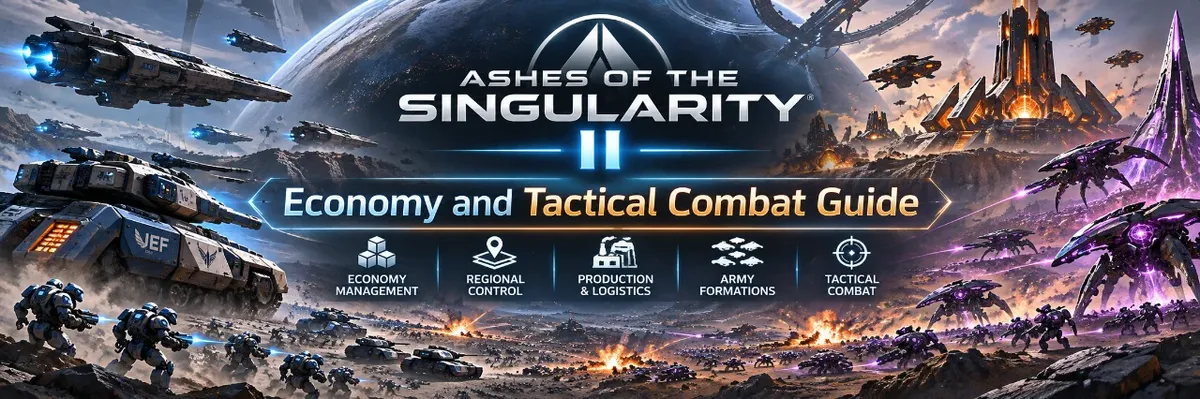
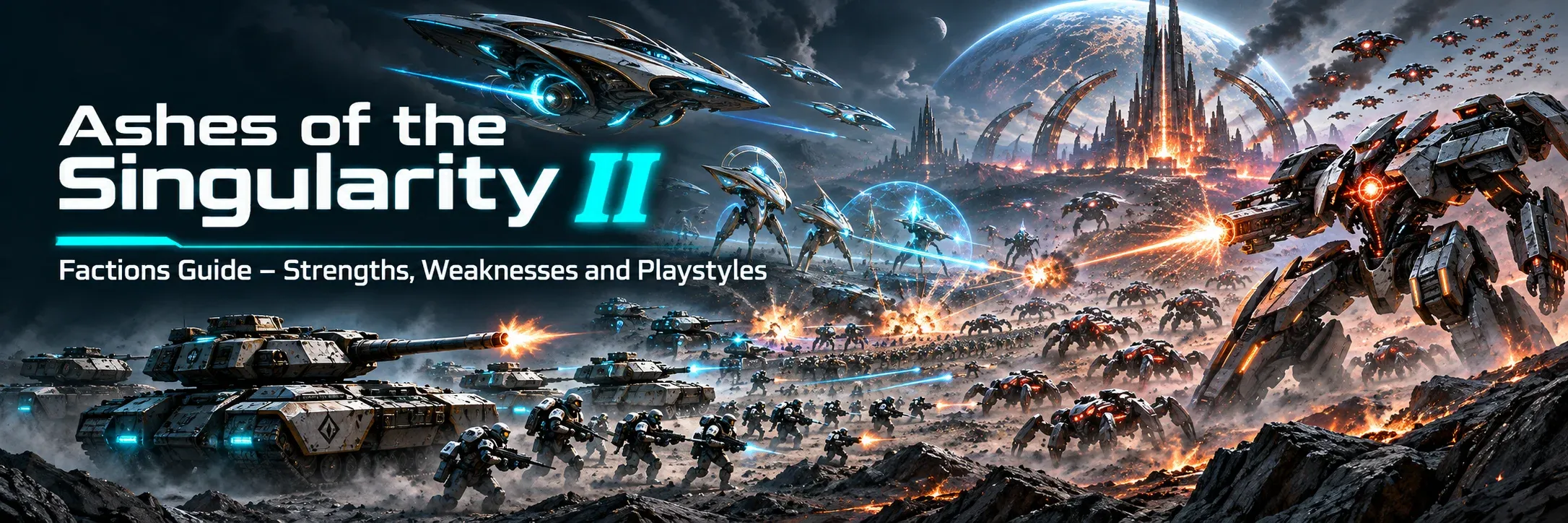
Ashes of the Singularity II takes place in a future where humanity faces a struggle against two technologically superior civilizations.
Although all three factions compete for control of the same battlefield objectives, their military philosophies are fundamentally different.
The United Earth Forces represent conventional humanity. Their strengths come from organized armies, combined military tactics, and the ability to deploy numerous relatively affordable units.
The Post-Human Coalition consists of former humans who have moved beyond their biological bodies. Their advanced technology allows them to field powerful military constructs and sophisticated weapons.
The AI Substrate represents a civilization of independent machine intelligences originating from Haalee, a powerful artificial intelligence. Their forces emphasize regenerative shielding, autonomous weapons, and continuous battlefield pressure.
The most important difference is how each faction turns resources into military power.
UEF commanders generally rely on numbers and coordination. PHC commanders must make expensive units deliver enough value to justify their investment. Substrate commanders can exploit regenerating shields to disengage, recover, and attack again.
These differences become especially important when multiple armies are fighting across large maps.
United Earth Forces (UEF) – Strengths, Weaknesses and Playstyle
The United Earth Forces represent humanity's military alliance against the Post-Human Coalition and AI Substrate.
Faced with technologically superior enemies, human governments combine their military capabilities to defend Earth and reclaim territory across the solar system.
Unlike their opponents, the UEF cannot simply rely on the overwhelming strength of individual advanced units.
Instead, the faction uses disciplined military formations, conventional weapons, and coordinated operations.
For players familiar with traditional real-time strategy games, the UEF offers the most recognizable military structure.
Its units include infantry squads, armored vehicles, artillery, aircraft, and powerful late-game war machines.
UEF Strengths – Affordable Units and Numerical Superiority
One of the UEF's greatest advantages is access to relatively inexpensive early-game units.
The faction can establish a military presence without requiring the same level of investment as the Post-Human Coalition's more sophisticated forces.
This creates opportunities for early expansion, defensive coverage, and pressure across multiple regions.
Affordable infantry makes it possible to deploy forces while reserving resources for economic development.
However, numerical superiority should not be confused with automatic victory.
Small groups of powerful enemy units may defeat unsupported UEF formations.
The UEF becomes most effective when its units cooperate and support one another.
The faction's greatest strength is its ability to combine numerous military assets into a coordinated fighting force.
UEF Strengths – Combined-Arms Warfare
Combined-arms warfare involves using multiple types of military units to overcome the weaknesses of individual formations.
The UEF is well suited to this approach.
Infantry can provide inexpensive frontline presence, armored vehicles can strengthen the main battle line, and artillery can deliver supporting fire.
Aircraft introduce additional tactical options when the enemy lacks sufficient anti-air protection.
For example, an army relying entirely on infantry might struggle against certain heavily armored opponents.
Adding suitable anti-armor firepower improves its ability to confront stronger targets.
Similarly, artillery can help attack defended positions, but it becomes vulnerable without protection from frontline units.
Players who develop balanced armies can make better use of the UEF's relatively conventional military capabilities.
UEF Strengths – Artillery and Heavy Armor
The UEF has access to dedicated artillery and increasingly powerful armored vehicles.
The Stormbreaker is a notable example of the faction's artillery capabilities, while the Titan M-7 represents a powerful heavy combat platform.
These units help the UEF move beyond its early numerical advantage into more substantial military operations.
Long-range fire support becomes particularly valuable when attacking fortified regions.
Heavy armor can also help protect supporting forces while advancing toward important objectives.
However, commanders still need to pay attention to production costs and the composition of enemy armies.
Investing in heavy units without supporting your economy can create an expensive force that is difficult to replace.
UEF Weaknesses – Lower Individual Unit Power
The United Earth Forces are generally weaker on a unit-for-unit basis than the technologically advanced Post-Human Coalition.
This means commanders cannot always expect individual UEF units to win direct confrontations against more expensive opponents.
A small group of elite enemy units may inflict substantial casualties if attacked without adequate support.
Players must compensate through superior positioning, efficient reinforcements, combined-arms tactics, and numerical advantages.
This makes economic management especially important.
If a UEF commander cannot afford to maintain military production, the faction loses one of its most important competitive advantages.
UEF Weaknesses – Dependence on Production and Logistics
Maintaining numerous military forces requires substantial production infrastructure.
Although individual UEF units may be relatively affordable, sustaining several armies can still place considerable pressure on resources.
As the battlefield expands, commanders must also consider the distance between military production centers and their frontline forces.
If reinforcements travel too far, losses may accumulate faster than replacement units can arrive.
Logistics limitations can also restrict army growth.
UEF players should therefore develop production and support capacity alongside military expansion.
Best UEF Playstyle – Expansion and Sustained Warfare
The UEF is particularly suited to players who enjoy economic development, territorial expansion, and large coordinated military operations.
A practical strategy begins with securing nearby regions and establishing sufficient resource income.
From there, build a functional frontline army and gradually develop supporting units.
As production improves, expand into additional valuable territories.
The goal is to create an economy capable of maintaining military pressure without becoming vulnerable to resource shortages.
When attacking, avoid sending unsupported units into expensive engagements.
Instead, coordinate infantry, armored vehicles, and appropriate supporting weapons.
UEF gameplay rewards commanders who can manage a large military organization rather than relying on a handful of elite units.
Is the UEF Good for Beginners?
Yes. The United Earth Forces are an excellent starting faction.
Their military organization is familiar, their early units are relatively accessible, and the single-player campaign introduces gameplay from the human perspective.
Beginners can learn the fundamentals of territorial control, economic management, and army coordination without immediately depending on expensive specialized units.
However, the UEF still rewards strategic thinking.
Building enormous armies without understanding logistics or unit composition can produce disappointing results.
For your first matches, focus on learning the economy and maintaining balanced forces rather than maximizing army size.
Post-Human Coalition (PHC) – Strengths, Weaknesses and Playstyle
The Post-Human Coalition consists of individuals who have transferred their consciousness beyond ordinary biological limitations.
Their transformation gives them access to extraordinary computational and military technologies.
Unlike the conventional armies of the United Earth Forces, PHC warfare emphasizes powerful constructs, advanced weapons, and high-value military assets.
The faction's units are generally more expensive and individually powerful than their UEF counterparts.
This creates a playstyle centered on making each investment count.
A small but sophisticated army can potentially defeat a larger opponent when its units are positioned and supported correctly.
However, expensive military forces also create significant risks when battles go badly.
PHC Strengths – Elite Military Units
The PHC's most recognizable advantage is its powerful individual units.
Compared with conventional forces, many PHC military assets provide greater combat capabilities at a higher resource cost.
This allows the faction to concentrate substantial firepower within smaller formations.
Elite units can be particularly effective when fighting in confined areas where opponents cannot bring their entire numerical advantage into combat.
However, commanders should not assume that expensive automatically means invulnerable.
Every unit still has weaknesses and can be countered through suitable opposing forces.
The most effective PHC armies use strong units together with supporting assets that cover their vulnerabilities.
PHC Strengths – Powerful Commanders
Command units are an important part of the PHC's military identity.
These advanced platforms provide substantial combat capabilities and can influence the performance of surrounding forces.
The PHC's starting Commander is a command-and-control unit classified in the official faction reveal as an enhancer.
As the faction develops, it gains access to additional powerful commander-class platforms.
Commanders can become central elements of PHC military formations.
However, they should not automatically be sent forward without support.
Losing a valuable commander can eliminate a significant investment and weaken the effectiveness of the remaining army.
PHC Strengths – Long-Range Specialized Weapons
The PHC possesses specialized units capable of attacking important enemy targets from considerable distances.
The Nemesis is a notable example.
It is a long-range anti-tank unit designed to engage armored targets.
This makes it useful when confronting conventional armored formations.
Correct positioning allows such units to exploit their range and damage potential.
However, specialized long-range units may be vulnerable if enemy forces reach them directly.
Frontline protection remains important.
PHC players should learn which targets their specialized units are intended to fight rather than expecting every expensive unit to perform every battlefield role.
PHC Strengths – Powerful Late-Game Technology
As the match progresses, the Post-Human Coalition can develop increasingly sophisticated military assets.
One of its most recognizable advanced units is the Hyperion.
The Hyperion is a powerful aerial dreadnought with significant firepower.
It represents the type of high-value military technology that makes the PHC particularly threatening once its economy and production infrastructure are established.
However, advanced units require major resource commitments.
A commander investing heavily in late-game technology must still protect economic infrastructure and maintain sufficient conventional forces.
An opponent who gains too much territory during the PHC's technological development may create serious problems.
PHC Weaknesses – Expensive Unit Production
The PHC's primary limitation is the high cost of its military assets.
A UEF player may deploy several affordable units while a PHC player invests in a smaller number of advanced constructs.
This means early losses can be particularly damaging.
Replacing an expensive unit may require significantly more resources than replacing a conventional infantry formation.
PHC players must therefore evaluate engagements carefully.
Attacking simply because a unit is powerful can lead to unnecessary economic losses.
PHC Weaknesses – Vulnerability to Being Outnumbered
Although PHC units are individually strong, large enemy armies can create difficult situations.
Numerical superiority allows opponents to pressure multiple regions or attack from several directions.
A small elite PHC army cannot defend every part of the map simultaneously.
If a commander concentrates all their forces in one location, the opponent may attack vulnerable economic infrastructure elsewhere.
Scouting and territorial awareness are therefore essential.
PHC players should identify potential threats early enough to reposition their forces.
PHC Weaknesses – Punishing Military Losses
Losing powerful PHC units can have long-term consequences.
An expensive army may take considerable resources to rebuild.
This can create a dangerous situation if the opponent immediately follows a successful battle with additional attacks.
Preserving military strength is therefore a central part of PHC strategy.
Players should become comfortable withdrawing damaged or poorly positioned forces rather than allowing every engagement to continue until one side is destroyed.
Best PHC Playstyle – Elite Armies and Calculated Engagements
The PHC is best suited to players who prefer carefully planned operations involving powerful units.
A successful strategy focuses on establishing reliable economic income and gradually developing advanced military capabilities.
Rather than producing large numbers of inexpensive units, PHC commanders should seek favorable engagements where their advanced technology provides an advantage.
Position specialized weapons behind durable frontline forces.
Scout enemy armies before committing expensive units.
Use terrain and range advantages where possible.
When an engagement becomes unfavorable, consider retreating and preserving valuable forces.
The PHC rewards quality, positioning, and efficient military trades rather than unrestricted unit production.
Is the PHC Good for Beginners?
The PHC is playable by beginners, but it may be less forgiving than the UEF.
Its expensive units can make mistakes more costly.
New players who lose several high-value constructs may struggle to recover economically.
However, players who enjoy managing smaller armies and learning individual unit roles may find the PHC appealing.
It is a strong second faction to learn after becoming comfortable with the game's economy and army management systems.
AI Substrate – Strengths, Weaknesses and Playstyle
The Substrate represents a civilization of artificial intelligences descended from Haalee.
Unlike the biologically originated United Earth Forces and Post-Human Coalition, the Substrate consists entirely of machine-based intelligence.
Its military forces use advanced robotic constructs, autonomous systems, and regenerating shields.
The faction's combat identity differs substantially from its opponents.
Instead of relying primarily on conventional numerical strength or expensive elite constructs, the Substrate emphasizes pressure, mobility, and the ability to recover from damage.
Its regenerating shields make repeated engagements a particularly interesting strategic option.
Substrate Strengths – Regenerating Shields
One of the Substrate's most important advantages is its shield regeneration system.
Substrate units can recover shield strength after taking damage.
This makes withdrawing damaged forces potentially valuable.
A Substrate army that survives an engagement may recover enough shielding to become effective again without requiring the same type of recovery investment as a force that must replace destroyed units.
However, shield regeneration does not make units immortal.
If a unit is destroyed before withdrawing, its defensive advantages no longer matter.
Players must recognize when an engagement has become too dangerous.
Substrate Strengths – Hit-and-Run Warfare
The Substrate's defensive mechanics support an aggressive but controlled battlefield approach.
Instead of always committing to a prolonged confrontation, commanders can engage opponents, inflict damage, withdraw, and return after recovering.
This approach can be particularly effective against opponents who are slower to reposition or have limited opportunities to recover their forces.
For example, a Substrate army might pressure an exposed enemy position and then disengage when additional defenders arrive.
After recovering shields, the same army can threaten another location.
This creates strategic pressure without requiring every encounter to become a decisive battle.
The Substrate rewards players who understand when to attack, when to retreat, and when to return.
Substrate Strengths – Drone Swarms
Drone-based attacks are another recognizable feature of the Substrate.
The faction uses autonomous weapons that allow it to apply pressure in ways that differ from conventional military formations.
One notable unit is the Overmind, a heavy fire-support hovercraft capable of deploying drone swarms.
Drone-based attacks can contribute additional offensive pressure while other units protect the formation.
However, drones should not be confused with ordinary infantry.
Stardock describes these autonomous systems as functioning more like projectiles than fully independent conventional units.
Understanding this distinction helps players avoid incorrect assumptions about how Substrate forces are organized.
Substrate Strengths – Specialized Machine Forces
The Substrate has several distinctive combat units.
The Hatchling is a small quadruped swarming unit that emerges from clutches of eggs.
Its battlefield role emphasizes swarm-based pressure.
The Reaper is a frontline armored hovercraft equipped with a plasma launcher.
Together with specialized support platforms such as the Overmind, these units demonstrate the faction's alternative military structure.
Rather than attempting to reproduce UEF or PHC strategies exactly, Substrate players should learn how their units work together.
A frontline formation can protect important supporting units while drone-based systems provide additional offensive pressure.
Substrate Weaknesses – Vulnerability to Concentrated Damage
Regenerating shields are valuable only when units survive long enough to benefit from recovery.
An opponent concentrating sufficient firepower can eliminate Substrate units before they withdraw.
This makes poorly planned frontal assaults dangerous.
If an army repeatedly attacks a stronger defensive position without adjusting its strategy, shield regeneration may not compensate for the losses.
Substrate commanders should evaluate enemy firepower before committing valuable units.
Substrate Weaknesses – Requires Active Strategic Decisions
Although the Substrate's mechanics support recovery, they also reward attentive management.
Players must recognize unfavorable engagements and reposition their forces before suffering unnecessary casualties.
A commander who leaves an army fighting until it is destroyed will lose much of the benefit associated with regeneration.
This makes battlefield awareness important.
Constantly checking army health, shield status, and enemy movement can improve the faction's effectiveness.
Substrate Weaknesses – Risk of Overaggression
The Substrate's pressure-oriented design can encourage players to attack too frequently.
However, aggressive movement without economic support can create serious vulnerabilities.
An army threatening an enemy region may leave its own infrastructure exposed.
Likewise, repeatedly committing forces into concentrated defenses can cause unnecessary losses.
The most effective Substrate strategy balances military pressure with territorial control and resource development.
Aggression should support specific objectives rather than become an automatic response to every opportunity.
Best Substrate Playstyle – Mobility and Continuous Pressure
The Substrate is particularly suited to players who enjoy aggressive strategies, repeated engagements, and mobile warfare.
A practical approach begins by establishing the economy required for sustained military operations.
From there, build an army capable of applying pressure without depending entirely on one expensive unit.
Identify vulnerable enemy regions and force your opponent to react.
When an engagement becomes unfavorable, withdraw surviving forces and allow their shields to recover.
Use the opportunity to scout or threaten another location.
The objective is to gradually weaken the opponent while preserving enough military strength to continue fighting.
Is the Substrate Good for Beginners?
The Substrate can be enjoyable for new players, particularly those who prefer aggressive gameplay.
However, understanding when to disengage may require practice.
Beginners sometimes mistake regenerating shields for unlimited durability.
This can lead to unnecessary losses against concentrated enemy firepower.
Players who want to learn the Substrate should practice small engagements against AI opponents and become comfortable withdrawing damaged forces.
Ashes of the Singularity II Faction Comparison
All three factions compete through the same broad strategic systems, including territory, resources, military production, and victory objectives.
However, their preferred approaches differ significantly.
Best Faction for Large Armies
United Earth Forces
The UEF is the most natural choice for players who enjoy deploying numerous conventional units.
Its military doctrine emphasizes numerical strength and coordinated formations.
Players who want to overwhelm enemy positions with infantry, armored vehicles, artillery, and supporting aircraft may prefer the UEF.
Best Faction for Powerful Individual Units
Post-Human Coalition
The PHC emphasizes technologically advanced military constructs.
Its army composition encourages players to preserve expensive units and make every engagement worthwhile.
Players who prefer commanding smaller numbers of highly capable units may find this approach more satisfying.
Best Faction for Aggressive Pressure
AI Substrate
The Substrate's regenerating shields and drone-related systems support repeated attacks and mobile operations.
It is particularly appealing to players who enjoy forcing opponents to react while keeping their own military forces active.
Best Faction for Defensive Warfare
No single faction is automatically the strongest defender in every situation.
The UEF can establish conventional defensive formations backed by supporting firepower.
The PHC can concentrate powerful units and specialized weapons around important positions.
The Substrate can use its regenerative advantages to recover between engagements and contest territory repeatedly.
Defensive effectiveness depends heavily on the available resources, map layout, army composition, and opponent's strategy.
Best Faction for Beginners
United Earth Forces
The UEF is the recommended starting faction for most new players.
Its recognizable military structure and relatively affordable early units provide a practical introduction to core RTS mechanics.
The UEF campaign also helps players become familiar with the game's interface and strategic systems.
UEF vs PHC – How the Matchup Works
The confrontation between the United Earth Forces and Post-Human Coalition highlights the difference between military quantity and technological quality.
The UEF wants to use its affordable units and production capabilities to develop substantial battlefield presence.
The PHC wants to create favorable engagements in which its expensive units deliver superior combat value.
How to Play UEF Against PHC
UEF players should take advantage of their ability to establish early military presence.
Expand into valuable territory while ensuring that production can support further military development.
Avoid attacking expensive PHC units with unsupported infantry.
Instead, build balanced armies capable of confronting advanced enemy armor and specialized weapons.
When possible, create pressure across several regions rather than allowing the PHC to concentrate all its firepower in one location.
However, do not divide your forces so extensively that they become easy targets.
How to Play PHC Against UEF
PHC players should prioritize efficient engagements.
Use powerful units where they can inflict significant damage without suffering unnecessary losses.
Specialized anti-armor weapons, including the Nemesis, may be useful against suitable UEF formations.
Maintain scouting information so large UEF armies do not surprise your defenses.
Preserve valuable military assets and avoid being forced into constant replacement of expensive units.
The central challenge is ensuring that your army's superior quality produces enough value to overcome the opponent's greater numbers.
UEF vs Substrate – How the Matchup Works
The UEF and Substrate approach warfare differently.
UEF commanders generally rely on sustained military production and conventional combined-arms tactics.
Substrate commanders can exploit regenerating shields and mobile pressure to create repeated engagements.
How to Play UEF Against Substrate
UEF players should avoid allowing Substrate armies to attack isolated forces without meaningful resistance.
Maintain balanced military formations and protect valuable economic infrastructure.
When a Substrate army withdraws, consider whether pursuing it will improve your strategic position or expose your forces to danger.
A retreating opponent may recover shields and return.
Therefore, prioritize useful objectives rather than chasing every damaged unit across the map.
Strong territorial control can limit the Substrate's opportunities for effective attacks.
How to Play Substrate Against UEF
Substrate players should look for opportunities to pressure exposed regions.
Avoid committing repeatedly against well-supported UEF defensive formations.
Instead, scout for vulnerable resource infrastructure or poorly protected military positions.
Use your mobility and recovery mechanics to maintain pressure.
If your army suffers significant damage, withdraw surviving forces before unnecessary losses occur.
The goal is to exploit favorable engagements rather than defeat the entire UEF military in one direct confrontation.
PHC vs Substrate – How the Matchup Works
The PHC and Substrate represent two technologically advanced civilizations with different battlefield advantages.
The PHC relies on powerful individual constructs and specialized weapon systems.
The Substrate emphasizes regenerative defenses, autonomous systems, and repeated pressure.
This creates an interesting conflict between concentrated combat strength and sustained operational flexibility.
How to Play PHC Against Substrate
PHC commanders should focus on eliminating important enemy units rather than simply dealing temporary damage.
The Substrate's regenerating shields can reduce the long-term value of attacks that fail to destroy targets.
Therefore, concentrated firepower and careful target selection become important.
Protect expensive PHC units against repeated Substrate attacks.
Avoid allowing your forces to become isolated or surrounded.
When you gain a favorable position, use it to secure territory and restrict the opponent's ability to recover safely.
How to Play Substrate Against PHC
Substrate commanders should avoid unnecessary direct confrontations with concentrated elite PHC forces.
Instead, explore opportunities to attack vulnerable regions or pressure multiple objectives.
Force the PHC to reposition expensive units.
Use regenerative shielding to support repeated operations when your forces can survive the exchanges.
However, be careful when confronting specialized PHC weapons capable of quickly destroying important units.
The objective is to create situations where the PHC cannot efficiently use all of its combat power.
How Economy Changes Between Factions
Although the three factions have different military units, they operate within the same broad economic framework.
Players must manage resources such as Durantium, Elerite, and Quanta while balancing production, research, territory, and logistics.
The major difference is how each faction spends those resources.
UEF Economic Priorities
The UEF requires a sustainable economy capable of maintaining large military forces.
Its relatively affordable units help with early military presence, but continued recruitment creates an ongoing resource demand.
As armies grow, logistics and production capacity become increasingly important.
UEF commanders should avoid developing more production infrastructure than their economy can support.
A stable flow of reinforcements is more valuable than an impressive number of inactive military facilities.
PHC Economic Priorities
The PHC must support expensive military investments.
Losing a powerful unit can represent a substantial economic setback.
Consequently, successful PHC gameplay requires careful coordination between resource income and technological development.
Do not rush advanced production if doing so leaves your army too small to protect important territory.
Preserving military investments is often as important as producing new units.
Substrate Economic Priorities
The Substrate benefits from keeping its military forces alive and allowing their shields to recover.
This creates opportunities to sustain pressure without fully replacing every damaged formation.
However, destroyed units still represent economic losses.
Substrate commanders must continue developing resource income and production infrastructure.
Regeneration supports efficient warfare, but it does not replace a functional economy.
How Terrain Affects Different Factions
Ashes of the Singularity II features enormous battlefields with different environmental conditions.
Mountains, narrow passes, open terrain, and other geographical features can influence military operations.
The effectiveness of a faction often depends on how well its commander uses the available terrain.
UEF Terrain Strategy
The UEF benefits from areas where its formations can operate together.
Open terrain may allow larger armies to maneuver, while defensible positions can support artillery and conventional frontline units.
However, narrow passages may limit how effectively a numerical advantage can be used.
A large army moving through a confined area can become vulnerable if it cannot bring sufficient firepower into combat.
PHC Terrain Strategy
The PHC can benefit from engagements where powerful units face a limited number of opponents at once.
Narrow approaches may reduce an enemy's ability to surround expensive constructs.
Long-range specialized weapons can also benefit from favorable positions.
However, concentrated PHC formations can become vulnerable if opponents attack important territory elsewhere.
Defensive terrain should not encourage commanders to ignore the wider map.
Substrate Terrain Strategy
The Substrate's pressure-oriented approach benefits from identifying routes that allow repeated engagements and withdrawals.
Terrain can influence whether an army escapes safely after suffering damage.
Open routes may provide more opportunities for repositioning, while narrow passages can create dangerous situations against concentrated defensive fire.
Substrate commanders should consider both the approach toward a target and the route available for disengagement.
Best Factions for Multiplayer and Team Battles
Multiplayer introduces additional challenges because human opponents adapt to battlefield developments.
Faction selection becomes especially interesting when several players cooperate in team matches.
Each faction can contribute different military strengths to a coordinated operation.
United Earth Forces in Multiplayer
UEF players can provide substantial military presence and conventional combined-arms support.
Their ability to field relatively affordable forces may be useful when protecting important regions or supporting allied attacks.
Team coordination is especially valuable when one player provides frontline strength while another contributes specialized units.
However, the UEF should not be assigned every defensive responsibility simply because it has access to numerous affordable units.
Its economy and logistics still require protection.
Post-Human Coalition in Multiplayer
The PHC can contribute powerful military assets to coordinated attacks.
Its specialized units may complement allied frontline formations.
However, PHC players should communicate before committing expensive forces to major engagements.
A poorly coordinated attack can result in valuable units being destroyed before allied support arrives.
Preserving these military assets can be crucial during extended team matches.
AI Substrate in Multiplayer
The Substrate can apply pressure to vulnerable regions and force opponents to redirect their attention.
Its ability to withdraw and recover shielding may support repeated operations.
In coordinated matches, this can create opportunities for allies to attack elsewhere.
However, aggressive movement must remain synchronized with the team's overall strategy.
Attacking alone while allied armies are unprepared can lead to unnecessary losses.
Which Faction Combination Is Best?
There is no confirmed universal combination that guarantees success.
A UEF and PHC pairing can combine conventional military presence with powerful technological units.
UEF and Substrate teams may experiment with sustained frontline operations supported by mobile pressure.
PHC and Substrate teams can combine strong individual military assets with more flexible engagement patterns.
The best combination depends on player coordination, map layout, opposing factions, and available resources.
Strong communication and coordinated objectives are usually more valuable than selecting factions based solely on theoretical advantages.
Which Ashes of the Singularity II Faction Should You Choose?
The ideal faction depends on how you prefer to approach real-time strategy games.
Players who enjoy economic expansion, numerous units, and conventional military formations should consider the United Earth Forces.
Those who prefer expensive, sophisticated armies and carefully planned engagements may enjoy the Post-Human Coalition.
Players who like mobile pressure, regenerative defenses, and repeated attacks may prefer the AI Substrate.
Choose UEF If You Enjoy Large Armies
The United Earth Forces suit players who enjoy building an economy capable of supporting substantial military operations.
If you prefer coordinating infantry, armored vehicles, artillery, and aircraft, the UEF offers a recognizable combined-arms experience.
It is also the recommended faction for beginners.
Choose PHC If You Prefer Powerful Units
The Post-Human Coalition appeals to players who enjoy commanding a smaller number of technologically advanced military assets.
Its powerful constructs reward strategic positioning and careful unit preservation.
Choose PHC if you prefer efficient engagements and substantial individual unit strength.
Choose Substrate If You Prefer Aggressive Mobility
The AI Substrate is designed for players interested in sustained pressure and alternative military mechanics.
Its regenerating shields support repeated engagements, while drone systems introduce distinctive offensive capabilities.
Choose Substrate if you enjoy attacking, withdrawing, and creating pressure across multiple locations.
Common Faction Mistakes to Avoid
Even experienced strategy players can struggle when switching factions.
Many mistakes occur when players try to apply the same approach to fundamentally different military systems.
Playing Every Faction Like the UEF
The UEF's reliance on affordable conventional forces does not translate directly to PHC gameplay.
Producing and losing expensive PHC units as if they were disposable infantry can quickly damage your economy.
Similarly, Substrate armies should take advantage of their regenerative mechanics rather than constantly fighting until destroyed.
Adapt your strategy to your faction's strengths.
Ignoring Unit Roles
Not every military unit is intended for direct frontline combat.
Specialized artillery, anti-armor weapons, support units, and aircraft all have different responsibilities.
For example, PHC Nemesis units are designed for long-range anti-tank operations.
Using specialized forces against unsuitable targets can reduce their effectiveness.
Read unit descriptions and build armies with complementary capabilities.
Overinvesting in Advanced Technology
Powerful units can be appealing, especially when learning a technologically advanced faction.
However, expensive research and military production require reliable economic support.
Rushing advanced technology without maintaining sufficient frontline strength can leave important regions vulnerable.
Develop technology when your strategic situation can support the investment.
Neglecting Scouting
Scouting helps identify enemy formations, production investments, and vulnerable territory.
Without information, commanders may select poor targets or commit expensive units against unexpected defenses.
This problem affects every faction.
Make scouting a regular part of your military operations rather than waiting until a major engagement begins.
Failing to Protect Valuable Territory
All three factions depend on economic infrastructure.
Losing an important resource-producing region can undermine an otherwise successful military strategy.
Defend key territorial connections and valuable production areas.
Avoid expanding faster than your forces can maintain control.
Ashes of the Singularity II Factions FAQ
How Many Factions Are in Ashes of the Singularity II?
The game includes three playable factions: United Earth Forces, Post-Human Coalition, and AI Substrate.
All three are available for skirmish and multiplayer matches.
The main campaign follows the United Earth Forces.
What Is the Best Faction for Beginners?
The United Earth Forces are the recommended starting faction.
Their conventional military structure and relatively affordable early units make it easier to learn the game's fundamental systems.
The single-player campaign also introduces the game through the UEF perspective.
Which Faction Has the Strongest Units?
The Post-Human Coalition generally emphasizes more expensive and individually powerful units.
However, this does not automatically make it the strongest faction overall.
Military effectiveness depends on unit composition, resource investment, positioning, and opposing forces.
Which Faction Is Best for Aggressive Players?
The AI Substrate is an appealing option for aggressive players.
Its regenerating shields and drone systems support repeated engagements and battlefield pressure.
Players must still manage their economy and withdraw forces when necessary.
Can Every Faction Build Aircraft?
The factions have different unit rosters, including their own air capabilities and available support technologies.
Their aircraft and specialized military roles are not identical.
Players should examine their chosen faction's unit roster and available production buildings.
Does Every Faction Have the Same Economy?
All three factions operate within the same overall resource and territorial systems.
However, their unit costs, production requirements, available buildings, and technological priorities differ.
These differences influence economic strategy.
Is the Post-Human Coalition Better Than the UEF?
Not necessarily.
The PHC has powerful individual units, while the UEF benefits from affordable conventional forces and combined-arms operations.
Either faction can gain an advantage depending on strategic decisions and the circumstances of the match.
Do Substrate Shields Regenerate Automatically?
Yes. Substrate shields have automatic regeneration mechanics.
This allows surviving units to recover defensive strength after taking damage.
However, units can still be destroyed before benefiting from regeneration.
Can I Change Factions During a Match?
Faction selection is part of the match setup.
You generally play the selected faction for the duration of that match rather than switching civilizations in the middle of battle.
Which Faction Is Best for Competitive Multiplayer?
No single faction should be considered universally strongest across every map and matchup.
The optimal choice depends on the current balance, player experience, unit compositions, and strategic objectives.
Players should focus on mastering their preferred faction before relying on tier rankings.
Final Thoughts – Which Faction Is Right for You?
Ashes of the Singularity II provides three distinctive military experiences through its asymmetric faction design.
The United Earth Forces rely on disciplined armies, conventional military technology, and the ability to coordinate substantial numbers of units.
The Post-Human Coalition emphasizes advanced technological constructs, powerful military assets, and carefully planned engagements.
Meanwhile, the AI Substrate introduces a more aggressive approach to warfare through regenerating shields, autonomous drone systems, and repeated battlefield pressure.
Each faction has important strengths, but every advantage comes with strategic limitations.
The UEF must support its armies through reliable production and logistics.
The PHC must protect expensive military investments and avoid unfavorable engagements.
The Substrate must exploit its recovery advantages without allowing aggressive operations to become unnecessary losses.
For newcomers, the United Earth Forces are the recommended starting faction because their military structure provides a practical introduction to the game's economy, territorial systems, and army management.
Once you're comfortable with those fundamentals, experimenting with the Post-Human Coalition and Substrate can help you discover alternative approaches to large-scale warfare.
Ultimately, the best faction is not simply the one with the most expensive units or the largest potential army.
The strongest faction for you is the one whose military strengths you understand, whose weaknesses you can manage, and whose playstyle supports your strategic decisions.
Master those principles, and you'll be prepared to command any of the three civilizations fighting for the future of the solar system.