What “Community Predictions” Really Mean in Midnight
When players say “predictions,” they’re usually mixing three things together:
- Hopes (what people want because it would improve their fun, time, or social experience)
- Expectations (what people assume will happen based on Blizzard’s recent direction and what’s been discussed publicly)
- Worries (what people fear because similar systems have missed the mark in past expansions)
Midnight is a perfect storm for this because several features touch sensitive topics:
- Housing touches identity, collection, and long-term motivation.
- UI and addon changes touch skill expression, accessibility, and competitiveness.
- Prey touches open-world difficulty (a long-running community pain point).
- Delves touch solo viability and “can I progress without a strict schedule?”
So when you read community predictions, the real question isn’t “are they right?” It’s: what are players trying to protect? Usually it’s one of these:
- their time (less wasted effort, fewer chores, clearer goals)
- their identity (class fantasy, transmog, housing style, character pride)
- their access (being able to participate without gatekeeping tools)
- their social life (guild cohesion, group formation, healthy community spaces)
The sections below are the biggest “please nail this” themes people keep circling back to.
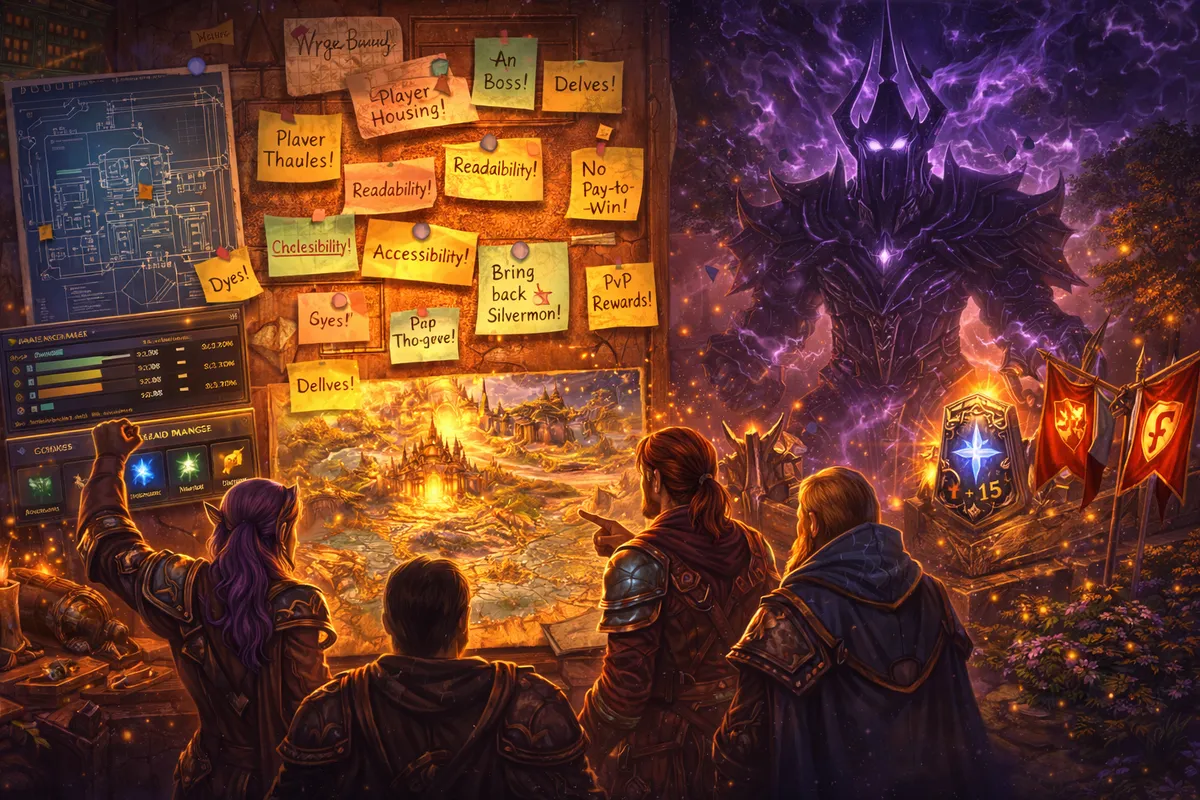
The 12 Biggest Things Players Hope Blizzard Nails
If you want the fastest overview, these are the most repeated hopes:
- Housing that feels deep, personal, and worth using all expansion
- Neighborhoods that feel social without being stressful or exclusive
- A fair balance between earnable décor and premium shop décor
- A base UI that genuinely replaces “mandatory” combat addons
- Accessibility solutions that keep disabled players fully supported
- Addon restrictions that feel fair without breaking harmless customization
- Class updates that improve fun and identity, not just numbers
- Mythic+ that’s challenging without being built around unavoidable one-shots
- Raids that remain epic while being readable without external boss mods
- Delves that stay relevant and rewarding for solo and small-group players
- Prey that makes the open world exciting without turning it into a chore
- Strong launch stability: servers, performance, and smooth patch cadence
Now let’s break those down into what players actually mean when they say them.
Housing: “Make It a Real Feature, Not a Mini-Game”
The loudest community hope is simple: Housing should be a pillar, not a novelty.
What players are really asking for when they say “real housing”:
- Creative freedom without fighting the placement system
- A huge variety of décor that supports multiple fantasy styles
- Long-term progression (new décor sources over time, not “done in two weeks”)
- Meaningful reasons to visit (social, cosmetic, utility, roleplay, screenshots)
- A system that respects time (fun collecting, not punishing grinds)
The community’s nightmare scenario is also simple: Housing launches with hype, but quickly becomes “place a few items, never return.” Players want Housing to become the kind of system you keep touching even when you’re not in a hardcore progression mood—because it’s relaxing, expressive, and social.
Housing Identity: “Let Homes Feel Like Azeroth, Not a Blank Template”
A big chunk of Housing hype is about identity: people want their home to feel like it belongs in Warcraft, not like a generic sandbox.
Common community wishes include:
- Racial and cultural styling that feels authentic (blood elf elegance, rugged orc utility, druidic nature spaces, void-touched horror corners, cozy tavern warmth)
- Décor that tells stories (trophies, banners, books, relics, artifacts, small interactive props)
- Lighting and atmosphere tools that actually change the mood
- Outdoor/indoor blending that lets you create gardens, patios, ritual circles, training yards, and scenic views
Players don’t want every house to look the same. They want “walk into my home and you instantly know what kind of character lives here.”
Neighborhoods: “Social, Not Stressful”
Neighborhoods are where Housing becomes a community feature rather than a single-player toy—and that’s exactly why people are nervous.
The hope is:
- Neighborhoods make Azeroth feel alive again in a way that isn’t just crowded city hubs.
The fear is:
- Neighborhoods become competitive (exclusive groups, pressure to decorate “well,” drama about who gets invited, or constant comparison).
What players keep asking Blizzard to nail:
- Easy visiting (drop in, look around, leave good vibes)
- Simple social tools (favorites, bookmarks, “who’s online,” quick invites for tours)
- Guild-friendly neighborhoods that strengthen community without becoming another obligation
- Privacy controls so people can decorate quietly when they want to
- Low friction: no complicated scheduling, no “you must log in daily to maintain your plot” feeling
The best version of Neighborhoods is where casual players feel included and proud, not judged.
Housing Rewards: “Earn Most of It, Don’t Make It Pay-to-Style”
This is one of the most sensitive topics. Players are generally okay with optional premium cosmetics existing in WoW—but Housing hits differently because it’s a self-expression system. If too much of the “cool stuff” is locked behind money, Housing starts feeling like a storefront instead of a feature.
What the community is hoping for:
- Most décor is earnable in-game through a wide variety of activities
- Premium décor exists but doesn’t dominate the most desirable aesthetics
- No power advantages from paid décor (no gameplay benefits that affect combat or progression)
- A strong earnable catalog that includes prestige items from raids, PvP, Mythic+, Delves, Prey, achievements, and exploration
Players want “I earned this” moments: trophies on the wall, raid banners, seasonal achievements turned into furniture, rare finds that make visitors go, “Whoa, where did you get that?”
Housing Economy: “Make Crafting Matter Without Creating a Miserable Grind”
Housing creates a second economy layer: not just power items, but lifestyle items.
The biggest hope:
- Crafting and gathering become exciting because Housing adds demand for décor materials, dyes, and building resources.
The biggest fear:
- The grind becomes brutal (rare bottlenecks, time-gated resources, or a market that’s impossible for casual players to participate in).
What players want Blizzard to nail:
- Multiple paths to décor (crafting, drops, achievements, vendors, exploration)
- Healthy pricing where casual decorators can build cool spaces without needing endless gold
- Clear source tracking so collectors can target-farm instead of guessing
- A stable system that doesn’t get exploited into “only the richest can decorate”
If Blizzard balances this well, Housing becomes a long-term gold sink that feels fun—not a paywall.
UI and QoL: “Make the Default UI Feel Like a Modern Game”
For years, a lot of players felt the same frustration: to raid or push keys comfortably, you needed to spend hours building an addon UI. Midnight is Blizzard’s big attempt to fix that feeling.
The community hope is huge:
- A fresh install should be playable at a serious level without hunting for third-party tools.
Players especially want these to feel genuinely good:
- Boss Alerts that are encounter-aware and readable
- Nameplates that clearly highlight dangerous casts
- A built-in damage meter for self-improvement and testing
- A powerful cooldown tracking system that replaces cluttered trackers
- Clean accessibility options like audio cues and scalable visuals
The payoff if Blizzard nails it:
- returning players come back faster
- new players don’t get overwhelmed
- groups gatekeep less based on “do you have the right addons?”
- raid leading becomes more about leadership and less about addon babysitting
Accessibility: “Don’t Leave Disabled Players Behind”
This is one of the most important parts of the community conversation—and it’s not a niche issue.
Many players rely on specialized setups for reasons like:
- visual impairment
- colorblindness
- hearing impairment
- cognitive load challenges
- limited mobility or input constraints
A lot of high-end accessibility support historically came from addons and custom alerts. When players hear “addon restrictions,” the immediate concern is: will accessibility get worse?
So the community’s biggest hope is:
- Blizzard builds accessibility into the base game as a first-class priority, not an afterthought.
What players want to see nailed:
- Strong audio alert systems that can replace custom callouts
- Clear visual telegraphs with options for contrast, scaling, and readability
- UI customization that supports different needs without requiring third-party hacks
- A willingness to iterate when real players with accessibility needs report problems
If Blizzard gets this right, Midnight becomes a landmark expansion for inclusion.
Addon Changes: “Fair Competition Without Killing Customization”
Players don’t all agree on addons, but most agree on one thing:
- nobody wants the game to feel like it’s balanced around external automation.
At the same time, many players love customizing UI aesthetics—fonts, layouts, bar styles, compact frames, and role-specific layouts. Those aren’t “cheating,” they’re comfort.
So the hope is a balanced outcome:
- Combat decision automation gets limited
- Cosmetic customization stays alive
- The base UI is strong enough that losing some combat addons doesn’t feel like losing your eyesight
What players want Blizzard to nail here:
- Clear communication about what breaks and why
- Stable tools that fill the gaps (boss alerts, cooldown manager, improved nameplates)
- A transition period where players can adapt without feeling punished
- Minimal collateral damage so harmless UI mods aren’t constantly broken
The emotional center of this topic is simple: players want to feel like their skill matters more than their scripts, without feeling like their personal comfort UI is being taken away.
Class Updates: “Make Specs Fun Again, Not Just Different”
Class changes are always controversial because everyone plays a different spec for different reasons. But there are a few common hopes that show up everywhere:
- Clearer spec identity (your spec should feel like itself again)
- Less button bloat without flattening gameplay into boredom
- More meaningful talent choices (fewer “mandatory filler points”)
- More consistent survivability tools so casual players don’t feel punished
- Better baseline utility clarity (interrupts, defensives, crowd control are readable and teachable)
The community usually isn’t asking for “make my spec top DPS forever.” They’re asking for:
- make it feel good to play in real content, under pressure, with imperfect groups.
When classes feel good, everything feels better: leveling, dungeons, raids, PvP, and even open-world systems like Prey.
Mythic+: “Hard Because It’s Skillful, Not Because It’s Unfair”
Mythic+ is one of WoW’s best systems and one of its most stressful. Midnight’s community hopes for Mythic+ tend to focus on three things:
- Clarity: dangerous casts and mechanics should be readable without external mods
- Fairness: fewer “oops you died instantly” moments that feel unavoidable
- Consistency: less volatility from random spikes that brick keys and tilt groups
Players want Mythic+ difficulty to come from skill expression:
- clean interrupts
- coordinated defensives
- smart routing
- controlled pulls
- calm execution
Not from “the addon pack told us exactly what to do and we followed it.”
If Blizzard nails Mythic+ readability in the base UI, it also reduces toxicity—because fewer wipes happen from invisible information.
Raids: “Epic, Readable, and Still Challenging Without Boss Mods”
Raiders tend to share two feelings that look contradictory but aren’t:
- They want raids to remain hard and satisfying at the top end.
- They want raids to be readable and fair without requiring external “puzzle-solving” addons.
So the community hope is that Blizzard hits a new balance:
- mechanics are communicated clearly through visuals, audio, and UI
- boss alerts help you anticipate major moments
- the fights still demand coordination and performance
- progression wipes feel like learning, not like “we didn’t have the right addon callout”
Players also hope story accessibility improves:
- more people can experience key moments through supported modes
- raiding feels less like a gated club for those with the best UI pack
If raids are readable, the whole raiding ecosystem becomes healthier: more guilds form, more players try it, and fewer people quit out of frustration.
Delves: “A Legit Endgame Lane for Solo and Small Groups”
Delves are widely seen as a potential solution to a long-standing problem:
- What do you do when you love WoW, but you can’t commit to scheduled raiding or constant group-finder stress?
The community hopes for Delves are very specific:
- Real progression value (not “cute side content” you abandon)
- Smooth difficulty scaling that rewards skill and learning
- Variety (not the same template repeated 50 times)
- Reasonable time investment (you can do meaningful runs in short sessions)
- Strong companion design that supports solo players without feeling cheesy
If Blizzard nails Delves, it changes who WoW is for. It strengthens the “play at your own pace” audience without weakening the high-end audience.
Prey: “Make the Open World Exciting Without Making It Mandatory”
Open-world difficulty has been a painful topic for years because it’s hard to serve everyone at once:
- new players want safety
- veterans want danger
- collectors want relaxing gameplay
- challenge-seekers want something that bites back
The community hope is that Prey becomes a clean solution:
- Opt-in difficulty that overlays the open world
- Rewards that feel worth it for those who want challenge
- A system that creates tension and surprise without becoming annoying
- Clear boundaries so you can choose intensity when you want it
The biggest fear is that Prey becomes either:
- too easy (dead on arrival), or
- too forced (turns into a weekly chore everyone feels obligated to do)
Players want the system to feel like hunting a dangerous target—cool, cinematic, skill-based—rather than “another checklist bar.”
PvP: “Grow Participation Without Flattening Competition”
PvP communities often feel neglected, so any major PvP additions spark a familiar hope:
- “Please let this bring more players in, without making high-end PvP meaningless.”
The most repeated hopes look like this:
- Better onboarding (training modes that teach objectives, not just mechanics)
- Clearer combat readability (especially in large fights)
- Reward structures that respect time (progress without endless grind)
- A healthier casual-to-competitive pipeline (players try PvP, enjoy it, and stick around)
If Blizzard nails PvP onboarding and readability, participation rises—and when participation rises, queues improve and the whole ecosystem feels more alive.
Story and World: “Make Quel’Thalas Feel Legendary Again”
Even players who “skip quests” still care about setting. Midnight’s return to iconic elven lands creates huge expectations:
- Silvermoon and its culture deserve modern presentation
- The atmosphere should feel like Warcraft: beauty, danger, magic, and tragedy
- The Void threat should feel real (not just a background effect)
- Character arcs should land without requiring external lore homework
- Zones should feel distinct and memorable, not “same forest, different color”
The community hope here is less about predicting exact plot twists and more about wanting the expansion to feel like a defining chapter—something you’ll remember the way people remember the best moments of past expansions.
Progression and Grind: “Give Us Clear Weekly Wins Without a Chore List”
This is one of the most universal hopes, from casual players to mythic raiders:
- Let players feel caught up without doing everything.
Players want:
- clear weekly goals
- fewer mandatory checklists
- better account-wide progress where it makes sense
- catch-up that doesn’t feel humiliating or exhausting
- rewards that respect time investment
When Blizzard nails “weekly structure,” players log in with purpose and log out satisfied—without that lingering feeling of being behind.
Economy and Gold: “Keep It Healthy When Housing Changes Everything”
Housing changes the economy because it adds new reasons to spend gold that aren’t purely power-related. That’s exciting—but also risky.
Community hopes include:
- Housing doesn’t become a gold prison where decorating is only for the rich
- Crafting and gathering feel rewarding, not exploit-driven
- Markets remain stable enough that casual players can participate
- The early launch economy doesn’t become absurd for basic items
- Décor sources are diverse so the economy isn’t dominated by one bottleneck
The best-case outcome is a fun, thriving economy where gold-making feels meaningful and décor collecting feels achievable at many play levels.
Technical Stability: “Please Let Launch Be Smooth”
This is the most exhausted community hope in WoW history, and it never goes away:
- stable servers
- sensible layering and shard behavior
- minimal quest-blocking bugs
- smooth performance in crowded areas
- UI features that don’t randomly break under pressure
Because Midnight is adding so many foundational UI and system changes, stability matters even more. If the base UI is meant to replace “mandatory addons,” it needs to be dependable in the exact moments players rely on it most: first raids, first keys, first Prey hunts, first big PvP fights.
Players don’t need perfection. They need “playable without constant frustration.”
Communication: “Tell Us What You’re Changing and Why”
A lot of community stress comes from uncertainty. Players can adapt to almost anything if they understand it—but sudden silent changes create chaos.
What players hope Blizzard nails:
- clear patch notes and hotfix notes
- honest explanations for addon restrictions and design changes
- quick acknowledgments of known issues
- visible iteration based on feedback (even if it takes time)
When communication is strong, players argue less and play more.
If Blizzard Nails These Things, Here’s What Your Midnight Will Feel Like
This is the “dream outcome” that community hopes point toward:
- You log in on a clean install and your UI feels good enough to do real content.
- Housing becomes a relaxing, creative home base you keep improving all expansion.
- Mythic+ and raids feel readable and skill-based without external automation.
- Delves and Prey give you meaningful progression even on solo schedules.
- PvP becomes easier to learn, increasing participation and improving the ecosystem.
- The story and zones feel iconic and memorable, not disposable.
- Weekly goals feel clear and achievable without turning into chores.
- You spend more time playing the game and less time fighting your setup.
That’s what “nailing it” means in the community’s language: less friction, more fantasy, more agency.
How to Join the “Nail It” Outcome
You can’t control design decisions, but you can position yourself to benefit if Blizzard lands them.
Here are practical steps that match the community’s biggest hopes:
- Build a minimal launch-safe UI you can play with comfortably (even if addons break).
- Practice core fundamentals: interrupts, defensives, movement, awareness. A more readable UI rewards real fundamentals.
- Pick a primary endgame lane (raids, keys, PvP, Delves) so you don’t burn out trying to do everything.
- Treat Housing as a long-term project, not a Day 1 sprint—this keeps it fun.
- If you care about accessibility, test the new tools early and share feedback in the right places; iteration depends on real use cases.
The players who enjoy expansions the most aren’t always the ones who “finish fastest.” They’re the ones who build a routine that stays fun.
BoostRoom: Turn Midnight Hype Into Real Progress (Without Burnout)
Community hopes are exciting, but launch reality can be messy: inconsistent groups, confusing priorities, and time wasted on trial-and-error. BoostRoom exists to protect your time so you can enjoy what Midnight offers instead of getting stuck in friction.
With BoostRoom, you can:
- stabilize your weekly plan around the endgame lane you actually enjoy
- reduce wasted hours from unreliable groups and failed runs
- ramp into higher keys or raid readiness with clearer goals and smarter pacing
- get practical help adapting to UI changes so your setup feels solved quickly
- keep momentum even if you start late or have limited weekly playtime
If Midnight becomes the expansion that rewards fundamentals and good structure, BoostRoom helps you get those benefits faster—while keeping the game fun.
FAQ
Is this page “leaks” or guaranteed information?
No. It’s a community expectations map: what players keep hoping for and predicting based on public direction and common experience.
What is the single biggest community hope for Midnight?
Housing being a true, long-term pillar—deep, customizable, and earnable—without becoming a stressful grind or a storefront vibe.
Why are addon and UI topics such a big deal in Midnight?
Because UI affects everything: raids, Mythic+, PvP, and accessibility. Players want the default experience to be strong so participation isn’t gated by external tools.
What do players want most from Mythic+ changes?
More fairness and readability—difficulty that rewards skillful play rather than hidden information or unavoidable spikes.
What do solo players want Midnight to deliver?
Delves and open-world systems like Prey that provide meaningful progression without requiring strict schedules or constant group finder friction.
What’s the biggest worry around addon restrictions?
Accessibility. Players hope Blizzard replaces critical accessibility functions inside the base UI so no one loses their ability to compete and enjoy the game.
How can I prepare for Midnight without overthinking it?
Build a stable minimal UI, lock in comfortable keybinds for interrupt/defensive/movement, and pick one main progression lane for your first weeks.
How can BoostRoom help if Midnight changes a lot week to week?
By keeping your routine focused and efficient—adapting your plan quickly when tuning shifts, reducing wasted time, and helping you keep momentum without burnout.



