The Real Question: What Ranks Up Faster Per Hour
Ranking up isn’t about the single best method. It’s about rate of improvement.
- Grinding improves your comfort under pressure and reduces “randomness” in your mechanics—up to a point.
- Coaching improves your decision quality and removes repeat mistakes—if you apply the plan.
So the real question is:
What makes you better fastest per hour you invest?
A useful way to think about it is this:
- If your gameplay has lots of obvious mechanical errors, grinding with a structured warm-up can create fast gains.
- If your gameplay has repeat decision mistakes (first deaths, bad buys, post-plant throws, retake trickles), coaching usually ranks you up faster because it targets the real leaks.
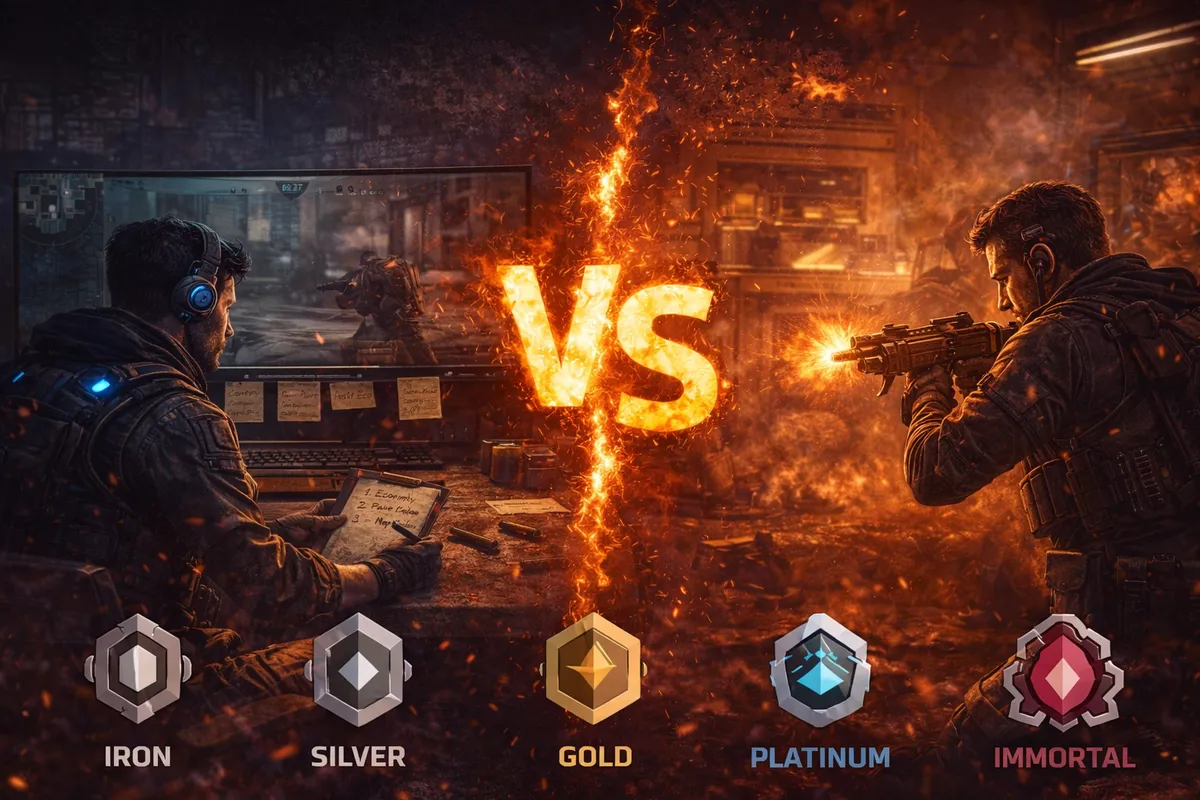
What Grinding Gives You
Grinding does work—when it’s not mindless.
Here’s what grinding actually improves well:
- Aim stability under stress: repeated gunfights teach your brain what “normal” looks like.
- Micro timing and reactions: you get used to common peeks, swing timings, and how fast fights happen in ranked.
- Map familiarity: angles, common hiding spots, rotation paths, and sound cues become automatic.
- Agent comfort: your ability usage becomes smoother just from repetition.
- Confidence and momentum control: you stop freezing in clutch moments because you’ve been there 200 times.
Grinding is basically exposure therapy for ranked pressure. The more you play, the less you panic—assuming you’re not tilting every session.
Where Grinding Fails (Why So Many Players Stay Hardstuck)
Grinding stops working when repetition becomes repetition of the same mistakes.
The hardstuck pattern looks like this:
- You play 200 games.
- You improve a bit early.
- Then you hit a plateau.
- Your rank stabilizes because your mistakes stabilize.
These are the most common “grinding traps”:
Grinding Trap 1: You’re Practicing the Wrong Thing
If your main issue is:
- split-buy economy,
- bad post-plant decisions,
- retake trickling,
- untradeable first deaths,
- then playing 5 more games usually means you’ll repeat those mistakes 5 more times.
Grinding Trap 2: You Don’t Know What To Fix
Most players can feel they played badly, but can’t name the exact pattern:
- “My aim felt off.”
- “We got unlucky.”
- “Teammates were weird.”
That’s not a fixable target. Without a clear target, grinding becomes gambling.
Grinding Trap 3: Volume Without Recovery
More games can also make you worse if you keep queuing while tilted or tired.
Fatigue creates:
- more re-peeks,
- worse crosshair placement,
- impulsive rotates,
- angry comms,
- and “throw rounds” that you wouldn’t normally throw.
In other words: grinding can increase your hours while decreasing your quality.
Grinding Trap 4: No Feedback Loop
The most important thing missing from pure grinding is a feedback loop. Without feedback, you can’t reliably answer:
- Why did we lose this round?
- Which decision was the turning point?
- What should I do differently next time?
That’s why coaching (or at least structured VOD review) often ranks people up faster after they reach their first plateau.
What Coaching Gives You
Good coaching is not “someone tells you to aim better.” Good coaching gives you clarity and a plan.
Here’s what quality coaching does better than grinding:
1) It Finds Your Real Rank-Blocking Patterns
Most players have 2–4 habits that cost them the most rounds. Coaching identifies them quickly, like:
- dying first on attack because you entry without a trade,
- losing anti-eco rounds because you peek alone,
- planting and then hunting instead of playing time,
- wasting utility early and having nothing for the final fight,
- rotating on weak info and giving free plants.
When you fix your top 3 patterns, you don’t need to “become a new player.” You just stop bleeding rounds.
2) It Gives You Rank-Specific Priorities
The skill that wins games changes as you climb. Coaching helps you train what matters now, not what sounds impressive.
Example:
- A Silver player often climbs faster by fixing trading and economy.
- A Diamond player often climbs faster by fixing mid-round conversions and post-plant discipline.
- Grinding alone often ignores this and keeps you training random things.
3) It Turns Improvement Into Simple Rules
The fastest improvement comes from “if/then” rules you can apply mid-round, like:
- “If I get first blood, I reset into cover—no chase.”
- “If we’re anti-eco, I do not take solo fights.”
- “If I’m Controller, I save one smoke for defuse timing.”
- “If we retake, we regroup and swing on a countdown.”
Coaching turns messy gameplay into a few clean rules that consistently win rounds.
4) It Saves Time by Removing Guesswork
A good coach reduces your trial-and-error phase.
Instead of:
- trying five agents,
- changing sens,
- grinding 100 games to “figure it out,”
- you get:
- a direct plan,
- a role identity,
- a training structure,
- and clear mistakes to stop repeating.
That’s why coaching can be faster per hour, especially if you have limited time.
What Coaching Cannot Do (So You Don’t Get Scammed by Expectations)
Coaching is powerful, but it’s not magic.
Coaching cannot:
- instantly replace basic mechanics you haven’t built,
- win your games for you,
- guarantee a rank jump in a fixed number of days,
- fix tilt if you refuse to change habits,
- or make you climb if you don’t play enough games to apply the plan.
The best way to think about coaching is:
Coaching increases the quality of your practice. You still need reps to convert it into rank.
Which Ranks Benefit Most from Coaching
Coaching can help at any rank, but the “speed boost” is different depending on where you are.
Iron–Bronze: Coaching Helps If It’s Mechanics-First
In Iron–Bronze, many losses come from:
- shooting while moving,
- low crosshair placement,
- panic spraying,
- untradeable peeks.
Coaching helps most here when it focuses on:
- simple mechanics routines,
- basic positioning rules,
- and “stop feeding” habits.
If coaching is too “macro heavy” at this rank, it won’t stick because fights end before strategy matters.
Silver–Gold: Coaching Often Produces the Fastest Visible Rank Gains
This is the biggest “coaching ROI zone” for many players because:
- mechanics are decent enough to win fights,
- but decision-making leaks are huge.
Common Silver–Gold leaks:
- split buys,
- anti-eco throws,
- post-plant hunting,
- retake trickling,
- not playing for trades.
Fixing those can swing several rounds per match, which quickly becomes RR.
Platinum–Diamond: Coaching Helps Break Plateaus
In Plat–Diamond, players often feel:
- “I can aim, but games are chaotic.”
- “I win duels but lose rounds.”
- “I’m inconsistent.”
This is where coaching shines through:
- map control planning,
- mid-round decision timing,
- role discipline,
- utility layering,
- and adaptation.
At this level, one or two decision upgrades can change your entire match quality.
Ascendant–Immortal: Coaching Is About Efficiency
At high ranks, everyone is good. The difference becomes:
- fewer unforced errors,
- cleaner utility,
- better timing,
- smarter economy/ult cycles,
- and faster adaptations.
Coaching is less about “learning basics” and more about removing tiny leaks that cost you high-level rounds.
The Fastest Ranking Formula: Volume + Feedback
If you want the honest best answer to “coaching vs grinding,” it’s this:
Grinding ranks you up faster when you already know what to fix and you’re applying it consistently.
Coaching ranks you up faster when you don’t know what to fix—or you keep repeating the same mistakes.
The fastest climb usually comes from a hybrid:
- Play enough games to get reps
- Review enough to stop repeating errors
A practical split that works for most players:
- 80% playing + 20% review/coaching (for lower ranks)
- 70% playing + 30% review/coaching (for higher ranks or plateau breaks)
A 4-Week Hybrid Plan That Ranks Up Fast
This is a realistic plan you can actually follow. It works whether you use coaching or self-review—but coaching makes it faster because the targets are clearer.
Week 1: Stop Donating First Deaths
Focus rule: No solo first contact.
- Always peek with a trade, utility, or escape.
- After contact, reposition (no same-angle re-peek).
Targets you should see improve:
- fewer 0–1 kill rounds,
- more traded fights,
- fewer “we started 4v5” rounds.
Week 2: Fix Economy and Anti-Eco
Focus rule: Buy with the team and respect pistols.
Check out some of our most popular Valorant services:
- No split buys.
- Anti-eco = trade-only, clear corners, avoid solo peeks.
Targets you should see improve:
- fewer “we lost to pistols” rounds,
- more stable rifle rounds,
- fewer momentum swings against you.
Week 3: Post-Plant and Retake Structure
Focus rule: Play time and swing together.
- After plant: first 5 seconds, no solo swings.
- Retakes: regroup and swing on a countdown.
Targets you should see improve:
- higher post-plant win rate,
- fewer “we planted and still lost” rounds,
- more clean retakes.
Week 4: Utility Timing and “Go Moments”
Focus rule: Utility must create movement.
- Smokes timed with entry.
- Flashes timed with swings (within 1–2 seconds).
- Info tools that immediately lead to space-taking.
Targets you should see improve:
- cleaner site takes,
- fewer wasted abilities,
- more rounds where the enemy feels forced into bad fights.
This plan works because each week improves a different “round conversion” pillar.
How to Measure Progress Without RR Obsession
RR is noisy. Your progress shows up first in repeatable metrics.
Track these instead (simple yes/no after each match):
- Did I die first more than twice?
- Did we lose an anti-eco round?
- Did we lose after planting the Spike?
- Did we retake by trickling?
- Did I use key utility with no follow-up?
- Did I re-peek after being spotted?
If those answers shift toward “no,” your rank usually follows.
A second layer (for more serious tracking):
- First death frequency
- Anti-eco win rate
- Post-plant win rate
- 5v4 conversion rate
- Clutch conversion rate (1v1, 1v2)
You don’t need complicated stats. You need to notice whether the same mistake keeps showing up.
Choosing a Coach: How to Avoid Wasting Time and Money
Coaching quality varies a lot. Here’s how to choose smartly.
Look for Coaching That Produces Clear Rules
The best coaches give you:
- 3–5 recurring mistakes,
- 3–5 rules to fix them,
- and a training routine that fits your schedule.
Avoid coaching that stays vague:
- “You need better game sense.”
- “Your aim is inconsistent.”
- “Just be more confident.”
Those statements might be true, but they aren’t a plan.
Look for Evidence-Based Review
Good coaching focuses on:
- your first deaths,
- your round type decisions,
- your utility value,
- your post-plants and retakes,
- your mid-round timing,
- not just highlight gunfights.
Look for Personalization
If every student gets the same tips, it’s not coaching—it’s a generic guide.
You want coaching that answers:
- What’s holding you back right now?
- What’s your best role identity?
- What drills actually fit your time?
Look for Ethical, Account-Safe Improvement
The safest, best way to rank up is by improving skill on your own account. Any service that involves account sharing or rule-breaking is a risk to your account and your progress. The goal is real improvement you keep.
BoostRoom Guide: How Our Coaching Helps You Rank Up Faster
BoostRoom is built around one idea: less guessing, more progress. Instead of telling you to “play more,” we help you play smarter with a clear roadmap.
What BoostRoom coaching focuses on:
VOD Reviews That Target Your Highest-Impact Mistakes
We don’t just watch “cool rounds.” We zoom in on:
- first deaths,
- anti-eco losses,
- post-plant throws,
- retake failures,
- and mid-round stalls.
Because those moments decide your win rate.
A Simple Playbook You Can Use in Solo Queue
You get a personal set of rules such as:
- what your default should look like on attack,
- how to anchor without feeding on defense,
- what to do post-plant every time,
- and how to retake with teamplay even when comms are quiet.
Rank-Specific Training That Fits Your Schedule
BoostRoom plans are built around real life:
- short warm-ups that transfer to ranked,
- 10-minute drills with clear purpose,
- weekly focus rules,
- and a review loop that prevents repeating the same losses.
Comms and Mental Without Toxicity
A lot of games are lost because the team collapses mentally. We focus on:
- calm callouts,
- non-toxic leadership,
- and decision discipline when you’re ahead.
Because closing games is a rank skill.
If you want a faster climb, the goal is not to “grind until it works.” The goal is to fix the few habits that are stealing rounds from you right now.
Cost vs Time: A Simple ROI Calculator
You don’t need exact numbers to think about ROI. Ask these questions:
How many hours do you grind to get one rank?
If you play 10–15 games a week and you climb very slowly, it usually means your improvement is stuck in repetition.
Do you know your top 3 recurring mistakes?
If the answer is no, coaching or structured VOD review often saves weeks of trial-and-error.
Do you tilt or autopilot after a few losses?
If yes, your grinding hours are not all productive. Coaching that installs a calm plan can turn the same hours into better results.
Are you limited on time?
If you only have a few hours per week, you can’t rely on volume alone. Feedback becomes more valuable because every game must teach you something.
A simple rule of thumb:
- If you have lots of time and strong discipline: grinding + self-review can work well.
- If you have limited time or a clear plateau: coaching often ranks you up faster per hour.
Common Myths That Keep Players Stuck
Check out some of our most popular Valorant services:
Myth 1: “If I just play enough, I’ll eventually climb.”
Only true if your practice changes your habits. If your habits don’t change, your rank doesn’t either.
Myth 2: “Coaching is only for high ranks.”
Coaching is valuable at any rank if it matches your needs:
- low ranks need simple mechanics and positioning rules,
- mid ranks need round conversion (economy, post-plant, retakes),
- high ranks need efficiency and adaptation.
Myth 3: “Aim is everything.”
Aim matters, but VALORANT rewards:
- trading,
- utility timing,
- economy discipline,
- post-plant structure,
- and decision-making under time pressure.
- Those skills win rounds even when your aim is “average.”
Myth 4: “I’m stuck because of teammates.”
Teammates can make games harder, but if you’re hardstuck over many matches, the consistent factor is your decisions. The fastest climbers learn to create structure in solo queue: trades, timing, and objective play.
Myth 5: “I need to learn every agent.”
Most players rank up faster by mastering a small pool (1–3 agents). Familiarity creates consistency.
FAQ
Is coaching always faster than grinding?
Not always. Coaching is faster when you’re repeating the same mistakes without realizing it. Grinding can be faster when you already have a clear plan and you just need reps to stabilize mechanics and confidence.
What’s the fastest way to rank up if I can only play a few games per week?
Use a short warm-up, play 2–3 focused games, and do a 10–20 minute review afterward. Limited time makes feedback more valuable than volume.
I’m Silver/Gold and hardstuck—should I get coaching or just grind?
Silver/Gold is where coaching often creates the fastest rank gains because decision leaks (trading, economy, post-plant, retakes) swing many rounds. If you don’t know your top 3 mistakes, coaching usually speeds things up.
How many games do I need to play for coaching to “work”?
You need enough games to apply the rules until they become habits. Coaching gives direction; reps create consistency. Even a few games per week can work if you follow one weekly focus rule.
What should I expect from a good coaching session?
You should leave with: your top recurring mistakes, simple rules to fix them, and a short practice routine you can actually follow. If you leave with only vague advice, it wasn’t effective coaching.
Can coaching fix my aim?
Coaching can improve your aim efficiency by fixing fundamentals (crosshair placement, movement discipline, peeking, burst control). But aim still requires reps—coaching just makes those reps higher quality.
What if I’m already good mechanically but still lose?
That’s usually a round conversion issue: economy discipline, post-plant, retakes, mid-round decisions, or utility timing. Coaching is especially helpful there.
How does BoostRoom help compared to just watching YouTube guides?
Guides are general. BoostRoom focuses on your exact VOD patterns and turns them into a personal playbook and weekly plan, so you stop guessing what to fix.



