Why Raids Feel Confusing at First
Most early wipes happen because players try to memorize the whole fight at once. That doesn’t work because your brain can’t store eight new mechanics + your rotation + eight players’ movements in one pull. Good raid learning is “chunking”: learning one small piece, then stacking the next piece on top.
Common “slow learning” traps:
- Trying to learn everything from one pull. You won’t. Pick one mechanic to understand per pull cycle.
- Watching the boss, but not the cast bar. Most major mechanics are announced by casts and debuffs.
- Over-moving. Panic running causes more damage loss, more missed positions, and more mistakes.
- No role clarity. If nobody owns responsibilities (mitigation plan, raise plan, LB plan, marker plan), progress slows.
- Mismatched Party Finder expectations. A “practice” party with half “clear-ready” players and half “first-timers” often becomes a messy experience.
Your goal isn’t to become perfect instantly. Your goal is to become consistent quickly—because consistency is what creates clears.
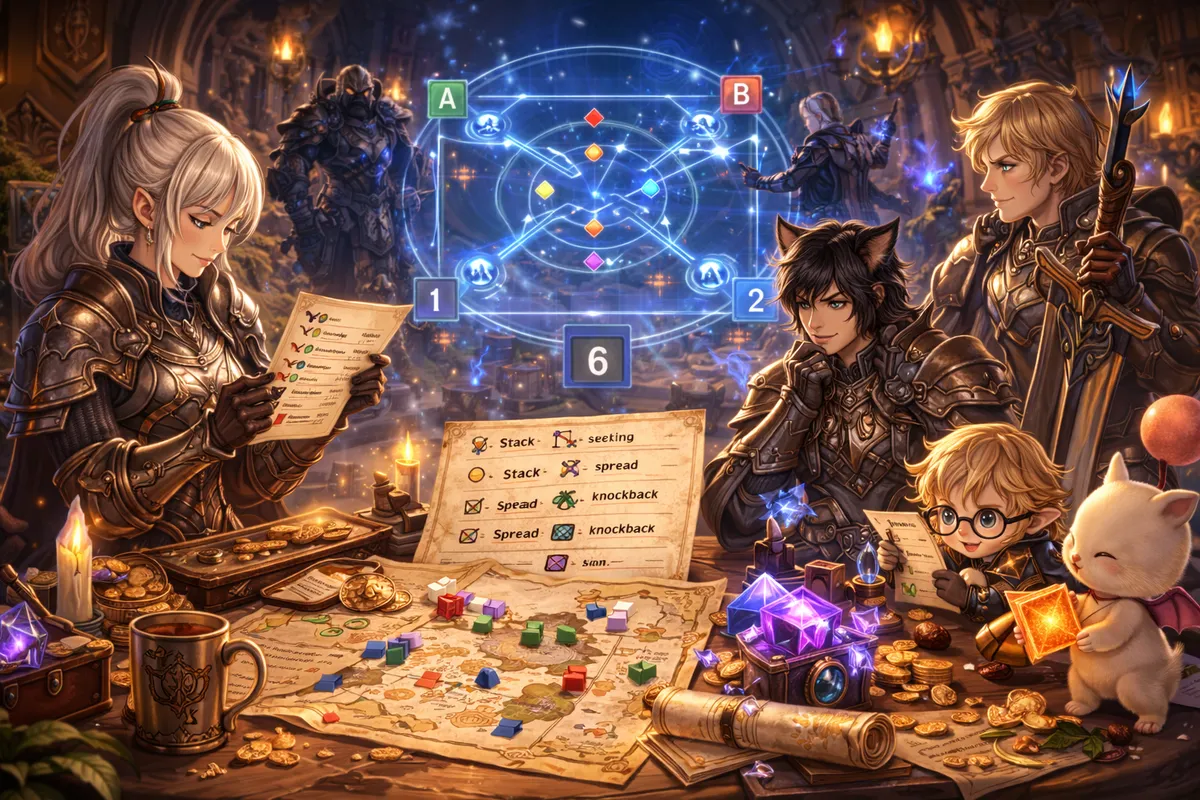
Define Your Goal Before You Queue
Learning mechanics faster starts before the first pull: you need the right objective. If the party objective and your personal objective don’t match, learning slows down and stress skyrockets.
A simple goal ladder:
- Fresh learning: You’re here to see mechanics and understand what kills you.
- Prog to X mechanic: You’re here to practice up to a specific point and get consistent there.
- Cleanup: You’ve seen everything; now you’re removing mistakes and improving consistency.
- Clear: You are expected to execute with few errors; mistakes still happen, but the goal is a kill.
- Farm: You want repeatable clears and efficient runs.
If you join a party above your real goal (example: joining “clear” when you’re still learning early mechanics), you’ll feel overwhelmed and you’ll learn slower. If you join below your real goal (example: joining “fresh” when you’ve already seen the whole fight), you’ll get bored and frustrated. Matching your goal is the first “learn faster” hack.
Your Core Raid Prep Checklist
Use this quick checklist before you ever step into a raid. It’s not about being sweaty—it’s about removing avoidable friction so your brain can focus on mechanics.
- Gear is appropriate for the duty (meet the item level requirement comfortably, not barely).
- Weapon is current (weapon upgrades are the biggest power swing).
- Materia is at least “reasonable” if you’re doing harder content (don’t stress about perfect melds at first).
- Food is ready (keep one stack of the food you like; refresh every time it falls off).
- Potions/tinctures are ready if you’re pushing clears or enrages (optional early in learning, valuable later).
- Gear is repaired (nothing ruins prog like broken gear mid-lockout).
- Hotbars are clean and consistent (mitigation, movement tools, sprint, raise tools).
- UI supports mechanics (boss cast bar and debuffs must be easy to see).
- A plan exists for markers and callouts (even if it’s “follow the party’s preset”).
If you do nothing else, do this: repair, eat food, and set up your UI to see casts and debuffs clearly.
Gear and Consumables: What Actually Matters for Learning
You don’t need best-in-slot to learn mechanics. You need stability:
- Enough HP/defense that you don’t get deleted by every mistake.
- Enough damage/healing output that the party isn’t constantly wiping to enrage or slow kill pace.
Practical gearing priorities:
- Weapon first whenever possible.
- Chest/legs next (big stat budget).
- Fill obvious weak slots (especially outdated accessories dragging your average item level down).
- Don’t let one ancient piece hold you hostage. Replace the worst slot first if you’re under requirements.
Consumables that reduce learning stress:
- Food: gives small but constant benefits; also helps survival.
- Potions: most useful when you’re close to enrage, or when you’re doing “clear” attempts.
- Echo mindset: If you’re wiping to mechanics, gear is not the solution. If you’re consistently hitting enrage, damage planning and execution matter more than tiny stat tweaks.
A fast learning strategy is to gear “enough” first, then focus on mechanics execution. If you try to solve mechanics problems with gear, you’ll waste time and still wipe.
UI Setup That Makes Mechanics Easier to Read
Mechanics learning is basically visual reading. Your UI should support that.
High-impact UI adjustments:
- Boss cast bar near the center. Many raidwides and tankbusters are announced by casts.
- Target debuffs visible and large. Debuff-based mechanics are common; missing one icon can cause a wipe.
- Party list close to your vision. Healers need this for triage; everyone benefits for stack/spread and debuff tracking.
- Enemy list visible (when relevant). Adds and multi-target phases are easier when you can see what’s alive and what’s casting.
- Battle effects tuned down. Too many effects hide markers, tethers, and ground AoEs.
- Camera zoomed out. More arena visibility = fewer surprise deaths.
If you feel “I didn’t see what killed me,” that’s a UI problem as often as it is a skill problem.
Mechanic Language: Learn the Common Patterns Once
The fastest way to learn mechanics faster is to recognize categories. Most raid mechanics are variations of a few patterns.
Common mechanic categories you should learn to identify instantly:
- Stack marker: group up (sometimes with role rules, sometimes with a partner).
- Spread marker: get away from others (often paired with a later stack).
- Partners: find your assigned buddy, resolve together.
- Light parties: split into two groups (often 4/4) and resolve separately.
- Tethers: something is linking you; it may mean “stay close,” “move far,” “break line of sight,” or “don’t cross tethers.”
- Towers: stand in them to soak; missing towers often wipes.
- Knockback: move to safe position and use knockback tools if needed.
- Gaze: look away from the enemy or object.
- Proximity: move away from the center of the blast.
- Line/cone cleave: don’t stand in front; tanks face boss away from party.
- Donut: safe near the boss, unsafe far away (or vice versa—read the telegraph).
- Baited AoEs: one or more players lure attacks to safe locations.
- Debuff timers: you resolve mechanics based on who has what debuff and when it expires.
When you treat mechanics as “new scary unique things,” learning is slow. When you treat them as “this is a stack into spread with debuff timers,” learning becomes fast.
The 7-Step “Learn Mechanics Faster” Method
Use this method every time you start a new fight. It’s designed to make progress even in messy parties.
- Identify the wipe reason
- After every pull, answer: “What actually killed us?” Not “we messed up,” but the specific cause: missed tower, wrong partner, wrong bait, late mitigation, etc.
- Name the mechanic
- Give it a simple name you’ll remember: “first raidwide + spreads,” “tethers + towers,” “limit cut,” “pairs,” “knockback.”
- Find the tell
- What announces it? A cast name, an arena animation, a debuff, a tether, a marker, an add spawn?
- Define your job
- What is your responsibility? Where do you stand? Who do you stack with? What do you mitigate?
- Choose one improvement
- Don’t try to fix five things. Pick one: “I will watch my debuff timer,” or “I will pre-position,” or “I will stop over-running.”
- Repeat until consistent
- Consistency beats “lucky progress.” Get the first half of the fight clean before you chase later mechanics.
- Lock it in with a quick note
- One sentence is enough: “After the raidwide, spread to cardinals, then partners.” You’re building a personal mini-guide as you prog.
If you follow this method, you turn every wipe into learning rather than frustration.
Pre-Positioning: The Secret to Doing Mechanics Without Losing Your Rotation
One of the biggest differences between slow learners and fast learners is when they move.
Slow learning movement:
- “Mechanic happens → panic run → lose uptime → clip others → die.”
Fast learning movement:
- “Mechanic is coming → drift early to a safe lane → keep hitting → small step to resolve → back to boss.”
Pre-positioning habits:
- When a mechanic is announced, move early while continuing damage.
- Stand in “neutral safe spots” (often cardinals/intercardinals) so you can flex to your assignment.
- Use Sprint proactively for long movement mechanics.
- For melee: learn the boss hitbox and stand where you can still hit while moving minimally.
- For casters: plan instant casts around forced movement; don’t spend all your movement tools randomly.
Learning faster is often just learning to move less.
Party Finder: How to Join the Right Rooms and Learn Faster
A massive amount of raid progress is social, not mechanical. If you’re in the wrong party type, learning slows.
How Party Finder settings usually map to reality:
- Practice: learning and early prog
- Duty completion / clear: the party expects you’ve seen most mechanics and can execute
- Loot / farm: repeated clears, efficiency, and consistency
How to avoid wasted time in PF:
- Read the description like it’s a contract. If it says “from start to X,” don’t join if you haven’t seen X.
- Respect “duty complete” conditions. If the party wants cleared players, it’s not personal—it’s just the party goal.
- If you’re fresh, choose fresh parties. You’ll learn more in 60 minutes of true learning than 60 minutes of being carried while confused.
- If you’ve seen the fight, don’t join a fresh party unless you want to help. It’s a different goal.
- Ask one simple question if needed: “Is this fresh or have you seen phase two?” That one line saves an hour.
Fast learning happens when everyone is on the same page.
Markers and Waymarks: Make the Arena Easier to Understand
Markers turn abstract “stand somewhere” mechanics into a consistent map. They speed learning because they reduce decision fatigue.
Common waymark logic:
- Letters on cardinals (north/east/south/west)
- Numbers on intercardinals (NE/SE/SW/NW)
- Separate markers for “light party” or “partner” splits
Best marker habits:
- Use the party’s markers. Don’t fight the group’s system mid-prog.
- Save waymarks for duties you run often. If you’re leading parties, saved presets remove setup friction.
- Agree on one set of callouts. “Go to B” is only useful if everyone knows where B is.
Markers won’t solve everything, but they remove confusion so you can focus on execution.
Ready Check and Countdown: Start Pulls Cleanly
A clean start makes learning faster because you reduce “random pull chaos.”
Good pull flow:
- Ready check to confirm people are present and prepared.
- Countdown so jobs can do openers smoothly and tanks can pull consistently.
- Reset quickly if someone missed the pull (better to restart than to waste a learning pull with half the party unready).
When you’re learning, the goal is repetition with clean starts. Sloppy starts create sloppy data and slow improvement.
Role Responsibilities: What You Should Focus On First
Learning mechanics faster depends on role clarity. Here’s what each role should prioritize during prog.
Tanks: Aggro, Facing, and Mitigation Rhythm
Tank prog priorities:
- Keep boss facing stable (avoid spinning; face away from party).
- Call or plan tankbusters (mitigate on busters; don’t “save cooldowns” forever).
- Use party mitigation for raidwides when appropriate (makes healer life easier and keeps pulls stable).
- Know your swap plan if the fight requires it (or ask early if you’re unsure).
- Keep pulls consistent. Consistent positioning helps everyone learn.
A tank that keeps the boss stable is basically giving the party free learning speed.
Healers: Stabilize, Mitigate, Recover
Healer prog priorities:
- Learn the raidwide timeline. You don’t need the entire fight—just the major damage events.
- Use mitigation early, not late. Preventing panic is faster than reacting to it.
- Own the raise plan. Decide who raises first if both healers can raise.
- Communicate if MP is the limiter. If the party is taking avoidable damage, say it calmly: “Need less avoidable damage; MP tight.”
- Keep yourself alive first. Healers dying is the fastest wipe.
A healer who stays calm turns “messy prog” into “recoverable prog.”
DPS: Uptime With Mechanics, Not Uptime Instead of Mechanics
DPS prog priorities:
- Stop dying. A death is the biggest DPS loss and slows learning for everyone.
- Learn your movement plan. Know how you handle spreads, stacks, and forced movement without dropping everything.
- Hit mechanics first, then optimize. Early prog is about surviving and seeing more.
- Use defensive tools. Many DPS have personal mitigation; using it on heavy raidwides saves healer resources.
- Know your interrupt/stun tools (when relevant). Some fights reward quick control of dangerous casts or adds.
The fastest DPS improvement is consistent survival and clean mechanics—parses come later.
Mechanic Notes: The One-Screen System That Actually Works
You don’t need a 10-page document. You need a tiny note system you can scan between pulls.
Use this structure:
- Mechanic name → my spot → my partner/group → my action
- Example style: “Tethers: go to D, break with partner, then stack mid.”
- If there’s a debuff: “Debuff: if red = far, if blue = near (resolve at 8s).”
Keep notes short:
- One line per major mechanic
- Only write what you need to do
- Update after wipes when you learn something new
This speeds learning because your brain doesn’t have to “rediscover” the plan every pull.
Pull Structure: How to Prog Faster With the Same Hours
Many groups waste time by talking too long or pulling too fast without fixing the cause. A good pull loop balances action and reflection.
A high-speed learning loop:
- Pull 2–4 times
- Stop for 60–90 seconds
- Agree on one fix
- Pull again
What to discuss (and what to skip):
- Discuss: the wipe cause, the tell, and one change.
- Skip: blame, long debates, and five competing strategies.
A simple rule for faster prog:
- If you wipe to the same thing twice, pause and fix it intentionally.
This keeps morale high and progress steady.
How to Handle “Brain Overload” Mechanics
Some mechanics feel impossible at first because they ask for multiple reads at once (debuff + tether + position + timing). The way through is to simplify.
De-overload strategy:
- Prioritize one read first. Example: “First read my debuff, then worry about tether.”
- Use anchors. Example: “I always start at B unless my debuff says otherwise.”
- Reduce movement. Stand in a stable spot so you can think.
- Use consistent callouts. Even a simple “pairs” or “spreads” call at the right time helps.
- Accept slower pulls briefly. It’s okay to sacrifice some DPS while learning a complex pattern. Once consistent, bring DPS back up.
Complex mechanics become easy when your response becomes automatic.
Limit Break: Use It Like a Tool, Not a Surprise
Limit Break (LB) is often misunderstood in learning parties. A simple LB plan reduces confusion.
Practical LB guidance:
- In many boss fights, melee LB is strong single-target damage and is often used to finish phases or push through enrage.
- Caster/ranged LB can be valuable in add phases when multiple targets need to die quickly.
- Healer LB3 can save runs when multiple players are dead (but don’t rely on it as a plan).
- Tank LB is a planned mitigation tool in specific mechanics where the party needs heavy damage reduction.
You don’t need to be perfect with LB in early prog. You just need to avoid wasting it randomly. If you’re unsure, ask: “Who’s LBing and when?” That one question prevents chaos.
Stone, Sky, Sea: A Simple Readiness Check Without Stress
If you want a practical “am I doing enough damage/healing?” check without turning raiding into a spreadsheet, use training content designed to mimic the minimum output needed for certain duties.
How to use it effectively:
- Treat it as a confidence check, not an ego test.
- If you can clear the appropriate dummy consistently, your baseline damage is likely fine for learning.
- If you can’t clear it, don’t panic—focus on:
- keeping your GCD rolling
- cleaning your opener
- improving uptime during movement
- checking weapon/item level and food
This is a great way to reduce “I’m holding everyone back” anxiety, which is one of the biggest reasons people learn slower.
Duty Recorder and Self-Review (When Available)
When the game offers a way to review pulls, it can accelerate learning because you can re-watch the exact moment you died and see the real cause: wrong angle, late movement, missed debuff, clipped teammate, etc.
If you can record:
- Focus on one question per review: “What was the tell?” or “Where should I have stood?”
- Re-watch the last 10–20 seconds before the wipe.
- Then return to pulling—don’t get stuck in analysis paralysis.
The goal of review is faster pattern recognition, not perfection.
Common Raid Prep Mistakes That Slow Learning
These mistakes are extremely common—and extremely fixable.
- Going in without food or repairs
- You become fragile, the healer spends more resources, and pulls end early.
- UI hiding the cast bar or debuffs
- You lose the “tells” that make mechanics predictable.
- Joining PF parties above your prog point
- You spend the session confused instead of learning.
- Over-talking after wipes
- You lose pull count and momentum.
- Chasing greed while learning
- Trying to squeeze extra damage at the cost of mechanics creates deaths and slows everything.
- No consistent markers or callouts
- Players resolve the same mechanic eight different ways and the party never stabilizes.
Fixing even two of these makes you learn noticeably faster.
A Simple “One Week to Confident Raider” Plan
If you want a structured plan that builds confidence quickly:
- Day 1–2: Prep and fundamentalsFix UI (cast bar, debuffs, party list)
- Run the training dummy once
- Do one learning session focused on early mechanics only
- Day 3–4: Mid-fight consistencyChoose one prog party objective (“to mechanic X”)
- Build one-line notes per mechanic
- Focus on survival and consistent positioning
- Day 5–6: CleanupIdentify your two biggest recurring mistakes
- Fix only those (movement timing, debuff reads, partner assignments)
- Day 7: Clear attemptsJoin a party that matches your real state (cleanup/clear)
- Bring consumables if you’re close to enrage
- Keep the mindset: calm execution beats frantic greed
This plan works because it stops you from skipping the boring-but-important foundation steps.
BoostRoom: Learn Mechanics Faster With a Clear Plan
If you want to raid without wasting nights in confusion, BoostRoom can help you learn mechanics faster by turning “raid prep” into a repeatable system that fits your role and your schedule.
BoostRoom can help you:
- Build a personal pre-raid checklist so you never forget the basics (gear, food, UI, keybinds)
- Set up markers and callouts that make mechanics easier to execute
- Create a mechanic learning plan for your role (tank mitigation timeline, healer recovery plan, DPS uptime movement plan)
- Improve your Party Finder strategy so you join parties that match your real prog point
- Reduce wipe loops by identifying the one fix that moves the party forward
The goal is simple: more learning per pull, fewer wasted sessions, and faster clears—without turning the game into stress.
FAQ
How do I learn raid mechanics faster if I keep panicking?
Reduce your focus. Pick one mechanic to understand per pull cycle, and use pre-positioning so you move less. Panic usually comes from trying to track too many things at once.
Do I need best-in-slot gear to start Extreme or Savage?
No. You need to meet item level expectations comfortably and have stable survivability. Mechanics learning comes first; optimization comes later.
What’s the fastest way to stop dying in prog?
Stop over-moving, zoom your camera out, watch the boss cast bar, and prioritize mechanics over greed. Staying alive makes every pull longer, which means more learning.
How do I know if I’m joining the right Party Finder group?
Match your prog point to the party objective. If the party says “from start to X,” join only if you can reliably reach X. If it says “clear,” you should have seen most mechanics and be ready to execute.
Should I use markers?
Yes. Markers reduce decision fatigue and make positioning consistent. They won’t solve everything, but they speed learning by making the arena readable.
What should we talk about after a wipe?
One thing: the wipe cause and the one fix. Long debates reduce pull count and slow progress.
When should we use Limit Break?
Use it intentionally: melee LB for boss damage, caster/ranged LB for add phases, healer LB3 as a recovery tool, tank LB for planned heavy mitigation moments. If unsure, ask the party before pulls.
How do I practice my damage without using third-party tools?
Use training dummies and readiness checks designed for content. Focus on uptime, clean openers, and stable movement during mechanics.



