Why Raid Prep Matters More in Midnight
Midnight’s raid structure and UI changes reward players who show up “ready to execute” instead of “ready to improvise.” When your raid team is learning bosses, the most common wipe causes are not complicated mysteries—they’re predictable failures:
- Players forget defensives until they’re already low
- Interrupts aren’t assigned, so dangerous casts stack
- People don’t notice warnings early enough to pre-position
- Someone is under-prepared on consumables and runs dry mid-night
- UI clutter hides the one mechanic that matters
- Addons break or behave differently, and people panic
Midnight’s built-in tools help, but only if you configure them and practice using them. Prep turns raiding into a rhythm: see → decide → press → live. If you want smoother progression, you don’t need perfect gear—you need consistency.
Midnight Raid Timeline: Plan Your Prep Around Real Dates
A practical prep plan starts with knowing when pressure begins. Midnight’s Season 1 rollout is staggered, which means you can schedule your prep in phases:
- March 2, 2026: Midnight launches
- Week of March 17: first raids open on Normal/Heroic (and early Raid Finder opens)
- Week of March 24: Mythic difficulty opens for early raids; Mythic+ Season 1 begins
- Week of March 31: the finale raid opens on Normal/Heroic/Mythic
- Week of April 7: Story Mode and Raid Finder open for the finale raid
Use this to your advantage:
- The first two weeks after launch are perfect for setting up UI, keybinds, and muscle memory while you gear through dungeons/Delves/world content.
- The week before the first raid reset is when you finalize consumables and run practice drills.
Raid Prep Core Rule: Your Goal Is “Zero Friction”
The best raid-ready players don’t look “insane.” They look smooth. Smooth means:
- You always have consumables in your bags
- Your UI clearly shows: boss danger, your defensives, and debuffs
- You can execute movement without losing your whole rotation
- You don’t need to ask “what killed me?” every pull
- You spend less time fixing your setup and more time pulling the boss
If you want a single sentence to guide everything here:
Reduce friction until your brain can focus on mechanics.
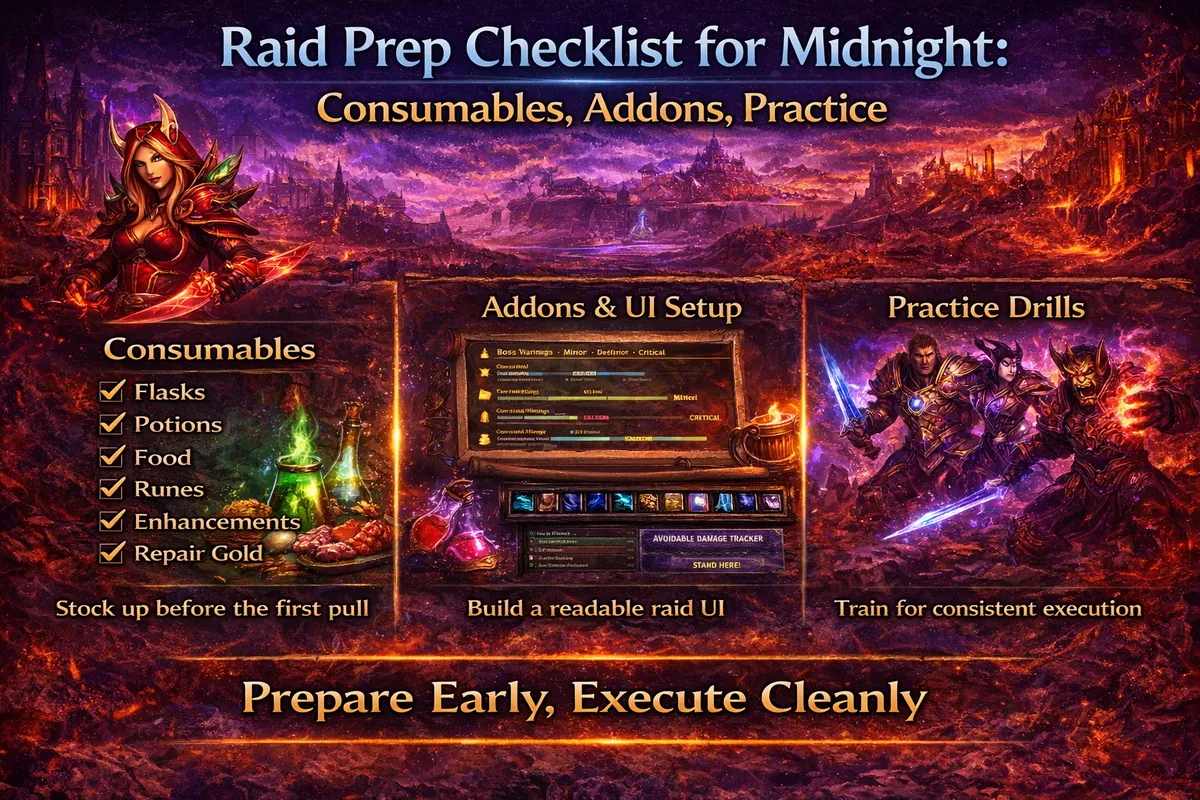
Consumables Checklist: The “Bring This or Regret It” List
Consumables are still the highest value prep you can do because they don’t depend on your spec tuning, your raid leader, or your luck. They only depend on you.
Below is the universal list. You’ll adapt which exact stat versions you buy/craft based on your role and current best stat priority.
Core Consumables (Every Role)
1) Primary combat flask (or equivalent long-duration stat buff)
- Bring enough for the full raid night plus a safety buffer.
- If your raid uses cauldrons, still carry personal backups—someone always forgets.
2) Food buff (personal food or feast)
- Have personal food even if your raid uses feasts. Feasts sometimes don’t get dropped instantly, and you don’t want to be the person who pulls without food.
3) Combat potions (burst potions)
- These are your “progression power.”
- Bring more than you think; early progression burns potions fast.
4) Health potions (personal emergency heal)
- Put this on an easy keybind.
- In progression, health potions save more pulls than “one more DPS talent point.”
5) Battle rez reagent (if your class uses one) / Engineering rez tools (if applicable)
- If you can battle rez, your job is not “maybe.” It’s “ready every pull.”
6) Augment rune / temporary extra stat buff (if available in the season)
- Many raids treat these as optional early and then mandatory later.
- If you want to look serious in PUGs, showing up with runes is an easy win.
7) Weapon enhancement (oil, stone, sharpening, weight, etc.)
- Whatever your role uses, keep it active.
- Reapply on deaths and between bosses.
8) Armor enhancement (armor kit/lining equivalent, if relevant)
- Not always required, but it’s a cheap consistency boost.
Gear Maintenance Items (Every Role)
9) Repairs
- Carry repair gold.
- If your guild uses repair funds, still be personally prepared—wiping with broken gear is painful and avoidable.
10) Extra reagents / ammo equivalents / class items
- Healers: extra reagents if your spec consumes them.
- Everyone: don’t get caught “out of X” mid-prog.
11) Talent swap tools (tomes/codex equivalents)
- Raid nights in Week 1 are full of “swap this talent for this mechanic.”
- Be the player who can adapt instantly.
Role-Specific Consumables (Pick What Applies)
Tanks
- Extra health/defensive oriented consumables if your season offers them
- Anything that increases survivability consistency is worth more than tiny DPS gains on early prog
- Carry more health potions than anyone else—your death is the raid’s death
Healers
- Mana-support items if your season offers them
- More combat potions than you think (you will use them on prog and on “save the pull” moments)
- Consider a second stack of food buffs so you never run out mid-night
DPS
- Bring both burst and sustain options if your class benefits from different potion choices depending on fight timing
- If your spec has a “ramp window,” practice pot timings before raid night so you don’t waste them
How Much to Bring (Simple Numbers That Work)
If you want a simple, practical amount without overthinking:
- Food: enough for 2–3 full raid nights
- Flasks: enough for 2 full raid nights
- Combat potions: enough for a full progression night (and then some)
- Health potions: at least one full stack
- Weapon buffs: enough for multiple reapplications
- Runes: enough for your main progression bosses (even if you don’t rune on farm)
The goal is not “perfect planning.” The goal is never running out mid-session.
Consumable Routine: Stop Losing Buffs to Chaos
Having consumables is step one. Using them on time is what separates “prepared” from “carried.”
Use this routine:
- Before first pull: flask + food + weapon buff + rune (if your team uses)
- Every pull: pre-pot (if your team does) or pot in the agreed burst window
- After every death: reapply weapon buff if it fell off; check food/flask timers
- Between bosses: top off buffs, restock from guild bank if needed, and reset mentally
If you’re a raid leader: make buffs part of the pull timer culture. “Pull in 10” should always imply “check buffs now.”
Addon Reality in Midnight: Build a Setup That Won’t Betray You
Midnight changes the addon landscape. Instead of building your raid performance on deep combat-logic addons, you should build a setup that relies on:
- Midnight’s base UI features
- Minimal “look and feel” addons that are unlikely to break your core gameplay
- A simple, readable screen that makes mechanics obvious
The best Midnight raid setups share a trait: they are stable. If an addon breaks on patch week, the player is mildly annoyed—not helpless.
The “Safe Addon List” Mindset
Rather than recommending a specific addon list that may change week to week, use this mindset:
Generally safer addon categories (because they mostly change presentation):
- Action bar layout helpers
- Bag and inventory organization
- Chat improvements
- Map and tooltip upgrades
- Raid marker and note tools (if they remain functional)
- Screenshot/transmog/collection helpers
Higher risk addon categories (more likely to be limited or behave differently):
- Combat decision-making overlays
- Heavy automation helpers
- Complex aura systems that rely on deep combat data
- Anything that “tells you exactly what to do next” in combat
Your goal is not to have zero addons. Your goal is to avoid building your raid survival on something fragile.
Use Midnight’s Built-In Tools Like a Raider
Midnight’s base UI now covers several “must-have” raid functions. If you configure these well, you’ll feel much less dependent on external tools.
Boss Warnings: Timeline + Text Alerts
Boss Warnings provide two core pieces:
- A Boss Timeline that shows upcoming boss casts in order
- Center-screen Text Alerts labeled Minor, Medium, or Critical
How to set this up for progression:
- Place the Timeline near your “eyes zone” (the area near your character where you already look)
- Keep Text Alerts visible but not so large they block ground effects
- Treat Critical warnings as “defensive / movement triggers,” not as “information”
How to practice using it:
- In your first raid night, call out to yourself: “Timeline says X is coming; I press defensive now.”
- The Timeline is most valuable when it teaches you to pre-act.
Cooldown Manager: Your Personal Survival Dashboard
Cooldown Manager in Midnight supports:
- Multiple layouts you can save and share
- Sound and visual alerts (including optional text-to-speech)
- Target debuff display with debuff-type borders
- Pandemic-range cues for applicable refresh mechanics
Your raid-ready setup should track only essentials:
- Interrupt
- Primary defensive
- Major defensive
- Mobility tool
- One “stop” (stun/disorient/silence/knock)
- One major offensive cooldown (or healing cooldown)
If you track everything, you track nothing. Keep it tight.
Best alert strategy (minimal but powerful):
- Alert when major defensive is ready
- Alert when interrupt is ready (optional)
- Alert when a key raid cooldown is ready
- Too many alerts will create a new kind of panic.
Damage Meter: Use It for Improvement, Not Ego
Midnight’s base Damage Meter can track:
- Interrupts
- Dispels
- Avoidable Damage Taken
- Damage Taken
- DPS/HPS and totals
For raid prep, the most valuable windows are:
- Interrupts (so you build responsibility habits)
- Avoidable Damage Taken (so you see why people are dying)
A simple raid improvement rule:
- If you’re top 2 in interrupts and bottom 2 in avoidable damage, you’re a progression MVP—even if your DPS isn’t #1.
Raid Frames: Make Debuffs and Defensives Obvious
Midnight’s raid frame improvements allow clearer visuals for things like dispels and defensive tracking. Your raid frames should answer two questions instantly:
- “Can I dispel this?”
- “Is someone using a defensive or about to die?”
Healers especially should:
- Make dispellable debuffs visually loud
- Keep frames close enough to your eyes zone that you actually see them
- Reduce unnecessary UI clutter around frames
Keybind Prep: The Three Buttons That Save Pulls
Even the best UI won’t save you if your hands can’t respond.
Before you raid, make sure these are on easy, consistent binds:
- Interrupt
- Primary defensive
- Health potion
If you press these late, you will die late. Late deaths are the most expensive deaths in progression.
Practice Checklist: What to Train Before the First Raid Week
Skill prep is what turns consumables into kills. You’re not trying to “master your spec.” You’re trying to be consistent under stress.
The Three Skills That Win Progression
1) Movement discipline
- Move early, not late
- Stop micro-movement that breaks casts and positioning
- Learn to keep uptime while repositioning
2) Defensive timing
- Press defensives before damage lands
- Plan defensives for predictable spikes (timeline helps)
- Use health potions proactively when a pull is salvageable
3) Responsibility habits
- Interrupt when it’s your job
- Stop casts when you can
- Handle mechanics without needing reminders
Practice Drills You Can Do in 20 Minutes
These are simple drills that translate directly to raid performance.
Drill A: “Stationary rotation under movement breaks”
- Do your normal rotation
- Every 8–12 seconds, take 2–3 steps and continue
- Goal: minimize rotation collapse when you move
Drill B: “Defensive on a timer”
- Set a simple repeating cue (mental or UI)
- Press your primary defensive every time the cue hits
- Goal: train “early defensive” behavior until it’s automatic
Drill C: “Interrupt reflex”
- In dungeons or world content, force yourself to kick the first dangerous cast every pull
- Goal: interrupt becomes muscle memory, not a decision
Drill D: “Potion keybind habit”
- Bind health potion and press it in real combat at a safe threshold
- Goal: stop dying with potion unused
Role Practice: Tanks, Healers, DPS
Midnight raids will punish sloppy fundamentals. Here’s what each role should practice before raid week.
Tank Practice Checklist
- Practice opening pulls with a defensive early (not when low)
- Practice stable boss positioning (face away, minimize unnecessary movement)
- Practice add control and “stop timing”
- Practice cooldown cycling: short defensive often, major defensive for real spikes
- Practice communicating simply: “using wall,” “taunt swap,” “moving boss”
Your raid value as a tank is predictability. Predictable tanks make healers stronger.
Healer Practice Checklist
- Practice cooldown planning: decide what you’ll press on predictable damage windows
- Practice triage: save the player who will die, not the player who took avoidable damage three times
- Practice moving while healing: don’t let mechanics stop your throughput completely
- Practice personal defensives: healers die because they forget they are also a target
Healers win progression by preventing panic. Your job is to keep the raid calm.
DPS Practice Checklist
- Practice doing mechanics without sacrificing your whole rotation
- Practice interrupt responsibility (become known as “reliable”)
- Practice defensive timing: don’t greed casts on lethal hits
- Practice priority targeting: swap when required, not when convenient
DPS who live and kick get invited more. That’s the real PUG meta.
Addons vs Practice: The Midnight Mindset Shift
If you used to rely on addons to “tell you what to do,” Midnight asks you to become the player who understands the pattern and reacts early.
That’s good news:
- It’s a learnable skill
- It makes you better across every piece of content
- It reduces patch-to-patch dependency on external tools
If you want to be strong in Midnight, train the fundamentals now. Your future self will thank you on Week 1.
One-Week Raid Prep Plan (Simple, Not Overwhelming)
Use this as a realistic plan you can actually complete.
7 Days Before Raid
- Finalize keybinds: interrupt, defensive, potion
- Configure Boss Warnings and Cooldown Manager essentials
- Set up raid frames and test visibility
- Stock basic consumables and start building a buffer
3 Days Before Raid
- Run a few dungeons or Delves focusing on: interrupts, defensives, avoidable damage
- Practice your opener and burst timing so potions aren’t wasted
- Make sure your UI remains readable in actual combat (not just standing in town)
24 Hours Before Raid
- Restock consumables to “safe levels”
- Repair gear and clear bag space
- Set up weak points: enchants, gems, missing upgrades
- Make sure your voice/chat setup works
- Decide your personal goals for raid night (one behavior to improve)
Night-Of Checklist: What to Do 15 Minutes Before Pull
- Repair
- Refill consumables, reagents, and talent swap tools
- Confirm keybinds didn’t reset
- Confirm Boss Warnings and Cooldown Manager are visible
- Turn off clutter (unneeded meters, extra windows)
- Warm up your hands with 2–3 minutes of rotation + movement drill
- Eat food, flask, weapon buff, rune (if used)
This is how you start the night calm instead of rushed.
Guild and Raid Leader Checklist: Make Prep a Team Habit
If you lead raids, you can massively improve progression by turning prep into a standard routine rather than an individual gamble.
- Post a simple consumables list in your guild channel
- Establish potion rules (pre-pot or not, when to pot)
- Assign interrupts and utility early, not mid-pull
- Encourage “less noise” comms: short calls, clear assignments
- Use early bosses to train habits (defensives, movement, interrupts)
- Track avoidable damage and deaths as coaching signals, not as blame tools
The fastest improving teams are the teams that treat mistakes as data.
PUG Prep: How to Get Invited More in Midnight
PUG leaders want two things: damage and reliability. Damage is common. Reliability is rare.
If you want more invites:
- Show up fully enchanted and consumable-ready
- Be reliable on interrupts
- Die less (especially to avoidable damage)
- Use defensives early
- Keep chat calm and useful
PUGs don’t remember your best parse. They remember the run that felt clean.
BoostRoom: Midnight Raid Prep That Builds Real Confidence
If you want to go into Midnight raiding with less stress and more consistency, BoostRoom can help you build a complete raid-ready package instead of piecing it together from scattered advice.
BoostRoom raid prep support can include:
- UI and keybind setup built around Midnight’s base tools (Boss Warnings, Cooldown Manager, raid frames)
- Role-specific coaching for defensive timing, movement discipline, and mechanic execution
- Rotation and burst timing practice so your consumables and cooldowns actually convert into progress
- Performance improvement routines using practical metrics like interrupts and avoidable damage
- Confidence building for PUG raiding so you stand out as reliable and get invited more
The goal isn’t “perfect.” The goal is repeatable clean play—because clean play kills bosses.
FAQ
What are the most important consumables for Midnight raids?
A flask-type stat buff, food buff, combat potions, health potions, weapon enhancement, and any runes or temporary stat buffs your group uses. Always bring backups.
Do I still need raid addons in Midnight?
Many players will use fewer combat-focused addons and rely more on Midnight’s built-in Boss Warnings, Cooldown Manager, and Damage Meter. A stable, minimal setup is safer than a fragile one.
What should I track on my UI to die less?
Boss Warnings (timeline + text alerts), your defensives and interrupt in the Cooldown Manager, and raid frames that clearly show dispels and dangerous debuffs.
What’s the fastest way to improve before Week 1 raids?
Practice movement while maintaining rotation, press defensives early, and train interrupt habits in dungeons/Delves. These three skills transfer to every boss.
How do I prepare if I only play PUG raids?
Over-prepare on consumables, keep your UI clean, and focus on being reliable: interrupt, survive, and avoid avoidable damage. PUG leaders re-invite reliable players.
How much should I pre-stock for a raid night?
Enough for multiple hours plus wipes: extra flasks, plenty of potions, a full stack of health potions, weapon buffs, and food. Running out mid-session is the easiest avoidable failure.