Why Midnight’s “3 Raids / 9 Bosses” Design Changes Everything
Midnight Season 1 is built around a clear design goal: tell the launch story through raids without forcing every player into one massive progression wall. Instead of making you farm a 10–12 boss raid for months while waiting for the “real story” to happen, Midnight spreads the action across three experiences:
- A main raid that functions as your traditional progression core (most bosses, most weeks farmed).
- A single-boss raid that works like a weekly “event boss” with full raid mechanics, loot, and prestige—fast to clear, hard to perfect.
- A two-boss finale raid that delivers big campaign beats and iconic set pieces without padding the runtime with filler bosses.
For players, this creates a very different season rhythm:
- Your week doesn’t revolve around one raid lockout anymore.
- You can meaningfully progress even if you only have time for “one serious night,” because one-boss and two-boss raids have high value per minute.
- Guilds can flex their schedule: a long progression night for the main raid, then a fast “cleanup night” for the smaller raids.
This structure also changes what “being raid ready” means. You’re preparing for three different pacing styles:
- endurance and consistency (main raid)
- precision and execution (single-boss raid)
- story pressure and final-boss discipline (finale raid)
The Three Raids at a Glance
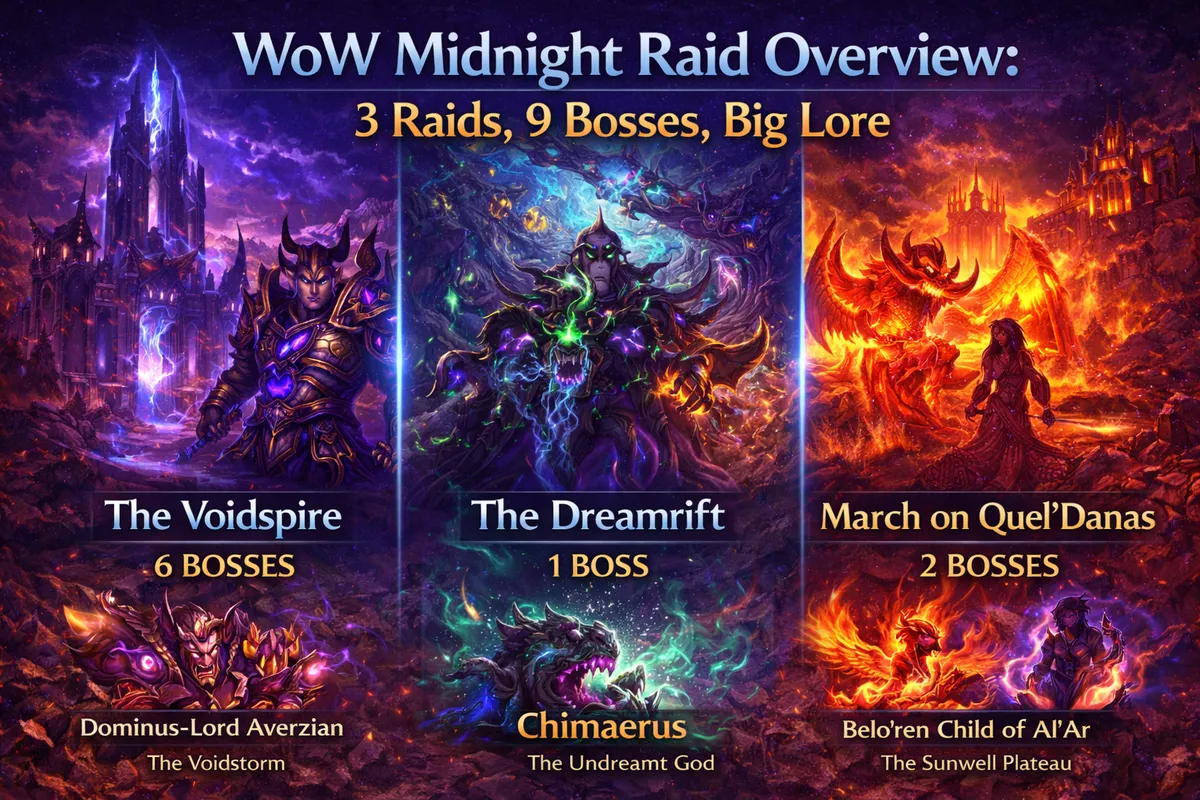
Here’s the confirmed Season 1 raid structure:
- The Voidspire — 6 bosses
- The Dreamrift — 1 boss
- March on Quel’Danas — 2 bosses
- Total: 9 bosses across 3 raids
Each raid has a distinct identity and purpose:
The Voidspire (6 bosses): your season’s “core ladder,” a vertical climb through a Void-infused stronghold where the stakes and mechanics ramp as you ascend.
The Dreamrift (1 boss): a concentrated, high-impact encounter where the entire raid night can be “one fight, done right.”
March on Quel’Danas (2 bosses): an iconic climax tied to the Sunwell, designed to land major lore moments with minimal filler.
Big Lore Setup: Why These Raids Matter to Midnight’s Story
Midnight’s story is centered on Xal’atath escalating the Worldsoul Saga conflict into a direct invasion that strikes the blood elf homelands. The raids are the “spikes” of that campaign:
- The Voidspire embodies the expansion’s Void escalation—cosmic horror, corrupted power structures, and the feeling that Azeroth is being pulled toward something vast and alien.
- The Dreamrift pushes into mythic, metaphysical territory: the boundary between primordial dreams and brutal reality becomes unstable, and something that “never should have been” is hunted and put down.
- March on Quel’Danas is a full-on narrative crescendo: united elven forces marching toward the Sunwell Plateau, with the story reaching a climax in one of Warcraft’s most sacred and volatile locations.
If you care about lore, Midnight is being very direct: raiding is where the biggest campaign moments land, not just a side activity for gear.
Story Mode and Accessibility: Raids Are Not “Only for Raiders” Now
One of the most important quality-of-life changes for Midnight raiding is that Story Mode is explicitly used to let more players experience key campaign moments inside raids—without requiring full progression raiding skill or time.
In Season 1, Story Mode is tied to:
- The Voidspire
- March on Quel’Danas
That’s a big deal for two reasons:
- The two raids most important to launch-story momentum are the ones more players can see.
- The “raid story gap” between casual and hardcore players gets smaller, which tends to make the whole community’s narrative conversation feel more unified.
If you’re a progression raider, Story Mode doesn’t replace your goals. It just means your friends who don’t mythic raid won’t be completely locked out of the biggest beats—and that’s healthy for the game’s culture.
Season 1 Release Pacing: The Practical Weekly Reality
Because Midnight has three raids, the season uses a staggered unlock schedule. The practical outcome is this: your gearing and progression plan should assume a ramp, not an instant full-tier availability.
What that means for you:
- Early weeks revolve around mastering the first two raids that open (main + one-boss).
- The finale raid arrives later, acting as a capstone for the launch arc rather than an immediate week-one requirement.
- Raid Finder wings and Story Mode roll out in a staged way, which influences how PUG raiders and alts experience the content.
If you’re a guild leader, this pacing is actually helpful: it reduces “everything at once” burnout and gives your team time to stabilize roster roles, comps, and assignments before the story climax raid becomes the new focus.
The Voidspire Overview: The Six-Boss Core Raid
The Voidspire is the main raid of Midnight Season 1 and the place you’ll spend the most raid nights early in the season. Blizzard describes it as a towering structure packed with formidable foes and cosmic horrors, including a showdown with Dominus-Lord Averzian and Salhadaar.
The clearest way to think about Voidspire is: a vertical climb raid designed to teach Midnight’s core combat language:
- movement discipline under pressure
- coordinated stops and assignment play
- handling overlapping raid-wide mechanics
- surviving “cosmic hazard” environments where positioning is part of the fight
What Voidspire is trying to test
Void-themed raids almost always demand the same fundamentals, and Voidspire’s design leans into them:
- Spatial awareness: you win by standing in the right place, not just doing the right rotation.
- Mechanic sequencing: fights often have repeating cycles that become lethal if your raid doesn’t learn the rhythm.
- Assignment discipline: “everyone do your own thing” usually fails in Void content; you need clear roles for soaking, interrupts, dispels, and add control.
- Throughput under movement: the more you move, the more your raid’s effective DPS/healing drops, so clean movement is power.
Voidspire’s boss count and “progression feel”
Because Voidspire has six bosses, it supports classic progression pacing:
- early bosses teach the raid’s language
- mid bosses punish sloppy fundamentals
- late bosses force real coordination and cooldown planning
That’s why Voidspire will be the guild separator in early Season 1. The guilds that learn “clean raiding habits” here will have easier weeks later.
Voidspire’s boss lineup
Blizzard has officially named Dominus-Lord Averzian and Salhadaar as major showdowns in Voidspire. In current preview and testing materials, the broader Voidspire boss list has been presented as six encounters that include:
- Imperator / Dominus-Lord Averzian
- Vorasius
- Fallen-King Salhadaar
- Vaelgor & Ezzorak (a dual boss encounter)
- Lightblinded Vanguard (multi-target coordination encounter)
- Crown of the Cosmos (finale-style encounter title seen in testing/lore discussion)
Important mindset: raid boss names and ordering can shift during testing, but the big takeaway remains stable—Voidspire is six bosses and it’s the progression backbone of the season.
Voidspire’s vibe: Void meets Light conflict
One of the most interesting subthemes around Voidspire is the friction between Light-aligned imagery and Void corruption. This kind of theme often results in mechanics that feel “holy” but behave like Void traps: shields that punish the wrong break timing, beams that reward precise movement lanes, and buffs that turn into liabilities if mishandled.
If you want to prepare for Voidspire mechanically before you even step inside:
- practice movement while maintaining rotation
- get comfortable using defensives proactively
- commit to being an interrupt/stop player, not a passenger
The Dreamrift Overview: The One-Boss Raid That Still Feels Like a Raid
The Dreamrift is Midnight’s single-boss raid: one encounter, no trash ladder, no “warm-up bosses.” Blizzard frames it as stepping into the permeable veil between primordial dreams and brutal reality and joining the Shul’ka in their hunt of an “undreamt god.”
The key difference versus typical raiding: all of the raid’s design energy is concentrated into one fight. That makes Dreamrift incredibly valuable for:
- players with limited time
- guilds that want an extra weekly loot/achievement shot
- teams that enjoy perfecting one encounter rather than clearing a long list
What a one-boss raid is trying to test
One-boss raids tend to be designed around a few pillars:
- Execution over endurance: you can’t “power through” with gear if the mechanics are built to punish repeated errors.
- Consistency: your raid must repeat the same correct responses for the full duration, because there’s no “next boss” to reset morale or regain focus.
- Role clarity: healers know their cooldown windows, tanks know their swaps and positioning, DPS know when to move and when to commit.
Dreamrift’s boss identity
In current preview materials, Dreamrift’s single encounter is presented as Chimaerus, the Undreamt God—a boss concept that fits the expansion’s metaphysical themes: something half-formed, born in the wrong place, pushing into reality.
Even if you ignore the specific name, the gameplay expectation is clear:
- expect phases that feel surreal and pattern-based
- expect add moments or manifestations that must be handled cleanly
- expect mechanics that punish “I didn’t see it” excuses with very real consequences
Why Dreamrift matters for guild schedules
Dreamrift is a gift for raid leaders:
- It gives you a “short night win” every week.
- It gives you a place to trial new recruits without committing a full raid night.
- It gives your roster a weekly focus target for performance improvement.
If your guild struggles with attendance, Dreamrift can keep your raid culture alive between longer progression nights.
March on Quel’Danas Overview: Two Bosses, Huge Stakes, Iconic Location
March on Quel’Danas is the raid that screams “finale.” Blizzard describes it as the story reaching a thrilling climax as the united armies of the elven tribes march on the iconic Sunwell Plateau.
This is the raid built to deliver:
- big narrative consequences
- spectacle fights
- a feeling of “this is what Midnight is about”
Why a two-boss finale raid works
Two-boss raids are powerful when done right because they cut straight to the point:
- Boss 1 sets the tone and teaches the environment’s hazards.
- Boss 2 is the “everything matters” climax encounter.
You don’t get filler. You get impact.
March on Quel’Danas boss lineup
In preview and community materials, March on Quel’Danas has been presented with two encounters:
- Belo’ren, Child of Al’ar (phoenix-themed encounter framing)
- Midnight Falls (an encounter title tied to the Sunwell’s crisis, widely discussed as a story-heavy finale)
Again: the major value isn’t memorizing the names. It’s knowing what kind of raid this is:
- short, high-stakes, story-first
- the kind of raid you’ll clear weekly once it’s on farm, but will take seriously while learning because the finale fight will punish mistakes hard
How to mentally prepare for a Sunwell-connected raid
Iconic locations come with iconic design expectations:
- strong environmental hazards
- heavy magic damage windows
- mechanics that force the raid to “respect the room”
If you want to show up ready:
- have defensives mapped to predictable burst moments
- practice disciplined positioning and spreading/stacking on command
- learn to stop tunneling when visuals get intense—finale raids love visual overload
How the 3-Raid Structure Changes Gearing Strategy
Most players are trained by recent expansions to think:
- one raid = one tier = one weekly farm loop
Midnight breaks that habit. Season 1 gearing is now about optimizing three raid clear types:
- Main raid farm value: more bosses means more chances at drops and more practice.
- One-boss raid value: extremely high reward per minute if the loot table is relevant to your needs.
- Two-boss finale value: small time investment with potentially very high-impact rewards and story progression.
The smart weekly order
If your goal is maximum weekly value, a practical approach is:
- Clear the content most likely to block your progression first (usually the main raid’s current wall boss).
- Then do the one-boss raid while the raid is still mentally fresh (it rewards focus).
- Then finish with whatever is most efficient for your group’s morale—either farming earlier bosses or saving the finale raid for its own focused session once available.
Avoid the biggest trap: “three raids means three full nights”
It doesn’t have to. In fact, one of Midnight’s quiet wins is that once you learn the fights:
- Dreamrift can be a fast weekly clear
- March on Quel’Danas can be a fast weekly clear
- Voidspire becomes your main time sink, but it’s also the most “normal raid” in structure
The season can be time-efficient if you treat the smaller raids as high-value targets, not as new full-night commitments.
Guild Planning: Roster, Roles, and Reducing Friction
If you lead a team, Midnight’s Season 1 structure rewards organization. The most common failure mode for guilds won’t be mechanics—it will be logistics.
Roster sizing and bench culture
With three raids, it’s tempting to overcommit. The best guild approach is:
- maintain a stable core roster
- keep a respectful bench rotation
- use the one-boss raid as a “performance check” environment where everyone stays engaged
Role stability matters more than ever
In raid structures that rely on tight execution, you want:
- tanks who are consistent with positioning and cooldown calls
- healers who plan cooldowns rather than reacting late
- DPS who handle mechanics without being asked every pull
The best teams aren’t the teams with the highest parses. They’re the teams with the lowest chaos.
Communication style that wins Midnight
Midnight raids are designed to be more readable in the base UI, with stronger built-in boss warnings and clearer combat tracking. That means your voice comms can be simpler:
- short calls
- fewer panicked speeches
- more consistent assignment reminders
The less noise, the cleaner the execution.
PUG Reality: How These Raids Will Feel Without a Guild
If you live in PUGs, your experience in Midnight raiding will depend on the raid type:
Voidspire in PUGs: early bosses will be PUG-friendly, but later bosses will become “invite gated” because leaders will demand proof of experience.
Dreamrift in PUGs: surprisingly PUG-friendly once strategies stabilize, because it’s one boss and easier to “teach quickly.”
March on Quel’Danas in PUGs: likely to be a mixed bag—short raid, high stakes, lots of people who want story and loot, which creates inconsistent skill levels.
How to stand out in PUG raids
If you want faster invites and fewer disbands, aim to be the player PUG leaders remember:
- be reliable on mechanics
- use defensives early instead of dying with them available
- handle interrupts/stops without being asked
- bring consumables and show you’re serious
- keep chat calm and minimal
In a season with three raids, reputation spreads quickly. One clean run can lead to repeat invites.
What to Practice Before Launch Week Raiding
You don’t need perfect gear to be raid-ready. You need habits.
Habit 1: Movement without DPS collapse
In Void-themed raids, movement is constant. Practice:
- keeping your rotation functional while repositioning
- saying “I’ll lose one global” instead of “I’ll risk a death”
- reacting early to telegraphs
Habit 2: Defensive timing
Most raid deaths come from players pressing defensives too late. A simple rule:
- if you know a damage spike is coming, press before it hits, not after your health drops
Habit 3: Assignment discipline
Even in PUGs, you can self-assign:
- “I will always handle this mechanic if it targets me.”
- “I will always interrupt X when possible.”
- “I will always move to the same safe spot.”
Consistency reduces mistakes.
Habit 4: UI clarity
Midnight continues the push toward better default combat readability. Use that:
- make raid warnings visible
- track your defensives clearly
- keep your screen readable so you don’t miss obvious mechanics
A clean UI is a DPS increase because it prevents avoidable deaths.
Meta Expectations: What Types of Specs Tend to Shine Early
Without turning this into a tier list, early-season raiding usually favors:
- Specs with strong personal defensives: because progression kills are won by survival, not by perfect throughput
- Specs with utility: interrupts, dispels, immunities, group damage reduction, and offheals
- Specs with good movement uptime: because Midnight raid mechanics lean into repositioning and hazard play
If your goal is to be “always invited,” bring something reliable:
- a combat res option if available
- a raid defensive if your class offers it
- consistent interrupt/stop participation on any add phases
Even in raids, utility gets you invited.
BoostRoom: Make Midnight Raiding Feel Easy (Even in PUGs)
Midnight’s raids are designed to be epic, but they don’t have to be stressful. The biggest difference between “fun progression” and “wipe fatigue” is preparation: knowing what your role needs to do, and having the confidence to do it cleanly every pull.
BoostRoom can help you get there with:
- Role coaching for raid execution: positioning, defensive plans, mechanic discipline
- Log-style performance fixes: turning “I keep dying” into a repeatable solution
- Guild-ready prep: cooldown planning, assignment structure, consistency habits
- PUG confidence coaching: how to stand out so you get invited more and waste less time
If you want to experience Midnight’s big lore moments without spending weeks stuck behind the same mistake, the fastest path is learning how to raid cleanly—because clean raids are consistent raids.
FAQ
Is it really 3 raids and only 9 bosses total in Season 1?
Yes. Midnight Season 1 is structured as three raids with nine bosses total: a six-boss main raid, a one-boss raid, and a two-boss finale raid.
Which raid is the “main progression” raid?
The Voidspire is the core progression raid, with six bosses and the season’s primary ladder-style structure.
Why does Midnight have a one-boss raid?
A one-boss raid creates a high-impact weekly encounter that’s fast to schedule, easy to repeat, and still mechanically deep—perfect for focused execution and efficient weekly value.
Will casual players be able to see the raid story?
Midnight uses Story Mode so more players can experience key campaign moments inside raids, especially in the raids most tied to the launch story.
Which raid is most PUG-friendly?
Dreamrift is likely to become the most PUG-friendly once strategies stabilize because it’s one boss and easier to teach quickly. Voidspire is PUG-friendly early but becomes more selective later.
How should a guild schedule raids with three raids in one season?
Most guilds will treat Voidspire as the main night and use Dreamrift (and later March on Quel’Danas) as short, efficient clears that fit into a second night or a cleanup session.
What should I do now if I want to be ready for Week 1 raiding?
Practice movement discipline, proactive defensives, interrupt/utility habits, and a clean UI setup. Those fundamentals transfer into every Midnight encounter.