What “Gameplay Loop” Means in PIONER
PIONER isn’t a “match, reset, repeat” shooter. It’s closer to an expedition simulator built inside an MMO FPS structure:
- You prepare (ammo, healing, food/rest supplies, repair plans, inventory space, weapon setup).
- You enter the world to complete story quests, faction jobs, errands, events, and dungeon/raid content.
- You collect value (resources, rare components, workpieces, artifacts/anomaly materials, currency, faction loyalty progress).
- You extract that value safely by returning to hubs, traders, stashes, and workbenches to convert loot into upgrades.
- You choose your risk level every run: stay in safer areas for steady gains, or push into dangerous zones for faster growth and rarer gear.
- You repeat, but smarter each time—because the island learns your habits.
That loop matters because PIONER rewards players who treat every trip like a plan, not a vibe. The game’s biggest upgrades come from turning what you find into better tools at the workbench, not just stacking kills.
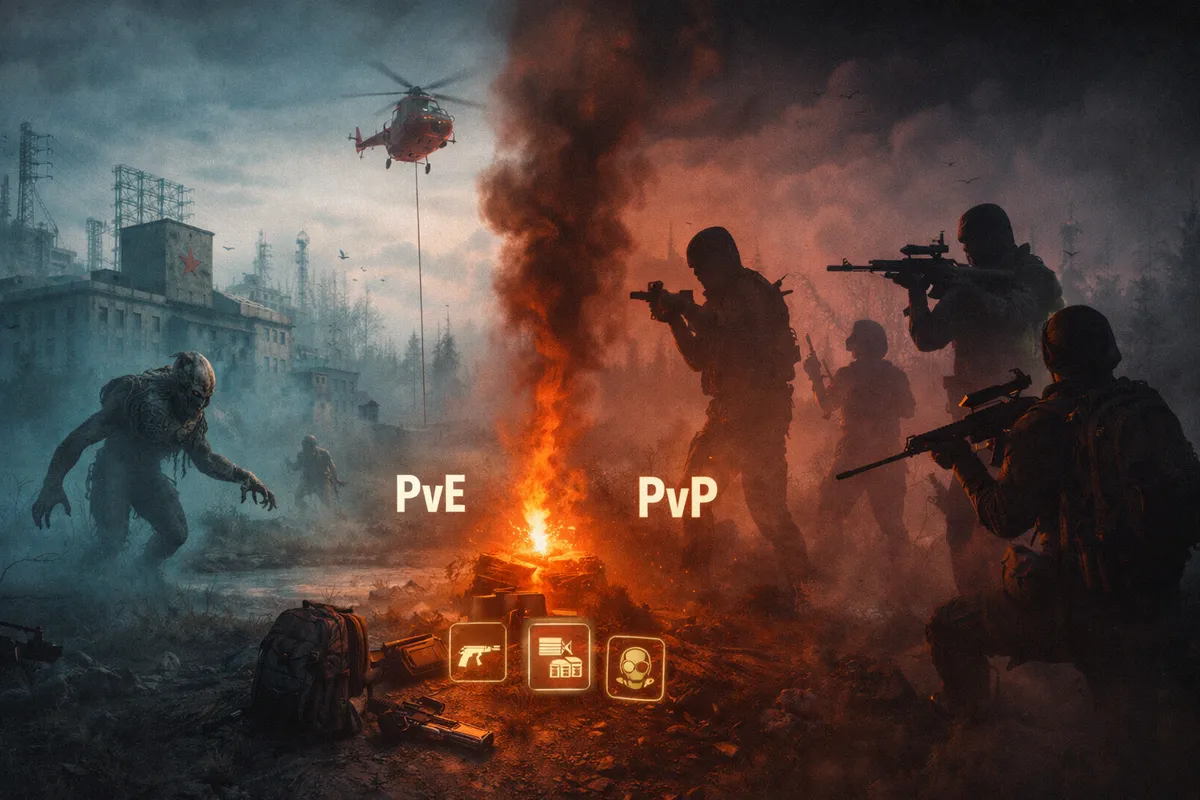
PvE Explained: Story, Factions, Errands, and Exploration
PvE is where most players build their foundation: gear, cash, crafting materials, and confidence.
Story campaign and handcrafted quests
PIONER leans heavily into questing. You’ll find:
- A main story line that pulls you into the island’s catastrophe and its strange “blue tide” transformations.
- A large set of handcrafted quests (with choices and moral dilemmas in some quest lines).
- Tons of smaller activities—quick errands, deliveries, hunts, and repeatables that fill downtime between big missions.
The practical takeaway: PvE is not filler. It’s your safest and most reliable way to:
- Unlock vendors and rewards through faction loyalty.
- Learn routes and map knowledge (which later decides your PvP survival rate).
- Build a crafting pipeline so you’re not broke after one bad death.
Exploration as progression
PIONER’s world is big (50+ km² not counting hidden dungeons), and it’s built to be traveled in layers:
- Early areas teach you the rhythm: loot, return, upgrade, repeat.
- Mid areas introduce tougher enemies, stronger anomalies, and better materials.
- Deep areas become “expedition territory” where you start thinking like a planner: outposts, trade routes, and longer runs.
Exploration isn’t just sightseeing—it’s a form of progression. The more you know, the less you die to surprises.
PvE enemy pressure and “why it feels risky anyway”
Even outside PvP, PvE can be punishing because:
- Enemy types vary wildly, including mutated wildlife and contaminated humanoids.
- The island’s “distortion” theme shows up as anomalies and infestations that punish careless movement.
- The deeper you go, the more often you’ll be forced to fight while under resource pressure (durability, ammo, healing, hunger/rest management).
If you’re treating PvE like a casual loot walk, you’ll still get punished. The game wants you to feel expedition stress—even before you ever step into PvP.
PvE Activities That Matter Most for Progress
Not all PvE is equal. If your goal is faster upgrades, prioritize content that converts into workbench power.
Raids and directed missions
PIONER supports structured group PvE through raids and training raids. These are designed to test coordination and reward players who can execute mechanics cleanly. If you want the “big jumps” in progress, raids are often where you’ll find them—especially when you’re targeting rare components and high-value rewards.
Dungeons (story, co-op, and solo)
The game includes many dungeon-like locations tied to story and side activities, plus larger dungeons intended for later progression. These can be the best “risk-managed” content in the game:
- You can plan for them.
- You can bring a squad.
- You can run them repeatedly to learn safe clears.
If you hate unpredictable open-world chaos, dungeons are your control-friendly path forward.
Global quests and world-boss style encounters
Large-scale missions (including at least one world boss tied to storylines in earlier testing content) are where PvE turns into social chaos:
- More players show up.
- More competition happens.
- More “third-party problems” appear (including opportunistic PvP nearby, depending on the zone).
They’re excellent for rewards, but only if you manage inventory and exits.
World events and treasure-driven activities
PIONER regularly pushes players into world events, and updates have added content like treasure maps and quality-of-life travel changes around event locations. These systems matter because they create predictable hotspots—meaning you can plan:
- When to go (quiet hours vs peak chaos),
- What to bring (lightweight “grab-and-go” kits),
- How to leave (fast routes and backup exits).
Treat events as scheduled jobs, not random distractions.
PvP Explained: Zones, Modes, and Why It Feels So Intense
PvP in PIONER is not “always on everywhere.” The game highlights special PvP areas, and it especially emphasizes one thing: the Shadowlands—a large territory where PvP is not meaningfully limited.
There are two big ways PvP shows up:
Open-world PvP zones (the high-stakes layer)
Open-world PvP zones are where risk-reward becomes real:
- You enter knowing another player can turn your run into a disaster.
- You’re motivated by rare loot and valuable equipment that’s more likely to appear in these dangerous places.
- You’re gambling your time, your supplies, and (sometimes) part of what you’re carrying.
This is where “PIONER stories” come from—ambushes, revenge runs, rescue attempts, and last-second escapes.
Structured PvP modes (the practice and prestige layer)
PIONER also supports PvP in more structured formats, including:
- Deathmatch (featured as a PvP option in earlier testing announcements).
- A 6v6 “Brawl” mode, which received a PvP map called “Dawn” in a major patch.
Structured PvP is valuable even if you live for Shadowlands runs, because it improves:
- Aim under pressure,
- Sound discipline,
- Team positioning,
- Weapon handling consistency.
Think of modes like Brawl as your PvP gym, and Shadowlands as your PvP exam.
The Shadowlands: Where Risk-Reward Becomes the Whole Game
If you only remember one thing about PIONER, make it this:
The Shadowlands are not a place you “visit.” They’re a place you “run.”
When you go there, your decisions matter more than your gun skill.
Why players go anyway
The Shadowlands offer:
- The chance to loot other players,
- A stronger shot at rare and valuable gear,
- Clan-driven conflict over territory and map control.
It’s attractive because it compresses progression: one successful high-risk run can equal multiple safe runs.
What you can lose (and why it’s not “game over”)
PIONER’s PvP loot system is designed to hurt, but not delete your will to play:
- When you die in PvP zones like the Shadowlands, you can lose resources and some equipment, but not necessarily all of it.
- There’s also a revenge window: you can return for your items if nobody picked them up yet.
That creates the core emotional loop:
- You feel real loss,
- You still have a reason to come back,
- You stay motivated instead of quitting.
Clan control and territory pressure
Clans can fight over outposts or map spots, and territory capture in the Shadowlands is designed to be a clan-driven objective (even if systems evolve over time). This matters because it means:
- Some fights are random,
- Some fights are “business.”
If you stumble into a clan conflict zone, you’re not in a fair duel—you’re in someone else’s mission.
Risk-Reward Loop: The 3 Decisions That Decide Every Run
Most players think the risk-reward loop is about aim. It isn’t. It’s about three decisions you make before you fire a shot.
Decision 1: How much value are you carrying?
Your inventory is your vulnerability. The more value you carry, the more “expensive” every second becomes.
Rule of thumb:
- In safer PvE zones, carry enough to be efficient.
- In PvP zones, carry only what you’re willing to lose.
This single habit prevents most tilt.
Decision 2: How hard is your exit plan?
A run without an exit plan is not a run—it’s a donation.
Before you commit to deeper territory, decide:
- Your primary exit route,
- Your backup route,
- Your “panic exit” (the fastest safe return even if you abandon the objective).
If you can’t describe your exit, you’re not ready to push deeper.
Decision 3: Are you upgrading your power, or just collecting loot?
Loot feels productive. Upgrades are productive.
The real loop is:
- Loot → convert to crafting progress → improve gear → survive deeper runs → access better loot.
If you’re stuck, it’s usually because you’re hoarding instead of converting.
Survival Systems: Hunger, Rest, and Why Preparation Wins Fights
PIONER’s survival mechanics push you to manage strength through hunger, rest, and resources. The devs have also stated they reduced pressure over development so players can focus more on exploration—but the system still matters because it affects consistency.
What this means in practice:
- You’re not a “full power soldier” all the time.
- Long runs drain you in ways that show up at the worst moments—like mid-fight, mid-escape, or mid-dungeon.
Practical survival routine (simple and effective)
Before leaving a hub:
- Bring enough food/rest support to cover your planned distance plus mistakes.
- Carry healing, but don’t rely on rare emergency items as your entire plan.
- Keep one inventory slot philosophy: “If it can’t save the run, it can’t take the slot.”
The survival layer exists to punish overconfidence and reward discipline. If you play like a planner, you’ll feel stronger than players with better aim but worse preparation.
Crafting and the Workbench: Where Real Power Comes From
If you want to understand PIONER’s long-term progression, remember this:
The workbench is not optional—it’s the game.
Crafting is emphasized as critical for:
- Improving items,
- Creating exclusive upgrades,
- Driving endgame development through repeated workbench use.
Why crafting connects directly to risk-reward
Crafting changes how you think about loot:
- A “boring” resource becomes valuable if it completes an upgrade chain.
- A rare component becomes urgent if it unlocks a power spike.
- A full bag becomes dangerous if it delays your conversion step.
Patch-driven quality-of-life that affects crafting decisions
Recent updates have included features like:
- Converting resources from rarer tiers down to more common tiers (and special recipes for resource downgrading from certain traders).
- Increased stacking limits for resources (which reduces inventory pain and speeds up farming loops).
The takeaway: the game is actively being tuned around the crafting economy, so players who build a clean crafting routine stay ahead.
Factions and Loyalty Rewards: PvE That Changes Your Options
Factions aren’t just lore—they shape your practical gameplay:
- Which quests you see,
- Which rewards you access,
- How certain groups react to you,
- What loyalty bonuses you can unlock.
You’ll run into major groups and organizations across the island, ranging from military structures to traders and neutral research networks. Faction missions are a perfect “safe progression engine” because they:
- Provide structured objectives,
- Pay out reliably,
- Stack loyalty progress over time.
Why factions matter even for PvP players
In many MMO shooters, PvP players ignore PvE. In PIONER, that’s a trap.
Faction loyalty can be the difference between:
- Being stuck with “almost good enough” gear,
- And having consistent access to better equipment and upgrade pathways.
If you want to dominate in PvP zones, build your economy in PvE first.
PvP Loot Rules: How to Think About Death Without Tilting
The Shadowlands loot rules are the emotional core of PIONER:
- You can lose a meaningful chunk of what you have,
- But you’re not erased,
- And you can attempt a recovery if your items weren’t taken.
The smart mindset
Instead of thinking “I lost everything,” train this:
- “I risked X value and got Y outcome.”
- “Was my risk appropriate for my route and loadout?”
- “Did I have an exit plan that matched my carry value?”
When you treat every run as a calculated risk, death becomes feedback, not humiliation.
A “no-tilt” loadout rule
Always keep one reliable fallback kit available.
That way:
- A bad loss doesn’t stop your gameplay session.
- You can immediately pivot into recovery, safer PvE, or structured PvP practice.
- You keep momentum, which is the real secret in grind-heavy games.
Practical Rules for Every Run
Use these rules and your progress will feel smoother within a week.
- Bank early, bank often: Convert loot into upgrades and currency before you chase “one more objective.”
- Carry value based on zone: Safe area = efficient carry. PvP area = minimal carry.
- Never run without an exit: Primary + backup + panic exit.
- Don’t overload on “rare saves”: If you can’t replace an item, don’t rely on it to save you.
- Treat events like hotspots: Assume other players will arrive. Plan your approach and departure.
- Upgrade the tool, not the trophy: Crafting power beats collecting pretty items.
- Practice PvP in modes before Shadowlands: Brawl/Deathmatch reps build confidence without risking your expedition economy.
- Play sessions in phases: Farm → convert → upgrade → risk run. Don’t mix everything into one chaotic loop.
How to Balance PvE and PvP for Fastest Progress
If you’re trying to level your power quickly (without burning out), use a simple 70/30 approach:
Phase 1: Build your base (mostly PvE)
- Focus on story and faction missions.
- Farm materials you actually need for your next upgrade step.
- Learn one region at a time until routes feel automatic.
Phase 2: Add structured PvP (small, consistent practice)
- Do short PvP sessions for aim and pressure training.
- Test weapons and handling preferences.
- Learn how players move, flank, and punish mistakes.
Phase 3: Schedule Shadowlands runs (high-focus, limited)
- Go in with a defined goal: one objective, one loot target, one route.
- Extract fast when you hit your goal.
- Don’t “victory lap” into extra danger with full bags.
Most players fail because they reverse this order and try to “main Shadowlands” before they have the economy to support it.
Example Run Plans You Can Copy
Here are three simple expedition templates you can run immediately—without needing perfect gear.
Solo PvE profit run (low risk)
- Goal: materials + currency for one specific upgrade
- Kit: mid-range weapon, reliable healing, lightweight supplies, extra inventory space
- Route: loop a familiar area, avoid deep anomalies, return early
- Exit rule: leave when you’re 60–70% full
Duo mixed run (medium risk)
- Goal: event completion + dungeon/mission chain progress
- Kit: one player brings utility (heals/support supplies), the other brings damage stability
- Route: event → quick loot sweep → immediate return
- Exit rule: don’t chase fights; fights are distractions unless they block the objective
Shadowlands “touch-and-go” (high risk, controlled)
- Goal: one targeted objective (loot, territory path, or mission step)
- Kit: minimal valuables, efficient weapons, enough supplies to sprint out if needed
- Route: direct path in, direct path out—no wandering
- Exit rule: leave the moment the goal is complete, even if it feels “too early”
If you want consistent growth, treat Shadowlands like a surgical strike, not a vacation.
Weapon and Build Thinking: Don’t Overcomplicate It
PIONER supports extensive weapon customization and modules, but you don’t need a perfect build to improve fast. You need clarity.
Choose one of these identities early
- Reliable all-rounder: stable aim, steady DPS, flexible range
- Close-range enforcer: quick fights, aggressive movement, high risk in open spaces
- Mid-to-long control: careful positioning, strong first-shot value, punishes exposed targets
Then craft toward that identity instead of constantly swapping. Your consistency will rise immediately.
The real build secret
Your “build” is not only your gun—it’s your habits:
- When you reload,
- How you reposition,
- How you manage inventory,
- Whether you fight on your terms or theirs.
In PIONER, strong habits feel like extra armor.
Clans, Social Play, and Why Groups Multiply Rewards
PIONER is designed so everything can be done solo or in a group—but grouping changes the math:
- Safer clears,
- Faster objective completion,
- More reliable dungeon/raid performance,
- Access to clan-driven activities and conflicts.
Clans also matter because they connect to:
- Territory conflicts,
- Outpost battles,
- Group expedition plans,
- Clan perks (including clan housing/rest spaces where clans can rent a room).
If you enjoy PvP at all, joining a clan is less about “friends” and more about having a safety net and coordinated access to high-value content.
BoostRoom: Faster Progress Without the Grind
If you love PIONER’s world but don’t love repeating the same grind loops (or you simply don’t have the time), BoostRoom is built for exactly that.
BoostRoom focuses on helping players reach the fun parts faster by supporting goals like:
- Faction reputation and loyalty progression (unlock rewards sooner)
- Raid help and completion support (especially if you’re stuck or short on a coordinated group)
- PvP improvement support (practice-driven help so your Shadowlands runs last longer)
- Resource and crafting progression goals (so your workbench upgrades don’t stall)
The best part is what it does to your risk-reward loop: when your baseline power rises, you die less, extract more, and can afford bigger risks without your progress collapsing. That’s when PIONER becomes addictive in a good way.
Common Mistakes That Make PIONER Feel Harder Than It Is
Avoid these and the game instantly feels fairer.
- Staying out too long with a full bag: Most “unlucky deaths” are actually “overstayed runs.”
- Taking irreplaceable gear into high-risk zones: If losing it ruins your night, it doesn’t belong in Shadowlands.
- Ignoring the workbench: Loot without conversion becomes clutter, not power.
- Fighting for ego instead of value: Not every fight is worth the ammo, time, and risk.
- Entering PvP zones without a recovery plan: If you can’t afford a loss, you’re not ready for that run.
- Treating factions as optional: Loyalty rewards and access pathways are real progression.
FAQ
Is PIONER more PvE or PvP?
It’s both, by design. PvE builds your foundation through story, faction missions, dungeons, events, and raids. PvP zones—especially the Shadowlands—turn that foundation into a high-stakes gamble for better loot and faster progress.
What is the Shadowlands zone?
It’s a large PvP-focused area where PvP isn’t meaningfully restricted, and where the rewards are higher—both from rare loot spawns and from other players’ drops.
Do you lose everything when you die in PvP zones?
No. The system is designed so you can lose meaningful resources and some equipment, but not necessarily everything, and you may be able to return for items if nobody looted them yet.
Are raids worth doing early?
Yes—if you can access them and you have a group (or reliable support). Raids are built to reward coordination and often provide stronger progress per hour than random roaming.
Can I play solo and still progress?
Yes. The game is built so tasks can be completed solo or in groups. Solo players just need stricter discipline: lighter carry value, safer routes, and more frequent banking.
What should I focus on first as a beginner?
Story missions, faction jobs, and a basic crafting routine. Build a stable economy and a repeatable “loot → convert → upgrade” habit before you start scheduling high-risk PvP runs.
Is structured PvP useful if I mainly want open-world PvP?
Absolutely. Modes like Deathmatch and 6v6 Brawl help you train aim, positioning, and pressure handling without risking your expedition inventory.
How do I get better at the risk-reward loop quickly?
Pick one goal per run, carry only what you can afford to lose, and leave earlier than you think you should. Most players improve fastest by extracting cleanly and upgrading consistently.
Where does BoostRoom fit into PIONER?
BoostRoom helps you skip repetitive grind and reach key progression milestones faster—like faction reputation, raid completions, and practical PvP improvement—so you can spend more time in the content you actually enjoy.



